 plumi
Modern analytical techniques: OCR A‑Level Chemistry B questions
Every OCR A-Level Chemistry B exam question on WM Modern analytical techniques (specification points WM(i)–(j)), 2016–2025, with its mark scheme and examiner’s report.
Find questions2,049
Calculations
Q23(e)
The whole paper ↗
Q1(c)(iii)
The whole paper ↗
Q3(h)
The whole paper ↗
Q4(c)(ii)
The whole paper ↗
Q3(a)(i)
The whole paper ↗
Q24(e)
The whole paper ↗


Q3(a)(iii)
The whole paper ↗
Q3(a)
The whole paper ↗
Q22(c)
The whole paper ↗
Q22(d)
The whole paper ↗
Q21(b)(iii)
The whole paper ↗
Q22(b)(ii)
The whole paper ↗
Q22(c)
The whole paper ↗
Q2(h)(i)
The whole paper ↗
Q2(h)(ii)
The whole paper ↗

Q1(g)(i)
The whole paper ↗
All 30 questions on Modern analytical techniques, as a list
- June 2025, AS Paper 1, Q23(e) (1 mark): The mass spectrum of C6H12 has an (M+1)+ peak at 85. What causes this peak? [1]
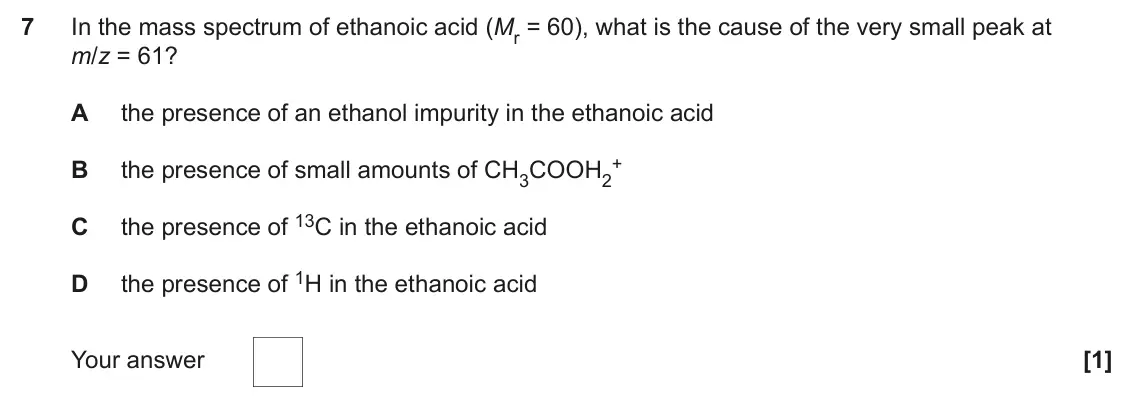
- June 2024, Paper 1, Q7 (1 mark): In the mass spectrum of ethanoic acid (Mr = 60), what is the cause of the very small peak at m/z = 61? A the presence of an ethanol impurity in the ethanoic aci
- June 2024, Paper 2, Q1(c)(iii) (1 mark): Mass spectrometry can be used to identify the emerging esters. Which property of the esters does mass spectrometry measure? [1]
- June 2024, AS Paper 2, Q3(h) (6 marks): Most diesel fuel is made from crude oil. However, biodiesel, made from vegetable oils, is increasingly being used. (h)* An organic compound A, has the following
- June 2023, Paper 2, Q4(c)(ii) (3 marks): Peaks are found at m / z values 15, 43 and 59 in the mass spectrum of propanone (Mr 58). Give the origin of these peaks. 15 43 59 [3]
- June 2023, Paper 3, Q3(a)(i) (1 mark): The IR spectrum of indigo has a significant absorption around 3300 cm–1. Suggest the most likely bond in indigo responsible for this absorption. [1]
- June 2023, AS Paper 1, Q24(e) (4 marks): The IR spectrum of a compound is shown below. 100 transmittance / % 50 0 4000 3000 2000 1500 1000 500 wavenumber / cm–1 The compound is one of: • ethanal • poly
- June 2022, Paper 1, Q15 (1 mark): What is the correct Mr value of the organic molecule whose mass spectrum is shown below? 100 80 60 Relative intensity 40 20 0 0 15 30 45 60 75 90 m / z A 75 B 7
- June 2022, AS Paper 1, Q18 (1 mark): The mass spectrum of (C3H7)2O has peaks at m/z 103, 102, 43 and other values. What is correct? A 102 is caused when the molecule gains an electron in the mass s
- June 2022, AS Paper 2, Q3(a)(iii) (3 marks): Reaction 1 occurs via the formation of compound C. CH2CHO Compound C The chemists use infrared spectroscopy to find out whether the conversion of compound A int
- November 2021, Paper 2, Q3(a) (2 marks): The mass spectrum of benzaldehyde has many peaks. Two of the peaks have m / z values of 107 and 77. Suggest explanations for these values. 107 77 [2]
- November 2021, AS Paper 1, Q22(c) (2 marks): The mass spectrum of phenol is shown below. 100 80 60 intensity / % 40 20 0 10 20 30 40 50 60 70 80 90 m / z Give the formula of the ion that causes the peak at
- November 2021, AS Paper 1, Q22(d) (3 marks): C6H5OH + (CH3CO)2O C6H5OCOCH3 + CH3COOH Equation 22.1 An infrared spectrum of one of the compounds in equation 22.1 is shown below. 100 50 transmittance / % 0 4
- November 2020, AS Paper 1, Q21(b)(iii) (1 mark): Describe what happens to molecules when they absorb IR radiation. [1]
- November 2020, AS Paper 1, Q22(b)(ii) (1 mark): A molecule consists of two carbon atoms. It has a visible ‘M+1’ peak but no visible ‘M+2’ peak in its mass spectrum. Suggest why. [1]
- November 2020, AS Paper 1, Q22(c) (4 marks): The mass spectrum of an alcohol is given below. The peak at 31 is caused by the fragment CH2OH+. 100 80 intensity / % 60 40 20 0 10 20 30 40 50 60 70 80 90 m /
- June 2019, Paper 3, Q2(h)(i) (2 marks): Give the structures that produce the peaks at: 60 43 [2]
- June 2019, Paper 3, Q2(h)(ii) (1 mark): Suggest why there is a small peak at 61. [1]
- June 2019, AS Paper 1, Q7 (1 mark): The mass spectrum of ethanoic acid has a peak at m/z 45. Which species could cause this? CH3COOH+ A COOH+ B 13CH3COOH+ C + D CH3 Your answer [1]
- June 2019, AS Paper 2, Q1(g)(i) (1 mark): Identify the biofuel given by the mass spectrum and infrared spectrum. [1]
- June 2019, AS Paper 2, Q1(g)(ii) (1 mark): Give one piece of evidence from the mass spectrum to support your answer to (g)(i). [1]
- June 2019, AS Paper 2, Q1(g)(iii) (1 mark): Give one piece of evidence from the infrared spectrum to support your answer to (g)(i). [1]
- June 2018, Paper 2, Q2(a)(i) (2 marks): Give the species responsible for these peaks 27 43 [2]
- June 2018, AS Paper 2, Q2(g) (6 marks): Bioethanol is a well-known biofuel. Biobutanol is another biofuel and can be used in some combustion engines. Biobutanol can be produced in the UK from sugar be
- June 2017, Paper 1, Q18 (1 mark): What is correct about a mass spectrum of a compound? A It shows the atoms produced from the compound. B It enables the Mr of the compound to be determined. It h
- June 2017, Paper 3, Q3(e) (1 mark): Mass spectrometry can also be used to distinguish between ocimenol and cinnamyl alcohol. The molecular ion peak in a mass spectrum of ocimenol is at an m/z valu
- June 2017, AS Paper 1, Q21(c)(i) (1 mark): Give the formula of the ion responsible for the peak at m/z 64. [1]
- June 2017, AS Paper 1, Q21(c)(iii) (1 mark): Suggest the formula of the ion that gives the peak at m/z 65. [1]
- June 2017, AS Paper 1, Q21(d) (1 mark): Chloroethane can be converted to ethanol. The infrared spectrum of ethanol has some absorptions that are not present in the infrared spectrum of chloroethane. G
- June 2016, AS Paper 2, Q4(e) (6 marks): Ethanoic acid is an important chemical intermediate in the manufacture of a wide range of products. It was originally made by oxidising ethanol. (e)* An alcohol
Questions, mark schemes and examiner’s reports are © OCR, from their published past papers. Plumi isn’t affiliated with any exam board. Want whole papers? Every OCR A-Level Chemistry B paper.
Rather write your answers by hand on iPad? Plumi marks them against the same mark schemes.