 plumi
Bonding and structure: OCR A‑Level Chemistry B questions
Every OCR A-Level Chemistry B exam question on OZ Bonding and structure (specification points OZ(a)–(d)), 2016–2025, with its mark scheme and examiner’s report.
Find questions2,049
Calculations

Q31(d)(iii)
The whole paper ↗
Q4(a)(iii)
The whole paper ↗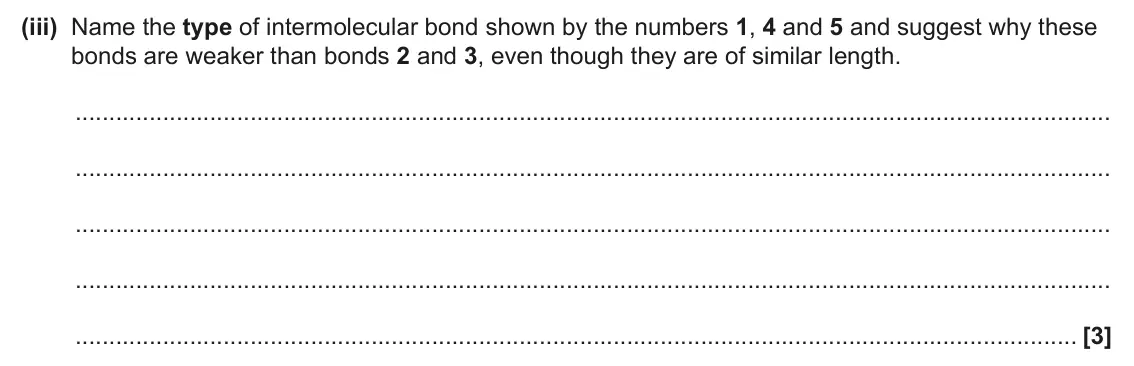
Q4(e)(ii)
The whole paper ↗

Q22(c)
The whole paper ↗


Q22(c)(ii)
The whole paper ↗
Q24(b)
The whole paper ↗
Q3(f)
The whole paper ↗

Q33(a)
The whole paper ↗
Q2(e)
The whole paper ↗

Q21(c)
The whole paper ↗
Q32(d)(ii)
The whole paper ↗
Q1(c)
The whole paper ↗


All 54 questions on Bonding and structure, as a list
- June 2025, Paper 1, Q14 (1 mark): Which row has ammonia, methane and water in order of increasing boiling point? A ammonia < methane < water B methane < ammonia < water C methane < water < ammon
- June 2025, Paper 1, Q31(d)(iii) (3 marks): Hydrogenation reactions convert vegetable oils into solid fats. Fats have higher melting points than oils because fats have more flexible molecules. Explain in
- June 2025, Paper 2, Q4(a)(iii) (3 marks): Name the type of intermolecular bond shown by the numbers 1, 4 and 5 and suggest why these bonds are weaker than bonds 2 and 3, even though they are of similar
- June 2025, Paper 2, Q4(e)(ii) (3 marks): Some dyes form instantaneous dipole–induced dipole bonds with certain fabrics. Explain how instantaneous dipole–induced dipole bonds are formed. [3]
- June 2025, AS Paper 1, Q15 (1 mark): Which molecule is most polar? A BF3 B CO2 C CH3Cl D CH3F Your answer [1]
- June 2025, AS Paper 1, Q22(c) (2 marks): The boiling point of bromoethane, C2H5Br, is higher than that of chloroethane, C2H5Cl . This is because one type of intermolecular bonds are stronger for C2H5Br
- June 2023, Paper 1, Q3 (1 mark): Which molecule is the most polar? A CCl 4 B CF4 C CHF3 D CHCl 2F Your answer [1]
- June 2023, Paper 1, Q15 (1 mark): What is the correct order of boiling points for CH3CH2OH, CH3CHO and CH3COOH? A CH3CHO > CH3CH2OH > CH3COOH B CH3COOH > CH3CH2OH > CH3CHO C CH3CH2OH > CH3COOH >
- June 2023, AS Paper 1, Q22(c)(ii) (2 marks): CH3Cl has a higher boiling point than CH4. This is because CH3Cl has permanent dipole‑permanent dipole bonding whereas CH4 does not. Explain why CH3Cl has a per
- June 2023, AS Paper 1, Q24(b) (1 mark): PVAc acts as a glue because of the intermolecular bonds it forms. Name the strongest type of intermolecular bond between chains of PVAc. [1]
- June 2023, AS Paper 2, Q3(f) (6 marks): Aspirin, CH3COOC6H4COOH, is a medicine that is made by an esterification reaction. It is conventionally made in the laboratory by refluxing a mixture of 2-hydro
- June 2022, Paper 1, Q14 (1 mark): What is the correct order of boiling points? A CH3CH2COOH > CH3CH2CH2OH > CH3CH2CHO B CH3CH2COOH > CH3CH2CHO > CH3CH2CH2OH C CH3CH2CH2OH > CH3CH2COOH > CH3CH2CH
- June 2022, Paper 1, Q33(a) (1 mark): The antifungal properties of parabens are linked to their solubility in fats (esters of propane-1,2,3-triol). Suggest the intermolecular bonds that cause parabe
- June 2022, Paper 2, Q2(e) (1 mark): The presence of the three isomers as monomers in ‘polybutene’ means that different side-chains are present that do not allow the polymer chains to get close tog
- June 2022, AS Paper 1, Q8 (1 mark): Which of these compounds will have the highest boiling point? A CH3CHO B CH3CH2OH C HOCH2CH2OH D CH3OCH3 Your answer [1]
- June 2022, AS Paper 1, Q21(c) (5 marks): Both compound A and vinyl chloride have instantaneous dipole-induced dipole intermolecular bonds. Vinyl chloride also has permanent dipole-permanent dipole inte
- November 2021, Paper 1, Q32(d)(ii) (6 marks): Chlorinated solvents were once widely used in industry. Some are made by chlorinating ethane. (ii)* Substance A was a solvent used in the electronics industry.
- November 2021, Paper 2, Q1(c) (3 marks): Suggest, with reasons, which of compounds 2, 3 and 4 from Table 1.1 has the highest boiling point. [3]
- November 2021, AS Paper 1, Q11 (1 mark): The bond between carbon and chlorine can be represented as Cδ+– Cl δ–. Which statement is correct? A All compounds containing C – Cl bonds have permanent dipole
- November 2021, AS Paper 1, Q18 (1 mark): Which compound has the highest boiling point? A CH3CH2OH B CH3COOH C CH3CHO D CH3OCH3 Your answer [1]
- November 2021, AS Paper 2, Q3(d) (6 marks): The manufacture of chlorofluorocarbons (CFCs) has been banned because they cause the depletion of ozone in the stratosphere. CFCs like CCl3F have been replaced
- November 2020, Paper 1, Q11 (1 mark): Which compound has the lowest boiling point? A CH3CH2CH2CH2Cl B CH3CH2CH2CH2OH C (CH3)3COH D (CH3)2CHCH2Cl Your answer [1]
- November 2020, Paper 1, Q32(d)(i) (1 mark): Explain why hydrogen chloride is a gas at room temperature. [1]
- November 2020, Paper 2, Q1(c) (1 mark): Aspartame tastes sweet. One theory is that the sweetness is caused by hydrogen bonds forming between sweetener molecules and sweetness receptors in the body. On
- November 2020, Paper 2, Q1(d) (1 mark): The enzyme pepsin catalyses the hydrolysis of protein chains. Some students read that pepsin breaks the peptide bonds adjacent to aromatic amino-acids, for exam
- November 2020, Paper 3, Q2(a)(ii) (2 marks): State the types of intermolecular bonds between molecules of both structures and describe where in the molecules they occur. [2]
- November 2020, Paper 3, Q2(a)(iii) (3 marks): Suggest why Structure A is more likely to be a solid at room temperature than Structure B. [3]
- November 2020, AS Paper 1, Q12 (1 mark): Iodopropane has a higher boiling point than chloropropane. What is a reason for this? A Iodopropane has more hydrogen bonds than chloropropane. B Iodopropane ha
- November 2020, AS Paper 2, Q3(d) (3 marks): 4-acetoxybenzoic acid has a melting point of 193 °C. A student explains the high melting point as follows: • Oxygen is more electronegative than carbon so the c
- June 2019, Paper 2, Q1(e)(i) (1 mark): Name the strongest intermolecular bonds that can form between the chains. [1]
- June 2019, Paper 2, Q1(e)(ii) (1 mark): Mark the positions of the intermolecular bonds by drawing dotted lines on the diagram below. O H N N H O O H N N H O [1]
- June 2019, Paper 3, Q1(b)(ii) (2 marks): State the strongest type of intermolecular bonding that occurs between PLA polymer chains. Explain, in terms of electronegativity, how this intermolecular bondi
- June 2019, AS Paper 1, Q14 (1 mark): Which molecule forms permanent dipole – permanent dipole bonds as its strongest intermolecular bond? A CH3CHO B CH3COOH C CCl4 D CO2 Your answer [1]
- June 2019, AS Paper 1, Q19 (1 mark): Which statement about instantaneous dipole – induced dipole bonds is correct? A They become weaker with increasing chain length of an organic compound. B They b
- June 2019, AS Paper 1, Q24(f) (2 marks): The boiling point of salicylaldehyde is 197 °C and the boiling point of salicyl alcohol is 267 °C. The structures of salicylaldehyde and salicyl alcohol are sho
- June 2019, AS Paper 2, Q4(a)(i) (2 marks): Explain, chemically, the correct part of the statement. [2]
- June 2018, Paper 2, Q4(b)(ii) (2 marks): A CO2 molecule has no dipole. A student says that this is because bonds between carbon and oxygen atoms are not polar. Discuss the student’s statement. [2]
- June 2018, Paper 2, Q4(c) (2 marks): Another student says that CO2 will form only instantaneous dipole-induced dipole bonds with water molecules. Explain why this is incorrect. [2]
- June 2018, AS Paper 1, Q4 (1 mark): What is the correct order of boiling points with the lowest first? A CH4 CH3Cl CH3OH B CH4 CH3OH CH3Cl C CH3Cl CH3OH CH4 D CH3OH CH3Cl CH4 Your answer [1]
- June 2018, AS Paper 1, Q11 (1 mark): Which statement about electronegativity is correct? A Electronegativity is the charge on an element’s ion. B If a bond is polar, the two atoms have different el
- June 2018, AS Paper 1, Q12 (1 mark): Which substance does not have hydrogen bonding between its molecules? A C6H5OH B CH3CHO C CH3COOH D C3H7OH Your answer [1]
- June 2018, AS Paper 1, Q18 (1 mark): What is not a consequence of hydrogen bonding? A Water expands on freezing. B Ethanol is very soluble in water. C Sodium chloride dissolves in water. D H2O has
- June 2018, AS Paper 2, Q3(b) (4 marks): A student predicts incorrectly that chloromethane will have a higher boiling point than bromomethane. The student’s reason is that chlorine is more electronegat
- June 2017, Paper 1, Q15 (1 mark): Which statement is correct about electronegativity? A It increases from left to right across a period. B It increases down a group. C It measures the negative c
- June 2017, Paper 1, Q16 (1 mark): Which one of these molecules has an overall dipole? A CH2F2 B CF4 C BF3 D SF6 Your answer [1]
- June 2017, Paper 2, Q2(b)(ii) (2 marks): The two nitrophenols formed can be separated since they have different boiling points. 2-nitrophenol has a lower boiling point than 4-nitrophenol. This is becau
- June 2017, AS Paper 1, Q18 (1 mark): This question concerns four compounds each with four carbon atoms. 1. CH3CH2CH2CH2OH 2. CH3CH(CH3)CH2OH 3. CH3CH2CH2CHO 4. CH3CH2OCH2CH3 What is the order of th
- June 2017, AS Paper 1, Q24(b)(i) (1 mark): Caffeine contains some atoms that have greater electronegativity than carbon. Explain the term electronegativity. [1]
- June 2017, AS Paper 1, Q24(b)(iv) (1 mark): Name the strongest intermolecular bond that can form between caffeine and ethyl ethanoate. [1]
- June 2016, AS Paper 1, Q5 (1 mark): Why do the boiling points of the halogens increase down the group? A There is an increase in bond enthalpy. B There is an increase in bond polarity. C There is
- June 2016, AS Paper 1, Q11 (1 mark): Which bar chart shows the boiling points of the group 15 hydrides? A B Boiling point Boiling point NH3 PH3 AsH3 SbH3 BiH3 NH3 PH3 AsH3 SbH3 BiH3 C D Boiling poi
- June 2016, AS Paper 1, Q15 (1 mark): Which molecule is non-polar? IBr A CH2Cl2 B C NF3 D BF3 Your answer [1]
- June 2016, AS Paper 1, Q22(c)(iv) (2 marks): Alcohol A has the lowest boiling point of the isomeric alcohols. Suggest why this is so, naming the intermolecular bonds involved. [2]
- June 2016, AS Paper 2, Q4(c) (4 marks): Ethanal (CH3CHO) is formed as an intermediate compound during the oxidation of ethanol to ethanoic acid. The boiling points of these three compounds are shown i
Questions, mark schemes and examiner’s reports are © OCR, from their published past papers. Plumi isn’t affiliated with any exam board. Want whole papers? Every OCR A-Level Chemistry B paper.
Rather write your answers by hand on iPad? Plumi marks them against the same mark schemes.