 plumi
Kinetics: OCR A‑Level Chemistry B questions
Every OCR A-Level Chemistry B exam question on OZ Kinetics (specification points OZ(e)–(h)), 2016–2025, with its mark scheme and examiner’s report.
Find questions2,049
Calculations
Q31(c)(iii)
The whole paper ↗

Q1(b)
The whole paper ↗
Q33(d)(ii)
The whole paper ↗
Q24(a)(i)
The whole paper ↗
Q24(a)(ii)
The whole paper ↗
Q24(a)(iii)
The whole paper ↗
Q24(a)(iv)
The whole paper ↗
Q24(b)
The whole paper ↗
Q1(b)(iii)
The whole paper ↗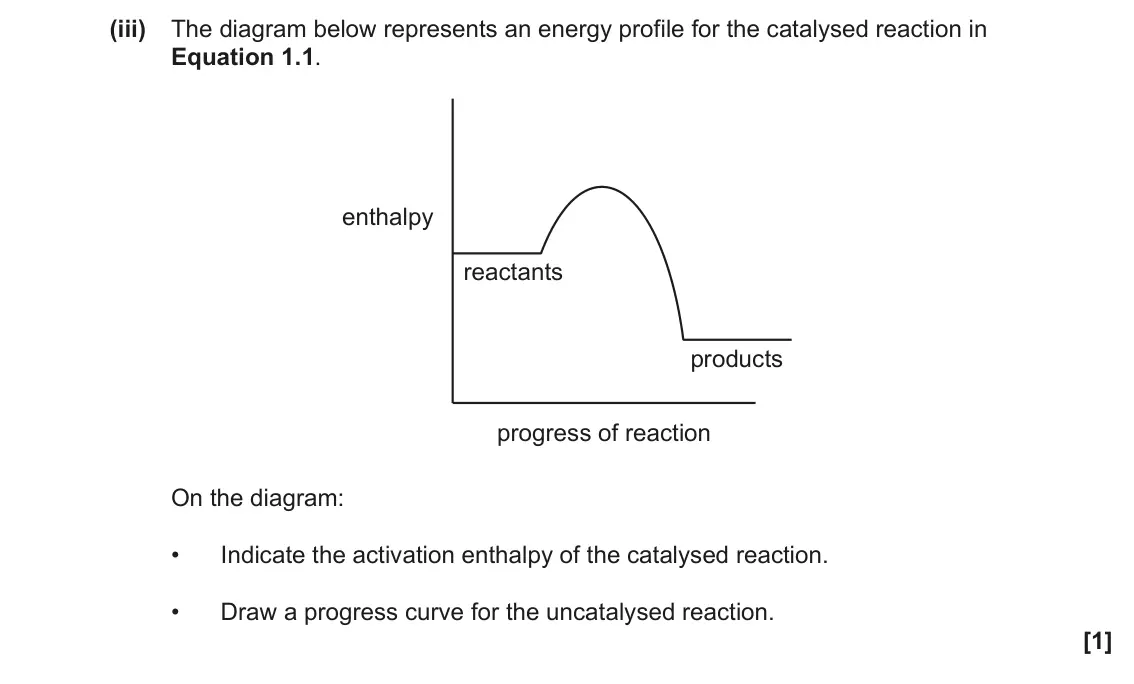
Q1(c)
The whole paper ↗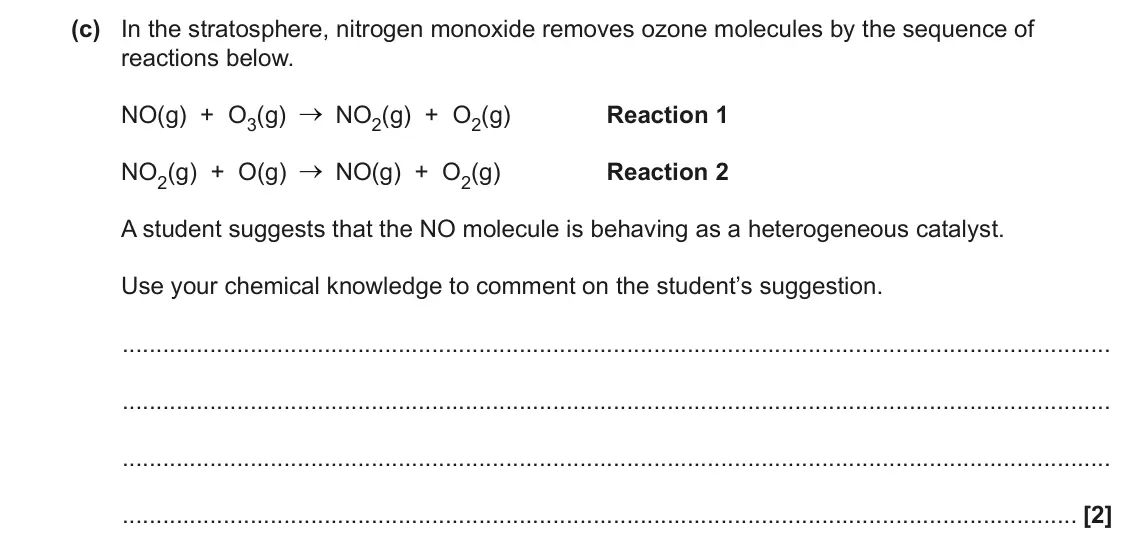
Q4(f)
The whole paper ↗
Q32(c)(i)
The whole paper ↗
Q32(c)(iii)
The whole paper ↗
Q24(e)
The whole paper ↗
Q2(b)(i)
The whole paper ↗
Q2(c)(ii)
The whole paper ↗
Q4(c)
The whole paper ↗
Q4(d)(i)
The whole paper ↗
Q31(b)(ii)
The whole paper ↗
All 39 questions on Kinetics, as a list
- June 2025, Paper 1, Q31(c)(iii) (3 marks): Catalysis can be explained using a Boltzmann distribution. Use the diagram to explain how a catalyst speeds up a reaction. Label the diagram and write on the li
- June 2025, AS Paper 1, Q5 (1 mark): A student is measuring the effect of temperature on the rate of reaction of hydrochloric acid with calcium carbonate. What is a variable that must be controlled
- June 2025, AS Paper 2, Q1(b) (6 marks): Catalytic converters on cars use metals such as platinum as heterogeneous catalysts. Catalytic converters turn exhaust emissions such as carbon monoxide and nit
- June 2024, Paper 1, Q33(d)(ii) (2 marks): Draw an enthalpy profile diagram for the reaction in Equation 33.1 and label the catalysed and uncatalysed reactions. Show the reactants and products and the ac
- June 2024, AS Paper 1, Q24(a)(i) (1 mark): Fill in the missing value in the table. [1]
- June 2024, AS Paper 1, Q24(a)(ii) (3 marks): On the graph paper below, plot a graph of rate against volume of sodium thiosulfate, including the origin. Label the axes. Draw a line of best fit. [3]
- June 2024, AS Paper 1, Q24(a)(iii) (1 mark): Explain why ‘volume of sodium thiosulfate’ is proportional to ‘concentration of sodium thiosulfate’. [1]
- June 2024, AS Paper 1, Q24(a)(iv) (2 marks): The graph shows the relationship between rate and thiosulfate concentration for the reaction in Equation 24.1. Describe this relationship and explain it in term
- June 2024, AS Paper 1, Q24(b) (2 marks): The students repeat the experiment, varying the temperature. They find that the reaction gets faster as the temperature is increased. Complete and label the dia
- June 2023, Paper 3, Q1(b)(iii) (1 mark): The diagram below represents an energy profile for the catalysed reaction in Equation 1.1. enthalpy reactants products progress of reaction On the diagram: • In
- June 2023, Paper 3, Q1(c) (2 marks): In the stratosphere, nitrogen monoxide removes ozone molecules by the sequence of reactions below. NO(g) + O3(g) NO2(g) + O2(g) Reaction 1 NO2(g) + O(g) NO(g) +
- June 2023, AS Paper 2, Q4(f) (2 marks): Draw a labelled Boltzmann distribution curve for a reaction. Mark the activation enthalpies when a catalyst is used and when it is not used. [2]
- June 2022, Paper 1, Q32(c)(i) (1 mark): Explain what is meant by the term homogeneous as applied to a catalyst. [1]
- June 2022, Paper 1, Q32(c)(iii) (1 mark): Explain how a catalyst increases the rate of a reaction. [1]
- June 2022, AS Paper 1, Q24(e) (2 marks): The students find data for repeating the experiment with the oil bath at 700 K. They notice that after 10 s the concentration of NO2 is 0.60 mol dm–3. Explain t
- June 2022, AS Paper 2, Q2(b)(i) (1 mark): Explain how a catalyst increases the rate of a chemical reaction. [1]
- June 2022, AS Paper 2, Q2(c)(ii) (1 mark): What is acting as a catalyst in this catalytic cycle and what type of catalysis is involved? [1]
- November 2021, AS Paper 2, Q4(c) (6 marks): Methanol can be used as a fuel. It can be made industrially by the catalysed reaction between carbon monoxide and hydrogen as shown in Equation 4.1. CH3OH(g) ΔH
- November 2021, AS Paper 2, Q4(d)(i) (3 marks): Complete the enthalpy level diagram below to show the effect of a catalyst on the activation enthalpy for this exothermic reaction. You should draw and label en
- November 2020, Paper 1, Q31(b)(ii) (1 mark): How does the catalyst speed up the reaction? [1]
- November 2020, Paper 3, Q1(b) (6 marks): A student is investigating the properties of some s-block metals and their compounds. (b)* Group 2 carbonates react with hydrochloric acid as shown in equation
- June 2019, Paper 2, Q5(e)(ii) (1 mark): Suggest a reason for the involvement of the molecule M. [1]
- June 2019, AS Paper 1, Q21(c)(v) (2 marks): Ammonia is not often made at temperatures below 473 K. This is because the equilibrium is established too slowly at lower temperatures. Explain why the rate of
- June 2018, Paper 1, Q9 (1 mark): The enthalpy profiles for the reaction W + X Y + Z are shown below, with and without a catalyst. enthalpy W + X Y + Z progress of reaction Which statement is co
- June 2018, AS Paper 1, Q23(b)(i) (1 mark): State how catalysts work in terms of the activation enthalpy. [1]
- June 2018, AS Paper 1, Q24(b) (3 marks): The students look up some data for the experimentally measured rates of the reaction shown below. 2NO2 2NO + O2 Their data are shown in the table below. T / K R
- June 2018, AS Paper 1, Q24(c) (3 marks): Draw two Boltzmann distributions at different temperatures on the axes below. Use your diagram to explain why the rate of reaction increases with temperature. L
- June 2018, AS Paper 2, Q3(g)(iii) (1 mark): Explain how equations 3.1 and 3.2 show that Br could be a catalyst for the breakdown of ozone. [1]
- June 2017, Paper 1, Q31(d)(iii) (3 marks): Chlorine radicals in the stratosphere act as homogeneous catalysts in the breakdown of ozone. Give equations for the catalytic cycle. Use the equations to expla
- June 2017, AS Paper 1, Q20 (1 mark): Nitrogen monoxide, NO, reacts instantaneously in air to form NO2. What is an explanation for this? A NO is a radical taking part in a termination reaction. B th
- June 2017, AS Paper 2, Q1(b)(i) (1 mark): The student says that the same mass of each powdered transition metal oxide must be used in order to make valid comparisons. State and explain whether or not th
- June 2017, AS Paper 2, Q1(b)(ii) (1 mark): Identify two variables, apart from details of the transition metal oxide, that the student must control in this experiment. 1 2 [1]
- June 2017, AS Paper 2, Q1(c)(i) (1 mark): The first five results for manganese(IV) oxide have been plotted on page 5. Plot the remaining results and draw the line of best fit. [1] 5 70 60 50 40 volume o
- June 2017, AS Paper 2, Q1(c)(ii) (1 mark): Use the graph to explain which of the three catalysts is the most effective. [1]
- June 2017, AS Paper 2, Q1(c)(iii) (2 marks): The experiment is carried out at room temperature and pressure. Use the graph to calculate the average rate of formation of oxygen over the first 15 s using cop
- June 2016, AS Paper 1, Q20 (1 mark): Nitrogen and oxygen combine, as shown below. 2NO(g) ΔrH = +180 kJ mol−1 N2(g) + O2(g) Which statement is correct for this reaction? A The reaction is exothermic
- June 2016, AS Paper 1, Q24(b)(i) (3 marks): The students read the concentrations of ozone at certain times from the computer model. Concentration of ozone / molecules cm−3 Time / s 5.000 × 10¹² 0 4.989 ×
- June 2016, AS Paper 1, Q24(b)(ii) (1 mark): Use the graph to determine the concentration of ozone after 500 seconds. concentration = molecules cm−3 [1]
- June 2016, AS Paper 1, Q24(b)(iii) (1 mark): How does the rate of reaction vary with time? Explain your answer. [1]
Questions, mark schemes and examiner’s reports are © OCR, from their published past papers. Plumi isn’t affiliated with any exam board. Want whole papers? Every OCR A-Level Chemistry B paper.
Rather write your answers by hand on iPad? Plumi marks them against the same mark schemes.