 plumi
Formulae, equations and amount of substance: OCR A‑Level Chemistry B questions
Every OCR A-Level Chemistry B exam question on EL Formulae, equations and amount of substance (specification points EL(a)–(d)), 2016–2025, with its mark scheme and examiner’s report.
Find questions2,049
Calculations

Q33(a)
The whole paper ↗
Q2(f)
The whole paper ↗
Q4(b)
The whole paper ↗

Q24(d)(iii)
The whole paper ↗
Q3(c)
The whole paper ↗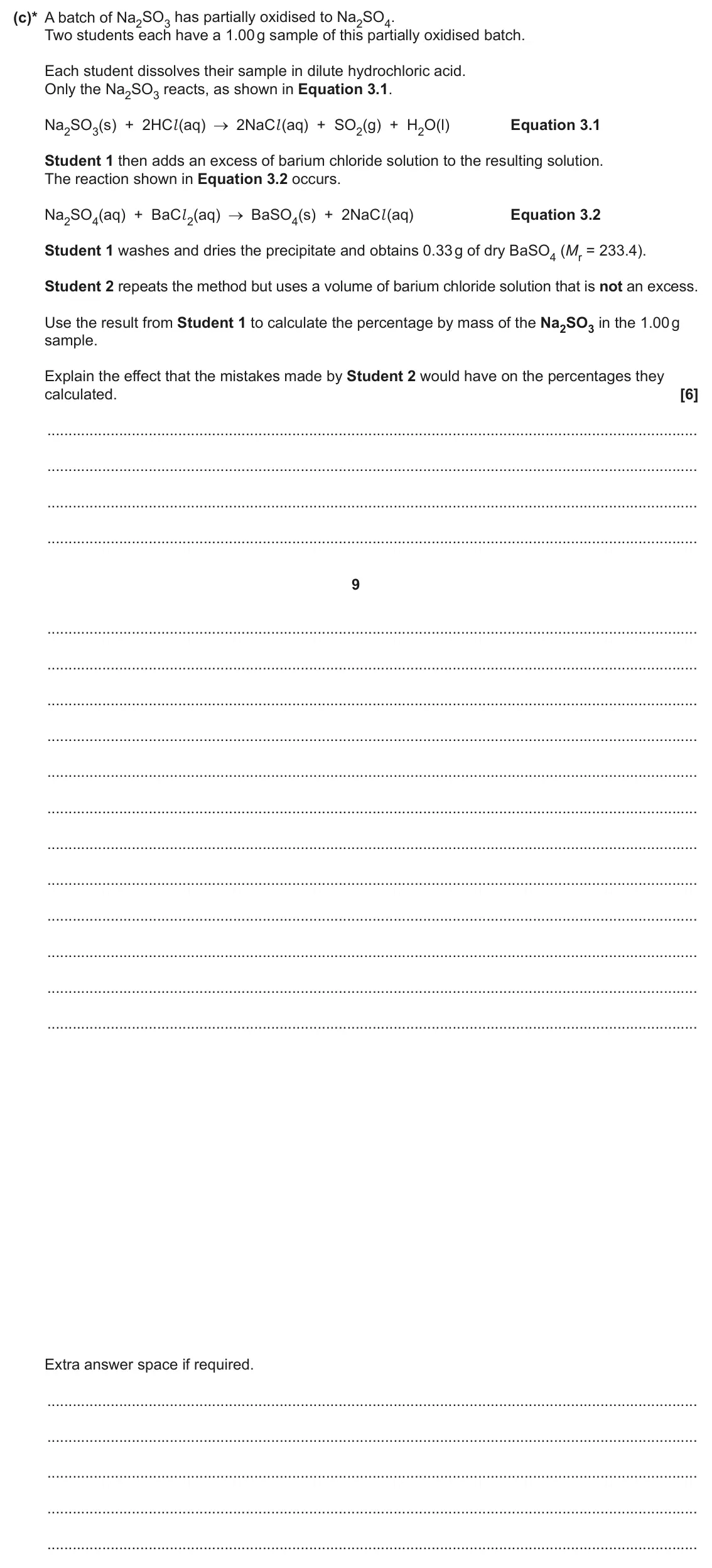
Q3(d)(i)
The whole paper ↗
Q3(d)(ii)
The whole paper ↗
Q3(d)(iii)
The whole paper ↗
Q4(c)(i)
The whole paper ↗
Q4(c)(ii)
The whole paper ↗
Q4(e)
The whole paper ↗
Q31(e)(i)
The whole paper ↗
Q31(e)(ii)
The whole paper ↗
Q31(e)(iii)
The whole paper ↗
Q1(e)(i)
The whole paper ↗
Q2(c)(i)
The whole paper ↗
All 149 questions on Formulae, equations and amount of substance, as a list
- June 2025, Paper 1, Q19 (1 mark): 2.00 g of an oxide of copper contains 1.78 g of copper. What is the oxidation state of the copper in the oxide? A –1 B 0 C +1 D +2 Your answer [1]
- June 2025, Paper 1, Q33(a) (2 marks): The student uses an incorrect method for measuring the mass of ammonium nitrate. Explain what the student should do to correctly measure the mass of ammonium ni
- June 2025, Paper 2, Q2(f) (2 marks): Another oxide of nitrogen contains 37% nitrogen by mass. Calculate the formula of the oxide. Formula = [2]
- June 2025, Paper 3, Q4(b) (6 marks): This question ref ers to the Practical Insert that is provided with this paper. – in a beaker. (b)* At the end of Part 1 of their method, the students have a so
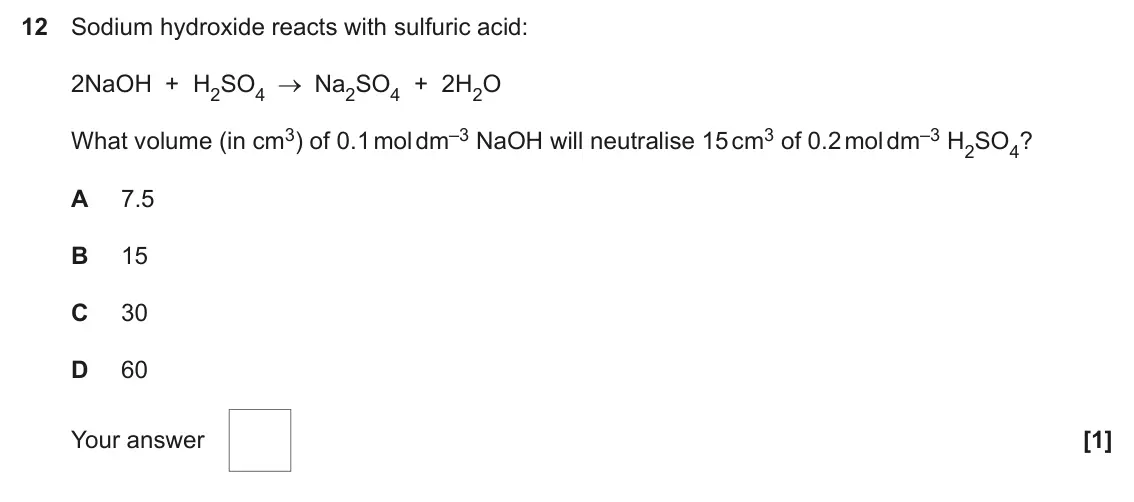
- June 2025, AS Paper 1, Q12 (1 mark): Sodium hydroxide reacts with sulfuric acid: 2NaOH + H2SO4 Na2SO4 + 2H2O What volume (in cm3) of 0.1 mol dm–3 NaOH will neutralise 15 cm3 of 0.2 mol dm–3 H2SO4?
- June 2025, AS Paper 1, Q19 (1 mark): 25 cm3 of 0.10 mol dm–3 silver nitrate solution reacts with an excess of a sodium halide solution to form 0.59 g of silver halide precipitate. Which halide is r
- June 2025, AS Paper 1, Q24(d)(iii) (3 marks): Calculate the volume (in cm3) of 0.24 mol dm–3 NaIO3 solution that would react with 15 g of NaI in Equation 24.1. Give your answer to an appropriate number of s
- June 2025, AS Paper 2, Q3(c) (6 marks): A student investigates the reactions of some of the elements and compounds of Group 2. (c)* A batch of Na2SO3 has partially oxidised to Na2SO4. Two students eac
- June 2025, AS Paper 2, Q3(d)(i) (3 marks): Plot a graph of mass of water against mass of hydrated salt on the graph paper below. Include the origin. Draw a line of best fit. [3]
- June 2025, AS Paper 2, Q3(d)(ii) (1 mark): Identify the anomalous point and suggest what caused this anomaly. Anomalous point Suggested cause of anomaly [1]
- June 2025, AS Paper 2, Q3(d)(iii) (3 marks): Calculate the value of x in the formula MgSO4•xH2O. Use the results from Student C. x = [3]
- June 2025, AS Paper 2, Q4(c)(i) (2 marks): used. Amount of ethanol = mol [2]
- June 2025, AS Paper 2, Q4(c)(ii) (2 marks): The student then uses a 1.00 cm3 volumetric pipette to transfer 1.00 cm3 of the mixture to a conical flask containing 100 cm3 of ice-cold water. The student tit
- June 2025, AS Paper 2, Q4(e) (1 mark): Suggest why the student uses a 1.00 cm3 volumetric pipette and not a small measuring cylinder for transferring 1.00 cm3 of the equilibrium mixture for the titra
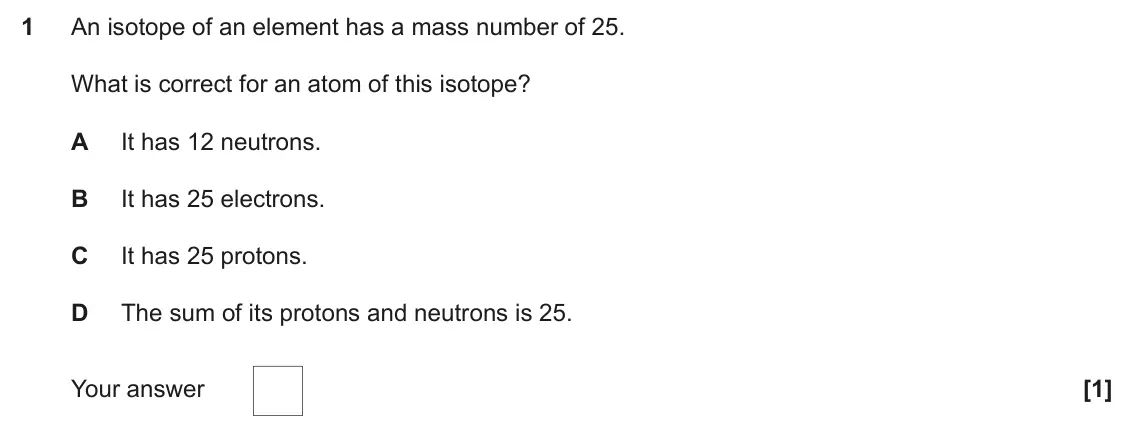
- June 2024, Paper 1, Q1 (1 mark): An isotope of an element has a mass number of 25. What is correct for an atom of this isotope? A It has 12 neutrons. B It has 25 electrons. C It has 25 protons.
- June 2024, Paper 1, Q31(e)(i) (2 marks): Describe the procedure they should use for weighing out the 3.02 g of MCO3. [2]
- June 2024, Paper 1, Q31(e)(ii) (5 marks): Calculate the Mr of MCO3. Mr = [5]
- June 2024, Paper 1, Q31(e)(iii) (1 mark): The 25.0 cm3 of the solution used for the titration is measured using a volumetric pipette. The uncertainty in reading the volumetric pipette is 0.06 cm3. Calcu
- June 2024, Paper 2, Q1(e)(i) (2 marks): The iodine value of a fat or carboxylic acid is the mass of iodine that will combine with 100 g of the substance, saturating the double bonds. Calculate the iod
- June 2024, Paper 2, Q2(c)(i) (3 marks): When 5.6 g of FeSO4•xH2O is heated gently, 3.1 g of FeSO4 is left. Calculate the value of x in FeSO4•xH2O, where x is a whole number. x = [3]
- June 2024, Paper 2, Q2(c)(ii) (3 marks): When FeSO4 is heated more strongly, a brown solid (Mr = 159.6) remains and two acidic gases are formed. Suggest an equation for this reaction. Give your reasoni
- June 2024, Paper 2, Q5(a)(iv) (3 marks): The article says: ‘A single gram of freon will often destroy as much as 70 kg of ozone.’ Calculate how many ozone molecules are destroyed by one Cl radical if 1
- June 2024, Paper 3, Q2(e) (3 marks): The students start with 0.90 g aspirin with the other reactants in excess. After the reaction, they collect 0.70 g of the purified oil of wintergreen. Calculate
- June 2024, Paper 3, Q3(d) (4 marks): The ‘Dead Sea’ is a lake that contains much more bromide than ‘normal’ sea water. Water from the Dead Sea is used to produce bromine. Some data about water from
- June 2024, AS Paper 1, Q1 (1 mark): On a Periodic Table the number 39.1 is shown for potassium, K. What is this number? A atomic number B mass number C relative atomic mass D relative molecular ma
- June 2024, AS Paper 1, Q11 (1 mark): Aluminium reacts with chlorine to form Al Cl 3. What is the maximum mass (in g) of Al Cl 3 (Mr = 133.5) that could be made by reacting 5.4 g of aluminium with 1
- June 2024, AS Paper 1, Q23(c) (3 marks): Calculate the minimum mass of CO needed to make 15 g of ethanoic acid by the Cativa process. Give your answer to an appropriate number of significant figures. m
- June 2024, AS Paper 2, Q1(c)(i) (3 marks): Calculate the percentage by mass of chlorine in the unknown solid. percentage by mass of chlorine = % [3]
- June 2024, AS Paper 2, Q1(c)(ii) (2 marks): The student fails to dry the AgCl precipitate fully. What effect would this have on the percentage by mass of chlorine calculated? Explain your answer. [2]
- June 2024, AS Paper 2, Q3(h) (6 marks): Most diesel fuel is made from crude oil. However, biodiesel, made from vegetable oils, is increasingly being used. (h)* An organic compound A, has the following
- June 2023, Paper 1, Q20 (1 mark): 10 cm3 of 0.30 mol dm–3 AgNO3 is mixed with 20 cm3 of 0.10 mol dm–3 NaCl . What is the maximum mass (in grams) of silver chloride (Mr = 143) that could be forme
- June 2023, Paper 1, Q25 (1 mark): A student records the following readings for a titration: Trial 1 2 3 2nd burette reading / cm3 20.45 40.80 40.45 20.50 1st burette reading / cm3 0.20 20.50 20.
- June 2023, Paper 1, Q33(a)(i) (2 marks): Calculate the percentage yield in this salt preparation. percentage yield = % [2]
- June 2023, Paper 2, Q1(e) (4 marks): The students have another solution containing 20 g dm–3 bromine. They find that 160 cm3 of this solution reacts exactly with 0.80 g of a hydrocarbon with a mole
- June 2023, Paper 2, Q2(b)(ii) (2 marks): The students use 14 g of both compound A and compound B. Calculate the amounts of each (in mol) that show that compound B is in excess. amount of compound A = m
- June 2023, Paper 2, Q2(b)(iii) (3 marks): The students recrystallise their crude phenacetin using water and obtain 20 g of solid product. They calculate their percentage yield. What advice would you giv
- June 2023, Paper 2, Q4(b) (2 marks): A concentration of greater than 6 × 10⁻⁴ mol dm–3 of ketone bodies in the bloodstream is known as ‘ketosis’. Calculate the mass of propanone (Mr 58) (in grams)
- June 2023, Paper 2, Q5(d)(ii) (2 marks): Impure calcium carbide contains calcium phosphide. The phosphide ion is P3–. Calcium phosphide reacts with water to form PH3. Suggest a chemical equation for th
- June 2023, AS Paper 1, Q17 (1 mark): What is the Avogadro constant, NA, the number of? A Atoms in one mole of carbon dioxide. B Carbon atoms in one mole of C2H5OH. C Sodium ions in one mole of NaCl
- June 2023, AS Paper 1, Q21(a)(i) (1 mark): Explain the meaning of heating to constant mass. [1]
- June 2023, AS Paper 1, Q21(a)(ii) (3 marks): On the grid below, plot a graph of the results in Table 21.1. Include the origin. Draw the line of best fit. [3]
- June 2023, AS Paper 1, Q21(a)(iii) (3 marks): Plaster of Paris has the formula CaSO4•xH2O. Calculate the value of x in this formula. Give your answer to 1 significant figure. x = [3]
- June 2023, AS Paper 2, Q1(d) (4 marks): A student is provided with a solid sample of an unknown Group 2 hydroxide, X(OH)2. The student describes how 250 cm3 of a solution of this solid is made up in a
- June 2023, AS Paper 2, Q1(e) (6 marks): This question is about Group 2 compounds. Group 2 hydroxides can be used to neutralise acidity in a variety of contexts. Magnesium hydroxide may be used to neut
- June 2023, AS Paper 2, Q3(c)(i) (3 marks): Calculate the percentage yield of aspirin in this preparation. percentage yield = % [3]
- June 2023, AS Paper 2, Q4(d) (2 marks): Ammonia can be converted into the fertiliser ammonium nitrate by reaction with nitric acid, as shown in Equation 4.3. NH3 + HNO3 NH4NO3 Equation 4.3 Calculate t
- June 2022, Paper 2, Q1(h)(i) (1 mark): What is meant by the term mass number? [1]
- June 2022, Paper 2, Q5(c) (1 mark): SnF2 is said in the article to hydrolyse at ‘higher pH’. Suggest an equation for the reaction between SnF2 and hydroxide ions. [1]
- June 2022, Paper 3, Q2(a)(i) (2 marks): The student adds 1.20 g of powdered zinc to 50.0 cm3 of 0.200 mol dm–3 copper(II) sulfate solution in a glass beaker. Use calculations to show which is the limi
- June 2022, Paper 3, Q4(a) (3 marks): Suggest how the students accurately made up a solution of 0.300 mol dm–3 copper(II) nitrate from their standard 0.400 mol dm–3 solution. Name the apparatus invo
- June 2022, AS Paper 1, Q13 (1 mark): What mass of Na2CO3 is needed to make up 250 cm3 of a 0.100 mol dm–3 solution? (Na, 23; C, 12; O, 16) A 2.65 g B 3.57 g C 10.6 g D 26.5 g Your answer [1]
- June 2022, AS Paper 1, Q23(c)(iv) (1 mark): The students are told that they should have used a volumetric pipette rather than a measuring cylinder to measure out 25 cm3 of bleach. What effect would this h
- June 2022, AS Paper 2, Q2(d) (3 marks): A CFC has the following percentage composition by mass: C, 11.7%; F, 18.8%; Cl, 69.5%. The relative molecular mass of this CFC is 204. Calculate the molecular f
- November 2021, Paper 1, Q1 (1 mark): Chlorine-35 is an isotope of chlorine. What is correct about an atom of chlorine-35? A It has 35 electrons. B It has 35 neutrons. C It has 35 protons. D It has
- November 2021, Paper 1, Q2 (1 mark): What is meant by ‘heating to constant mass’? A Heating a sample for a long time. B Heating a sample, then weighing, then heating and weighing again several time
- November 2021, Paper 1, Q20 (1 mark): The iodine number of an oil is a measure of its unsaturation. The iodine number is the mass of iodine that will react with 100 g of the oil. What is the iodine
- November 2021, Paper 1, Q25 (1 mark): A student has 50 cm3 of a 0.25 mol dm–3 solution. What volume of water (in cm3) should the student add to get a 0.10 mol dm–3 solution? A 2.5 B 20 C 75 D 125 Yo
- November 2021, Paper 1, Q31(c)(ii) (5 marks): The students make up a solution containing 6.58 g of fertiliser in 0.250 dm3 of deionised water. 25.0 cm3 of this solution needs 15.50 cm3 of 0.200 mol dm–3 bar
- November 2021, Paper 2, Q1(g) (3 marks): A hydrocarbon is completely burned. 11 g of carbon dioxide and 6.0 g of water are formed. Calculate the empirical formula of the hydrocarbon. formula [3]
- November 2021, Paper 2, Q2(e) (2 marks): The students are given a sample of 5.0 g of rust with the formula Fe2O3•2H2O. The students heat the rust and find that it loses 1.0 g. Show by calculation wheth
- November 2021, Paper 2, Q3(e)(iii) (3 marks): In an experiment, 5.0 g of benzaldehyde gives 6.3 g of mandelic acid. Calculate the percentage yield. yield = % [3]
- November 2021, Paper 2, Q5(g)(ii) (2 marks): The Article says that one form of indium tin oxide has percentages by mass: 53% In, 28% Sn and 19% O. Show how the percentages by mass are related to the formul
- November 2021, AS Paper 1, Q21(b)(i) (1 mark): The high Mr of BaSO4 makes it absorb X-rays well, compared with CaSO4. Give the Mr values of CaSO4 and BaSO4. CaSO4 BaSO4 [1]
- November 2021, AS Paper 1, Q22(a)(ii) (2 marks): Which reagent is in excess? Show your calculations. reagent in excess is [2]
- November 2021, AS Paper 2, Q2(c) (4 marks): A student wishes to determine the concentration of a sample of hydrochloric acid by titrating the acid with a standard solution of sodium carbonate. The student
- November 2021, AS Paper 2, Q2(d)(i) (3 marks): A student titrates 25.0 cm3 of a solution of sodium carbonate with 0.100 mol dm–3 hydrochloric acid in order to find the concentration of the sodium carbonate.
- November 2021, AS Paper 2, Q2(d)(ii) (4 marks): Another student is asked to determine the value of x in hydrated sodium carbonate, Na2CO3•xH2O. The student dissolves 1.46 g of the hydrated salt in water and m
- November 2020, Paper 1, Q32(b) (3 marks): The concentration of bromide ions in water from the Dead Sea is 5 g dm−3. Calculate the number of bromide ions in 1 cm3 of Dead Sea water. Give your answer to a
- November 2020, Paper 1, Q35(b) (3 marks): The students first dilute the seawater by pipetting 20.0 cm3 of seawater into a 100 cm3 volumetric flask and making up to the mark with deionised water. 25.0 cm
- November 2020, Paper 2, Q2(d)(iii) (3 marks): The students are told that in a standard IO3 They plan to prepare 40 cm3 of the solution for the electrode by mixing 20 cm3 of 0.08 mol dm−3 I2(aq) with 20 cm3
- November 2020, Paper 2, Q3(b) (2 marks): KH2PO4 when used in fertilisers is said to be equivalent to 52% P2O5 and 34% K2O by mass. Show that the mole ratio of potassium to phosphorus in 52% P2O5 and 34
- November 2020, Paper 2, Q4(a)(ii) (3 marks): A solution has 2.32 g dm−3 of maleic acid. Calculate the volume (in cm3) of 2.0 mol dm−3 NaOH(aq) that would completely neutralise 250 cm3 of the solution. volu
- November 2020, Paper 2, Q4(b)(i) (1 mark): Give the empirical formula of both acids. [1]
- November 2020, Paper 3, Q1(c)(i) (1 mark): Explain the term ‘heat to constant mass’. [1]
- November 2020, Paper 3, Q1(c)(ii) (3 marks): 4.00 g of a metal carbonate MCO3 gives 1.91 g of MO on heating to constant mass. Identify metal M in MCO3 showing a suitable calculation. metal M is [3]
- November 2020, Paper 3, Q2(c) (4 marks): A student followed the procedure in the flow chart and obtained 5.46 g of methyl benzoate. The equation for the preparation is: C6H5COOH + CH3OH C6H5COOCH3 + H2
- November 2020, AS Paper 1, Q19 (1 mark): A student measures a volume of 200 cm3. What is the best way to express the number ‘two hundred’ to two significant figures? A 200 B 200.00 2.0 × 10² C 2.00 × 1
- November 2020, AS Paper 1, Q20 (1 mark): A student is doing a titration. The student measures a titre of 21.5 cm3. How can the student decrease the uncertainty in the burette readings? A Repeat the tit
- November 2020, AS Paper 1, Q23(c) (2 marks): Calcium chloride is added to lower the melting temperature of sodium chloride. The electrolyte often contains 33% NaCl and 67% CaCl 2 by mass. Calculate the num
- November 2020, AS Paper 2, Q2(a) (2 marks): Write an equation for the reaction of solid barium carbonate with hydrochloric acid. Carbon dioxide is produced in the reaction. Include state symbols. [2]
- November 2020, AS Paper 2, Q2(d)(i) (1 mark): The uncertainty in using a 25.0 cm3 pipette is 0.06 cm3. Calculate the percentage uncertainty in using this pipette. percentage uncertainty = % [1]
- November 2020, AS Paper 2, Q2(d)(ii) (4 marks): The student titrates the 25.0 cm3 of saturated Ca(OH)2 with hydrochloric acid of concentration 0.100 mol dm−3. Ca(OH)2 + 2HCl CaCl 2 + 2H2O A mean titre of 11.7
- November 2020, AS Paper 2, Q3(b)(ii) (3 marks): The student reacts 3.5 g of 4-hydroxybenzoic acid with an excess of ethanoic anydride. After purifying the crude product the student obtains 2.8 g of 4-acetoxyb
- June 2019, Paper 1, Q1 (1 mark): Which statement about an atom of 23Na is correct? 1 A It is an isomer of sodium. B It has an atomic number of 23. C It has 12 neutrons in its nucleus. D It has
- June 2019, Paper 1, Q19 (1 mark): When all the water is driven off from 11.89 g of NiCl2•xH2O, the residue weighs 6.49 g. What is the value of x? A 2 B 3 C 4 D 6 Your answer [1]
- June 2019, Paper 1, Q20 (1 mark): A student adds 10 cm3 of water to 12 cm3 of a 0.010 mol dm–3 solution. What is the resulting concentration in mol dm–3? A 0.0045 B 0.0055 C 0.0083 D 0.018 Your
- June 2019, Paper 1, Q26 (1 mark): 0.125 mol of CuO is reacted with excess sulfuric acid and the solution allowed to crystallise. What mass of hydrated copper sulfate, CuSO4•5H2O, is formed if th
- June 2019, Paper 2, Q1(c) (2 marks): Compound A can be made by the reaction in Fig. 1.2. O O O O + 2SOCl2 + 2HCl + 2SO2 HO OH Cl Cl benzene-1,4-dicarboxylic acid compound A Fig. 1.2 Calculate the m
- June 2019, Paper 2, Q2(c)(i) (1 mark): How many neutrons are there in an atom of 84Sr? number of neutrons = [1]
- June 2019, Paper 2, Q2(d) (6 marks): Strontium carbonate is used in fireworks to colour the flames red. (d)* Strontium oxide reacts with water to form strontium hydroxide, Sr(OH)2. The solubility o
- June 2019, Paper 3, Q2(f) (3 marks): The students then recrystallised their paracetamol sample. The students started with a mass of 2.1 g of 4-aminophenol and used excess ethanoic anhydride. The ma
- June 2019, AS Paper 1, Q10 (1 mark): Urea has formula CO(NH2)2. What is the percentage of nitrogen by mass in urea? A 23% B 25% C 41% D 47% Your answer [1]
- June 2019, AS Paper 1, Q22(c)(i) (1 mark): Write the equation for the reaction in the titration. [1]
- June 2019, AS Paper 1, Q22(c)(ii) (2 marks): Calculate the concentration of Ba(OH)2 in mol dm–3. concentration = mol dm–3 [2]
- June 2019, AS Paper 1, Q22(c)(iii) (1 mark): Calculate the concentration of Ba(OH)2 in g dm–3. concentration = g dm–3 [1]
- June 2019, AS Paper 2, Q2(f)(ii) (3 marks): A solution of sodium bromide has a concentration of 0.0260 mol dm–3. 25.0 cm3 of this solution are mixed with an excess of silver nitrate solution. 0.118 g of s
- June 2019, AS Paper 2, Q4(b) (2 marks): An alternative halon that is also used in fire extinguishers has the following composition by mass. C Br F 9.2% 61.5% 29.3% The Mr of this halon is 259.8. Deduc
- June 2018, Paper 1, Q17 (1 mark): An unsaturated carboxylic acid has an Mr of 280. 70 g of the acid is saturated by 1.0 g of hydrogen. How many C=C bonds are there in one molecule of the acid? A
- June 2018, Paper 1, Q18 (1 mark): Sodium carbonate reacts with hydrochloric acid as shown in the equation. Na2CO3 + 2HCl 2NaCl + CO2 + H2O What mass (in grams) of Na2CO3 will react exactly with
- June 2018, Paper 1, Q31(a) (3 marks): In a cracking reaction 1.50 tonnes of dodecane (C12H26) produce 478 kg of hexane (C6H14). Calculate the percentage yield of the reaction in equation 31.1. perce
- June 2018, Paper 1, Q35(a) (2 marks): Describe how the chemists would dissolve one bolt and make the solution up to 1.00 dm3. [2]
- June 2018, Paper 1, Q36(f)(ii) (4 marks): The overall yield of the reactions in equations 36.4 – 36.6 is 77%. The yield of ammonium nitrate in equation 36.7 can be taken as 100%. What mass (in tonnes) o
- June 2018, Paper 2, Q1(b) (2 marks): Some students heat a sample of MgCO3•3H2O to try to make MgCO3. Calculate the percentage loss in mass they will obtain if they succeed. percentage loss in mass
- June 2018, Paper 2, Q2(c)(ii) (2 marks): What mass of propene (in kg) would be obtained from 15 kg of nonane in the reaction in (i) if the percentage yield was 85%? mass of propene = kg [2]
- June 2018, Paper 2, Q3(g) (2 marks): The students have 20.0 cm3 0.35 mol dm−3 H2O2 and wish to make a 0.05 mol dm−3 solution. How much water should they add? volume of water to add = cm3 [2]
- June 2018, Paper 2, Q5(c) (2 marks): Write an equation for the reaction of a solution of As3+ with hydrogen sulfide. Show state symbols. [2]
- June 2018, Paper 3, Q4(a)(ii) (3 marks): Use the student results to calculate the percentage yield of phenyl benzoate obtained from the practical. percentage yield = % [3]
- June 2018, AS Paper 1, Q9 (1 mark): What is the percentage of chlorine by mass in magnesium chloride? A 59% B 66% C 74% D 75% Your answer [1]
- June 2018, AS Paper 1, Q14 (1 mark): 35 cm3 of a solution has a concentration of 0.125 mol dm–3. A student calculates the amount (in moles) of solute in this solution. Which answer is given to the
- June 2018, AS Paper 1, Q15 (1 mark): Hydrochloric acid reacts with sodium carbonate as shown in the equation. 2HCl + Na2CO3 2NaCl + CO2 + H2O 20 cm3 of 2.0 mol dm–3 Na2CO3 are added to 20 cm3 2.0 m
- June 2018, AS Paper 1, Q21(b)(ii) (1 mark): The density of ethanoic anhydride is 1.1 g cm–3. Calculate the amount (in moles) of ethanoic anhydride used. amount of ethanoic anhydride = mol [1]
- June 2018, AS Paper 1, Q21(b)(iii) (2 marks): Which is in excess, the salicylic acid or the ethanoic anhydride? [2]
- June 2018, AS Paper 1, Q21(d) (2 marks): After recrystallisation, the students obtained 3.1 g of aspirin. What value for the percentage yield does this give? yield = % [2]
- June 2018, AS Paper 2, Q1(d) (6 marks): Chemists have arranged the elements into a Periodic Table which allows them to make predictions about the behaviour of the elements and their compounds. (d)* A
- June 2017, Paper 1, Q1 (1 mark): What is a possible mass number of a magnesium isotope? A 12 B 23.99 C 24 D 24.3 Your answer [1]
- June 2017, Paper 1, Q23 (1 mark): 5.6 g of Fe (Ar = 56) and 4.0 g of S (Ar = 32) are heated in air until no further reaction occurs. All the iron is converted to FeS and the rest of the sulfur f
- June 2017, Paper 1, Q24 (1 mark): A student has 25 cm3 of a 0.014 mol dm–3 solution. How much water should be added to make the solution 0.010 mol dm–3? 10 cm3 A 14 cm3 B 35 cm3 C 49 cm3 D Your
- June 2017, Paper 1, Q31(b) (3 marks): A sodium chloride solution contains 24.0% of sodium chloride by mass. 1.0 tonne of this solution is electrolysed. Calculate the mass of chlorine produced (in to
- June 2017, Paper 1, Q35(a) (6 marks): Magnesium sulfate, MgSO4, has a variety of uses in agriculture and in medicine. It exists in the solid state as a hydrated salt, MgSO4•xH2O. In order to find th
- June 2017, Paper 2, Q1(a)(ii) (2 marks): Calculate the volume (in cm3) of 0.500 mol dm–3 Na2CO3 that would react with 25.0 cm3 of 0.450 mol dm–3 CH3COOH. volume of Na2CO3 = cm3 [2]
- June 2017, Paper 2, Q2(b)(i) (2 marks): The students want to make 5.0 g of 4-nitrophenol in step 1. Calculate the mass of phenol they should start with. Give your answer to an appropriate number of si
- June 2017, Paper 2, Q4(a)(ii) (2 marks): Calculate the maximum mass of chromium (in kg) that could be obtained from 1000 g of chromite. mass = kg [2]
- June 2017, Paper 3, Q2(a)(ii) (3 marks): 50 cm3 acid is used each time. The concentration ranged from 0.1 to 0.5 mol dm–3. Calculate the maximum mass of magnesium ribbon that would completely react wit
- June 2017, Paper 3, Q2(a)(iii) (1 mark): Calculate the maximum length of magnesium ribbon needed to completely react with the acid in all the experiments. The mass per unit length of Mg ribbon = 1.3 ×
- June 2017, Paper 3, Q4 (15 marks): (a) (i) Name the piece of apparatus which is most suitable for removing the 25.0 cm3 of the 4 Cu2+ ion solution. [1] (ii) Use the student’s results in the Pract
- June 2017, AS Paper 1, Q1 (1 mark): How many hydrogen atoms are there in 1 mol of methanol? A 3 B 4 1.8 × 1024 C 2.4 × 1024 D [1] Your answer
- June 2017, AS Paper 1, Q22(c)(i) (1 mark): Write a full equation for the reaction that occurs. [1]
- June 2017, AS Paper 1, Q22(d)(i) (2 marks): 25.0 cm3 of the Na2CO3 solution requires 23.6 cm3 of HCl. Calculate the concentration of the HCl. concentration = mol dm–3 [2]
- June 2017, AS Paper 1, Q22(d)(ii) (2 marks): A student says: ‘There is no point writing 0.150 mol dm–3 for the Na2CO3 solution. Writing 0.15 mol dm–3 means the same thing.’ Discuss whether or not the stude
- June 2017, AS Paper 1, Q22(f)(i) (1 mark): Describe how the students could ensure that all the water had been lost. [1]
- June 2017, AS Paper 1, Q22(f)(ii) (2 marks): Calculate the value of x. x = [2]
- June 2017, AS Paper 2, Q3(a)(i) (1 mark): Calculate the amount (in moles) of NaOH in 0.50 tonne of sodium hydroxide. amount of NaOH = mol [1]
- June 2017, AS Paper 2, Q3(a)(ii) (1 mark): Calculate the mass of chlorine (in tonnes) produced at the same time as 0.50 tonne of sodium hydroxide. mass = tonnes [1]
- June 2017, AS Paper 2, Q4(c)(i) (1 mark): Explain why the appropriate mean titre for this titration is 20.85 cm3. [1]
- June 2017, AS Paper 2, Q4(c)(ii) (1 mark): The student uses a burette that can be read to the nearest 0.05 cm3. Calculate the percentage uncertainty in the titre of 20.80 cm3. percentage uncertainty = %
- June 2017, AS Paper 2, Q4(c)(iii) (3 marks): The equation for the reaction between calcium hydroxide and hydrochloric acid is shown below. Ca(OH)2(aq) + 2HCl(aq) CaCl2(aq) + 2H2O(l) Calculate the concentra
- June 2017, AS Paper 2, Q4(d) (1 mark): The elements in a modern Periodic Table are arranged by atomic number. Explain the meaning of the term atomic number. [1]
- June 2016, AS Paper 1, Q18 (1 mark): Some students wish to make 0.970 mol of zinc oxide by the reaction shown below. They are told that the reaction gives a 95.0% yield. ZnCO3(s) ZnO(s) + CO2(s) Wh
- June 2016, AS Paper 1, Q19 (1 mark): Which solution contains the greatest number of ions? 10.0 cm3 of 0.500 mol dm−3 NaCl A 0.300 dm3 of 0.0400 mol dm−3 NaCl B 0.0200 dm3 of 0.500 mol dm−3 MgCl2 C
- June 2016, AS Paper 1, Q22(d)(ii) (1 mark): Write an equation, using molecular formulae, for the reaction of isobutylene with methanol. [1]
- June 2016, AS Paper 2, Q2(b) (3 marks): Calculate the amount (in mol) of Mg(OH)2 in a bottle containing 250 cm3 at 8.0% w/v. Give your answer to two significant figures. amount of Mg(OH)2 = mol [3]
- June 2016, AS Paper 2, Q2(c)(ii) (1 mark): Suggest why it is not easy to use a direct titration in this situation. [1]
- June 2016, AS Paper 2, Q2(d)(i) (1 mark): Explain why the student should use 16.65 cm3 as the mean titre. [1]
- June 2016, AS Paper 2, Q2(d)(ii) (2 marks): The equation for the titration is shown below. 2NaOH + H2SO4 Na2SO4 + 2H2O Calculate the amount (in mol) of the H2SO4 in excess. amount of H2SO4 in excess = mol
- June 2016, AS Paper 2, Q2(d)(iii) (3 marks): Calculate the mass of Mg(OH)2 in 250 cm3 of milk of magnesia. The equation for the reaction of sulfuric acid with magnesium hydroxide is shown below. Mg(OH)2 +
- June 2016, AS Paper 2, Q2(d)(iv) (1 mark): The uncertainty associated with the use of a class B pipette is 0.06 cm3. Calculate the percentage uncertainty associated with using this pipette to measure the
- June 2016, AS Paper 2, Q3(e) (2 marks): Student B prepares 0.68 g pure aspirin starting with 1.15 g of 2-hydroxybenzoic acid. Calculate student B’s percentage yield of pure aspirin. percentage yield o
- June 2016, AS Paper 2, Q4(d)(ii) (1 mark): The gaseous products of the reaction are cooled to room temperature. Calculate the percentage of the products (by mass) that remain gaseous. % by mass of produc
- June 2016, AS Paper 2, Q4(e) (6 marks): Ethanoic acid is an important chemical intermediate in the manufacture of a wide range of products. It was originally made by oxidising ethanol. (e)* An alcohol
Questions, mark schemes and examiner’s reports are © OCR, from their published past papers. Plumi isn’t affiliated with any exam board. Want whole papers? Every OCR A-Level Chemistry B paper.
Rather write your answers by hand on iPad? Plumi marks them against the same mark schemes.