 plumi
Energy and matter: OCR A‑Level Chemistry B questions
Every OCR A-Level Chemistry B exam question on OZ Energy and matter (specification points OZ(s)–(u)), 2016–2025, with its mark scheme and examiner’s report.
Find questions2,049
Calculations
Q1(a)(iii)
The whole paper ↗
Q1(a)(iv)
The whole paper ↗
Q2(b)
The whole paper ↗
Q2(c)
The whole paper ↗
Q3(b)(i)
The whole paper ↗

Q32(b)
The whole paper ↗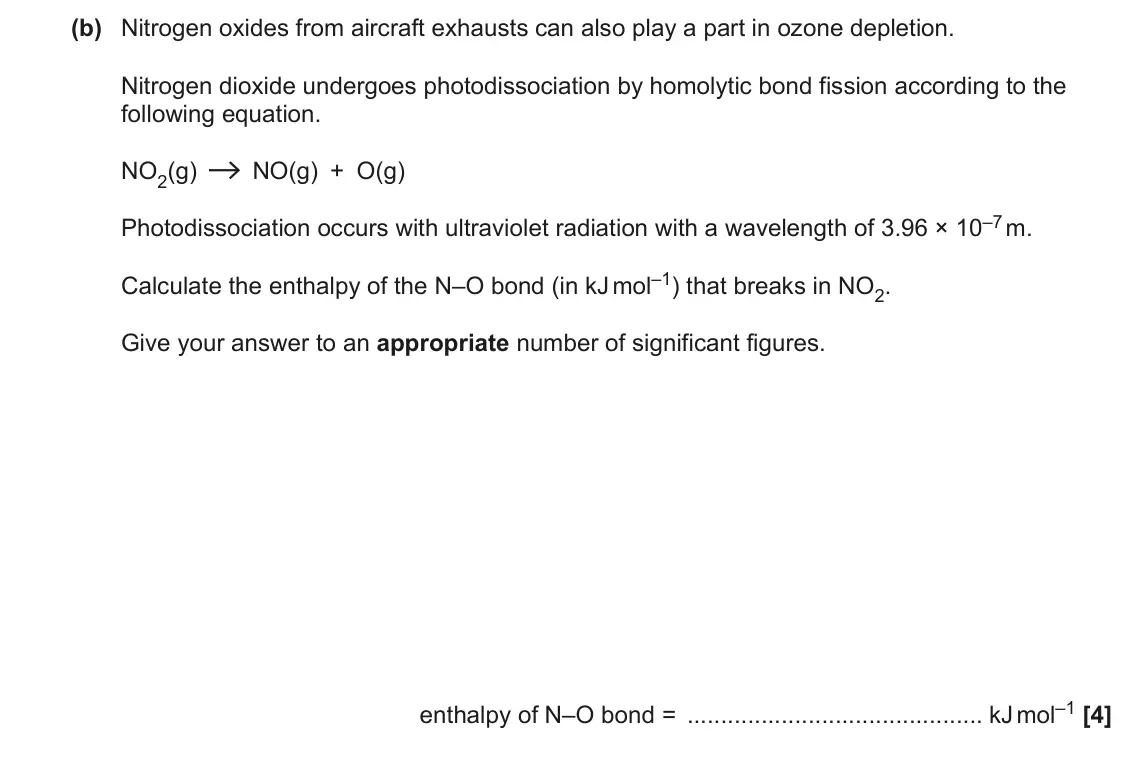
Q22(d)
The whole paper ↗
Q3(d)(ii)
The whole paper ↗
Q3(b)
The whole paper ↗


Q21(d)(ii)
The whole paper ↗

Q33(a)
The whole paper ↗
Q4(c)
The whole paper ↗
Q34(c)
The whole paper ↗
Q3(e)
The whole paper ↗
Q3(f)
The whole paper ↗
All 24 questions on Energy and matter, as a list
- June 2025, Paper 2, Q1(a)(iii) (1 mark): Which type of electromagnetic radiation causes this homolytic fission to occur in the stratosphere? [1]
- June 2025, Paper 2, Q1(a)(iv) (5 marks): The bond energy of the C–Cl bond is 346 kJ mol–1. Calculate the wavelength (in m) of radiation which breaks this bond. Give your answer to an appropriate number
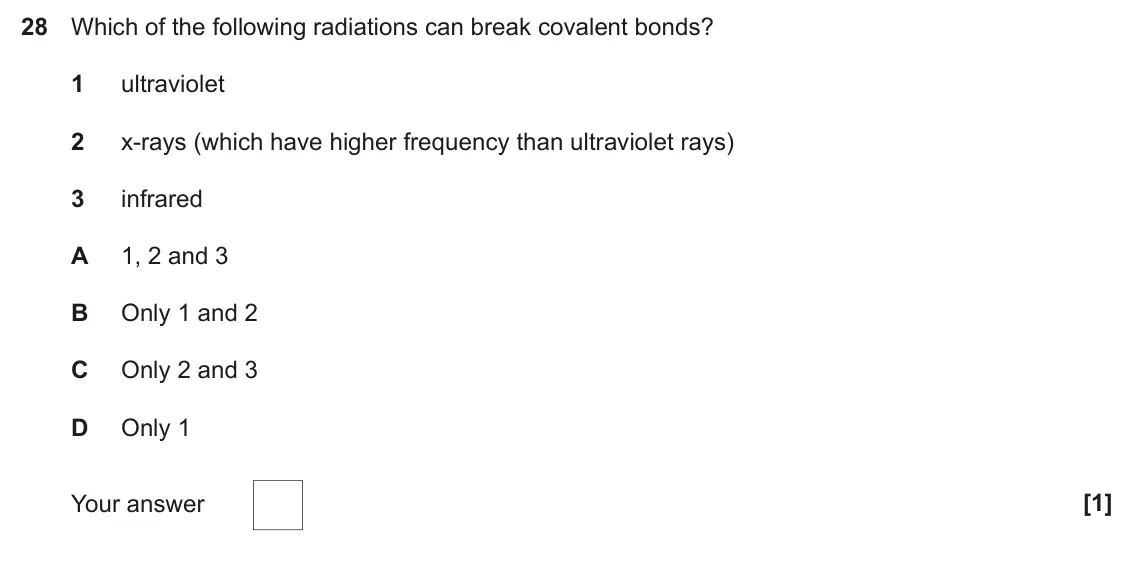
- June 2024, Paper 1, Q28 (1 mark): Which of the following radiations can break covalent bonds? 1 ultraviolet 2 x-rays (which have higher frequency than ultraviolet rays) 3 infrared A 1, 2 and 3 B
- June 2024, AS Paper 2, Q2(b) (1 mark): Ozone in the stratosphere is exposed to high energy ultraviolet radiation. This radiation sometimes breaks bonds. Describe another effect that high energy ultra
- June 2024, AS Paper 2, Q2(c) (2 marks): Calculate the frequency, in Hz, of ultraviolet radiation with a wavelength of 2.55 × 10⁻⁵ cm. frequency = Hz [2]
- June 2023, Paper 3, Q3(b)(i) (3 marks): Calculate the energy (in kJ) associated with one mole of photons of this wavelength. energy = kJ [3]
- June 2023, AS Paper 1, Q8 (1 mark): The Earth and the Sun both emit electromagnetic radiation. Which statement is correct? A The Earth emits infrared radiation. B The Earth emits mainly ultraviole
- June 2022, Paper 1, Q32(b) (4 marks): Nitrogen oxides from aircraft exhausts can also play a part in ozone depletion. Nitrogen dioxide undergoes photodissociation by homolytic bond fission according
- June 2022, AS Paper 1, Q22(d) (3 marks): CH3CH2Cl is a chloroalkane that decomposes in the stratosphere. CH3CH2Cl CH3CH2 + Cl Reaction 22.3 The bond energy of the C–Cl bond is +346 kJ mol–1. Calculate
- November 2021, Paper 2, Q3(d)(ii) (3 marks): Calculate the wavelength (in cm) of the light associated with an electron energy change of 3.5 × 10⁻¹⁹ J. wavelength = cm [3]
- November 2021, AS Paper 2, Q3(b) (3 marks): The bond enthalpy of the O–H bond in water is +463 kJ mol–1. Calculate the minimum frequency of radiation, in Hz, needed to break a single O–H bond. frequency =
- November 2020, Paper 1, Q20 (1 mark): Electromagnetic radiation with frequency 8.34 × 10¹⁴ Hz breaks a bond. What is the bond enthalpy of the bond in kJ mol−1? A 1.44 × 10⁻⁷ B 0.111 C 333 D 902 Your
- November 2020, AS Paper 1, Q13 (1 mark): Which statement about UV radiation is correct? A It causes the bonds in molecules to vibrate more. B It has a longer wavelength than IR radiation. C It is the p
- November 2020, AS Paper 1, Q21(d)(ii) (4 marks): Calculate the wavelength of radiation required, in cm, to break the C–Cl bond. wavelength = cm [4]
- June 2019, Paper 1, Q28 (1 mark): Which type(s) of radiation can break covalent bonds? 1 IR 2 UV 3 visible A 1, 2 and 3 B Only 1 and 2 C Only 2 and 3 D Only 1 Your answer [1]
- June 2019, Paper 1, Q33(a) (3 marks): When ozone absorbs UV radiation the following reaction occurs: hv O3 O2 + O This reaction is one that absorbs the harmful UV radiation that causes sunburn. One
- June 2019, AS Paper 2, Q4(c) (3 marks): When halons get into the stratosphere, C–Cl bonds can be broken by UV radiation from the Sun. The minimum frequency of radiation needed to break one C–Cl bond i
- June 2018, Paper 1, Q34(c) (3 marks): Years ago, the air conditioning in cars used CFC-12, CCl 2F2. CFC-12 absorbs some UV radiation when it breaks down. The most harmful UV radiation from the Sun t
- June 2018, AS Paper 2, Q3(e) (1 mark): When bromomethane, CH3Br, gets into the Earth’s atmosphere, a C–Br bond may be broken by ultraviolet radiation from the Sun. However, the ultraviolet radiation
- June 2018, AS Paper 2, Q3(f) (3 marks): The minimum frequency of radiation needed to break one C–Br bond is 7.14 × 10¹⁴ Hz. Calculate the bond enthalpy of the C–Br bond, in kJ mol–1. Give your answer
- June 2017, Paper 1, Q31(d)(iv) (2 marks): Ozone is also broken down by radiation in the stratosphere. O3 O2 + O The bond broken in this reaction has a bond enthalpy of +302 kJ mol–1. Calculate the wavel
- June 2017, Paper 2, Q5(b)(ii) (3 marks): Calculate the energy (in kJ mol–1) that corresponds to a wavelength of 350 nm absorbed by lignin. (1 nm = 10–9 m) energy = kJ mol–1 [3]
- June 2017, AS Paper 2, Q1(f)(ii) (3 marks): The bond enthalpy of the C–Cl bond is +346 kJ mol–1. Calculate the maximum wavelength of radiation (in nm) needed to break a single C—Cl bond. Give your answer
- June 2016, AS Paper 1, Q24(d) (3 marks): A data book gives the O–O bond enthalpy in ozone as +302 kJ mol−1 and shows that the highest frequency of UVA radiation is 9.5 × 10¹⁴ Hz. Show, using a calculat
Questions, mark schemes and examiner’s reports are © OCR, from their published past papers. Plumi isn’t affiliated with any exam board. Want whole papers? Every OCR A-Level Chemistry B paper.
Rather write your answers by hand on iPad? Plumi marks them against the same mark schemes.