Skip to content

Eduqas A‑Level Biology questions by topic

Every question from every Eduqas A-Level Biology paper, 2016–2025, part by part. Filter by topic, paper or year, open the mark scheme under any question, and download a set as a PDF.

Find questions2,061
Topics Pick as many as you like. Open one to choose its sub-topics.

Year 1 · AS

Year 2 · A‑Level only

Paper 3 options

Calculations

2,061 questions

  1. Q1(a)(i)

    June 2025 · Component 1

    1 mark
    The whole paper ↗
    June 2025 Component 1, question 1(a)(i): Name two hydrogen carriers that are involved in aerobic respiration in mitochondria. [1]
  2. Q1(a)(ii)

    June 2025 · Component 1

    3 marks
    The whole paper ↗
    June 2025 Component 1, question 1(a)(ii): Describe the role of hydrogen ions in ATP synthesis. [3]
  3. Q1(a)(iii)

    June 2025 · Component 1

    2 marks
    The whole paper ↗
    June 2025 Component 1, question 1(a)(iii): Explain why the two hydrogen carriers involved in aerobic respiration result in the synthesis of different numbers of ATP molecules. [2]
  4. Q1(b)(i)

    June 2025 · Component 1

    1 mark
    The whole paper ↗
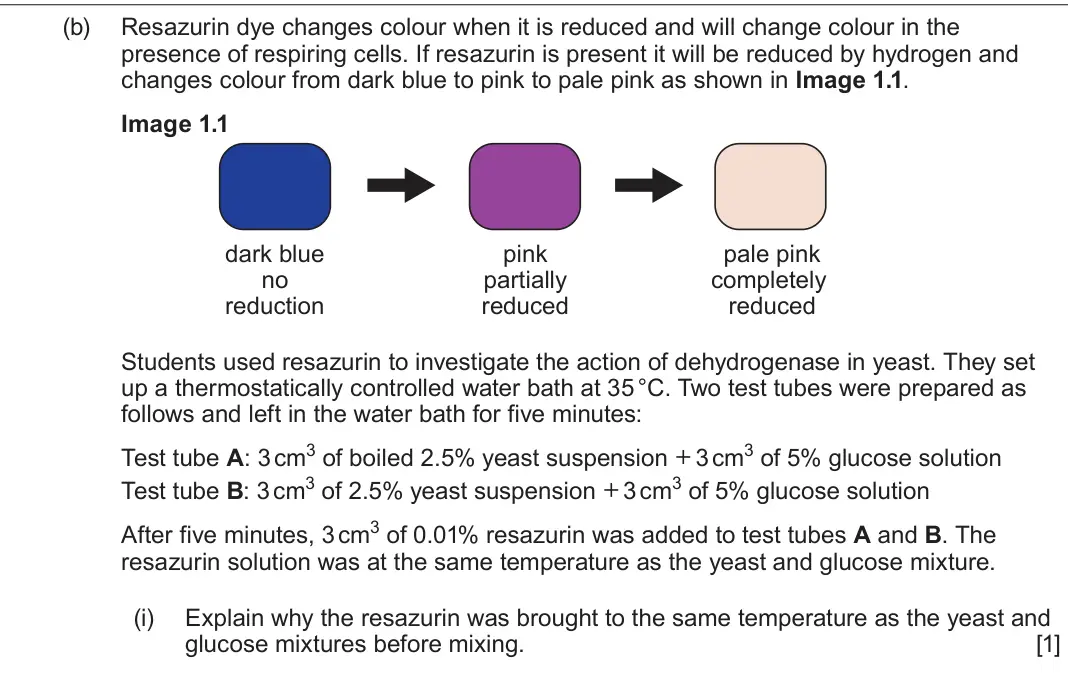
    June 2025 Component 1, question 1(b)(i): Explain why the resazurin was brought to the same temperature as the yeast and glucose mixtures before mixing. [1]
  5. Q1(b)(ii)

    June 2025 · Component 1

    2 marks
    The whole paper ↗
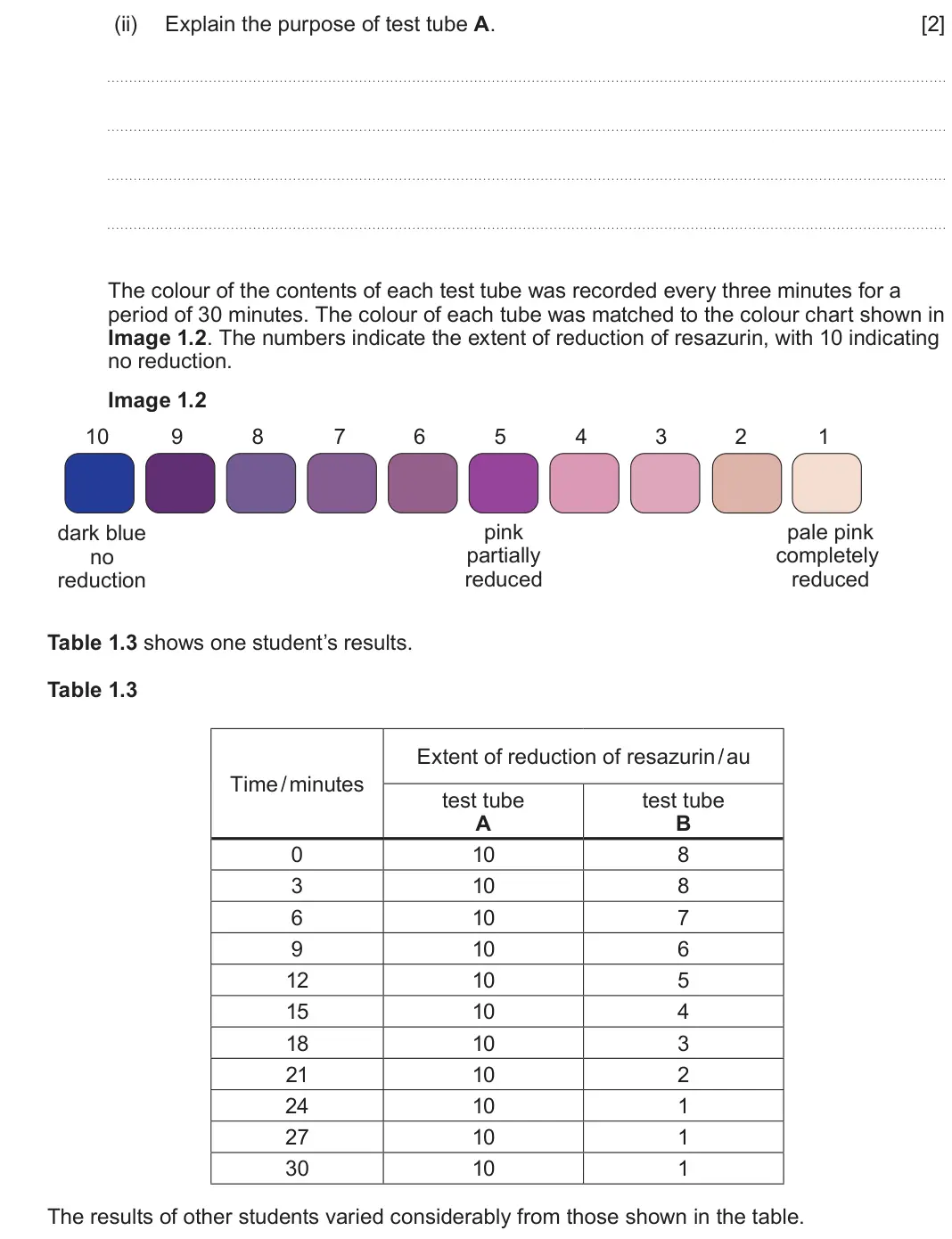
    June 2025 Component 1, question 1(b)(ii): Explain the purpose of test tube A. [2] The colour of the contents of each test tube was recorded every three minutes for a period of 30 minutes. The colour of
  6. Q1(b)(iii)

    June 2025 · Component 1

    3 marks
    The whole paper ↗
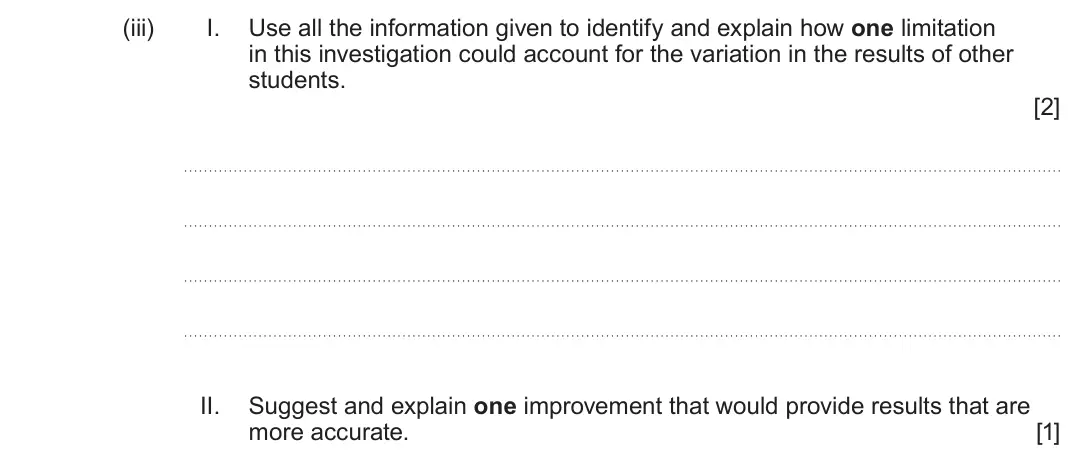
    June 2025 Component 1, question 1(b)(iii): I. Use all the information given to identify and explain how one limitation in this investigation could account for the variation in the results of other studen
  7. Q2(a)(i)

    June 2025 · Component 1

    1 mark
    The whole paper ↗
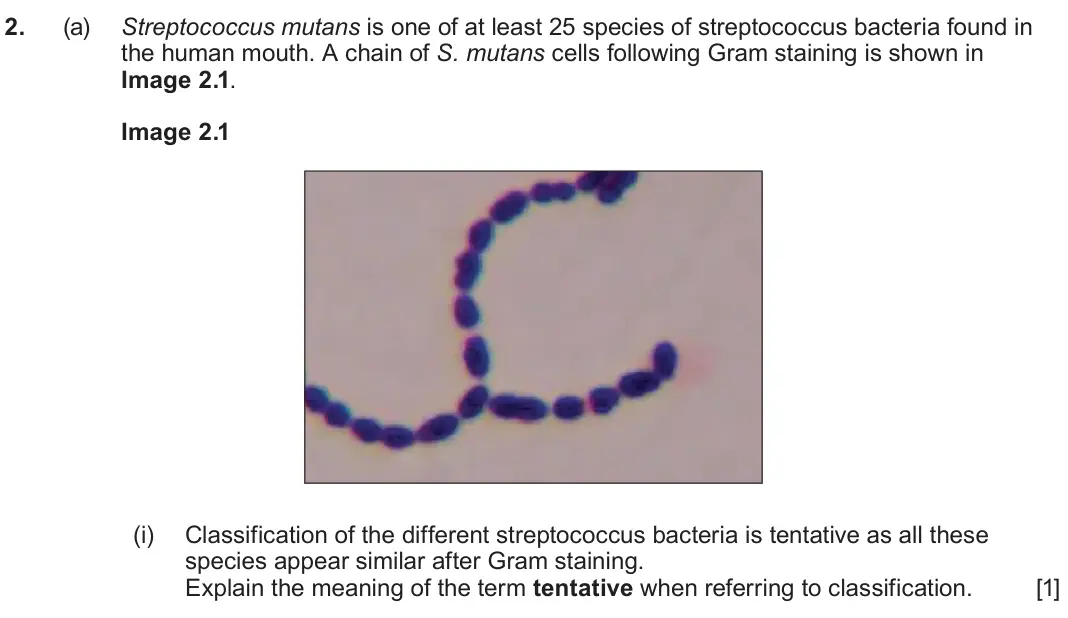
    June 2025 Component 1, question 2(a)(i): Classification of the different streptococcus bacteria is tentative as all these species appear similar after Gram staining. Explain the meaning of the term ten
  8. Q2(a)(ii)

    June 2025 · Component 1

    2 marks
    The whole paper ↗
    June 2025 Component 1, question 2(a)(ii): Explain how one biochemical method of analysis could be used to distinguish between the different species of Streptococcus. [2]
  9. Q2(b)(i)

    June 2025 · Component 1

    1 mark
    The whole paper ↗
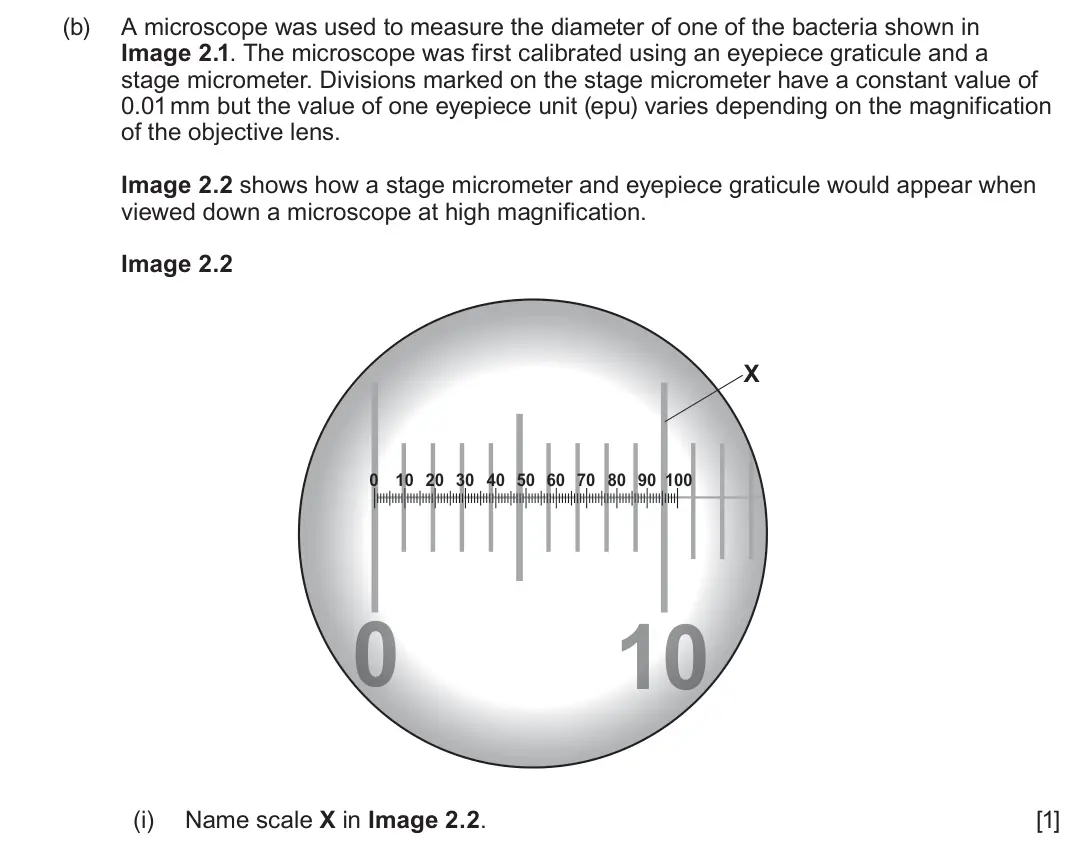
    June 2025 Component 1, question 2(b)(i): Name scale X in Image 2.2. [1]
  10. Q2(b)(ii)

    June 2025 · Component 1

    1 mark
    The whole paper ↗
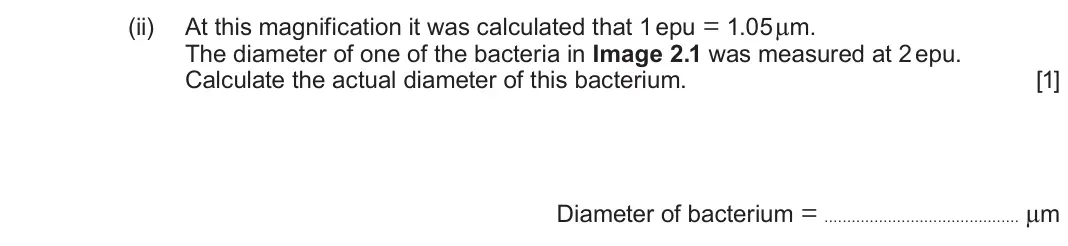
    June 2025 Component 1, question 2(b)(ii): At this magnification it was calculated that 1 epu = 1.05 μm. The diameter of one of the bacteria in Image 2.1 was measured at 2 epu. Calculate the actual diame
  11. Q2(c)(i)

    June 2025 · Component 1

    3 marks
    The whole paper ↗
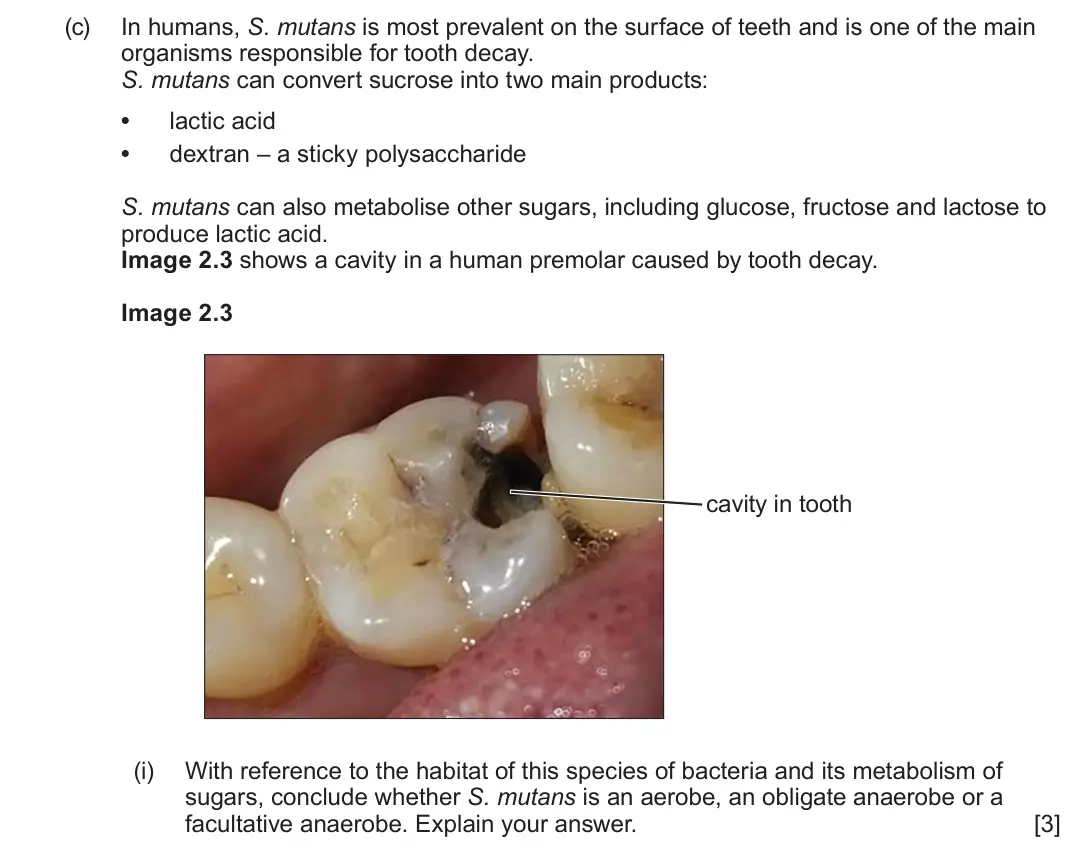
    June 2025 Component 1, question 2(c)(i): With reference to the habitat of this species of bacteria and its metabolism of sugars, conclude whether S. mutans is an aerobe, an obligate anaerobe or a facul
  12. Q2(c)(ii)

    June 2025 · Component 1

    2 marks
    The whole paper ↗
    June 2025 Component 1, question 2(c)(ii): Use the information provided to explain why not brushing your teeth can increase the risk of cavity formation. [2]
  13. Q2(d)

    June 2025 · Component 1

    4 marks
    The whole paper ↗
    June 2025 Component 1, question 2(d): Dextran solutions are used to treat cases of very low blood pressure caused by excessive blood loss. When dextran solutions are injected into the blood, they si
  14. Q3(a)(i)

    June 2025 · Component 1

    2 marks
    The whole paper ↗
    June 2025 Component 1, question 3(a)(i): State which two of the macronutrients listed above are required to produce the amino acids involved in cross-linking polypeptide chains. [2]
  15. Q3(a)(ii)

    June 2025 · Component 1

    2 marks
    The whole paper ↗
    June 2025 Component 1, question 3(a)(ii): State one role of each of the following elements in plants. [2] calcium magnesium
  16. Q3(b)(i)

    June 2025 · Component 1

    2 marks
    The whole paper ↗
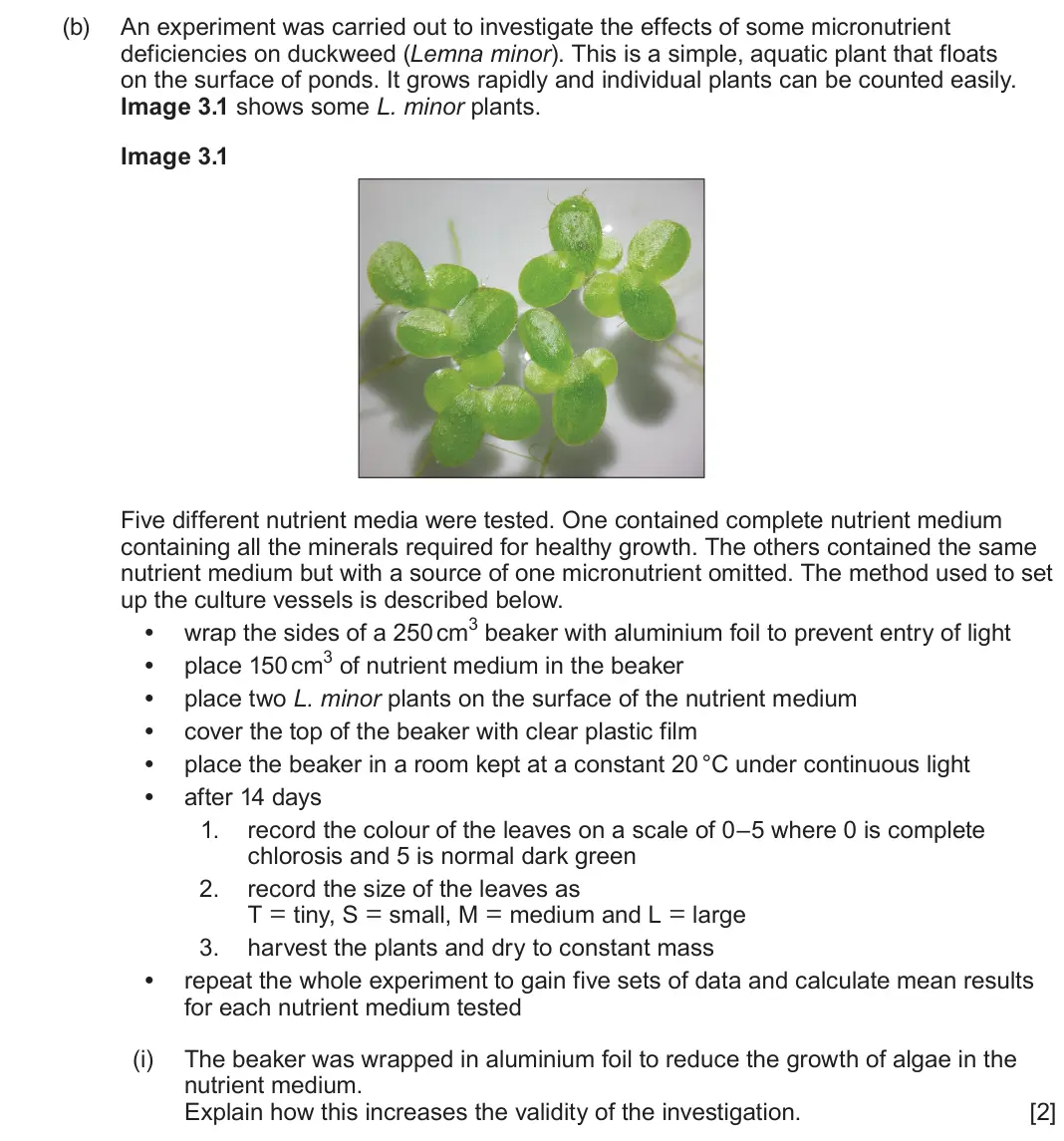
    June 2025 Component 1, question 3(b)(i): An experiment was carried out to investigate the effects of some micronutrient deficiencies on duckweed (Lemna minor). This is a simple, aquatic plant that floa
  17. Q3(b)(ii)

    June 2025 · Component 1

    2 marks
    The whole paper ↗
    June 2025 Component 1, question 3(b)(ii): Explain one reason why the top of the beaker was covered with clear plastic film. [2]
  18. Q3(b)(iii)

    June 2025 · Component 1

    1 mark
    The whole paper ↗
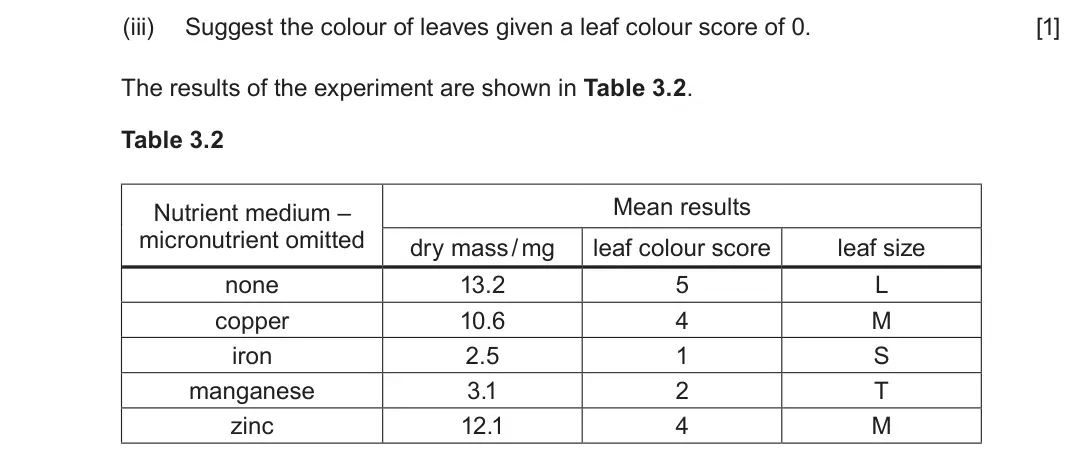
    June 2025 Component 1, question 3(b)(iii): Suggest the colour of leaves given a leaf colour score of 0. [1] The results of the experiment are shown in Table 3.2. Table 3.2 Mean results Nutrient medium –
  19. Q3(b)(iv)

    June 2025 · Component 1

    3 marks
    The whole paper ↗
    June 2025 Component 1, question 3(b)(iv): Use Table 3.2 to plot a bar chart of the mean dry mass of L. minor harvested for each nutrient medium on the grid below. [3]
  20. Q3(b)(v)

    June 2025 · Component 1

    5 marks
    The whole paper ↗
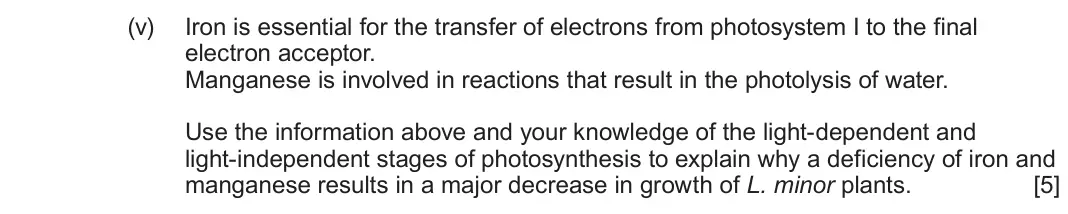
    June 2025 Component 1, question 3(b)(v): Iron is essential for the transfer of electrons from photosystem I to the final electron acceptor. Manganese is involved in reactions that result in the photoly

Questions, mark schemes and examiner’s reports are © WJEC Eduqas, from their published past papers. Plumi isn’t affiliated with any exam board. Want whole papers? Every Eduqas A-Level Biology paper.

Rather write your answers by hand on iPad? Plumi marks them against the same mark schemes.