 plumi
Gas exchange: Edexcel A‑Level Biology B questions
Every Edexcel A-Level Biology B exam question on 4.3 Gas exchange, 2016–2025, with its mark scheme and examiner’s report.
Find questions1,826
Calculations
Q7(a)(i)
The whole paper ↗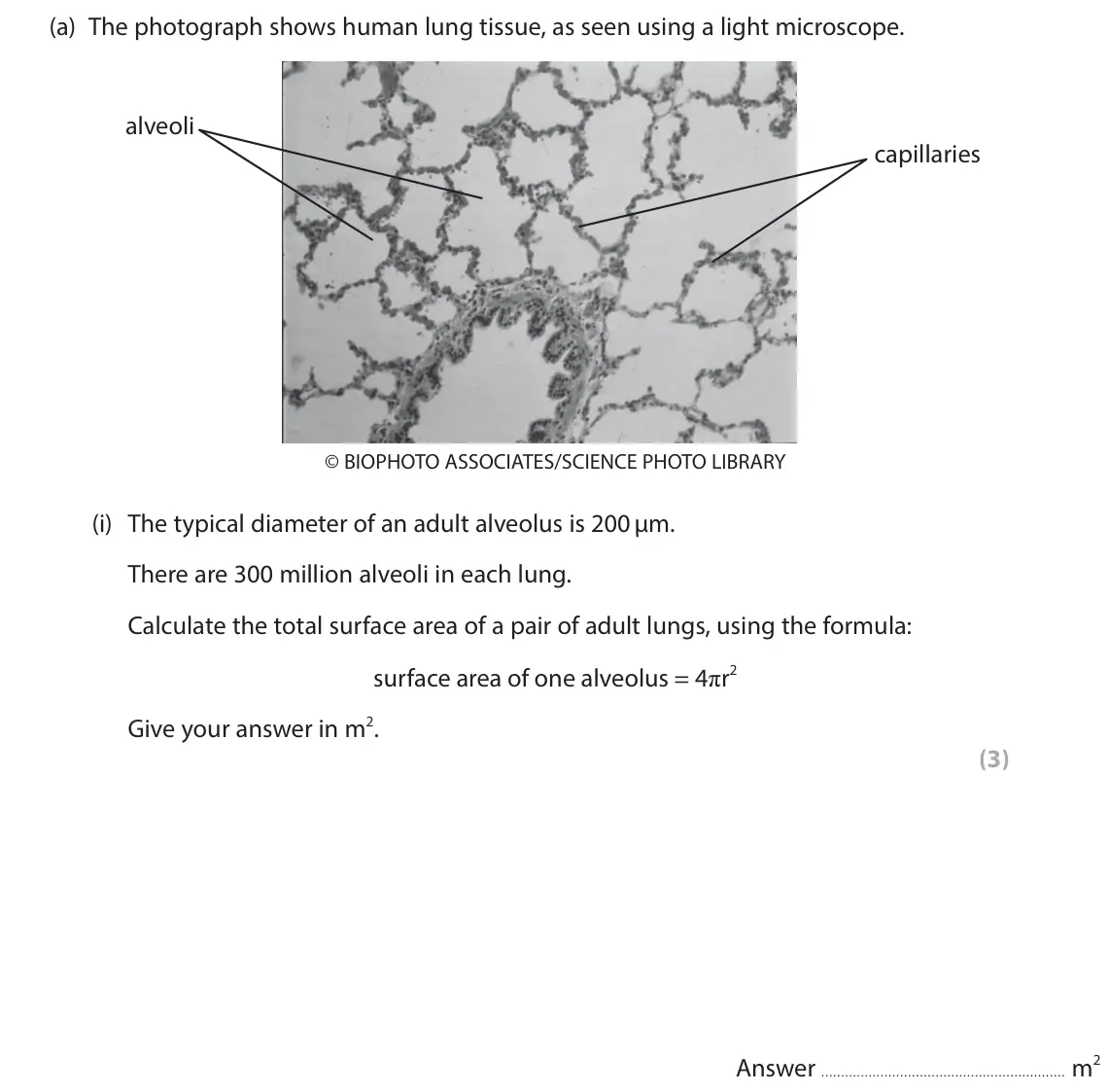
Q7(a)(ii)
The whole paper ↗
Q7(a)(iii)
The whole paper ↗
Q7(b)
The whole paper ↗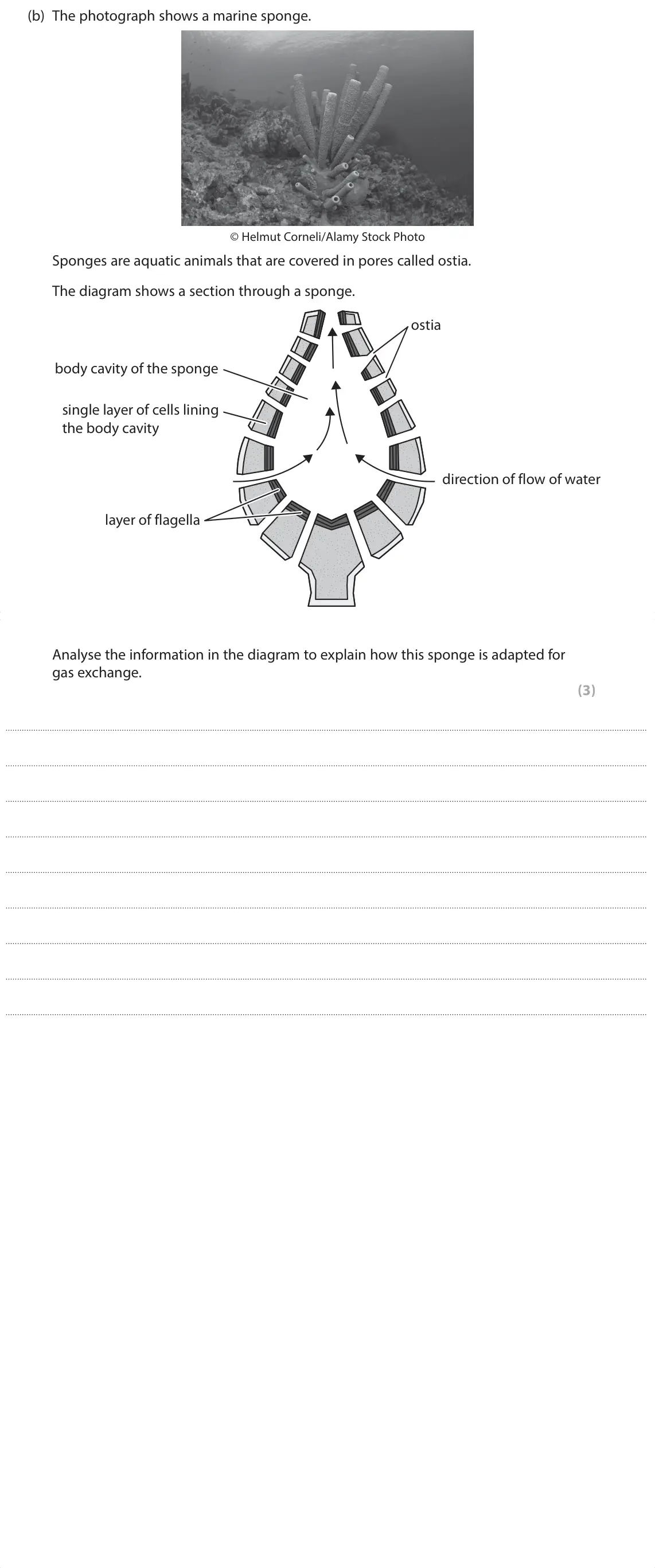
Q7(c)
The whole paper ↗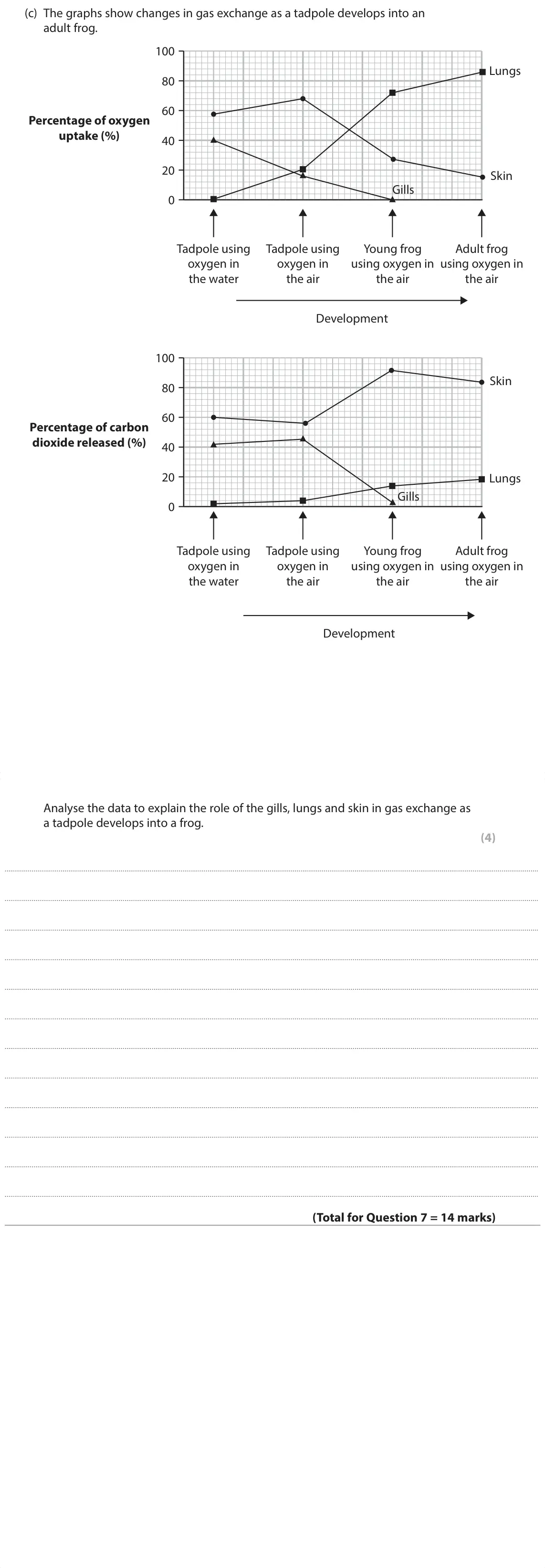
Q8(b)(i)
The whole paper ↗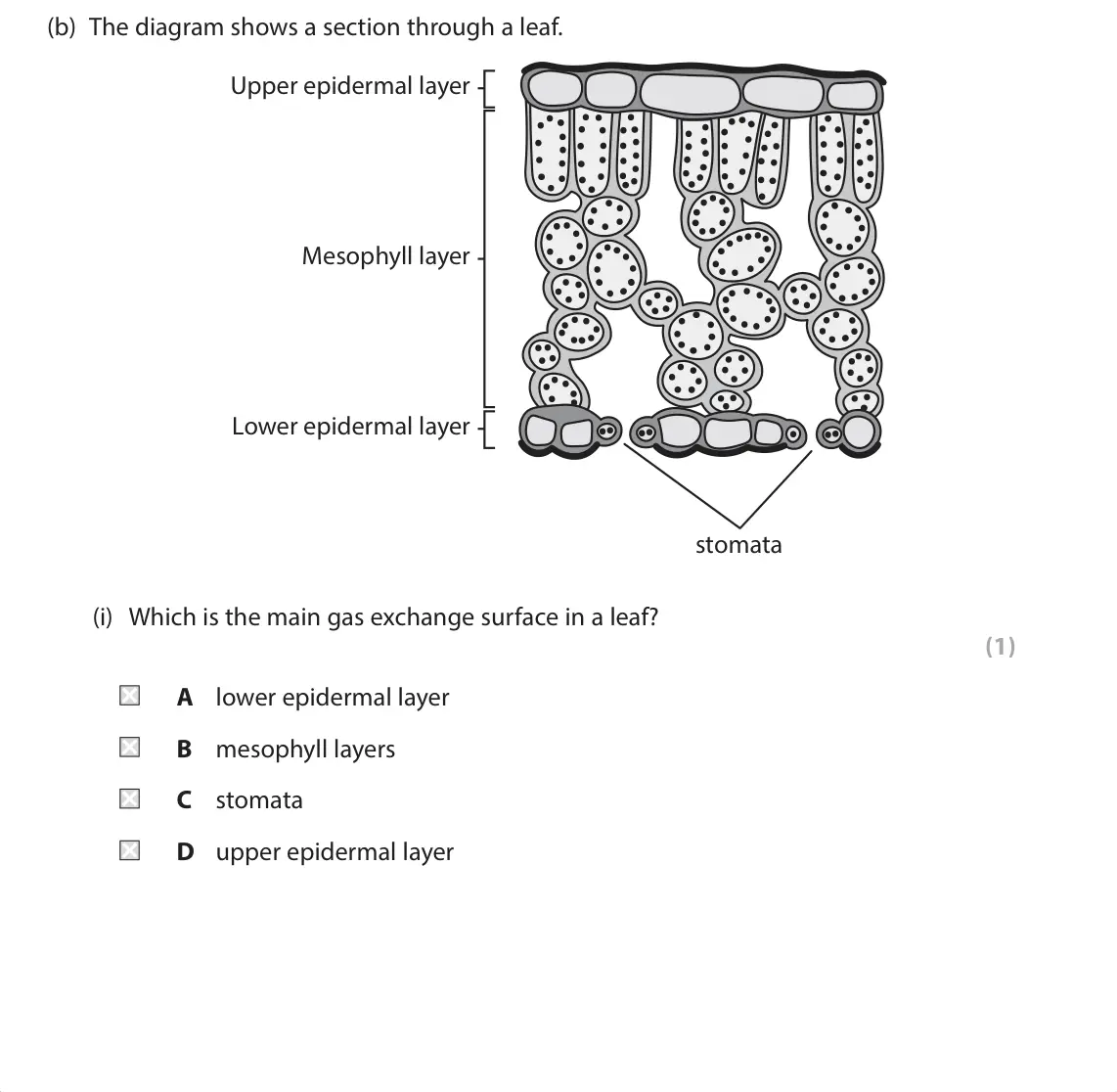
Q8(b)(ii)
The whole paper ↗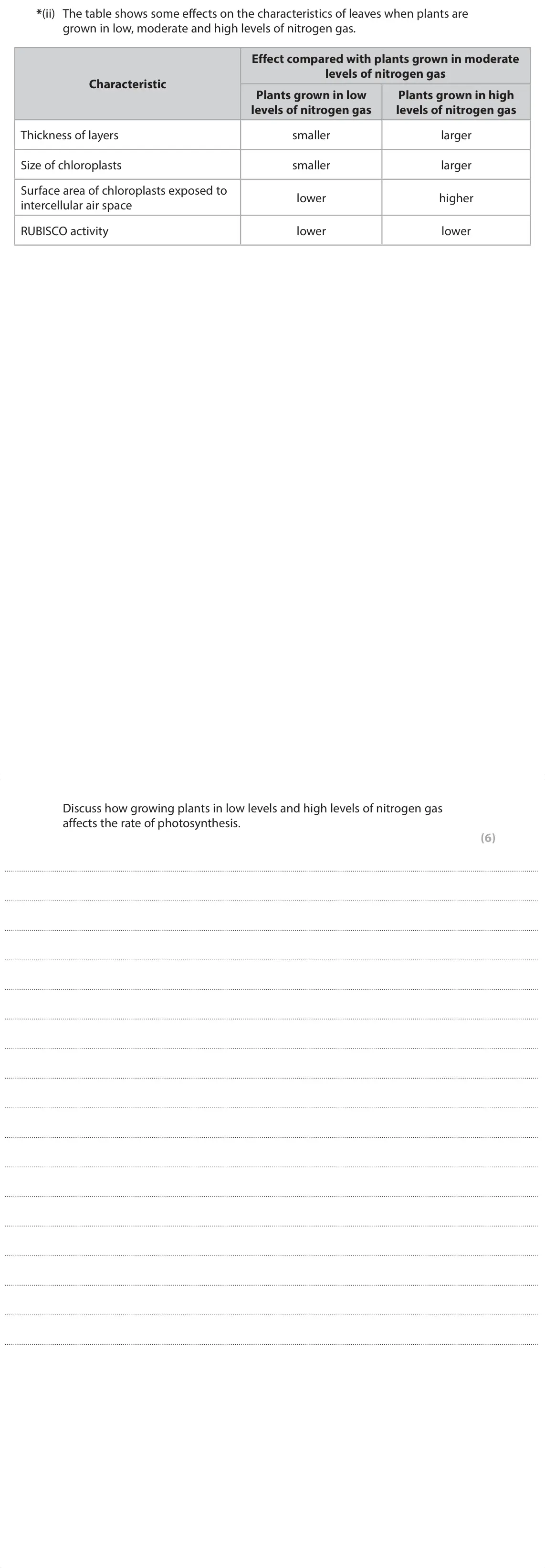
Q4(b)
The whole paper ↗
Q8(b)
The whole paper ↗
Q8(c)(i)
The whole paper ↗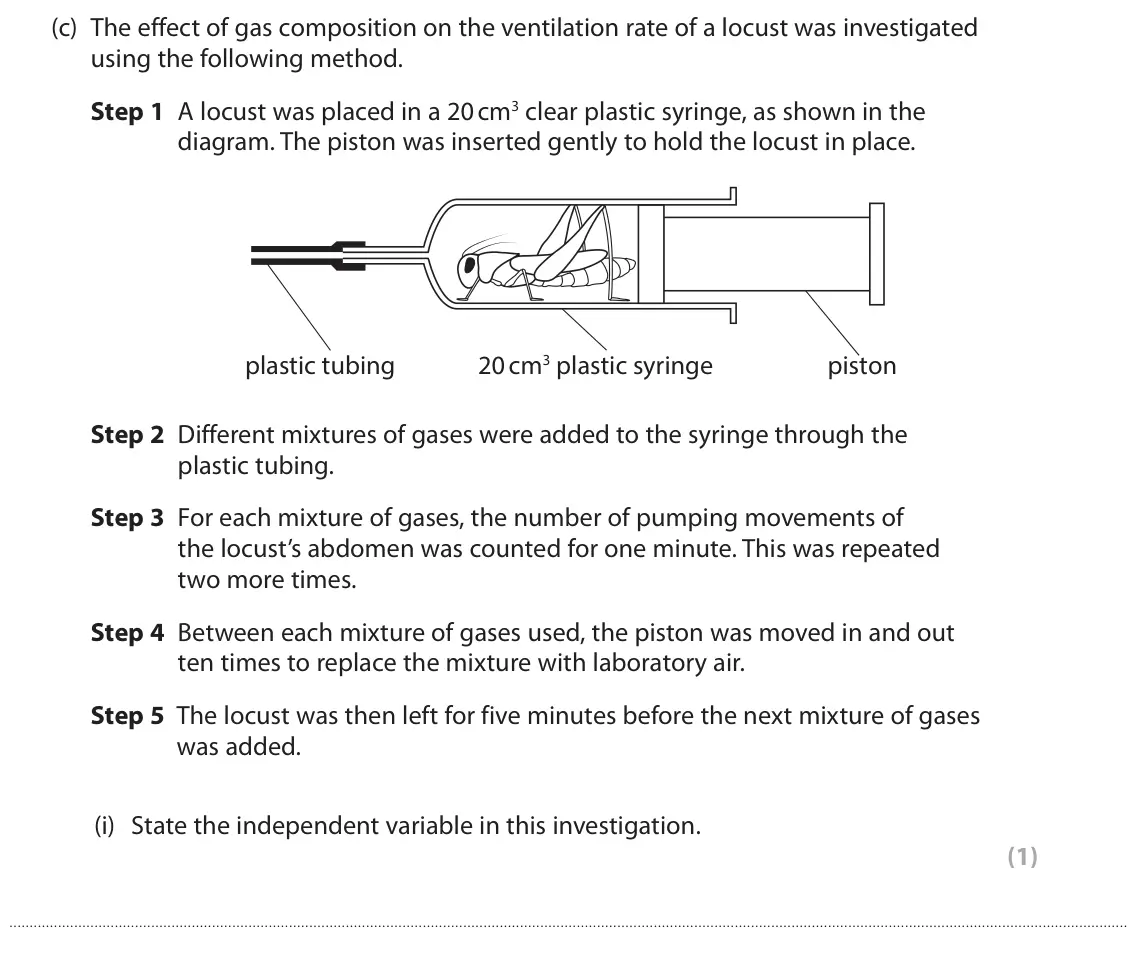
Q8(c)(ii)
The whole paper ↗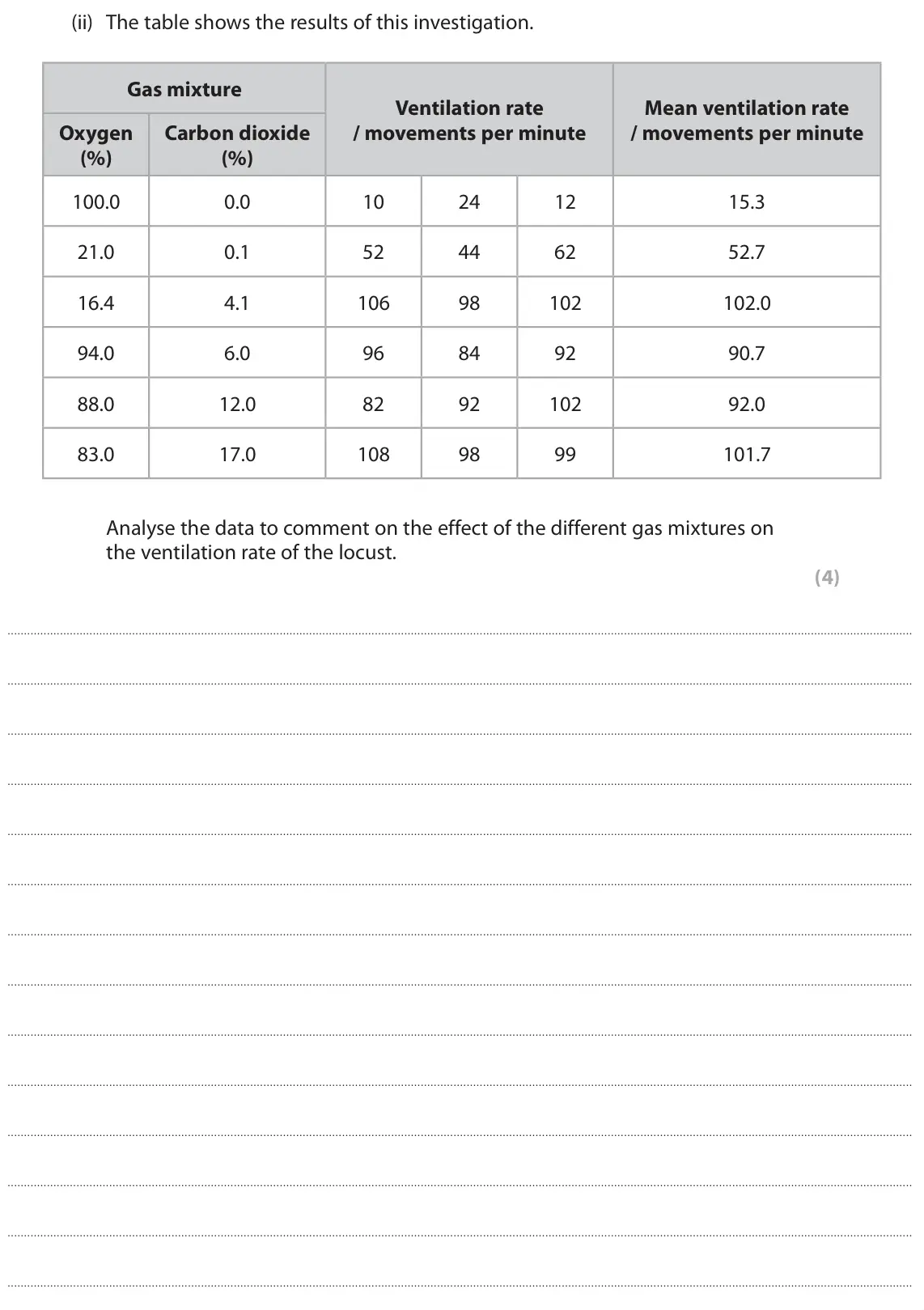
Q8(c)(iii)
The whole paper ↗
Q4(a)
The whole paper ↗
Q4(c)(i)
The whole paper ↗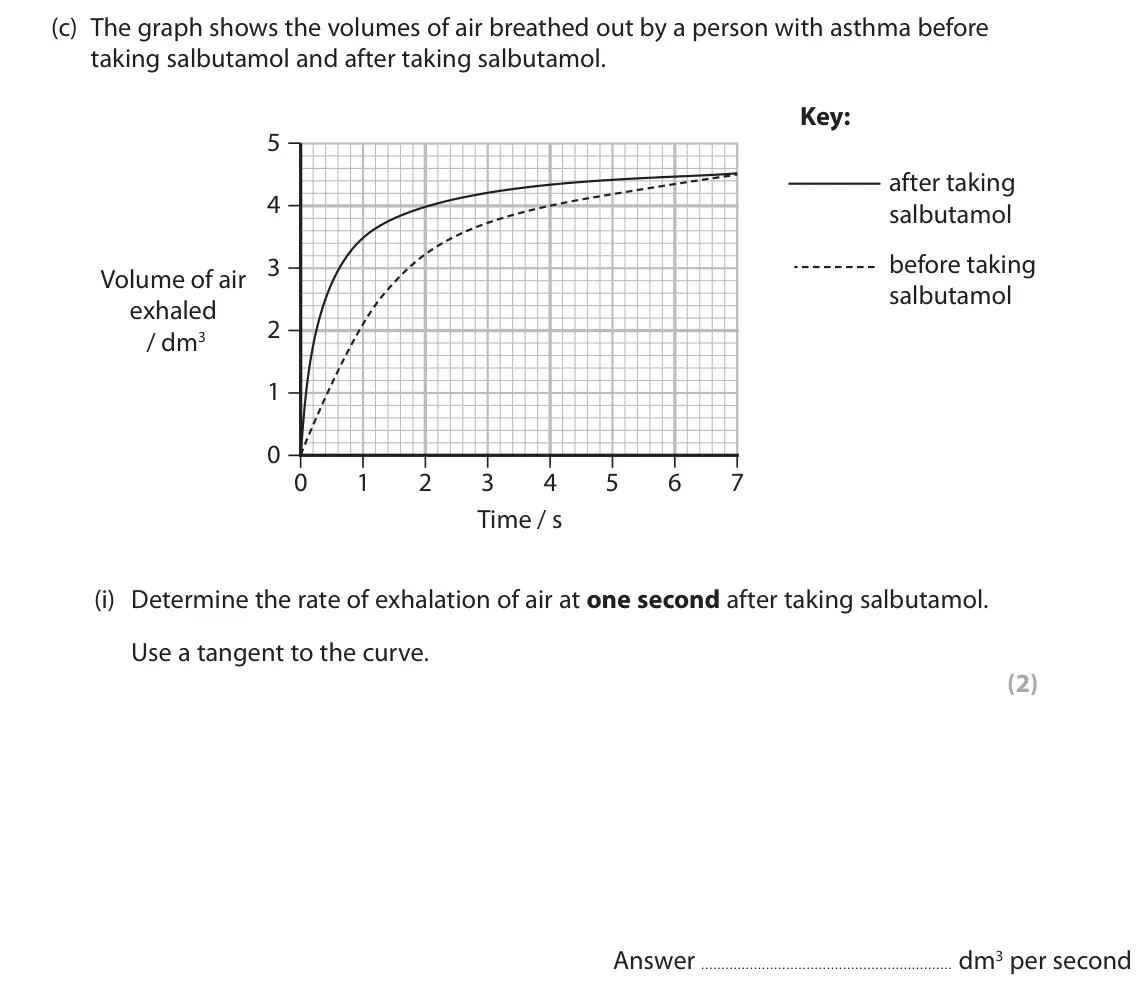
Q4(c)(ii)
The whole paper ↗
Q2(a)(i)
The whole paper ↗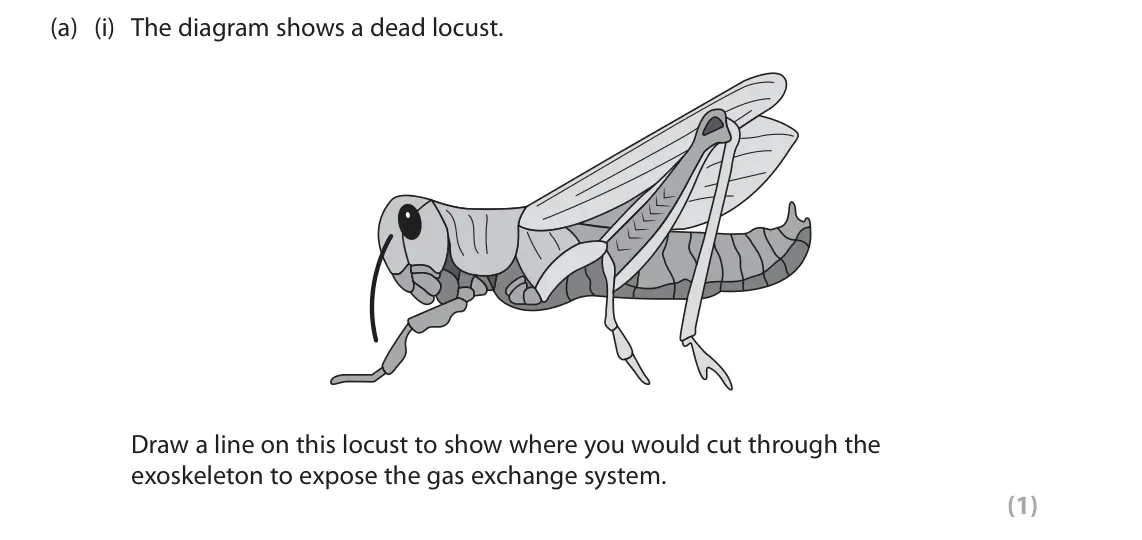
Q2(a)(ii)
The whole paper ↗
Q2(b)(i)
The whole paper ↗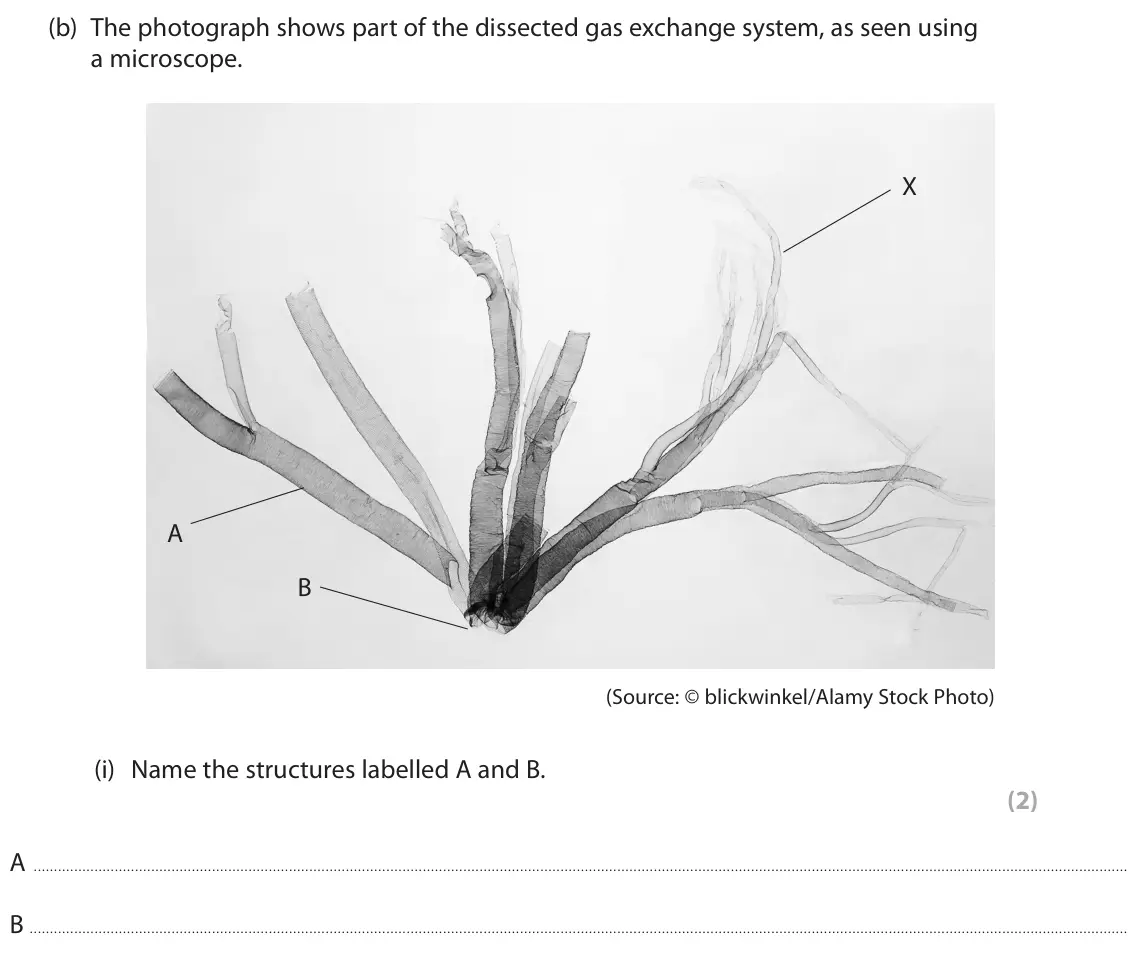
Q2(b)(ii)
The whole paper ↗
Q2(b)(iii)
The whole paper ↗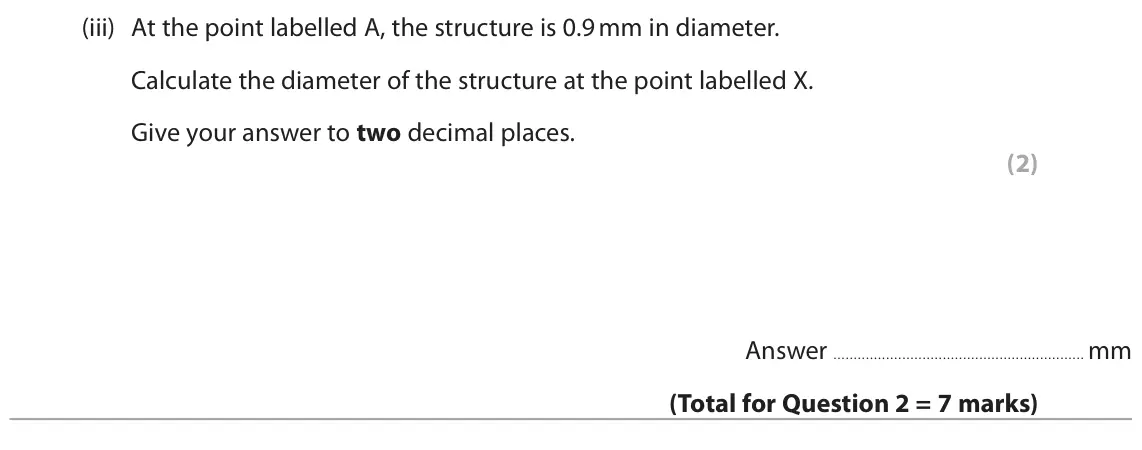
All 71 questions on Gas exchange, as a list
- June 2025, Paper 1, Q7(a)(i) (3 marks): The typical diameter of an adult alveolus is 200 µm. There are 300 million alveoli in each lung. Calculate the total surface area of a pair of adult lungs, usin
- June 2025, Paper 1, Q7(a)(ii) (2 marks): Explain the importance of a large surface area in a gas exchange system. (2)
- June 2025, Paper 1, Q7(a)(iii) (2 marks): Fluid passes out of the capillaries into the spaces around the alveoli. Some of this fluid passes into the alveoli. Explain the importance of having fluid insid
- June 2025, Paper 1, Q7(b) (3 marks): The photograph shows a marine sponge. © Helmut Corneli/Alamy Stock Photo Sponges are aquatic animals that are covered in pores called ostia. The diagram shows a
- June 2025, Paper 1, Q7(c) (4 marks): The graphs show changes in gas exchange as a tadpole develops into an adult frog. 100 Lungs 80 60 Percentage of oxygen uptake (%) 40 20 Skin Gills 0 Tadpole usi
- June 2025, Paper 1, Q8(b)(i) (1 mark): Which is the main gas exchange surface in a leaf? (1) A lower epidermal layer B mesophyll layers C stomata D upper epidermal layer
- June 2025, Paper 1, Q8(b)(ii) (6 marks): The table shows some effects on the characteristics of leaves when plants are grown in low, moderate and high levels of nitrogen gas. Effect compared with plant
- June 2025, AS Paper 1, Q4(b) (6 marks): The pores are closed in the dark and open in the light. When the pores are open, the width of the pores increases. Potassium ions are involved in the opening of
- June 2025, AS Paper 2, Q8(b) (3 marks): Compare and contrast the gas exchange systems in insects and in mammals. (3)
- June 2025, AS Paper 2, Q8(c)(i) (1 mark): State the independent variable in this investigation. (1)
- June 2025, AS Paper 2, Q8(c)(ii) (4 marks): The table shows the results of this investigation. Gas mixture Ventilation rate Mean ventilation rate Oxygen Carbon dioxide / movements per minute / movements p
- June 2025, AS Paper 2, Q8(c)(iii) (2 marks): Describe how the method could be modified to investigate the effect of temperature on the ventilation rate of a locust. (2)
- June 2024, Paper 2, Q4(a) (3 marks): Gas exchange in the lungs occurs at the alveoli. Explain how alveoli are adapted to maximise gas exchange. (3)
- June 2024, Paper 2, Q4(c)(i) (2 marks): Determine the rate of exhalation of air at one second after taking salbutamol. Use a tangent to the curve. (2) Answer dm3 per second
- June 2024, Paper 2, Q4(c)(ii) (3 marks): Explain why taking salbutamol increases the concentration of oxygen in the blood compared with not taking salbutamol. (3)
- June 2023, Paper 3, Q2(a)(i) (1 mark): The diagram shows a dead locust. Draw a line on this locust to show where you would cut through the exoskeleton to expose the gas exchange system. (1)
- June 2023, Paper 3, Q2(a)(ii) (1 mark): State why you would cover the dissected locust with water. (1)
- June 2023, Paper 3, Q2(b)(i) (2 marks): Name the structures labelled A and B. (2) A B
- June 2023, Paper 3, Q2(b)(ii) (1 mark): Name the structure that supplies oxygen directly to the muscle tissue. (1)
- June 2023, Paper 3, Q2(b)(iii) (2 marks): At the point labelled A, the structure is 0.9 mm in diameter. Calculate the diameter of the structure at the point labelled X. Give your answer to two decimal p
- June 2023, AS Paper 2, Q1(c) (4 marks): Compare and contrast the gas exchange adaptations in an insect and in a fish. (4)
- June 2023, AS Paper 2, Q2(a) (1 mark): Which of the following allow gases to enter woody plant stems? (1) A lenticels B stomata C waxy cuticle D xylem
- June 2023, AS Paper 2, Q2(b)(i) (3 marks): Calculate the number of stomata per cm2 on this part of the leaf surface. Give your answer to the nearest whole number. (3) Answer
- June 2023, AS Paper 2, Q2(b)(ii) (1 mark): Calculate the estimated number of stomata found on the lower surface of a leaf that has a total area of 130 cm2. Use your answer from b(i) in your calculation.
- June 2023, AS Paper 2, Q2(b)(iii) (1 mark): Give a reason why the estimated number of stomata on the lower surface of the leaf may not be accurate. (1)
- June 2023, AS Paper 2, Q2(b)(iv) (3 marks): Explain why it is important for plants to be able to open and close their stomata. (3)
- June 2022, Paper 1, Q9(a)(i) (1 mark): Which row of the table describes gas exchange in the root of a plant? (1) Net movement of carbon dioxide Net movement of oxygen A in only out only B out only in
- June 2022, Paper 1, Q9(a)(ii) (1 mark): Which is the gas exchange surface in the stem of a woody plant? (1) A lenticel B pit C plasmodesmata D stomata
- June 2022, Paper 1, Q9(b)(i) (1 mark): State how the water loss could have been measured in this investigation. (1)
- June 2022, Paper 1, Q9(b)(ii) (1 mark): Calculate the percentage increase in water loss from the insects kept in air at 0% humidity compared with those kept at 80% humidity. Give your answer to two de
- June 2022, Paper 1, Q9(b)(iii) (2 marks): Explain why the insects were kept in air with 80% humidity at the start of this investigation. (2)
- June 2022, Paper 1, Q9(b)(iv) (3 marks): Explain the results of this investigation. (3)
- June 2022, Paper 1, Q9(c)(i) (1 mark): Lamellae are present on both sides of the gill filaments. The mean length of a gill filament is 25 mm. Calculate the total number of lamellae on the gill filame
- June 2022, Paper 1, Q9(c)(ii) (6 marks): Analyse the data to explain the relationships between the activity of these fish and the structure of their gills. (6)
- November 2021, Paper 3, Q5(a) (5 marks): Analyse the data and the photographs to explain the distribution of the stomata. (5)
- November 2021, AS Paper 2, Q6(a)(i) (1 mark): State the purpose of Step 5. (1)
- November 2021, AS Paper 2, Q6(a)(ii) (1 mark): State the purpose of Step 6. (1)
- November 2021, AS Paper 2, Q6(b)(i) (3 marks): Calculate the standard deviation for the number of movements in 30 seconds when the gas has a composition of 88% oxygen and 12% carbon dioxide. Use the formula
- November 2021, AS Paper 2, Q6(b)(ii) (2 marks): Explain the relationship between the range and the standard deviation. (2)
- November 2021, AS Paper 2, Q6(c) (4 marks): Analyse the data to comment on the effect gas composition has on the breathing rate of this locust. (4)
- October 2020, Paper 3, Q1(a) (3 marks): Describe how oxygen from the air is able to reach insect muscle cells. (3)
- October 2020, AS Paper 2, Q2(d) (4 marks): Explain the features of gas exchange surfaces that are common to both insects and mammals. (4)
- June 2019, Paper 1, Q8(a)(ii) (1 mark): Calculate how many times wider the aperture of the stoma of the GM plant is compared with the stoma of the non-modified plant. (1) Answer
- June 2019, Paper 1, Q8(d)(iii) (1 mark): Which of the following explains why the aperture of the stoma widens? (1) A The guard cells become smaller and the inner wall of the guard cell is more flexible
- June 2019, Paper 2, Q9(b)(i) (1 mark): Calculate the partial pressure of oxygen in arterial blood for the unaffected baby, if the proportion of oxygen in inhaled air is 0.21. (1) Answer kPa
- June 2019, Paper 2, Q9(b)(ii) (4 marks): Explain why the Carrico index for the baby with ARDS is lower than the Carrico index for the unaffected baby. (4)
- June 2019, Paper 2, Q9(c) (6 marks): Scientists investigated the effect of two synthetic surfactants, A and B, for treating ARDS. Four groups of rabbits with ARDS were used. Each group of rabbits w
- June 2019, Paper 3, Q11(b) (3 marks): Adult frogs use lungs for gas exchange but tadpoles use gills. Explain how gills are adapted for gas exchange. (3)
- June 2019, AS Paper 2, Q7(b)(i) (2 marks): Explain how having many alveoli increases the efficiency of the diffusion in the lungs. (2)
- June 2019, AS Paper 2, Q7(b)(ii) (3 marks): Explain how other features of alveoli enable efficient diffusion in the lungs. (3)
- June 2019, AS Paper 2, Q8 (6 marks): The photograph shows a locust. Locusts ventilate their tracheal systems by muscular contractions of their abdomen. Devise an investigation to determine the effe
- June 2018, Paper 1, Q3(c) (3 marks): Mayfly eggs hatch into immature insects called nymphs. The nymphs live in the water and develop to form adult mayflies. The photograph shows a mayfly nymph. } f
- June 2018, Paper 3, Q6(b) (2 marks): The diameter of the field of view is 0.4 mm. Calculate the number of stomata per mm2 on the leaf surface. The area of a circle is πr2, where π is 3.142. (2) Ans
- June 2018, Paper 3, Q6(d)(i) (2 marks): Calculate the SD for the leaves in dim light. Use the formula − − ∑ x x 2 ( ) SD = n − 1 (2) Answer
- June 2018, Paper 3, Q6(d)(ii) (2 marks): Describe how these nail varnish peel samples should be taken to allow a valid comparison between the mean numbers of stomata. (2)
- June 2018, Paper 3, Q6(d)(iii) (3 marks): Analyse the data to explain how fewer stomata might affect the growth of coffee plants. (3)
- June 2018, AS Paper 2, Q1 (4 marks): The photograph shows an insect. Explain how the gas exchange system of an insect is adapted for the efficient uptake of oxygen. (4)
- June 2017, Paper 1, Q5(b) (4 marks): Explain why the student chose to keep these two species of fish in an aquarium at 30 °C. (4)
- June 2017, Paper 3, Q2(a) (3 marks): Describe how you would dissect a locust to ensure that the gas exchange system is clearly visible. (3)
- June 2017, Paper 3, Q2(b) (5 marks): A student investigated the effect of different gases on the breathing rate of a locust. The student blew exhaled air over a locust in a syringe and recorded its
- June 2017, Paper 3, Q2(c) (2 marks): Explain the role of air sacs in the gas exchange system of locusts. (2)
- June 2017, AS Paper 2, Q7(c) (2 marks): The vet noticed that blood had collected in the lower part of the lungs of the farmer’s dog. Explain how this would affect the farmer’s dog. (2)
- June 2017, AS Paper 2, Q9(a) (1 mark): State how the oxygen in the air bubble reaches the cells in the beetle. (1)
- June 2017, AS Paper 2, Q9(b) (3 marks): When the beetle is underwater, gases can enter or leave the air bubble. These gas movements affect the size of the bubble. When the beetle first dives, the conc
- June 2017, AS Paper 2, Q9(c) (5 marks): Warm weather increases the temperature of the water. This affects the time a beetle can stay underwater. Devise an investigation to show the effect of water tem
- June 2016, AS Paper 2, Q1(c) (2 marks): The CFTR protein is also found in the membrane of epithelial cells in the lungs. Cystic fibrosis is a recessive genetic condition caused by mutations of the all
- June 2016, AS Paper 2, Q6(a) (1 mark): The diagram shows some of the gill lamellae from a bony fish. blood entering gill blood leaving gill lamella Draw one arrow on the diagram to show the direction
- June 2016, AS Paper 2, Q6(b) (1 mark): The diagram shows a section through the head of a bony fish. The graph shows the pressure changes in the buccal cavity and opercular cavity during ventilation.
- June 2016, AS Paper 2, Q6(c)(i) (1 mark): The comparison of surface area to mass of mullet is (1) A 1010 cm2 g–1 B 10.10 cm2 g–1 C 1.01 cm2 g–1 D 0.99 cm2 g–1
- June 2016, AS Paper 2, Q6(c)(ii) (3 marks): Analyse the data to explain the difference in the activity levels of these fish species. (3)
- June 2016, AS Paper 2, Q6(d) (2 marks): Water polluted with heavy metal ions can cause the death of fish. The photographs show cross-sections of the lamellae from a fish caught in unpolluted water and
Questions, mark schemes and examiner’s reports are © Pearson Edexcel, from their published past papers. Plumi isn’t affiliated with any exam board. Want whole papers? Every Edexcel A-Level Biology B paper.
Rather write your answers by hand on iPad? Plumi marks them against the same mark schemes.