 plumi
Transport in plants: Edexcel A‑Level Biology B questions
Every Edexcel A-Level Biology B exam question on 4.7 Transport in plants, 2016–2025, with its mark scheme and examiner’s report.
Find questions1,826
Calculations
Q9(a)
The whole paper ↗
Q9(b)(i)
The whole paper ↗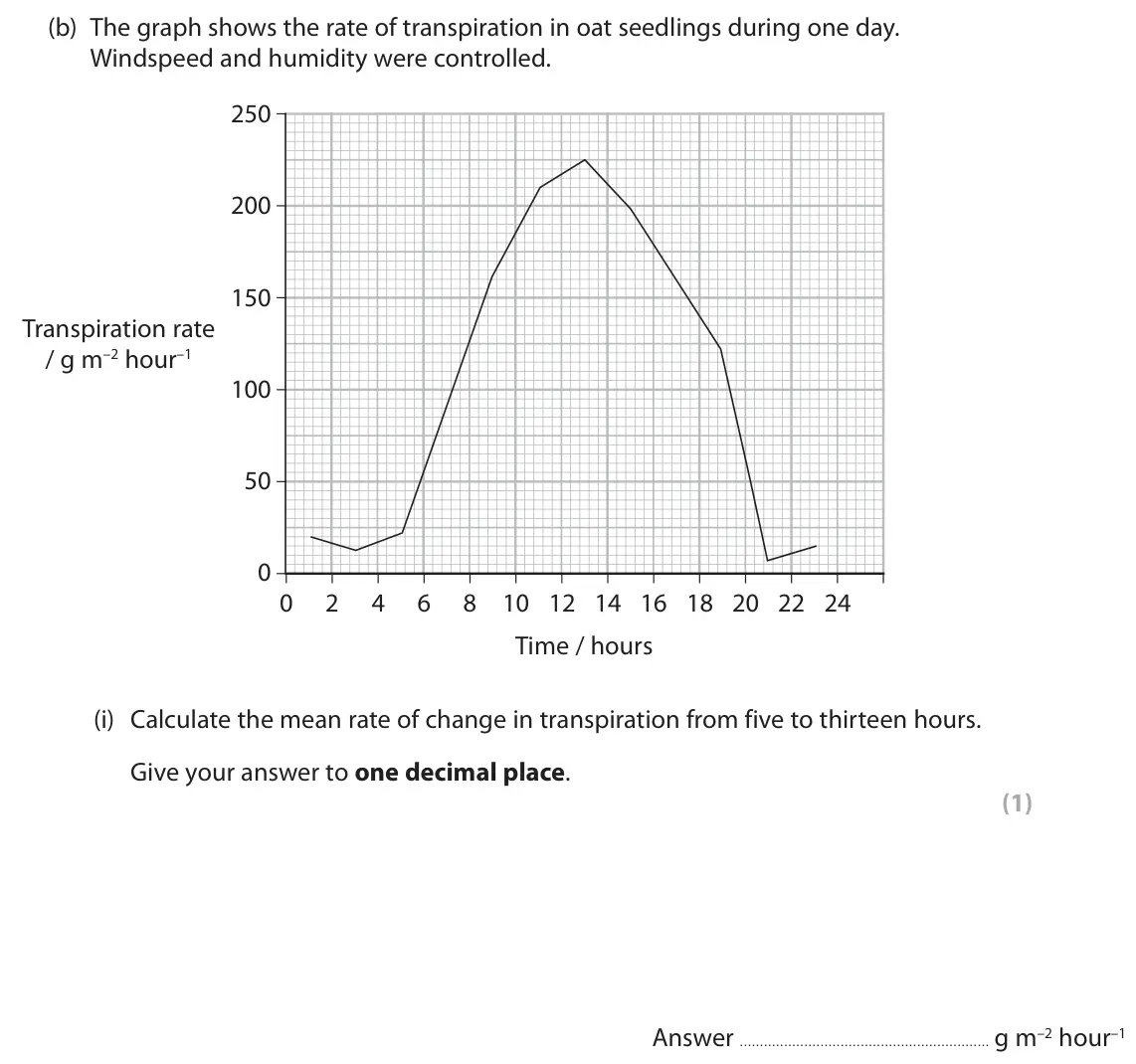
Q9(b)(ii)
The whole paper ↗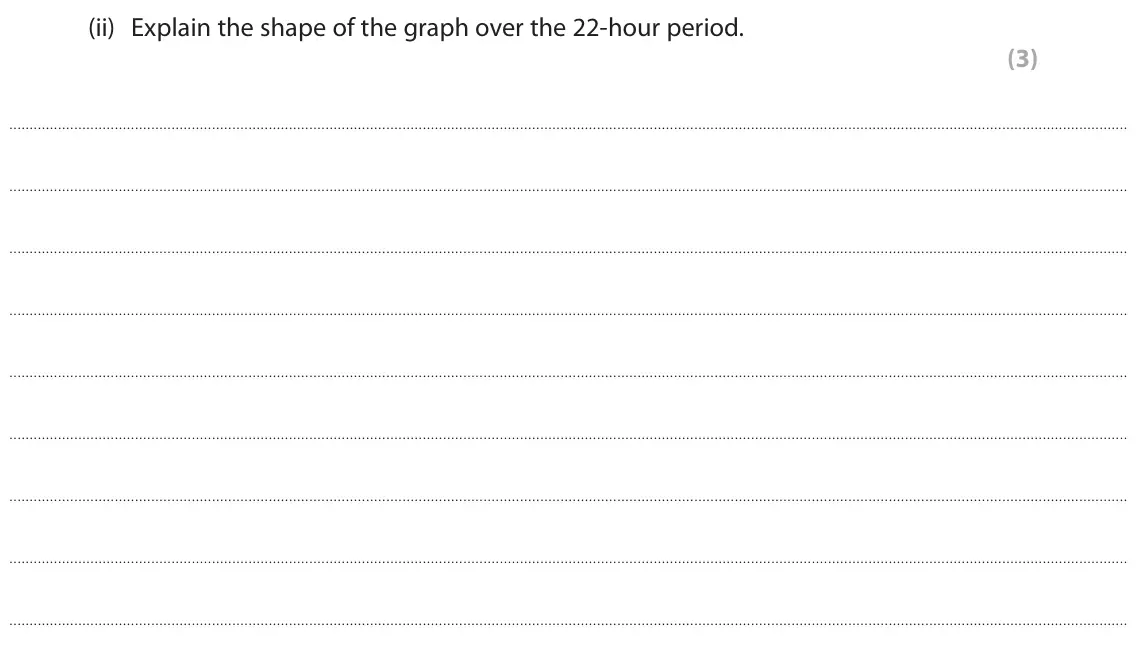
Q9(c)
The whole paper ↗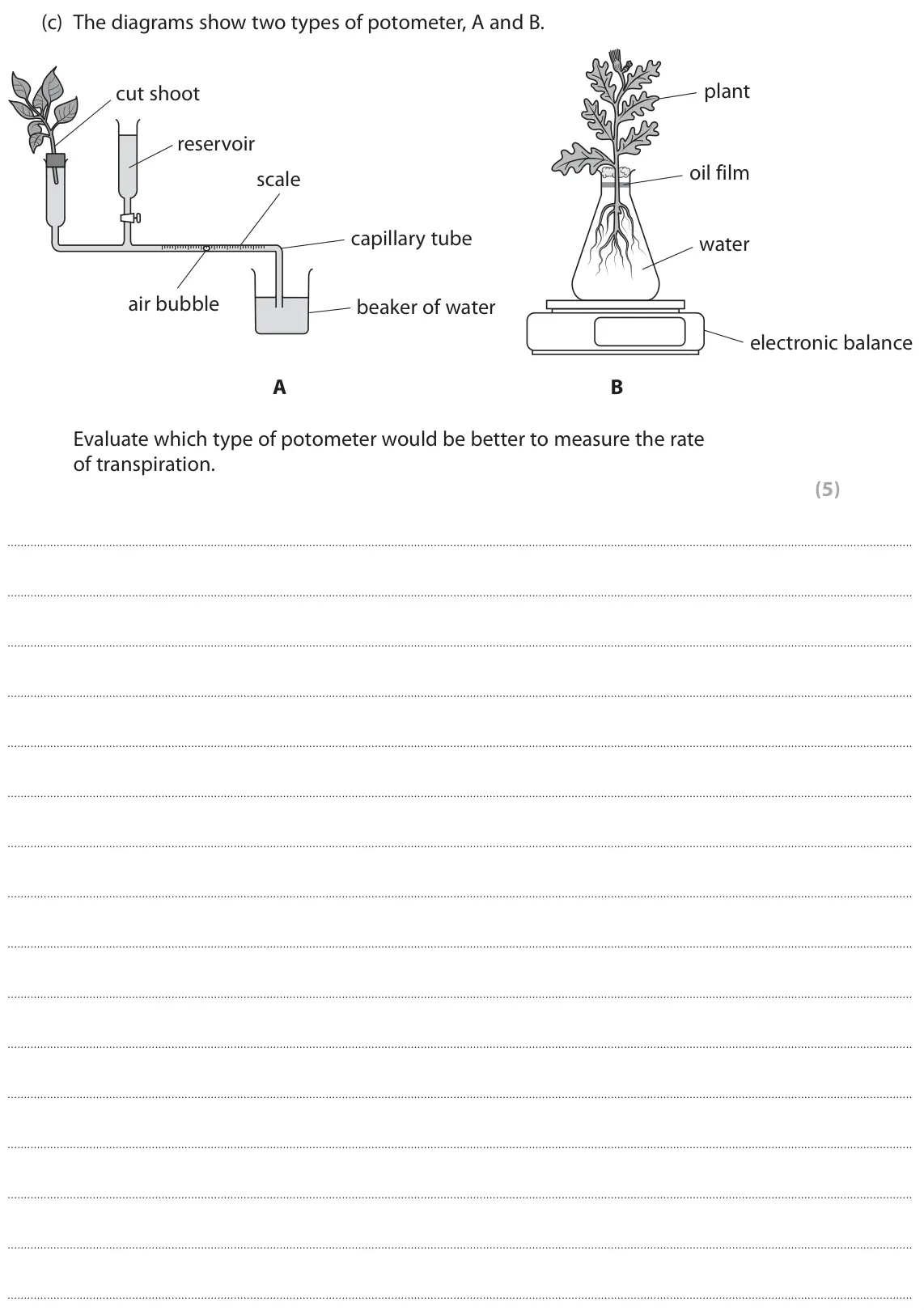
Q9(d)(i)
The whole paper ↗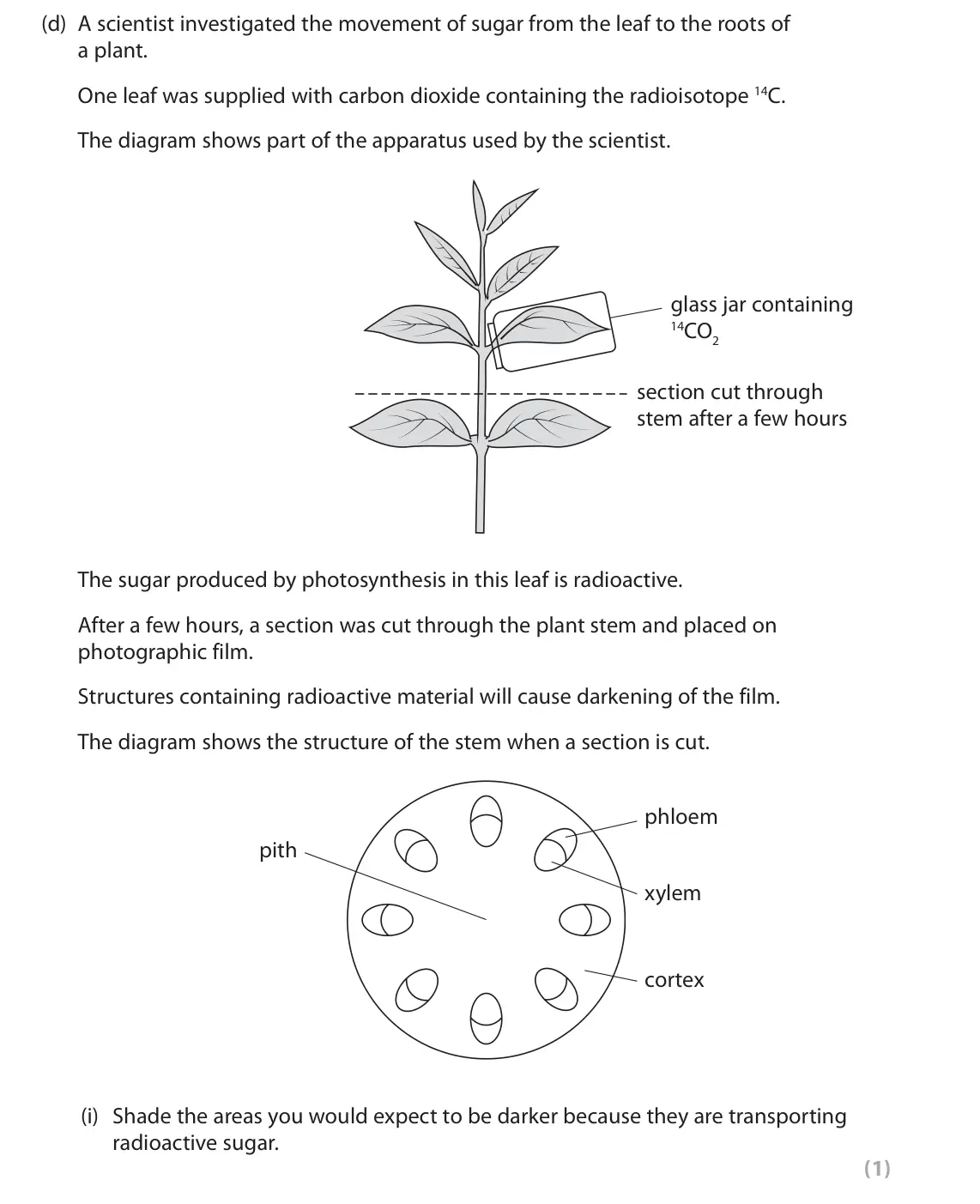
Q9(d)(ii)
The whole paper ↗
Q7(a)
The whole paper ↗
Q7(b)(i)
The whole paper ↗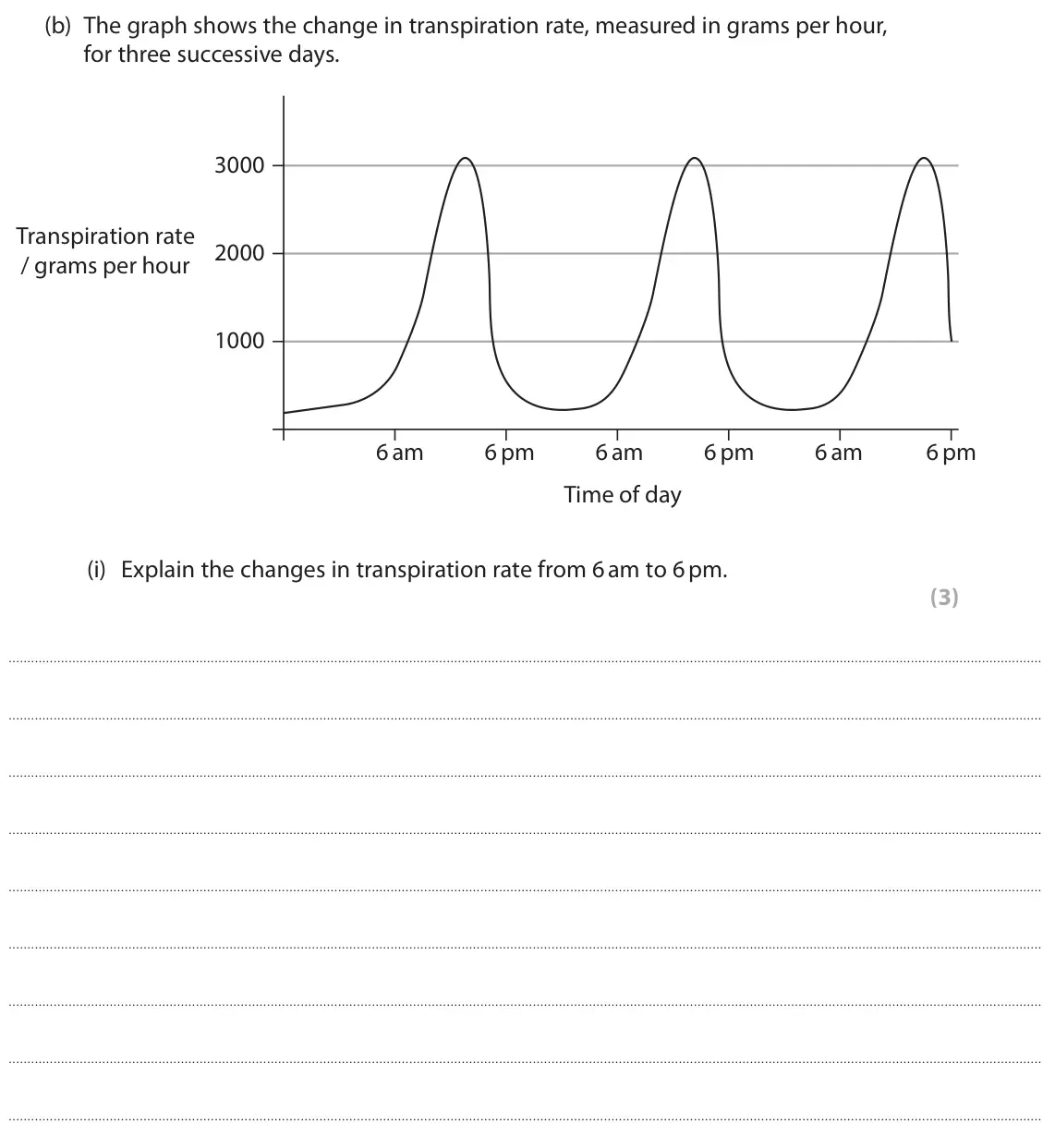
Q7(b)(ii)
The whole paper ↗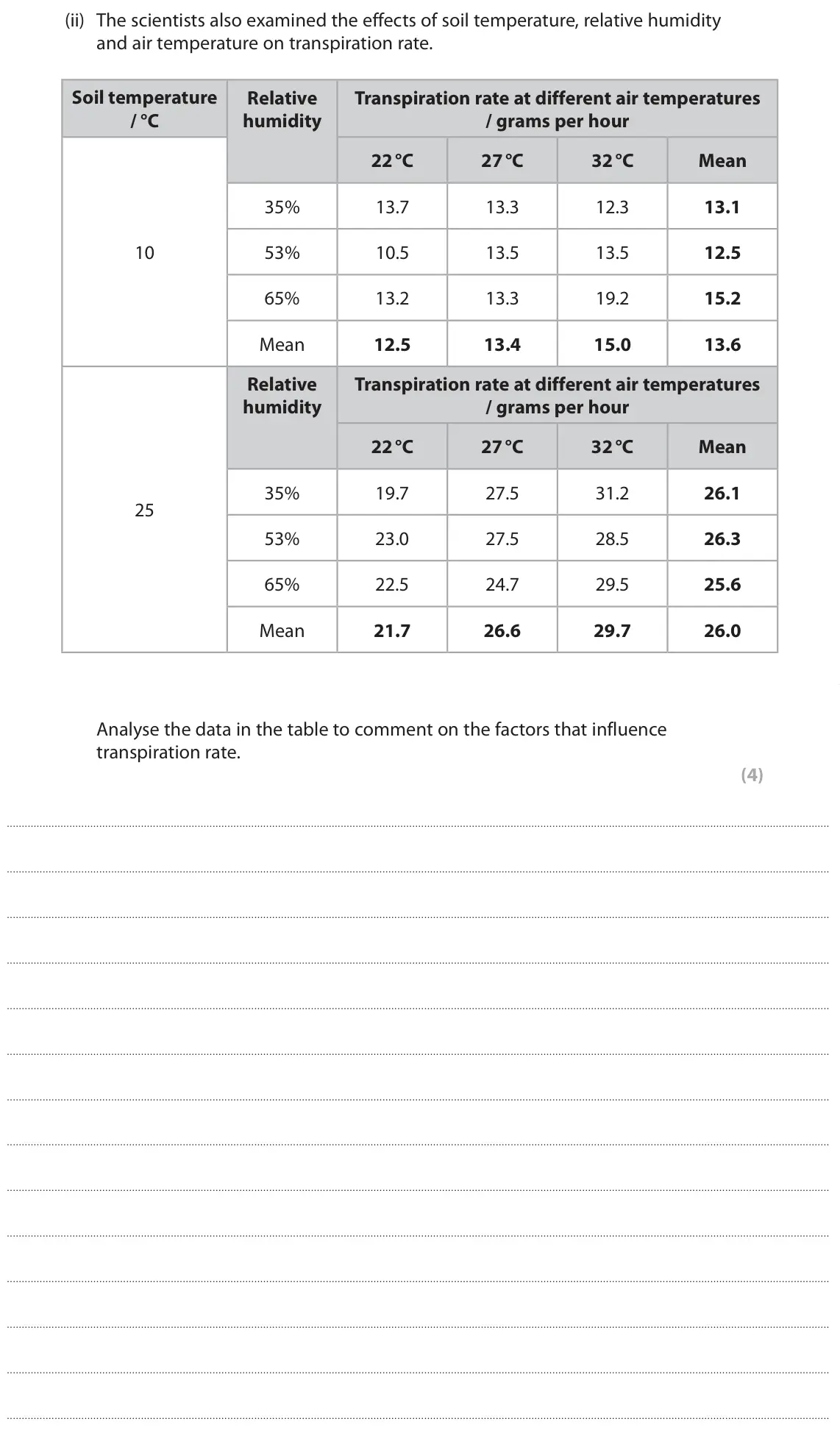
Q7(c)
The whole paper ↗
Q2(a)(i)
The whole paper ↗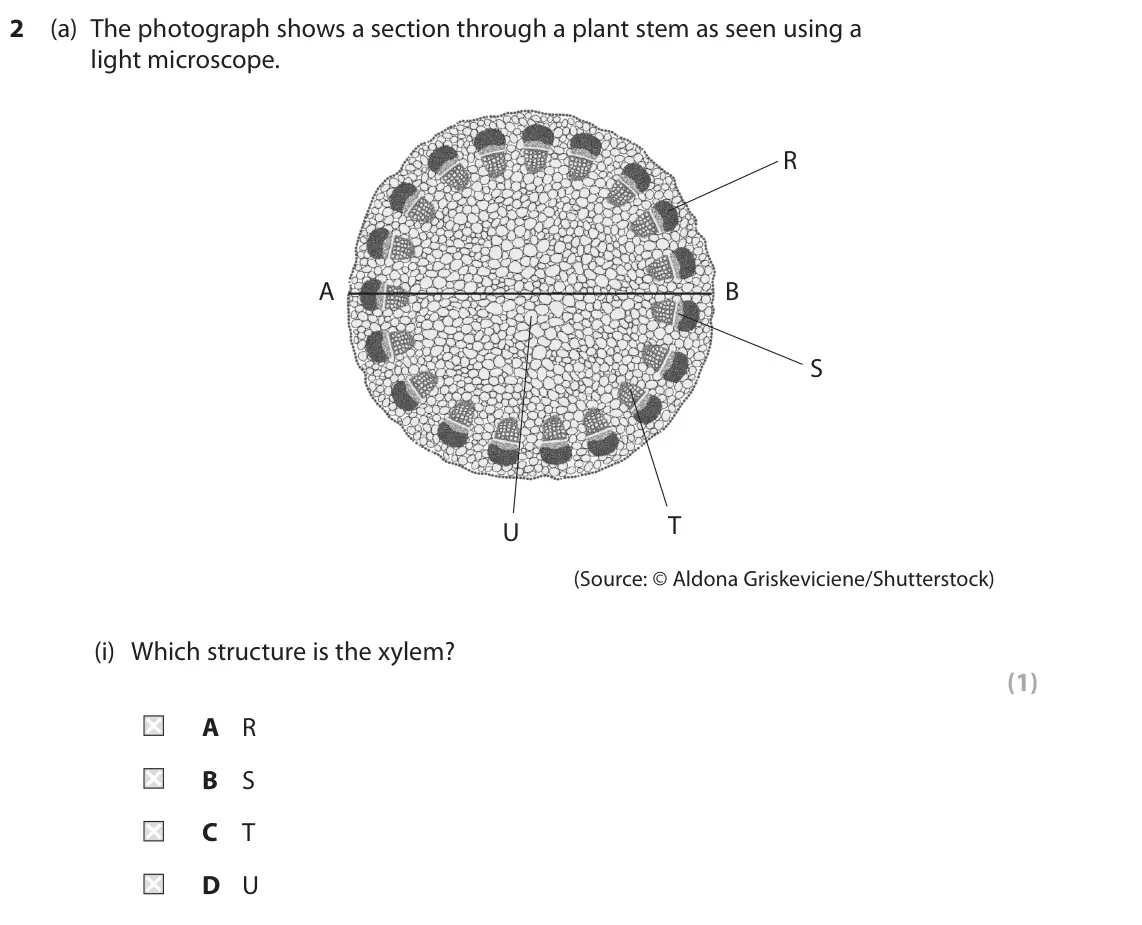
Q2(b)(i)
The whole paper ↗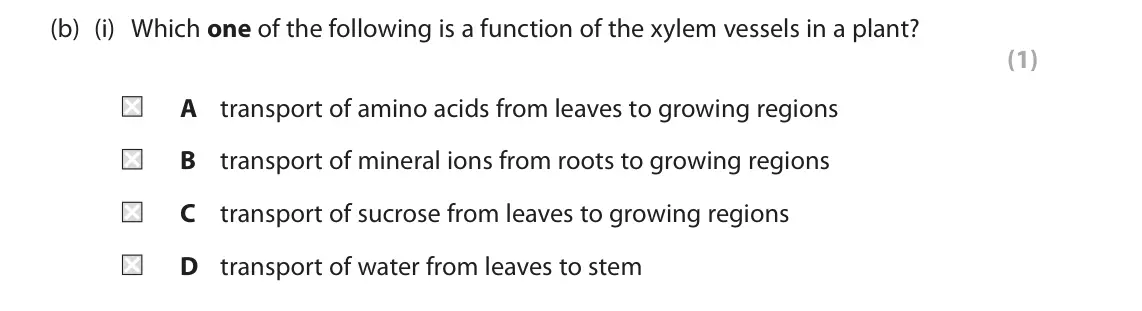
Q2(b)(ii)
The whole paper ↗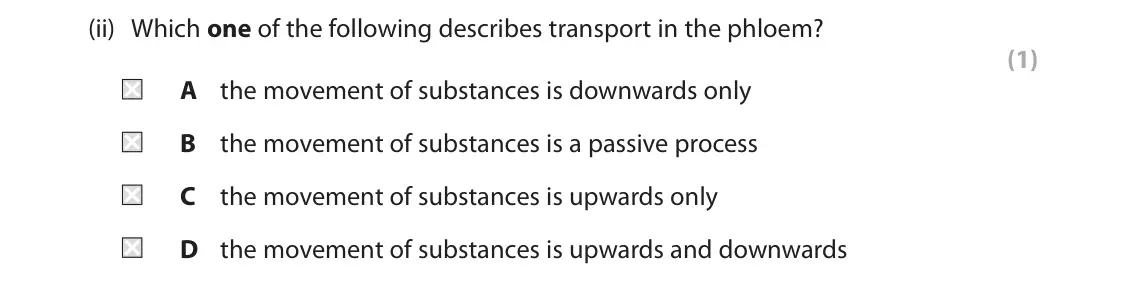
Q2(c)
The whole paper ↗
Q3(a)(i)
The whole paper ↗
Q3(a)(ii)
The whole paper ↗
Q3(a)(iii)
The whole paper ↗
Q3(b)
The whole paper ↗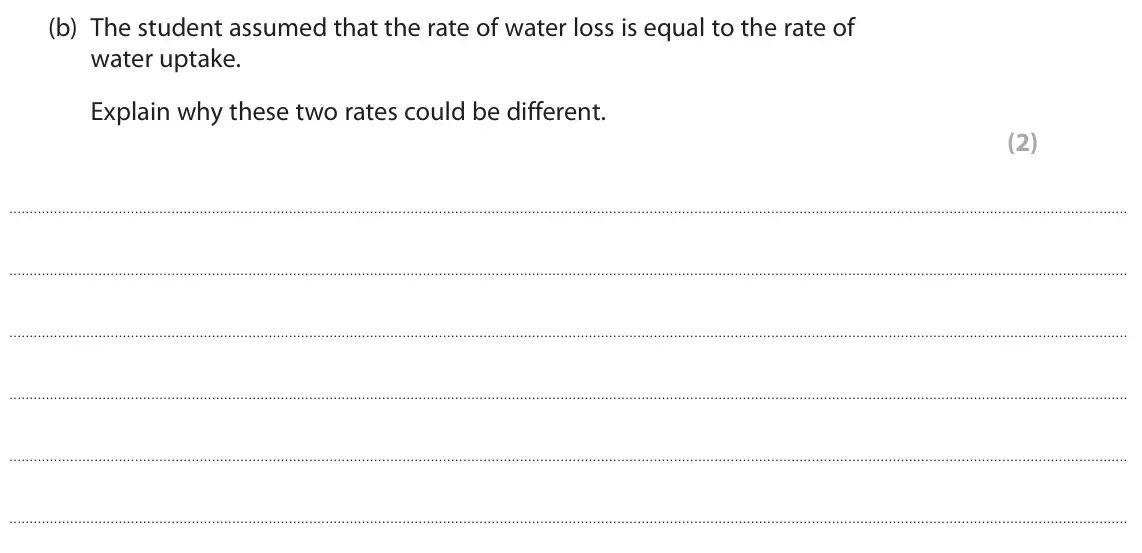
Q3(c)
The whole paper ↗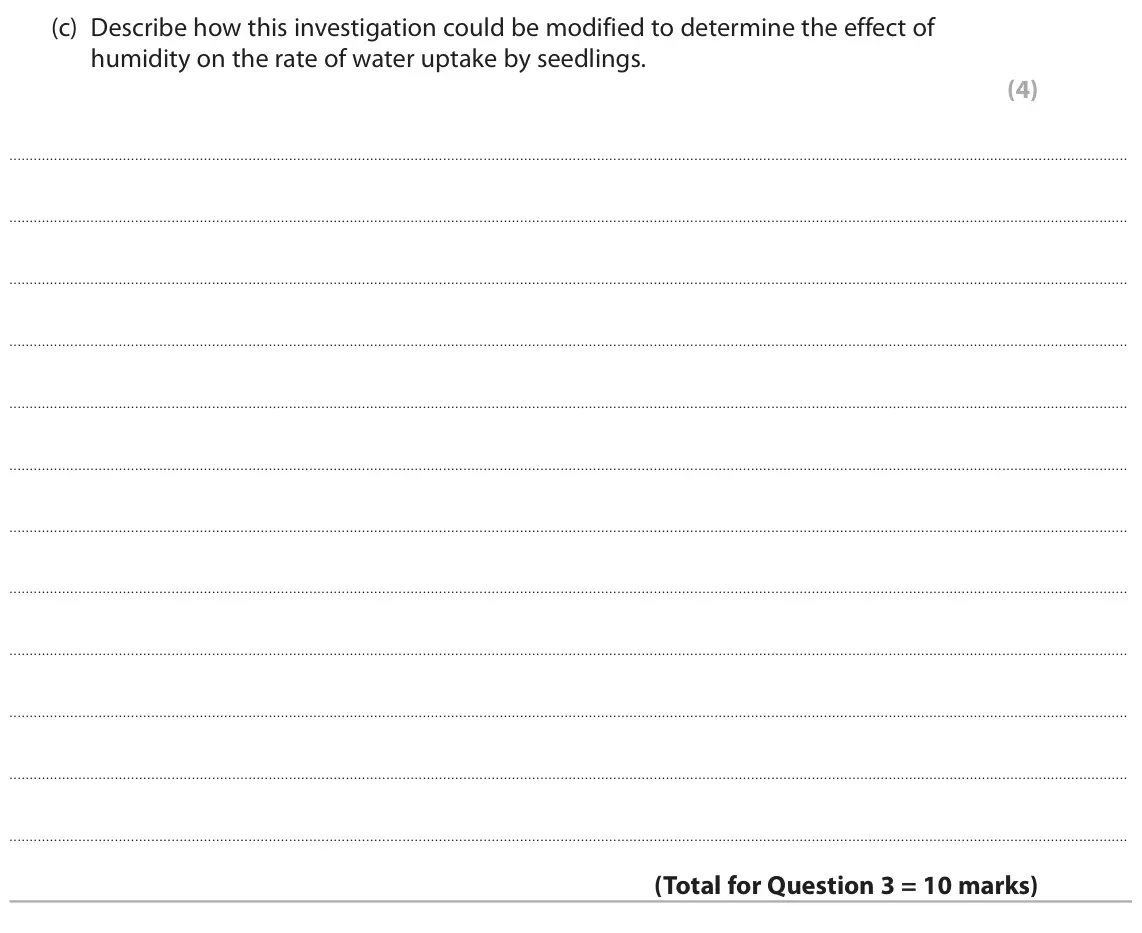
Q3(b)
The whole paper ↗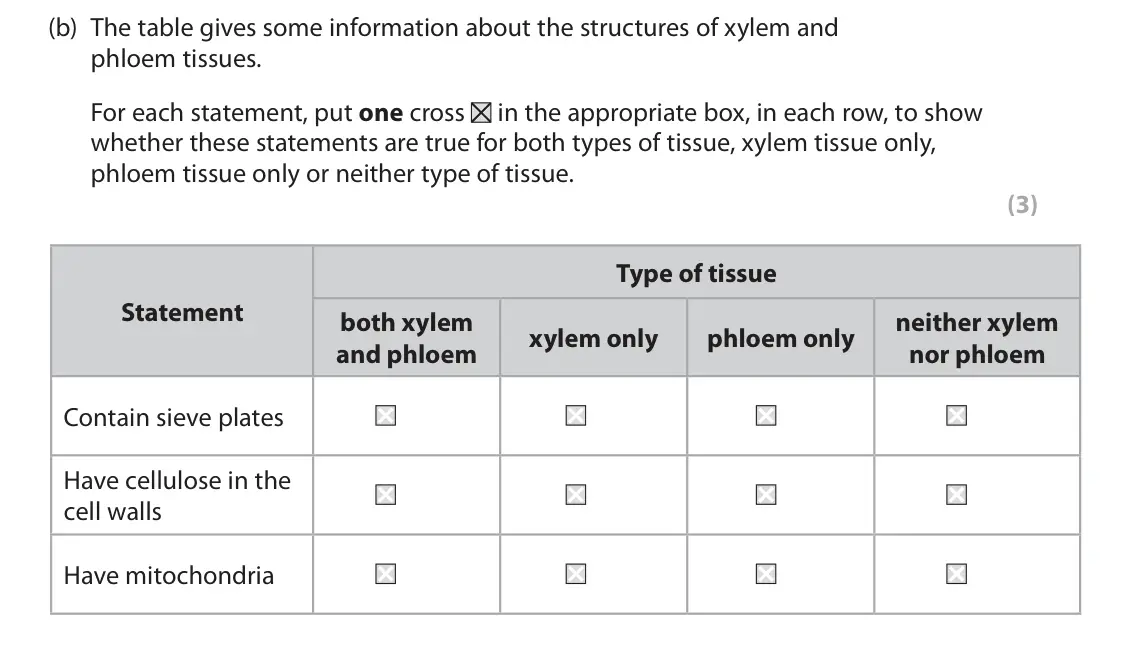
All 92 questions on Transport in plants, as a list
- June 2025, Paper 3, Q9(a) (2 marks): Water moves through xylem vessels in a plant during transpiration. Explain one way in which xylem vessels are adapted for their function. (2)
- June 2025, Paper 3, Q9(b)(i) (1 mark): Calculate the mean rate of change in transpiration from five to thirteen hours. Give your answer to one decimal place. (1) Answer g m–2 hour–1
- June 2025, Paper 3, Q9(b)(ii) (3 marks): Explain the shape of the graph over the 22-hour period. (3)
- June 2025, Paper 3, Q9(c) (5 marks): The diagrams show two types of potometer, A and B. plant cut shoot reservoir oil film scale capillary tube water air bubble beaker of water electronic balance A
- June 2025, Paper 3, Q9(d)(i) (1 mark): Shade the areas you would expect to be darker because they are transporting radioactive sugar. (1)
- June 2025, Paper 3, Q9(d)(ii) (1 mark): Name the radioactive sugar causing this darkening on the film. (1)
- June 2025, AS Paper 2, Q7(a) (1 mark): State what is meant by the term transpiration. (1)
- June 2025, AS Paper 2, Q7(b)(i) (3 marks): Explain the changes in transpiration rate from 6 am to 6 pm. (3)
- June 2025, AS Paper 2, Q7(b)(ii) (4 marks): The scientists also examined the effects of soil temperature, relative humidity and air temperature on transpiration rate. Soil temperature Relative Transpirati
- June 2025, AS Paper 2, Q7(c) (3 marks): Transpiration can be measured in the laboratory using a cut leafy shoot. Describe how you could accurately measure the effect of changing light intensity on the
- June 2024, AS Paper 2, Q2(a)(i) (1 mark): Which structure is the xylem? (1) A R B S C T D U
- June 2024, AS Paper 2, Q2(b)(i) (1 mark): Which one of the following is a function of the xylem vessels in a plant? (1) A transport of amino acids from leaves to growing regions B transport of mineral i
- June 2024, AS Paper 2, Q2(b)(ii) (1 mark): Which one of the following describes transport in the phloem? (1) A the movement of substances is downwards only B the movement of substances is a passive proce
- June 2024, AS Paper 2, Q2(c) (4 marks): Xylem and phloem are involved in the transport of substances in plants. Compare and contrast the structure of xylem and phloem tissues. (4)
- June 2024, AS Paper 2, Q3(a)(i) (1 mark): State the hypothesis being tested by the investigation. (1)
- June 2024, AS Paper 2, Q3(a)(ii) (2 marks): Explain one feature of the plants that should be controlled in this investigation. (2)
- June 2024, AS Paper 2, Q3(a)(iii) (1 mark): State the function of the layer of oil in this apparatus. (1)
- June 2024, AS Paper 2, Q3(b) (2 marks): The student assumed that the rate of water loss is equal to the rate of water uptake. Explain why these two rates could be different. (2)
- June 2024, AS Paper 2, Q3(c) (4 marks): Describe how this investigation could be modified to determine the effect of humidity on the rate of water uptake by seedlings. (4)
- June 2023, Paper 1, Q3(b) (3 marks): The table gives some information about the structures of xylem and phloem tissues. For each statement, put one cross in the appropriate box, in each row, to sho
- June 2023, Paper 1, Q3(c)(ii) (1 mark): In an experiment, the time between radioactivity appearing in aphid A and aphid D was 210 minutes. The distance between these two aphids was 50 cm. Calculate th
- June 2023, Paper 1, Q3(c)(iii) (3 marks): Describe how sugars are transported through the phloem. (3)
- June 2023, Paper 2, Q4(a)(i) (1 mark): Which row in the table causes the highest rate of transpiration from a plant? (1) Temperature Wind speed Air humidity A high high high B high high low C high lo
- June 2023, Paper 2, Q4(a)(ii) (4 marks): Samphire is one of the few plants that can grow in the areas close to the sea. Samphire plants have very small leaves and swollen stems. The diagrams show a sam
- June 2023, AS Paper 2, Q8(a) (1 mark): State one advantage of using potometer A compared with using potometer B. (1)
- June 2023, AS Paper 2, Q8(b) (2 marks): A student used potometer B and an electric fan to investigate the effect of air movement on the rate of water uptake by a leafy shoot. The table shows the resul
- June 2023, AS Paper 2, Q8(c)(i) (2 marks): Explain one variable that is difficult to control in this investigation. (2)
- June 2023, AS Paper 2, Q8(c)(ii) (2 marks): Explain one factor that may reduce the accuracy of potometer B. (2)
- June 2023, AS Paper 2, Q8(d)(i) (3 marks): Calculate the mean rate of water uptake by the shoot when the fan speed setting was high. Give your answer to two significant figures. (3) Answer mm3 min–1
- June 2023, AS Paper 2, Q8(d)(ii) (2 marks): Describe how the student could determine the rate of water uptake per cm2 of leaf surface. (2)
- June 2023, AS Paper 2, Q8(e) (3 marks): Describe how the student could use potometer B to measure the effect of temperature on the rate of water uptake. (3)
- June 2022, Paper 3, Q9(a) (3 marks): Compare and contrast the structure of xylem tissue and phloem tissue. (3)
- June 2022, Paper 3, Q9(b)(i) (3 marks): The internal diameter of the capillary tubing is 0.3 mm. The volume of a cylinder is calculated using the formula πr2h Calculate the mean rate of water uptake f
- June 2022, Paper 3, Q9(b)(ii) (3 marks): Analyse the data to explain the results of this investigation. (3)
- June 2022, Paper 3, Q9(b)(iii) (4 marks): Describe how this investigation could be modified to make a valid comparison of water loss from the upper and lower surfaces of the leaves. (4)
- June 2022, AS Paper 2, Q6(a)(i) (1 mark): Give the name of the apparatus. (1)
- June 2022, AS Paper 2, Q6(a)(ii) (2 marks): Explain one precaution that needs to be taken when setting up this apparatus before it can be used to measure the water uptake of the leafy shoot. (2)
- June 2022, AS Paper 2, Q6(a)(iii) (2 marks): Explain why the water uptake of the leafy shoot may not be the same as the water transpired. (2)
- June 2022, AS Paper 2, Q6(b) (2 marks): Determine which condition produced the greatest change in the mean rate of water uptake. (2)
- June 2022, AS Paper 2, Q6(c)(i) (1 mark): State how the student could vary the humidity around the shoot. (1)
- June 2022, AS Paper 2, Q6(c)(ii) (1 mark): Give one way in which the temperature could be increased without affecting the validity of this investigation. (1)
- June 2022, AS Paper 2, Q6(c)(iii) (2 marks): Describe how the student would use the syringe to convert the results into a measure of the volume of water uptake in mm3 min–1. (2)
- June 2022, AS Paper 2, Q6(d) (2 marks): Explain the effect of increasing humidity on the rate of water uptake by the leafy shoot. (2) (Total for Question 6 =13 marks)
- November 2021, Paper 1, Q4(b)(i) (1 mark): Root hairs have a large surface area that increases the rate of uptake of water. The surface area of a root hair is rounded up to 3.14 × 105µm2. Which is the ac
- November 2021, Paper 1, Q4(b)(ii) (1 mark): Which row of the table shows the movement of water through the apoplastic and symplastic pathways? (1) Apoplastic pathway Symplastic pathway A B C D
- November 2021, Paper 1, Q4(b)(iii) (1 mark): Water moves through the root tissue due to a difference in water potential between one cell and the next cell. Which row of the table describes this movement? (
- November 2021, Paper 1, Q4(c) (3 marks): Explain how transpiration depends on the dipole nature of water. (3)
- November 2021, Paper 3, Q1(a)(ii) (3 marks): Explain how phloem tissue is adapted for its function. (3)
- November 2021, Paper 3, Q5(b)(i) (2 marks): Calculate the approximate percentage increase in the transpiration rate due to the extra illumination. (2) Answer
- November 2021, Paper 3, Q5(b)(ii) (2 marks): Explain two factors that should have been controlled in this investigation. (2)
- November 2021, AS Paper 2, Q2(a)(i) (2 marks): On the diagram, draw the symplastic pathway that water takes from the soil to the xylem vessel. (2)
- November 2021, AS Paper 2, Q2(b) (4 marks): Explain how the cohesion-tension model accounts for the transport of water from plant roots to leaves. (4)
- November 2021, AS Paper 2, Q3(a)(i) (2 marks): Explain why the apparatus should be assembled under water. (2)
- November 2021, AS Paper 2, Q3(a)(ii) (2 marks): Explain why the leaves must be kept dry whilst assembling the apparatus. (2)
- November 2021, AS Paper 2, Q3(b)(i) (4 marks): Explain how this potometer can be used to investigate the effect of light intensity on the rate of water uptake by this shoot. (4)
- November 2021, AS Paper 2, Q3(b)(ii) (2 marks): This potometer measures the uptake of water by a plant shoot. Give two reasons why the water lost by transpiration is less than the water taken up by the plant
- October 2020, Paper 2, Q7(a) (1 mark): The diagram shows the movement of water across a root. epidermal cell Casparian strip water xylem vessel root hair What is the name of the water movement pathwa
- October 2020, Paper 2, Q7(b) (4 marks): Explain how the mass-flow hypothesis accounts for the movement of sugars from leaves to roots. (4)
- October 2020, Paper 2, Q7(c) (6 marks): Mistletoe is a plant that is a parasite on trees. Mistletoe has green leaves. Mistletoe also has a modified root that grows into the xylem of a tree. The diagra
- October 2020, Paper 3, Q9(d)(i) (1 mark): Give an advantage for older plants of containing more wood. (1)
- October 2020, Paper 3, Q9(d)(ii) (3 marks): Describe a method to show that the stem of an older plant contains more wood. (3)
- October 2020, AS Paper 2, Q3(b)(ii) (2 marks): Explain how two of these adaptations enable this plant to survive in dry sand. (2)
- October 2020, AS Paper 2, Q3(b)(iii) (2 marks): Marram grass also contains extra xylem tissue that strengthens the leaves. Explain why these plants need extra xylem in their leaves. (2)
- October 2020, AS Paper 2, Q3(c) (2 marks): Cells in the roots of marram grass have a very low water potential. Explain how this adaptation enables the marram grass to survive in the sand dunes. (2)
- June 2019, Paper 3, Q6(d) (3 marks): Marram grass leaves are adapted to enable the plants to survive in dry soil. The photograph shows a section of a marram grass leaf, as seen using a light micros
- June 2019, AS Paper 2, Q4(a) (1 mark): The correct conclusion from these results is (1) A the plant absorbed more water than it lost B the plant lost more water than it absorbed C the rate of respira
- June 2019, AS Paper 2, Q4(b) (1 mark): In which of these conditions would water uptake be slowest? (1) A cold, dry and bright conditions B cold, humid and dark conditions C warm, dry and bright condi
- June 2019, AS Paper 2, Q4(c)(i) (4 marks): Compare and contrast the mass potometer with the bubble potometer as methods of measuring the rate of transpiration. (4)
- June 2019, AS Paper 2, Q4(c)(ii) (4 marks): Describe how the bubble potometer can be used to investigate the effect of wind speed on the rate of water uptake. (4)
- June 2018, Paper 1, Q7(a)(i) (1 mark): Which row of the table shows some of the substances transported in xylem and phloem? (1) Xylem Phloem A water only sucrose only B water only water and sucrose C
- June 2018, Paper 1, Q7(a)(ii) (3 marks): Describe the differences between the structure of xylem and that of phloem. (3)
- June 2018, Paper 1, Q7(b)(i) (2 marks): Describe the effect of pressure gradient and radius on the velocity of flow within the xylem vessels. (2)
- June 2018, Paper 1, Q7(b)(ii) (2 marks): Calculate the percentage increase in the velocity of water flowing through a xylem vessel of radius 20 µm and a xylem vessel of radius 100 µm, at a pressure gra
- June 2018, Paper 1, Q7(c) (6 marks): Double fertilisation in some plants leads to the development of fruits, such as berries. In an investigation, the rate of flow in xylem during the formation of
- June 2018, Paper 3, Q2(a) (2 marks): In this investigation, a leafy shoot was cut from a plant. The leafy shoot was then put under water and the stem inserted into the rubber connection. Explain ho
- June 2018, Paper 3, Q2(b) (2 marks): During the investigation, the air bubble moved off the scale very quickly. Explain how this potometer could be modified to obtain repeat readings. (2)
- June 2018, Paper 3, Q2(c)(i) (3 marks): Explain how the student could convert these readings into a transpiration rate using the units mm3 cm–2 min–1. (3)
- June 2018, Paper 3, Q2(c)(ii) (2 marks): The table shows the mean results and standard deviations of this investigation. Mean rate of transpiration / mm3 cm–2 min–1 In moving air In still air 3.2 ± 0.3
- June 2018, AS Paper 2, Q8(a) (3 marks): Describe the differences between the apoplastic and the symplastic pathways. (3)
- June 2018, AS Paper 2, Q8(b)(ii) (2 marks): Some herbicides are applied to the soil. Explain how these herbicides will be transported to the leaves. (2)
- June 2018, AS Paper 2, Q8(c) (5 marks): To grow plants successfully in a glasshouse, the humidity needs to be controlled because the humidity would be higher in the summer than in the spring. Explain
- June 2017, AS Paper 2, Q3(b)(i) (1 mark): Which of the following describes the pathway taken by this water before entering the xylem? (1) A apoplast only B apoplast and symplast C neither apoplast nor s
- June 2017, AS Paper 2, Q3(b)(ii) (3 marks): Explain how this water is transported in the xylem to the leaves. (3)
- June 2017, AS Paper 2, Q3(c)(i) (2 marks): Calculate the increase in the rate of water loss caused by wind. (2) Answer g min−1
- June 2017, AS Paper 2, Q3(c)(ii) (2 marks): The student was told that this investigation was not valid because certain variables had not been controlled. Explain how the student could modify this investig
- June 2016, AS Paper 2, Q2(a)(i) (2 marks): Explain why the stem of a plant should be cut under water before it is inserted into a potometer. (2)
- June 2016, AS Paper 2, Q2(a)(ii) (1 mark): Which combination of the following factors would increase the rate of transpiration the most? (1) A high wind speed, low humidity, high temperature B low wind s
- June 2016, AS Paper 2, Q2(b) (1 mark): Which of the following shows the order of the structures a water molecule would pass through as it moves from the soil along the symplastic pathway in a root? (
- June 2016, AS Paper 2, Q2(c) (6 marks): Scientists investigated the transpiration of pine trees over a 24-hour period. The mass of water lost per second and the total area of the leaves were measured.
- June 2016, AS Paper 2, Q8(a) (1 mark): Which row in the table shows the conditions present in the sink and the source of a plant carrying out rapid photosynthesis? (1) Sink Source Sucrose Water Sucro
- June 2016, AS Paper 2, Q8(b)(i) (1 mark): Calculate the mean rate of sucrose transport when the plant is kept in 14CO2 + air whilst at 30°C. Show your working.
- June 2016, AS Paper 2, Q8(b)(ii) (4 marks): Analyse the data in the table to explain the effect of temperature and oxygen on sucrose transport. (4)
Questions, mark schemes and examiner’s reports are © Pearson Edexcel, from their published past papers. Plumi isn’t affiliated with any exam board. Want whole papers? Every Edexcel A-Level Biology B paper.
Rather write your answers by hand on iPad? Plumi marks them against the same mark schemes.