 plumi
Photosynthesis: Edexcel A‑Level Biology B questions
Every Edexcel A-Level Biology B exam question on 5.7 Photosynthesis, 2016–2025, with its mark scheme and examiner’s report.
Find questions1,826
Calculations
Q6(a)(i)
The whole paper ↗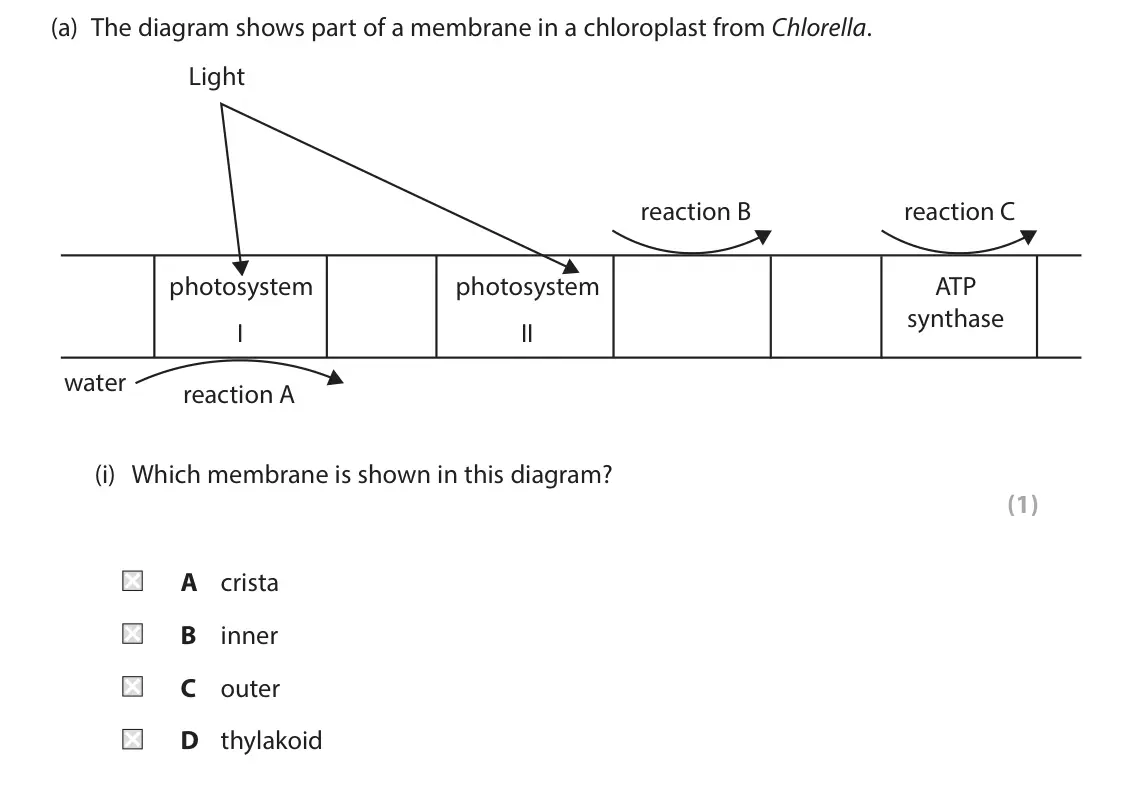
Q6(a)(ii)
The whole paper ↗
Q6(a)(iii)
The whole paper ↗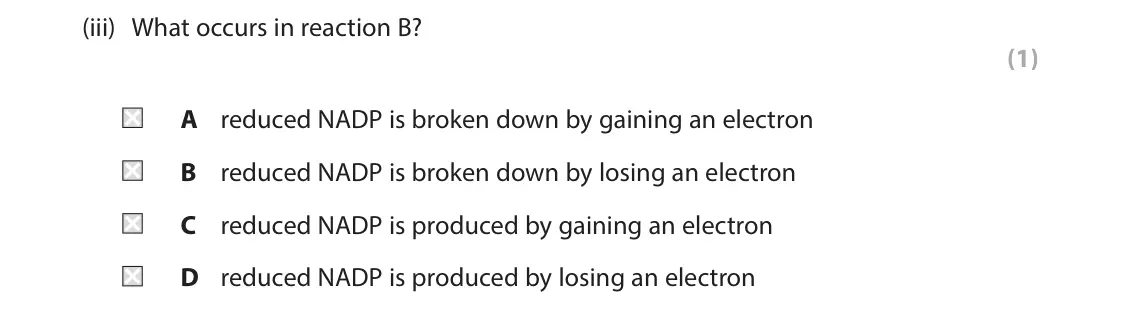
Q6(a)(iv)
The whole paper ↗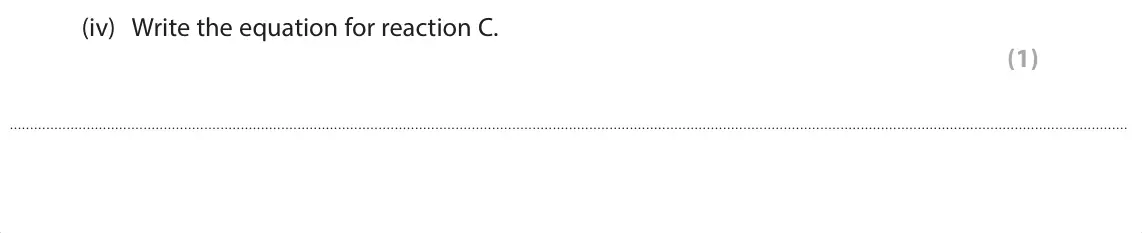
Q6(b)(i)
The whole paper ↗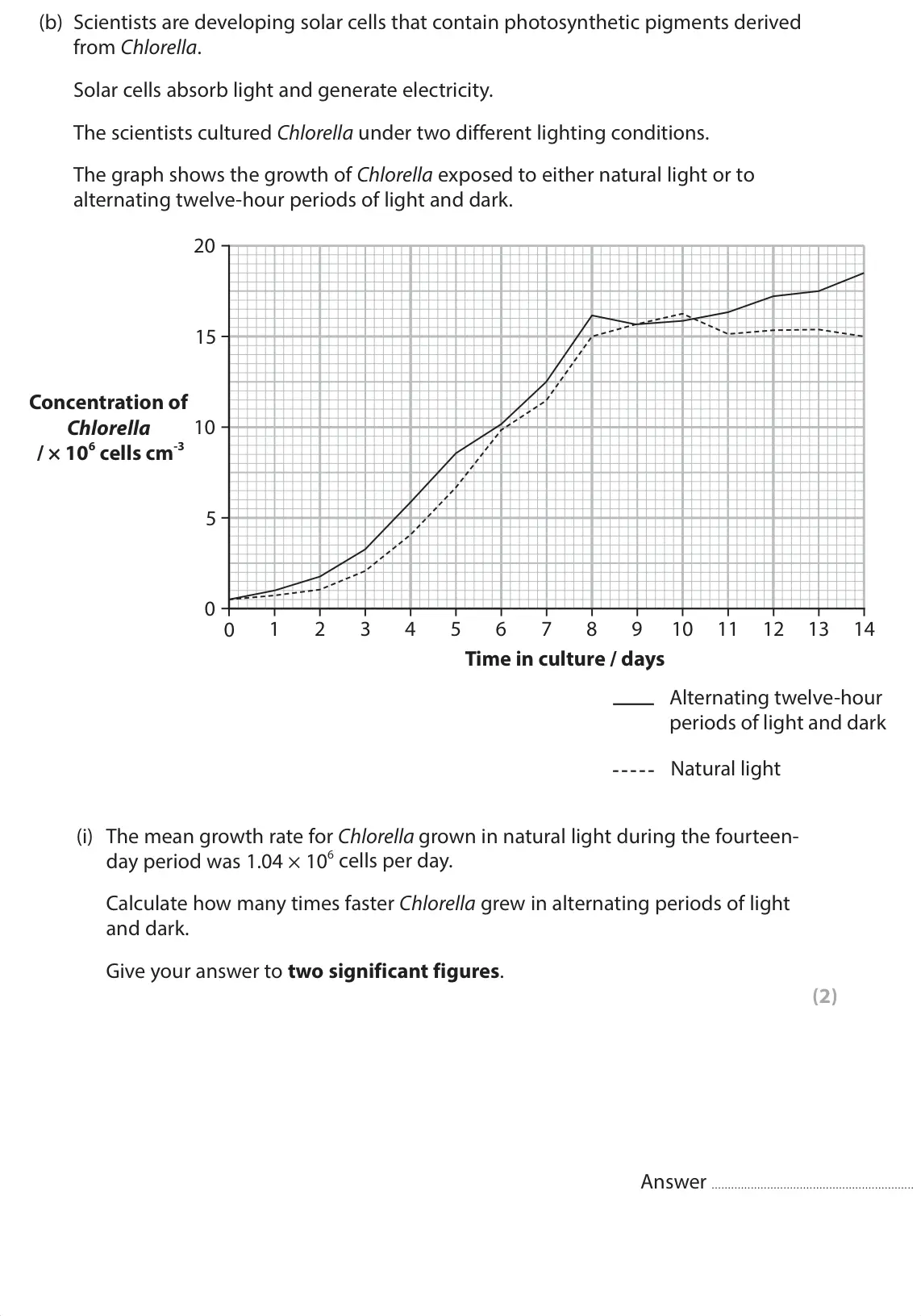
Q8(b)(ii)
The whole paper ↗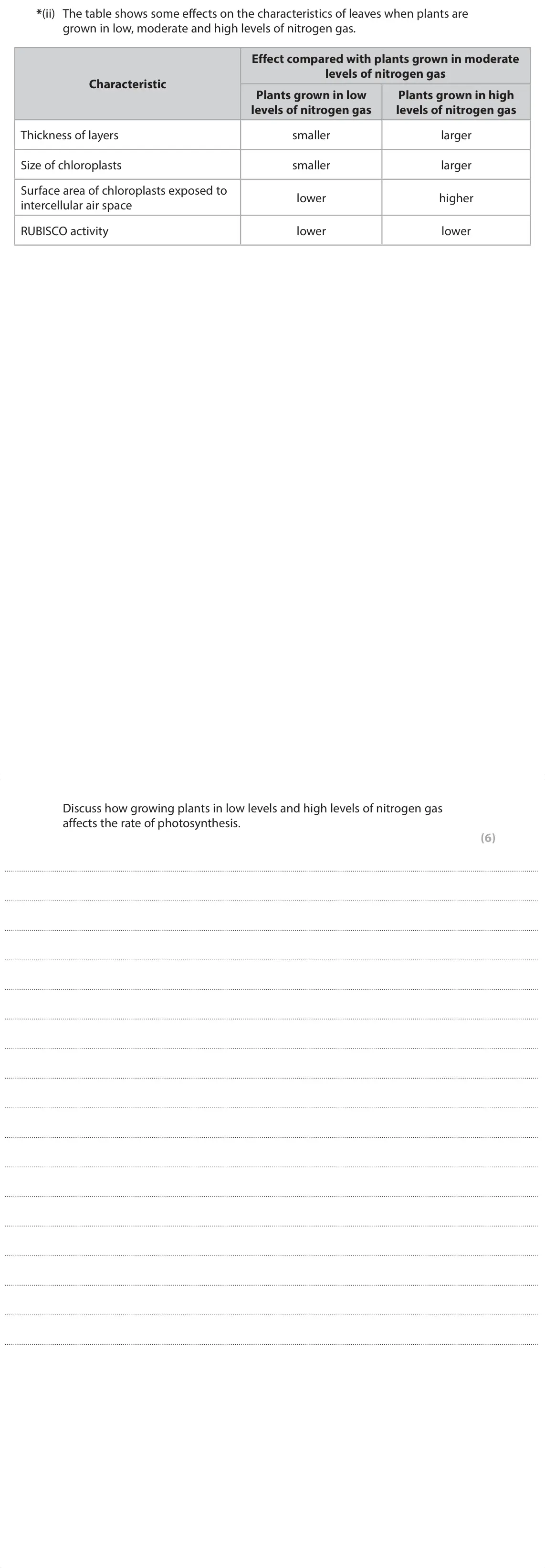
Q4(a)
The whole paper ↗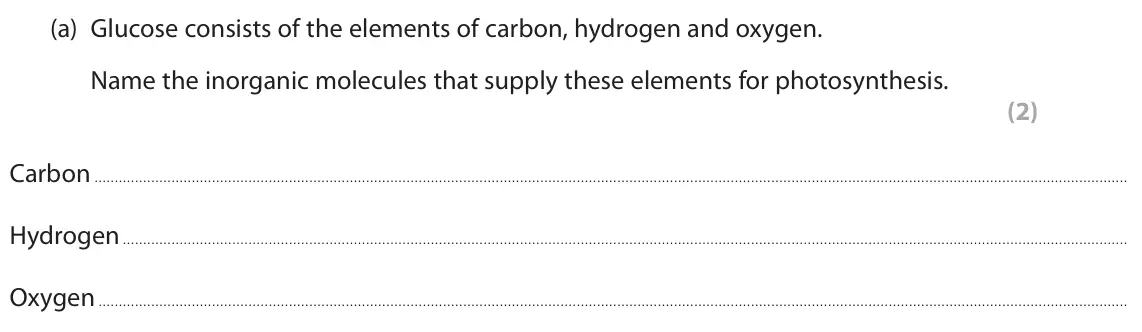
Q4(b)
The whole paper ↗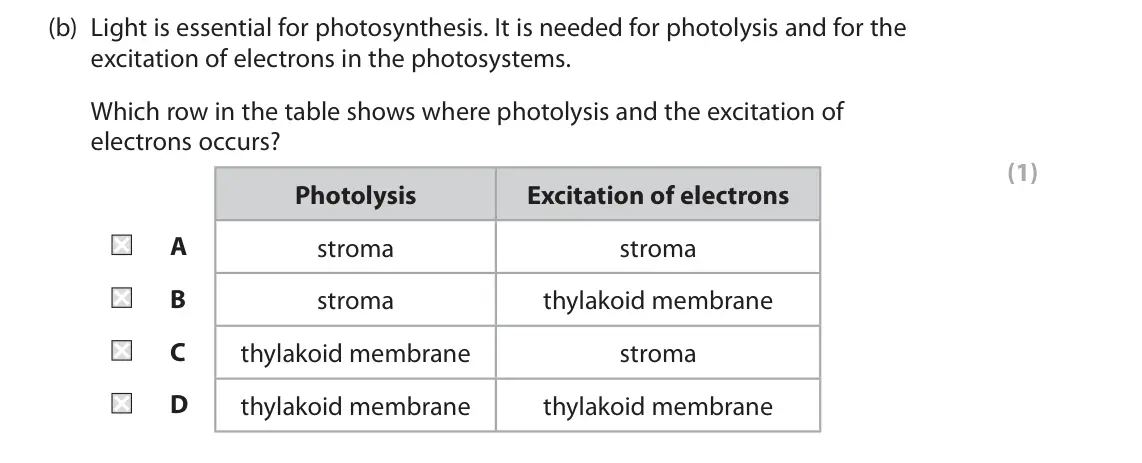
Q4(c)(i)
The whole paper ↗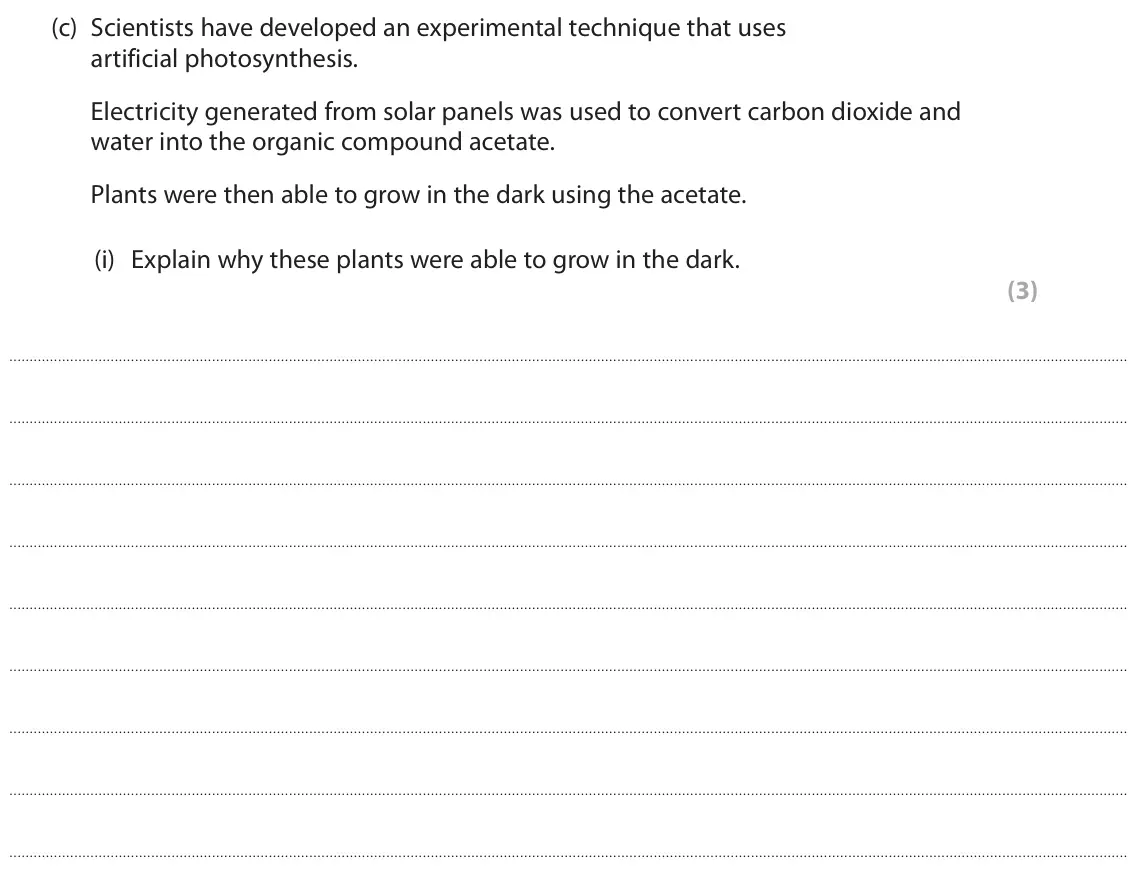
Q4(c)(ii)
The whole paper ↗
Q6(a)(ii)
The whole paper ↗
Q6(a)(i)
The whole paper ↗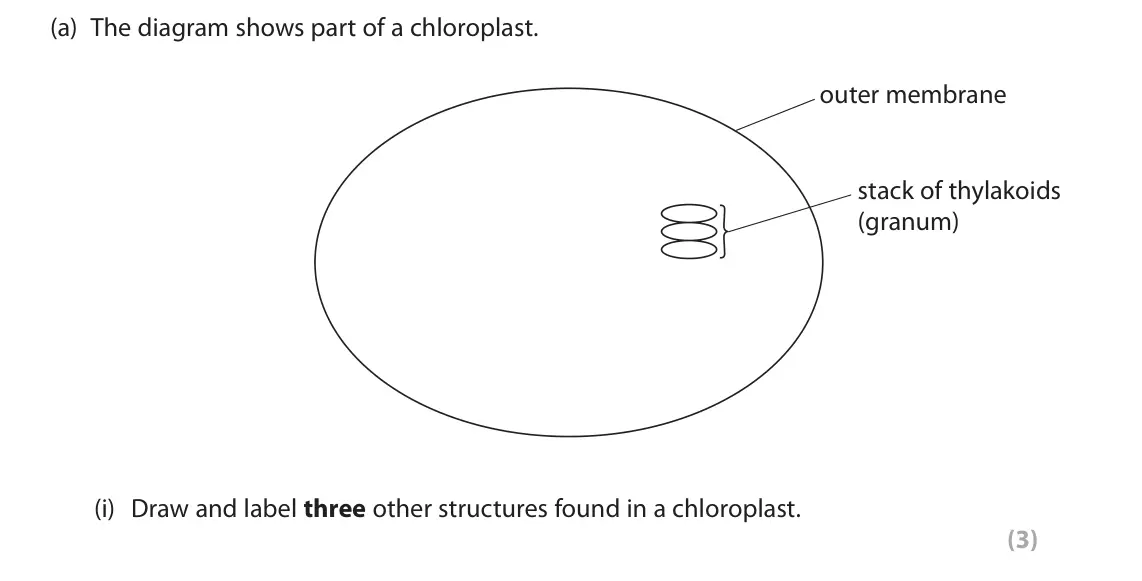
Q6(b)
The whole paper ↗
Q6(c)(i)
The whole paper ↗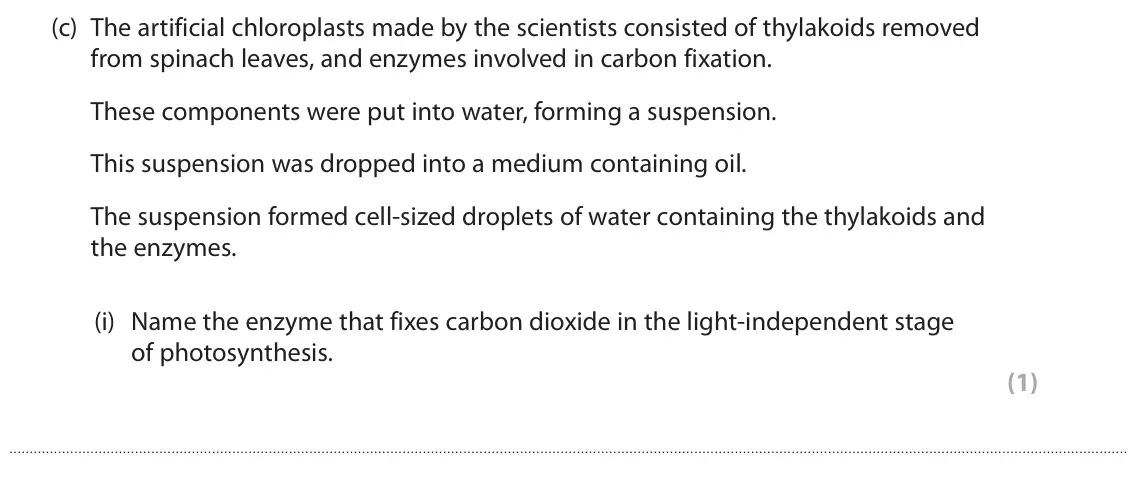
Q6(c)(ii)
The whole paper ↗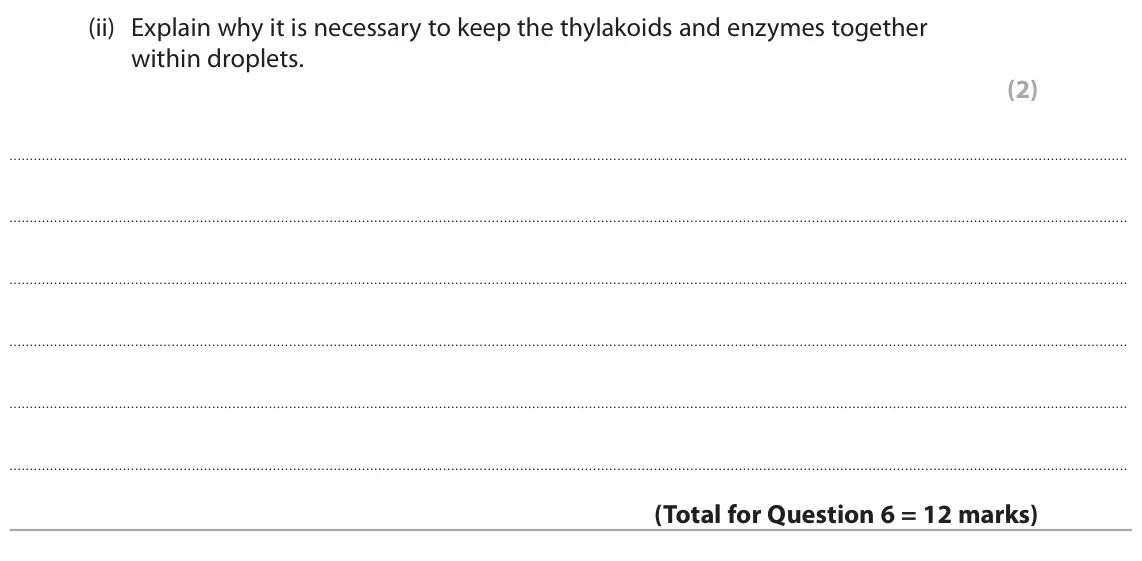
Q5(a)(i)
The whole paper ↗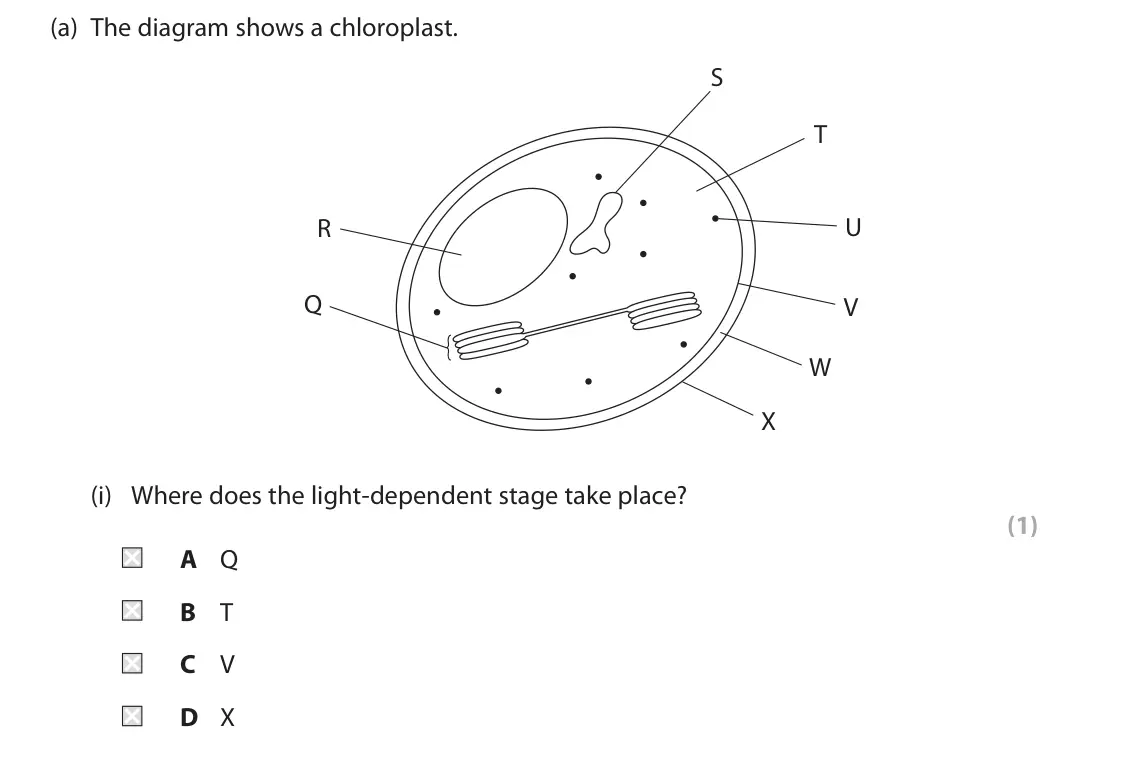
Q5(a)(ii)
The whole paper ↗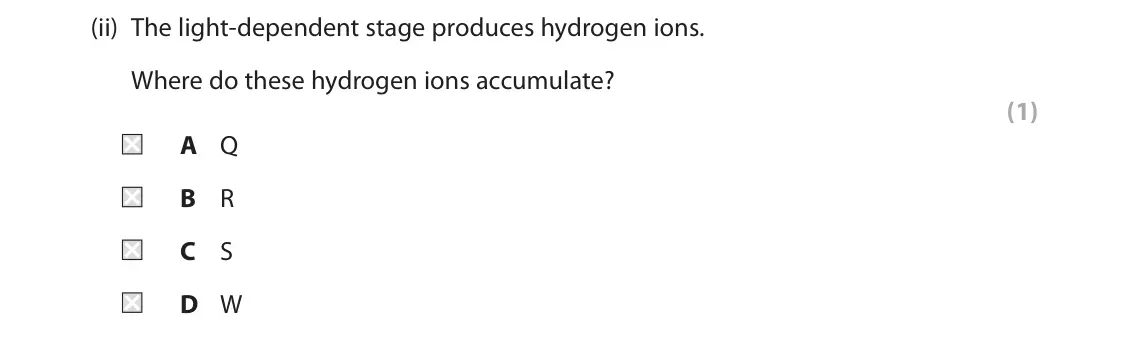
Q5(b)(i)
The whole paper ↗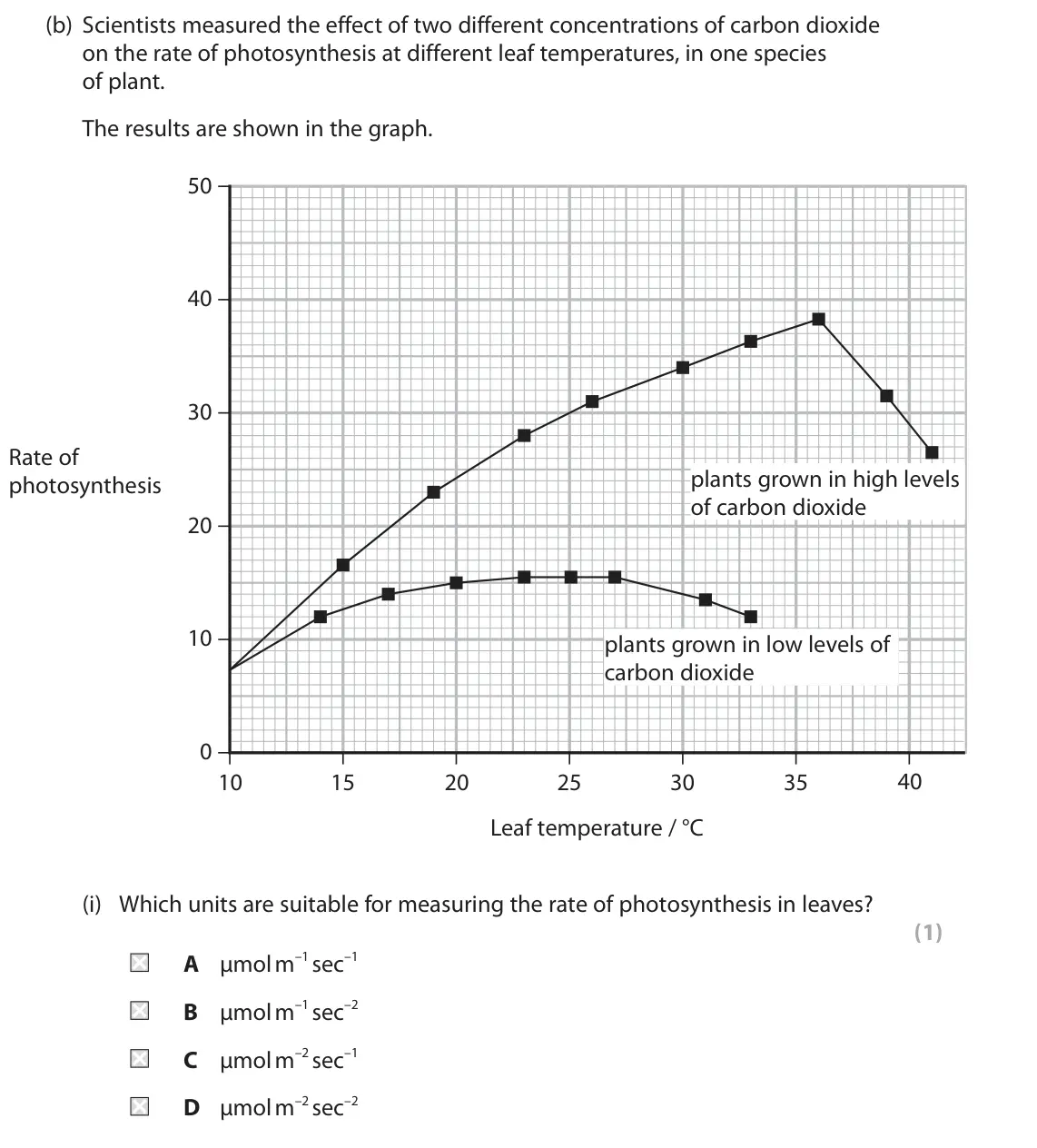
Q5(b)(ii)
The whole paper ↗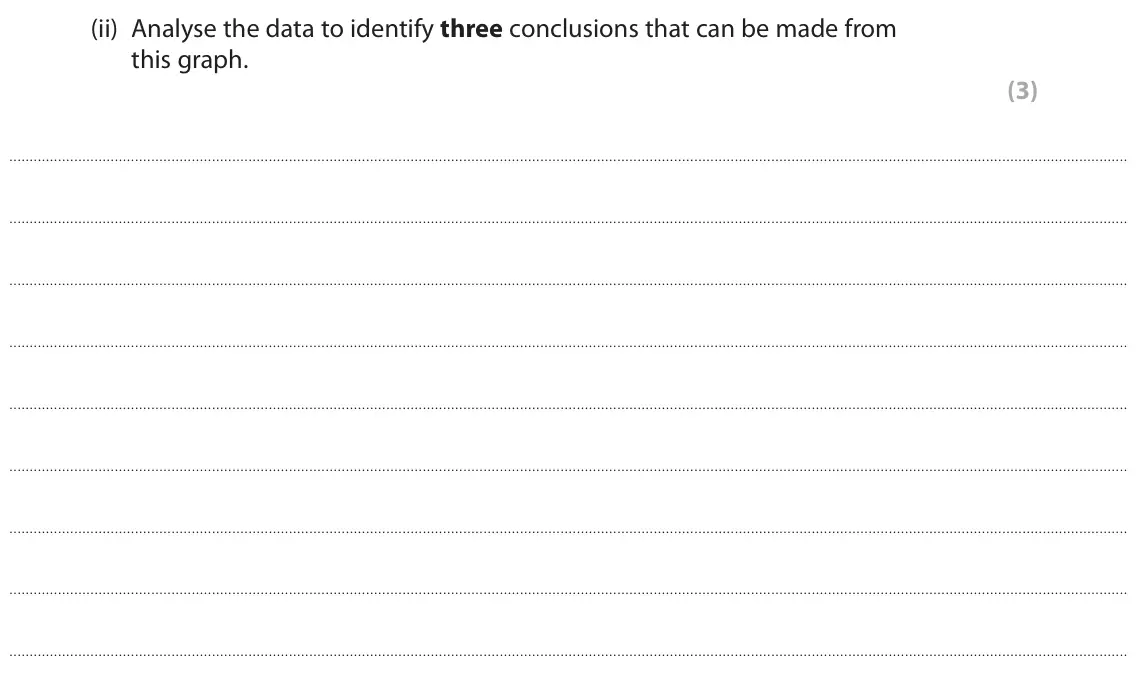
Q5(b)(iii)
The whole paper ↗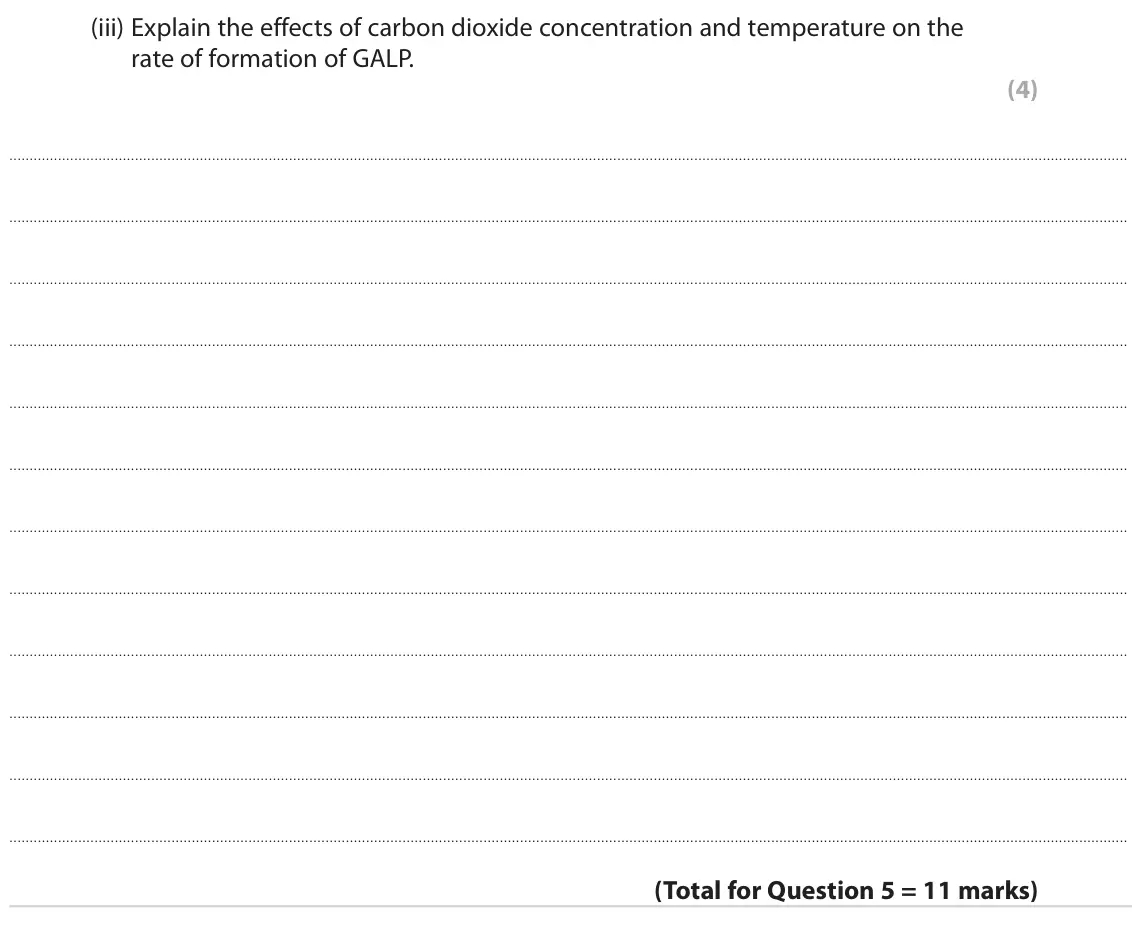
All 35 questions on Photosynthesis, as a list
- June 2025, Paper 1, Q6(a)(i) (1 mark): Which membrane is shown in this diagram? (1) A crista B inner C outer D thylakoid
- June 2025, Paper 1, Q6(a)(ii) (1 mark): Name reaction A. (1)
- June 2025, Paper 1, Q6(a)(iii) (1 mark): What occurs in reaction B? (1) A reduced NADP is broken down by gaining an electron B reduced NADP is broken down by losing an electron C reduced NADP is produc
- June 2025, Paper 1, Q6(a)(iv) (1 mark): Write the equation for reaction C. (1)
- June 2025, Paper 1, Q6(b)(i) (2 marks): The mean growth rate for Chlorella grown in natural light during the fourteen- day period was 1.04 × 10⁶ cells per day. Calculate how many times faster Chlorell
- June 2025, Paper 1, Q8(b)(ii) (6 marks): The table shows some effects on the characteristics of leaves when plants are grown in low, moderate and high levels of nitrogen gas. Effect compared with plant
- June 2024, Paper 1, Q4(a) (2 marks): Glucose consists of the elements of carbon, hydrogen and oxygen. Name the inorganic molecules that supply these elements for photosynthesis. (2) Carbon . Hydrog
- June 2024, Paper 1, Q4(b) (1 mark): Light is essential for photosynthesis. It is needed for photolysis and for the excitation of electrons in the photosystems. Which row in the table shows where p
- June 2024, Paper 1, Q4(c)(i) (3 marks): Explain why these plants were able to grow in the dark. (3)
- June 2024, Paper 1, Q4(c)(ii) (1 mark): The scientists hope that this technique will be able to produce plant‑based food. State one advantage of using this method. Give a reason for your answer. (1)
- June 2024, Paper 3, Q6(a)(ii) (2 marks): The shortest time for the number of plants to double was more than 3 days. Give two ways of reducing the time taken for the number of plants to double. (2) 1 2
- June 2023, Paper 1, Q6(a)(i) (3 marks): Draw and label three other structures found in a chloroplast. (3)
- June 2023, Paper 1, Q6(b) (4 marks): Explain the importance of the thylakoid membranes in the light‑dependent stage of photosynthesis. (4)
- June 2023, Paper 1, Q6(c)(i) (1 mark): Name the enzyme that fixes carbon dioxide in the light‑independent stage of photosynthesis. (1)
- June 2023, Paper 1, Q6(c)(ii) (2 marks): Explain why it is necessary to keep the thylakoids and enzymes together within droplets. (2)
- June 2022, Paper 1, Q5(a)(i) (1 mark): Where does the light‑dependent stage take place? (1) A Q B T C V D X
- June 2022, Paper 1, Q5(a)(ii) (1 mark): The light‑dependent stage produces hydrogen ions. Where do these hydrogen ions accumulate? (1) A Q B R C S D W
- June 2022, Paper 1, Q5(b)(i) (1 mark): Which units are suitable for measuring the rate of photosynthesis in leaves? (1) A µmol m–1 sec–1 B µmol m–1 sec–2 C µmol m–2 sec–1 D µmol m–2 sec–2
- June 2022, Paper 1, Q5(b)(ii) (3 marks): Analyse the data to identify three conclusions that can be made from this graph. (3)
- June 2022, Paper 1, Q5(b)(iii) (4 marks): Explain the effects of carbon dioxide concentration and temperature on the rate of formation of GALP. (4)
- June 2022, Paper 3, Q3(a)(i) (2 marks): Describe two control tubes that should be used in this investigation. (2)
- June 2022, Paper 3, Q3(a)(ii) (3 marks): Explain the changes in colour of the hydrogencarbonate indicator in this investigation. (3)
- June 2022, Paper 3, Q3(b) (3 marks): The colour of the indicator and the position of the beads can be used to give a quantitative measure of the effect of light intensity. Describe how the method c
- October 2020, Paper 1, Q9(a) (5 marks): Explain why drought affects the quality and quantity of the food of wombats. (5)
- June 2019, Paper 1, Q8(b)(i) (3 marks): The rate of photosynthesis is expressed as ȝmol m−2 s−1. Describe what was measured to find the rate of photosynthesis. (3)
- June 2019, Paper 1, Q8(b)(ii) (3 marks): Explain the results of this investigation. (3)
- June 2019, Paper 1, Q8(c) (3 marks): Explain why the wider stomata in GM crop plants could increase their yield. (3)
- June 2018, Paper 1, Q9(b)(ii) (5 marks): The soil in Londrina is more fertile than the soil in Ponta Grossa. Londrina has higher temperatures and rainfall during the growing season. Explain the differe
- June 2018, Paper 3, Q6(d)(iii) (3 marks): Analyse the data to explain how fewer stomata might affect the growth of coffee plants. (3)
- June 2018, Paper 3, Q9(b)(i) (4 marks): Explain how the student used this me
- June 2018, Paper 3, Q9(b)(ii) (4 marks): Analyse the data to explain the effect of this herbicide on the growth of weeds. (4)
- June 2017, Paper 1, Q6(b)(i) (1 mark): Calculate the number of photons of light needed to fix enough carbon to form one cyanobacterial cell. (1)
- June 2017, Paper 1, Q6(b)(ii) (2 marks): Explain why the value calculated in (b)(i) is likely to be an underestimate. (2)
- June 2017, Paper 1, Q6(b)(iii) (3 marks): Describe how carbon fixation takes place in chloroplasts. (3)
- June 2017, Paper 1, Q8(a) (1 mark): What is the name of the part of the chloroplast labelled Y? (1) A cytoplasm B matrix C nucleoplasm D stroma
Questions, mark schemes and examiner’s reports are © Pearson Edexcel, from their published past papers. Plumi isn’t affiliated with any exam board. Want whole papers? Every Edexcel A-Level Biology B paper.
Rather write your answers by hand on iPad? Plumi marks them against the same mark schemes.