 plumi
Work, energy and power: AQA A‑Level Physics questions
AQA A-Level Physics past-paper questions on 3.4.1.7 Work, energy and power, 2008–2025, with mark schemes and examiner’s reports where available.
Paper
All papers
Exam
All years
Calculations
Q05.2
The whole paper ↗
Q04.7
The whole paper ↗
Q03.4
The whole paper ↗
Q02.3
The whole paper ↗
Q04.4
The whole paper ↗
Q05.3
The whole paper ↗
Q05.4
The whole paper ↗Q07.2
The whole paper ↗Q07.3
The whole paper ↗Q03.1
The whole paper ↗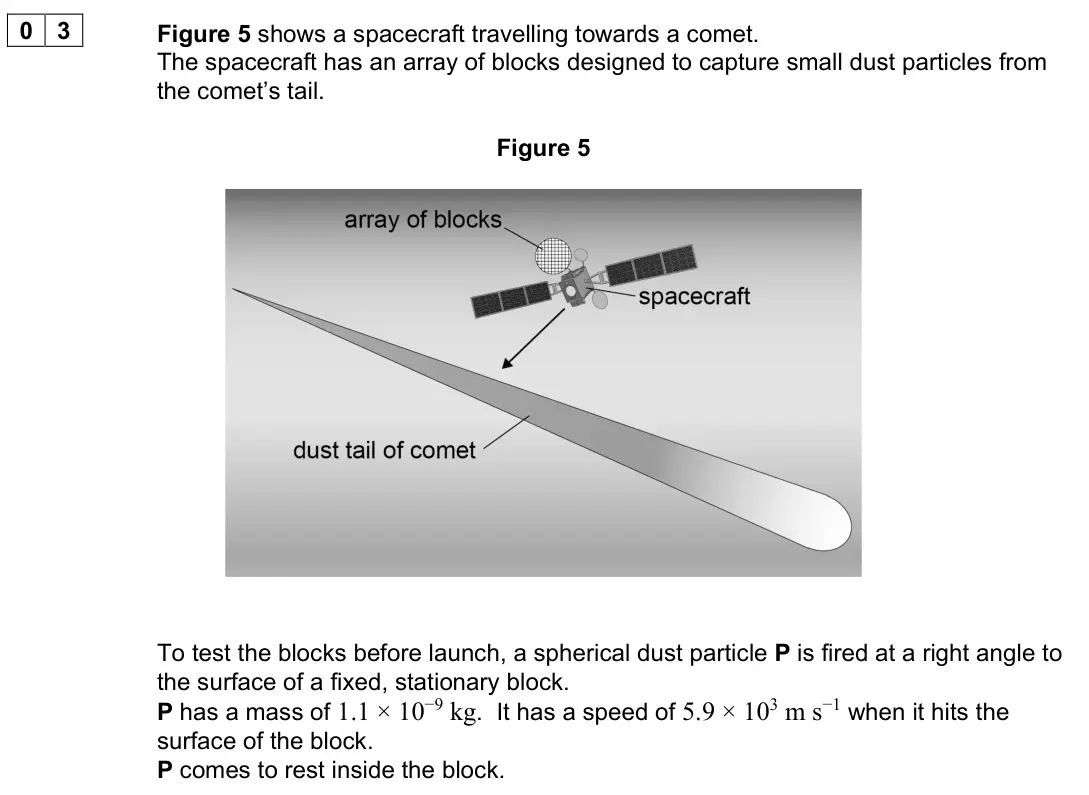
Q03.2
The whole paper ↗
All 75 questions on Work, energy and power, as a list
- June 2025, AS Paper 2, Q31 (1 mark): An aircraft flies horizontally with a constant velocity v. The aircraft is subject to a constant resistive force F. The aircraft engine has an efficiency of 10%
- June 2025, AS Paper 2, Q34 (1 mark): A car moves along a horizontal road at a constant speed of 15 m s−1. The car’s engine provides a constant thrust of 3800 N. The car then travels up a hill. The
- June 2024, Paper 1, Q05.2 (5 marks): In a second test, pulley P with O attached is released from A. P and O move along the cable to B. The change in height of the centre of mass of O between A and
- June 2024, Paper 1, Q26 (1 mark): A spring is compressed by a force F. The spring has stiffness k and its length changes by ΔL during the compression. When the force is removed the spring return
- June 2024, AS Paper 1, Q04.7 (3 marks): The car has a maximum power output of 95 kW. The maximum velocity of the car and trailer is 25 m s−1. At this velocity, the force D on the trailer is 3100 N. Th
- June 2024, AS Paper 2, Q03.4 (4 marks): A village combines the storage system with a wind turbine to provide energy. Figure 12 shows how the output power of the wind turbine varies with time during on
- June 2024, AS Paper 2, Q12 (1 mark): An electric pump forces water continually through a horizontal pipe at a speed of 4.0 m s−1. cross-sectional area of the pipe = 5.0 × 10⁻⁴ m2 density of water =
- June 2024, AS Paper 2, Q27 (1 mark): The electric motor of a lift raises a load of 750 N at a constant speed. The load moves through a vertical distance of 3.0 m in 1.5 s. As the load is being rais
- June 2023, Paper 1, Q02.3 (4 marks): At any point on the graph in Figure 1, the acceleration is given by: acceleration = speed × gradient of line When the car is at its maximum acceleration, the po
- June 2023, AS Paper 1, Q04.4 (3 marks): The bow has an efficiency of 0.82 The arrow leaves the bow in a horizontal direction with a velocity of 190 km h−1. Calculate m. [3 marks] m = kg
- June 2023, AS Paper 1, Q05.3 (2 marks): The battery stores 0.035 kW h of energy before a flight. The flight lasts for 39 s. The battery has a power output of 340 W during the flight. Determine the per
- June 2023, AS Paper 1, Q05.4 (3 marks): The helicopter has a maximum flight time of a few minutes due to the limited amount of energy stored in the battery. The battery accounts for about 15% of the h
- June 2023, AS Paper 2, Q33 (1 mark): A pellet of mass 25 g travelling horizontally at 40 m s−1 enters a fixed wooden block. The pellet stops after travelling a horizontal distance of 2.5 cm in the
- June 2023, AS Paper 2, Q34 (1 mark): The graph shows the variation of force with distance between a proton and a neutron. The shaded area represents [1 mark] A acceleration. B impulse. C rate of ch
- June 2022, AS Paper 1, Q07.2 (2 marks): The useful power output of the cyclist is 310 W. The cyclist has a steady speed of 1.63 m s−1. Assume that air resistance is negligible at this speed. Calculate
- June 2022, AS Paper 1, Q07.3 (3 marks): Discuss how her useful power output when taking the path in Figure 9 compares with her useful power output in Question 07.2. [3 marks]
- June 2022, AS Paper 2, Q27 (1 mark): A climber wears a harness attached to a rope. The rope passes through a brake. There is friction between the rope and the brake. The climber uses the brake to d
- June 2022, AS Paper 2, Q28 (1 mark): A solar panel powers a pump for a water feature. Solar energy is incident on the solar panel at a rate of 1.5 W. Water from the bottom container is continually
- November 2021, AS Paper 1, Q03.1 (1 mark): Calculate the work done in bringing P to rest. [1 mark] work done = J
- November 2021, AS Paper 1, Q03.2 (2 marks): P travels a distance of 2.9 cm in a straight line inside the block before coming to rest. The resultant force on P varies as it penetrates the block. Calculate
- November 2021, AS Paper 1, Q03.4 (3 marks): In another test, a spherical particle Q is fired at a right angle to the surface of an identical block. Q has the same mass as P and is travelling at the same s
- November 2021, AS Paper 1, Q05.3 (3 marks): Figure 12 shows the bottom of the hull with a drag reduction system in operation. Air bubbles are introduced into the water below the hull. This reduces the wor
- November 2021, AS Paper 2, Q04.4 (4 marks): The motor is connected to a 110 V dc supply that has negligible internal resistance. The maximum operating current in the motor is 5.0 A. The efficiency of the
- November 2021, AS Paper 2, Q11 (1 mark): An object of mass m is accelerated from rest to a velocity v by a constant resultant force F. What is the work done on the object during this acceleration? [1 m
- November 2020, Paper 1, Q06 (1 mark): [multiple choice] Mechanical power [1 mark] A is a vector quantity. B is measured in J. C has base units of kg m2 s−3. D can be calculated from force × distance
- November 2020, Paper 1, Q23 (1 mark): An electric motor lifts a load of weight W through a vertical height h in time t. The potential difference across the motor is V and the current in it is I. Wha
- November 2020, AS Paper 2, Q25 (1 mark): The drag force on a boat is kv2, where v is the speed and k = 64 kg m−1. The boat’s engine has a useful power output of 8000 W. What is the maximum speed of the
- June 2019, Paper 1, Q05.4 (3 marks): The steel safety barrier deforms during the collision. For the barrier to pass the test, the test vehicle should not move more than 1.5 m towards the other carr
- June 2019, Paper 1, Q17 (1 mark): An electric vehicle is driven by a motor which produces a constant driving force. The vehicle travels from rest along a straight horizontal road. Friction and a
- June 2019, Paper 1, Q18 (1 mark): Which is a correct statement about mechanical power? [1 mark] A It is a vector quantity. B It is measured in J. C In fundamental units, its unit is kg m2 s–3 D
- June 2019, Paper 1, Q27 (1 mark): An electric motor lifts a load of weight W through a vertical height h in time t. The potential difference across the motor is V and the current through it is I
- June 2019, AS Paper 1, Q03.5 (3 marks): The designers also claim that the loaded cage reaches a maximum speed of at least 90 km h−1. Calculate, in J, the kinetic energy of the loaded cage when it trav
- June 2019, AS Paper 2, Q04.2 (3 marks): The boat and trailer are initially at rest. In the first 200 ms the boat and trailer are raised through a vertical height of 3.3 × 10⁻² m and the speed increase
- June 2019, AS Paper 2, Q13 (1 mark): What is the approximate average kinetic energy of a cyclist in a race? [1 mark] A 10 J B 10 kJ C 10 MJ D 10 TJ
- June 2019, AS Paper 2, Q27 (1 mark): A car of mass 1000 kg accelerates uniformly from rest to a speed of 25.0 m s–1 in 50.0 s. The car is travelling along a horizontal road. What is the average use
- June 2018, AS Paper 2, Q03.1 (2 marks): Show that the velocity of an alpha particle with kinetic energy 8.1 × 10⁻¹³ J is approximately 2 × 10⁷ m s–1 specific charge of an alpha particle = 4.81 × 10⁷ C
- June 2018, AS Paper 2, Q03.2 (2 marks): The alpha particles travel through air in straight lines with a range of 3.5 cm Calculate the average force exerted on an alpha particle as it is stopped by the
- June 2018, AS Paper 2, Q21 (1 mark): A car’s engine produces a useful output power of 6.5 × 10⁴ W The car of mass 950 kg is moving up a hill at a steady speed. The slope of the hill is 12° to the h
- June 2018, AS Paper 2, Q27 (1 mark): Objects P and Q are initially at rest at time t = 0 The same resultant force F is applied to P and Q for time T. The mass of P is 10 times greater than the mass
- June 2017, Paper 1, Q04.3 (3 marks): Solar cells convert solar energy to useful electrical energy in the road sign with an efficiency of 4.0%. The solar-cell supply used by the engineer has a total
- June 2017, AS Paper 1, Q03.1 (3 marks): Show that the average power output of the battery during the journey is about 100 W. [3 marks]
- June 2017, AS Paper 1, Q03.2 (2 marks): During the journey, forces due to friction and air resistance act on the wheelchair and its user. Assume that all the energy available in the battery is used to
- June 2017, AS Paper 1, Q03.4 (2 marks): Calculate the maximum speed of the wheelchair and its user when travelling up this hill when the power output of the battery is 100 W. Assume that the resistive
- June 2017, AS Paper 1, Q03.5 (4 marks): Explain how and why the maximum range of the wheelchair on level ground is affected by • the mass of the user • the speed at which the wheelchair travels. [4 ma
- June 2017, AS Paper 2, Q04.3 (3 marks): Determine the length of time the ion propulsion unit operated before all of the 79 kg of xenon was used up. mass of xenon atom = 2.18 × 10⁻²⁵ kg [3 marks] time
- June 2017, AS Paper 2, Q04.4 (3 marks): Ion propulsion units could use helium ions instead of xenon ions. An ion of helium-4 (He+) has a much higher specific charge than an ion of xenon-131 (Xe+). Bot
- June 2016, AS Paper 2, Q04.2 (1 mark): Only 6% of the energy from the decay is used to generate electricity. Calculate the rate at which energy is transferred from the decay of plutonium-238 on Curio
- June 2016, AS Paper 2, Q04.5 (2 marks): The alternative to using an RTG is to use a solar panel. A typical solar panel installation on a house roof in the UK provides about 1000 kW h of electricity ea
- June 2016, AS Paper 2, Q24 (1 mark): What is represented by the area under a force–displacement graph? [1 mark] A rate of change of kinetic energy B change in momentum C work done D acceleration
- June 2016, AS Paper 2, Q25 (1 mark): Which of the following is not a unit of power? [1 mark] A N m s–1 B J s C W D kg m2 s–3
- June 2016, AS Paper 2, Q27 (1 mark): In a test a 500 kg car travelling at 10 m s–1 hits a wall. The front 0.30 m of the car crumples as the car is brought to rest. What is the average force on the
- Specimen, Paper 1, Q04.1 (4 marks): The speed of an air rifle pellet is measured by firing it into a wooden block suspended from a rigid support. The wooden block can swing freely at the end of a
- Specimen, Paper 1, Q23 (1 mark): A car exerts a driving force of 500 N when travelling at a constant speed of 72 km h −1 on a level track. What is the work done in 5 minutes? [1 mark] A 3.0 × 1
- Specimen, Paper 1, Q26 (1 mark): An electric motor of input power 100 W raises a mass of 10 kg vertically at a steady speed of 0.5 m s −1. What is the efficiency of the system? [1 mark] A 5% B
- June 2016, PHYA2 (old spec), Q4(b)(ii) (1 mark): The block travels 1.2 m after leaving the spring before coming to rest. Show that the frictional force between the block and the table top is about 1.8 N. [1 ma
- June 2015, PHYA2 (old spec), Q3(d) (2 marks): The vehicle now accelerates to a constant speed of 55 m s–1. The useful power output of the motors is 22 kW at this speed. Calculate the horizontal resistive fo
- June 2013, PHYA2 (old spec), Q1(b)(ii) (3 marks): Calculate the percentage efficiency of the winch system used to launch the glider. Assume the kinetic energy of the glider after the launch is negligible. effic
- January 2013, PHYA2 (old spec), Q2(b)(ii) (1 mark): At D the snowboarder has reached a constant velocity. She moves a distance of 2.0m at constant velocity between D and E. Calculate the work done against resisti
- January 2013, PHYA2 (old spec), Q3(c) (2 marks): In order to maintain a constant velocity of 15ms–1 downhill, the cyclist applies the brake. The power developed by the braking force is 2.8 kW. Calculate the to
- January 2012, PHYA2 (old spec), Q1(a) (2 marks): The average tension in the cable is 170kN. Show that, when the ship travels 1.0km, the work done by the sail on the ship is 1.3 × 10⁸J. (2 marks)
- January 2012, PHYA2 (old spec), Q1(b)(i) (2 marks): Calculate the power developed by the sail. answer = W (2 marks)
- January 2012, PHYA2 (old spec), Q1(b)(ii) (2 marks): Calculate the percentage of the ship’s power requirement that is provided by the wind when the ship is travelling at this speed. The power output of the engines
- June 2011, PHYA2 (old spec), Q3(a)(iv) (3 marks): The efficiency of the rollercoaster acceleration system is 20%. Calculate the average power input to this system during the acceleration. answer = W (3 marks)
- June 2011, PHYA2 (old spec), Q4(b) (3 marks): The horses move at a constant speed of 0.91ms–1. Calculate the combined power output of the two horses. Give your answer to an appropriate number of significant
- June 2011, PHYA2 (old spec), Q4(c) (1 mark): During the Industrial Revolution in the 19th Century, James Watt became well known for developing and improving steam engines to replace horses. He defined the
- January 2011, PHYA1 (old spec), Q4(b)(i) (3 marks): An alpha particle of mass 6.6 × 10⁻²⁷ kg has a kinetic energy of 9.6 × 10⁻¹³ J. Show that the speed of the alpha particle is 1.7 × 10⁷ ms–1. (3 marks)
- January 2011, PHYA2 (old spec), Q1(b)(ii) (3 marks): The person causes a compression of 0.28m in a time of 1.5s. Use the graph in part (a) to calculate the average power developed. answer = W (3 marks)
- June 2010, PHYA2 (old spec), Q1(e) (2 marks): The maximum power of the motorcycle is 7.5kW and it has a maximum speed of 26 m s–1, when travelling on a level road. Calculate the total horizontal resistive f
- June 2010, PHYA2 (old spec), Q4(e) (6 marks): On her next jump the gymnast decides to reach a height above position B. Describe and explain, in terms of energy and work, the transformations that occur as sh
- January 2010, PHYA2 (old spec), Q7(a)(iii) (2 marks): It has been predicted that the turbine would produce an electrical power output of 10MW in these wind conditions. Calculate the percentage efficiency of the tur
- June 2009, PHYA2 (old spec), Q1(a)(iii) (3 marks): The work done by the cyclist when pedalling downhill is 2400 J. Account for the difference between the loss of gravitational potential energy and the gain of ki
- January 2009, PHYA2 (old spec), Q2(b)(ii) (3 marks): The ship is moving at a constant velocity of 8.3 m s –1 and the horizontal component of the force of the cable on the ship acts in the direction in which the sh
- June 2008, PA02 (2008 spec), Q6(c) (4 marks): 6 (c) After an impact the hammer and the pile move so that the pile sinks into the ground to a depth of 0.25 m. Calcuate 6 (c) (i) the loss of kinetic energy of
- June 2008, PA02 (2008 spec), Q6(d) (2 marks): 6 (d) The process is repeated several times and each time the hammer is raised 4.5 m above the pile. Suggest why the extra depth of penetration is likely to dec
- June 2008, PA10 (2008 spec), Q2(b) (6 marks): 2 (b) On a certain day, the output power of the solar cell panel varied as shown on the graph. output power /W time of day 2 (b) (i) Use the graph to show that
Questions, mark schemes and examiner’s reports are © AQA, from their published past papers. Plumi isn’t affiliated with any exam board. Want whole papers? AQA A-Level Physics past papers.
The Plumi iPad app also offers exam-style questions with AI feedback on your handwritten working.