 plumi
Projectile motion: AQA A‑Level Physics questions
AQA A-Level Physics past-paper questions on 3.4.1.4 Projectile motion, 2008–2025, with mark schemes and examiner’s reports where available.
Paper
All papers
Exam
All years
Calculations
Q06.3
The whole paper ↗
Q04.1
The whole paper ↗
Q04.2
The whole paper ↗Q04.3
The whole paper ↗Q04.4
The whole paper ↗Q01.5
The whole paper ↗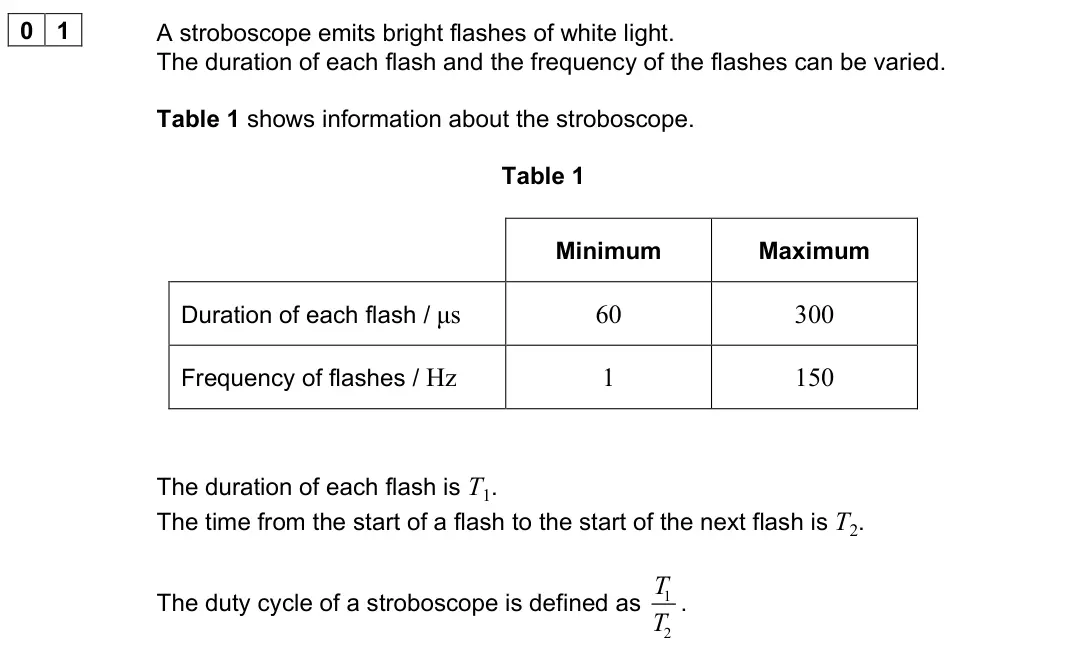
Q01.6
The whole paper ↗Q02.1
The whole paper ↗
Q02.2
The whole paper ↗Q02.3
The whole paper ↗Q05.1
The whole paper ↗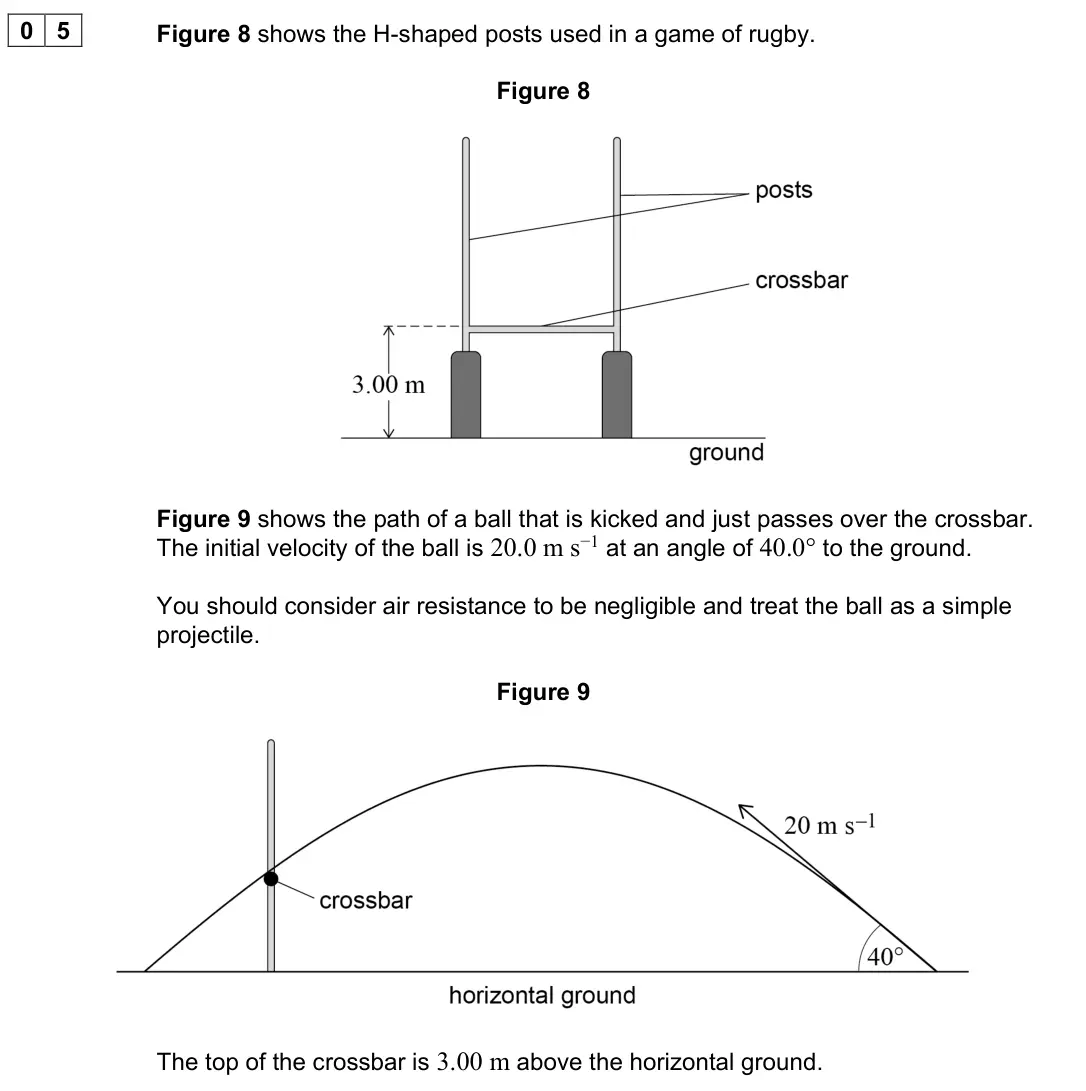
All 78 questions on Projectile motion, as a list
- June 2025, Paper 1, Q06.3 (3 marks): A player jumps up to head a football when it is 2.0 m above the ground. The initial velocity of the ball is 18 m s−1 at an angle of 48° to the horizontal. Figur
- June 2025, Paper 1, Q21 (1 mark): A skydiver is falling at a terminal velocity v1. When she is at a height h1 she opens her parachute. When she is at a height h2 she reaches a new terminal veloc
- June 2025, AS Paper 2, Q04.1 (2 marks): Determine D. [2 marks] D = m
- June 2025, AS Paper 2, Q04.2 (3 marks): The vertical displacement of the ball from the floor in the last image is 3.10 m. Determine h. [3 marks] h = m
- June 2025, AS Paper 2, Q04.3 (2 marks): The ball is again thrown by the robot. The initial speed of the ball is the same as in Figure 8. The angle for this throw is less than 73°. Another set of image
- June 2025, AS Paper 2, Q04.4 (3 marks): When air resistance is significant, the magnitude of the vertical component av of the acceleration of the ball varies throughout the flight. Discuss how air res
- June 2025, AS Paper 2, Q13 (1 mark): Two skydivers X and Y step out of a stationary hot-air balloon at the same time. Both skydivers reach terminal speed. mass of X = 120 kg mass of Y = 90 kg Which
- June 2024, Paper 1, Q20 (1 mark): A projectile is fired from ground level over horizontal ground. Its initial velocity is u at an angle θ to the horizontal. The range of the projectile is d. A s
- June 2024, Paper 1, Q21 (1 mark): A particle travelling horizontally at 1.0 × 10⁷ m s−1 enters a region where it has a constant vertical acceleration of 4 × 10¹⁴ m s−2. What is the horizontal di
- June 2024, Paper 1, Q22 (1 mark): An object is thrown vertically upwards at time t = 0 The object reaches its maximum height when t = T and reaches its terminal speed on the way down. The magnit
- June 2024, AS Paper 2, Q11 (1 mark): The graph shows the variation with time of a quantity y for an object as it falls through the air. Which row gives y and the amount of air resistance? [1 mark]
- June 2023, Paper 1, Q18 (1 mark): A ball is kicked from point P on level ground. The ball initially travels at 45° to the horizontal. The ball reaches its maximum height after a time of 2.0 s. A
- June 2023, Paper 1, Q23 (1 mark): A sphere of mass m falls with speed v. The resistive force on the sphere is kv, where k is a constant. What is the terminal speed of the sphere? [1 mark] A mg k
- June 2023, Paper 3A, Q01.5 (2 marks): Determine, in mm s−1, the horizontal velocity of the ball between the second and third contacts of the ball with the floor. [2 marks] horizontal velocity = mm s
- June 2023, Paper 3A, Q01.6 (3 marks): Determine the time between the second and third contacts. Annotate Figure 3 to show your method. [3 marks] time = s
- June 2023, AS Paper 2, Q02.1 (1 mark): To measure x a student must locate a point P on the floor vertically below the end of the track. Describe a procedure to locate P. You may add detail to Figure
- June 2023, AS Paper 2, Q02.2 (3 marks): A ruler, graduated in mm, is used to determine x. The student places the ruler on the floor with the zero graduation aligned with P. The student determines x wh
- June 2023, AS Paper 2, Q02.3 (3 marks): The student obtains values of x corresponding to other values of h. Figure 6 shows his results. Figure 6 It can be shown that 2 20 7 x h H = Determine H. [3 mar
- June 2022, AS Paper 2, Q24 (1 mark): P and Q are two balls of the same diameter. P has a greater mass than Q. Both balls are projected at the same time from the top of a tall building that stands o
- November 2021, Paper 1, Q05.1 (2 marks): Show that the minimum speed of the ball in flight is about 15 m s−1. Explain your answer. [2 marks]
- November 2021, Paper 1, Q05.2 (2 marks): The ball just passes over the crossbar at a time t after it is kicked. Show that t must satisfy the following equation: 4.91t2 – 12.9t + 3.00 = 0 [2 marks]
- November 2021, Paper 1, Q05.3 (4 marks): There are two solutions to the equation 4.91t2 – 12.9t + 3.00 = 0 Discuss which of the two solutions is the time taken for the ball to pass over the crossbar fr
- November 2021, Paper 1, Q05.4 (1 mark): Another attempt is made to kick the ball over the crossbar. The initial velocity of the ball is the same as in the first attempt. This kick is made from a horiz
- November 2021, Paper 1, Q05.5 (5 marks): Figure 10 shows the variations with time of the vertical velocity of a ball with and without air resistance. Figure 10 Discuss the features of the motion of the
- November 2021, Paper 1, Q23 (1 mark): A coin is projected horizontally from the top of a desk. The diagram shows the coin at one point in its path. The air resistance is negligible. The arrows E, F
- November 2021, AS Paper 2, Q27 (1 mark): What is true about the accelerations of the spheres at the instant they are released? [1 mark] A The acceleration of X is less than that of Y. B The acceleratio
- November 2021, AS Paper 2, Q28 (1 mark): What is true about the terminal speeds? [1 mark] A The terminal speed of X is greater than that of Y. B The terminal speed of X is the same as that of Y. C The
- November 2020, AS Paper 1, Q03.2 (1 mark): Later, the golf ball lands in a sandpit. The golfer hits the ball, giving it an initial velocity u at 35° to the horizontal, as shown in Figure 4. The horizonta
- November 2020, AS Paper 1, Q03.3 (2 marks): The ball is travelling horizontally as it reaches X, as shown in Figure 5. Figure 5 Assume that weight is the only force acting on the ball when it is in the ai
- November 2020, AS Paper 1, Q03.4 (2 marks): Calculate the vertical distance of X above the initial position of the ball. [2 marks] vertical distance = m
- November 2020, AS Paper 1, Q03.5 (1 mark): Sketch on Figure 6 a possible trajectory for the ball. [1 mark]
- November 2020, AS Paper 1, Q03.6 (2 marks): Explain your reason for selecting this trajectory. [2 marks]
- November 2020, AS Paper 2, Q23 (1 mark): Two ball bearings X and Y are projected from horizontal ground at the same time. X has mass 2m and is projected vertically upwards with speed u. Y has mass m an
- June 2019, Paper 1, Q04.3 (2 marks): When the rope is cut, the counterweight rotates clockwise. When the beam is vertical it is prevented from rotating further. The projectile is then released hori
- June 2019, Paper 1, Q04.4 (3 marks): In another release, the sling is adjusted so that a projectile of the same mass is released just before the wooden beam is vertical. The projectile is not relea
- June 2019, AS Paper 2, Q25 (1 mark): Three objects U, V and W leave the edge of a bench at the same time. The objects fall in the same vertical plane with negligible air resistance. U is released f
- June 2018, Paper 1, Q23 (1 mark): A projectile is launched with a speed of 25 m s−1 at an angle of 35° to the horizontal, as shown in the diagram. Air resistance is negligible. What is the time
- June 2018, AS Paper 2, Q24 (1 mark): Two spheres, P and Q, have the same volume but P has a greater mass. The spheres fall in air at their terminal velocities vP and vQ respectively. Which row stat
- June 2017, Paper 1, Q21 (1 mark): Figure 12 shows the path of a projectile launched from ground level with a speed of 25 m s−1 at an angle of 42° to the horizontal. Figure 12 What is the horizon
- June 2017, AS Paper 2, Q28 (1 mark): Two identical balls, X and Y, are at the same height and a horizontal distance of 25 cm apart. X is projected horizontally with a velocity of 0.10 m s–1 towards
- June 2016, AS Paper 2, Q21 (1 mark): A golf ball was hit from the surface of the Moon. The time of flight was 4.0 s. What is the best estimate for the maximum height reached by the ball? [1 mark] a
- June 2016, AS Paper 2, Q22 (1 mark): A deep-space probe travelling forward at constant speed is briefly acted on by a force at right angles to its motion. What is the effect of this force on the fo
- Specimen, Paper 1, Q21 (1 mark): A ballbearing X of mass 2m is projected vertically upwards with speed u. A ballbearing Y of mass m is projected at 30º to the horizontal with speed 2u at the sa
- Specimen, Paper 2, Q01.3 (1 mark): Figure 1 shows a system that separates two minerals from the ore containing them using an electric field. Figure 1 The crushed particles of the two different mi
- June 2016, PHYA2 (old spec), Q2(a)(i) (2 marks): Show that the initial speed of the projectile is about 12 m s–1. [2 marks]
- June 2016, PHYA2 (old spec), Q2(a)(ii) (2 marks): Calculate the horizontal component of velocity as the projectile hits the ground. [2 marks] horizontal component of velocity = ________________________ m s–1
- June 2016, PHYA2 (old spec), Q2(b)(i) (2 marks): Calculate the maximum height above the starting point reached by the projectile. Give your answer to an appropriate number of significant figures. [2 marks] max
- June 2016, PHYA2 (old spec), Q2(b)(ii) (1 mark): Calculate the total horizontal distance travelled by the projectile from its starting point. [1 mark] horizontal distance = ___________________________ m
- June 2016, PHYA2 (old spec), Q2(c)(i) (1 mark): Mark with an A on the flight path in Figure 2 the position where the speed of the projectile is greatest. [1 mark]
- June 2016, PHYA2 (old spec), Q2(c)(ii) (1 mark): Mark with a B on the flight path in Figure 2 the position where the speed of the projectile is least. [1 mark]
- June 2016, PHYA2 (old spec), Q2(d) (2 marks): The projectile reaches its maximum height at time tH and finishes its flight at time tF. Draw on Figure 3 a graph to show how the magnitude of the vertical comp
- June 2016, PHYA2 (old spec), Q5 (6 marks): A fully-loaded lorry transporting water starts from rest and travels along a straight road. Figure 7 is a graph showing how the speed of the lorry varies with t
- June 2015, PHYA2 (old spec), Q1(c) (3 marks): In a game of tennis, a ball is hit horizontally at a height of 1.2 m and travels a horizontal distance of 5.0 m before reaching the ground. The ball is at rest
- June 2014, PHYA2 (old spec), Q2(a)(i) (3 marks): Calculate the time between positions A and B. [3 marks] time s
- June 2014, PHYA2 (old spec), Q2(a)(ii) (2 marks): The athlete is moving horizontally at A with a velocity of 8.5ms–1. Assume there is no air resistance. Calculate the horizontal displacement of the centre of ma
- June 2013, PHYA2 (old spec), Q2(a)(i) (2 marks): Calculate the time that the bullet is in the air before it hits the ground. time s (2 marks)
- June 2013, PHYA2 (old spec), Q2(a)(ii) (1 mark): Calculate the horizontal distance travelled by the bullet before it hits the ground. horizontal distance m (1 mark)
- June 2013, PHYA2 (old spec), Q2(b) (3 marks): Rifle B is fired and the bullet emerges with a smaller horizontal velocity than the bullet from rifle A. Explain why the horizontal distance travelled by bullet
- June 2013, PHYA2 (old spec), Q3(b)(i) (6 marks): Figure 4 shows the velocity-time graph for steel ball A. Figure 4 Explain the shape of the graph in Figure 4. Your account should include l how the velocity and
- June 2013, PHYA2 (old spec), Q3(b)(ii) (3 marks): On Figure 5, sketch the velocity-time graph you would expect to see for steel ball B. Assume air resistance is negligible. Figure 5 (3 marks) velocity 0 0 time
- January 2012, PHYA2 (old spec), Q3(b)(ii) (2 marks): State and explain one characteristic of the aircraft that limits its maximum horizontal velocity. (2 marks)
- January 2012, PHYA2 (old spec), Q3(b)(iii) (2 marks): On the axes below, sketch the velocity-time graph for the horizontal motion of the aircraft as it accelerates from zero to its maximum horizontal velocity. (2 m
- June 2011, PHYA2 (old spec), Q2(c) (2 marks): State and explain one reason why the card would give more reliable results than a table tennis ball for this experiment. (2 marks)
- January 2011, PHYA2 (old spec), Q2(a)(i) (2 marks): Show that the time taken for the cannonball to reach the water surface after being fired from the cannon was 3.7s. Assume the air resistance was negligible. (2
- January 2011, PHYA2 (old spec), Q2(a)(ii) (2 marks): Calculate the velocity at which the cannonball was fired. Give your answer to an appropriate number of significant figures. answer = ms–1 (2 marks)
- January 2011, PHYA2 (old spec), Q2(a)(iii) (2 marks): Calculate the vertical component of velocity just before the cannonball hit the ship. answer = ms–1 (2 marks)
- January 2011, PHYA2 (old spec), Q2(a)(iv) (4 marks): By calculation or scale drawing, find the magnitude and direction of the velocity of the cannonball just before it hit the ship. velocity = ms–1 direction = (4
- January 2010, PHYA2 (old spec), Q1(b)(i) (3 marks): Show that the ball would fall to the ground in about 0.7s. (3 marks)
- January 2010, PHYA2 (old spec), Q1(b)(ii) (2 marks): Calculate the horizontal distance that the ball will travel after it leaves the racket before hitting the ground. Assume that only gravity acts on the ball as i
- January 2010, PHYA2 (old spec), Q1(b)(iii) (2 marks): Explain why, in practice, the ball will not travel this far before hitting the ground. (2 marks)
- June 2009, PHYA2 (old spec), Q3(b) (6 marks): Figure 4 below shows how the velocity of the ball changed after it was released. Figure 4 velocity time after release νo 0 0 to Describe and explain how the acc
- January 2009, PHYA2 (old spec), Q4(a) (2 marks): Using two labelled arrows, show on Figure 3 the direction of the velocity, v, and the acceleration, a, of the ball when it is at point P. (2 marks)
- January 2009, PHYA2 (old spec), Q4(b)(i) (2 marks): Calculate the time taken from when the ball is thrown to when it first hits the ground. Assume air resistance is negligible. Answer s (2 marks)
- January 2009, PHYA2 (old spec), Q4(b)(ii) (2 marks): The ball hits the ground 27 m from the base of the tower. Calculate the speed at which the ball is thrown. Answer m s –1 (2 marks)
- January 2009, PA02 (2008 spec), Q1(b) (4 marks): 1 (b) State two forces that act on the falling object and explain how these forces cause the changes in acceleration described in part (a). (4 marks)
- January 2008, PA02 (2008 spec), Q4(a) (4 marks): (a) State and explain the motion of the dart and the dartboard, while the dart is in flight. You may be awarded additional marks to those shown in brackets for
- January 2008, PA02 (2008 spec), Q4(b) (5 marks): (b) Calculate (i) the time taken for the dart to hit the dartboard, (ii) the vertical component of the dart’s velocity just before it strikes the dartboard, (ii
- January 2008, PA02 (2008 spec), Q5(b) (2 marks): (b) In practice, the acceleration is unlikely to be constant. State a reason for this and explain what effect this will have on the minimum length of runway req
Questions, mark schemes and examiner’s reports are © AQA, from their published past papers. Plumi isn’t affiliated with any exam board. Want whole papers? AQA A-Level Physics past papers.
The Plumi iPad app also offers exam-style questions with AI feedback on your handwritten working.