 plumi
Conservation of energy: AQA A‑Level Physics questions
AQA A-Level Physics past-paper questions on 3.4.1.8 Conservation of energy, 2008–2025, with mark schemes and examiner’s reports where available.
Paper
All papers
Exam
All years
Calculations
Q06.1
The whole paper ↗
Q05.2
The whole paper ↗
Q05.5
The whole paper ↗Q04.2
The whole paper ↗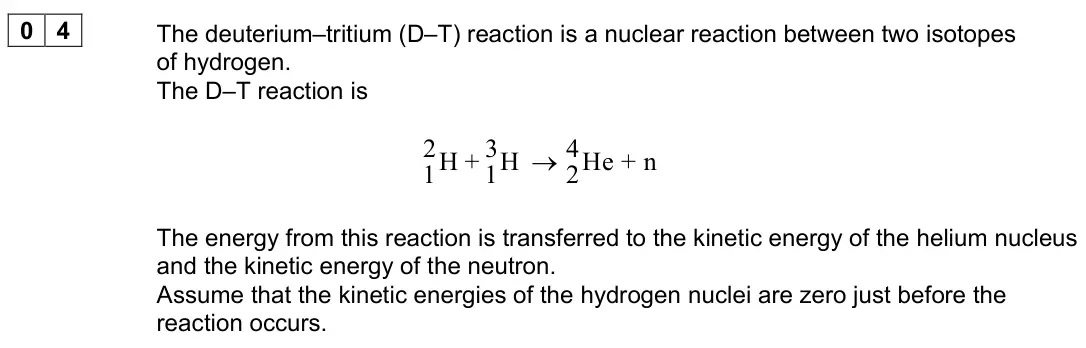
Q05.2
The whole paper ↗
Q06.2
The whole paper ↗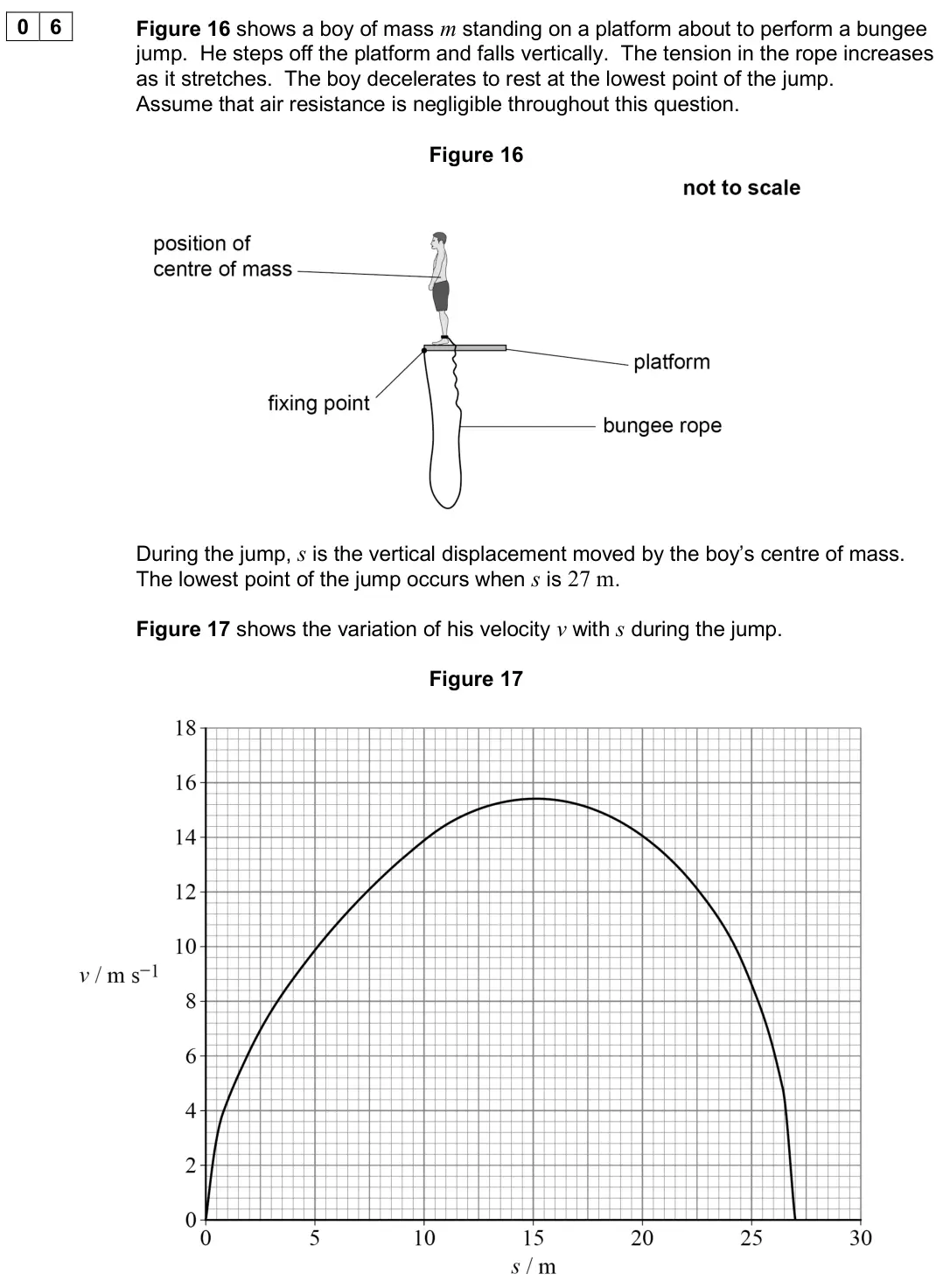
Q06.3
The whole paper ↗Q06.6
The whole paper ↗Q02.2
The whole paper ↗
Q04.4
The whole paper ↗
Q05.4
The whole paper ↗
Q07.5
The whole paper ↗Q01.2
The whole paper ↗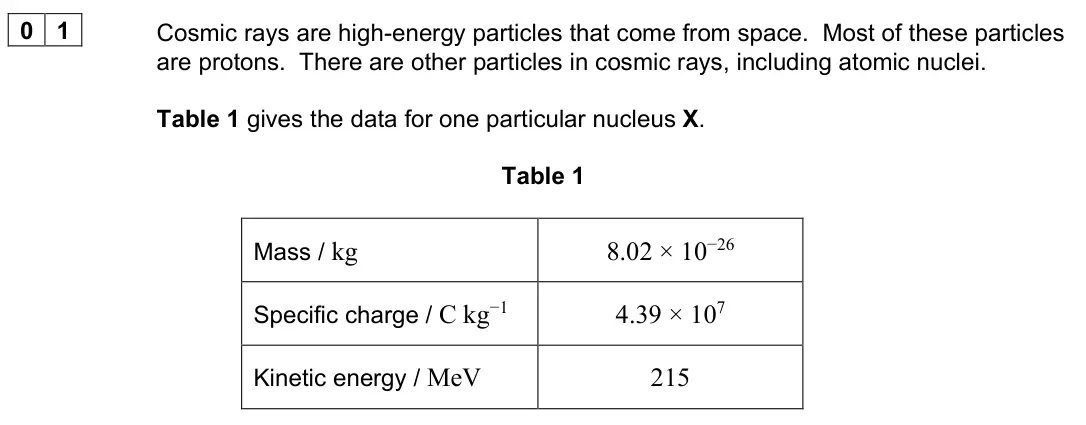
Q02.1
The whole paper ↗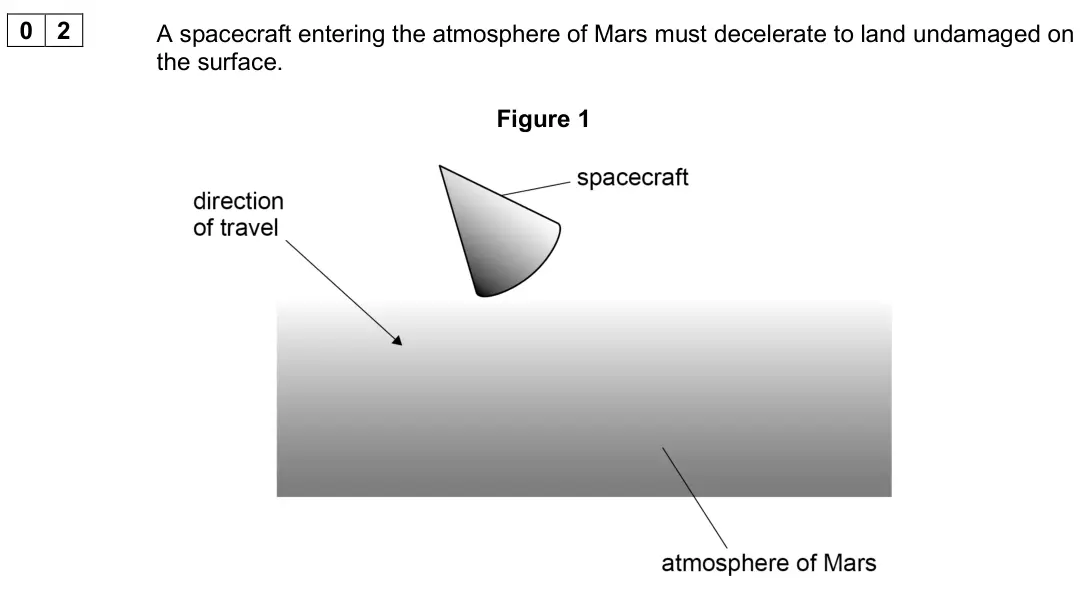
Q02.3
The whole paper ↗
All 77 questions on Conservation of energy, as a list
- June 2025, Paper 1, Q06.1 (2 marks): Calculate the kinetic energy transferred to the ball during the kick. [2 marks] kinetic energy = J
- June 2025, AS Paper 1, Q05.2 (3 marks): Determine the gravitational potential energy gained by the lift during the first 1.5 s of the motion. [3 marks] gravitational potential energy = J
- June 2025, AS Paper 1, Q05.5 (2 marks): Sketch on Figure 8 the variation with time of the kinetic energy of the object from when it becomes detached until it hits the ground. No calculations are requi
- June 2024, Paper 1, Q04.2 (2 marks): The combined kinetic energy of the helium nucleus and the neutron is 2.82 × 10⁻¹² J. Calculate the initial speed of the neutron. [2 marks] initial speed = m s−1
- June 2024, Paper 1, Q05.2 (5 marks): In a second test, pulley P with O attached is released from A. P and O move along the cable to B. The change in height of the centre of mass of O between A and
- June 2024, AS Paper 1, Q06.2 (2 marks): When the boy’s centre of mass has moved through a distance s of 15.0 m the change in his gravitational potential energy is 9.56 kJ. Calculate the mass m of the
- June 2024, AS Paper 1, Q06.3 (3 marks): The maximum kinetic energy of the boy is 7.71 kJ. Calculate, by considering the energy transfers, the extension ΔL of the bungee rope when the kinetic energy of
- June 2024, AS Paper 1, Q06.6 (3 marks): Deduce whether the boy’s maximum velocity is increased when using the second rope. [3 marks]
- June 2023, Paper 1, Q02.2 (2 marks): Engineers are designing a new jet-powered car to break this record. Figure 1 shows the variation of speed with distance for the car, as predicted by the enginee
- June 2023, AS Paper 1, Q04.4 (3 marks): The bow has an efficiency of 0.82 The arrow leaves the bow in a horizontal direction with a velocity of 190 km h−1. Calculate m. [3 marks] m = kg
- June 2023, AS Paper 1, Q05.4 (3 marks): The helicopter has a maximum flight time of a few minutes due to the limited amount of energy stored in the battery. The battery accounts for about 15% of the h
- June 2023, AS Paper 2, Q26 (1 mark): A ball is dropped from a height h. The ball hits the ground with a velocity v. The ball is now dropped from a height of 2h. Air resistance is negligible. What i
- June 2022, AS Paper 1, Q07.5 (4 marks): Energy transfers occur as the cyclist travels down the hill. Outline how these energy transfers explain the shape of the graph in Figure 10. [4 marks]
- November 2021, Paper 1, Q01.2 (3 marks): Calculate the speed of X. Ignore relativistic effects. [3 marks] speed = m s−1
- November 2021, AS Paper 2, Q10 (1 mark): An electron has speed v. The electron’s kinetic energy is doubled. What is the new speed of the electron? [1 mark] A 2 v B 2v C 2v D 4v
- November 2021, AS Paper 2, Q26 (1 mark): A mass m is added to a vertical spring that is initially unextended, as shown in Diagram 1. The mass is then lowered until it hangs stationary on the spring, as
- November 2020, Paper 1, Q08 (1 mark): A photon has energy of 1 × 10¹⁸ eV. An object of mass 0.03 kg has kinetic energy equal to the energy of the photon. What is the speed of the object? [1 mark] A
- November 2020, Paper 1, Q22 (1 mark): A pellet with velocity 200 m s−1 and mass 5.0 g is fired vertically upwards into a stationary block of mass 95.0 g. The pellet remains in the block. The impact
- November 2020, AS Paper 1, Q02.1 (3 marks): Figure 1 shows the spacecraft of total mass 610 kg entering the atmosphere at a speed of 5.5 km s−1. Calculate the kinetic energy of the spacecraft as it enters
- November 2020, AS Paper 1, Q02.3 (3 marks): As the parachute–spacecraft system decelerates, it falls through a vertical distance of 49 m and loses 2.2 × 10⁵ J of kinetic energy. During this time, 3.3 × 10
- June 2019, Paper 1, Q05.1 (2 marks): Show that the initial kinetic energy of the test vehicle is 700 kJ. [2 marks]
- June 2019, Paper 1, Q05.3 (3 marks): Immediately after the collision, the test vehicle moves along the safety barrier with no change in its momentum in this direction. Show that the kinetic energy
- June 2019, AS Paper 1, Q03.4 (3 marks): The designers of the ride claim that the loaded cage will reach a height of 50 m above Q. Deduce whether this claim is justified. [3 marks]
- June 2019, AS Paper 1, Q03.6 (1 mark): Deduce without further calculation whether the maximum speed claim is justified. [1 mark]
- June 2019, AS Paper 2, Q04.2 (3 marks): The boat and trailer are initially at rest. In the first 200 ms the boat and trailer are raised through a vertical height of 3.3 × 10⁻² m and the speed increase
- June 2018, Paper 1, Q01.3 (2 marks): Discuss the energy transfers that take place when a vehicle is decelerated in an escape lane. [2 marks]
- June 2018, Paper 1, Q01.4 (3 marks): An alternative to an escape lane containing gravel is an escape lane that consists of a ramp. An escape ramp is a straight road with a concrete surface that has
- June 2018, AS Paper 1, Q02.1 (2 marks): Figure 1 shows a truck moving freely down a ramp inclined at an angle to the horizontal. Figure 1 The truck starts from rest at the top of the ramp and reaches
- June 2018, AS Paper 1, Q02.2 (3 marks): Figure 2 shows the truck moving down a ramp with a varying slope. Figure 2 The truck starts from rest and moves freely down the ramp. It reaches point C and the
- June 2018, AS Paper 1, Q02.3 (1 mark): The total vertical displacement of the centre of mass of the truck in Figure 2 is also 8.0 m The speed of the truck when it reaches the horizontal runway is the
- June 2017, Paper 3A, Q03.1 (1 mark): The value of p corresponding to n = 0 is the glider’s initial position at the top of the track. Deduce this value of p using Figure 13 and Figure 15. Write this
- June 2017, Paper 3A, Q03.2 (1 mark): and question 03.3. Table 2 n p/cm x/cm ln(x/cm) 0 2 157.0 4 125.4 6 101.3 9 75.4 13 53.8 0 3 . 2 As it travels from the lower end of the track to each position
- June 2017, Paper 3A, Q03.3 (3 marks): Plot on Figure 16 a graph of ln(x/cm) against n. Record your values of ln(x/cm) in Table 2. [3 marks]
- June 2017, Paper 3A, Q03.4 (1 mark): Explain why the graph you plotted confirms that x decreases exponentially with n. [1 mark] Figure 16
- June 2017, Paper 3A, Q03.5 (3 marks): Determine, using your graph in Figure 16, the value of x when n is 20. [3 marks] x when n is 20 = cm
- June 2017, AS Paper 1, Q03.5 (4 marks): Explain how and why the maximum range of the wheelchair on level ground is affected by • the mass of the user • the speed at which the wheelchair travels. [4 ma
- June 2017, AS Paper 2, Q05 (1 mark): [multiple choice] A mass of 2.5 kg is released from rest at X and slides down a ramp, of height 3.0 m, to point Y as shown. When the mass reaches Y at the botto
- June 2016, AS Paper 2, Q26 (1 mark): A roller coaster car is raised to a height of 65 m and released from rest. What is the maximum possible speed of the car? [1 mark] A 11 m s–1 B 25 m s–1 C 36 m
- Specimen, Paper 1, Q04.1 (4 marks): The speed of an air rifle pellet is measured by firing it into a wooden block suspended from a rigid support. The wooden block can swing freely at the end of a
- June 2016, PHYA2 (old spec), Q4(a) (2 marks): State the law of conservation of energy. [2 marks] ______________________________________________________________________________ ______________________________
- June 2016, PHYA2 (old spec), Q4(b)(i) (1 mark): When the block leaves the spring, the block has a kinetic energy of 2.2 J. The mass of the block is 0.40 kg. Calculate the maximum velocity of the block. [1 mar
- June 2016, PHYA2 (old spec), Q4(b)(iii) (3 marks): The spring was initially compressed through 0.20 m. The constant frictional force acts on the block whenever it is moving. Calculate the elastic potential energ
- June 2014, PHYA2 (old spec), Q1(b)(i) (2 marks): Calculate the kinetic energy of the car including the passengers when travelling at 56ms–1. [2 marks] kinetic energy J
- June 2014, PHYA2 (old spec), Q1(b)(ii) (2 marks): Calculate the maximum height above A that would be reached by the car and passengers if all the kinetic energy could be transferred to gravitational potential e
- June 2014, PHYA2 (old spec), Q1(c)(i) (2 marks): Explain the main reason why the car does not reach this height. [2 marks]
- June 2014, PHYA2 (old spec), Q1(c)(ii) (2 marks): The car reaches point C which is at a height of 140m above A. Calculate the speed that the car would reach when it descends from rest at C to its original heigh
- June 2013, PHYA2 (old spec), Q1(b)(i) (2 marks): Calculate the gain in gravitational potential energy (gpe) of the glider. gain in gpe J (2 marks)
- January 2013, PHYA2 (old spec), Q1(a) (2 marks): Calculate the loss in gravitational potential energy (gpe) of a diver of mass 65kg falling through 54m. loss in gpe = J (2 marks)
- January 2013, PHYA2 (old spec), Q1(b) (2 marks): Calculate the vertical velocity of the diver the instant before he enters the water. Ignore the effects of air resistance. velocity = ms–1 (2 marks)
- January 2013, PHYA2 (old spec), Q1(d) (3 marks): Explain, with reference to energy, why the velocity of the diver is independent of his mass if air resistance is insignificant.
- January 2013, PHYA2 (old spec), Q2(c) (3 marks): State and explain what happens to the gravitational potential energy lost between D and E. (3 marks)
- June 2012, PHYA4 Section B (old spec), Q1(b)(i) (1 mark): Show that the velocity of the sand as it lands in the container is 5.6ms–1. (1 mark)
- June 2012, PHYA2 (old spec), Q2(a) (3 marks): Galileo thought that, under these circumstances, the ball would reach position C if released from rest at position A. Position C is the same height above the gr
- January 2012, PHYA4 Section B (old spec), Q3(a)(i) (2 marks): Assuming that the centre of mass of the student has fallen through a vertical distance of 25m when she reaches point P, calculate her speed at P. You may assume
- January 2012, PHYA2 (old spec), Q2(a)(ii) (2 marks): Calculate the kinetic energy of the E-bike and rider when at B. Give your answer to an appropriate number of significant figures. answer = J (2 marks)
- January 2012, PHYA2 (old spec), Q2(a)(iii) (2 marks): Calculate the gravitational potential energy gained by the E-bike and rider between A and B. answer = J (2 marks)
- January 2012, PHYA2 (old spec), Q2(b)(i) (2 marks): Calculate the wasted energy as the cyclist travels from A to B. answer = J (2 marks)
- January 2012, PHYA2 (old spec), Q2(b)(ii) (2 marks): State two causes of this wasted energy. Cause 1 Cause 2 (2 marks)
- June 2011, PHYA2 (old spec), Q3(b) (3 marks): After reaching its top speed the driving force is removed and the rollercoaster train begins to ascend a steep track. By considering energy transfers, calculate
- January 2011, PHYA2 (old spec), Q2(b)(i) (1 mark): Calculate the loss in gravitational potential energy of the cannonball. mass of the cannonball = 22kg answer = J (1 mark)
- January 2011, PHYA2 (old spec), Q2(b)(ii) (2 marks): Describe the energy changes that take place from the moment the cannonball leaves the cannon until just before it hits the water. Include the effects of air res
- June 2010, PHYA4 Section B (old spec), Q3(b)(ii) (4 marks): Determine the total amount of energy given to the probe and capsule by the explosion. answer = J (4 marks)
- June 2010, PHYA2 (old spec), Q4(a) (2 marks): Calculate the increase in her gravitational potential energy when she ascends from position A to position B. answer = J (2 marks)
- June 2010, PHYA2 (old spec), Q4(b)(i) (1 mark): Calculate her kinetic energy at the instant she touches the unstretched trampoline. answer = J (1 mark)
- June 2010, PHYA2 (old spec), Q4(b)(ii) (2 marks): Calculate her vertical speed at the same instant. answer = ms-1 (2 marks)
- June 2010, PHYA2 (old spec), Q4(e) (6 marks): On her next jump the gymnast decides to reach a height above position B. Describe and explain, in terms of energy and work, the transformations that occur as sh
- January 2010, PHYA4 Section B (old spec), Q1(b)(ii) (2 marks): To set her swinging, the girl and seat were displaced from equilibrium and released from rest. This initial displacement of the girl raised the centre of mass o
- January 2010, PHYA4 Section B (old spec), Q1(b)(iii) (1 mark): Calculate the maximum speed of the girl during the first oscillation. answer = ms–1 (1 mark)
- January 2010, PHYA2 (old spec), Q7(a)(ii) (2 marks): Calculate the kinetic energy of the air that would enter the turbine each second. answer = J (2 marks)
- June 2009, PHYA2 (old spec), Q1(a)(i) (2 marks): Calculate the total kinetic energy of the cyclist and the cycle on reaching the horizontal section of the road. answer J (2 marks)
- June 2009, PHYA2 (old spec), Q1(a)(ii) (2 marks): The height difference between the top of the hill and the horizontal section of road is 12 m. Calculate the loss of gravitational potential energy of the cyclis
- June 2009, PHYA2 (old spec), Q1(a)(iii) (3 marks): The work done by the cyclist when pedalling downhill is 2400 J. Account for the difference between the loss of gravitational potential energy and the gain of ki
- January 2009, PA02 (2008 spec), Q1(e) (5 marks): 1 (e) (i) Using your answer from part (d) calculate the change in potential energy, ΔEp, of the object that occurred during the first 16 s. 1 (e) (ii) Calculate
- June 2008, PA02 (2008 spec), Q6(a) (1 mark): 6 (a) State the main energy changes that take place as the hammer is falling. (1 mark)
- June 2008, PA02 (2008 spec), Q6(b) (4 marks): 6 (b) The hammer has a mass of 250 kg and falls 4.5 m before striking the pile. After impact the hammer and pile move downwards together. Calculate 6 (b) (i) th
- June 2008, PA10 (2008 spec), Q1(a) (3 marks): 1 (a) Calculate the speed and kinetic energy of the car before the brakes are applied. (3 marks)
- January 2008, PA02 (2008 spec), Q6(a) (2 marks): (a) Calculate the kinetic energy lost by the car. (2 marks)
Questions, mark schemes and examiner’s reports are © AQA, from their published past papers. Plumi isn’t affiliated with any exam board. Want whole papers? AQA A-Level Physics past papers.
The Plumi iPad app also offers exam-style questions with AI feedback on your handwritten working.