 plumi
Newton’s laws of motion: AQA A‑Level Physics questions
AQA A-Level Physics past-paper questions on 3.4.1.5 Newton’s laws of motion, 2008–2025, with mark schemes and examiner’s reports where available.
Paper
All papers
Exam
All years
Calculations
Q07.4
The whole paper ↗
Q05.3
The whole paper ↗
Q04.2
The whole paper ↗
Q04.6
The whole paper ↗Q06.1
The whole paper ↗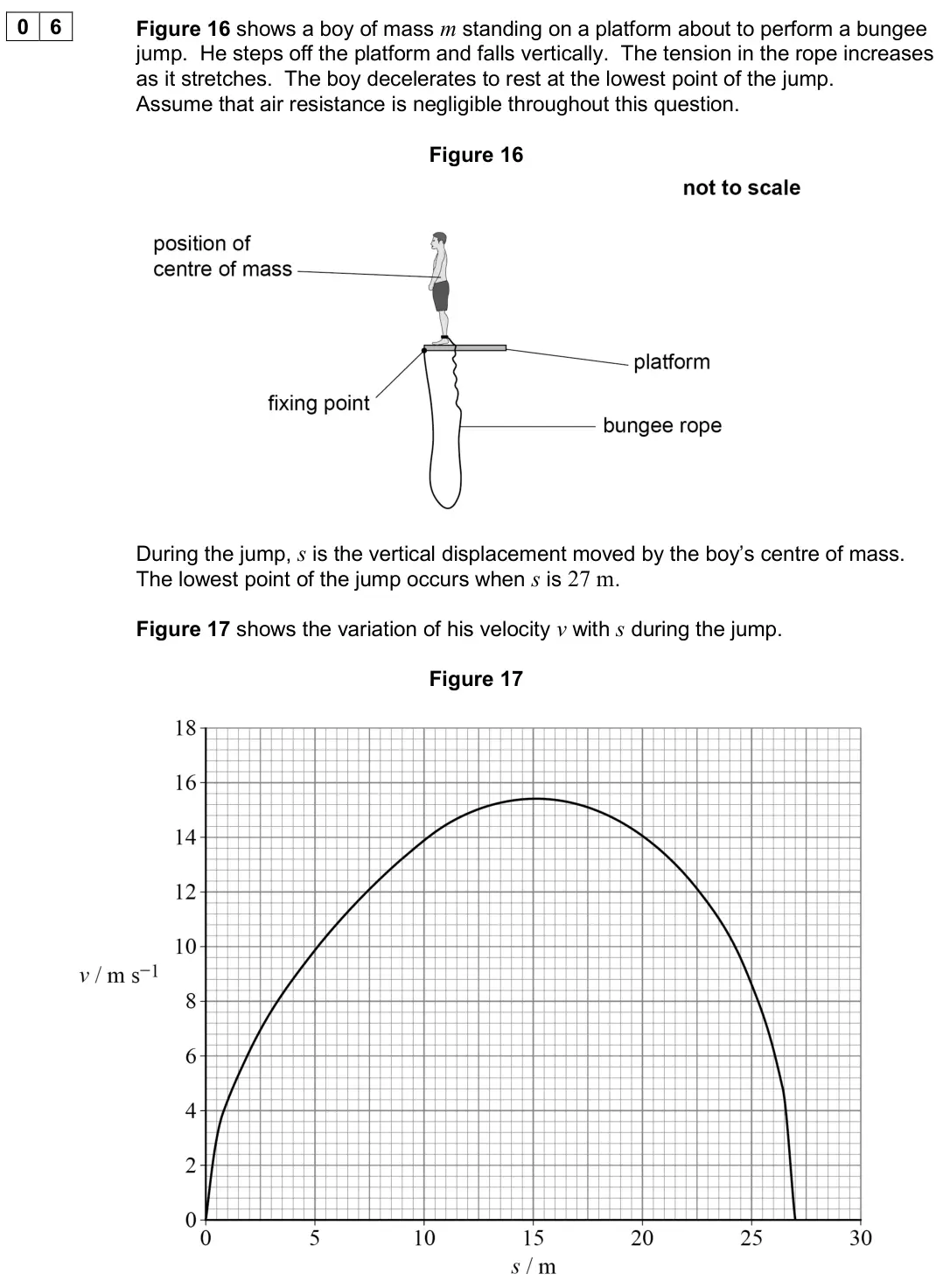
Q01.7
The whole paper ↗
Q03.2
The whole paper ↗
Q02.3
The whole paper ↗
Q04.2
The whole paper ↗
Q05.7
The whole paper ↗
Q05.4
The whole paper ↗
Q04.5
The whole paper ↗
All 85 questions on Newton’s laws of motion, as a list
- June 2025, Paper 1, Q07.4 (2 marks): The car in Figure 11 stays at the same height on the curved section of the track. There is no tendency for the car to slip up or down the track and therefore th
- June 2025, Paper 1, Q21 (1 mark): A skydiver is falling at a terminal velocity v1. When she is at a height h1 she opens her parachute. When she is at a height h2 she reaches a new terminal veloc
- June 2025, Paper 1, Q23 (1 mark): A ramp is inclined at an angle θ to the horizontal. A block of weight 240 N is pushed up the ramp by a 25.0 N force. This force acts parallel to the ramp. The b
- June 2025, AS Paper 1, Q05.3 (3 marks): Q and R are connected to P as shown in Figure 6. Determine the tension in P during the last 2.0 s of the motion. [3 marks] tension = N
- June 2025, AS Paper 2, Q13 (1 mark): Two skydivers X and Y step out of a stationary hot-air balloon at the same time. Both skydivers reach terminal speed. mass of X = 120 kg mass of Y = 90 kg Which
- June 2024, Paper 1, Q18 (1 mark): A force of magnitude F acts on a box of mass m that moves along a frictionless slope. The slope is at an angle α to the horizontal and the force acts at an angl
- June 2024, Paper 1, Q23 (1 mark): A man has a mass of 75.0 kg. He stands on weighing scales in a lift that accelerates upwards at 2.60 m s−2. What is the reading on the scales during the acceler
- June 2024, AS Paper 1, Q04.2 (2 marks): Initially, there are no resistive forces and the trailer accelerates at 1.5 m s−2. Calculate the initial value of PH. [2 marks] PH = N
- June 2024, AS Paper 1, Q04.6 (3 marks): The air resistance D acting on the trailer increases as the velocity v of the trailer increases. Explain this increase in D with reference to the momentum of th
- June 2024, AS Paper 1, Q06.1 (1 mark): The boy experiences freefall when he steps off the platform. During which part of the jump does the boy’s acceleration begin to decrease? Tick () one box. [1 m
- June 2024, AS Paper 2, Q01.7 (2 marks): Figure 6 is a diagram drawn by a student to explain why the trolley accelerates. The diagram is incomplete because the student has ignored the friction forces i
- June 2024, AS Paper 2, Q03.2 (4 marks): The load is accelerated from its lowest point. The mass of the load is 2.8 × 10⁵ kg. The maximum tension in each cable is 1.6 × 10⁶ N during the acceleration. C
- June 2023, Paper 1, Q02.3 (4 marks): At any point on the graph in Figure 1, the acceleration is given by: acceleration = speed × gradient of line When the car is at its maximum acceleration, the po
- June 2023, Paper 1, Q24 (1 mark): A trolley moves down a slope with constant acceleration. The mass of the trolley is doubled and the trolley moves down the same slope again. Air resistance and
- June 2023, AS Paper 1, Q04.2 (2 marks): An arrow of mass 21 g is placed in the bow. The archer pulls P back by a distance s of 0.22 m and then releases the arrow in a horizontal direction. Assume that
- June 2023, AS Paper 1, Q05.7 (2 marks): A student suggests that the acceleration of the helicopter is constant from the instant the blades stop rotating until the helicopter makes contact with the sur
- June 2022, Paper 1, Q05.4 (2 marks): Describe, with reference to one of Newton’s laws of motion, the evidence that a resultant force is acting on the block. [2 marks]
- June 2022, Paper 1, Q24 (1 mark): A truck of mass 2.1 × 10³ kg tows a car of mass 1.3 × 10³ kg along a horizontal road. The total resistive force on the car is 1100 N. The acceleration of the ca
- June 2022, Paper 1, Q25 (1 mark): A parachutist descends to the ground at a constant speed with the parachute open. Which force, together with the parachutist’s weight, makes a pair according to
- June 2022, AS Paper 2, Q04.5 (2 marks): Determine, using Figure 7, the combined mass of the athlete and chair. [2 marks] mass = kg END OF SECTION B Section C
- June 2022, AS Paper 2, Q25 (1 mark): A firework rocket moves vertically upwards. The rocket’s fuel burns at a steady rate to produce a constant thrust. The mass of the rocket decreases with time. I
- November 2021, Paper 1, Q24 (1 mark): A Formula 1 racing car uses up its fuel during the race, causing its lap times to decrease. The lap times decrease because [1 mark] A the acceleration of the ca
- November 2021, AS Paper 1, Q05.2 (4 marks): Figure 11 shows the direction of the thrust exerted by the ship’s propeller as the propeller rotates. The ship’s engine makes the propeller rotate. When more wa
- November 2021, AS Paper 1, Q05.3 (3 marks): Figure 12 shows the bottom of the hull with a drag reduction system in operation. Air bubbles are introduced into the water below the hull. This reduces the wor
- November 2021, AS Paper 2, Q04.1 (1 mark): Draw an arrow on Figure 11 to show the line of action of F. [1 mark]
- November 2021, AS Paper 2, Q04.3 (3 marks): The belt is driven by an electric motor. When the motor is switched on, the belt and the block accelerate uniformly from rest to a speed of 0.32 m s−1 in a time
- November 2021, AS Paper 2, Q24 (1 mark): A suitcase weighing 200 N is placed on a weighing scale in a lift. The scale reads 180 N when the lift is moving. The lift is [1 mark] A moving down at a consta
- November 2020, Paper 1, Q04.3 (4 marks): The chevron separation is based on the response time, not on the time taken for a car to stop. The brakes of a car are applied when its speed is 31 m s−1 and th
- November 2020, AS Paper 1, Q02.2 (4 marks): A parachute opens during the spacecraft’s descent through the atmosphere. Figure 2 shows the parachute–spacecraft system, with the open parachute displacing the
- November 2020, AS Paper 1, Q02.4 (3 marks): Dust from the surface of Mars can enter the atmosphere. This increases the density of the atmosphere significantly. Deduce how an increase in dust content will
- June 2019, Paper 1, Q14 (1 mark): A 0.20 kg mass is suspended from a spring. A 0.10 kg mass is suspended from the 0.20 kg mass using a thread of negligible mass. The system is in equilibrium and
- June 2019, Paper 1, Q15 (1 mark): A lift of mass M is suspended from a cable. The lift descends with a downward acceleration, a. A frictional force F acts on the lift. What is the tension T in t
- June 2019, AS Paper 1, Q03.2 (2 marks): Calculate the initial acceleration of the loaded cage when the clamp is released. [2 marks] acceleration = m s–2
- June 2019, AS Paper 2, Q03.6 (2 marks): The reflectance of a surface is proportional to the percentage of incident photons that are reflected off the surface. Explain the effect of increasing the refl
- June 2018, Paper 1, Q01.1 (3 marks): Determine the force decelerating the vehicle 2.0 s after entering the escape lane. [3 marks] force decelerating the vehicle = N
- June 2018, Paper 1, Q22 (1 mark): Immediately after take-off from the surface of the Earth, a rocket of mass 12 000 kg accelerates vertically upwards at 1.4 m s−2 What is the thrust produced by
- June 2018, AS Paper 2, Q02.4 (5 marks): The student measures the mass mB of magnet B and then positions the magnet so it is in equilibrium above magnet A as shown in Figure 7. The student measures the
- June 2018, AS Paper 2, Q04.2 (3 marks): Figure 10 shows a cross-sectional view of an optical fibre strain gauge. Figure 10 A maximum intensity of the reflected light is produced due to superposition o
- June 2018, AS Paper 2, Q24 (1 mark): Two spheres, P and Q, have the same volume but P has a greater mass. The spheres fall in air at their terminal velocities vP and vQ respectively. Which row stat
- June 2017, Paper 1, Q06.1 (1 mark): The tension in the wire when the trolleys are moving is T. Draw and label arrows on Figure 9 to represent the magnitudes and directions of any forces and compon
- June 2017, Paper 1, Q06.2 (2 marks): Assume that no friction acts at the axle of the pulley or at the axles of the trolleys and that air resistance is negligible. Show that the acceleration a of tr
- June 2017, Paper 1, Q06.4 (3 marks): In practice, for safety reasons there is a friction brake in the pulley that provides a resistive force to reduce the acceleration to 25% of the maximum possibl
- June 2017, Paper 1, Q20 (1 mark): A rocket of mass 12 000 kg accelerates vertically upwards from the surface of the Earth at 1.4 m s−2. What is the thrust of the rocket? [1 mark] A 1.7 × 10⁴ N B
- June 2016, AS Paper 1, Q01.2 (3 marks): Explain, using appropriate laws of motion, why the air exerts a force on the engine in the forward direction. [3 marks]
- June 2016, AS Paper 1, Q01.5 (1 mark): The total horizontal decelerating force exerted on the deflector plates of the jet engines is 190 kN. Calculate the deceleration of the aircraft when it has a m
- June 2016, AS Paper 2, Q03.4 (2 marks): Before an earthquake occurs, the line being drawn on the graph paper is horizontal. Explain what happens to the line on the graph paper when an earthquake is de
- June 2016, AS Paper 2, Q23 (1 mark): The mass of fuel in a racing car decreases during a race. As a result the lap time decreases. Which of the following could explain this decrease? [1 mark] A The
- Specimen, Paper 1, Q02.6 (3 marks): A student adds a series of masses to a vertical metal wire of circular cross-section and measures the extension of the wire produced. Figure 1 is a force–extens
- Specimen, Paper 1, Q24 (1 mark): Two masses hang at rest from a spring, as shown in the diagram. The string separating the masses is burned through. Which of the following gives the acceleratio
- Specimen, Paper 1, Q27 (1 mark): The velocity of a vehicle varies with time as shown by the following graph. Which graph below represents how the resultant force F on the car varies during the
- June 2016, PHYA2 (old spec), Q3(a) (2 marks): On leaving the space station the spacecraft is given an initial horizontal thrust of 1400 N. Calculate the initial acceleration of the spacecraft during the fir
- June 2016, PHYA2 (old spec), Q3(b)(i) (1 mark): State one way in which a pair of forces referred to in Newton’s Third Law are the same. [1 mark] _______________________________________________________________
- June 2016, PHYA2 (old spec), Q3(b)(ii) (1 mark): State one way in which a pair of forces are different. [1 mark] ______________________________________________________________________________ _________________
- June 2016, PHYA2 (old spec), Q3(c) (1 mark): When the spacecraft returns to the Earth’s atmosphere the orbital module and the service module are separated from the descent module. This descent module has i
- June 2016, PHYA2 (old spec), Q3(d) (3 marks): In one particular descent, the descent module has its speed reduced to 5.5 m s–1 by parachutes. The descent module also releases its empty tanks and shield to r
- June 2016, PHYA2 (old spec), Q5 (6 marks): A fully-loaded lorry transporting water starts from rest and travels along a straight road. Figure 7 is a graph showing how the speed of the lorry varies with t
- June 2015, PHYA4 Section B (old spec), Q5(c) (6 marks): Discuss the motion of the ball in terms of the forces that act on it. In your answer you should: l explain how Newton’s three laws of motion apply to its motion
- June 2015, PHYA2 (old spec), Q3(a)(ii) (2 marks): Calculate the average horizontal resultant force on the vehicle while it is accelerating. [2 marks] resultant force = N
- June 2015, PHYA2 (old spec), Q3(b) (3 marks): State and explain how the horizontal forward force on the vehicle has to change for constant acceleration to be maintained from 0 to 27.8 m s–1. [3 marks]
- June 2015, PHYA2 (old spec), Q3(c) (2 marks): The electric motors drive both wheels of the vehicle. Add labelled force arrows to Figure 3 to show the horizontal forces acting on the vehicle when it is movin
- June 2014, PHYA2 (old spec), Q2(b)(ii) (3 marks): The athlete has a mass of 75kg. Calculate the horizontal component of the resistive force from the sand. [3 marks] horizontal component of resistive force N
- June 2014, PHYA2 (old spec), Q3(a)(i) (1 mark): Calculate the mass of the ship if its weight was 3.4 × 10⁴ N. [1 mark] mass kg
- June 2013, PHYA2 (old spec), Q1(a)(iii) (2 marks): Calculate the resultant acceleration of the glider in Figure 1. resultant acceleration m s–2 (2 marks)
- June 2013, PHYA2 (old spec), Q3(b)(i) (6 marks): Figure 4 shows the velocity-time graph for steel ball A. Figure 4 Explain the shape of the graph in Figure 4. Your account should include l how the velocity and
- January 2013, PHYA2 (old spec), Q4(a) (2 marks): Each cable has a mass of 4.8kg per metre. Calculate the weight of a 35m length of one cable. weight = N (2 marks)
- June 2012, PHYA2 (old spec), Q2(c) (2 marks): Newton later published his three laws of motion. Explain how Newton’s first law of motion is illustrated by the motion of the ball between B and X. (2 marks)
- June 2012, PHYA2 (old spec), Q3(b)(ii) (2 marks): Calculate the resultant force necessary to produce this acceleration. answer = N (2 marks)
- January 2012, PHYA2 (old spec), Q3(b)(i) (2 marks): When the resultant horizontal force is 155kN, calculate the horizontal acceleration of the aircraft. answer = ms–2 (2 marks)
- June 2011, PHYA4 Section B (old spec), Q2(a)(ii) (2 marks): Calculate the acceleration of the trolley at the moment of release and state its direction. answer = ms–2 direction (2 marks)
- June 2011, PHYA2 (old spec), Q1(b)(i) (2 marks): Explain how Newton’s third law of motion applies to Figure 2. (2 marks)
- June 2011, PHYA2 (old spec), Q1(b)(ii) (2 marks): Explain why there is a resultant upward force on the ball in Figure 2. (2 marks)
- June 2011, PHYA2 (old spec), Q2(b) (1 mark): The student doubles the mass of the card and finds a value for g that is similar to the original value. Use the relationship between weight, mass and g to expla
- June 2011, PHYA2 (old spec), Q3(a)(ii) (3 marks): Calculate the average tension in the cable as the train is accelerated, stating an appropriate unit. answer = (3 marks)
- January 2011, PHYA2 (old spec), Q5(a)(i) (2 marks): The average thrust from the rocket was 30kN and the mass of the Lunar Module was 15100kg. Calculate the horizontal deceleration of the Lunar Module. answer = ms
- January 2011, PHYA2 (old spec), Q5(b)(i) (2 marks): Draw force vectors on Figure 6 to show the forces acting on the Lunar Module at this time. Label the vectors. (2 marks)
- January 2011, PHYA2 (old spec), Q5(b)(ii) (2 marks): Calculate the thrust force needed to maintain a constant vertical downwards velocity. answer = N (2 marks)
- June 2010, PHYA2 (old spec), Q2(b)(ii) (2 marks): Calculate the initial acceleration down the slope. answer = ms-2 (2 marks)
- June 2010, PHYA2 (old spec), Q4(c) (1 mark): Draw an arrow on Figure 4 to show the force exerted on the gymnast by the trampoline when she is in position A. (1 mark)
- June 2009, PHYA2 (old spec), Q1(b)(ii) (3 marks): Calculate the average horizontal force on the cyclist and the cycle during this time. answer N (3 marks)
- June 2009, PHYA2 (old spec), Q3(b) (6 marks): Figure 4 below shows how the velocity of the ball changed after it was released. Figure 4 velocity time after release νo 0 0 to Describe and explain how the acc
- January 2009, PA02 (2008 spec), Q1(b) (4 marks): 1 (b) State two forces that act on the falling object and explain how these forces cause the changes in acceleration described in part (a). (4 marks)
- January 2009, PA02 (2008 spec), Q2(b) (3 marks): 2 (b) In a collision, ball A collides with ball B. During the collision, ball A exerts a force FA, on ball B and ball B exerts a force FB, on ball A. 2 (b) (i)
- June 2008, PA02 (2008 spec), Q2(a) (2 marks): 2 (a) With reference to an appropriate law of motion, explain why the sledge is moving at constant velocity. (2 marks)
- January 2008, PA02 (2008 spec), Q3(a) (5 marks): (a) With reference to Newton’s Laws of motion, (i) state and explain why the momentum of the water changes as it strikes the wall, (ii) explain why the water ex
- January 2008, PA02 (2008 spec), Q5(a) (3 marks): (a) Calculate (i) the initial acceleration of the aircraft, (ii) the minimum length of runway required, assuming the acceleration is constant. (3 marks)
Questions, mark schemes and examiner’s reports are © AQA, from their published past papers. Plumi isn’t affiliated with any exam board. Want whole papers? AQA A-Level Physics past papers.
The Plumi iPad app also offers exam-style questions with AI feedback on your handwritten working.