 plumi
Bulk properties of solids: AQA A‑Level Physics questions
AQA A-Level Physics past-paper questions on 3.4.2.1 Bulk properties of solids, 2008–2025, with mark schemes and examiner’s reports where available.
Paper
All papers
Exam
All years
Calculations
Q04.1
The whole paper ↗Q04.2
The whole paper ↗Q04.3
The whole paper ↗Q06.3
The whole paper ↗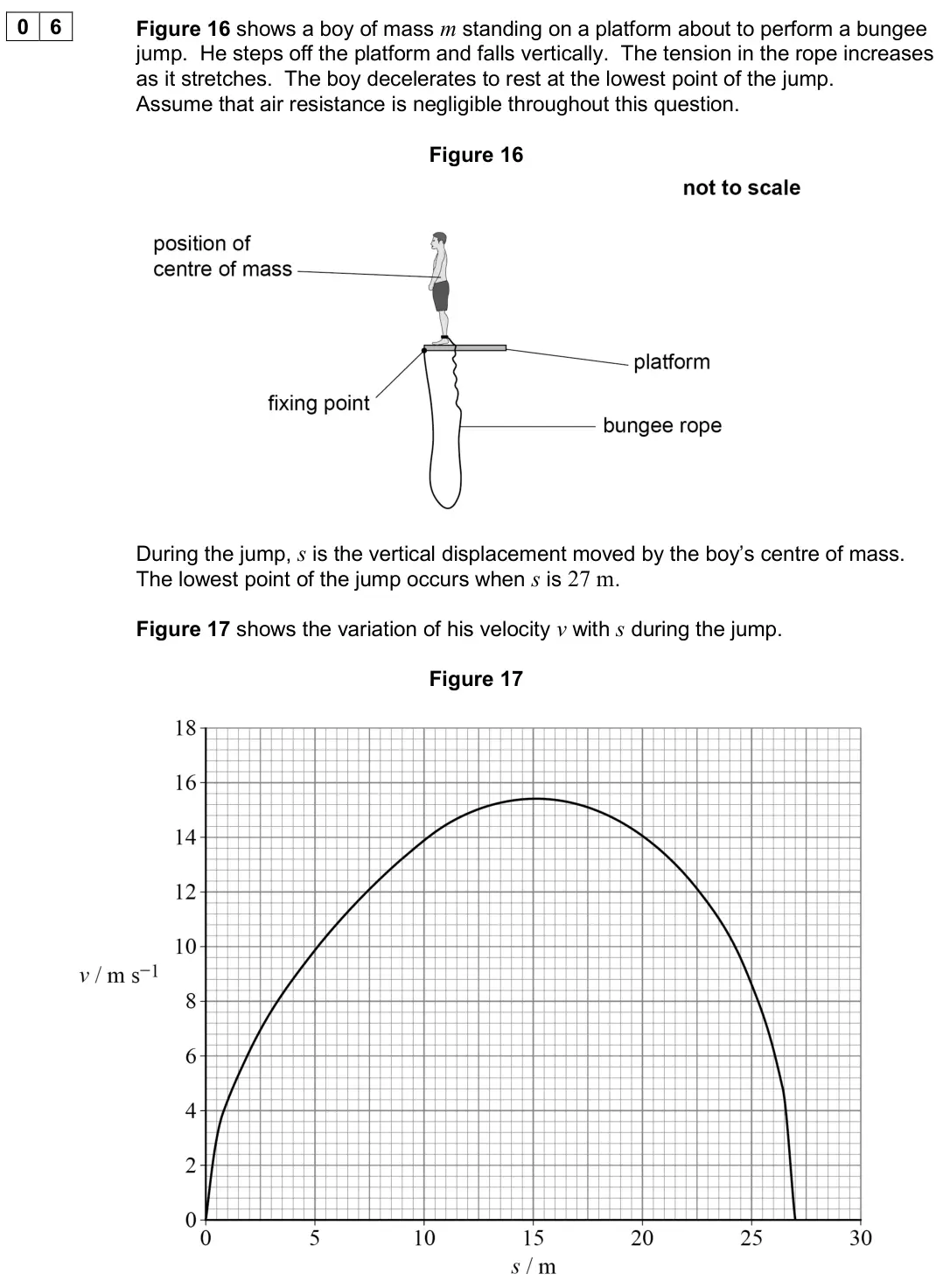
Q06.4
The whole paper ↗Q06.6
The whole paper ↗Q02.1
The whole paper ↗
Q02.2
The whole paper ↗Q02.3
The whole paper ↗Q03.1
The whole paper ↗
Q03.3
The whole paper ↗Q05.2
The whole paper ↗
Q04.3
The whole paper ↗
All 123 questions on Bulk properties of solids, as a list
- June 2025, Paper 1, Q04.1 (1 mark): Explain why the Young modulus and the breaking stress of a wire have the same SI unit. [1 mark] Table 1 contains data about four metal wires W, X, Y and Z. Tabl
- June 2025, Paper 1, Q04.2 (3 marks): The metal used to make wire X costs £75 per gram. Calculate, in £, the cost of wire X. [3 marks] cost = £
- June 2025, Paper 1, Q04.3 (1 mark): State and explain which of the wires in Table 1 are made from the same material. [1 mark]
- June 2025, AS Paper 2, Q24 (1 mark): A rod is made of a metal of Young modulus E. When the rod is unstretched, it has a cross-sectional area A and a length L. A force is then applied to the rod tha
- June 2025, AS Paper 2, Q29 (1 mark): A cylindrical rod R is made of a material with a density ρ. R has mass m and diameter d. Four other cylindrical rods A, B, C and D each have diameter 2d. The ta
- June 2024, Paper 1, Q25 (1 mark): A uniform wire is stretched by a load F. The elastic strain energy stored in the wire is E. The load is increased from F to 2F. The wire obeys Hooke’s law. What
- June 2024, Paper 1, Q26 (1 mark): A spring is compressed by a force F. The spring has stiffness k and its length changes by ΔL during the compression. When the force is removed the spring return
- June 2024, AS Paper 1, Q06.3 (3 marks): The maximum kinetic energy of the boy is 7.71 kJ. Calculate, by considering the energy transfers, the extension ΔL of the bungee rope when the kinetic energy of
- June 2024, AS Paper 1, Q06.4 (2 marks): Deduce the tension in the rope when the kinetic energy of the boy is at a maximum. Give a reason to support your answer. [2 marks] tension = N reason The origin
- June 2024, AS Paper 1, Q06.6 (3 marks): Deduce whether the boy’s maximum velocity is increased when using the second rope. [3 marks]
- June 2024, AS Paper 2, Q02.1 (1 mark): Determine the value of F that was used to produce Figure 9. [1 mark] F = N
- June 2024, AS Paper 2, Q02.2 (2 marks): Brass was not one of the five materials tested. When brass was tested using these values of F and D, the value of h = 1.60 mm. Determine, using Figure 9, B for
- June 2024, AS Paper 2, Q02.3 (2 marks): B for lead is about 5 kg mm−2. Show that this result cannot be obtained with the steel sphere and the value of F used to produce Figure 9. Go on to suggest how
- June 2024, AS Paper 2, Q03.1 (2 marks): Calculate L. density of steel = 7.4 × 10³ kg m−3 [2 marks] L = m
- June 2024, AS Paper 2, Q03.3 (2 marks): For safety, the breaking stress of each steel cable must be at least three times the maximum stress produced during the initial acceleration. breaking stress fo
- June 2024, AS Paper 2, Q10 (1 mark): A wire obeys Hooke’s law. When the wire is extended by ΔL, the elastic strain energy is Es and the tension in the wire is T. Which pair of graphs shows the vari
- June 2024, AS Paper 2, Q24 (1 mark): Which statement is true? [1 mark] A A brittle fracture occurs after little or no elastic deformation. B A brittle fracture occurs after little or no plastic def
- June 2023, Paper 1, Q05.2 (1 mark): Explain how the graph shows that this metal is brittle. [1 mark]
- June 2023, Paper 1, Q26 (1 mark): A heavy cable is attached to a fixed support and carries a load at its lower end. The weight of the cable is not negligible. The cable has constant cross-sectio
- June 2023, AS Paper 1, Q04.3 (2 marks): Deduce sr. [2 marks] sr = m
- June 2023, AS Paper 1, Q05.1 (3 marks): The gas moved by the rotor blades has a density of 0.020 kg m−3. Show that the helicopter moves approximately 0.4 kg of gas every second. [3 marks]
- June 2022, Paper 1, Q03.1 (3 marks): Deduce which one of the three materials is used for A. [3 marks]
- June 2022, Paper 1, Q27 (1 mark): A mass M is suspended from a spring. When the mass is at rest at the equilibrium position, the elastic potential energy stored is E. An extra mass of 2M is adde
- June 2022, Paper 1, Q28 (1 mark): Two wires P and Q are made of the same material and have the same cross-sectional area. P has an original length L and is subject to a tensile force F. P extend
- June 2022, AS Paper 1, Q06.2 (2 marks): Determine d for position X. [2 marks] d = m
- June 2022, AS Paper 2, Q06 (1 mark): A baby bouncer consists of an inextensible harness attached to a spring. The stiffness of the spring is in the range: [1 mark] A 1–10 N m−1 B 10–100 N m−1 C 100
- June 2022, AS Paper 2, Q14 (1 mark): A mass M hangs in equilibrium from a vertical spring that obeys Hooke’s law. M is pulled down by 10 cm and then released to oscillate about the equilibrium posi
- June 2022, AS Paper 2, Q29 (1 mark): A wire is made from a material of Young modulus E. The wire obeys Hooke’s law. The wire has an unstretched length L and a cross-sectional area A. When a force i
- November 2021, AS Paper 1, Q03.3 (4 marks): The block is rectangular with an area of cross-section of 8.0 cm2 and a thickness of 3.0 cm. Figure 6 shows how the density of the block varies with depth up to
- November 2021, AS Paper 2, Q26 (1 mark): A mass m is added to a vertical spring that is initially unextended, as shown in Diagram 1. The mass is then lowered until it hangs stationary on the spring, as
- November 2020, AS Paper 2, Q26 (1 mark): A tensile force 1F causes a wire to stretch to length 1x . When the tensile force is increased to 2F the length of the wire is 2x . The wire obeys Hooke’s Law.
- November 2020, AS Paper 2, Q27 (1 mark): Which is a force–extension graph for a brittle material? [1 mark] A B C D A B C D
- June 2019, Paper 1, Q19 (1 mark): A load of 50 N is suspended from a wire that has an area of cross-section of 1 mm2. The stress in the wire, in Pa, is between [1 mark] A 100 and 103 B 103 and 1
- June 2019, Paper 3A, Q03.7 (3 marks): Determine the density of the rod. The mass per unit length of the rod is 3.54 × 10⁻³ kg m−1. [3 marks] density = kg m−3
- June 2019, AS Paper 1, Q03.3 (4 marks): The unstretched length of each elastic rope is 24 m. The ropes obey Hooke’s Law for all extensions used in the ride. The vertical distance between points P and
- June 2019, AS Paper 1, Q03.4 (3 marks): The designers of the ride claim that the loaded cage will reach a height of 50 m above Q. Deduce whether this claim is justified. [3 marks]
- June 2018, Paper 1, Q03.4 (4 marks): Figure 6 shows how the tension in the string in question 03.2 varies with the extension of the string. Figure 6 The string with its initial tension of 25 N is v
- June 2018, Paper 1, Q21 (1 mark): A non-uniform sign is 0.80 m long and has a weight of 18 N It is suspended from two vertical springs P and Q. The springs obey Hooke’s law and the spring consta
- June 2018, AS Paper 1, Q05.1 (2 marks): Calculate the weight of an ice cube that has volume 4.0 × 10⁻⁶ m3 density of ice = 920 kg m–3 [2 marks] weight = N
- June 2018, AS Paper 1, Q05.2 (1 mark): Figure 5 shows the ice cube floating in a beaker of water. Figure 5 When the ice cube is placed in the beaker, it displaces a volume of water causing the water
- June 2018, AS Paper 1, Q05.3 (3 marks): The ice cube in Figure 5 is replaced by another cube also with volume 4.0 × 10⁻⁶ m3 This cube is made of ice containing a small piece of iron. The mass of water
- June 2018, AS Paper 2, Q23 (1 mark): The table contains information on four wires. It shows the stiffness of each wire and the maximum strain energy stored in the wire when extended to the breaking
- June 2017, AS Paper 1, Q05.4 (1 mark): Calculate the mass of a 1.0 m length of the aerial wire. Density of copper = 8900 kg m–3 [1 mark] mass = kg
- June 2017, AS Paper 1, Q05.7 (2 marks): High winds produce large amplitudes of vibration of the aerial wire. Explain why the wire may sag when the high wind stops. [2 marks]
- June 2017, AS Paper 2, Q17 (1 mark): What is the name given to a material that breaks without deformation when a force is applied to it? [1 mark] A Plastic B Brittle C Stiff D Elastic
- June 2017, AS Paper 2, Q30 (1 mark): Two separate wires X and Y have the same original length and cross-sectional area. The graph shows the extension ΔL produced in X and Y when the tensile force F
- June 2016, AS Paper 1, Q03.2 (2 marks): Identify a property of material A using evidence from the graph to support your choice. [2 marks] property evidence
- June 2016, AS Paper 1, Q03.4 (6 marks): Discuss which of the four materials shown on the graph is most suitable for each of the following applications: • the cable supporting a lift in a tall building
- June 2016, AS Paper 2, Q03.1 (3 marks): The ball is made of steel of density 8030 kg m–3 and has a diameter of 5.0 cm. Show that the weight of the ball is approximately 5 N. [3 marks]
- June 2016, AS Paper 2, Q03.3 (3 marks): The spring is attached at a distance of 8.0 cm from the pivot and the spring has a stiffness of 100 N m–1. Calculate the extension of the spring when the rod is
- Specimen, Paper 1, Q02.1 (1 mark): A student adds a series of masses to a vertical metal wire of circular cross-section and measures the extension of the wire produced. Figure 1 is a force–extens
- Specimen, Paper 1, Q02.3 (1 mark): A student adds a series of masses to a vertical metal wire of circular cross-section and measures the extension of the wire produced. Figure 1 is a force–extens
- Specimen, Paper 1, Q02.4 (2 marks): A student adds a series of masses to a vertical metal wire of circular cross-section and measures the extension of the wire produced. Figure 1 is a force–extens
- June 2016, PHYA2 (old spec), Q4(b)(iii) (3 marks): The spring was initially compressed through 0.20 m. The constant frictional force acts on the block whenever it is moving. Calculate the elastic potential energ
- June 2016, PHYA2 (old spec), Q4(b)(iv) (1 mark): The force exerted on the block by the spring is proportional to the compression of the spring. Calculate the maximum force exerted on the block by the spring. [
- June 2015, PHYA2 (old spec), Q2(b)(iii) (2 marks): The extension of the spring is 15 mm. Calculate the spring constant k of the spring. Give your answer in N m–1. [2 marks] spring constant = N m–1
- June 2015, PHYA2 (old spec), Q2(b)(iv) (2 marks): Calculate the work done on the spring to squeeze it to the position shown in Figure 2. [2 marks] work done = J
- June 2015, PHYA2 (old spec), Q4(a) (1 mark): Tick () two of the boxes in Table 2 to indicate which are properties of the material from which the wing is made. [1 mark] Table 2 breaking stress stiffness co
- June 2015, PHYA2 (old spec), Q4(b)(i) (1 mark): The engineer has labelled a point Q on the graph in Figure 4. This is a point beyond which the behaviour of the material changes irreversibly. State the name fo
- June 2015, PHYA2 (old spec), Q4(c) (2 marks): The engineer who carried out the experiment to obtain the stress–strain graph decided to stretch another sample to a strain of 0.10. She then gradually reduced
- June 2015, PHYA2 (old spec), Q4(d) (1 mark): Calculate the volume of 25.0 kg of the aluminium alloy. density of aluminium alloy = 2.78 × 10³ kg m–3. [1 mark] volume = m3
- June 2015, PHYA2 (old spec), Q4(e) (2 marks): 1.28% of the aluminium alloy’s volume is copper. Calculate the mass of pure aluminium needed to make 25.0 kg of the aluminium alloy. density of pure aluminium =
- June 2014, PHYA2 (old spec), Q4(b)(i) (1 mark): From this evidence, state a mechanical property of the metal that wire A is made from. [1 mark]
- June 2014, PHYA2 (old spec), Q4(b)(ii) (3 marks): On the axes below, sketch possible stress-strain graphs for wires A and B. Label the axes and label the lines A and B. [3 marks]
- June 2013, PHYA2 (old spec), Q3(a) (4 marks): Calculate the weight of the steel ball. Give your answer to an appropriate number of significant figures. density of steel = 8100kgm–3 weight N (4 marks)
- June 2013, PHYA2 (old spec), Q4(a) (2 marks): State Hooke’s law. (2 marks)
- June 2013, PHYA2 (old spec), Q4(b) (3 marks): Calculate the spring constant, k, for the spring. State an appropriate unit. spring constant unit (3 marks)
- June 2013, PHYA2 (old spec), Q4(c) (3 marks): Use the graph to find the work done in extending the spring up to point B. work done J (3 marks)
- June 2013, PHYA2 (old spec), Q4(d) (1 mark): Beyond point A the spring undergoes plastic deformation. Explain the meaning of the term plastic deformation. (1 mark)
- June 2013, PHYA2 (old spec), Q4(e) (2 marks): When the spring reaches an extension of 0.045m, the load on it is gradually reduced to zero. On the graph in Figure 6, sketch how the extension of the spring wi
- June 2013, PHYA2 (old spec), Q4(f) (1 mark): Without further calculation, compare the total work done by the spring when the load is removed with the work that was done by the load in producing the extensi
- January 2013, PHYA4 Section B (old spec), Q5(b)(i) (1 mark): The dimensions of P and Q are identical but Q has a greater mass than P. Explain what material property is responsible for this difference. (1 mark)
- January 2013, PHYA2 (old spec), Q4(b) (2 marks): The cables would break if the crane attempted to lift a load of 1.5 × 10⁶ N or more. Calculate the breaking stress of one cable. cross-sectional area of each ca
- January 2013, PHYA2 (old spec), Q4(c)(i) (2 marks): Calculate the weight of the load. weight = N (2 marks)
- January 2013, PHYA2 (old spec), Q4(c)(iii) (2 marks): Calculate the combined stiffness constant, k, for the two cables. stiffness constant = Nm–1 (2 marks)
- January 2013, PHYA2 (old spec), Q4(c)(iv) (2 marks): Calculate the total energy stored in both stretched cables. energy stored = J (2 marks)
- June 2012, PHYA2 (old spec), Q5(a) (6 marks): Describe an experiment to accurately determine the spring constant k of a spring that is thought to reach its limit of proportionality when the load is about 20
- June 2012, PHYA2 (old spec), Q5(b)(i) (2 marks): Calculate the extension for the parallel arrangement when the load is midway between the lower ends of the springs. answer = m (2 marks)
- June 2012, PHYA2 (old spec), Q5(b)(ii) (2 marks): Calculate the extension for the series arrangement. answer = m (2 marks)
- June 2012, PHYA2 (old spec), Q5(b)(iii) (2 marks): Calculate the energy stored in the parallel arrangement. answer = J (2 marks)
- June 2012, PHYA2 (old spec), Q5(b)(iv) (3 marks): Without further calculation, discuss whether the energy stored in the series arrangement is less, or greater, or the same as in the parallel arrangement.
- January 2012, PHYA4 Section B (old spec), Q3(a)(ii) (2 marks): The bungee cord behaves like a spring of spring constant 54Nm–1. Calculate the distance d, from P to Q, assuming the cord obeys Hooke’s law. answer = m (2 marks
- January 2012, PHYA4 Section B (old spec), Q3(d)(i) (1 mark): Where is the student when the stress in the bungee cord is a maximum? (1 mark)
- January 2012, PHYA4 Section B (old spec), Q3(d)(ii) (2 marks): The bungee cord has a significant mass. Whereabouts along the bungee cord is the stress a maximum? Explain your answer. (2 marks)
- January 2012, PHYA2 (old spec), Q4(a) (1 mark): Define tensile strain. (1 mark)
- January 2012, PHYA2 (old spec), Q4(b) (1 mark): State the breaking stress of this copper wire. answer = Pa (1 mark)
- January 2012, PHYA2 (old spec), Q4(c) (1 mark): Mark on Figure 4 a point on the line where you consider plastic deformation may start. Label this point A. (1 mark)
- January 2012, PHYA2 (old spec), Q4(e)(i) (2 marks): Use the graph to find the work done per unit volume in stretching the wire to a strain of 3.0 × 10⁻³. answer = J m–3 (2 marks)
- January 2012, PHYA2 (old spec), Q4(e)(ii) (2 marks): Calculate the work done to stretch a 0.015kg sample of this wire to a strain of 3.0 × 10⁻³. The density of copper = 8960kgm–3. answer = J (2 marks)
- January 2012, PHYA2 (old spec), Q4(f) (2 marks): A certain material has a Young modulus greater than copper and undergoes brittle fracture at a stress of 176MPa. On Figure 4 draw a line showing the possible va
- June 2011, PHYA4 Section B (old spec), Q2(a)(i) (2 marks): The trolley is displaced to the left by 60mm and then released. Show that the magnitude of the resultant force on it at the moment of release is 3.6N. (2 marks)
- January 2011, PHYA2 (old spec), Q1(a)(i) (2 marks): State Hooke’s law. (2 marks)
- January 2011, PHYA2 (old spec), Q1(a)(ii) (2 marks): State which two features of the graph confirm that the spring obeys Hooke’s law over the range of values tested. (2 marks)
- January 2011, PHYA2 (old spec), Q1(a)(iii) (3 marks): Use the graph to calculate the spring constant, stating an appropriate unit. answer = (3 marks)
- January 2011, PHYA2 (old spec), Q1(b)(i) (3 marks): The formula for the energy stored by the spring is Ε = FΔL Explain how this formula can be derived from a graph of force against extension.
- January 2011, PHYA2 (old spec), Q6(a)(i) (2 marks): Draw a line of best fit on the graph. (2 marks)
- January 2011, PHYA2 (old spec), Q6(a)(ii) (2 marks): Use the graph to calculate the initial gradient, k, for this sample of the cable. answer = Nm–1 (2 marks)
- January 2011, PHYA2 (old spec), Q6(b) (3 marks): The cable breaks when the extension of the sample reaches 7 0mm. Calculate the breaking stress, stating an appropriate unit. answer = (3 marks) .
- January 2011, PHYA2 (old spec), Q6(c) (2 marks): In a cable car system a 1000m length of this cable is used. Calculate the extension of this cable when the tension is 150kN. answer = m (2 marks)
- June 2010, PHYA4 Section B (old spec), Q2(a)(ii) (1 mark): The spring constant of the glass spring is 0.24Nm–1. Show that the force exerted on the sphere by the electric field is 4.3 × 10⁻³N. (1 mark)
- June 2010, PHYA2 (old spec), Q5(a) (1 mark): State which feature of this graph confirms that the rubber cord is elastic. (1 mark)
- June 2010, PHYA2 (old spec), Q5(b) (3 marks): Explaining your method, use the graph (curve A) to estimate the work done in producing an extension of 0.30m.
- June 2010, PHYA2 (old spec), Q5(d)(i) (1 mark): On Figure 5, draw the load-extension line for this spring up to a load of 50N and label it C. (1 mark)
- June 2010, PHYA2 (old spec), Q5(d)(ii) (1 mark): With reference to the spring, explain what is meant by limit of proportionality. (1 mark)
- January 2010, PHYA2 (old spec), Q2(b) (2 marks): The spring constant for each of these springs is 100000Nm–1. Calculate the distance that each of these rear springs is compressed by this vehicle as shown in Fi
- January 2010, PHYA2 (old spec), Q2(c) (2 marks): The springs must not be compressed by more than an additional 0.065m. Calculate the maximum load that could be placed at point X, which is directly above the ce
- January 2010, PHYA2 (old spec), Q6(c) (1 mark): After reaching a strain of 7.7 × 10⁻³, the wire is to be unloaded. On Figure 7, sketch the line you would expect to obtain for this. (1 mark)
- January 2010, PHYA2 (old spec), Q7(a)(i) (2 marks): Show that the mass of air that would pass through the blades each second is about 4 × 10⁵kg. The density of air is 1.2 kgm–3 (2 marks)
- June 2009, PHYA2 (old spec), Q2(b)(i) (3 marks): Calculate the tensile stress in each cable, stating an appropriate unit. answer (3 marks)
- June 2009, PHYA2 (old spec), Q4(a)(i) (1 mark): Give a reason why the graph shows the rubber cord does not obey Hooke’s law. (1 mark)
- June 2009, PHYA2 (old spec), Q4(a)(ii) (1 mark): Give a reason why the graph shows the rubber cord does not exhibit plastic behaviour. (1 mark)
- June 2009, PHYA2 (old spec), Q4(a)(iii) (1 mark): What physical quantity is represented by the area shaded on the graph between the loading curve and the extension axis? (1 mark)
- June 2009, PHYA2 (old spec), Q4(b) (6 marks): Describe, with the aid of a diagram, the procedure and the measurements you would make to carry out this investigation. The quality of your written answer will
- January 2009, PHYA2 (old spec), Q2(c) (5 marks): The cable has a diameter of 0.014 m. Calculate the tensile stress in the cable when it exerts a force of 2.8 kN on the ship, stating an appropriate unit. Assume
- January 2009, PHYA2 (old spec), Q3(a) (2 marks): State Hooke’s law. (2 marks)
- January 2009, PHYA2 (old spec), Q3(b)(i) (6 marks): Describe how you would use this arrangement to measure the mass of the rock sample. State the measurements you would make and explain how you would use the meas
- January 2009, PHA3W (2008 spec), Q5(a) (8 marks): 5 (a) The load on the wire is increased by adding a 30 N weight. The extension of the wire from its initial length is then measured accurately and found to be 1
- January 2009, PHA3W (2008 spec), Q5(b) (4 marks): 5 (b) When an additional 30 N weight was added, the total extension of the wire became 2.73 mm. The total load of 60 N was then removed and the wire regained it
- June 2008, PA10 (2008 spec), Q3(b) (4 marks): 3 (b) The fundamental frequency of vibration, fo, of the wire is given by fo = 1 2l T µ where l is the length of the wire, µ is the mass per unit length of the
- June 2008, PA10 (2008 spec), Q3(c) (3 marks): 3 (c) The breaking stress of steel is 1.2 × 10 9 Pa. Discuss whether or not the wire is in danger of breaking if its tension is increased to raise the frequency
- June 2008, PHA3W (2008 spec), Q6(b) (7 marks): tensile stress 6 (b) (i) A wire, P, is subjected to an increasing tensile stress by application of a force. This results in a tensile strain being produced in t
- January 2008, PHA3W (2008 spec), Q5(a) (2 marks): 5 (a) When a tensile stress is applied to a wire, a tensile strain is produced in the wire. State the meaning of tensile stress tensile strain (2 marks)
- January 2008, PHA3W (2008 spec), Q5(b) (8 marks): (b) Two wires, A and B, of equal length and diameter are to be compared. Each of the two wires is subjected, in turn, to an increasing tensile stress until the
Questions, mark schemes and examiner’s reports are © AQA, from their published past papers. Plumi isn’t affiliated with any exam board. Want whole papers? AQA A-Level Physics past papers.
The Plumi iPad app also offers exam-style questions with AI feedback on your handwritten working.