 plumi
Motion along a straight line: AQA A‑Level Physics questions
AQA A-Level Physics past-paper questions on 3.4.1.3 Motion along a straight line, 2008–2025, with mark schemes and examiner’s reports where available.
Paper
All papers
Exam
All years
Calculations
Q05.2
The whole paper ↗
Q05.4
The whole paper ↗Q04.1
The whole paper ↗
Q06.1
The whole paper ↗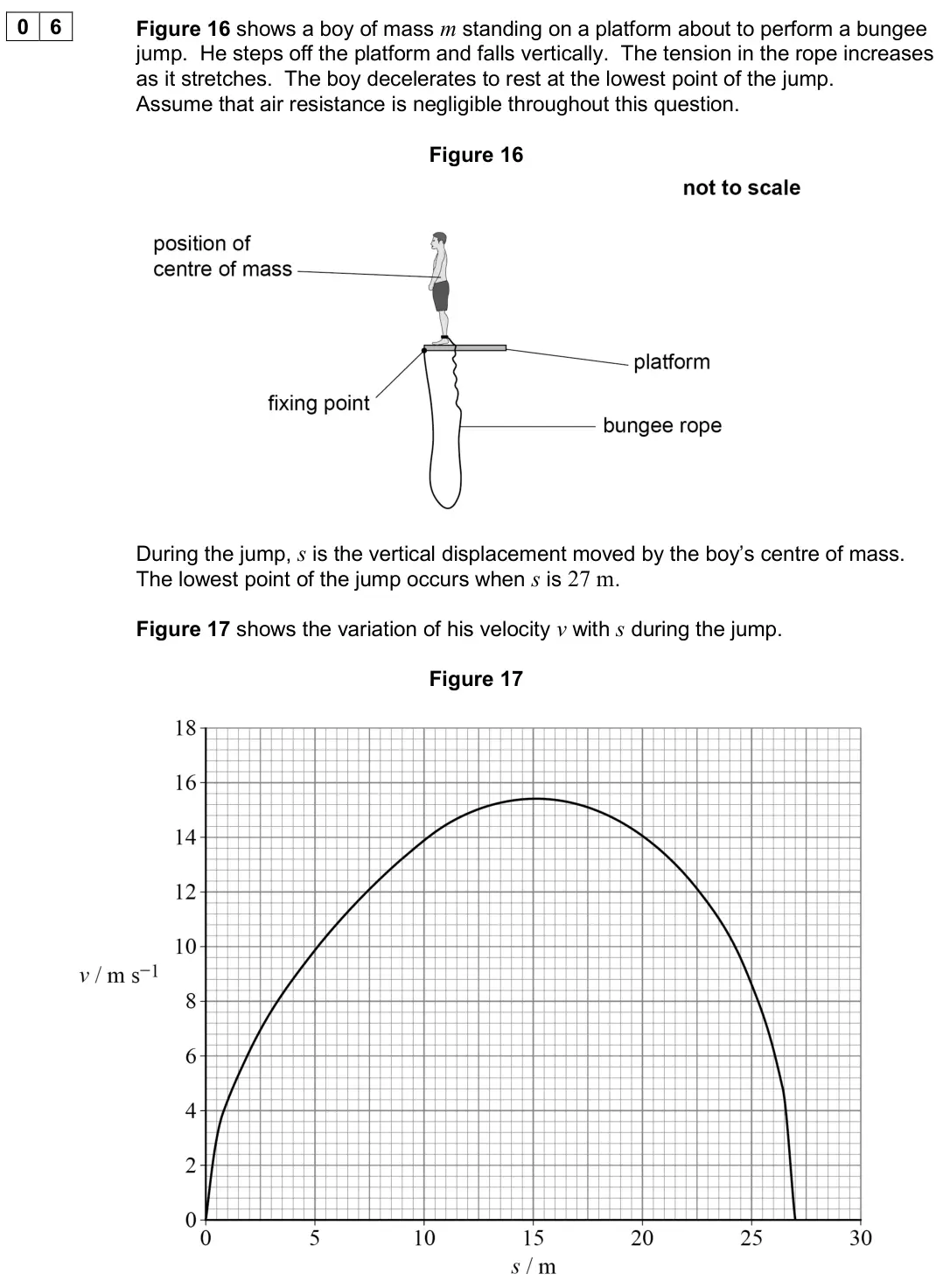
Q01.2
The whole paper ↗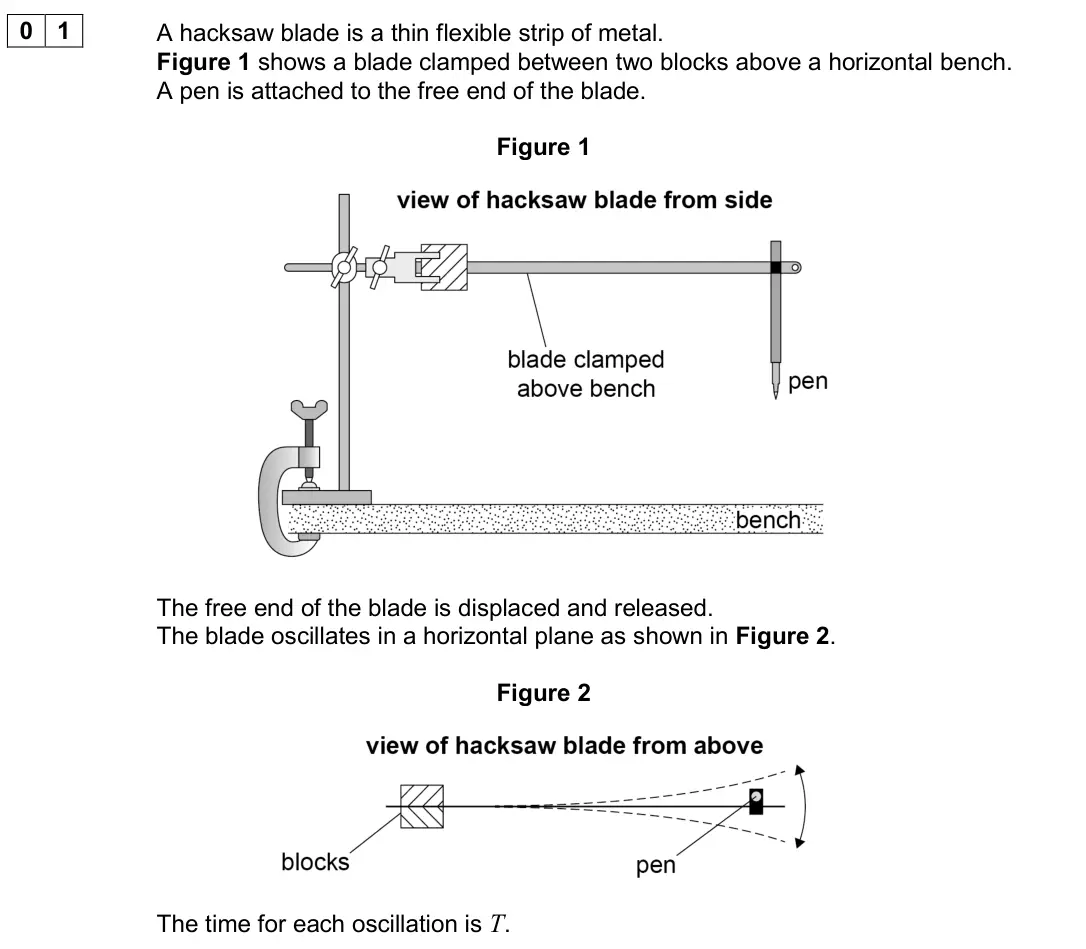
Q01.3
The whole paper ↗Q01.4
The whole paper ↗Q02.1
The whole paper ↗
Q02.4
The whole paper ↗Q01.2
The whole paper ↗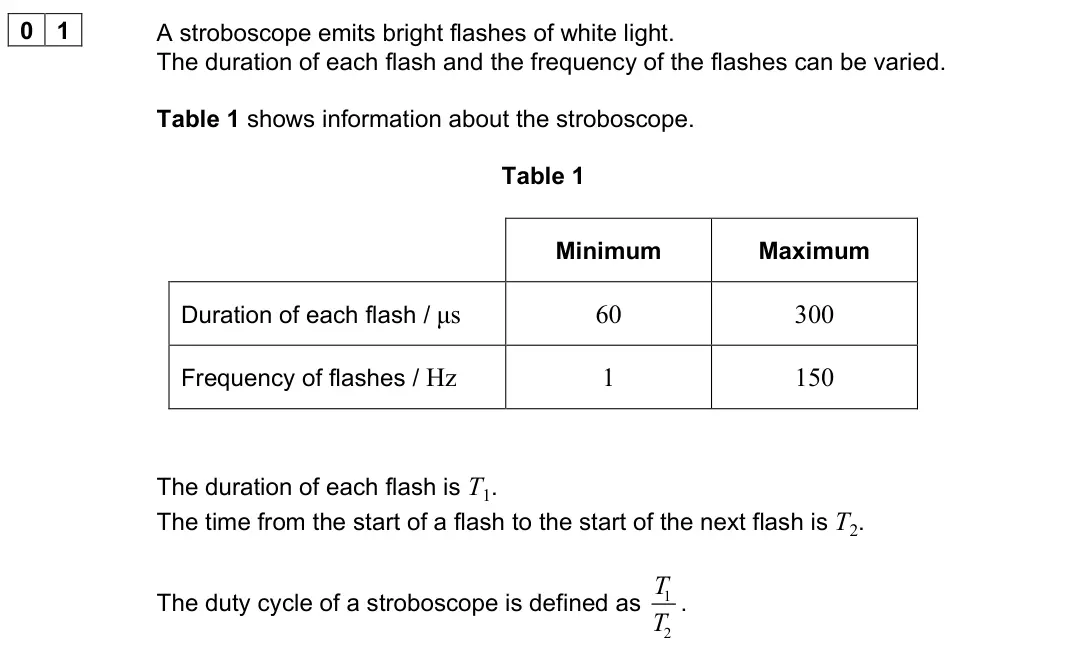
Q01.3
The whole paper ↗Q01.4
The whole paper ↗Q05.5
The whole paper ↗
Q05.6
The whole paper ↗
All 108 questions on Motion along a straight line, as a list
- June 2025, AS Paper 1, Q05.2 (3 marks): Determine the gravitational potential energy gained by the lift during the first 1.5 s of the motion. [3 marks] gravitational potential energy = J
- June 2025, AS Paper 1, Q05.4 (3 marks): Determine the velocity of the object when it reaches ground level. [3 marks] velocity = m s−1
- June 2025, AS Paper 2, Q20 (1 mark): An object falls from rest. Air resistance is negligible. When the object has fallen through a distance x, its velocity is v. How does v vary with x? [1 mark] A
- June 2024, AS Paper 1, Q04.1 (2 marks): Figure 7 shows a car and trailer moving at 25 m s−1 at a distance s from traffic lights. Figure 7 The driver applies the brakes so that the car and trailer stop
- June 2024, AS Paper 1, Q06.1 (1 mark): The boy experiences freefall when he steps off the platform. During which part of the jump does the boy’s acceleration begin to decrease? Tick () one box. [1 m
- June 2024, AS Paper 2, Q01.2 (2 marks): Determine TPQ. Assume that the time for each full oscillation of the blade is 0.42 s. [2 marks] TPQ = s
- June 2024, AS Paper 2, Q01.3 (1 mark): Determine s. The scale of the graph paper is shown on Figure 5. [1 mark] s = m
- June 2024, AS Paper 2, Q01.4 (2 marks): Determine the acceleration a of the trolley. [2 marks] a = m s−2
- June 2024, AS Paper 2, Q19 (1 mark): The graph shows the variation with time t of the acceleration of an object moving in a straight line. When t = 0 the speed of the object is 4.0 m s−1. What is t
- June 2024, AS Paper 2, Q23 (1 mark): A horse starts walking from point X on a circular track of circumference 60 m. The speed of the horse is a constant 2.0 m s−1. What is the horse’s displacement
- June 2023, Paper 1, Q02.1 (2 marks): The average speed for one of these runs was 343 m s−1. Calculate, in s, the time taken for the car to complete the other run. [2 marks] time = s
- June 2023, Paper 1, Q02.4 (2 marks): Scientists recommend that the average deceleration of the driver of the car should be less than 3g. Deduce whether the average deceleration is less than 3g. [2
- June 2023, Paper 3A, Q01.2 (1 mark): Figure 1 shows images produced in an experiment in which a bouncing ball is illuminated by a stroboscope. The stroboscope flashes at a constant frequency. Figur
- June 2023, Paper 3A, Q01.3 (3 marks): In order to find g, a graph is plotted with values of H h n − on the y-axis. Suggest what is plotted on the x-axis. Go on to explain how g is determined from th
- June 2023, Paper 3A, Q01.4 (3 marks): Determine u0. [3 marks] u0 = m s−1
- June 2023, AS Paper 1, Q05.5 (2 marks): Calculate the time taken for the helicopter to reach its maximum height from the instant the blades stop rotating. [2 marks] time = s
- June 2023, AS Paper 1, Q05.6 (2 marks): When the helicopter makes contact with the surface it has a velocity of 2.2 m s−1. Calculate h. [2 marks] h = m
- June 2023, AS Paper 2, Q10 (1 mark): A girl kicks a football vertically upwards at time t = 0 Air resistance is negligible. What is the variation of the vertical component of velocity v of the foot
- June 2023, AS Paper 2, Q26 (1 mark): A ball is dropped from a height h. The ball hits the ground with a velocity v. The ball is now dropped from a height of 2h. Air resistance is negligible. What i
- June 2022, Paper 1, Q23 (1 mark): A ball is thrown vertically upwards and returns to its original position 2.4 s later. The effect of air resistance is negligible. What is the total distance tra
- June 2022, AS Paper 1, Q07.4 (3 marks): Determine the acceleration of the cyclist 10.0 s after she begins to go down the hill. [3 marks] acceleration = m s−2
- June 2022, AS Paper 2, Q01.3 (2 marks): It can be shown that 2s = gt2. Determine a value for g using Gmax and Gmin. [2 marks] g = m s−2
- June 2022, AS Paper 2, Q04.1 (1 mark): Show that the athlete and chair accelerate towards the platform at approximately 5 m s−2. [1 mark]
- June 2022, AS Paper 2, Q04.2 (2 marks): Calculate the speed of the athlete when her right foot makes initial contact with the platform. [2 marks] speed = m s−1
- June 2022, AS Paper 2, Q04.4 (3 marks): Determine the distance travelled by the athlete between C and D. [3 marks] distance travelled = m
- November 2021, Paper 1, Q05.5 (5 marks): Figure 10 shows the variations with time of the vertical velocity of a ball with and without air resistance. Figure 10 Discuss the features of the motion of the
- November 2021, AS Paper 2, Q23 (1 mark): A vehicle travels on a straight road, starting at time t = 0 The graph shows how its velocity varies with time. What is the distance of the vehicle from its sta
- November 2020, Paper 1, Q04.1 (3 marks): The speed limit for the motorway between the two cameras is 22 m s−1. Determine whether the average speed of the car exceeded this speed limit. [3 marks]
- November 2020, Paper 1, Q04.2 (2 marks): Markings called chevrons are used on motorways. The chevron separation is designed to give a driver time to respond to any change in speed of the car in front.
- November 2020, Paper 1, Q04.3 (4 marks): The chevron separation is based on the response time, not on the time taken for a car to stop. The brakes of a car are applied when its speed is 31 m s−1 and th
- November 2020, Paper 1, Q04.4 (1 mark): Suggest why the chevron separation on motorways does not take into account the distance travelled as a car comes to rest after the brakes are applied. [1 mark]
- November 2020, Paper 1, Q21 (1 mark): Small water drops leave a tap with zero velocity at intervals of 0.20 s. They then fall freely 0.80 m to reach a horizontal surface. How far has a drop fallen w
- November 2020, AS Paper 1, Q03.1 (2 marks): Figure 3 shows a golf ball at rest on a horizontal surface 1.3 m from a hole. Figure 3 A golfer hits the ball so that it moves horizontally with an initial velo
- November 2020, AS Paper 2, Q22 (1 mark): The diagram shows how the speed v of an object varies with time t. Which graph shows the variation of distance s with t for the object? [1 mark] A B C D A B C D
- June 2019, Paper 1, Q13 (1 mark): Two cars P and Q leave from the same point and travel in the same direction. Q leaves at time t = 0 and P leaves one second later. The figure shows the velocity
- June 2019, AS Paper 2, Q03.5 (2 marks): Figure 6 shows a stream of photons of light, emitted from the Sun, incident on a solar sail. A solar sail is an experimental spacecraft that uses photons of lig
- June 2018, Paper 1, Q01.1 (3 marks): Determine the force decelerating the vehicle 2.0 s after entering the escape lane. [3 marks] force decelerating the vehicle = N
- June 2018, Paper 1, Q01.2 (3 marks): Deduce whether a lane of length 85 m is long enough to stop the vehicle, assuming that the engineer’s graph is correct. [3 marks]
- June 2018, Paper 1, Q01.4 (3 marks): An alternative to an escape lane containing gravel is an escape lane that consists of a ramp. An escape ramp is a straight road with a concrete surface that has
- June 2018, Paper 1, Q01.5 (1 mark): Discuss whether an escape lane containing gravel or an escape ramp would provide the safer experience for the driver of the vehicle as it comes to rest. [1 mark
- June 2018, AS Paper 2, Q01.1 (3 marks): Table 1 gives measurements made with the light gates as shown in Figure 1. Table 1 Time to pass through first light gate / s Time to pass through second light g
- June 2018, AS Paper 2, Q01.2 (2 marks): Two further sets of readings, A and B, are taken each with the light gates in different positions along the air track. Assume the acceleration is the same in ea
- June 2018, AS Paper 2, Q01.3 (2 marks): Additional values for the acceleration of the air-track glider are obtained by further raising the end of the air track by using a stack consisting of identical
- June 2018, AS Paper 2, Q01.4 (1 mark): It can be shown that, for the apparatus used by the student, g is equal to where h is the thickness of each block used in the experiment. The student obtains a
- June 2018, AS Paper 2, Q01.5 (1 mark): Explain how you could find out, without drawing another graph, whether the data presented in the graph in Figure 2 support the suggestion that a is directly pro
- June 2018, AS Paper 2, Q22 (1 mark): A girl is bouncing on a trampoline. Assuming that air resistance is negligible, her acceleration [1 mark] A is zero when she is at maximum height. B is constant
- June 2017, Paper 1, Q06.4 (3 marks): In practice, for safety reasons there is a friction brake in the pulley that provides a resistive force to reduce the acceleration to 25% of the maximum possibl
- June 2017, Paper 1, Q06.5 (2 marks): It takes 12 s to remove the blocks from the lower trolley and reload the upper trolley. Calculate the number of blocks that can be transferred to the lower leve
- June 2017, Paper 1, Q19 (1 mark): Which row gives two features of graphs that provide the same information? [1 mark] Feature 1 Feature 2 A Gradient of a displacement–time graph Area under a velo
- June 2017, Paper 1, Q23 (1 mark): Which graph best represents the velocity–time graph for a ball that is dropped from rest and bounces repeatedly? [1 mark] A B C D
- June 2017, AS Paper 2, Q03.3 (3 marks): A maximum is detected each time the mirror travels a distance equal to half a wavelength of the light. In one measurement 2.37 × 10⁵ maxima are recorded as the
- June 2017, AS Paper 2, Q03.4 (2 marks): Figure 10 is a graph that the gravimeter could produce to show how the distance travelled by the mirror varies with time as it falls. Figure 10 Determine the gr
- June 2017, AS Paper 2, Q03.5 (1 mark): State what this gradient represents. [1 mark]
- June 2016, AS Paper 1, Q01.6 (2 marks): The aircraft lands on the runway travelling at a speed of 68 m s–1 with the deflector plates acting. Calculate the distance the aircraft travels along the runwa
- June 2016, AS Paper 2, Q19 (1 mark): The velocity–time graph for a falling object is shown. Which of the following shows the corresponding acceleration–time graph? [1 mark] A B C D
- June 2016, AS Paper 2, Q20 (1 mark): A girl jogs at 2.0 m s–1 in a straight line for 30 seconds, turns around and returns to her starting point 20 seconds later. What is her average velocity and av
- Specimen, Paper 1, Q22 (1 mark): What is the relationship between the distance y travelled by an object falling freely from rest and the time x the object has been falling? [1 mark] A y is prop
- Specimen, Paper 1, Q25 (1 mark): An object falls freely from rest. After falling a distance d its velocity is v. What is its velocity after it has fallen a distance 2d? [1 mark] A 2 v B 4 v C 2
- Specimen, Paper 1, Q27 (1 mark): The velocity of a vehicle varies with time as shown by the following graph. Which graph below represents how the resultant force F on the car varies during the
- Specimen, Paper 2, Q01.1 (2 marks): Figure 1 shows a system that separates two minerals from the ore containing them using an electric field. Figure 1 The crushed particles of the two different mi
- Specimen, Paper 2, Q01.4 (2 marks): Figure 1 shows a system that separates two minerals from the ore containing them using an electric field. Figure 1 The crushed particles of the two different mi
- Specimen, Paper 3A, Q01.6 (3 marks): This question is about measuring the acceleration of free fall g. A student undertakes an experiment to measure the acceleration of free fall. Figure 1 shows a
- Specimen, Paper 3A, Q01.8 (3 marks): This question is about measuring the acceleration of free fall g. A student undertakes an experiment to measure the acceleration of free fall. Figure 1 shows a
- June 2016, PHYA2 (old spec), Q3(d) (3 marks): In one particular descent, the descent module has its speed reduced to 5.5 m s–1 by parachutes. The descent module also releases its empty tanks and shield to r
- June 2016, PHYA2 (old spec), Q5 (6 marks): A fully-loaded lorry transporting water starts from rest and travels along a straight road. Figure 7 is a graph showing how the speed of the lorry varies with t
- June 2015, PHYA2 (old spec), Q1(b)(i) (3 marks): Show that the speed of the ball is about 4 m s–1 just before it strikes the ground. [3 marks]
- June 2015, PHYA2 (old spec), Q1(b)(ii) (3 marks): The ball is released at time t = 0. It hits the ground at time tA and is caught at time tB. On Figure 1, sketch a velocity–time graph for the vertical motion of
- June 2015, PHYA2 (old spec), Q3(a)(i) (2 marks): Calculate the average acceleration during the 4.6 s time interval. Give your answer to an appropriate number of significant figures. [2 marks] acceleration = m
- June 2014, PHYA2 (old spec), Q2(b)(i) (2 marks): The athlete in Figure 2 slides horizontally through the sand a distance of 0.35m before stopping. Calculate the time taken for the athlete to stop. Assume the h
- June 2013, PHYA2 (old spec), Q3(b)(ii) (3 marks): On Figure 5, sketch the velocity-time graph you would expect to see for steel ball B. Assume air resistance is negligible. Figure 5 (3 marks) velocity 0 0 time
- January 2013, PHYA4 Section B (old spec), Q5(b)(ii) (2 marks): When P and Q are released from rest and allowed to fall freely through a vertical distance of 1.0m, they each take 0.45s to do so. Justify this time value and e
- January 2013, PHYA2 (old spec), Q1(c) (2 marks): Calculate the time taken for the diver to fall 54m. Ignore the effects of air resistance. time = s (2 marks)
- January 2013, PHYA2 (old spec), Q2(a) (3 marks): The snowboarder travels 1.5m from B to C in a time of 0.43s and her velocity down the slope at C is 5.0ms–1. Calculate her velocity down the slope at B. velocit
- June 2012, PHYA2 (old spec), Q2(b) (3 marks): Galileo then imagined that the track was changed, as shown in Figure 3. Figure 3 The slope beyond B was now horizontal. On the axes below, sketch a speed – time
- June 2012, PHYA2 (old spec), Q3(b)(i) (2 marks): Calculate her average acceleration over this distance. answer = ms–2 (2 marks)
- January 2012, PHYA2 (old spec), Q2(a)(i) (2 marks): The cyclist begins at rest at A and accelerates uniformly to a speed of 6.7ms–1 at B. The distance between A and B is 50m. Calculate the time taken for the cycl
- January 2012, PHYA2 (old spec), Q3(b)(iii) (2 marks): On the axes below, sketch the velocity-time graph for the horizontal motion of the aircraft as it accelerates from zero to its maximum horizontal velocity. (2 m
- January 2012, PHYA2 (old spec), Q3(c) (1 mark): State how a velocity-time graph could be used to find the maximum acceleration. (1 mark) Turn to page 10 for the next question
- June 2011, PHYA2 (old spec), Q1(a)(i) (1 mark): State which feature of a displacement-time graph represents the velocity. (1 mark)
- June 2011, PHYA2 (old spec), Q1(a)(ii) (3 marks): On the axes below, draw the shape of the velocity-time graph for the ball between t0 and t2. The starting point is labelled X. (3 marks) t0 t1 t2 velocity X 0 t
- June 2011, PHYA2 (old spec), Q2(a) (2 marks): The computer calculated a value of 3.10ms–1 for the velocity of the card as it travelled through the light gate. Calculate a value for the acceleration due to g
- June 2011, PHYA2 (old spec), Q3(a)(i) (2 marks): Calculate the average acceleration of the train. answer = ms–2 (2 marks)
- June 2011, PHYA2 (old spec), Q3(a)(iii) (2 marks): Calculate the distance the train moves while accelerating from rest to 58ms–1. answer = m (2 marks)
- January 2011, PHYA4 Section B (old spec), Q3(a) (6 marks): Describe the procedure the student should follow, including the measurements he should make, when using this arrangement. Explain how he should use the measurem
- January 2011, PHYA4 Section B (old spec), Q3(b)(ii) (2 marks): What value does this result give for the acceleration of the cylinder down the slope, assuming the acceleration is constant? answer = ms–2 (2 marks)
- January 2011, PHYA2 (old spec), Q5(a)(ii) (2 marks): Calculate the time for the Lunar Module to slow to the required horizontal velocity of 150ms–1. Assume the mass remained constant. answer = s (2 marks)
- January 2011, PHYA2 (old spec), Q5(c) (2 marks): When the Lunar Module was 1.2 m from the lunar surface, the rocket was switched off. At this point the vertical velocity was 0.80ms–1. Calculate the vertical ve
- June 2010, PHYA2 (old spec), Q2(a) (2 marks): Explain why using an inclined plane rather than free fall would produce data which is valid when investigating the motion of a falling object. (2 marks)
- June 2010, PHYA2 (old spec), Q2(c) (2 marks): In this experiment, the following data was obtained. A graph of the data is shown below it. time/pendulum swings distance travelled/m 1 0.29 2 1.22 3 2.70 4 4.8
- June 2010, PHYA2 (old spec), Q2(d) (3 marks): Each complete pendulum swing had a period of 1.4s. Use the graph on page 6 to find the speed of the trolley after it had travelled 3.0m. answer = ms-1 (3 marks)
- June 2010, PHYA2 (old spec), Q4(d) (2 marks): As she accelerates upwards again from position A, she is in contact with the trampoline for a further 0.26 s. Calculate the average acceleration she would exper
- January 2010, PHYA2 (old spec), Q1(a)(i) (3 marks): Show that the horizontal velocity of the ball between positions D and G in Figure 1 is about 45ms–1. (3 marks)
- January 2010, PHYA2 (old spec), Q1(a)(ii) (1 mark): Calculate the horizontal acceleration of the ball between A and D. answer = ms–2 (1 mark)
- June 2009, PHYA2 (old spec), Q1(b)(i) (3 marks): Calculate the time taken by the cyclist to travel this distance. answer s (3 marks)
- June 2009, PHYA2 (old spec), Q3(a)(i) (3 marks): Calculate the time taken, to, by the ball to fall to the liquid surface from the point where it is released. Give your answer to an appropriate number of signif
- June 2009, PHYA2 (old spec), Q3(a)(ii) (2 marks): Calculate the velocity, νo, of the ball on reaching the liquid. answer m s –1 (2 marks)
- January 2009, PHYA2 (old spec), Q1(a) (5 marks): Draw a graph of speed on the y-axis against time on the x-axis on the grid provided. (5 marks)
- January 2009, PHYA2 (old spec), Q1(b)(i) (2 marks): State and explain what feature of the graph shows that the car’s deceleration was uniform. (2 marks)
- January 2009, PHYA2 (old spec), Q1(b)(ii) (4 marks): Use your graph to calculate the distance the car travelled after the lights turned red to when it stopped. Answer m (4 marks)
- January 2009, PA02 (2008 spec), Q1(a) (3 marks): 1 (a) With reference to the graph describe, without calculation, how the acceleration of the falling object changes over the first 16 s. You may be awarded addi
- January 2009, PA02 (2008 spec), Q1(c) (3 marks): 1 (c) Use the graph to determine the acceleration of the object 5.0 s after it was released. (3 marks)
- January 2009, PA02 (2008 spec), Q1(d) (2 marks): 1 (d) Show that the distance fallen in the first 16 s is approximately 430 m. (2 marks)
- January 2009, PA02 (2008 spec), Q5(a) (2 marks): 5 (a) Passenger A steps on the moving walkway and walks 20 m along its surface. The time taken to walk this distance is 8.0 s. Calculate, 5 (a) (i) the velocity
- January 2009, PA02 (2008 spec), Q5(b) (3 marks): 5 (b) Figure 4 shows a passenger B who is not on the walkway and is initially level with passenger A. Figure 4 passenger A passenger B 1.5 m s –1 1.0 m s –1 Pas
- June 2008, PA02 (2008 spec), Q3(a) (3 marks): 3 (a) Describe the motion of the car for the 50 s period. You may be awarded additional marks to those shown in brackets for the in your answer. (3 marks)
- June 2008, PA02 (2008 spec), Q3(b) (4 marks): 3 (b) The mass of the car is 1200 kg. Calculate for the first 20 s of motion, 3 (b) (i) the change in momentum of the car, 3 (b) (ii) the rate of change of mome
- June 2008, PA10 (2008 spec), Q1(a) (3 marks): 1 (a) Calculate the speed and kinetic energy of the car before the brakes are applied. (3 marks)
- January 2008, PA02 (2008 spec), Q5(a) (3 marks): (a) Calculate (i) the initial acceleration of the aircraft, (ii) the minimum length of runway required, assuming the acceleration is constant. (3 marks)
Questions, mark schemes and examiner’s reports are © AQA, from their published past papers. Plumi isn’t affiliated with any exam board. Want whole papers? AQA A-Level Physics past papers.
The Plumi iPad app also offers exam-style questions with AI feedback on your handwritten working.