 plumi
Momentum: AQA A‑Level Physics questions
AQA A-Level Physics past-paper questions on 3.4.1.6 Momentum, 2008–2025, with mark schemes and examiner’s reports where available.
Paper
All papers
Exam
All years
Calculations
Q06.1
The whole paper ↗
Q06.2
The whole paper ↗Q04.1
The whole paper ↗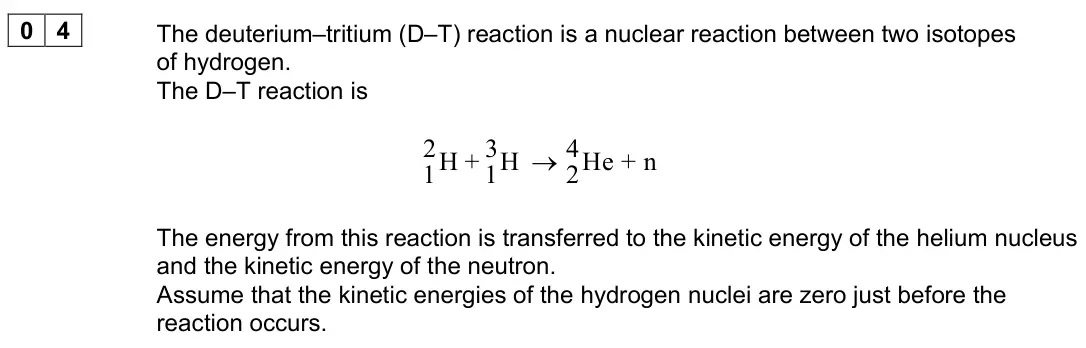
Q05.3
The whole paper ↗
Q04.6
The whole paper ↗
Q07.3
The whole paper ↗Q05.1
The whole paper ↗
Q05.2
The whole paper ↗Q04.3
The whole paper ↗
All 112 questions on Momentum, as a list
- June 2025, Paper 1, Q06.1 (2 marks): Calculate the kinetic energy transferred to the ball during the kick. [2 marks] kinetic energy = J
- June 2025, Paper 1, Q06.2 (3 marks): Figure 8 shows how the force F acting on the ball varies with time t. Figure 8 Determine the scale for the F / N axis and add your scale to Figure 8. [3 marks]
- June 2025, AS Paper 2, Q19 (1 mark): The graph shows how the force acting on an object varied with time. The shaded area represents: [1 mark] A the change in kinetic energy of the object. B the cha
- June 2024, Paper 1, Q04.1 (2 marks): Show that the kinetic energy of the neutron represents approximately 80% of the total energy transferred. [2 marks]
- June 2024, Paper 1, Q05.3 (3 marks): O contains a fragile item packed in suitable material. Explain how the material can prevent damage to the fragile item when O stops suddenly at B. [3 marks]
- June 2024, Paper 1, Q24 (1 mark): An average force of 42 kN acts on the air passing through a jet engine. This force causes the speed of the air to increase by 540 m s−1. What mass of air passes
- June 2024, AS Paper 1, Q04.6 (3 marks): The air resistance D acting on the trailer increases as the velocity v of the trailer increases. Explain this increase in D with reference to the momentum of th
- June 2024, AS Paper 2, Q20 (1 mark): An object is released and falls from rest. Air resistance is negligible. After falling for time t, the momentum of the object is [1 mark] A constant. B proporti
- June 2024, AS Paper 2, Q22 (1 mark): A cricket ball of mass 0.16 kg travels at a speed of 35 m s−1 towards a bat. When the ball is hit, it is in contact with the bat for 52 ms. As a result, the bal
- June 2024, AS Paper 2, Q29 (1 mark): Glider X of mass 400 g travels at 1.8 m s−1 to the right on a horizontal, frictionless track. Glider Y of mass 300 g travels towards X at 0.7 m s−1. X and Y col
- June 2023, Paper 1, Q19 (1 mark): An object is moving in a straight line. A graph is plotted to show the variation of the momentum of the object with time. Which quantities can be calculated fro
- June 2023, Paper 1, Q25 (1 mark): A variable force F acts on an object of mass 2.0 kg. The object is at rest at time t = 0 The graph shows the variation of F with t. What is the speed of the obj
- June 2023, Paper 2, Q07.3 (2 marks): The collision of a neutron with the nucleus of a moderator atom is modelled using two gliders on a horizontal frictionless air track. In Figures 13 and 14 the g
- June 2023, AS Paper 1, Q05.1 (3 marks): The gas moved by the rotor blades has a density of 0.020 kg m−3. Show that the helicopter moves approximately 0.4 kg of gas every second. [3 marks]
- June 2023, AS Paper 1, Q05.2 (3 marks): Calculate the mass of the helicopter. [3 marks] mass = kg
- June 2023, AS Paper 2, Q08 (1 mark): An object of mass 0.20 kg moves with an initial velocity u. It collides with a stationary object of mass 0.30 kg. The objects stick together when they collide.
- June 2022, Paper 1, Q26 (1 mark): A tennis ball has a mass of 58 g. The ball is dropped from rest from a height of 1.8 m above the ground and falls vertically. The ball rebounds vertically to a
- June 2022, AS Paper 2, Q04.3 (2 marks): Determine the impulse provided by the force platform between B and C. [2 marks] impulse = N s
- June 2022, AS Paper 2, Q26 (1 mark): Object P has a mass of 7500 kg and travels at 12 m s−1. Object Q has a mass of 2500 kg and travels at 20 m s−1 in the same direction as P. P and Q collide and r
- November 2021, Paper 1, Q25 (1 mark): A golf ball has a mass of 46 g and is initially stationary. The diagram shows the variation with time of the force acting on the golf ball as it is hit with a g
- November 2021, AS Paper 1, Q05.1 (2 marks): Figure 10 shows a ship leaving a harbour at a constant velocity. The ship moves at the same velocity as a person walking on the harbour wall alongside the ship.
- November 2021, AS Paper 1, Q05.2 (4 marks): Figure 11 shows the direction of the thrust exerted by the ship’s propeller as the propeller rotates. The ship’s engine makes the propeller rotate. When more wa
- November 2021, AS Paper 2, Q16 (1 mark): What is true for an inelastic collision between two isolated objects? [1 mark] A Both total momentum and total kinetic energy are conserved. B Neither total mom
- November 2021, AS Paper 2, Q25 (1 mark): A stationary ball is free to move. The ball is hit with a bat. The graph shows how the force of the bat on the ball changes with time. The ball has a mass of 0.
- November 2020, Paper 1, Q22 (1 mark): A pellet with velocity 200 m s−1 and mass 5.0 g is fired vertically upwards into a stationary block of mass 95.0 g. The pellet remains in the block. The impact
- November 2020, AS Paper 1, Q02.4 (3 marks): Dust from the surface of Mars can enter the atmosphere. This increases the density of the atmosphere significantly. Deduce how an increase in dust content will
- November 2020, AS Paper 2, Q19 (1 mark): Which quantity is represented by the area under a force–time graph? [1 mark] A average power B elastic strain energy stored C momentum change D work done
- November 2020, AS Paper 2, Q23 (1 mark): Two ball bearings X and Y are projected from horizontal ground at the same time. X has mass 2m and is projected vertically upwards with speed u. Y has mass m an
- November 2020, AS Paper 2, Q24 (1 mark): Which row is true for an elastic collision between two objects in an isolated system? [1 mark] Kinetic energy Momentum A conserved conserved B not conserved con
- June 2019, Paper 1, Q05.2 (3 marks): The test vehicle hits a steel safety barrier at an angle of 20°, as shown in Figure 7. Figure 7 Calculate the component of the momentum of the test vehicle in a
- June 2019, Paper 1, Q05.5 (2 marks): A different safety barrier uses a solid concrete wall which does not deform. The same standard test is carried out on a concrete wall. Discuss which type of bar
- June 2019, Paper 1, Q16 (1 mark): A body of constant mass falls freely due to gravity. The rate of change of momentum of the body is equal to its [1 mark] A kinetic energy. B mass. C gravitation
- June 2019, AS Paper 2, Q03.3 (1 mark): Figure 5 shows a cross-sectional view of the patient’s head inside a ring of gamma detectors during the PET scan. Figure 5 A positron and an electron meet and a
- June 2019, AS Paper 2, Q03.4 (2 marks): Explain your answer to question 03.3. [2 marks]
- June 2019, AS Paper 2, Q03.6 (2 marks): The reflectance of a surface is proportional to the percentage of incident photons that are reflected off the surface. Explain the effect of increasing the refl
- June 2019, AS Paper 2, Q26 (1 mark): A railway truck of mass 2000 kg travelling horizontally at 1.5 m s–1 collides with a stationary truck of mass 3000 kg. After the collision they move together. W
- June 2018, Paper 1, Q06.1 (1 mark): State the quantity that is not conserved in an inelastic collision. [1 mark]
- June 2018, Paper 1, Q06.2 (3 marks): Show that the speed of the joined trucks immediately after the collision is about 0.3 m s–1 [3 marks]
- June 2018, Paper 1, Q06.3 (2 marks): Calculate the impulse that acts on each truck during the collision. Give an appropriate unit for your answer. [2 marks] impulse = unit
- June 2018, Paper 1, Q06.4 (2 marks): Explain, without doing a calculation, how the motion of the trucks immediately after the collision would be different for a collision that is perfectly elastic.
- June 2018, Paper 1, Q07 (1 mark): [multiple choice] What is a correct unit for the area under a force−time graph? [1 mark] A N m B kg m s−1 C kg m s−2 D N s−1
- June 2018, AS Paper 1, Q02.4 (3 marks): The horizontal runway in Figure 2 has negligible friction and air resistance. As the truck moves along the runway, it starts to rain. The rain falls vertically
- June 2018, AS Paper 2, Q26 (1 mark): The graph shows how the resultant force F on a football, which is initially at rest, varies with time t. Which graph shows how the momentum p of the football va
- June 2018, AS Paper 2, Q27 (1 mark): Objects P and Q are initially at rest at time t = 0 The same resultant force F is applied to P and Q for time T. The mass of P is 10 times greater than the mass
- June 2017, Paper 1, Q06.3 (2 marks): Compare the momentum of loaded trolley A as it moves downwards with the momentum of loaded trolley B. [2 marks]
- June 2017, Paper 1, Q22 (1 mark): A car of mass 580 kg collides with the rear of a stationary van of mass 1200 kg. Following the collision, the van moves with a velocity of 6.20 m s−1 and the ca
- June 2017, AS Paper 2, Q04.4 (3 marks): Ion propulsion units could use helium ions instead of xenon ions. An ion of helium-4 (He+) has a much higher specific charge than an ion of xenon-131 (Xe+). Bot
- June 2017, AS Paper 2, Q09 (1 mark): A bullet of mass 10 g is fired with a velocity of 100 m s–1 from a stationary rifle of mass 4.0 kg. Consider the rifle and bullet to be an isolated system. What
- June 2017, AS Paper 2, Q19 (1 mark): The graph shows how the force F applied to an object varies with time t. What is the momentum gained by the object from t = 0 to t = 10 s? [1 mark] A 18 kg m s–
- June 2017, AS Paper 2, Q29 (1 mark): Two bodies of different masses undergo an elastic collision in the absence of any external force. Which row gives the effect on the total kinetic energy of the
- June 2016, AS Paper 1, Q01.1 (1 mark): State what happens to the momentum of the air as it passes through the engine. [1 mark]
- June 2016, AS Paper 1, Q01.2 (3 marks): Explain, using appropriate laws of motion, why the air exerts a force on the engine in the forward direction. [3 marks]
- June 2016, AS Paper 1, Q01.3 (1 mark): In one second a mass of 210 kg of air enters at A. The speed of this mass of air increases by 570 m s–1 as it passes through the engine. Calculate the force tha
- June 2016, AS Paper 1, Q01.4 (2 marks): When an aircraft lands, its jet engines exert a decelerating force on the aircraft by making use of deflector plates. These cause the air leaving the engines to
- June 2016, AS Paper 1, Q01.7 (2 marks): Suggest why in practice the decelerating force provided by the deflector plates may not remain constant. [2 marks]
- Specimen, Paper 1, Q04.2 (4 marks): The speed of an air rifle pellet is measured by firing it into a wooden block suspended from a rigid support. The wooden block can swing freely at the end of a
- Specimen, Paper 1, Q04.3 (2 marks): The speed of an air rifle pellet is measured by firing it into a wooden block suspended from a rigid support. The wooden block can swing freely at the end of a
- June 2016, PHYA4 Section A (old spec), Q1 (1 mark): Which line, A to D, in the table correctly shows what is conserved in an elastic collision? Mass Momentum Kinetic energy Total energy A conserved not conserved
- June 2016, PHYA4 Section A (old spec), Q2 (1 mark): The graph shows how the resultant force applied to an object of mass 2.0 kg, initially at rest, varies with time. What is the speed of the object after 1.0 s? A
- June 2016, PHYA4 Section B (old spec), Q3(a) (1 mark): State the condition for momentum to be conserved in a system. [1 mark] _____________________________________________________________________________ ___________
- June 2016, PHYA4 Section B (old spec), Q3(b)(i) (2 marks): Show how the principle of conservation of momentum may be used to derive an expression for V in terms of N, m and v. [2 marks]
- June 2016, PHYA4 Section B (old spec), Q3(b)(ii) (4 marks): Assume that all of the energy released in the emission process is transferred as kinetic energy to the α particle and the recoiling nucleus. The total energy re
- June 2016, PHYA4 Section B (old spec), Q3(c)(ii) (4 marks): The total energy released when a nucleus of 220 86Rn decays is 1.02 × 10⁻¹² J. Calculate the magnitude of the momentum of the α particle. State an appropriate u
- June 2015, PHYA4 Section A (old spec), Q1 (1 mark): Which one of the following has the same unit as the rate of change of momentum? A work B energy C acceleration D weight
- June 2015, PHYA4 Section A (old spec), Q2 (1 mark): The nucleus of a radioactive isotope X is at rest and decays by emitting an α particle so that a new nuclide Y is formed. Which one of the following statements
- June 2015, PHYA4 Section A (old spec), Q3 (1 mark): Trolley T1, of mass 2.0 kg, collides on a horizontal surface with trolley T2, which is also of mass 2.0 kg. The collision is elastic. Before the collision T1 wa
- June 2014, PHYA4 Section A (old spec), Q1 (1 mark): The graph shows how the force acting on a rocket varies with time. Which one of the following is represented by the area under the graph? A distance travelled B
- June 2014, PHYA4 Section A (old spec), Q2 (1 mark): A golf club strikes a stationary golf ball of mass 4.8 × 10⁻²kg and the ball leaves the club with a speed of 95ms–1. If the average force exerted on the ball is
- June 2014, PHYA4 Section A (old spec), Q3 (1 mark): Water of density 1000kgm–3 flows out of a garden hose of cross-sectional area 7.2 × 10⁻⁴ m2 at a rate of 2.0 × 10⁻⁴ m3 per second. How much momentum is carried
- June 2013, PHYA4 Section A (old spec), Q1 (1 mark): Which one of the following is a possible unit of impulse? A Ns–1 B kgms–1 C kgms–2 D sN–1
- June 2013, PHYA4 Section A (old spec), Q2 (1 mark): A railway truck of mass 8000kg travels along a level track at a velocity of 2.5ms–1 and collides with a stationary truck of mass 12000kg. The two trucks move to
- June 2013, PHYA4 Section A (old spec), Q3 (1 mark): A gas molecule of mass m moving at velocity u collides at right angles with the side of a container and rebounds elastically. Which one of the following stateme
- June 2013, PHYA4 Section A (old spec), Q4 (1 mark): The graph shows how the resultant force, F, acting on a body varies with time, t. What is the change in momentum of the body over the 5s period? A 12Ns B 18Ns C
- January 2013, PHYA4 Section A (old spec), Q1 (1 mark): A ball of mass m travelling at velocity v collides normally with a smooth wall, as shown in the diagram, and rebounds elastically. Which line, A to D, in the ta
- January 2013, PHYA4 Section A (old spec), Q2 (1 mark): A cricket ball of mass 0.16kg travelling at a speed of 35ms–1 is hit by a bat and, as a result of the impact, leaves the bat in the opposite direction at 30ms–1
- January 2013, PHYA4 Section A (old spec), Q3 (1 mark): A ball is released so that it falls vertically. The graph shows how the resultant force acting on the ball changes with time. Which one of the following is repr
- January 2013, PHYA4 Section B (old spec), Q1(a) (2 marks): State one similarity and one difference between an elastic collision and an inelastic collision. similarity difference (2 marks)
- January 2013, PHYA4 Section B (old spec), Q1(b)(ii) (2 marks): The α particle is emitted from a stationary 144 60 Nd nucleus at a speed of 9.3 × 10⁶ms–1. Calculate the recoil speed of the daughter nucleus. recoil speed ms–1
- January 2013, PHYA4 Section B (old spec), Q1(b)(iii) (3 marks): Show that, when a stationary 144 60 Nd nucleus decays, the kinetic energy of the recoiling cerium nucleus is only about 3% of the kinetic energy of the emitted
- June 2012, PHYA4 Section A (old spec), Q1 (1 mark): The graph shows how the force acting on a body changes with time. The body has a mass of 0.25kg and is initially at rest. What is the speed of the body after 40
- June 2012, PHYA4 Section A (old spec), Q2 (1 mark): A stationary unstable nucleus of mass M emits an α particle of mass m with kinetic energy E. What is the speed of recoil of the daughter nucleus? A ––––––– B ––
- June 2012, PHYA4 Section A (old spec), Q3 (1 mark): Two ice skaters, initially at rest and in contact, push apart from each other. Which line, A to D, in the table states correctly the change in the total momentu
- June 2012, PHYA4 Section B (old spec), Q1(a) (1 mark): State, in words, the relationship between the force acting on a body and the momentum of the body. (1 mark)
- June 2012, PHYA4 Section B (old spec), Q1(b)(ii) (1 mark): Calculate the magnitude of the momentum of the sand that lands in the container in each second. answer = Ns (1 mark)
- June 2012, PHYA4 Section B (old spec), Q1(b)(iii) (3 marks): The mass of the container is 0.650kg. Show that the reading of the balance, 10.0s after the sand starts landing continuously in the container, will be 3.82kg. Y
- June 2012, PHYA4 Section B (old spec), Q1(c) (3 marks): It takes 20.0s for all of the sand to fall into the container. On the axes below, sketch a graph to show how the reading of the balance will change over a 30.0s
- January 2012, PHYA4 Section A (old spec), Q1 (1 mark): A ball of mass 2.0kg, initially at rest, is acted on by a force F which varies with time t as shown by the graph. What is the velocity of the ball after 8.0s? A
- January 2012, PHYA4 Section A (old spec), Q2 (1 mark): A body X moving with a velocity v makes an elastic collision with a stationary body Y of equal mass on a smooth horizontal surface. Which line, A to D, in the t
- June 2011, PHYA4 Section A (old spec), Q2 (1 mark): The graph shows how the resultant force applied to an object of mass 2.0kg, initially at rest, varies with time. What is the speed of the object after 1.0s? A 2
- June 2011, PHYA4 Section A (old spec), Q3 (1 mark): Which of the following is a possible unit for rate of change of momentum? A Ns B Ns–1 C kgms–1 D kgms–2
- January 2011, PHYA4 Section A (old spec), Q1 (1 mark): A rail truck X travels along a level track and collides with a stationary truck Y. The two trucks move together at the same velocity after the collision. Which
- January 2011, PHYA4 Section B (old spec), Q2(a) (1 mark): State, in words, how the force acting on a body is related to the change in momentum of the body. (1 mark)
- January 2011, PHYA4 Section B (old spec), Q2(b)(i) (1 mark): What is the significance of the area enclosed by the line on a force –time graph and the time axis when a force acts on a body for a short time? (1 mark)
- January 2011, PHYA4 Section B (old spec), Q2(b)(ii) (4 marks): Estimate the impulse that acts on the ball, stating an appropriate unit. answer = (4 marks)
- January 2011, PHYA4 Section B (old spec), Q2(b)(iii) (4 marks): Calculate the speed of the ball after it has been kicked, assuming that it returns along the same horizontal line it followed when approaching the boot. Express
- January 2011, PHYA4 Section B (old spec), Q2(c) (3 marks): Discuss the consequences if the ball had approached the boot at a higher speed but still received the same impulse.
- June 2010, PHYA4 Section A (old spec), Q1 (1 mark): Which one of the following statements is correct? The force acting on an object is equivalent to A its change of momentum. B the impulse it receives per second.
- June 2010, PHYA4 Section A (old spec), Q2 (1 mark): The graph shows how the force on a glider of mass 2000kg changes with time as it is launched from a level track using a catapult. Assuming the glider starts at
- June 2010, PHYA4 Section A (old spec), Q3 (1 mark): A gas molecule of mass m in a container moves with velocity v. If it makes an elastic collision at right angles to the walls of the container, what is the chang
- June 2010, PHYA4 Section B (old spec), Q3(a) (6 marks): Discuss how the principles of conservation of momentum and conservation of energy apply in this instance. The quality of your written communication will be asse
- June 2010, PHYA4 Section B (old spec), Q3(b)(i) (3 marks): Calculate the magnitude of the velocity of the capsule immediately after the explosion and state its direction of movement. magnitude of velocity = ms–1 directi
- June 2010, PHYA4 Section B (old spec), Q3(b)(ii) (4 marks): Determine the total amount of energy given to the probe and capsule by the explosion. answer = J (4 marks)
- January 2010, PHYA4 Section A (old spec), Q1 (1 mark): The graph shows the variation with time, t, of the force, F, acting on a body. What physical quantity does the area X represent? A the displacement of the body
- January 2010, PHYA4 Section A (old spec), Q2 (1 mark): Water of density 1000kgm–3 flows out of a garden hose of cross-sectional area 7.2 × 10⁻⁴m2 at a rate of 2.0 × 10⁻⁴m3 per second. How much momentum is carried by
- January 2010, PHYA4 Section A (old spec), Q3 (1 mark): Which row, A to D, in the table correctly shows the quantities conserved in an inelastic collision? mass momentum kinetic energy total energy A conserved not co
- January 2009, PA02 (2008 spec), Q2(a) (2 marks): 2 (a) State what is meant by the conservation of linear momentum. (2 marks)
- January 2009, PA02 (2008 spec), Q2(b) (3 marks): 2 (b) In a collision, ball A collides with ball B. During the collision, ball A exerts a force FA, on ball B and ball B exerts a force FB, on ball A. 2 (b) (i)
- June 2008, PA02 (2008 spec), Q3(b) (4 marks): 3 (b) The mass of the car is 1200 kg. Calculate for the first 20 s of motion, 3 (b) (i) the change in momentum of the car, 3 (b) (ii) the rate of change of mome
- June 2008, PA02 (2008 spec), Q6(b) (4 marks): 6 (b) The hammer has a mass of 250 kg and falls 4.5 m before striking the pile. After impact the hammer and pile move downwards together. Calculate 6 (b) (i) th
- January 2008, PA02 (2008 spec), Q3(a) (5 marks): (a) With reference to Newton’s Laws of motion, (i) state and explain why the momentum of the water changes as it strikes the wall, (ii) explain why the water ex
- January 2008, PA02 (2008 spec), Q3(b) (3 marks): (b) Water arrives at the wall at a rate of 18 kg s –1. It strikes the wall horizontally, at a speed of 7.2 m s –1 without rebounding. Calculate (i) the change i
- January 2008, PA02 (2008 spec), Q3(c) (2 marks): (c) State and explain the effect on the magnitude of the force if the water rebounds after striking the wall. (2 marks)
Questions, mark schemes and examiner’s reports are © AQA, from their published past papers. Plumi isn’t affiliated with any exam board. Want whole papers? AQA A-Level Physics past papers.
The Plumi iPad app also offers exam-style questions with AI feedback on your handwritten working.