 plumi
Mass and energy: AQA A‑Level Physics questions
AQA A-Level Physics past-paper questions on 3.8.1.6 Mass and energy, 2008–2025, with mark schemes and examiner’s reports where available.
Paper
All papers
Exam
All years
Calculations
Q03.1
The whole paper ↗
Q04.1
The whole paper ↗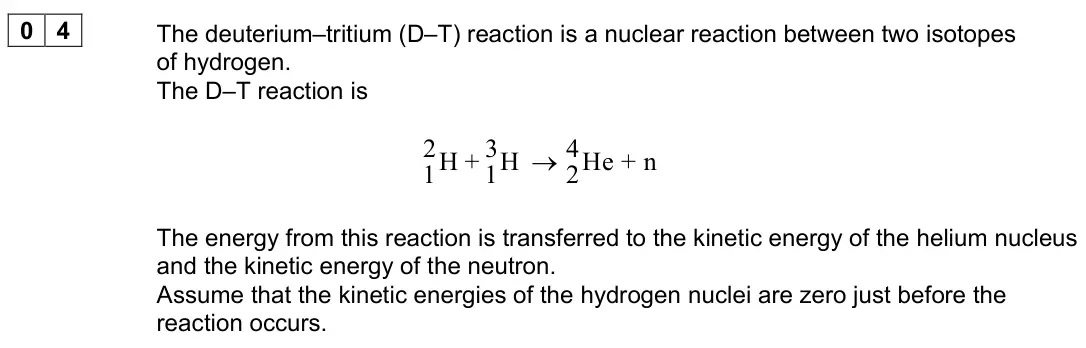
Q06.1
The whole paper ↗
Q06.2
The whole paper ↗Q06.3
The whole paper ↗Q06.1
The whole paper ↗Q06.2
The whole paper ↗Q06.4
The whole paper ↗- Your answer
- Your answer
Q06.4
The whole paper ↗
- Your answer
All 47 questions on Mass and energy, as a list
- June 2025, Paper 2, Q03.1 (2 marks): Determine the initial mass of plutonium-238 in the RTG. [2 marks] initial mass = kg
- June 2025, Paper 2, Q28 (1 mark): Polonium-210 decays into lead-206 by emitting an alpha particle. mass of nucleus of polonium-210 = 209.983 u mass of nucleus of lead-206 = 205.975 u mass of alp
- June 2025, Paper 2, Q31 (1 mark): The plot of average binding energy per nucleon is shown. P, Q and R indicate regions of the plot. In which region or regions labelled on the plot do nuclei unde
- June 2024, Paper 1, Q04.1 (2 marks): Show that the kinetic energy of the neutron represents approximately 80% of the total energy transferred. [2 marks]
- June 2024, Paper 2, Q17 (1 mark): The following reaction occurs when a proton and a carbon-13 ( ) 13C 6 nucleus fuse. 13 1 14 C p N 6 1 7 + → mass of 13C 6 nucleus = 13.00007 u mass of 14 N 7 nu
- June 2024, Paper 2, Q18 (1 mark): The equation represents a typical fission reaction. 235 1 87 146 1 U n Br La 3 n 92 0 35 57 0 + → + + Which statement about this reaction is not true? [1 mark]
- June 2024, Paper 2, Q19 (1 mark): 5.6 kW h of heat energy is released when 1.0 kg of wood pellets are burnt in a power station. What is the mass lost in burning 1.0 kg of wood pellets? [1 mark]
- June 2023, Paper 2, Q31 (1 mark): The mass of fuel in a nuclear reactor decreases at a rate of 4.0 × 10⁻⁶ kg per hour. What is the rate at which energy is transferred due to nuclear fission? [1
- June 2022, Paper 2, Q06.1 (2 marks): State what is meant by the binding energy of a nucleus. [2 marks]
- June 2022, Paper 2, Q06.2 (3 marks): Calculate, in MeV, the binding energy for a nucleus of iron 56Fe 26 . mass of 56Fe 26 nucleus = 9.288 × 10⁻²⁶ kg [3 marks] binding energy = MeV
- June 2022, Paper 2, Q06.3 (2 marks): The nuclide labelled X in Figure 10 undergoes fission. Annotate Figure 10 with F1 and F2 to show one possible pair of nuclides resulting from the fission of X.
- November 2021, Paper 2, Q06.1 (2 marks): Explain, in terms of binding energy, why energy can be released when two nuclei undergo nuclear fusion. [2 marks]
- November 2021, Paper 2, Q06.2 (2 marks): During the collapse of a supermassive star, helium-3 and oxygen-17 fuse to release energy. The equation for this reaction is 3 17 20 He + O Ne 2 8 10 → Table 2
- November 2021, Paper 2, Q06.4 (3 marks): 3He 2 can undergo fusion reactions with either 34S 16 or 17O 8 at the same temperature in a star. The nucleus has properties that depend on its proton number an
- November 2021, Paper 2, Q30 (1 mark): In the core of a nuclear reactor, the mass of fuel decreases at a rate of 9.0 × 10⁻⁶ kg hour−1 due to nuclear reactions. What is the maximum power output of the
- November 2020, Paper 1, Q09 (1 mark): A deuterium nucleus and a tritium nucleus fuse together to produce a helium nucleus and particle X. 2 3 4 H + H He + 1 1 2 → X What is X? [1 mark] A an electron
- November 2020, Paper 2, Q30 (1 mark): The table shows the masses of three particles. Particle Mass / u proton 1.00728 neutron 1.00867 nucleus of lithium Li 3 7 7.01436 What is the mass difference of
- November 2020, Paper 2, Q31 (1 mark): The mass of the fuel in a fission reactor decreases at a rate of 6.0 × 10⁻⁶ kg hour−1. What is the maximum possible power output of the reactor? [1 mark] A 75 M
- June 2019, Paper 2, Q06.4 (3 marks): One fission process which can occur in a thermal nuclear reactor is represented by the equation U 92 235 + n 0 1 = Xe 54 142 + Sr 38 90 + 4 n 0 1 Calculate in M
- June 2019, Paper 2, Q30 (1 mark): A deuterium nucleus and a tritium nucleus fuse together to form a helium nucleus and a particle X. The equation for this process is: 2 3 4 1 1 2 H + H He + X →
- June 2018, Paper 2, Q31 (1 mark): During a single fission event of uranium-235 in a nuclear reactor the total mass lost is 0.23 u. The reactor is 25% efficient. How many events per second are re
- June 2017, Paper 2, Q05.1 (3 marks): Calculate the binding energy, in MeV, of a nucleus of Co 27 59 . nuclear mass of Co 27 59 = 58.93320 u [3 marks] binding energy = MeV
- June 2017, Paper 2, Q05.2 (2 marks): A nucleus of iron Fe-59 decays into a stable nucleus of cobalt Co-59. It decays by β− emission followed by the emission of γ-radiation as the Co-59 nucleus de-e
- June 2017, Paper 2, Q32 (1 mark): Uranium-236 undergoes nuclear fission to produce barium-144, krypton-89 and three free neutrons. What is the energy released in this process? Nuclide Binding en
- Specimen, Paper 2, Q31 (1 mark): The graph shows how the binding energy per nucleon varies with the nucleon number for stable nuclei. What is the approximate total binding energy for a nucleus
- June 2016, PHYA5 Section A (old spec), Q3(a)(i) (2 marks): Fission and fusion are two nuclear processes in which energy can be released. Explain why nuclei that undergo fission are restricted to a different part of the
- June 2016, PHYA5 Section A (old spec), Q3(a)(ii) (2 marks): Explain, with reference to Figure 3, why the energy released per nucleon from fusion is greater than that from fission. [2 marks] ______________________________
- June 2016, PHYA5 Section A (old spec), Q3(b)(i) (2 marks): Calculate the mass difference, in kg, of the 16 8O nucleus. mass of 16 8O nucleus = 15.991 u [2 marks] mass difference = ___________________________ kg
- June 2016, PHYA5 Section A (old spec), Q3(b)(ii) (1 mark): Using your answer to part (b)(i), calculate the binding energy, in MeV, of an oxygen 16 8O nucleus. [1 mark] binding energy = ________________________ MeV
- June 2016, PHYA5 Section A (old spec), Q3(b)(iii) (1 mark): Explain how the binding energy of an oxygen 16 8O nucleus can be calculated with information obtained from Figure 3. [1 mark] __________________________________
- June 2014, PHYA5 Section A (old spec), Q1(a) (2 marks): State what is meant by the binding energy of a nucleus. [2 marks]
- June 2014, PHYA5 Section A (old spec), Q1(b)(ii) (3 marks): Calculate the energy released, in MeV, when a single 235 92 U nucleus undergoes fission in this way. binding energy per nucleon of 235 92 U = 7.59 MeV binding e
- June 2014, PHYA5 Section A (old spec), Q1(b)(iii) (2 marks): Calculate the loss of mass when a 235 92 U nucleus undergoes fission in this way. [2 marks] loss of mass kg
- June 2013, PHYA5 Section A (old spec), Q1(a)(i) (1 mark): Define the atomic mass unit. (1 mark)
- June 2013, PHYA5 Section A (old spec), Q1(a)(ii) (2 marks): State and explain how the mass of a 4 2 He nucleus is different from the total mass of its protons and neutrons when separated. (2 marks)
- June 2013, PHYA5 Section A (old spec), Q1(b) (3 marks): Explain why nuclei in a star have to be at a high temperature for fusion to take place.
- June 2013, PHYA5 Section A (old spec), Q1(c)(ii) (3 marks): The whole series of reactions is summarised by the following equation. 4 1 1H → 4 2He + 2e+ + 2ve Calculate the energy, in MeV, that is released. nuclear mass o
- June 2012, PHYA5 Section A (old spec), Q2(b)(i) (2 marks): Explain what is meant by the binding energy of a nucleus. (2 marks)
- June 2012, PHYA5 Section A (old spec), Q2(b)(ii) (1 mark): Figure 2 shows the binding energy per nucleon for some stable nuclides. Figure 2 Use Figure 2 to estimate the binding energy, in MeV, of the 206 82Pb nucleus. a
- June 2011, PHYA5 Section A (old spec), Q1(c)(ii) (3 marks): Calculate the energy released, in MeV, in the fission reaction above. mass of neutron = 1.00867u mass of 233 92U nucleus = 232.98915u mass of 91 36Kr nucleus =
- June 2011, PHYA5 Section A (old spec), Q3(a) (4 marks): Sketch a graph of binding energy per nucleon against nucleon number for the naturally occurring nuclides on the axes given in Figure 2. Add values and a unit to
- June 2011, PHYA5 Section A (old spec), Q3(b) (3 marks): Use the graph to explain how energy is released when some nuclides undergo fission and when other nuclides undergo fusion.
- June 2008, PA04A (2008 spec), Q13 (2 marks): 13 If 1g of matter is completely transformed into energy, how much energy is released? A 9.0 × 10 13 MeV B 9.0 × 10 16 MeV C 5.6 × 10 23 MeV D 5.6 × 10 26 MeV
- June 2008, PA04A (2008 spec), Q14 (2 marks): 14 Which one of the following statements correctly describes the changes that occur when a uranium nucleus undergoes Þ ssion? A The binding energy per nucleon d
- January 2008, PA04B (2008 spec), Q4(a) (5 marks): 4 (a) In order for fusion of two nuclei to take place, they have to be brought together to a separation of about 2 fm. (i) Show that the electrostatic potential
- January 2008, PA04B (2008 spec), Q4(b) (4 marks): (b) One reaction that can occur when deuterium nuclei undergo fusion is + 2 H 1 3 H 1 1 p 1 2 H 1 → + (i) Calculate the energy released, in J, by this reaction.
- January 2008, PA04B (2008 spec), Q4(c) (2 marks): (c) State two reasons why fusion reactions would be preferable to fission reactions as an energy resource, provided the necessary conditions required for contin
Questions, mark schemes and examiner’s reports are © AQA, from their published past papers. Plumi isn’t affiliated with any exam board. Want whole papers? AQA A-Level Physics past papers.
The Plumi iPad app also offers exam-style questions with AI feedback on your handwritten working.