 plumi
Thermodynamics: AQA A‑Level Chemistry questions
Every AQA A-Level Chemistry exam question on 3.1.8 Thermodynamics, 2016–2025, with its mark scheme and examiner’s report.
Find questions2,301
Calculations
Q04.2
The whole paper ↗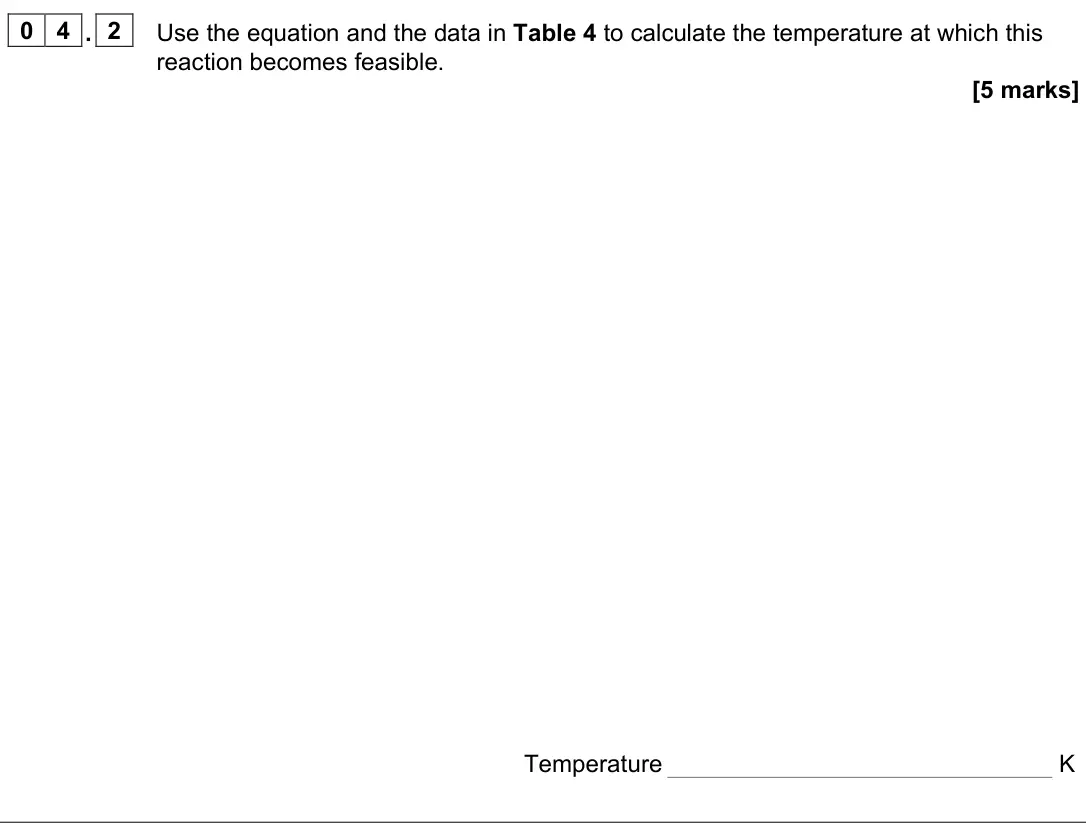
Q01.3
The whole paper ↗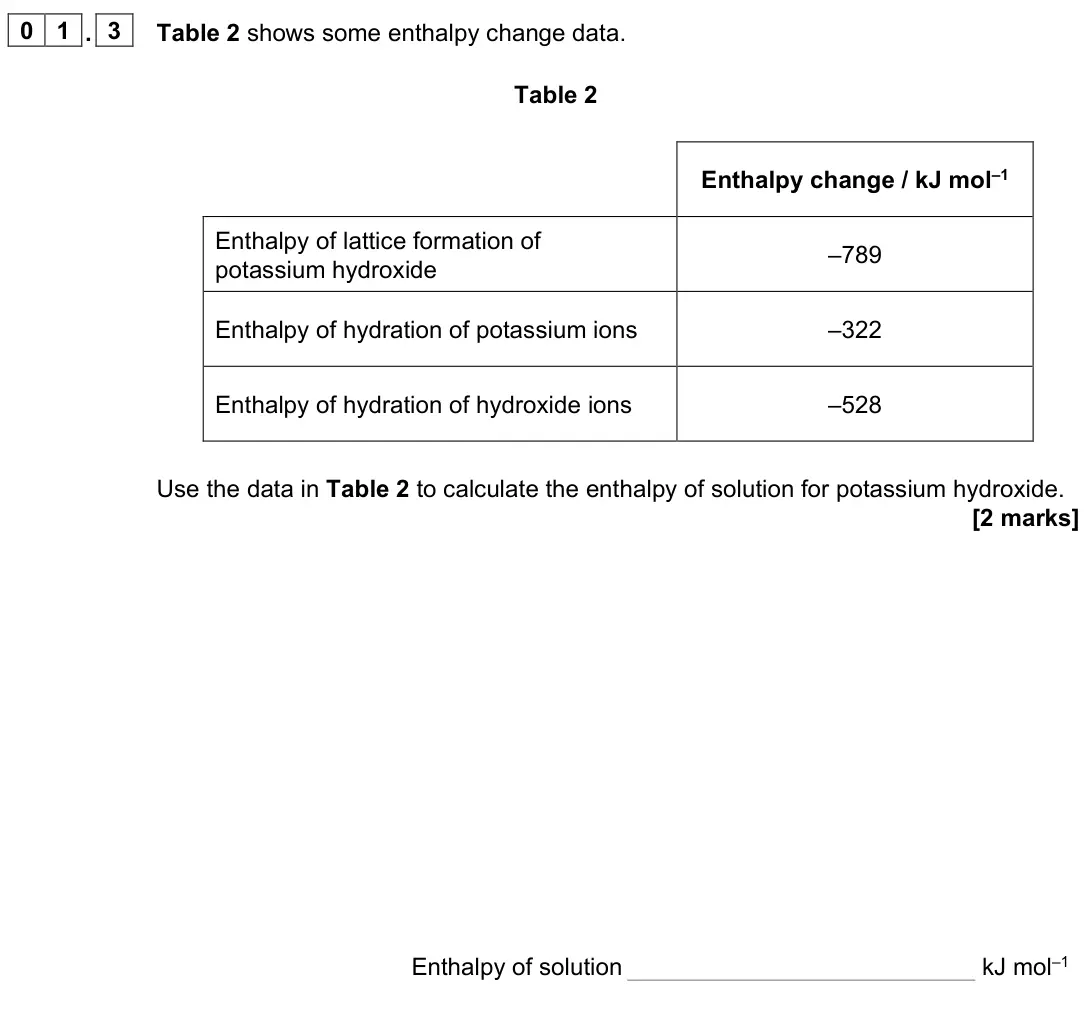
Q08.1
The whole paper ↗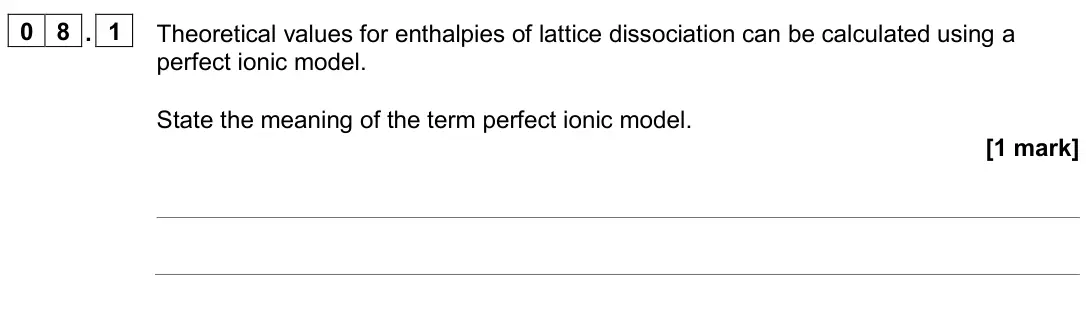
Q08.2
The whole paper ↗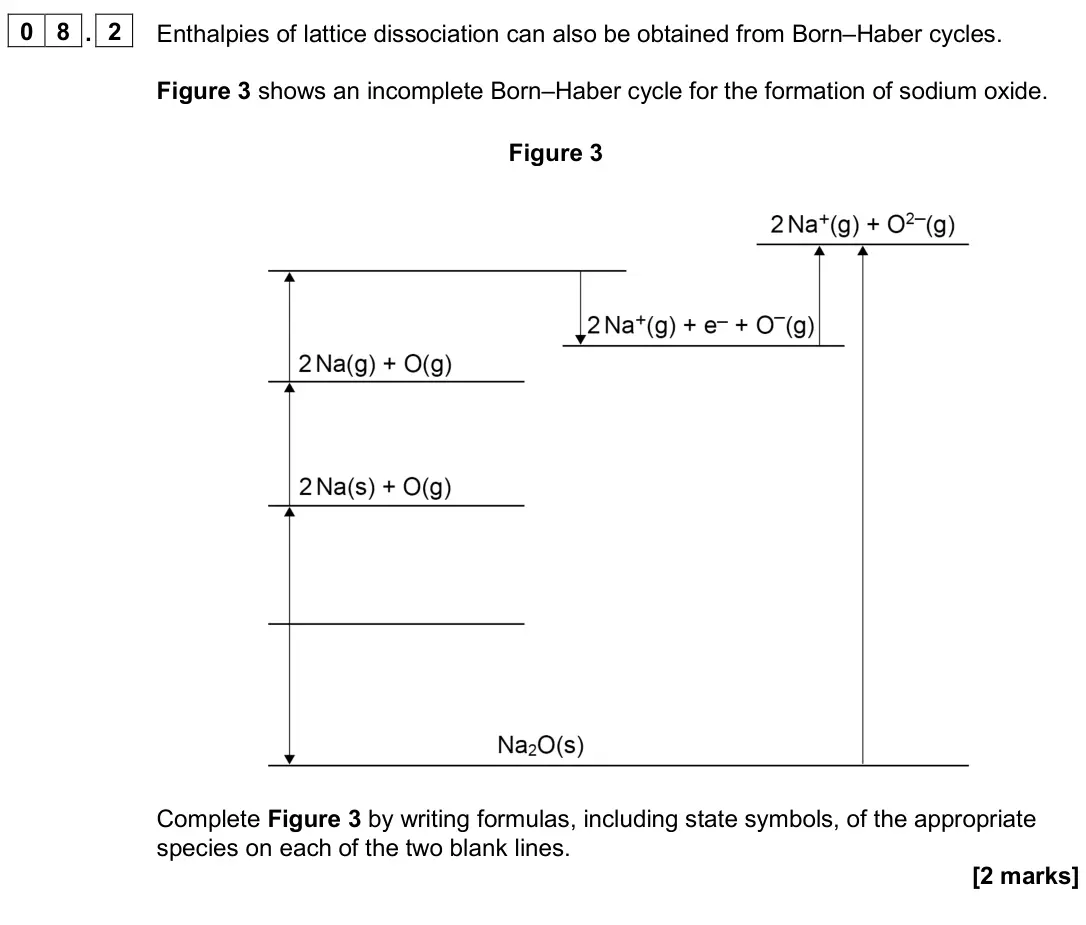
Q08.3
The whole paper ↗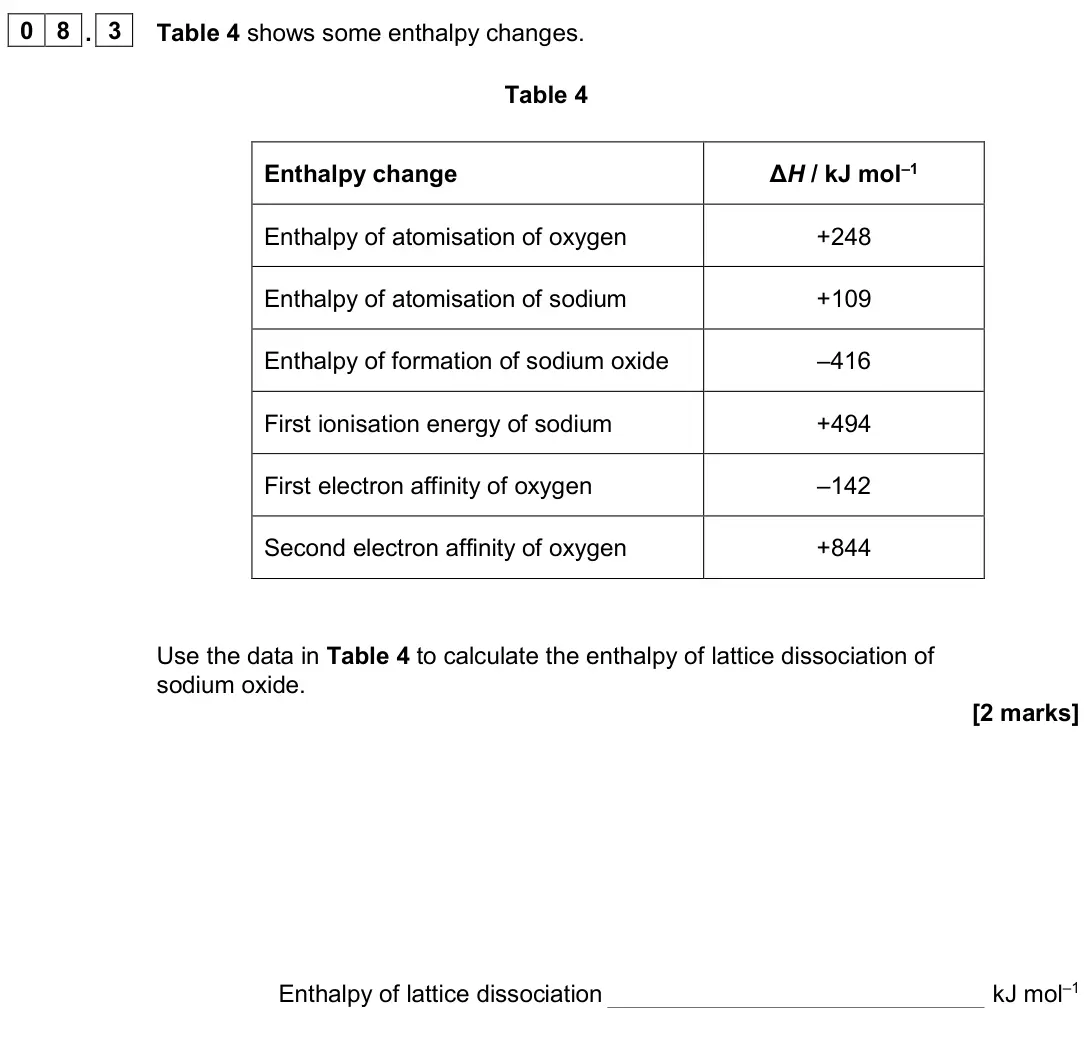
Q08.4
The whole paper ↗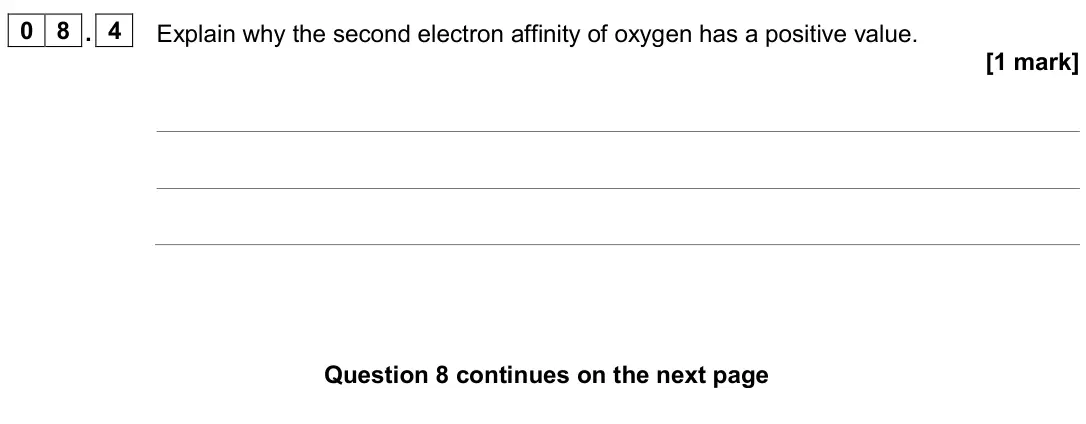
Q08.5
The whole paper ↗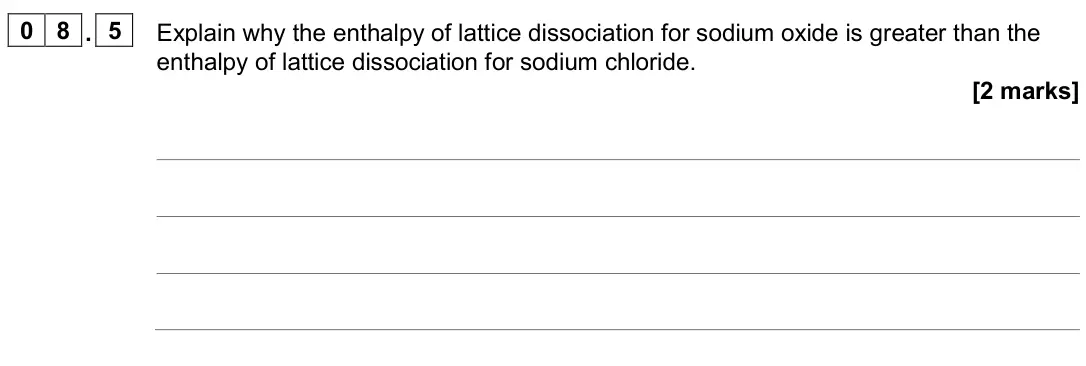
Q08.6
The whole paper ↗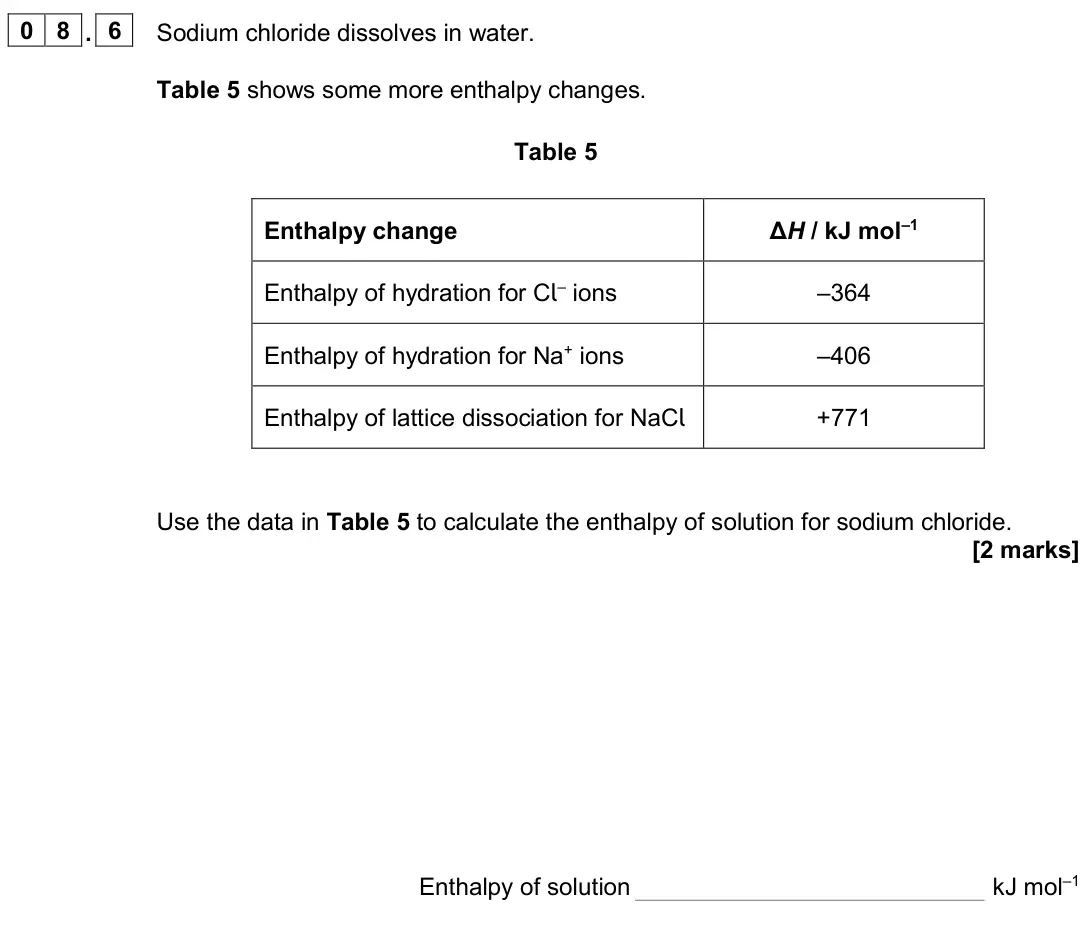
Q08.7
The whole paper ↗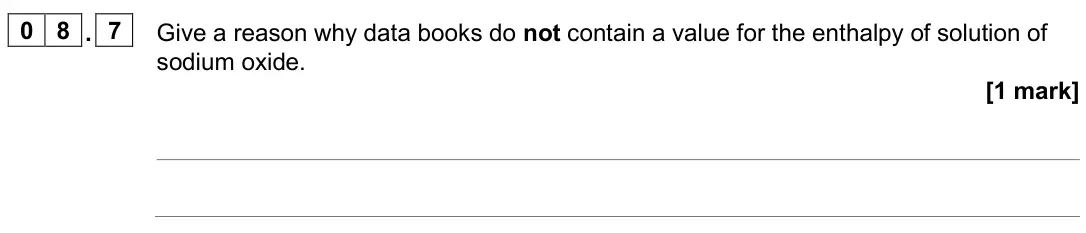
Q08.8
The whole paper ↗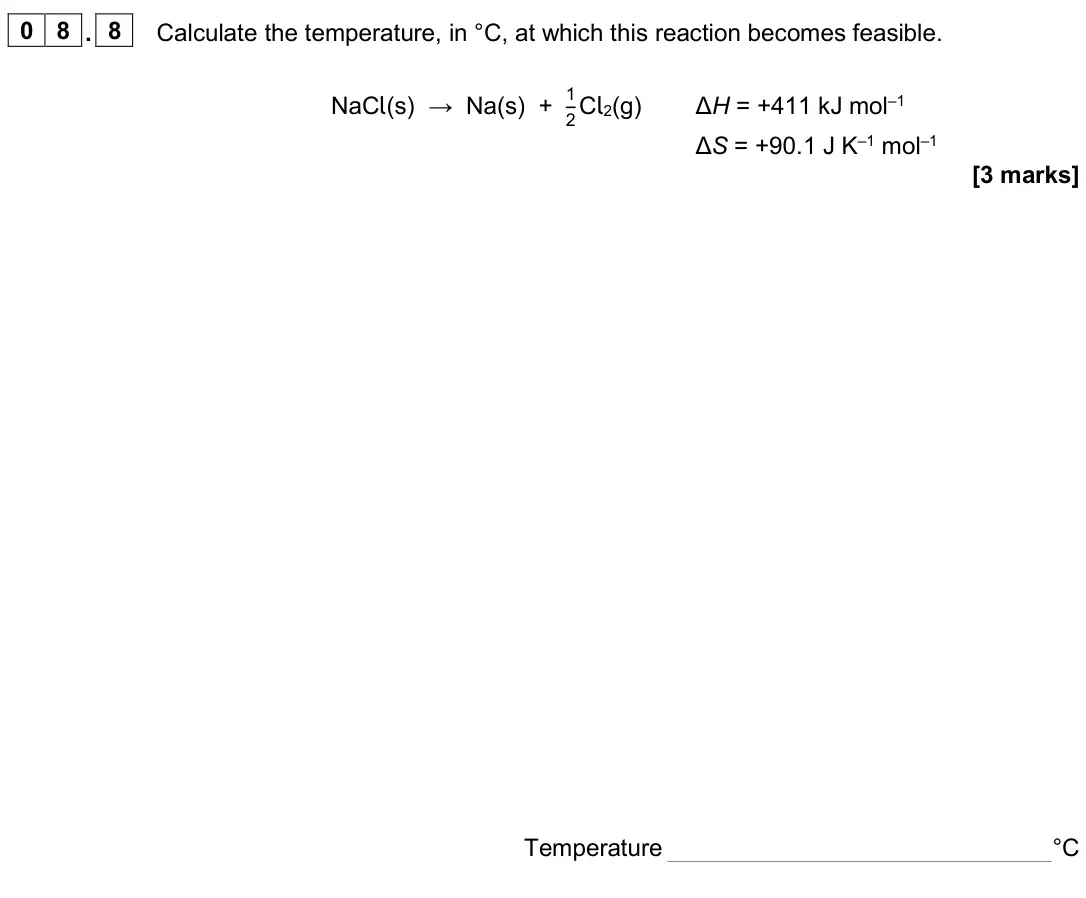
Q05.1
The whole paper ↗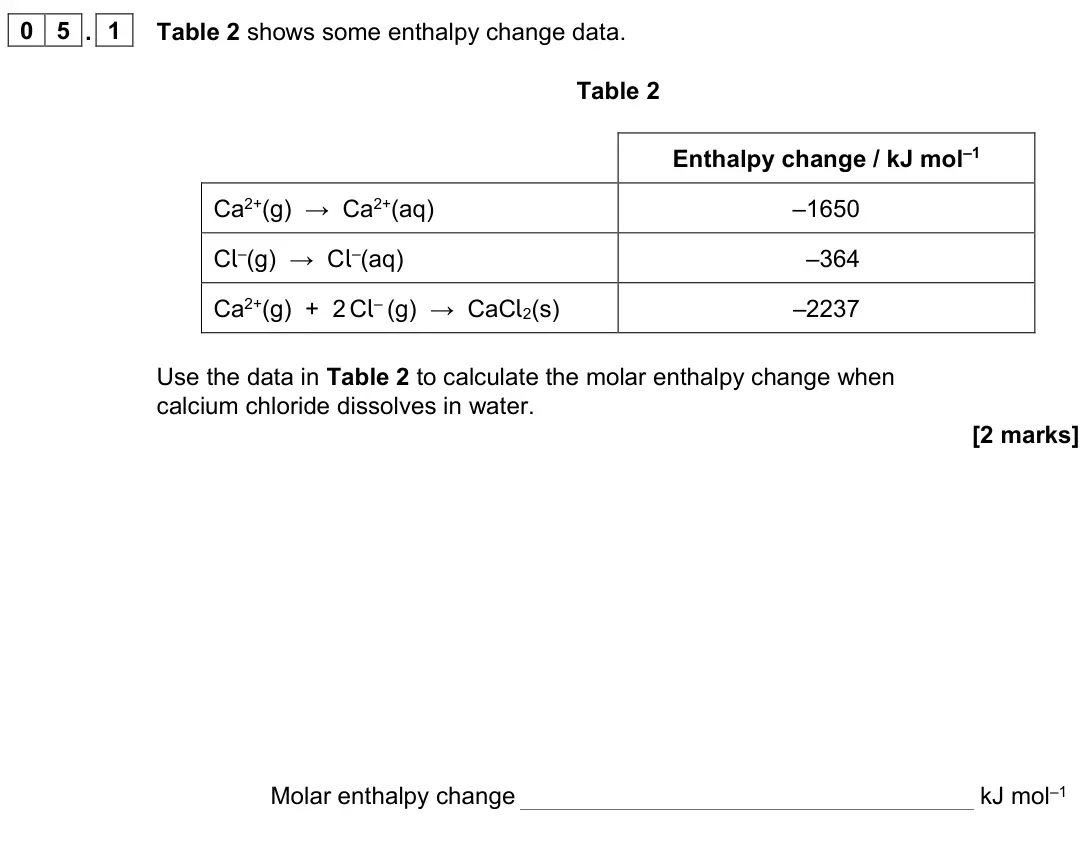
Q05.2
The whole paper ↗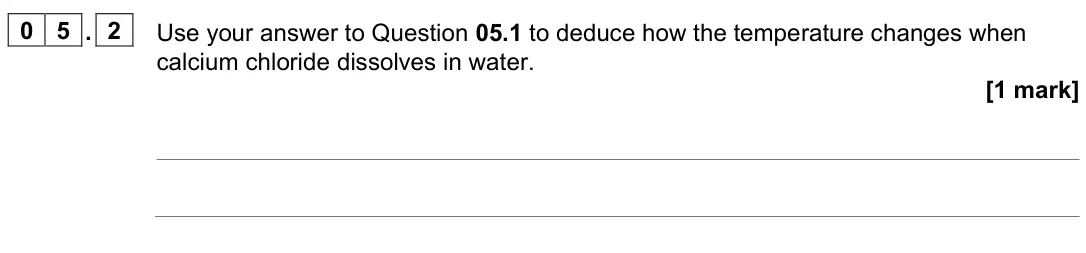
Q05.3
The whole paper ↗
Q05.4
The whole paper ↗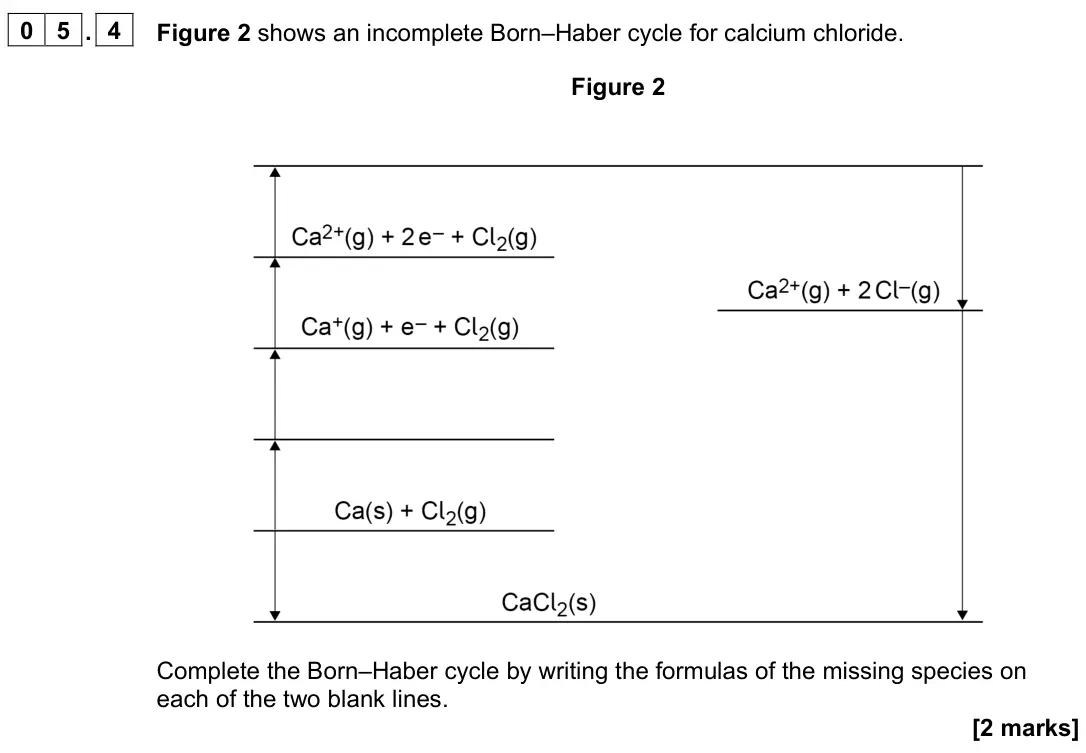
Q05.5
The whole paper ↗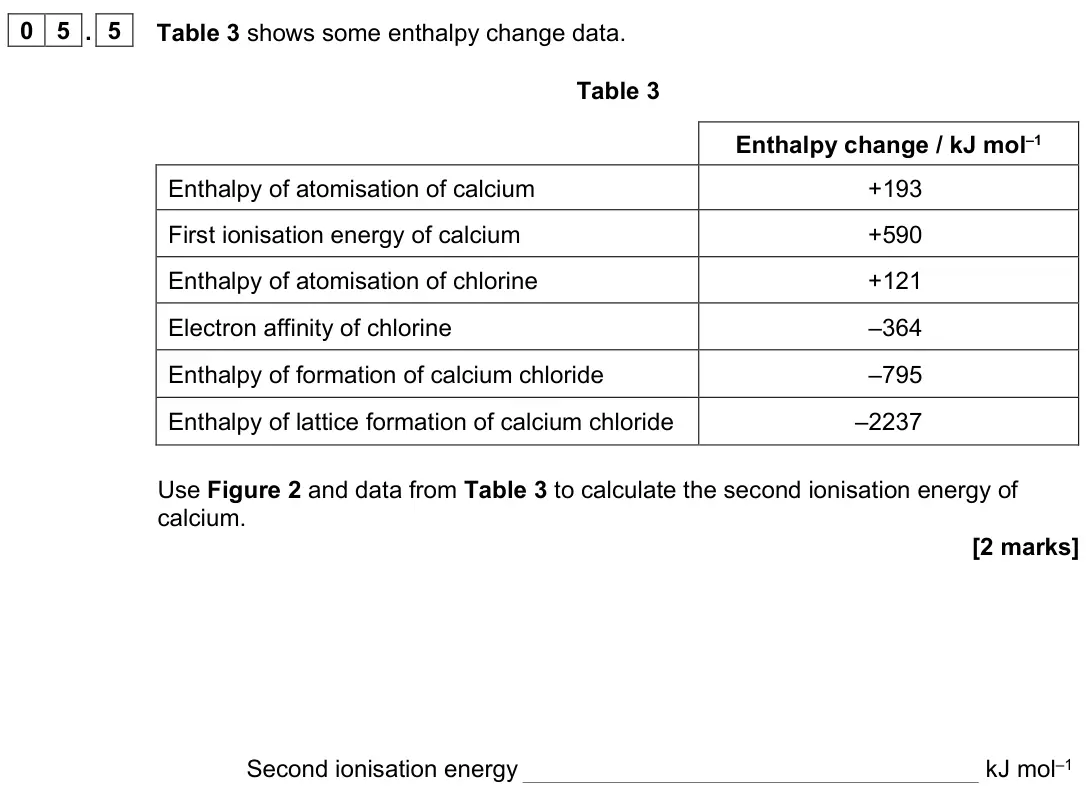
Q05.7
The whole paper ↗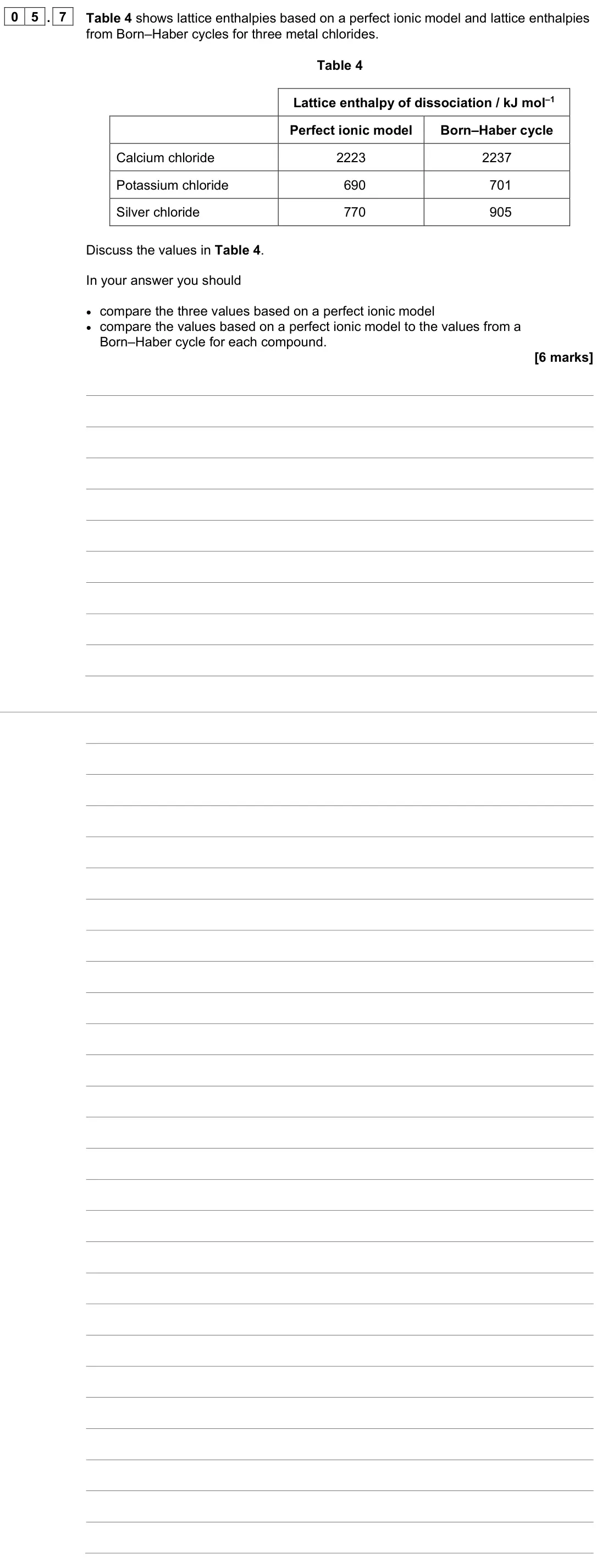
Q01.1
The whole paper ↗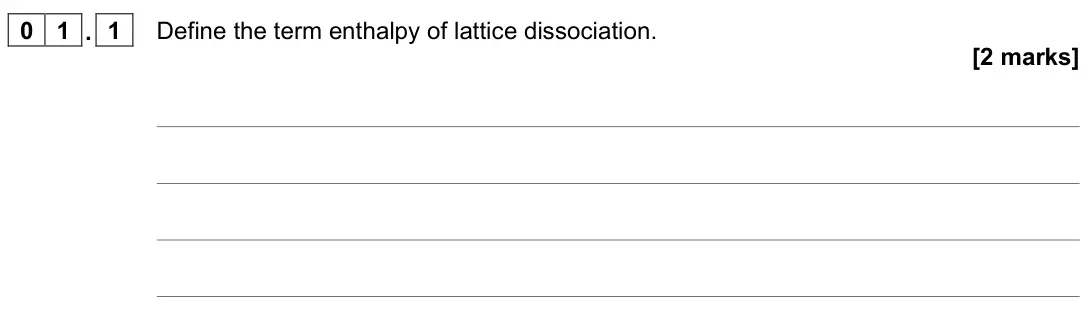
Q01.2
The whole paper ↗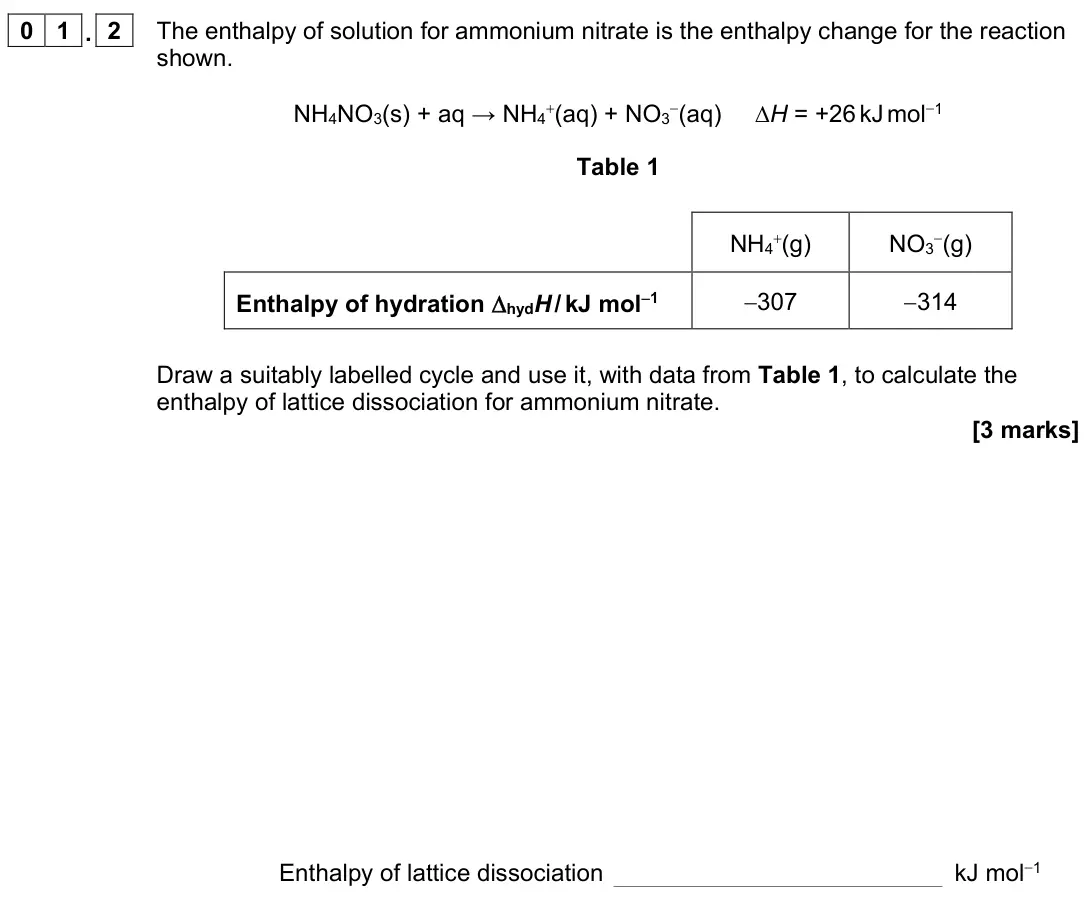
Q01.7
The whole paper ↗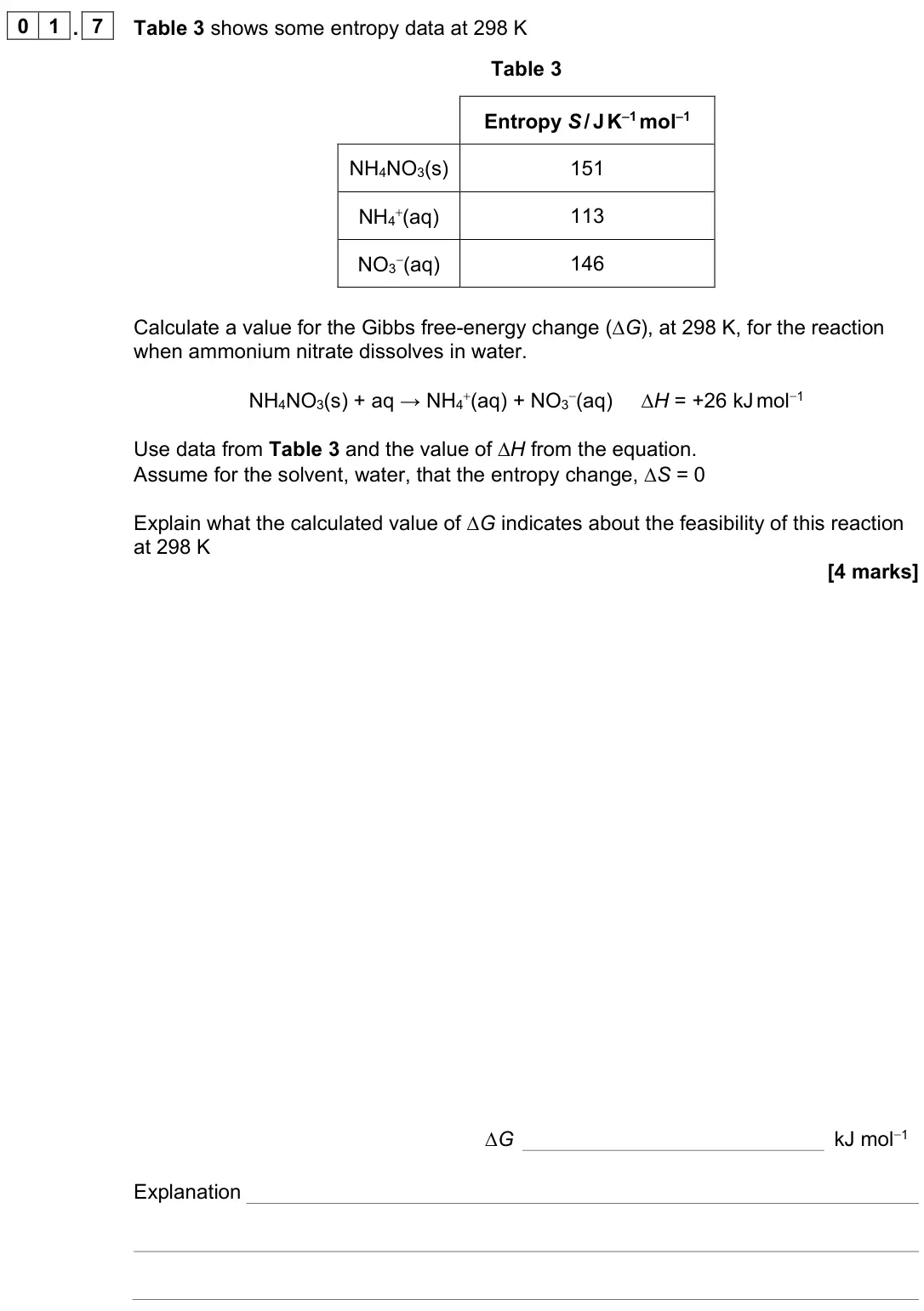
Q01.8
The whole paper ↗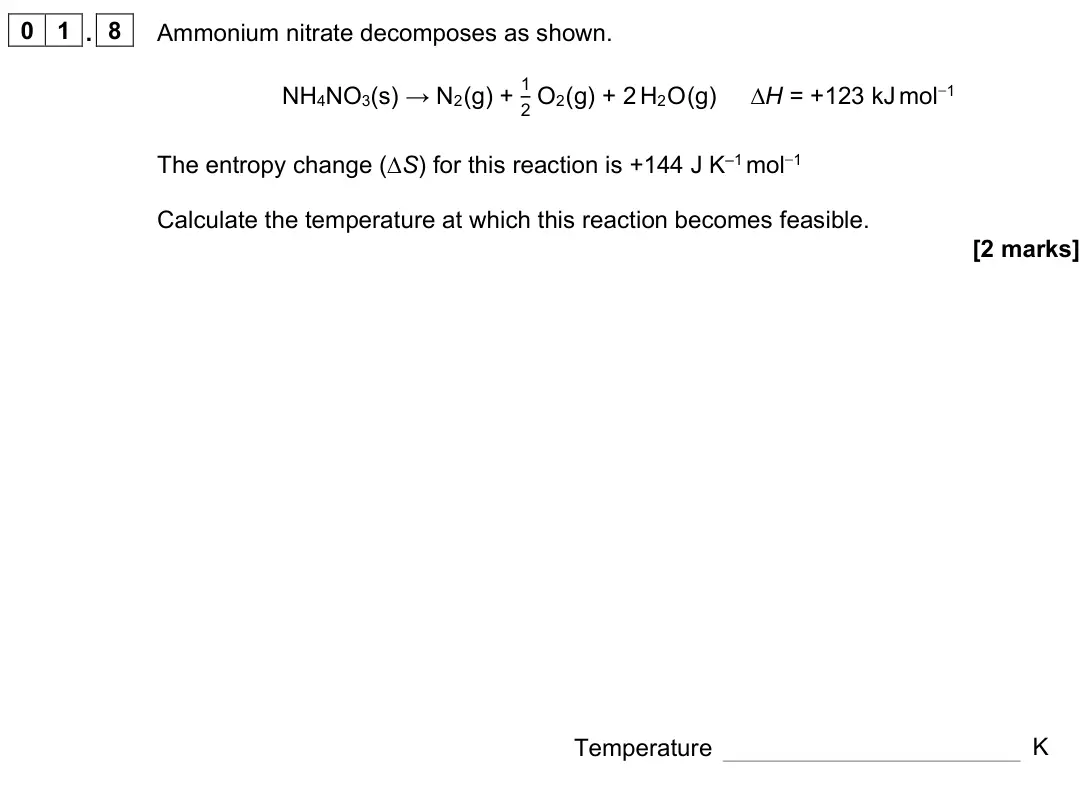
All 57 questions on Thermodynamics, as a list
- June 2025, Paper 1, Q04.2 (5 marks): Use the equation and the data in Table 4 to calculate the temperature at which this reaction becomes feasible. [5 marks] Temperature K
- June 2025, Paper 3, Q01.3 (2 marks): Table 2 shows some enthalpy change data. Table 2 Enthalpy change / kJ mol–1 Enthalpy of lattice formation of potassium hydroxide –789 Enthalpy of hydration of p
- June 2024, Paper 1, Q08.1 (1 mark): Theoretical values for enthalpies of lattice dissociation can be calculated using a perfect ionic model. State the meaning of the term perfect ionic model. [1 m
- June 2024, Paper 1, Q08.2 (2 marks): Enthalpies of lattice dissociation can also be obtained from Born–Haber cycles. Figure 3 shows an incomplete Born–Haber cycle for the formation of sodium oxide.
- June 2024, Paper 1, Q08.3 (2 marks): Table 4 shows some enthalpy changes. Table 4 Enthalpy change ΔH / kJ mol–1 Enthalpy of atomisation of oxygen +248 Enthalpy of atomisation of sodium +109 Enthalp
- June 2024, Paper 1, Q08.4 (1 mark): Explain why the second electron affinity of oxygen has a positive value. [1 mark]
- June 2024, Paper 1, Q08.5 (2 marks): Explain why the enthalpy of lattice dissociation for sodium oxide is greater than the enthalpy of lattice dissociation for sodium chloride. [2 marks]
- June 2024, Paper 1, Q08.6 (2 marks): Sodium chloride dissolves in water. Table 5 shows some more enthalpy changes. Table 5 Enthalpy change ΔH / kJ mol–1 Enthalpy of hydration for Cl– ions –364 Enth
- June 2024, Paper 1, Q08.7 (1 mark): Give a reason why data books do not contain a value for the enthalpy of solution of sodium oxide. [1 mark]
- June 2024, Paper 1, Q08.8 (3 marks): Calculate the temperature, in °C, at which this reaction becomes feasible. NaCl(s) → Na(s) + 1 2 Cl2(g) ΔH = +411 kJ mol–1 ΔS = +90.1 J K–1 mol–1 [3 marks] Temp
- June 2023, Paper 1, Q05.1 (2 marks): Table 2 shows some enthalpy change data. Table 2 Enthalpy change / kJ mol–1 Ca2+(g) → Ca2+(aq) –1650 Cl–(g) → Cl–(aq) –364 Ca2+(g) + 2 Cl– (g) → CaCl2(s) –2237
- June 2023, Paper 1, Q05.2 (1 mark): Use your answer to Question 05.1 to deduce how the temperature changes when calcium chloride dissolves in water. [1 mark]
- June 2023, Paper 1, Q05.3 (2 marks): Explain why the enthalpy of hydration of fluoride ions is more negative than the enthalpy of hydration of chloride ions. [2 marks]
- June 2023, Paper 1, Q05.4 (2 marks): Figure 2 shows an incomplete Born–Haber cycle for calcium chloride. Figure 2 Complete the Born–Haber cycle by writing the formulas of the missing species on eac
- June 2023, Paper 1, Q05.5 (2 marks): Table 3 shows some enthalpy change data. Table 3 Enthalpy change / kJ mol–1 Enthalpy of atomisation of calcium +193 First ionisation energy of calcium +590 Enth
- June 2023, Paper 1, Q05.7 (6 marks): Table 4 shows lattice enthalpies based on a perfect ionic model and lattice enthalpies from Born–Haber cycles for three metal chlorides. Table 4 Lattice enthalp
- June 2022, Paper 3, Q01.1 (2 marks): Define the term enthalpy of lattice dissociation. [2 marks]
- June 2022, Paper 3, Q01.2 (3 marks): The enthalpy of solution for ammonium nitrate is the enthalpy change for the reaction shown. NH4NO3(s) + aq → NH4+(aq) + NO3−(aq) ∆H = +26 kJ mol−1 Table 1 NH4+
- June 2022, Paper 3, Q01.7 (4 marks): Table 3 shows some entropy data at 298 K Table 3 Entropy S / J K 1 mol 1 NH4NO3(s) 151 NH4+(aq) 113 NO3−(aq) 146 Calculate a value for the Gibbs free-energy cha
- June 2022, Paper 3, Q01.8 (2 marks): Ammonium nitrate decomposes as shown. NH4NO3(s) → N2 (g) + 1 2 O2 (g) + 2 H2 O (g) ∆H = +123 kJ mol−1 The entropy change (∆S) for this reaction is +144 J K–1 mo
- November 2021, Paper 1, Q01.2 (3 marks): Complete Figure 1 by writing the formulas, including state symbols, of the appropriate species on each of the three blank lines. [3 marks]
- November 2021, Paper 1, Q01.3 (2 marks): Table 1 shows some enthalpy data. Table 1 Enthalpy change / kJ mol–1 Enthalpy of formation of calcium chloride –795 Enthalpy of atomisation of calcium +193 Firs
- November 2021, Paper 1, Q01.4 (1 mark): Magnesium chloride dissolves in water. Give an equation, including state symbols, to represent the process that occurs when the enthalpy of solution of magnesiu
- November 2021, Paper 1, Q01.5 (2 marks): Table 2 shows some enthalpy data. Table 2 Enthalpy change / kJ mol–1 Enthalpy of lattice dissociation of MgCl2 +2493 Enthalpy of hydration of Mg2+(g) –1920 Enth
- November 2021, Paper 1, Q01.6 (2 marks): The enthalpy of hydration of Ca2+(g) is –1650 kJ mol–1 Suggest why this value is less exothermic than that of Mg2+(g) [2 marks]
- November 2021, Paper 1, Q07.1 (1 mark): Explain why the standard entropy value for carbon dioxide is greater than that for carbon. [1 mark]
- November 2021, Paper 1, Q07.2 (1 mark): State the temperature at which the standard entropy of aluminium is 0 J K–1 mol–1 [1 mark]
- November 2021, Paper 1, Q07.3 (7 marks): Use the equation and the data in Table 7 to calculate the minimum temperature, in K, at which this reaction becomes feasible. [7 marks] Minimum temperature K
- November 2020, Paper 1, Q01.1 (3 marks): Figure 1 shows a Born–Haber cycle for the formation of strontium chloride, SrCl2 Figure 1 Table 1 shows some thermodynamic data. Table 1 Enthalpy change / kJ mo
- November 2020, Paper 1, Q01.2 (1 mark): Draw a line from each substance to the enthalpy of lattice formation of that substance. [1 mark] Substance Enthalpy of lattice formation / kJ mol–1 MgCl2 –2018
- November 2020, Paper 1, Q01.3 (1 mark): State why there is a difference between the theoretical and experimental values. [1 mark]
- November 2020, Paper 1, Q01.4 (2 marks): Table 3 shows enthalpy of hydration values for ions of some Group 1 elements. Table 3 Li+(g) Na+(g) K+(g) Enthalpy of hydration / kJ mol–1 –519 –406 –322 Explai
- November 2020, Paper 1, Q01.5 (3 marks): Calcium bromide dissolves in water. Table 4 shows some enthalpy data. Table 4 Enthalpy change / kJ mol–1 Enthalpy of solution of calcium bromide –110 Enthalpy o
- November 2020, Paper 1, Q10.1 (6 marks): Use the equation and the data in Table 5 to calculate the Gibbs free-energy change (ΔG), in kJ mol–1, for this reaction at 890 K [6 marks] ΔG kJ mol–1
- November 2020, Paper 1, Q10.2 (4 marks): Use the values of the intercept and gradient from the graph in Figure 4 to calculate the enthalpy change (ΔH), in kJ mol–1, and the entropy change (ΔS), in J K–
- November 2020, Paper 1, Q10.3 (1 mark): State what Figure 4 shows about the feasibility of the reaction. [1 mark]
- June 2019, Paper 1, Q01.1 (2 marks): Complete Figure 1 by writing the formulas, including state symbols, of the appropriate species on each of the two blank lines. [2 marks]
- June 2019, Paper 1, Q01.2 (2 marks): Use Figure 1 and the data in Table 1 to calculate the standard enthalpy of atomisation of iodine. [2 marks] Standard enthalpy of atomisation of iodine kJ mol-1
- June 2019, Paper 1, Q01.3 (1 mark): The enthalpy of lattice formation for caesium iodide in Table 1 is a value obtained by experiment. The value obtained by calculation using the perfect ionic mod
- June 2019, Paper 1, Q01.4 (4 marks): Use data from Table 2 to show that this reaction is not feasible at 298 K CsI(s) → Cs(s) + 1 2 I2(s) ∆Ho = +337 kJ mol–1 Table 2 CsI(s) Cs(s) I2(s) So / J K–1 m
- June 2018, Paper 1, Q01.1 (3 marks): Figure 1 shows a Born–Haber cycle for the formation of magnesium oxide. Complete Figure 1 by writing the missing symbols on the appropriate energy levels. [3 ma
- June 2018, Paper 1, Q01.2 (3 marks): Table 1 contains some thermodynamic data. Table 1 Enthalpy change / kJ mol–1 Enthalpy of formation for magnesium oxide –602 Enthalpy of atomisation for magnesiu
- June 2018, Paper 1, Q03.1 (2 marks): Calculate the entropy change for the reaction between ammonia and oxygen. [2 marks] Entropy change J K–1 mol–1
- June 2018, Paper 1, Q03.2 (2 marks): Calculate a value for the Gibbs free-energy change (ΔG), in kJ mol–1, for the reaction between ammonia and oxygen at 600 °C (If you were unable to obtain an ans
- June 2018, Paper 1, Q03.3 (2 marks): The reaction between ammonia and oxygen was carried out at a higher temperature. Explain how this change affects the value of ΔG for the reaction. [2 marks]
- June 2018, Paper 3, Q14 (1 mark): Which equation represents the process that occurs when the standard enthalpy of atomisation of iodine is measured? [1 mark] A I2(s) I(g) B I2(s) 2I(g) C I2(
- June 2018, Paper 3, Q33 (1 mark): Lattice enthalpy values can be obtained from Born–Haber cycles and by calculations based on a perfect ionic model. Which compound shows the greatest percentage
- June 2017, Paper 1, Q01.1 (2 marks): Define the term enthalpy of lattice formation. [2 marks
- June 2017, Paper 1, Q01.2 (2 marks): Some enthalpy change data are shown in Table 1. Table 1 Enthalpy change / kJ mol−1 AgI(s) → Ag+(aq) + I–(aq) +112 Ag+(g) → Ag+(aq) −464 I–(g) → I–(aq) −293 Use
- June 2017, Paper 1, Q01.3 (2 marks): A calculation of the enthalpy of lattice formation of silver iodide based on a perfect ionic model gives a smaller numerical value than the value calculated in
- June 2017, Paper 1, Q05.1 (6 marks): Some entropy data are shown in Table 3. Table 3 Substance TiO2(s) C(s) Cl2(g) CO(g) TiCl4(l) So / J K−1 mol−1 50.2 5.70 223 198 253 Use the equation and the dat
- June 2017, Paper 3, Q01.4 (5 marks): Anhydrous magnesium chloride can be formed by direct reaction between its elements. Mg(s) + Cl2(g) → MgCl2(s) The free-energy change, ∆G, for this reaction vari
- June 2017, Paper 3, Q32 (1 mark): A reaction is exothermic and has a negative entropy change. Which statement is correct? [1 mark] A The reaction is always feasible B The reaction is feasible ab
- Specimen, Paper 1, Q05.1 (4 marks): Free-energy change = Units = 3
- Specimen, Paper 1, Q05.2 (2 marks): Temperature = K
- Specimen, Paper 1, Q09.3 (2 marks): Lattice enthalpy of dissociation = kJ mol –1
- Specimen, Paper 1, Q09.4 (2 marks): 6
Questions, mark schemes and examiner’s reports are © AQA, from their published past papers. Plumi isn’t affiliated with any exam board. Want whole papers? Every AQA A-Level Chemistry paper.
Rather write your answers by hand on iPad? Plumi marks them against the same mark schemes.