 plumi
Acids and bases: AQA A‑Level Chemistry questions
Every AQA A-Level Chemistry exam question on 3.1.12 Acids and bases, 2016–2025, with its mark scheme and examiner’s report.
Find questions2,301
Calculations
Q08.1
The whole paper ↗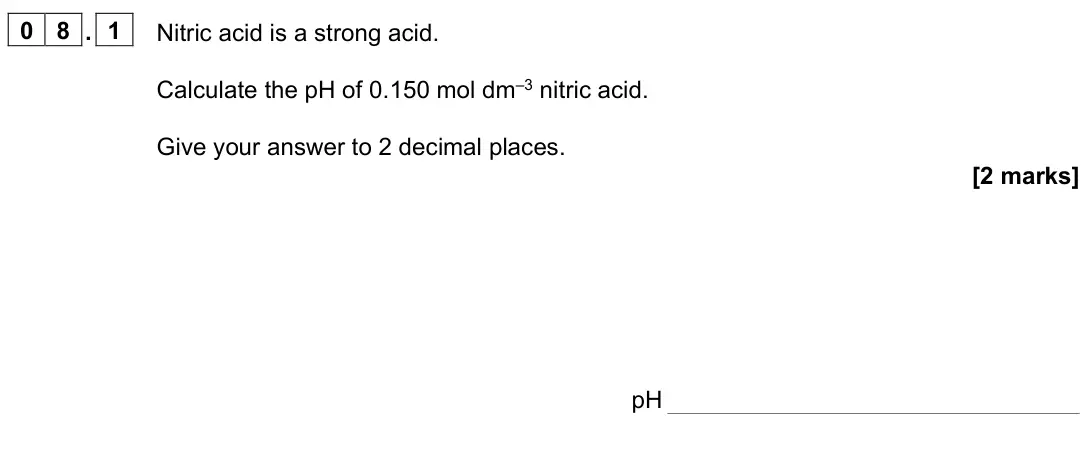
Q08.2
The whole paper ↗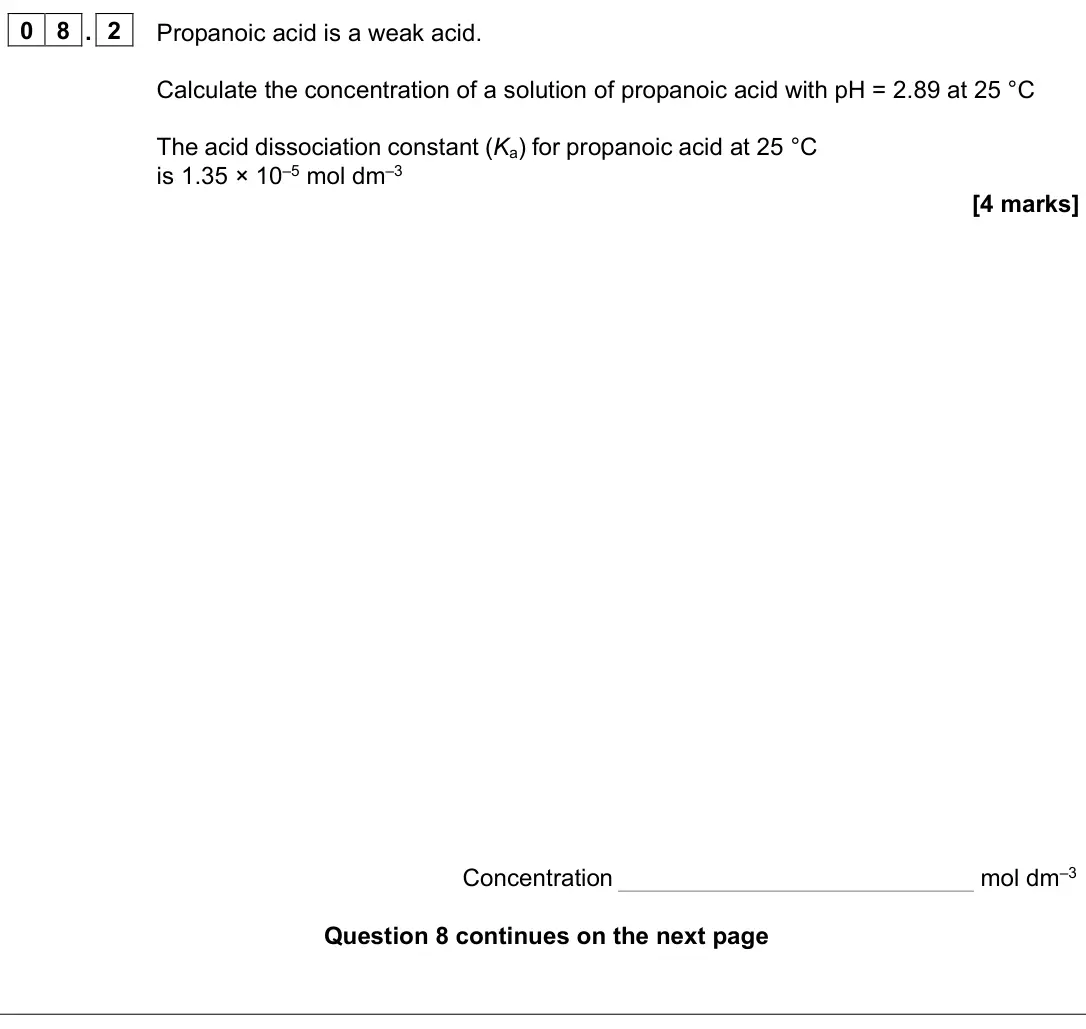
Q08.3
The whole paper ↗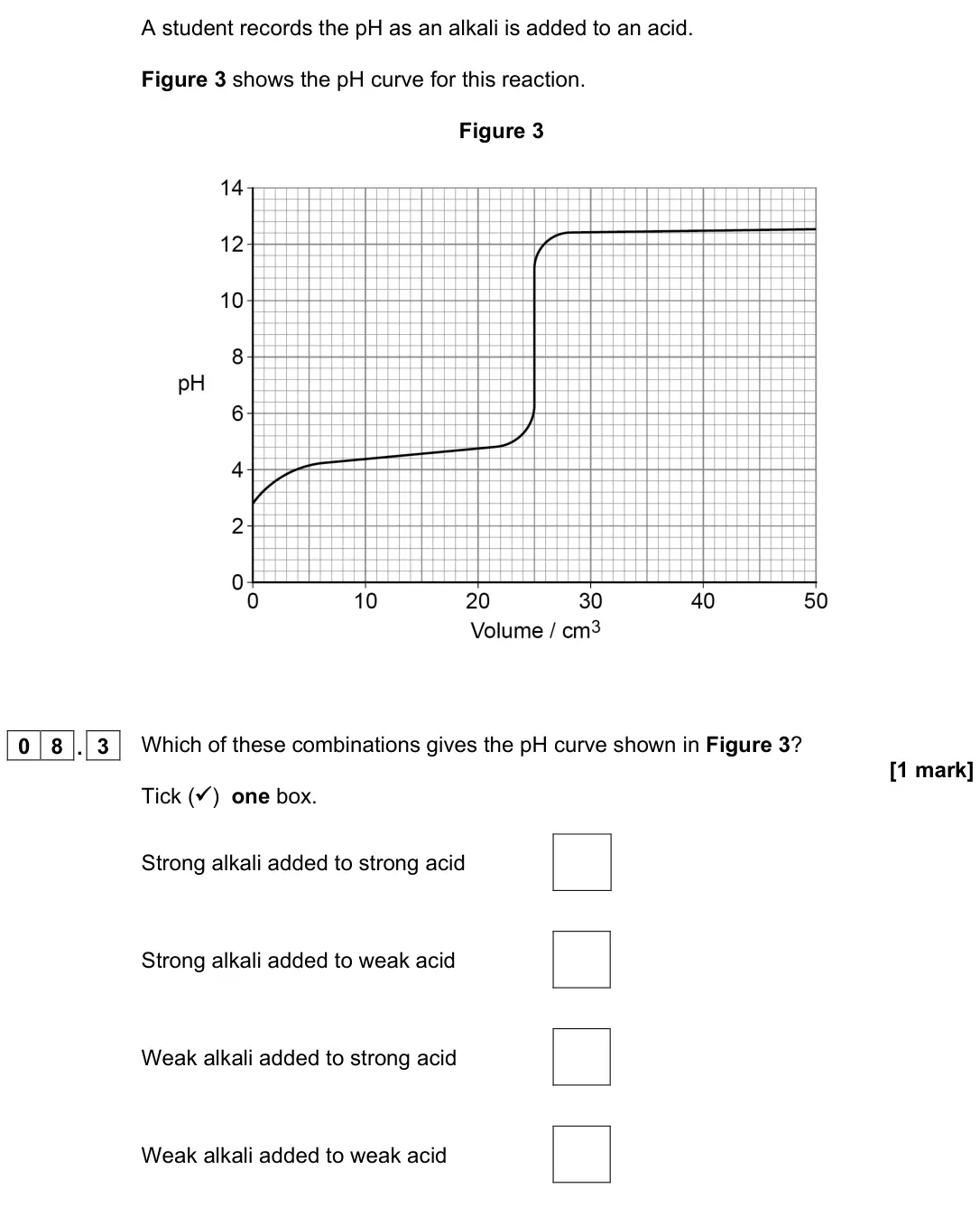
Q08.4
The whole paper ↗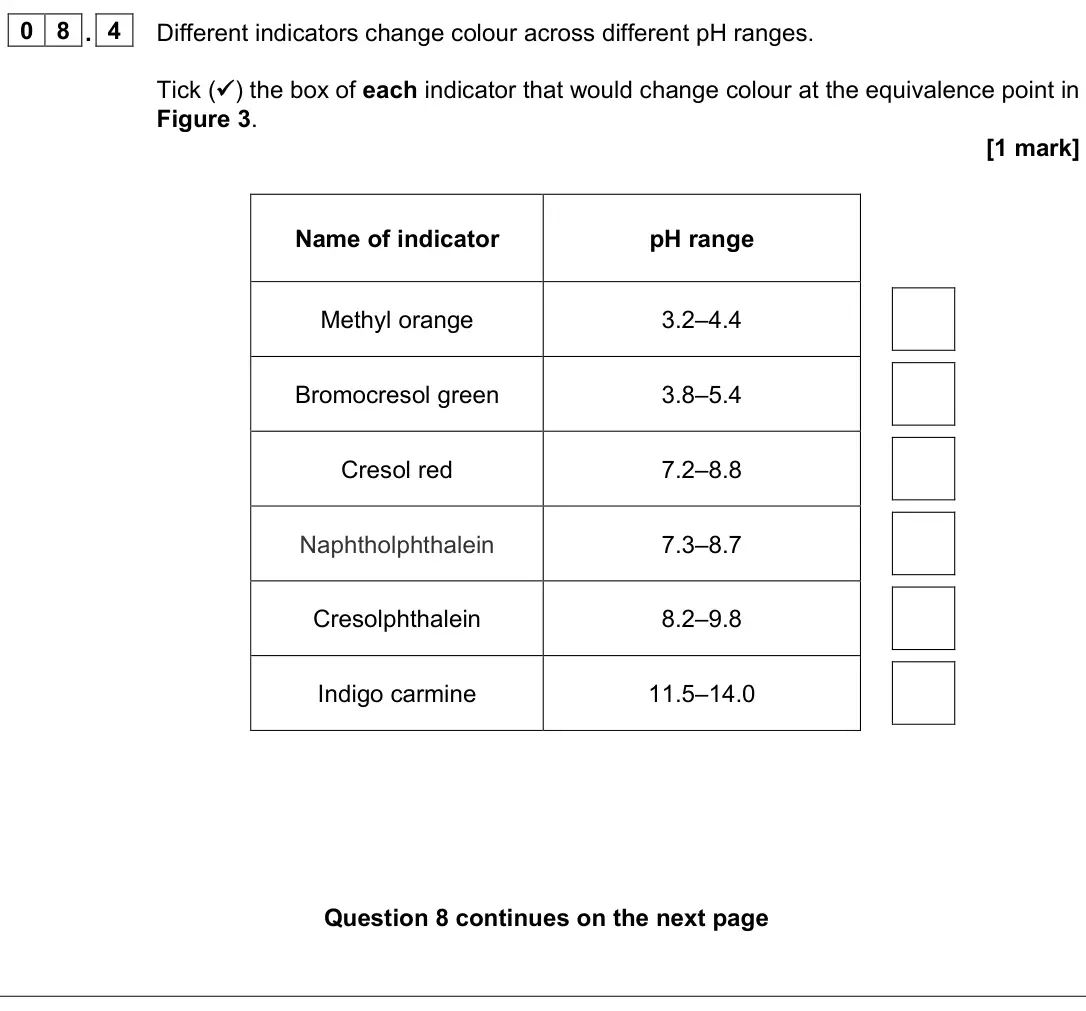
Q08.5
The whole paper ↗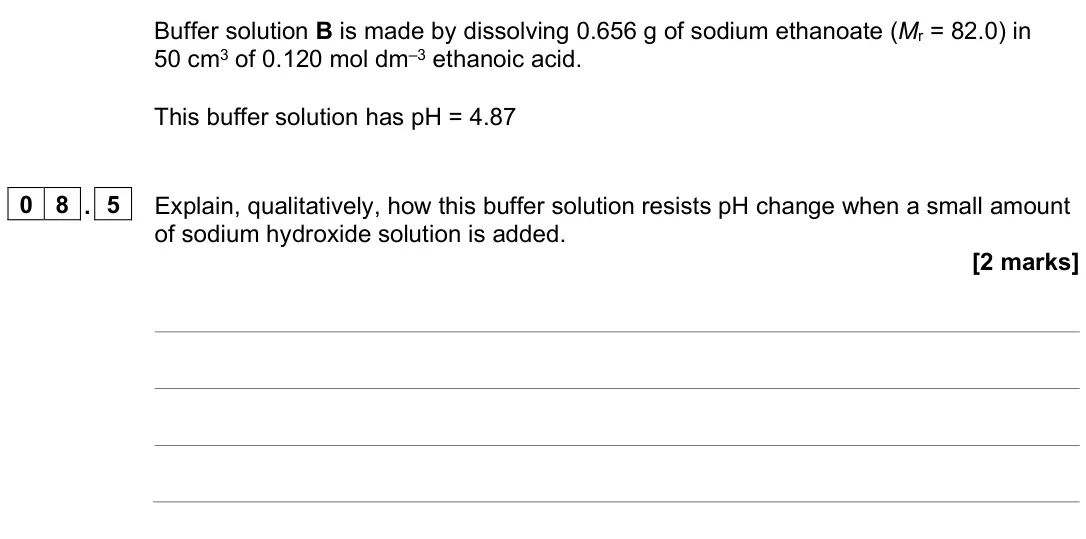
Q08.6
The whole paper ↗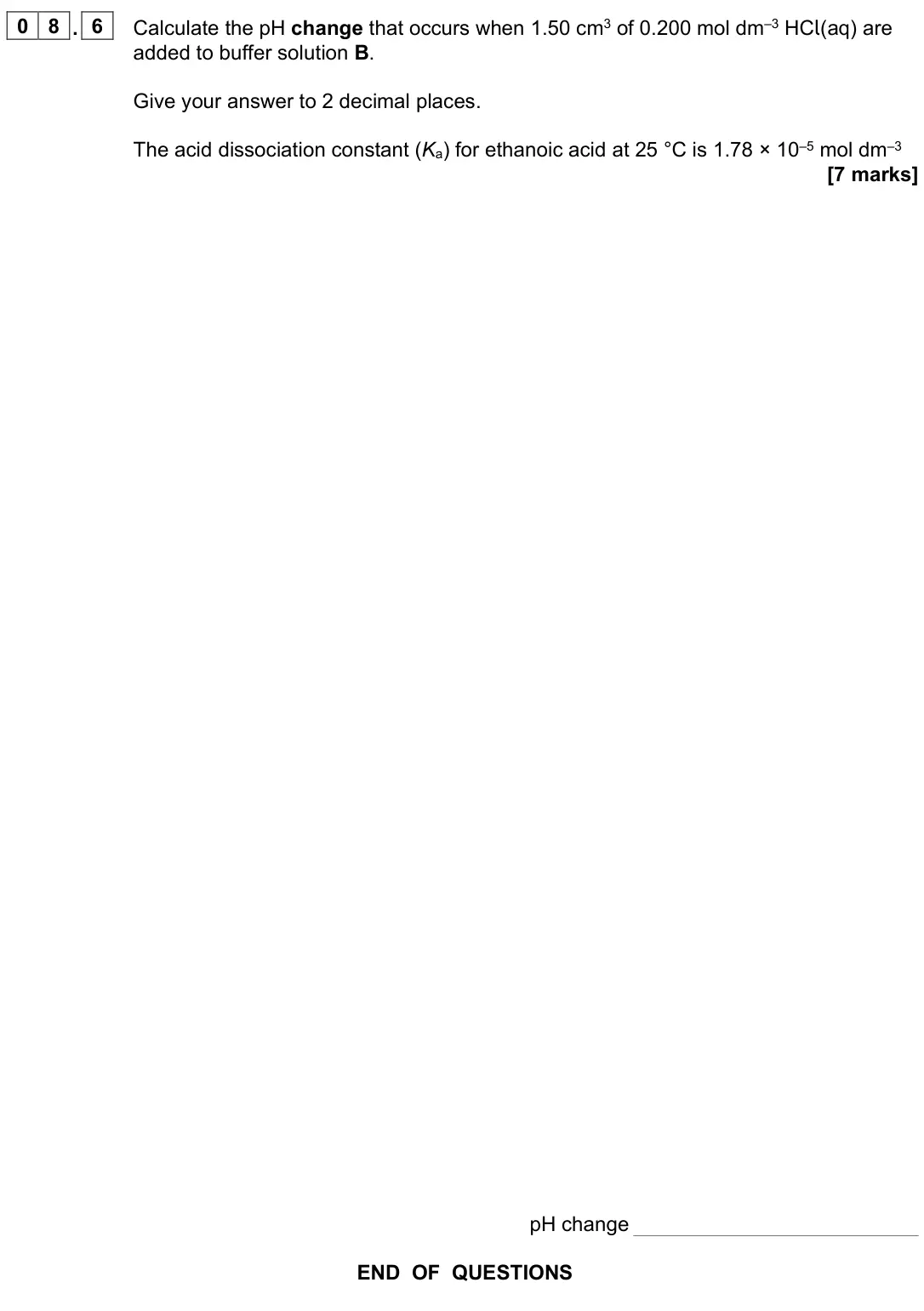
Q07.1
The whole paper ↗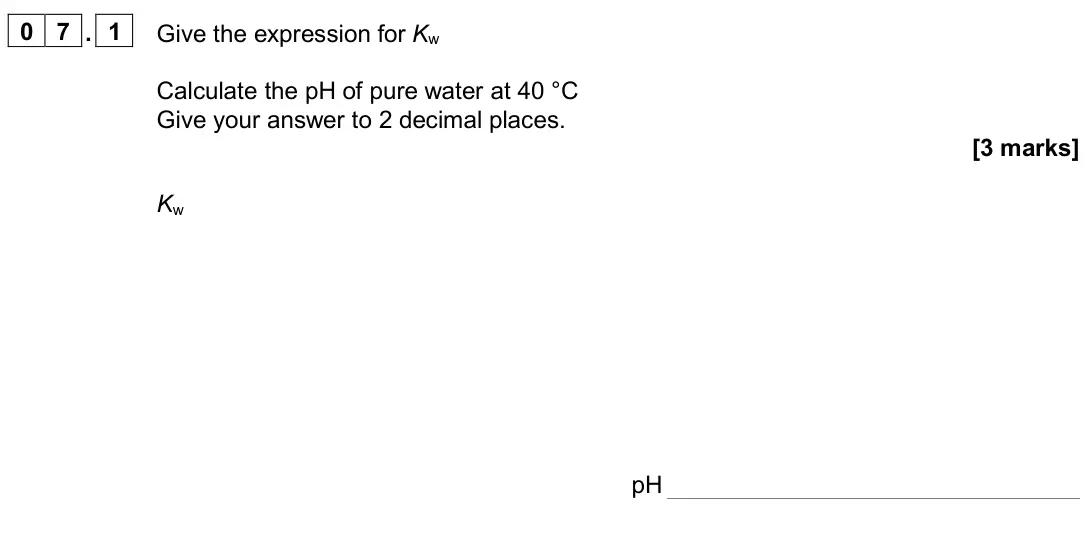
Q07.2
The whole paper ↗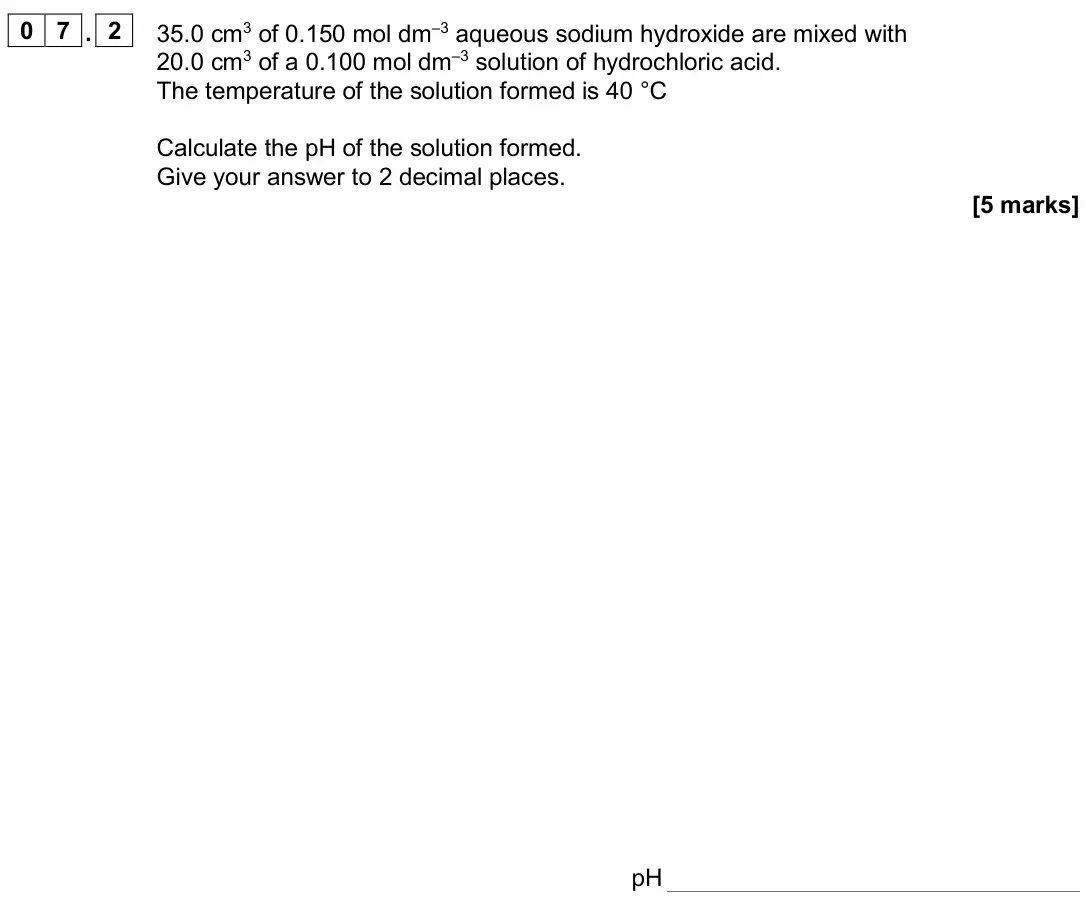
Q09.6
The whole paper ↗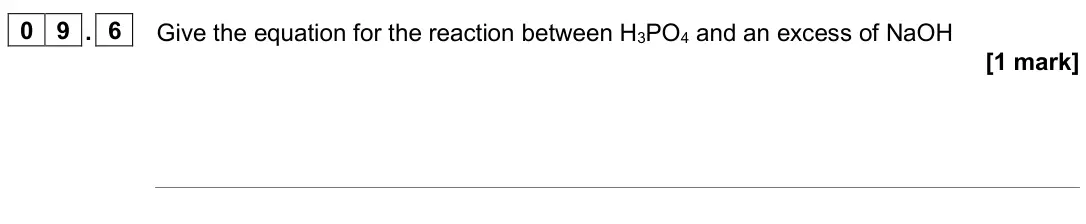
Q04.1
The whole paper ↗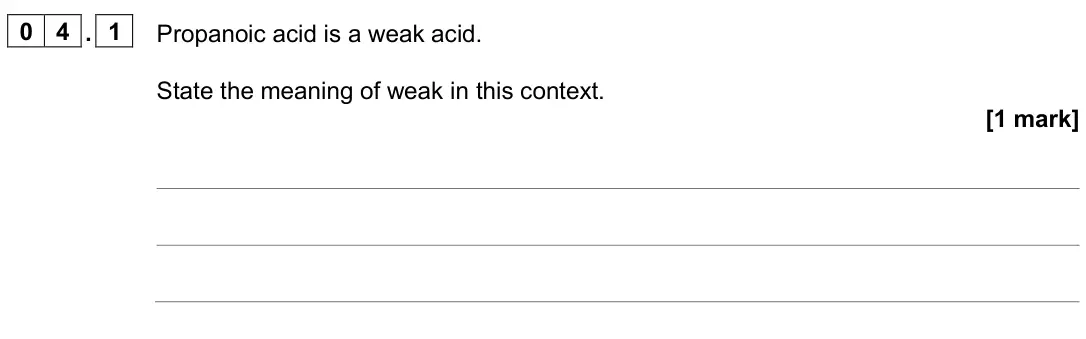
Q04.2
The whole paper ↗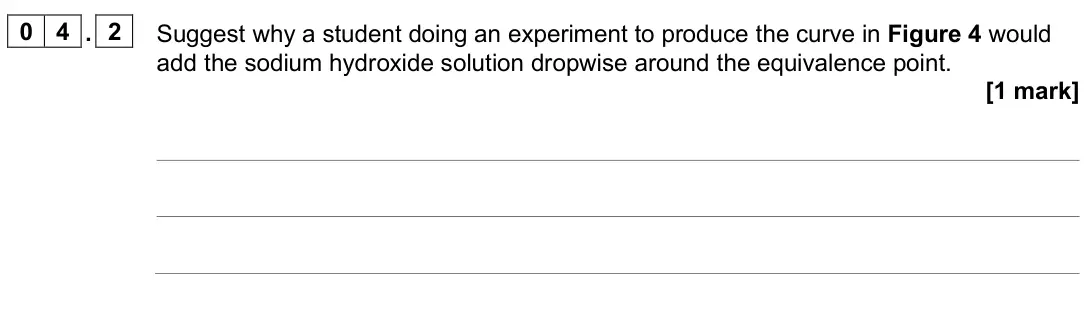
Q04.3
The whole paper ↗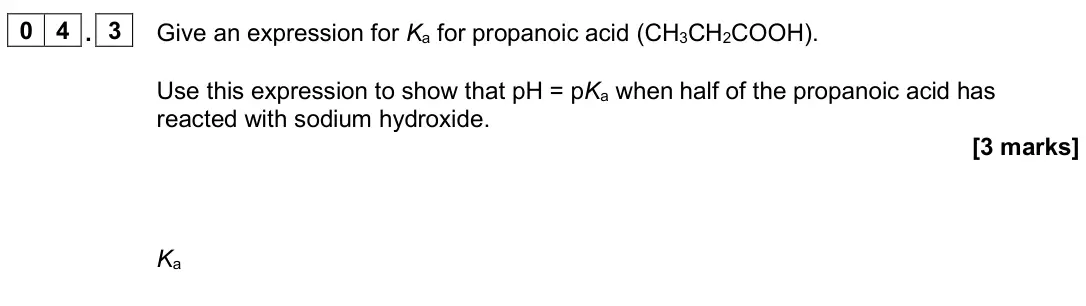
Q04.4
The whole paper ↗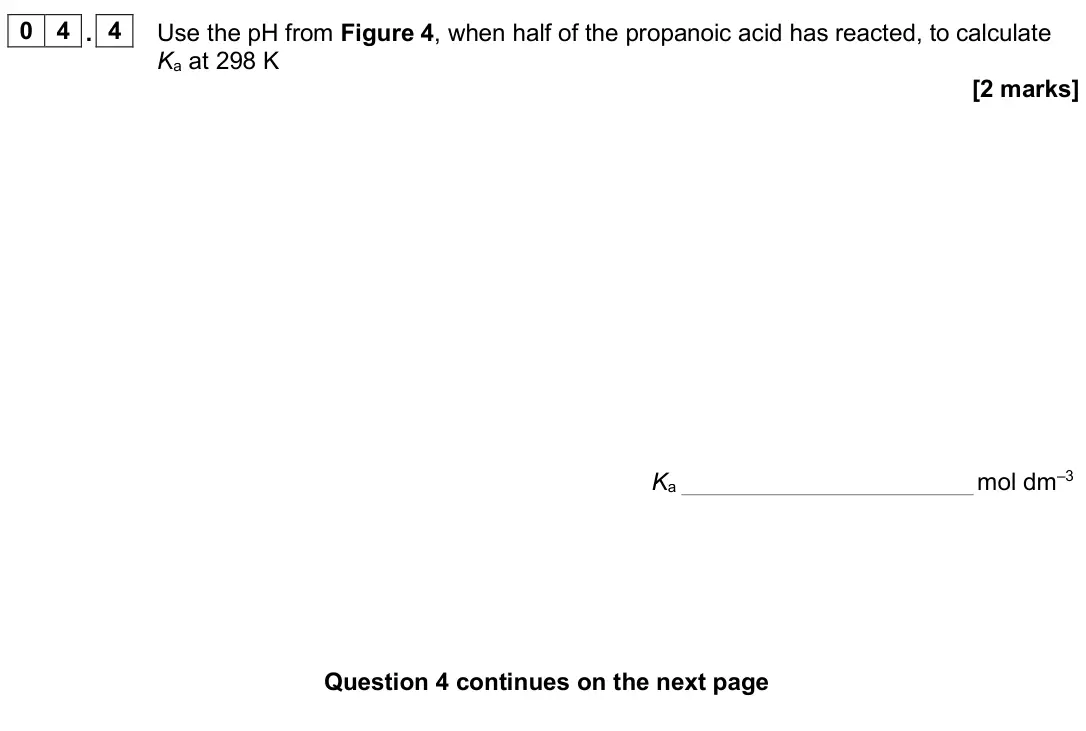
Q04.5
The whole paper ↗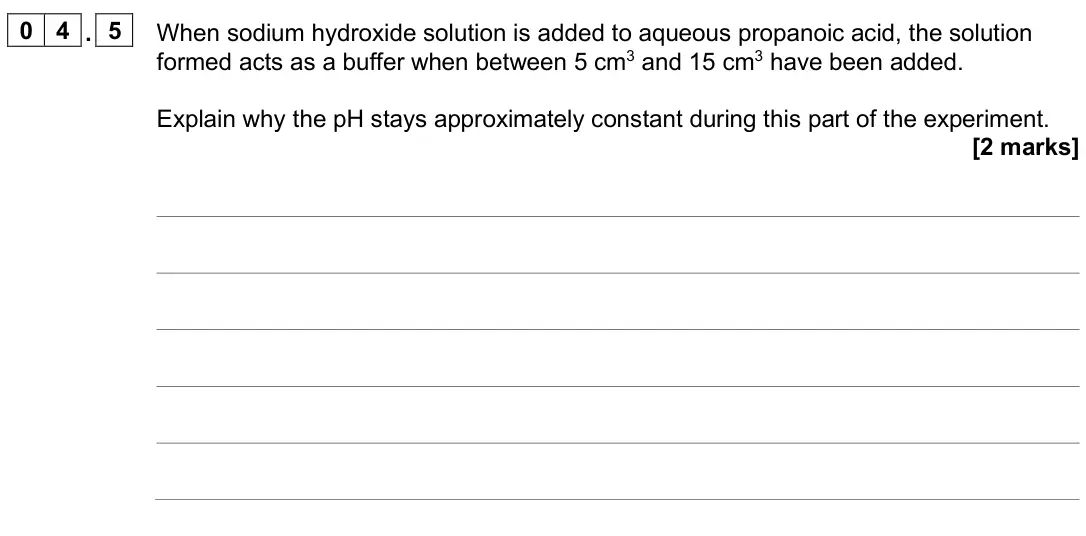
Q04.6
The whole paper ↗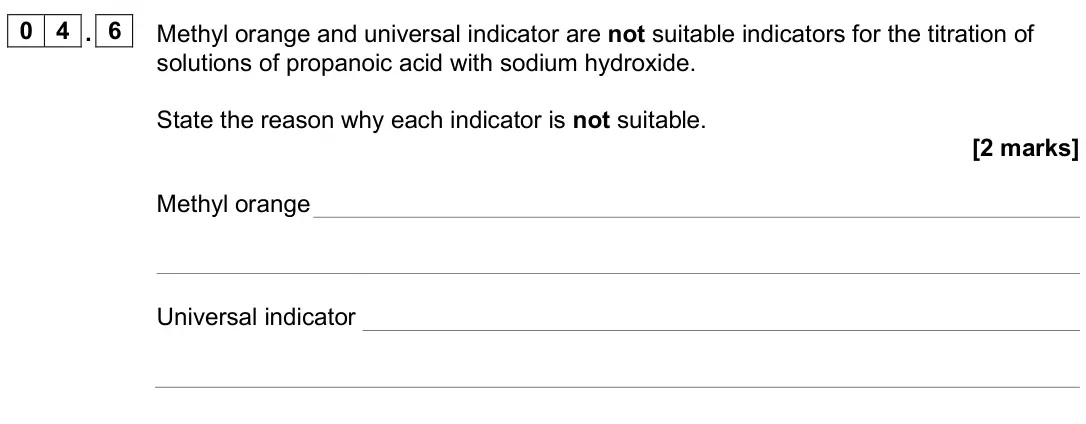
Q10.1
The whole paper ↗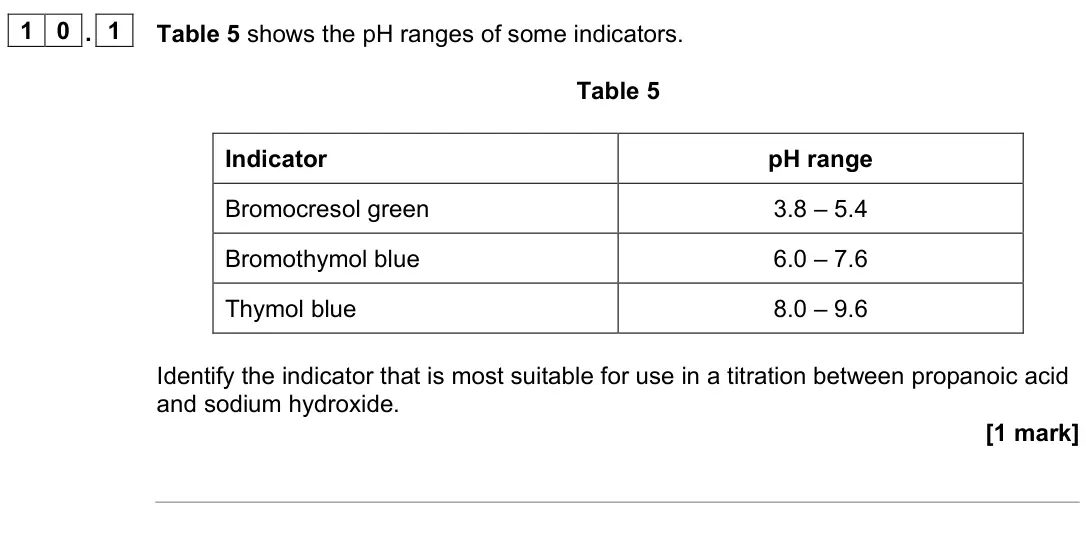
Q10.2
The whole paper ↗
Q10.3
The whole paper ↗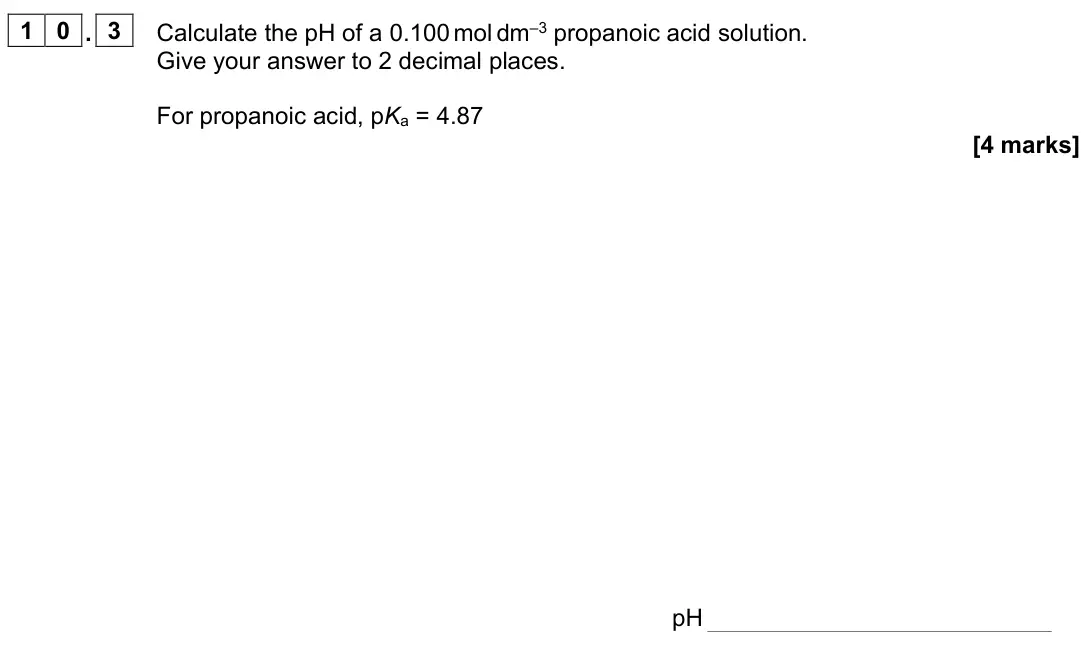
Q10.4
The whole paper ↗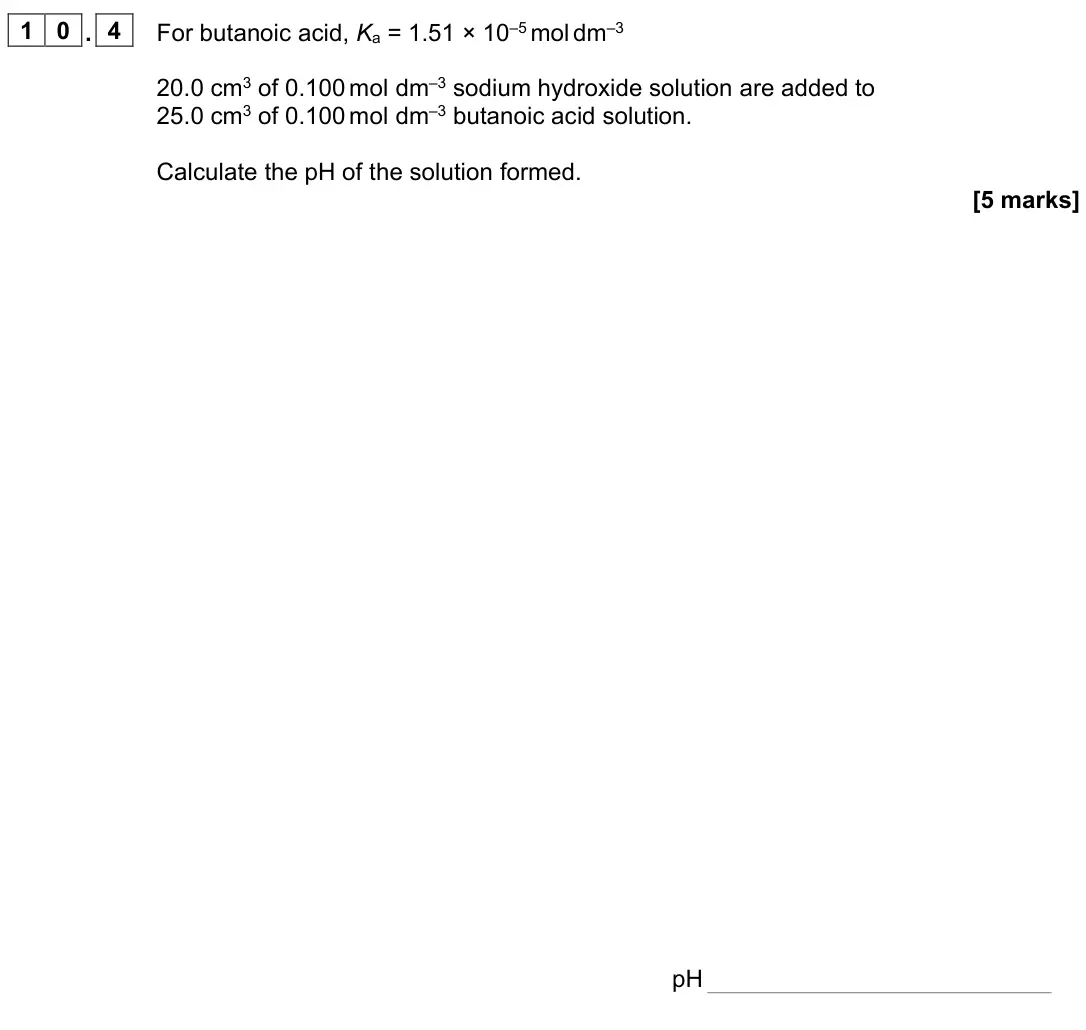
All 91 questions on Acids and bases, as a list
- June 2025, Paper 1, Q08.1 (2 marks): Nitric acid is a strong acid. Calculate the pH of 0.150 mol dm–3 nitric acid. Give your answer to 2 decimal places. [2 marks] pH
- June 2025, Paper 1, Q08.2 (4 marks): Propanoic acid is a weak acid. Calculate the concentration of a solution of propanoic acid with pH = 2.89 at 25 °C The acid dissociation constant (Ka) for propa
- June 2025, Paper 1, Q08.3 (1 mark): Which of these combinations gives the pH curve shown in Figure 3? [1 mark] Tick ( ) one box. Strong alkali added to strong acid Strong alkali added to weak acid
- June 2025, Paper 1, Q08.4 (1 mark): Different indicators change colour across different pH ranges. Tick ( ) the box of each indicator that would change colour at the equivalence point in Figure 3.
- June 2025, Paper 1, Q08.5 (2 marks): Explain, qualitatively, how this buffer solution resists pH change when a small amount of sodium hydroxide solution is added. [2 marks]
- June 2025, Paper 1, Q08.6 (7 marks): Calculate the pH change that occurs when 1.50 cm3 of 0.200 mol dm–3 HCl(aq) are added to buffer solution B. Give your answer to 2 decimal places. The acid disso
- June 2024, Paper 1, Q07.1 (3 marks): Give the expression for Kw Calculate the pH of pure water at 40 °C Give your answer to 2 decimal places. [3 marks] Kw pH
- June 2024, Paper 1, Q07.2 (5 marks): 35.0 cm3 of 0.150 mol dm–3 aqueous sodium hydroxide are mixed with 20.0 cm3 of a 0.100 mol dm–3 solution of hydrochloric acid. The temperature of the solution f
- June 2024, Paper 1, Q09.6 (1 mark): Give the equation for the reaction between H3PO4 and an excess of NaOH [1 mark]
- June 2024, Paper 3, Q04.1 (1 mark): Propanoic acid is a weak acid. State the meaning of weak in this context. [1 mark]
- June 2024, Paper 3, Q04.2 (1 mark): Suggest why a student doing an experiment to produce the curve in Figure 4 would add the sodium hydroxide solution dropwise around the equivalence point. [1 mar
- June 2024, Paper 3, Q04.3 (3 marks): Give an expression for Ka for propanoic acid (CH3CH2COOH). Use this expression to show that pH = pKa when half of the propanoic acid has reacted with sodium hyd
- June 2024, Paper 3, Q04.4 (2 marks): Use the pH from Figure 4, when half of the propanoic acid has reacted, to calculate Ka at 298 K [2 marks] Ka mol dm–3
- June 2024, Paper 3, Q04.5 (2 marks): When sodium hydroxide solution is added to aqueous propanoic acid, the solution formed acts as a buffer when between 5 cm3 and 15 cm3 have been added. Explain w
- June 2024, Paper 3, Q04.6 (2 marks): Methyl orange and universal indicator are not suitable indicators for the titration of solutions of propanoic acid with sodium hydroxide. State the reason why e
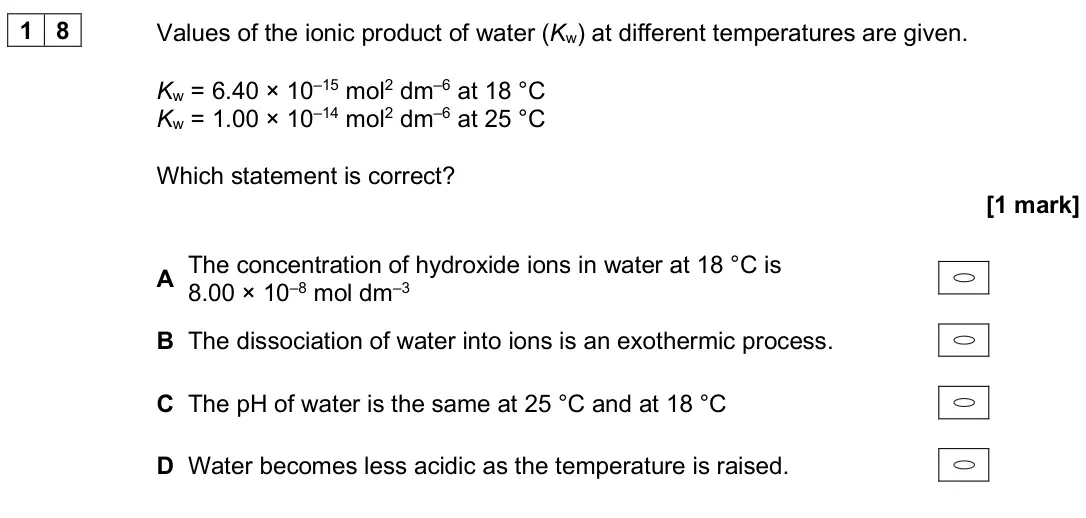
- June 2024, Paper 3, Q18 (1 mark): Values of the ionic product of water (Kw) at different temperatures are given. Kw = 6.40 × 10⁻¹⁵ mol2 dm–6 at 18 °C Kw = 1.00 × 10⁻¹⁴ mol2 dm–6 at 25 °C Which s
- June 2023, Paper 1, Q10.1 (1 mark): Table 5 shows the pH ranges of some indicators. Table 5 Indicator pH range Bromocresol green 3.8 – 5.4 Bromothymol blue 6.0 – 7.6 Thymol blue 8.0 – 9.6 Identify
- June 2023, Paper 1, Q10.2 (1 mark): Give the expression for the acid dissociation constant (Ka) for propanoic acid (CH3CH2COOH). [1 mark] Ka
- June 2023, Paper 1, Q10.3 (4 marks): Calculate the pH of a 0.100 mol dm–3 propanoic acid solution. Give your answer to 2 decimal places. For propanoic acid, pKa = 4.87 [4 marks] pH
- June 2023, Paper 1, Q10.4 (5 marks): For butanoic acid, Ka = 1.51 × 10⁻⁵ mol dm–3 20.0 cm3 of 0.100 mol dm–3 sodium hydroxide solution are added to 25.0 cm3 of 0.100 mol dm–3 butanoic acid solution
- June 2023, Paper 1, Q10.5 (2 marks): A student plans to titrate butanoic acid solution with a solution of ethylamine. Explain why this titration could not be done using an indicator. [2 marks]
- June 2023, Paper 3, Q06.2 (5 marks): The final mixture contains a saturated solution of Ca(OH)2 at 293 K At 293 K • the solubility of Ca(OH)2 in this solution is 0.400 g dm–3 • Kw = 6.80 × 10⁻¹⁵ mo
- June 2023, Paper 3, Q16 (1 mark): Which species can behave as a Brønsted–Lowry acid in aqueous solution? [1 mark] A SO42− B HCO3− C BF3 D NH3
- June 2023, Paper 3, Q17 (1 mark): Which change causes the pH of 10 cm3 of 1.0 mol dm–3 NaOH to be halved at 298 K? Kw = 1.0 × 10⁻¹⁴ at 298 K [1 mark] A adding 10 cm3 of water B adding 10 dm3 of
- June 2023, Paper 3, Q18 (1 mark): A 0.100 mol dm–3 solution of a weak acid has pH = 2.50 What is the value of Ka for this acid, in mol dm–3 ? [1 mark] A 3.16 × 10⁻² B 3.16 × 10⁻³ C 1.00 × 10⁻⁴ D
- June 2023, Paper 3, Q20 (1 mark): Equal volumes of pairs of solutions are mixed. Which pair forms a buffer solution? [1 mark] A ammonia and ammonium chloride B ammonia and methylamine C ethanoic
- June 2022, Paper 1, Q04.1 (3 marks): Calculate the pH of a 0.150 mol dm–3 solution of ethanoic acid at 25 oC Give your answer to 2 decimal places. For ethanoic acid, Ka = 1.74 x 10⁻⁵ mol dm–3 at 25
- June 2022, Paper 1, Q04.2 (3 marks): Strontium is an element in Group 2. Calculate the pH of a 0.0100 mol dm–3 solution of strontium hydroxide at 10 oC You may assume that strontium hydroxide is co
- June 2022, Paper 1, Q04.3 (2 marks): The pH of a barium hydroxide solution is lower at 50 °C than at 10 °C At 50 °C a 25 cm3 sample of this barium hydroxide solution was neutralised by 22.45 cm3 of
- June 2022, Paper 1, Q04.4 (3 marks): State how a buffer solution can be made from solutions of potassium hydroxide and ethanoic acid. Give an equation for the reaction between potassium hydroxide a
- June 2022, Paper 1, Q04.5 (5 marks): A buffer solution is made by adding 2.00 g of sodium hydroxide to 500 cm3 of 1.00 mol dm–3 ethanoic acid solution. Calculate the pH of this buffer solution at 2
- June 2022, Paper 3, Q13 (1 mark): Which can not function as a Brønsted-Lowry acid? [1 mark] A CH3COO– B HCO3– C H3O+ D NH4+
- June 2022, Paper 3, Q14 (1 mark): A strong acid H2X dissociates in aqueous solution. H2X(aq) → 2 H+(aq) + X2– (aq) What is the pH of a 0.020 mol dm–3 solution of this acid? [1 mark] A 1.00 B 1.4
- June 2022, Paper 3, Q15 (1 mark): Equal volumes of two solutions, each with the same concentration, are mixed together at 298 K Which two solutions, when mixed, form a solution with a pH >7? [1
- November 2021, Paper 1, Q06.1 (1 mark): Explain why [H2O] is not shown in the Kw expression. [1 mark]
- November 2021, Paper 1, Q06.2 (2 marks): Explain why the value of Kw increases as the temperature increases. [2 marks]
- November 2021, Paper 1, Q06.3 (4 marks): Give the expression for pH. Calculate the pH of pure water at 50 °C Give your answer to 2 decimal places. Explain why water is neutral at 50 °C [4 marks] Expres
- November 2021, Paper 1, Q06.4 (1 mark): Use Figure 3 to give the true pH value when the pH meter reading is 5.6 [1 mark]
- November 2021, Paper 1, Q06.5 (1 mark): Suggest why the pH probe is washed with distilled water between each of the calibration measurements. [1 mark]
- November 2021, Paper 1, Q06.6 (1 mark): The calibrated pH meter is used to monitor the pH during a titration of hydrochloric acid with sodium hydroxide. Explain why the volume of sodium hydroxide solu
- November 2021, Paper 1, Q06.7 (1 mark): State why all three of the indicators in Table 6 are suitable for this titration. [1 mark]
- November 2021, Paper 1, Q06.8 (5 marks): 36.25 cm3 of 0.200 mol dm–3 sodium hydroxide solution are added to 25.00 cm3 of 0.150 mol dm–3 hydrochloric acid. Calculate the pH of the final solution at 25 º
- November 2021, Paper 3, Q05 (5 marks): A mixture of methanoic acid and sodium methanoate in aqueous solution acts as an acidic buffer solution. The equation shows the dissociation of methanoic acid.
- November 2020, Paper 1, Q04.1 (1 mark): State the meaning of the term weak acid. [1 mark]
- November 2020, Paper 1, Q04.2 (1 mark): Give an expression for the acid dissociation constant for propanoic acid. [1 mark] Ka
- November 2020, Paper 1, Q04.3 (4 marks): A student dilutes 25.0 cm3 of 0.500 mol dm–3 propanoic acid by adding water until the total volume is 100.0 cm3 Calculate the pH of this diluted solution of pro
- November 2020, Paper 1, Q04.4 (6 marks): A buffer solution with a pH of 4.50 is made by dissolving x g of sodium propanoate (C2H5COONa) in a solution of propanoic acid. The final volume of buffer solut
- November 2020, Paper 3, Q13 (1 mark): Which statement about pH is correct? [1 mark] A The pH of a weak base is independent of temperature. B At temperatures above 298 K, the pH of pure water is less
- November 2020, Paper 3, Q14 (1 mark): A 0.10 mol dm–3 aqueous solution of an acid is added slowly to 25 cm3 of a 0.10 mol dm–3 aqueous solution of a base. Which acid–base pair has the highest pH at
- November 2020, Paper 3, Q32 (1 mark): Which is the concentration of NaOH(aq), in mol dm–3, that has pH = 14.30? Kw = 1.00 × 10⁻¹⁴ mol2 dm–6 at 25 °C [1 mark] A –1.16 B 5.01 × 10⁻¹⁵ C 2.00 × 10¹⁴ D 2
- November 2020, Paper 3, Q34 (1 mark): What is the pH of 0.015 mol dm–3 sulfuric acid? [1 mark] A –1.82 B –1.52 C 1.52 D 1.82
- June 2019, Paper 1, Q09.1 (4 marks): For pure water at 40 °C, pH = 6.67 A student thought that the water was acidic. Explain why the student was incorrect. Determine the value of Kw at this tempera
- June 2019, Paper 1, Q09.2 (3 marks): Sodium hydroxide solution was added gradually from a burette to 25 cm3 of 0.080 mol dm–3 propanoic acid at 25 °C The pH was measured and recorded at regular int
- June 2019, Paper 1, Q09.3 (1 mark): Suggest which indicator is the most appropriate for the reaction in Question 09.2? Tick () one box. [1 mark] Indicator pH range Tick () one box methyl orange
- June 2019, Paper 1, Q09.4 (6 marks): A student prepared a buffer solution by adding 0.0136 mol of a salt KX to 100 cm3 of a 0.500 mol dm–3 solution of a weak acid HX and mixing thoroughly. The stud
- June 2019, Paper 1, Q09.5 (1 mark): A buffer solution has a constant pH even when diluted. Use a mathematical expression to explain this. [1 mark]
- June 2019, Paper 3, Q02.2 (2 marks): In aqueous solution, sulfuric acid acts as a strong acid. The H2SO4 dissociates to form HSO4 − ions and H+ ions. The HSO4 − ions act as a weak acid and dissocia
- June 2019, Paper 3, Q02.4 (6 marks): A solution that contains 605 mg of NaHSO4 in 100 cm3 of solution has a pH of 1.72 Calculate the value of Ka for the hydrogensulfate ion (HSO4 −) that is behavin
- June 2019, Paper 3, Q02.5 (2 marks): Some sodium sulfate is dissolved in a sample of the solution from question 02.4. Explain why this increases the pH of the solution. [2 marks]
- June 2018, Paper 1, Q05.1 (1 mark): State the meaning of the term strong acid. [1 mark]
- June 2018, Paper 1, Q05.2 (6 marks): In an experiment, 10.35 cm3 of 0.100 mol dm–3 hydrochloric acid are added to 25.0 cm3 of 0.150 mol dm–3 barium hydroxide solution. Calculate the pH of the solut
- June 2018, Paper 1, Q05.3 (1 mark): The pH of water at 30 °C is 6.92 Give the reason why water is neutral at this temperature. [1 mark]
- June 2018, Paper 1, Q05.5 (1 mark): Give the expression for the acid dissociation constant (Ka) for ethanoic acid (CH3COOH). [1 mark] Ka
- June 2018, Paper 1, Q05.6 (5 marks): A buffer solution contains 0.025 mol of sodium ethanoate dissolved in 500 cm3 of 0.0700 mol dm–3 ethanoic acid at 25 °C A sample of 5.00 cm3 of 2.00 mol dm–3 hy
- June 2018, Paper 3, Q32 (1 mark): Which indicator should be used in a titration to find the concentration of a solution of methylamine using 0.010 mol dm–3 hydrochloric acid? [1 mark] A Thymol b
- June 2017, Paper 1, Q02.1 (3 marks): The acid dissociation constant, Ka, for ethanoic acid is given by the expression Ka = COOH] [CH ] [H ] COO [CH 3 3 + − The value of Ka for ethanoic acid is 1.74
- June 2017, Paper 1, Q02.2 (6 marks): In a different buffer solution, the concentration of ethanoic acid was 0.260 mol dm−3 and the concentration of ethanoate ions was 0.121 mol dm−3 A 7.00 × 10⁻³ m
- June 2017, Paper 1, Q03.1 (1 mark): Which is the correct expression for Kw? Tick () one box. [1 mark A Kw = ] ][OH [H O] [H2 − + B Kw = [H+][H2O] C Kw = [H+][OH−] D Kw = O] [H ] ][OH [H 2 − +
- June 2017, Paper 1, Q03.2 (2 marks): Calculate the pH of pure water at 10 °C Give your answer to two decimal places. [2 marks pH of water
- June 2017, Paper 1, Q03.3 (1 mark): Suggest why this pure water at 10 °C is not alkaline. [1 mark
- June 2017, Paper 1, Q03.4 (3 marks): Calculate the pH of a 0.0131 mol dm−3 solution of calcium hydroxide at 10 °C Give your answer to two decimal places. [3 marks] pH of solution
- June 2017, Paper 1, Q03.5 (2 marks): The 0.0131 mol dm−3 calcium hydroxide solution at 10 °C was a saturated solution. A student added 0.0131 mol of magnesium hydroxide to 1.00 dm3 of water at 10 °
- June 2017, Paper 3, Q04.1 (1 mark): The pH range of an indicator is the range over which it changes colour. Suggest the pH range of a suitable indicator for this titration. [1 mark]
- June 2017, Paper 3, Q04.2 (1 mark): Give the expression for the acid dissociation constant of HX. [1 mark] Ka = 14
- June 2017, Paper 3, Q04.3 (2 marks): Calculate the concentration of HX in the original solution. [2 marks] Concentration mol dm−3
- June 2017, Paper 3, Q04.4 (2 marks): Calculate the pH of the solution of HX before the addition of any sodium hydroxide. (If you were unable to calculate a value for the concentration of HX in Ques
- June 2017, Paper 3, Q04.5 (1 mark): Calculate the pH of the solution when half of the acid has reacted. [1 mark] pH of solution
- June 2017, Paper 3, Q04.6 (2 marks): Plot your answers to Questions 4.4 and 4.5 on the grid in Figure 1. Use these points to sketch the missing part of the curve between 0 and 20 cm3 of NaOH soluti
- June 2017, Paper 3, Q09 (1 mark): 2,4,6-Trichlorophenol is a weak monoprotic acid, with Ka = 2.51 × 10⁻⁸ mol dm−3 at 298 K. What is the concentration, in mol dm–3, of hydrogen ions in a 2.00 × 1
- June 2017, Paper 3, Q10 (1 mark): What is the pH of a 0.46 mol dm−3 solution of potassium hydroxide at 298 K? (Kw = 1.0 × 10⁻¹⁴ mol2 dm−6 at 298 K) [1 mark] A 0.34 B 13.66 C 13.96 D 14.34
- June 2017, Paper 3, Q22 (1 mark): The diagram shows a pH curve produced by adding a strong alkali to a weak acid. Which point on the curve represents a solution that can act as a buffer? [1 mark
- Specimen, Paper 1, Q06.1 (2 marks): Apparatus Explanation 5
- Specimen, Paper 1, Q06.2 (2 marks): Use information from the curve in Figure 1 to explain why the end point of this reaction would be difficult to judge accurately using an indicator. [2 marks] 0
- Specimen, Paper 1, Q06.3 (3 marks): Concentration = mol dm – 6
- Specimen, Paper 1, Q06.4 (3 marks): Ka = mol dm
- Specimen, Paper 1, Q06.5 (2 marks): pH= 8
- Specimen, Paper 3, Q02.4: The pH ranges of three indicators are shown in Table 3. Table 3 Indicator pH range Bromocresol green 3.8–5.4 Bromothymol blue 6.0–7.6 Thymol blue 8.0–9.6 Select
- Specimen, Paper 3, Q04.1 (6 marks): Ethanedioic acid is a weak acid. Ethanedioic acid acts, initially, as a monoprotic acid. 4 – Use the concept of electronegativity to justify why the acid streng
- Specimen, Paper 3, Q04.2 (5 marks): pH =
- Specimen, Paper 3, Q13 (1 mark): What is the pH of a 0.020 mol dm–3 solution of a diprotic acid which is completely dissociated? [1 mark] A 1.00 B 1.40 C 1.70 D 4.00 1 3
- Specimen, Paper 3, Q14 (1 mark): The acid dissociation constant, Ka, of a weak acid HA has the value 2.56 × 10⁻⁴ mol dm–3 What is the pH of a 4.25 × 10⁻³ mol dm-3 solution of HA? [1 mark] A 5.9
Questions, mark schemes and examiner’s reports are © AQA, from their published past papers. Plumi isn’t affiliated with any exam board. Want whole papers? Every AQA A-Level Chemistry paper.
Rather write your answers by hand on iPad? Plumi marks them against the same mark schemes.