 plumi
Bonding: AQA A‑Level Chemistry questions
Every AQA A-Level Chemistry exam question on 3.1.3 Bonding, 2016–2025, with its mark scheme and examiner’s report.
Find questions2,301
Calculations
Q05.1
The whole paper ↗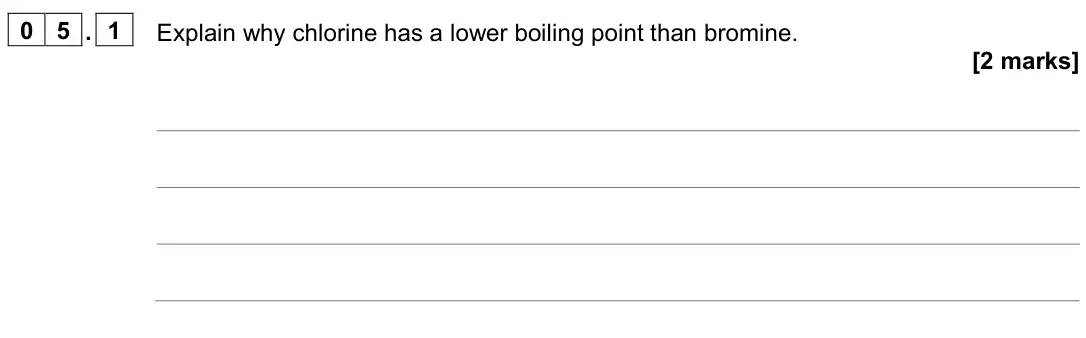
Q05.3
The whole paper ↗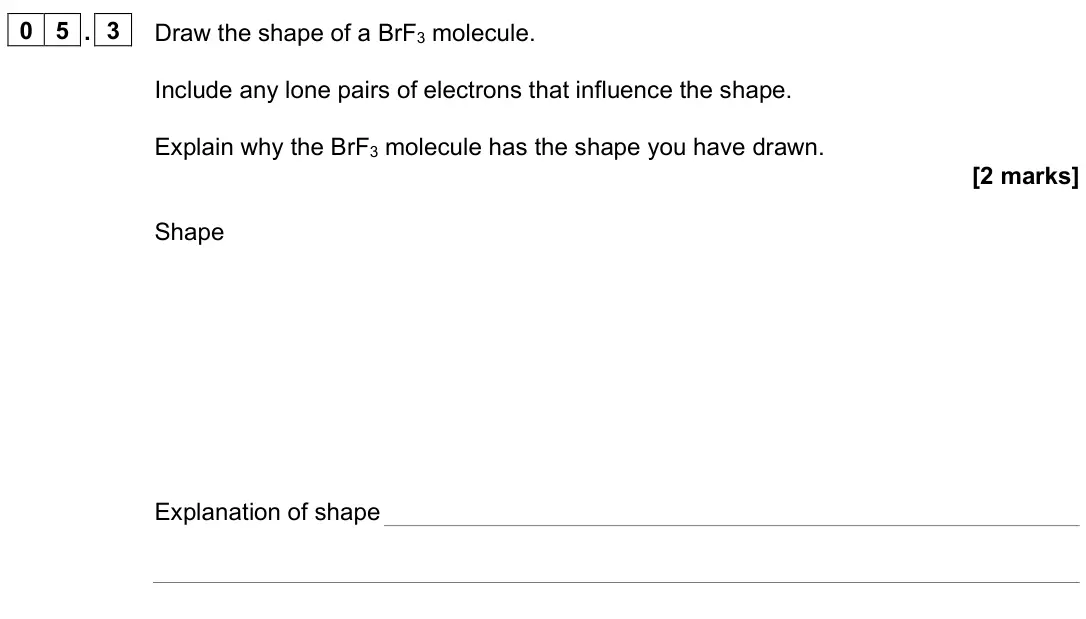
Q07.2
The whole paper ↗
Q07.5
The whole paper ↗
Q04.1
The whole paper ↗
Q01.5
The whole paper ↗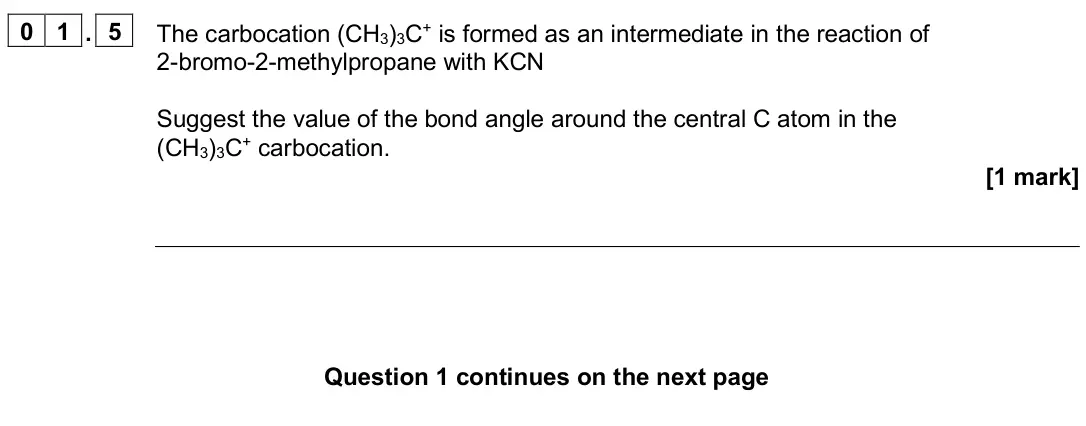
Q01.6
The whole paper ↗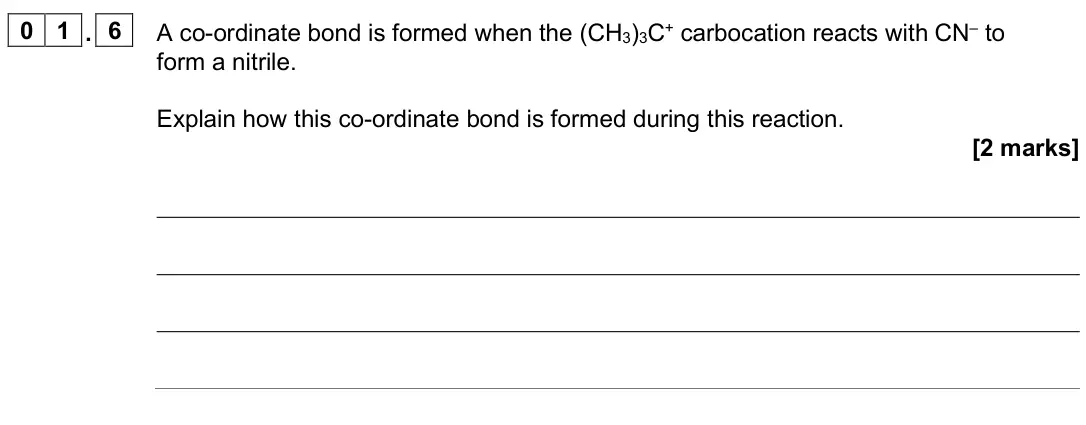
Q02.3
The whole paper ↗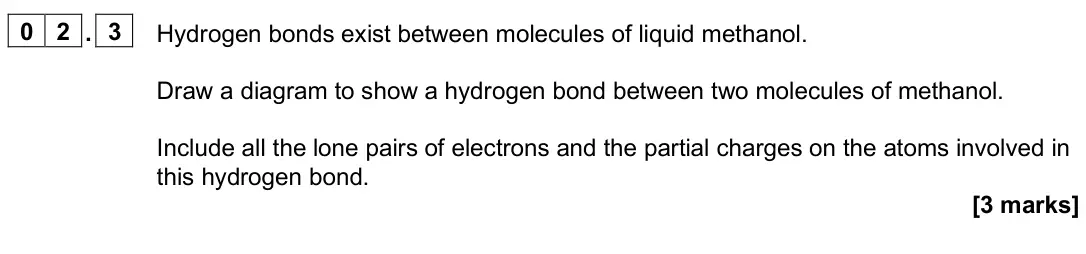
Q05.5
The whole paper ↗
Q05.6
The whole paper ↗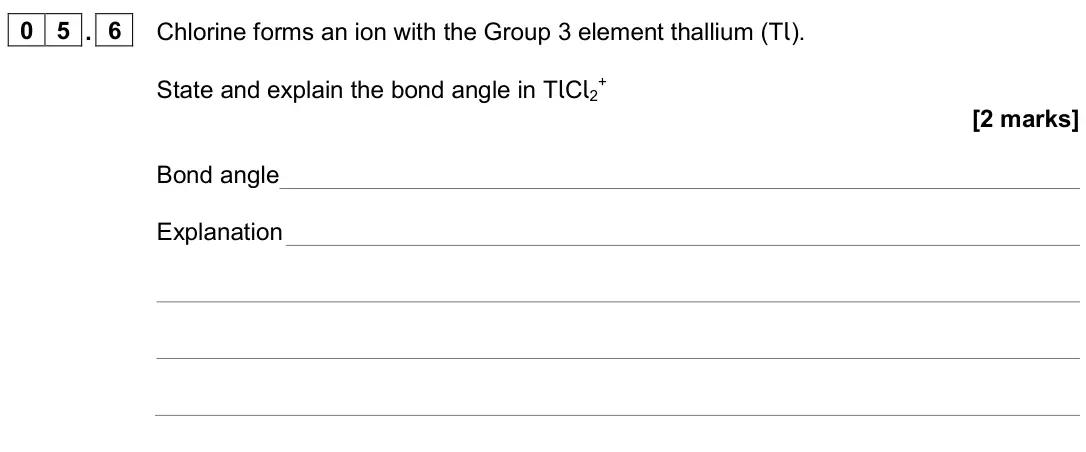
Q09.5
The whole paper ↗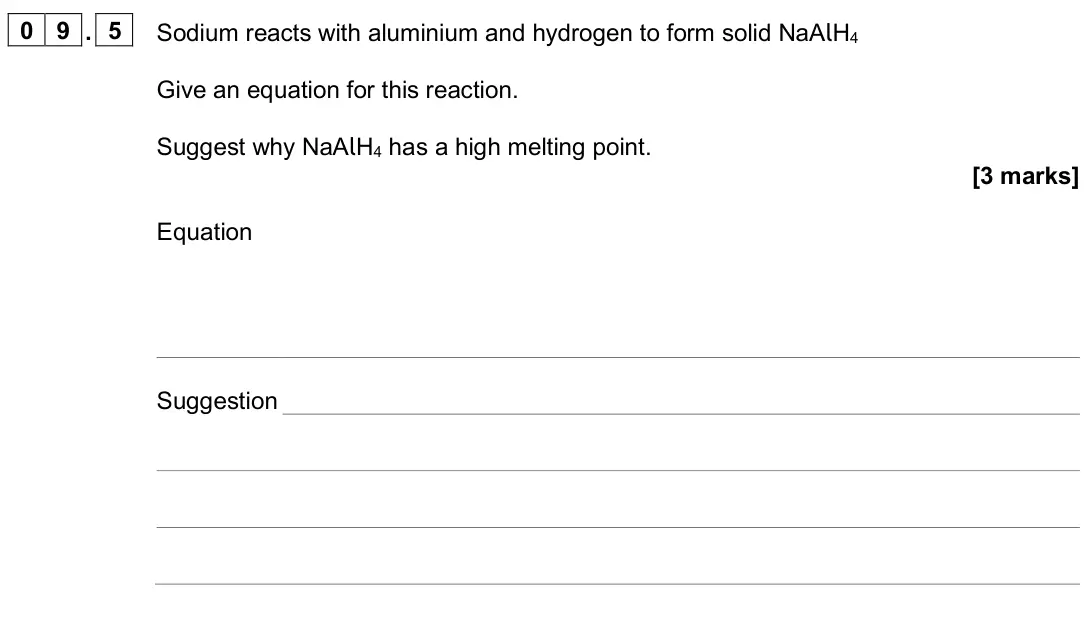
All 132 questions on Bonding, as a list
- June 2025, Paper 1, Q05.1 (2 marks): Explain why chlorine has a lower boiling point than bromine. [2 marks]
- June 2025, Paper 1, Q05.3 (2 marks): Draw the shape of a BrF3 molecule. Include any lone pairs of electrons that influence the shape. Explain why the BrF3 molecule has the shape you have drawn. [2
- June 2025, Paper 1, Q07.2 (1 mark): Suggest why vanadium can be pulled into thin wires. [1 mark]
- June 2025, Paper 1, Q07.5 (2 marks): Explain why vanadium(III) sulfate has a high melting point. [2 marks]
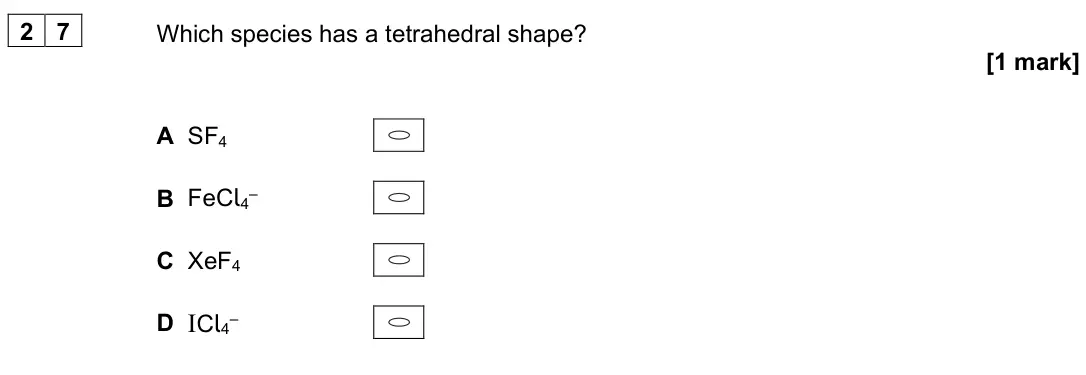
- June 2025, Paper 3, Q27 (1 mark): Which species has a tetrahedral shape? [1 mark] A SF4 B FeCl4– C XeF4 D ICl4–
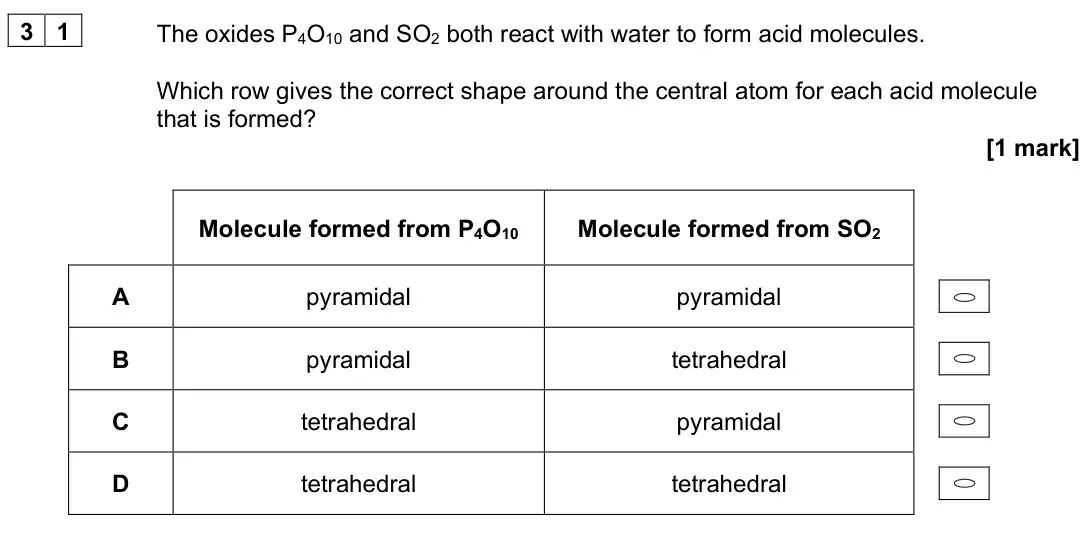
- June 2025, Paper 3, Q31 (1 mark): The oxides P4O10 and SO2 both react with water to form acid molecules. Which row gives the correct shape around the central atom for each acid molecule that is
- June 2025, AS Paper 1, Q04.1 (2 marks): Strontium and calcium have the same metallic structure. Explain why strontium has a lower melting point than calcium. [2 marks]
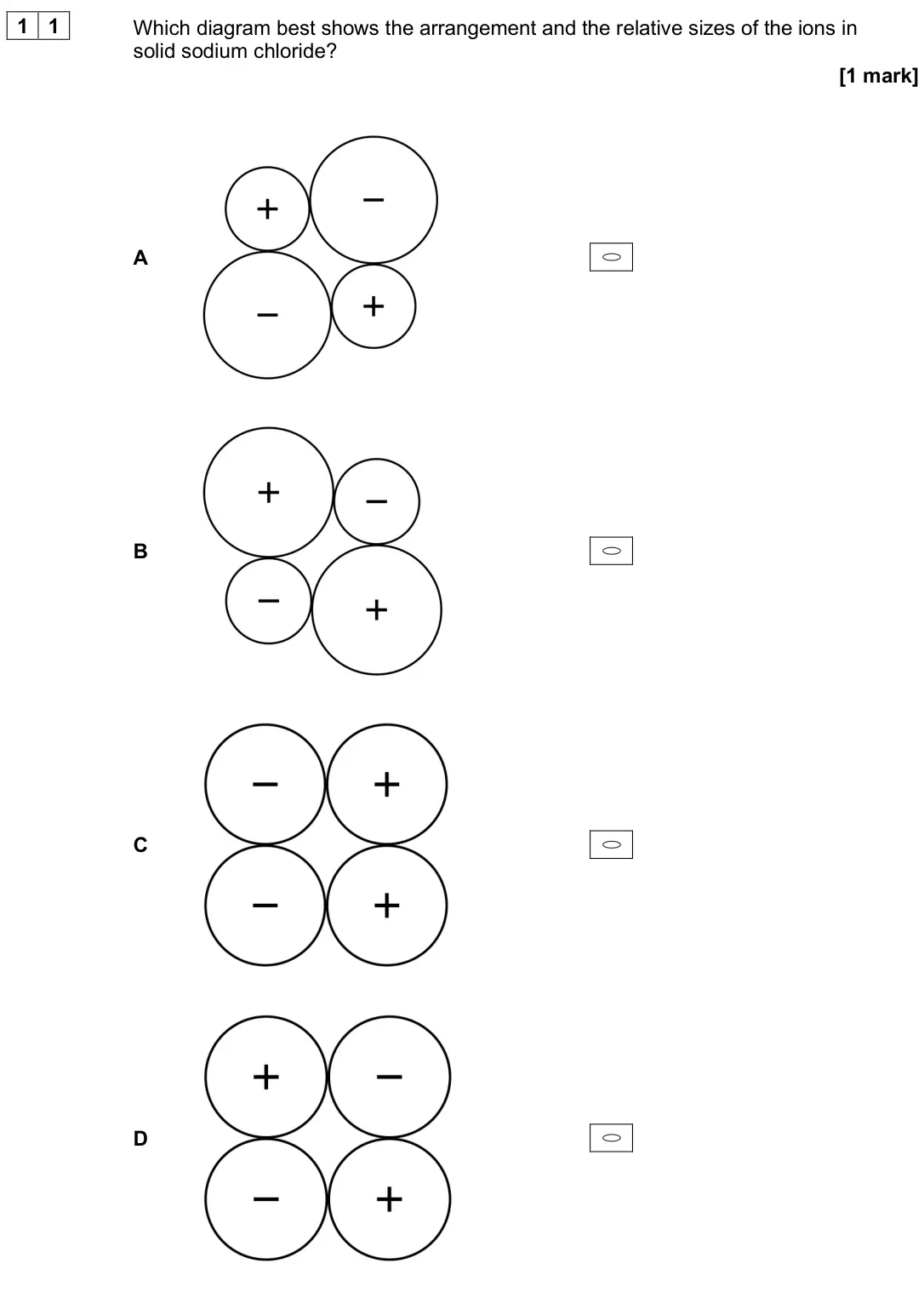
- June 2025, AS Paper 1, Q11 (1 mark): Which diagram best shows the arrangement and the relative sizes of the ions in solid sodium chloride? [1 mark] A B C D
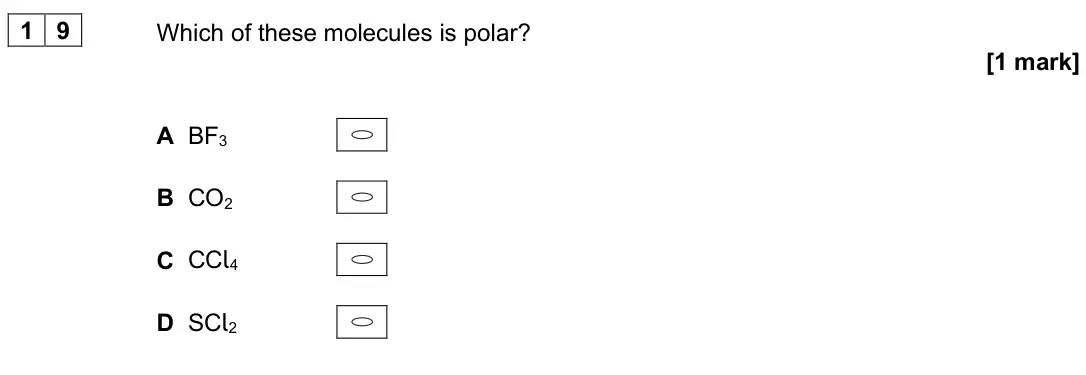
- June 2025, AS Paper 1, Q19 (1 mark): Which of these molecules is polar? [1 mark] A BF3 B CO2 C CCl4 D SCl2
- June 2025, AS Paper 2, Q01.5 (1 mark): The carbocation (CH3)3C+ is formed as an intermediate in the reaction of 2-bromo-2-methylpropane with KCN Suggest the value of the bond angle around the central
- June 2025, AS Paper 2, Q01.6 (2 marks): A co-ordinate bond is formed when the (CH3)3C+ carbocation reacts with CN– to form a nitrile. Explain how this co-ordinate bond is formed during this reaction.
- June 2025, AS Paper 2, Q02.3 (3 marks): Hydrogen bonds exist between molecules of liquid methanol. Draw a diagram to show a hydrogen bond between two molecules of methanol. Include all the lone pairs
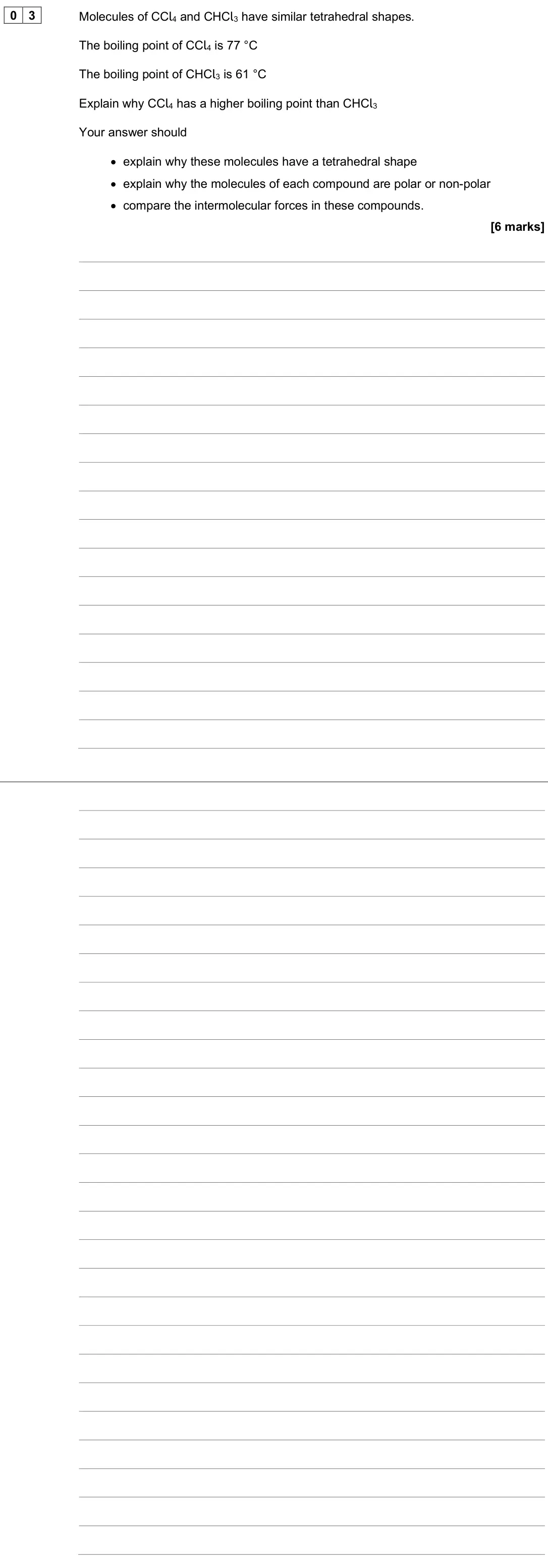
- June 2025, AS Paper 2, Q03 (6 marks): Molecules of CCl4 and CHCl3 have similar tetrahedral shapes. The boiling point of CCl4 is 77 °C The boiling point of CHCl3 is 61 °C Explain why CCl4 has a highe
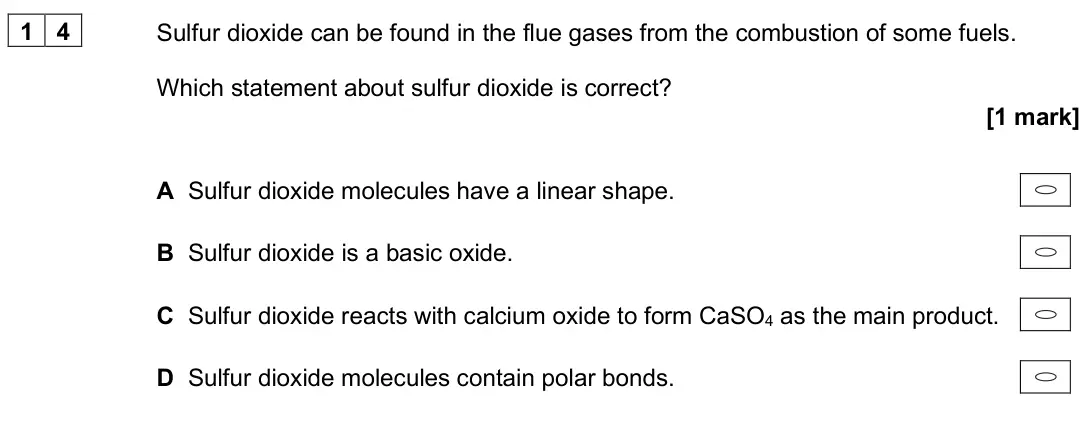
- June 2025, AS Paper 2, Q14 (1 mark): Sulfur dioxide can be found in the flue gases from the combustion of some fuels. Which statement about sulfur dioxide is correct? [1 mark] A Sulfur dioxide mole
- June 2024, Paper 1, Q05.5 (1 mark): Draw the shape of the Cl3 – ion. Include any lone pairs of electrons that influence the shape. [1 mark]
- June 2024, Paper 1, Q05.6 (2 marks): Chlorine forms an ion with the Group 3 element thallium (Tl). State and explain the bond angle in TlCl2 + [2 marks] Bond angle Explanation
- June 2024, Paper 1, Q09.5 (3 marks): Sodium reacts with aluminium and hydrogen to form solid NaAlH4 Give an equation for this reaction. Suggest why NaAlH4 has a high melting point. [3 marks] Equati
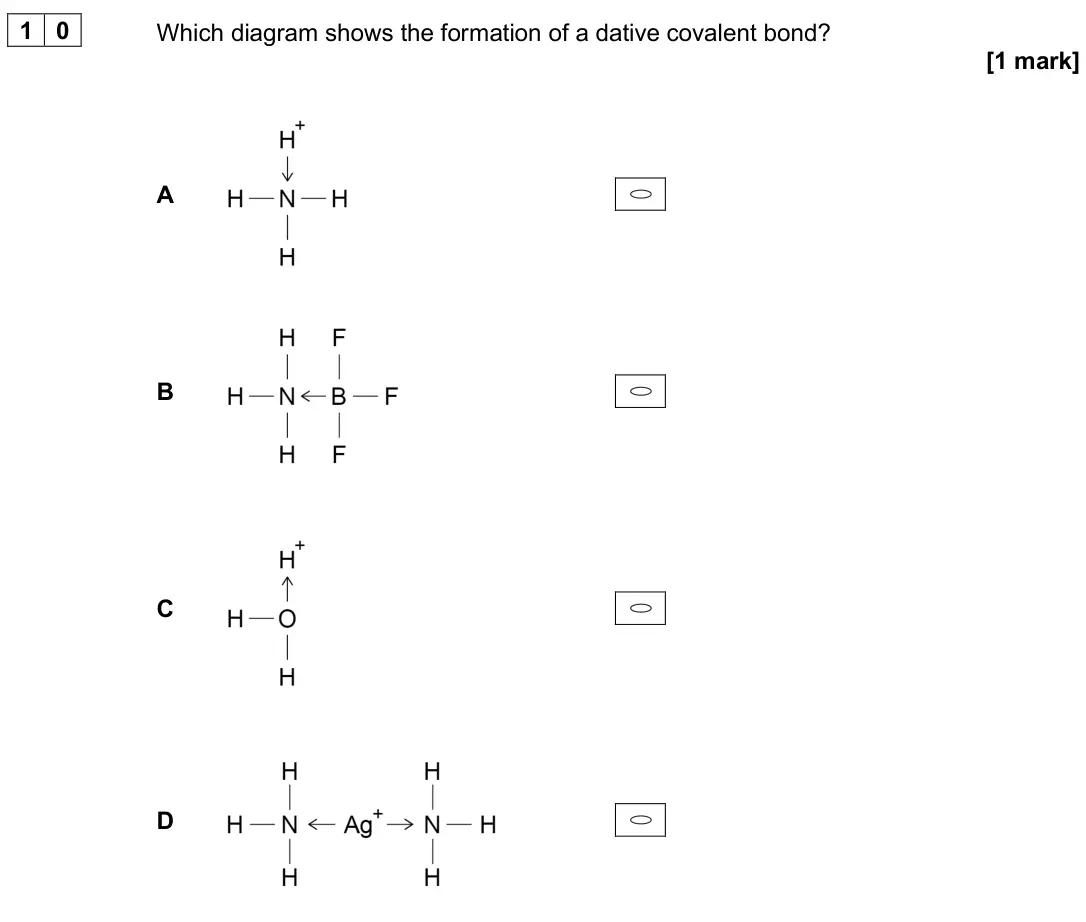
- June 2024, Paper 3, Q10 (1 mark): Which diagram shows the formation of a dative covalent bond? [1 mark] A B C D
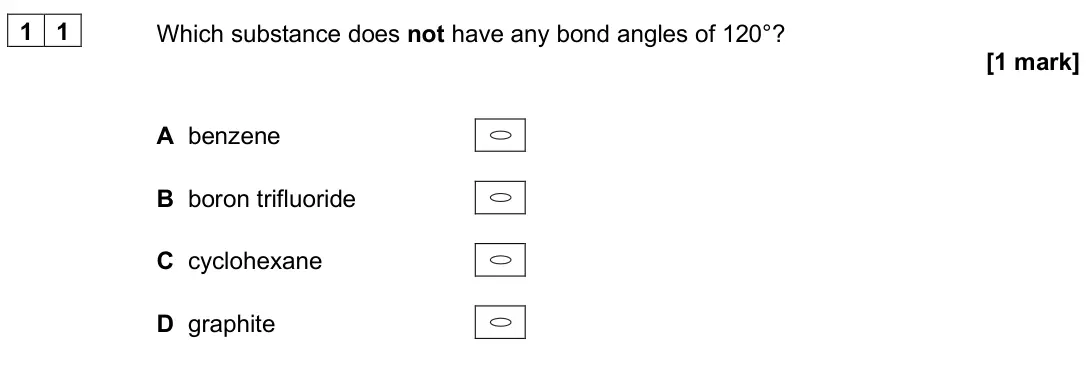
- June 2024, Paper 3, Q11 (1 mark): Which substance does not have any bond angles of 120°? [1 mark] A benzene B boron trifluoride C cyclohexane D graphite
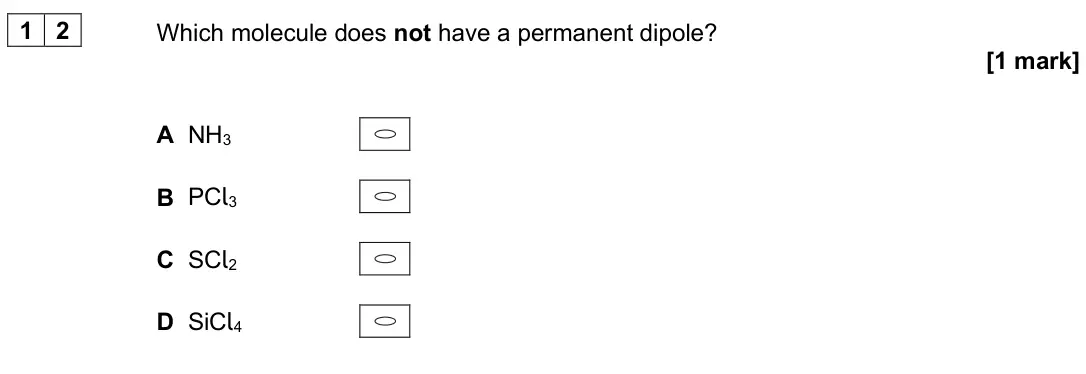
- June 2024, Paper 3, Q12 (1 mark): Which molecule does not have a permanent dipole? [1 mark] A NH3 B PCl3 C SCl2 D SiCl4
- June 2024, Paper 3, Q13 (1 mark): Which compound forms the greatest number of hydrogen bonds per molecule in the liquid state? [1 mark] A CH3CH2COOH B CH3CH2OCH3 C CH3CH2CHO D CH3CH2CH2OH
- June 2024, AS Paper 1, Q03.1 (1 mark): Define electronegativity. [1 mark]
- June 2024, AS Paper 1, Q03.2 (2 marks): Explain why the C–Cl bond is polar. [2 marks]
- June 2024, AS Paper 1, Q03.3 (2 marks): Although the C–Cl bond is polar, CCl4 is a non-polar molecule. Explain why. [2 marks]
- June 2024, AS Paper 1, Q03.4 (3 marks): There are van der Waals forces between non-polar molecules. Explain what causes these forces. [3 marks]
- June 2024, AS Paper 1, Q03.5 (2 marks): Draw a 3D diagram to show how the particles are arranged in a barium oxide lattice. You should draw eight particles. [2 marks]
- June 2024, AS Paper 1, Q05 (6 marks): SF6 and SF3+ have different shapes and different bond angles. Deduce the shape of SF6 and the shape of SF3+ State the bond angle in SF6 and the bond angle in SF
- June 2024, AS Paper 1, Q11 (1 mark): Which involves the formation of a dative covalent bond? [1 mark] A PCl3 + Cl2 → PCl5 B Na+ + H– → NaH C Mg + Cl2 → MgCl2 D BH3 + H– → BH4–
- June 2024, AS Paper 1, Q15 (1 mark): Which element has the lowest melting point? [1 mark] A Na B Mg C K D Ca
- June 2024, AS Paper 2, Q07.3 (3 marks): Propanoic acid molecules cannot be separated from the reaction mixture by simple distillation because propanoic acid forms hydrogen bonds with water molecules.
- June 2023, Paper 1, Q01.2 (2 marks): The electron pair repulsion theory can be used to predict the shape of a PF3 molecule. Draw the shape of a PF3 molecule. Include any lone pairs of electrons tha
- June 2023, Paper 1, Q01.5 (1 mark): Name the type of bond between N and H in ammonia. [1 mark]
- June 2023, Paper 3, Q05.2 (4 marks): All three compounds in Table 2 are polar. Ethanol is the most polar and ethylamine is the least polar. Explain why all three molecules are polar and why ethylam
- June 2023, Paper 3, Q05.3 (3 marks): Explain the trend in the boiling points of the three compounds. Refer to the intermolecular forces in all three compounds in your answer. [3 marks]
- June 2023, Paper 3, Q09 (1 mark): Which substance has significant electron delocalisation? [1 mark] A graphite B iodine C sodium chloride D tetrachloromethane
- June 2023, Paper 3, Q15 (1 mark): What happens when water is vaporised? [1 mark] A Covalent bonds break within molecules. B Intermolecular forces are overcome. C The enthalpy of the molecules de
- June 2023, AS Paper 1, Q02.1 (2 marks): Describe the structure and bonding in magnesium. [2 marks]
- June 2023, AS Paper 1, Q05 (6 marks): This question is about the shapes of molecules. Discuss the difference between the shapes of CF4 and XeF4 In your answer you should: • name the shape of each mo
- June 2023, AS Paper 1, Q13 (1 mark): Which molecule has a permanent dipole? [1 mark] A NCl3 B CCl4 C PF5 D SF6
- June 2023, AS Paper 1, Q14 (1 mark): Which molecule can accept an electron pair during the formation of a coordinate bond? [1 mark] A NH3 B AlCl3 C SiH4 D PCl3
- June 2023, AS Paper 2, Q06.1 (1 mark): State why the C–Cl bonds in dichloromethane and tetrachloromethane are polar. [1 mark]
- June 2023, AS Paper 2, Q06.2 (1 mark): Suggest why tetrachloromethane molecules are non-polar. [1 mark]
- June 2023, AS Paper 2, Q06.3 (2 marks): Explain why tetrachloromethane has a higher boiling point than dichloromethane. [2 marks]
- June 2023, AS Paper 2, Q06.4 (2 marks): Propan-1-ol has a higher boiling point than the other two compounds because of hydrogen bonding. Describe the hydrogen bonding in propan-1-ol. [2 marks]
- June 2022, Paper 1, Q05.7 (6 marks): Table 4 shows the melting points of three substances. Table 4 Substance Melting point / K sodium chloride 1074 chlorine 172 hydrogen chloride 158 Explain why th
- June 2022, Paper 1, Q06.6 (3 marks): The ClF2+ ion contains two different Group 7 elements. Use your understanding of the electron pair repulsion theory to draw the shape of this ion. Include any l
- June 2022, Paper 3, Q08 (1 mark): Which substance has no delocalised electrons? [1 mark] A graphite B methylbenzene C poly(propene) D sodium
- June 2022, AS Paper 1, Q03 (3 marks): This question is about shapes of molecules. Complete Table 2 by drawing the shapes of both the AsF5 and KrF2 molecules, showing all lone pairs of electrons that
- June 2022, AS Paper 1, Q04.1 (3 marks): Complete the diagram to show how one molecule of ammonia can form a hydrogen bond with one molecule of ethanol. Include all lone pairs of electrons and partial
- June 2022, AS Paper 1, Q04.2 (1 mark): Define the term electronegativity. [1 mark]
- June 2022, AS Paper 1, Q04.3 (1 mark): Deduce the two atoms from Table 3 that will form the most polar bond. [1 mark]
- June 2022, AS Paper 1, Q04.4 (2 marks): The C–Br bond is polar. Explain why CBr4 is not a polar molecule. [2 marks]
- June 2022, AS Paper 1, Q04.5 (3 marks): Suggest, in terms of the intermolecular forces for each compound, why CBr4 has a higher boiling point than CHBr3 [3 marks]
- June 2022, AS Paper 1, Q15 (1 mark): The equation for a reaction is AsH3 + H+ → AsH4+ What type of interaction forms in this reaction? [1 mark] A Co-ordinate bond B Dipole–dipole force C Hydrogen b
- June 2022, AS Paper 1, Q23 (1 mark): Which is not responsible for conducting electricity? [1 mark] A The sodium ions in molten sodium chloride B The electrons between layers of carbon atoms in grap
- June 2022, AS Paper 2, Q13 (1 mark): Which compound has the highest boiling point? [1 mark] A CH3COCH2CH3 B CH3CH2CH2CH2OH C CH3CH2CH2CHO D CH3CH2CH2CH2CH3
- November 2021, Paper 1, Q03.3 (4 marks): Explain, in terms of crystal structure and bonding, why silicon(IV) oxide has a higher melting point than phosphorus(V) oxide. [4 marks]
- November 2021, Paper 2, Q02.5 (4 marks): HOCH2CH2NH2 can be represented as XNH2 [HOCH2CH2NH3]+ can be represented as [XNH3]+ Draw the shape of XNH2 and of [XNH3]+ State whether the H–N–H bond angle in
- November 2021, Paper 3, Q12 (1 mark): Which statement about inorganic ionic compounds is always correct? [1 mark] A They dissolve in water to give neutral solutions. B They release energy when they
- November 2021, Paper 3, Q13 (1 mark): Which species has a lone pair of electrons on the central atom? [1 mark] A CO2 B SO2 C PCl6‒ D SO42–
- November 2021, Paper 3, Q14 (1 mark): In which substance do covalent bonds break when it melts? [1 mark] A hexane B ice C iodine D silicon dioxide
- November 2021, Paper 3, Q15 (1 mark): In which molecule are all the atoms in the same plane? [1 mark] A CH3CHO B CH3NH2 C C6H5Cl D C6H5CH3
- November 2021, Paper 3, Q16 (1 mark): Which molecule has a permanent dipole? [1 mark] A BF3 B NH3 C SiCl4 D SO3
- November 2021, Paper 3, Q17 (1 mark): Which statement about (CH3)2CHCH2COOH is correct? [1 mark] A In aqueous solution it reacts with magnesium to form carbon dioxide. B It can form hydrogen bonds.
- November 2021, Paper 3, Q22 (1 mark): Which substance contains delocalised electrons? [1 mark] A cyclohexane B graphite C iodine D sodium chloride
- November 2021, AS Paper 1, Q02.2 (2 marks): Describe the bonding in magnesium. [2 marks]
- November 2021, AS Paper 1, Q02.3 (3 marks): Explain, in terms of structure and bonding, why magnesium chloride has a high melting point. [3 marks]
- November 2021, AS Paper 1, Q05.1 (3 marks): Chlorine has a low boiling point because the forces between the molecules are weak. Explain how these forces arise between molecules of chlorine. [3 marks]
- November 2021, AS Paper 1, Q13 (1 mark): Which molecule is not able to form a co-ordinate bond with another species? [1 mark] A BH3 B CH4 C NH3 D H2O
- November 2021, AS Paper 1, Q14 (1 mark): Which species has a square planar shape? [1 mark] A NH4+ B SF4 C XeF4 D PCl4+
- November 2021, AS Paper 1, Q15 (1 mark): Which bond has the most unsymmetrical electron distribution? [1 mark] A H–O B H–S C H–N D H–P
- November 2021, AS Paper 2, Q03.3 (2 marks): Molecules of propan-2-ol and propanone each contain three carbon atoms. Complete Table 1 to suggest the shape and a bond angle around the central C atom in a mo
- November 2021, AS Paper 2, Q03.4 (3 marks): Explain why propanone has a lower boiling point than propan-2-ol. [3 marks]
- November 2020, Paper 1, Q07 (6 marks): The melting point of XeF4 is higher than the melting point of PF3 Explain why the melting points of these two compounds are different. In your answer you should
- November 2020, Paper 2, Q05.1 (3 marks): Define the term electronegativity. Explain the polarity of the C–Br bond in 2-bromopropane. [3 marks] Electronegativity Explanation
- November 2020, Paper 3, Q08 (1 mark): Which has a bond angle of 109.5°? [1 mark] A C (diamond) B C (graphite) C NH2– D NH3
- November 2020, AS Paper 1, Q05.1 (2 marks): Explain why the melting point of magnesium is higher than the melting point of sodium. [2 marks]
- November 2020, AS Paper 1, Q06 (5 marks): This question is about shapes of molecules and ions. Draw the shape of NCl3 and of NCl4+ Include any lone pairs of electrons that influence the shape. Name the
- November 2020, AS Paper 1, Q10 (1 mark): Which species contains bonds that have different polarities? [1 mark] A NH4+ B CCl4 C CH3Cl D H3O+
- November 2020, AS Paper 1, Q11 (1 mark): Which compound has hydrogen bonding? [1 mark] A NaH B NH3 C HI D SiH4
- November 2020, AS Paper 1, Q16 (1 mark): Which compound contains a co-ordinate bond? [1 mark] A HF B NH3 C CHCl3 D NH4Cl
- November 2020, AS Paper 1, Q18 (1 mark): Which of these elements has the highest melting point? [1 mark] A Argon B Chlorine C Silicon D Sulfur
- November 2020, AS Paper 1, Q23 (1 mark): Which molecule has a permanent dipole? [1 mark] A CF4 B PCl5 C CO2 D Cl2O
- November 2020, AS Paper 2, Q01.4 (1 mark): The C–Cl bond in 1-chloropropane is polar because carbon and chlorine have different electronegativities. Define the term electronegativity. [1 mark]
- November 2020, AS Paper 2, Q04.1 (3 marks): The boiling point of pentan-2-ol is 119 °C The boiling point of pent-1-ene is 30 °C Explain why pentan-2-ol has a higher boiling point than pent-1-ene. [3 marks
- June 2019, Paper 1, Q08.1 (3 marks): Draw a diagram to show the strongest type of interaction between two molecules of ethanol (C2H5OH) in the liquid phase. Include all lone pairs and partial charg
- June 2019, Paper 1, Q08.2 (3 marks): Methoxymethane (CH3OCH3) is an isomer of ethanol. Table 5 shows the boiling points of ethanol and methoxymethane. Table 5 Compound Boiling point / °C ethanol 78
- June 2019, Paper 3, Q01.3 (4 marks): Draw a diagram to show the shape of a molecule of H2O Include any lone pairs of electrons. State the H−O−H bond angle. Explain this shape and bond angle. [4 mar
- June 2019, Paper 3, Q02.1 (1 mark): Draw the displayed formula of a molecule of H2SO4 [1 mark]
- June 2019, Paper 3, Q31 (1 mark): Which is not responsible for conduction of electricity? [1 mark] A The sodium ions in molten sodium chloride B The electrons between layers of carbon atoms in g
- June 2019, AS Paper 1, Q01.2 (2 marks): Explain, in terms of structure and bonding, why the melting point of sodium fluoride is high. [2 marks]
- June 2019, AS Paper 1, Q01.3 (2 marks): The ion H2F+ is formed when hydrogen fluoride gains a proton as shown in the equation HF + H+ → H2F+ Name the type of bond formed when HF reacts with H+ Explain
- June 2019, AS Paper 1, Q01.4 (4 marks): Fluoroantimonic acid contains two ions, SbF6 – and H2F+ Draw the shape of the SbF6 – ion and the shape of the H2F+ ion. Include any lone pairs that influence th
- June 2019, AS Paper 1, Q11 (1 mark): Which substance has delocalised electrons? [1 mark] A graphite B iodine C sodium chloride D tetrachloromethane
- June 2019, AS Paper 1, Q12 (1 mark): Which species is not pyramidal in shape? [1 mark] A PF3 B H3O+ C CH3 – D BF3
- June 2019, AS Paper 1, Q13 (1 mark): Which change occurs when water is vaporised? [1 mark] A An exothermic change occurs. B Covalent bonds are broken. C Intermolecular forces are overcome. D The to
- June 2019, AS Paper 2, Q05.1 (3 marks): Draw a diagram to show how two methanol molecules interact with each other through hydrogen bonding in the liquid phase. Include all partial charges and all lon
- June 2019, AS Paper 2, Q05.2 (1 mark): The bond angle around the oxygen atom in methanol is slightly smaller than the regular tetrahedral angle of 109.5° Explain why this bond angle is smaller than 1
- June 2019, AS Paper 2, Q21 (1 mark): Which compound has the highest boiling point? [1 mark] A CH3CH2CH2Br B CH3CH2CH2F C CH3CH2CHO D CH3CH2COOH
- June 2018, Paper 1, Q08.1 (6 marks): Use your knowledge of structure and bonding to explain why sodium bromide has a melting point that is higher than that of sodium, and higher than that of sodium
- June 2018, Paper 1, Q08.4 (4 marks): Sodium reacts with ammonia to form the compound NaNH2 that contains the NH2 – ion. Draw the shape of the NH2 – ion. Include any lone pairs of electrons that inf
- June 2018, Paper 3, Q06 (1 mark): Which diagram shows the correct bonding and correct bond polarity in a molecule of oxygen difluoride? [1 mark] A B C D In the early twentieth century the appara
- June 2018, Paper 3, Q30 (1 mark): Which species has a shape that is influenced by the presence of one or more lone pairs of electrons around the central atom? [1 mark] A AlCl3 B ClF3 C IF6 + D P
- June 2018, AS Paper 1, Q09.1 (3 marks): Draw the shape of a molecule of krypton difluoride (KrF2). Include in your answer any lone pairs of electrons that influence the shape. Name the shape produced
- June 2018, AS Paper 1, Q09.2 (2 marks): There are two lone pairs of electrons on the oxygen atom in a molecule of oxygen difluoride (OF2). Explain how the lone pairs of electrons on the oxygen atom in
- June 2018, AS Paper 1, Q09.3 (3 marks): Silicon tetrafluoride (SiF4) is a tetrahedral molecule. Deduce the type of intermolecular forces in SiF4 Explain how this type of intermolecular force arises an
- June 2018, AS Paper 1, Q10 (1 mark): Which row shows the bonding in ammonium chloride? [1 mark] Covalent Dative covalent Ionic A B C D
- June 2018, AS Paper 2, Q10 (1 mark): Which molecule does not have a permanent dipole? [1 mark] A CH3Br B CH2Br2 C CHBr3 D CBr4
- June 2018, AS Paper 2, Q13 (1 mark): Which compound has the highest boiling point? [1 mark] A butanal B butan-2-ol C but-2-ene D 1-fluorobutane
- June 2017, Paper 1, Q06.3 (2 marks): State the type of crystal structure shown in silicon dioxide and in sulfur trioxide [2 marks Silicon dioxide Sulfur trioxide
- June 2017, Paper 1, Q06.4 (4 marks): Explain why silicon dioxide has a higher melting point than sulfur trioxide. [4 marks
- June 2017, Paper 3, Q05 (1 mark): Which compound has the highest boiling point? [1 mark] A CH3CH2CH2OH B CH3CH2CHO C CH3COCH3 D CH3COOCH3
- June 2017, AS Paper 1, Q05.1: Give the meaning of the term electronegativity. [1 mar
- June 2017, AS Paper 1, Q05.2 (2 marks): Explain how permanent dipole-dipole forces arise between hydrogen chloride molecules. [2 mark
- June 2017, AS Paper 1, Q05.3 (4 marks): Complete Table 4 by naming the shape of each molecule. Place a tick () in the final column if the molecule has a permanent dipole. [4 mark Table 4 Molecule Nam
- June 2017, AS Paper 1, Q09: Which is the correct crystal structure for the substance named? [1 mar Substance Structure A Iodine Simple molecular B Diamond Ionic C Sodium chloride Giant cov
- June 2017, AS Paper 1, Q18: Which species has one or more bond angle(s) of 90°? [1 mar A CH4 B NH4 + C ClF4 − D AlCl4 −
- June 2017, AS Paper 2, Q09.1 (2 marks): Chloroethene has a melting point of −154 ºC All types of PVC melt at temperatures over 100 ºC Explain why PVC melts at a higher temperature than chloroethene. [
- June 2017, AS Paper 2, Q13 (1 mark): Which is the most likely bond angle around the oxygen atom in ethanol? [1 mark] A 104.5º B 109.5º C 120º D 180º
- June 2016, AS Paper 1, Q04.1 (5 marks): In terms of structure and bonding explain why the boiling point of bromine is different from that of magnesium. Suggest why magnesium is a liquid over a much gr
- June 2016, AS Paper 1, Q07.1 (3 marks): Draw diagrams to illustrate the shapes of NH3 molecules and of AlCl3 molecules. Include in your diagrams any lone pairs of electrons that influence the shape. I
- June 2016, AS Paper 1, Q07.2 (2 marks): Name the type of bond formed between N and Al in H3NAlCl3 and explain how this bond is formed. [2 marks] Type of bond Explanation
- June 2016, AS Paper 1, Q07.3 (2 marks): Explain how the value of the Cl-Al-Cl bond angle in AlCl3 changes, if at all, on formation of the compound H3NAlCl3 [2 marks]
- June 2016, AS Paper 1, Q18: Which substance exists as a macromolecule? [1 mar A Cu B SiO2 C P4O10 D MgO
- June 2016, AS Paper 1, Q20 (1 mark): Which molecule has the largest dipole? [1 mark A ClF3 B BF3 C SF6 D CF4
- June 2016, AS Paper 2, Q04.3 (6 marks): Predict the relative boiling points of these three compounds from the highest to the lowest boiling points. Justify this order in terms of intermolecular forces
- Specimen, Paper 1, Q01.1 (6 marks): 3
- Specimen, Paper 1, Q05.3 (4 marks): Diagram Explanation
- Specimen, Paper 2, Q04.6 (1 mark): List alcohol A, product B and isomer C in order of increasing boiling point. [1 mark] 0 4 . 6
- Specimen, Paper 2, Q05.2 (4 marks): 5
- Specimen, Paper 3, Q01.4 (2 marks): Use your knowledge of structure and bonding to explain why it is possible to separat ethanal in this way. [2 mark 0 1 . 4
- Specimen, Paper 3, Q07: 5
Questions, mark schemes and examiner’s reports are © AQA, from their published past papers. Plumi isn’t affiliated with any exam board. Want whole papers? Every AQA A-Level Chemistry paper.
Rather write your answers by hand on iPad? Plumi marks them against the same mark schemes.