 plumi
Kinetics: AQA A‑Level Chemistry questions
Every AQA A-Level Chemistry exam question on 3.1.5 Kinetics, 2016–2025, with its mark scheme and examiner’s report.
Find questions2,301
Calculations
Q04.4
The whole paper ↗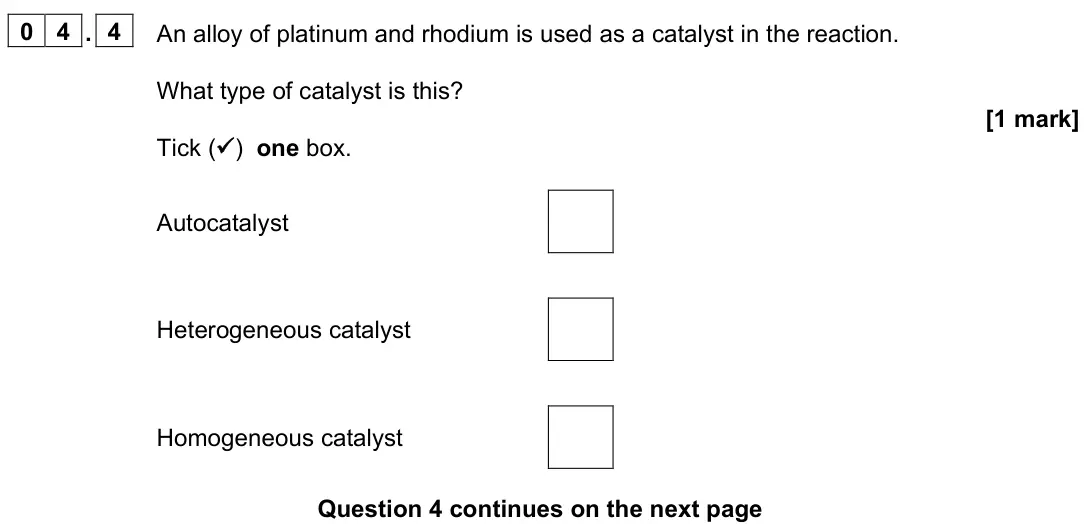
Q09.1
The whole paper ↗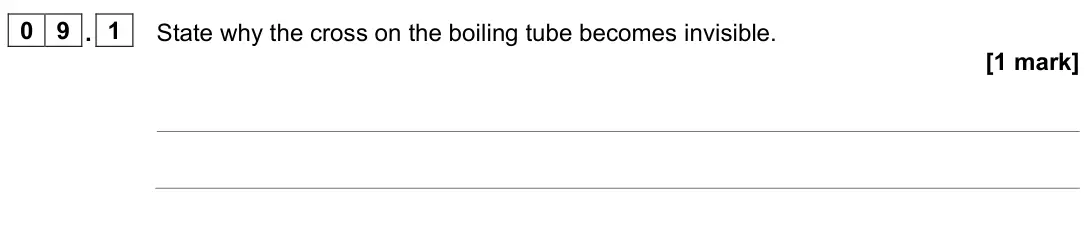
Q09.2
The whole paper ↗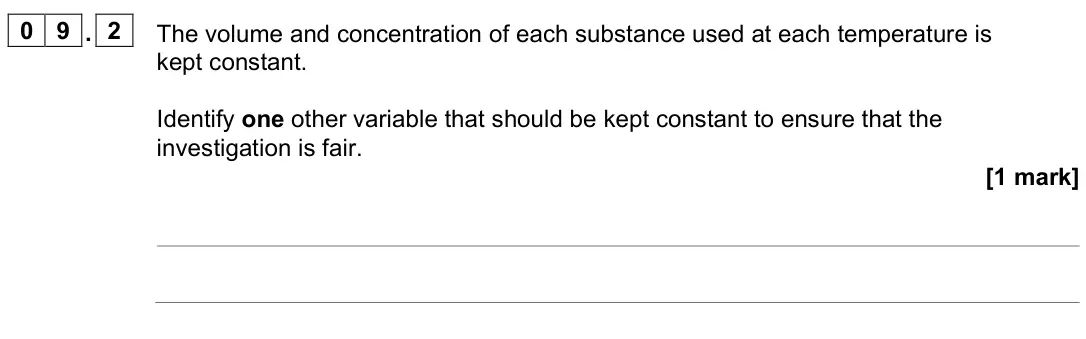
Q02.1
The whole paper ↗
Q02.2
The whole paper ↗
Q02.1
The whole paper ↗
Q02.6
The whole paper ↗
Q06.2
The whole paper ↗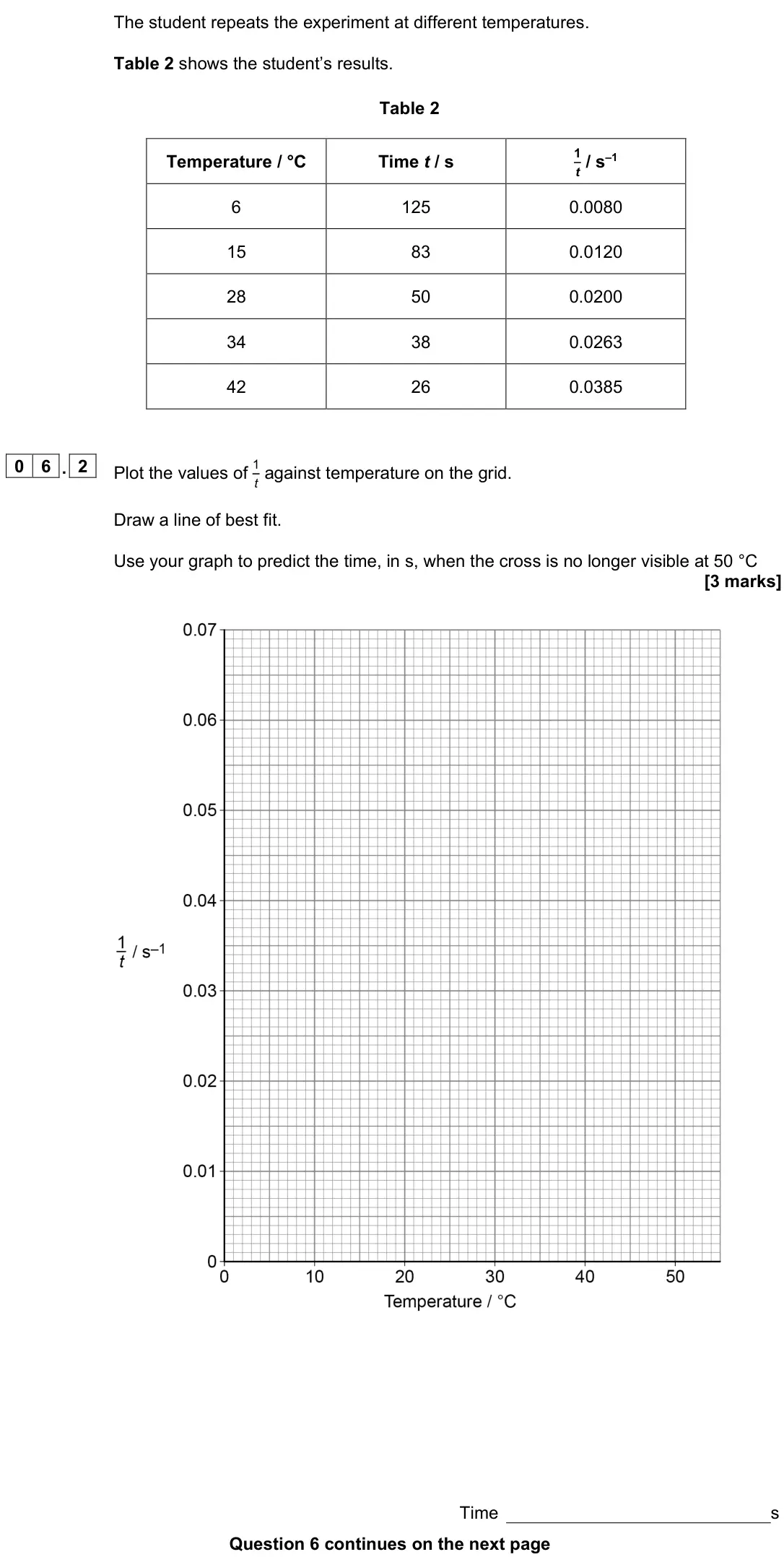
Q01.1
The whole paper ↗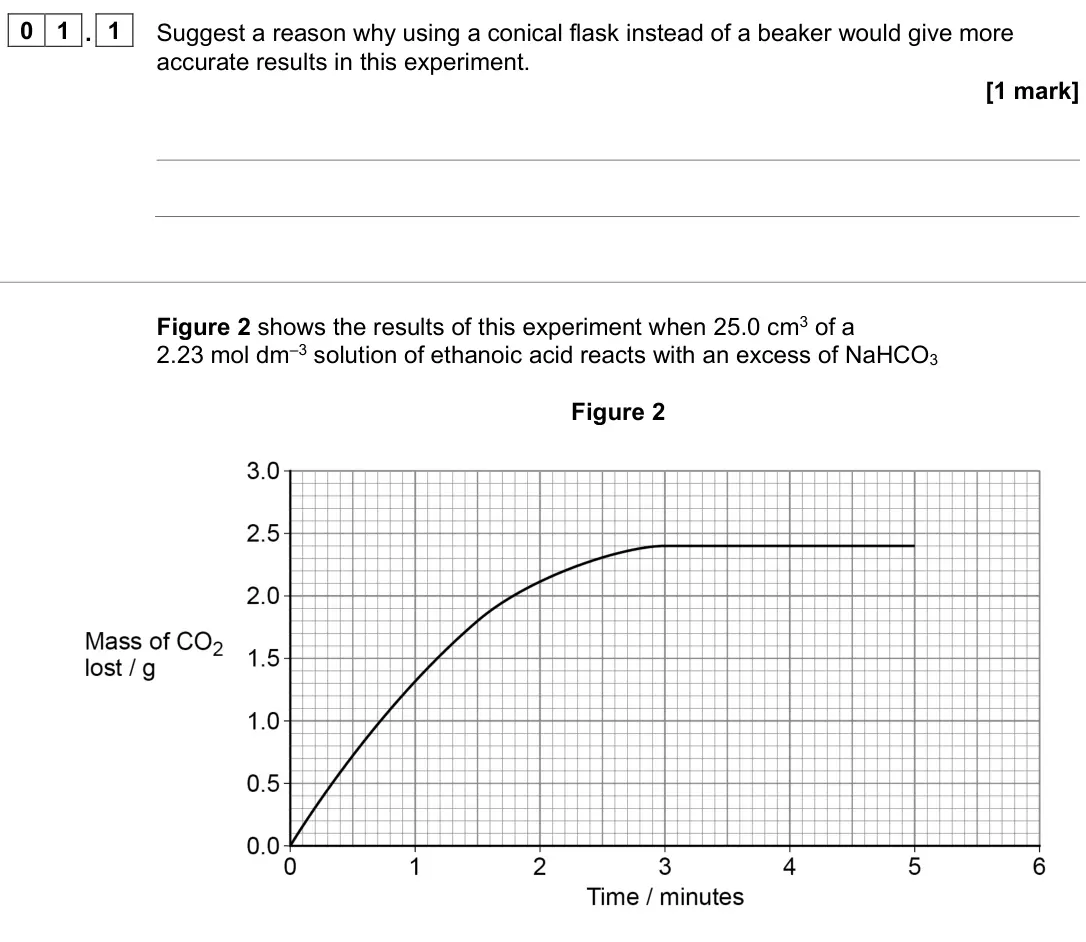
Q01.2
The whole paper ↗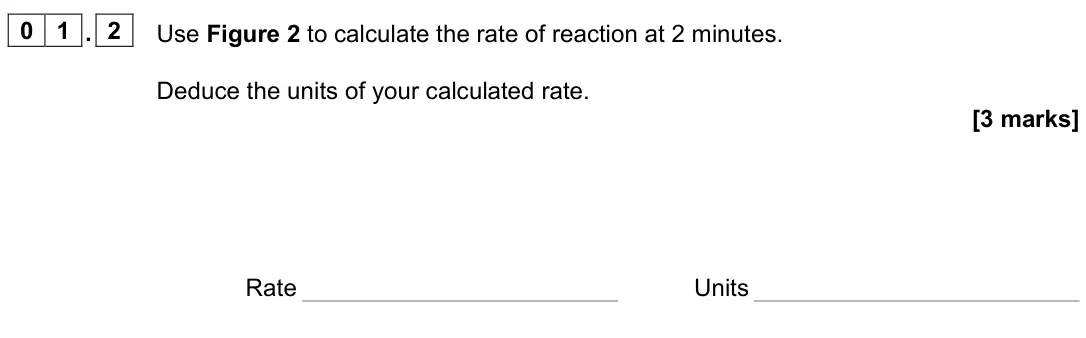
Q01.3
The whole paper ↗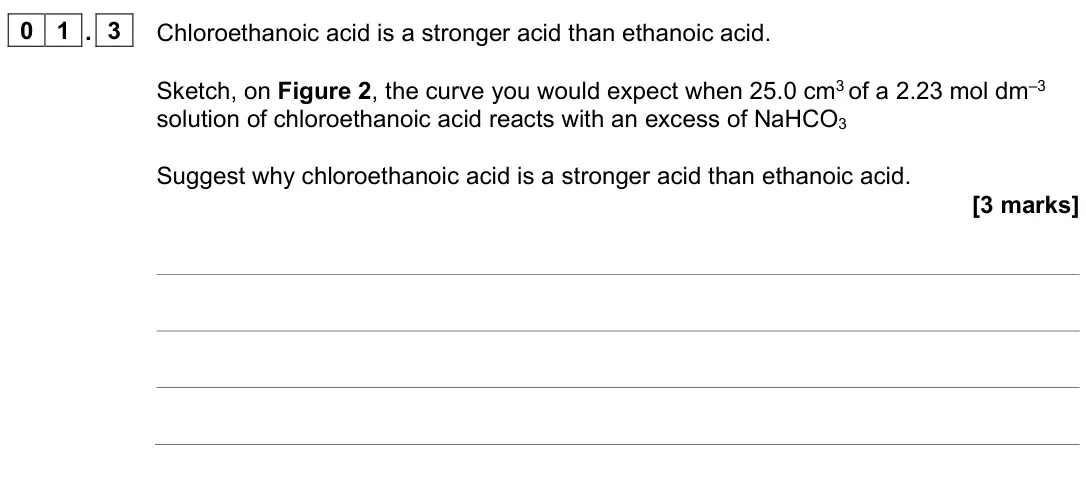
Q09.4
The whole paper ↗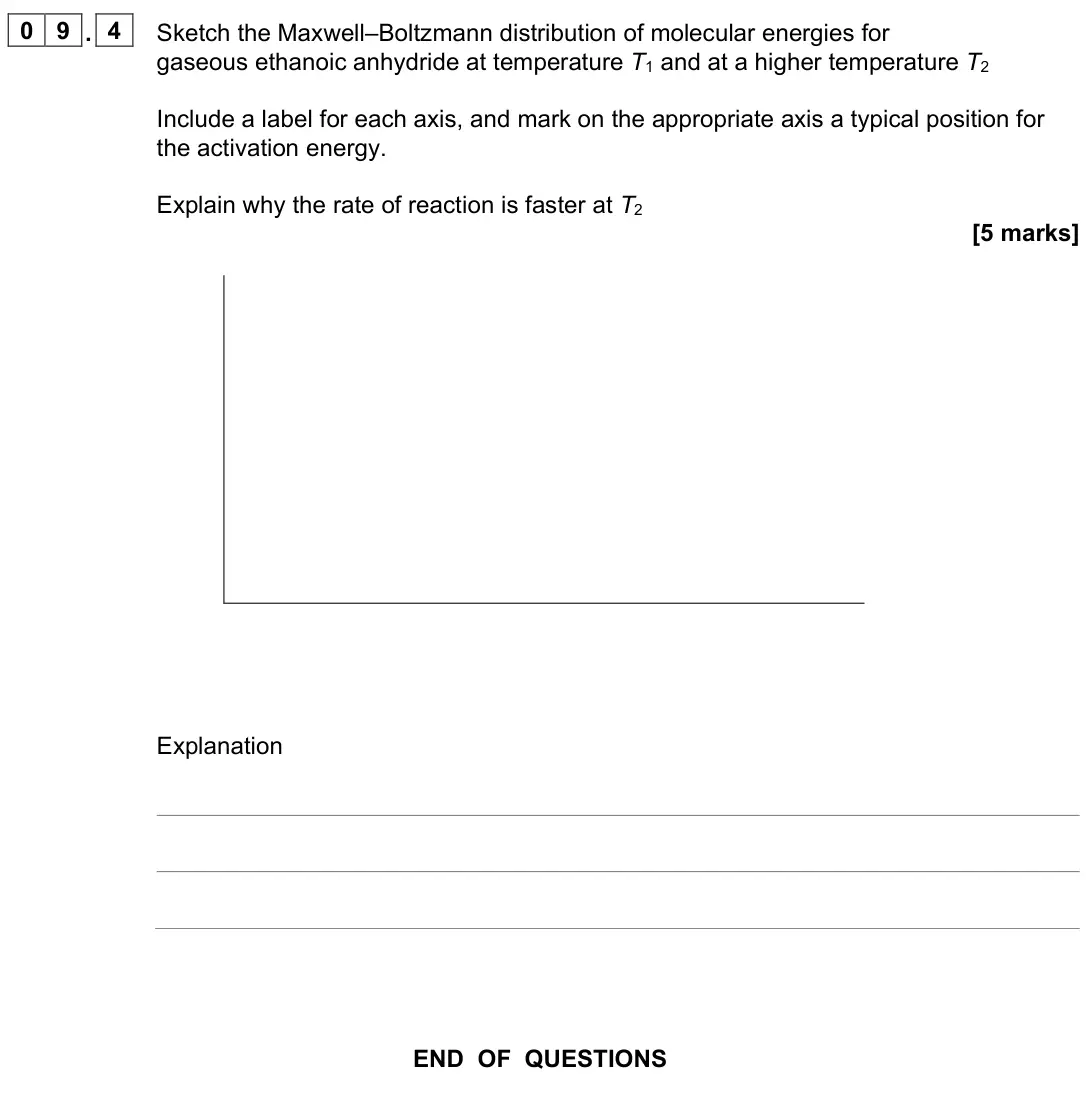
All 68 questions on Kinetics, as a list
- June 2025, Paper 1, Q04.4 (1 mark): An alloy of platinum and rhodium is used as a catalyst in the reaction. What type of catalyst is this? [1 mark] Tick ( ) one box. Autocatalyst Heterogeneous cat
- June 2025, Paper 2, Q09.1 (1 mark): State why the cross on the boiling tube becomes invisible. [1 mark]
- June 2025, Paper 2, Q09.2 (1 mark): The volume and concentration of each substance used at each temperature is kept constant. Identify one other variable that should be kept constant to ensure tha
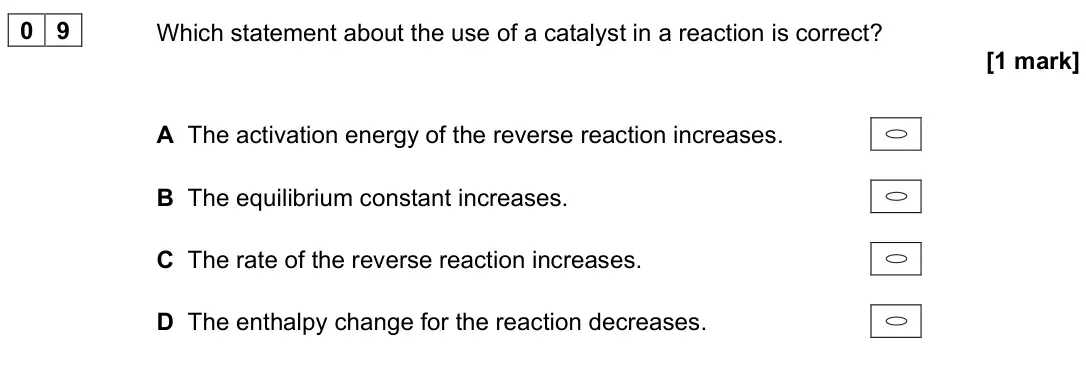
- June 2025, Paper 3, Q09 (1 mark): Which statement about the use of a catalyst in a reaction is correct? [1 mark] A The activation energy of the reverse reaction increases. B The equilibrium cons
- June 2025, AS Paper 2, Q02.1 (2 marks): Describe how a catalyst increases the rate of a reaction. [2 marks]
- June 2025, AS Paper 2, Q02.2 (3 marks): Explain why the rate of a reaction increases as the temperature increases. [3 marks]
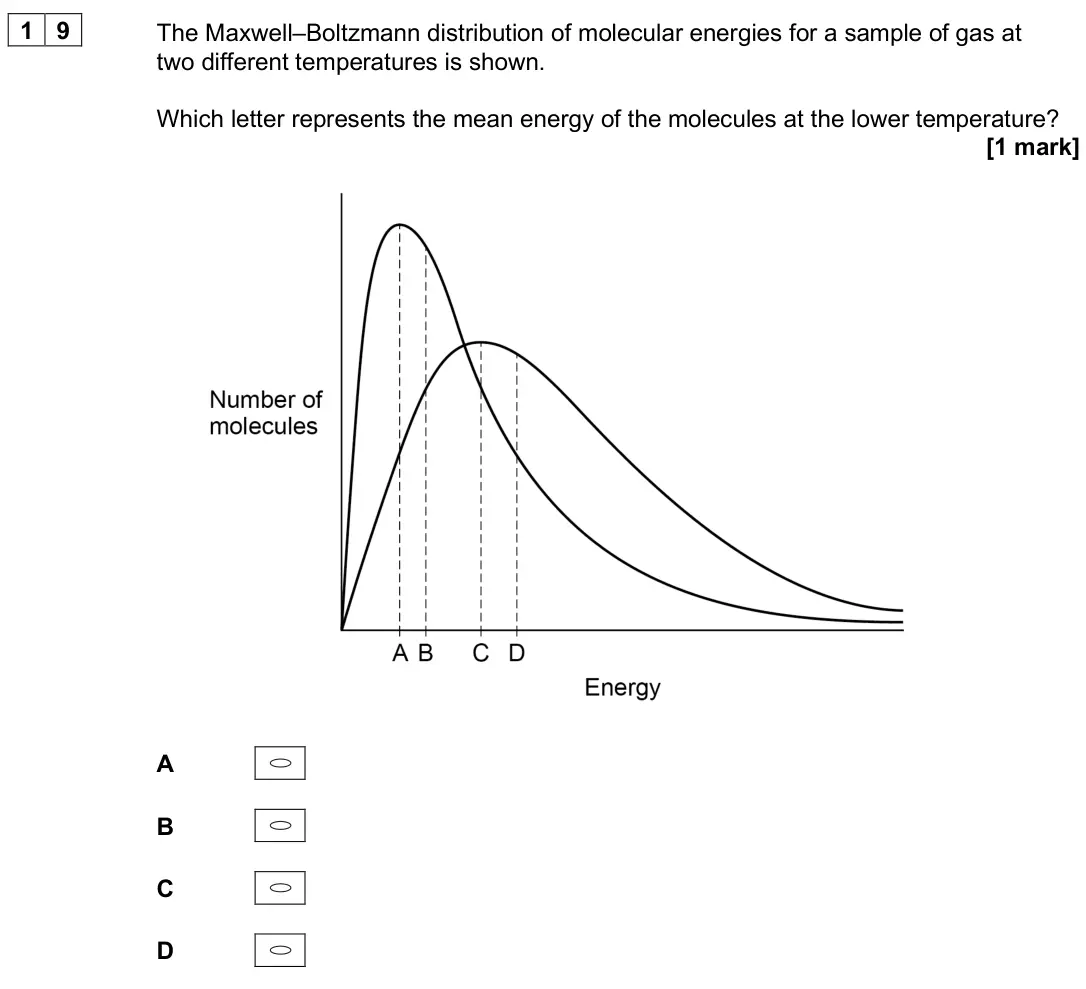
- June 2025, AS Paper 2, Q19 (1 mark): The Maxwell–Boltzmann distribution of molecular energies for a sample of gas at two different temperatures is shown. Which letter represents the mean energy of
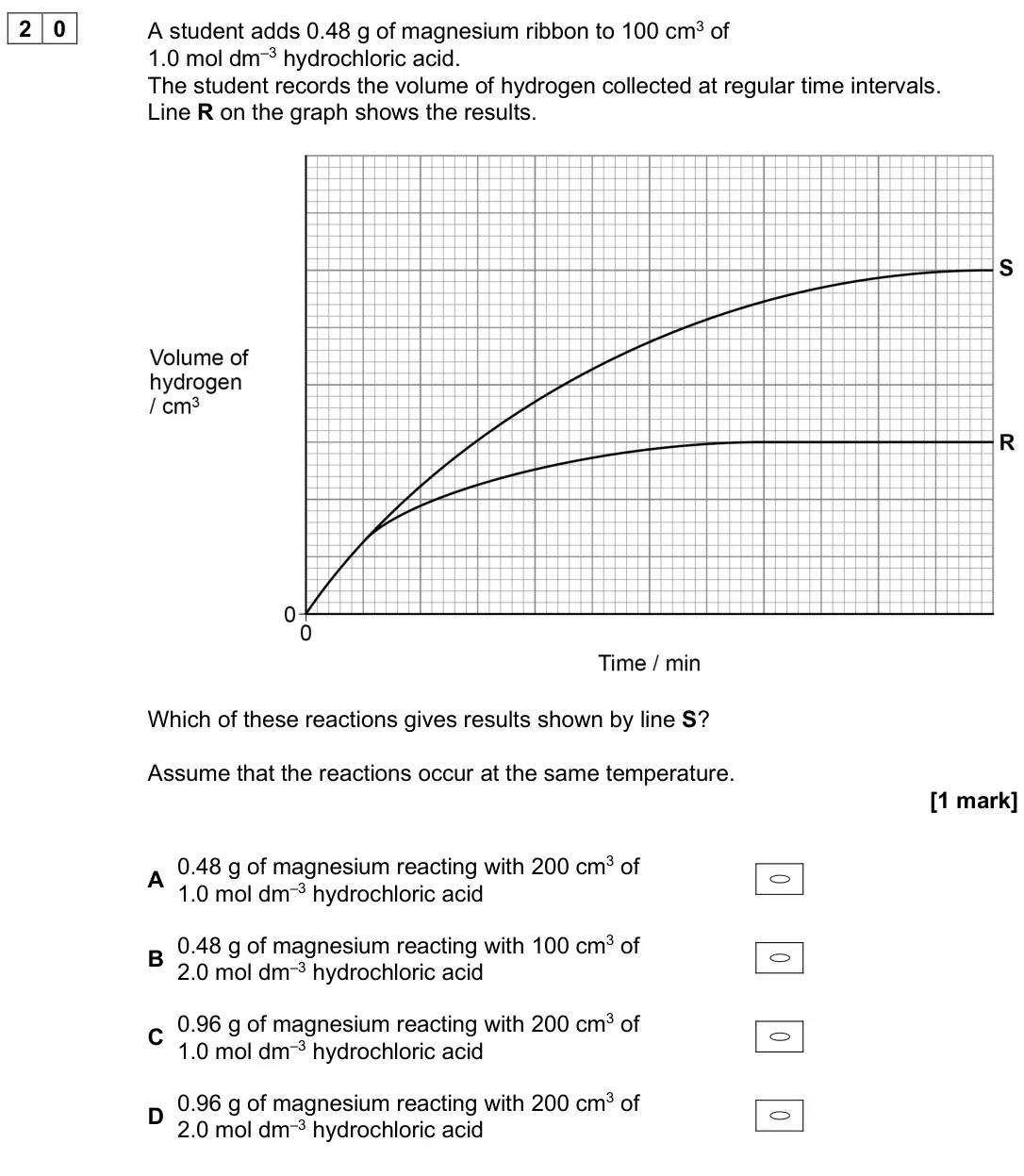
- June 2025, AS Paper 2, Q20 (1 mark): A student adds 0.48 g of magnesium ribbon to 100 cm3 of 1.0 mol dm–3 hydrochloric acid. The student records the volume of hydrogen collected at regular time int
- June 2024, Paper 3, Q02.1 (2 marks): Suggest why a loose cotton wool plug is placed in the neck of the flask, instead of leaving the flask open or inserting a bung. [2 marks] Instead of leaving the
- June 2024, Paper 3, Q02.6 (2 marks): In this experiment the variable measured is mass loss. The rate of this reaction at a constant temperature can be investigated in other ways. Suggest two other
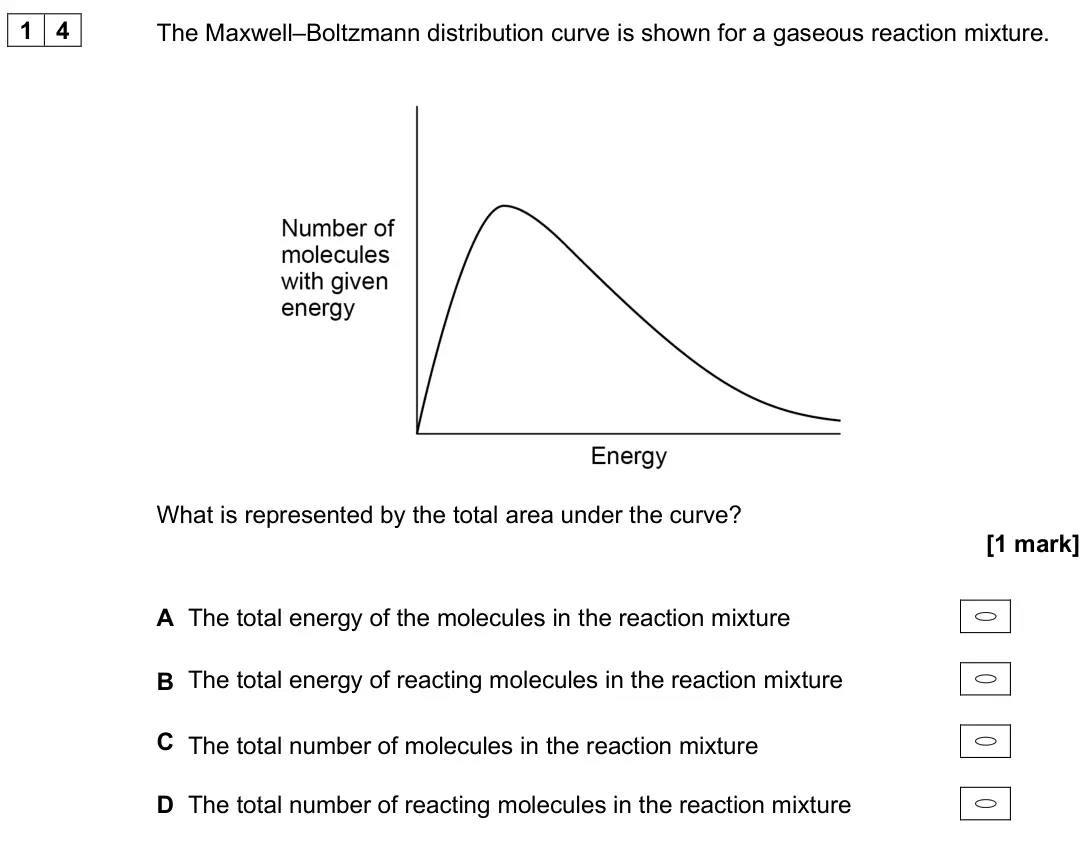
- June 2024, Paper 3, Q14 (1 mark): The Maxwell–Boltzmann distribution curve is shown for a gaseous reaction mixture. What is represented by the total area under the curve? [1 mark] A The total en
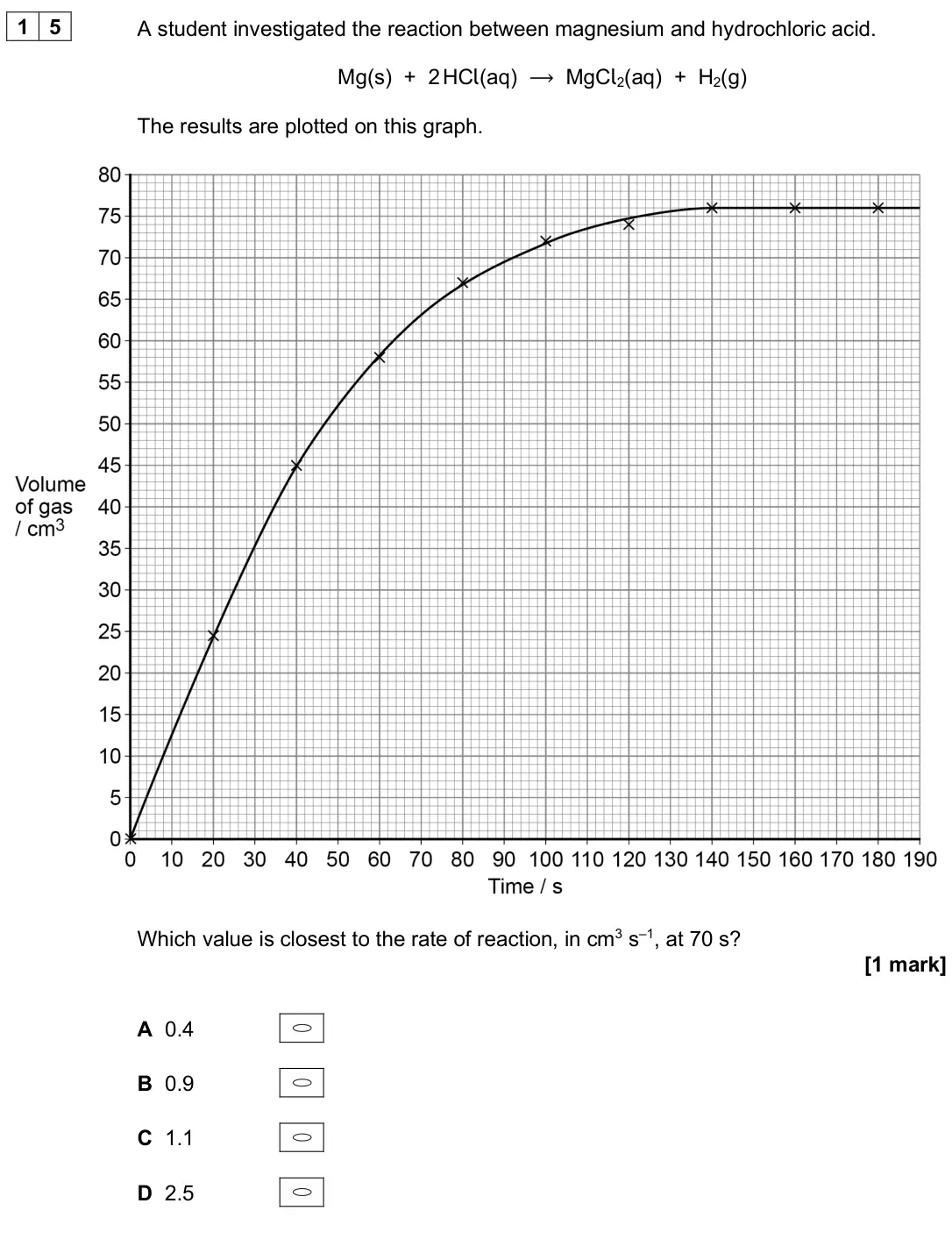
- June 2024, Paper 3, Q15 (1 mark): A student investigated the reaction between magnesium and hydrochloric acid. Mg(s) + 2 HCl(aq) ⟶ MgCl2(aq) + H2(g) The results are plotted on this graph. Which
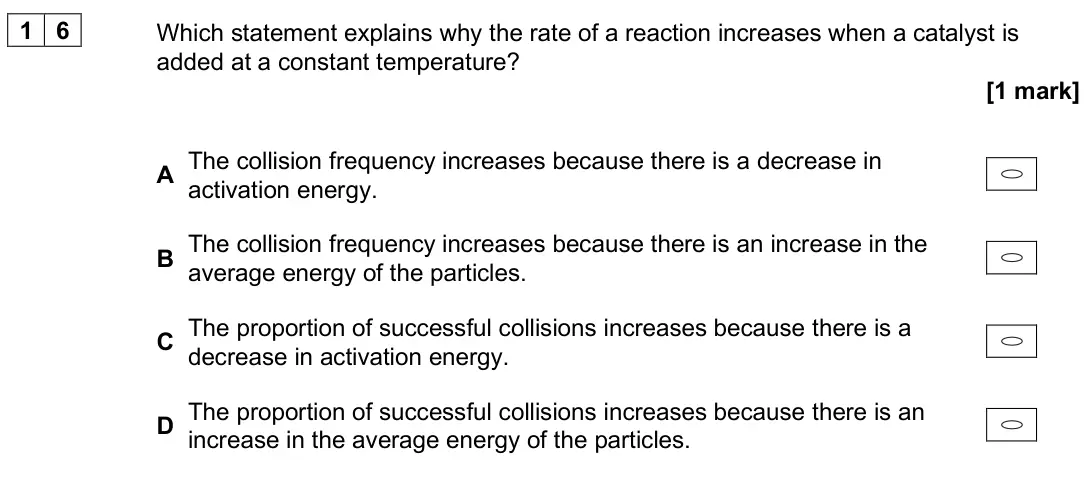
- June 2024, Paper 3, Q16 (1 mark): Which statement explains why the rate of a reaction increases when a catalyst is added at a constant temperature? [1 mark] A The collision frequency increases b
- June 2024, AS Paper 2, Q06.2 (3 marks): Plot the values of 1 t against temperature on the grid. Draw a line of best fit. Use your graph to predict the time, in s, when the cross is no longer visible a
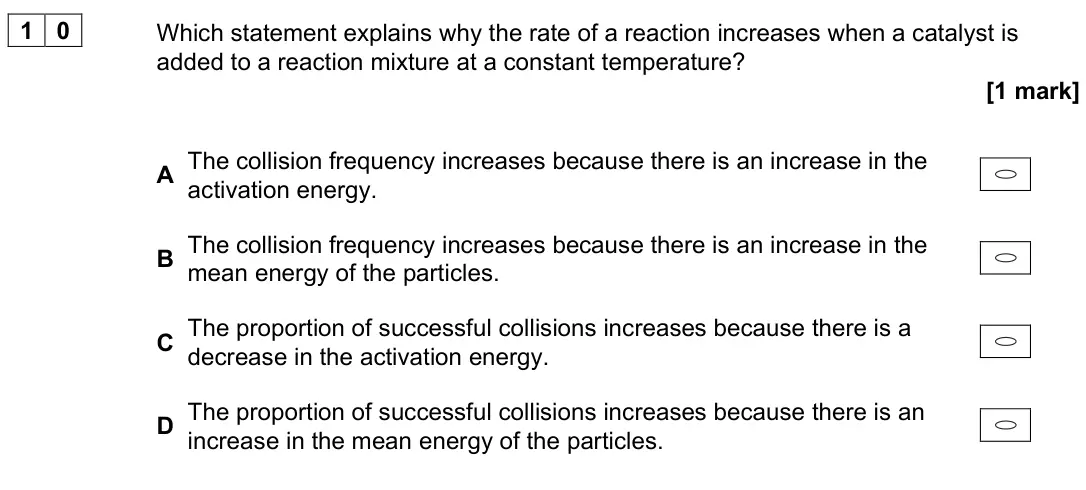
- June 2024, AS Paper 2, Q10 (1 mark): Which statement explains why the rate of a reaction increases when a catalyst is added to a reaction mixture at a constant temperature? [1 mark] A The collision
- June 2023, Paper 2, Q01.1 (1 mark): Suggest a reason why using a conical flask instead of a beaker would give more accurate results in this experiment. [1 mark] Figure 2 shows the results of this
- June 2023, Paper 2, Q01.2 (3 marks): Use Figure 2 to calculate the rate of reaction at 2 minutes. Deduce the units of your calculated rate. [3 marks] Rate Units
- June 2023, Paper 2, Q01.3 (3 marks): Chloroethanoic acid is a stronger acid than ethanoic acid. Sketch, on Figure 2, the curve you would expect when 25.0 cm3 of a 2.23 mol dm–3 solution of chloroet
- June 2023, Paper 2, Q09.4 (5 marks): Sketch the Maxwell–Boltzmann distribution of molecular energies for gaseous ethanoic anhydride at temperature T1 and at a higher temperature T2 Include a label
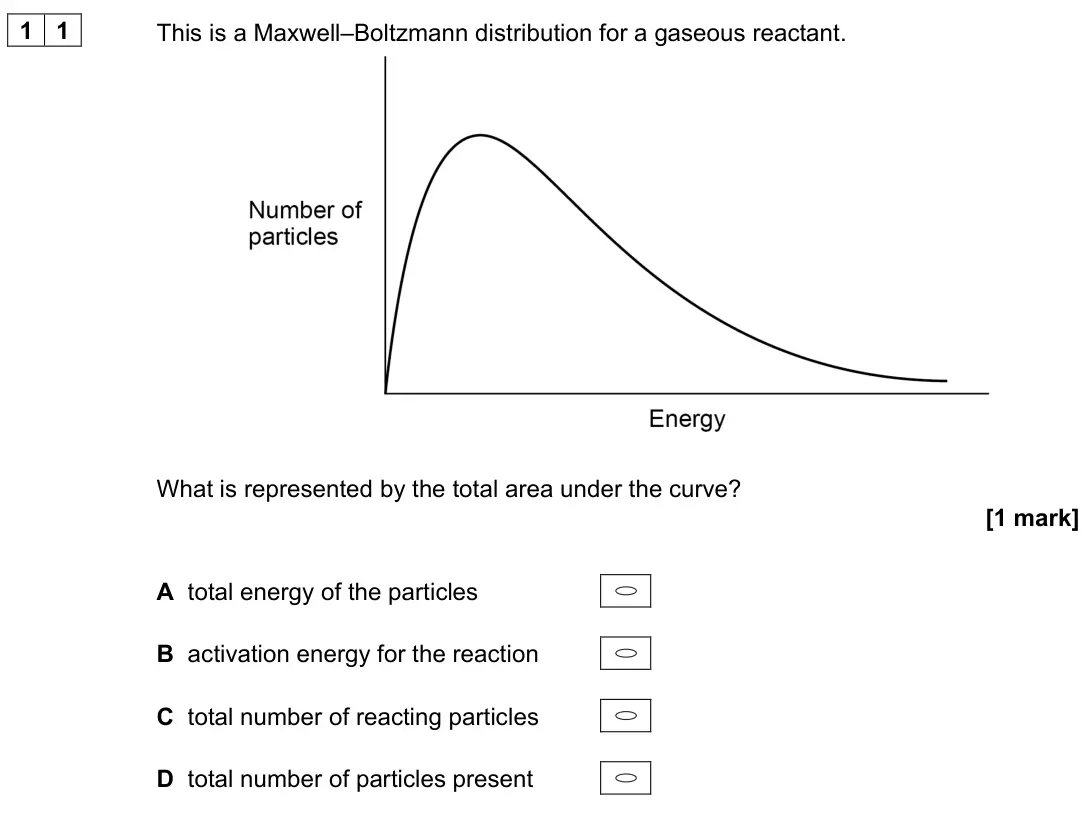
- June 2023, Paper 3, Q11 (1 mark): This is a Maxwell–Boltzmann distribution for a gaseous reactant. What is represented by the total area under the curve? [1 mark] A total energy of the particles
- June 2023, Paper 3, Q12 (1 mark): The rate of reaction is greater when a catalyst is used, without changing the temperature. Which statement explains why the rate of reaction is greater with a c
- June 2023, AS Paper 2, Q08 (6 marks): Draw the Maxwell–Boltzmann distribution curves for a fixed mass of a gas at two different temperatures. This gas decomposes when heated. By reference to these d
- June 2023, AS Paper 2, Q19 (1 mark): Magnesium reacts with an acid to form hydrogen gas. Line X on the graph shows how the volume of hydrogen gas varies with time when 50 cm3 of 0.50 mol dm–3 acid
- June 2022, Paper 2, Q01.5 (3 marks): Describe and explain the shape of the graph in Figure 1. [3 marks]
- June 2022, Paper 2, Q01.6 (1 mark): Deduce the time taken for the reaction at 35 oC [1 mark] Time s
- June 2022, Paper 3, Q04.1 (2 marks): Explain why the reaction is fastest at the start. [2 marks]
- June 2022, Paper 3, Q09 (1 mark): Consider the change that occurs in the shape of the curve for the distribution of molecular energies in a gas when the temperature of the gas is increased. Whic
- June 2022, AS Paper 2, Q01.1 (1 mark): Complete Table 1. [1 mark]
- June 2022, AS Paper 2, Q01.2 (1 mark): State the independent variable in this investigation. [1 mark]
- June 2022, AS Paper 2, Q01.3 (1 mark): The student noticed that the temperature of each reaction mixture decreased during each experiment. Suggest how the student calculated the temperature values in
- June 2022, AS Paper 2, Q01.4 (3 marks): 0 1 This question is about rates of reaction. Potassium manganate(VII), KMnO4, reacts with sodium ethanedioate, Na2C2O4, in the presence of dilute sulfuric acid
- June 2022, AS Paper 2, Q01.5 (1 mark): Use your graph in Question 01.4 to find the time taken for the mixture to go colourless at 60 °C Show your working. [1 mark] Time t s
- June 2022, AS Paper 2, Q01.6 (2 marks): The investigation shows that increasing the temperature causes the rate of reaction to increase. Explain why a small increase in temperature causes a large incr
- June 2022, AS Paper 2, Q14 (1 mark): Which statement about molecules in a gas is correct? [1 mark] A At a fixed temperature they all move at the same speed. B At a fixed temperature their average k
- November 2021, Paper 3, Q18 (1 mark): A mixture of 2 dm3 of hydrogen and 1 dm3 of oxygen is at room temperature. Which statement is correct? [1 mark] A There is no reaction to form water because the
- November 2021, Paper 3, Q19 (1 mark): Which statement about the distribution curve of molecular energies in an ideal gas at a given temperature is correct? [1 mark] A There are no molecules with zer
- November 2021, AS Paper 1, Q09 (6 marks): Hydrogen can be prepared on an industrial scale using the reversible reaction between methane and steam. CH4(g) + H2O(g) ⇌ CO(g) + 3 H2(g) ΔH = +206 kJ mol−1 Th
- November 2021, AS Paper 2, Q01.1 (1 mark): Label the y-axis on Figure 1. [1 mark]
- November 2021, AS Paper 2, Q01.2 (1 mark): State why the curve starts at the origin. [1 mark]
- November 2021, AS Paper 2, Q01.3 (1 mark): State what X indicates on Figure 1. [1 mark] X indicates
- November 2021, AS Paper 2, Q01.4 (2 marks): Half of the gas molecules in the sample are removed. The remaining gas molecules are kept at the same temperature. Draw the new distribution of molecular energi
- November 2021, AS Paper 2, Q20 (1 mark): Which statement about the use of a catalyst in a reversible reaction is correct? [1 mark] A The activation energy for the reverse reaction is increased. B The e
- November 2021, AS Paper 2, Q21 (1 mark): An excess of magnesium reacts with hydrochloric acid to form hydrogen gas. Line X on the graph shows how the volume of hydrogen produced changes with time as ma
- November 2020, AS Paper 2, Q02.1 (1 mark): The student uses a stopwatch to measure the time. The stopwatch shows each time to the nearest 0.01 s Suggest why the student records the times to the nearest s
- November 2020, AS Paper 2, Q02.2 (1 mark): The rate of reaction is proportional to 1 t Complete Table 2. [1 mark]
- November 2020, AS Paper 2, Q02.3 (2 marks): Plot the values of 1 t against temperature on Figure 1. Draw a line of best fit. [2 marks] Figure 1
- November 2020, AS Paper 2, Q02.4 (1 mark): Use your line of best fit to estimate the time for the cross to disappear at 40 °C Show your working. [1 mark] Time s
- November 2020, AS Paper 2, Q02.5 (1 mark): Suggest, by considering the products of this reaction, why small amounts of reactants are used in this experiment. [1 mark]
- November 2020, AS Paper 2, Q02.6 (1 mark): The student could do the experiment at lower temperatures using an ice bath. Suggest why the student chose not to carry out experiments at temperatures in the r
- November 2020, AS Paper 2, Q20 (1 mark): Which statement about the molecules in a sample of a gas is correct? [1 mark] A At a given temperature they all move at the same speed. B At a given temperature
- June 2019, Paper 3, Q01.4 (6 marks): The initial rate of the reaction between sodium thiosulfate and hydrochloric acid can be monitored by measuring the time taken for a fixed amount of sulfur to b
- June 2019, AS Paper 2, Q05.3 (6 marks): Methanol is made by the reaction of carbon monoxide with hydrogen. CO + 2 H2 ⇌ CH3OH ∆H = –91 kJ mol–1 The reaction uses a copper-based catalyst, a pressure of
- June 2019, AS Paper 2, Q11 (1 mark): Which statement is correct for the distribution curve of molecular energies in a gas? [1 mark] A The curve is symmetrical about the maximum. B There are always
- June 2018, AS Paper 2, Q01.1 (2 marks): Explain, in general terms, how a catalyst increases the rate of a reaction. [2 marks]
- June 2018, AS Paper 2, Q01.2 (2 marks): Draw two lines on Figure 1 to show how the volume of oxygen collected varied with time in Experiments 2 and 3. Label each line with the experiment number. [2 ma
- June 2018, AS Paper 2, Q01.3 (2 marks): Explain, in terms of collision theory, the effect of increasing the concentration of hydrogen peroxide on the rate of reaction. [2 marks]
- June 2018, AS Paper 2, Q16 (1 mark): The Maxwell–Boltzmann distribution of molecular energies in a sample of gas at a fixed temperature is shown. Which letter represents the mean energy of the mole
- June 2017, Paper 1, Q09.1 (6 marks): The first stage involves a gaseous equilibrium between the reactants (methane and steam), and some gaseous products. Figures 1 and 2 show the percentage convers
- June 2017, Paper 3, Q16 (1 mark): The diagram shows the Maxwell−Boltzmann distribution of molecular energies in a gas at two different temperatures. Which letter represents the most probable ene
- June 2017, AS Paper 2, Q01.1 (1 mark): Label the horizontal axis in Figure 1. [1 mark]
- June 2017, AS Paper 2, Q01.2 (2 marks): On Figure 1, sketch a distribution of molecular energies for this sample of gas at a higher temperature. [2 marks]
- June 2017, AS Paper 2, Q01.3 (2 marks): This gas decomposes on heating. Explain why an increase in temperature increases the rate at which this gas decomposes. [2 marks]
- June 2016, AS Paper 2, Q03.4 (2 marks): Explain, in general terms, how a catalyst works. [2 marks]
- June 2016, AS Paper 2, Q03.6 (2 marks): Platinum, palladium and rhodium are metals used inside catalytic converters. A very thin layer of the metals is used on a honeycomb ceramic support. Explain why
- June 2016, AS Paper 2, Q08.2 (2 marks): The reaction was repeated using 20 cm3 of 0.800 mol dm−3 of ethanoic acid solution with all other conditions the same. The magnesium was still in excess. Sketch
- June 2016, AS Paper 2, Q16 (1 mark): Figure 7 shows a typical energy distribution for particles of an ideal gas in a sealed container at a fixed temperature. Figure 7 Which of the following stateme
- Specimen, Paper 1, Q04.5 (1 mark): 0
- Specimen, Paper 2, Q01.4 (3 marks): The rate equation for a reaction is rate = k[E] Explain qualitatively why doubling the temperature has a much greater effect on the rate of the reaction than do
Questions, mark schemes and examiner’s reports are © AQA, from their published past papers. Plumi isn’t affiliated with any exam board. Want whole papers? Every AQA A-Level Chemistry paper.
Rather write your answers by hand on iPad? Plumi marks them against the same mark schemes.