 plumi
Electrode potentials and electrochemical cells: AQA A‑Level Chemistry questions
Every AQA A-Level Chemistry exam question on 3.1.11 Electrode potentials and electrochemical cells, 2016–2025, with its mark scheme and examiner’s report.
Find questions2,301
Calculations
Q06.1
The whole paper ↗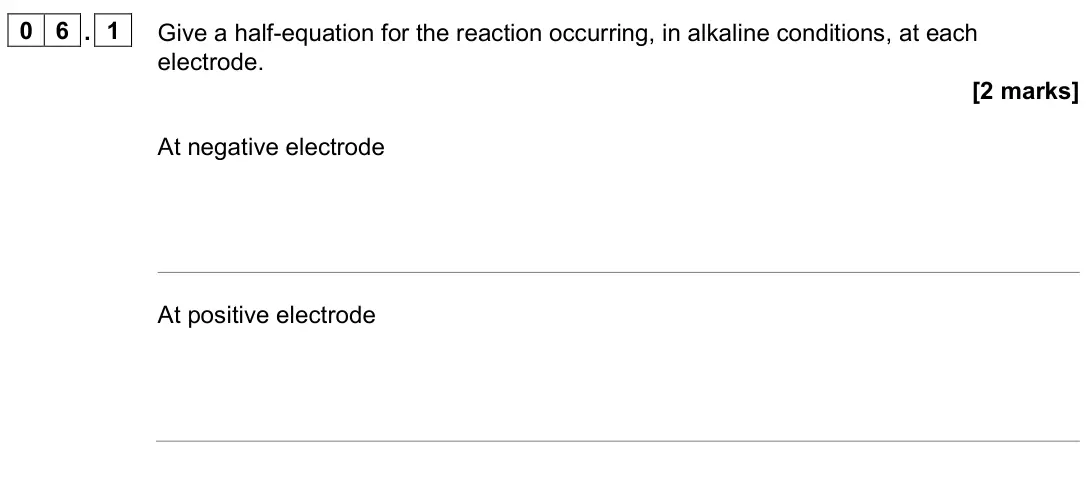
Q06.2
The whole paper ↗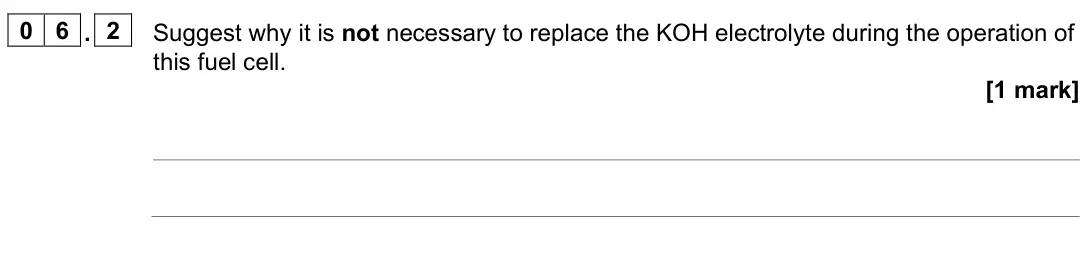
Q06.3
The whole paper ↗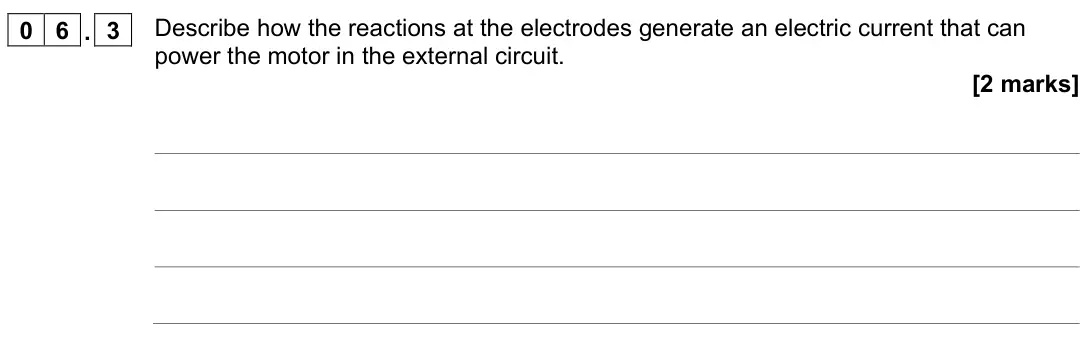
Q06.4
The whole paper ↗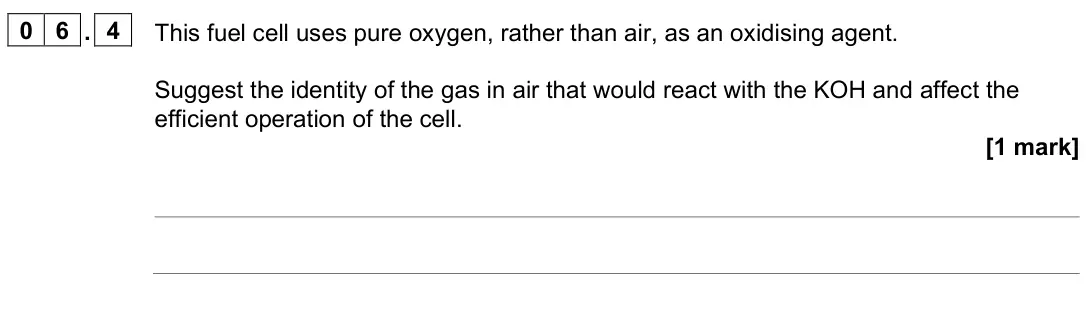
Q06.5
The whole paper ↗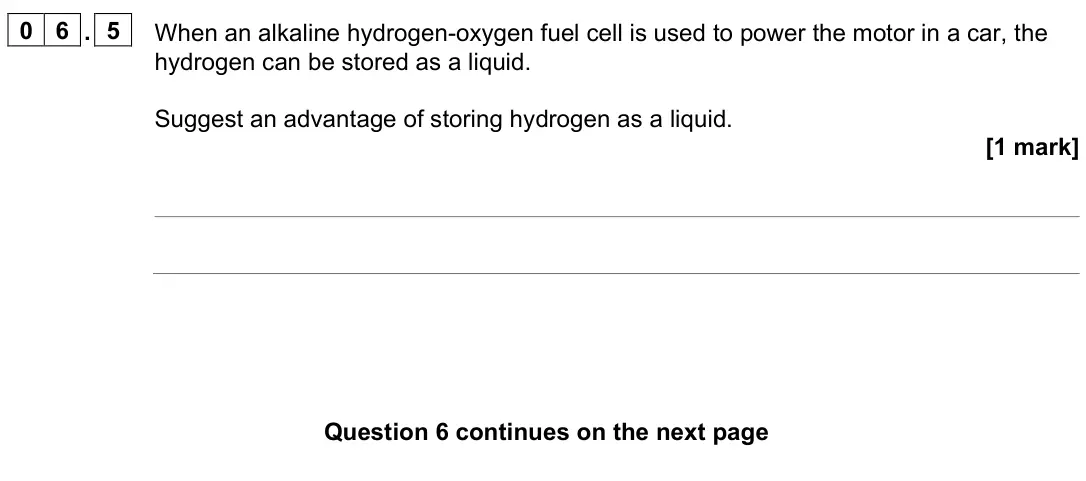
Q06.6
The whole paper ↗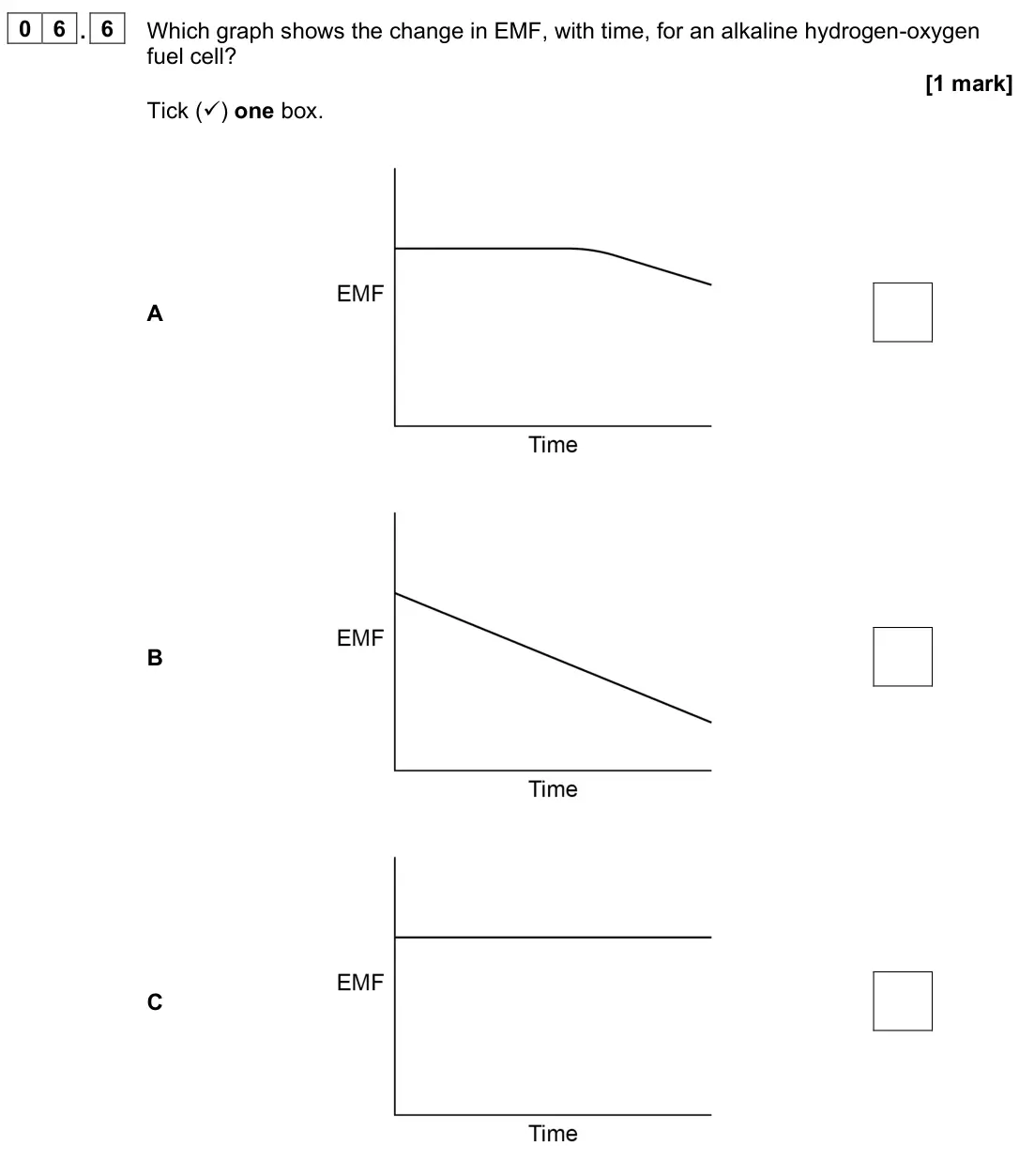
Q06.7
The whole paper ↗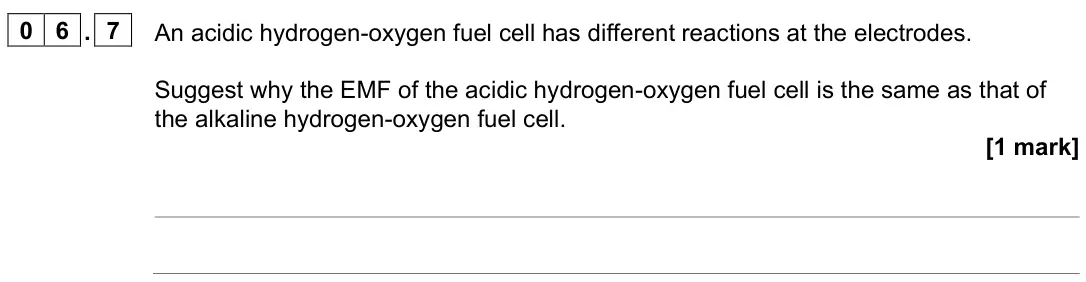
Q07.4
The whole paper ↗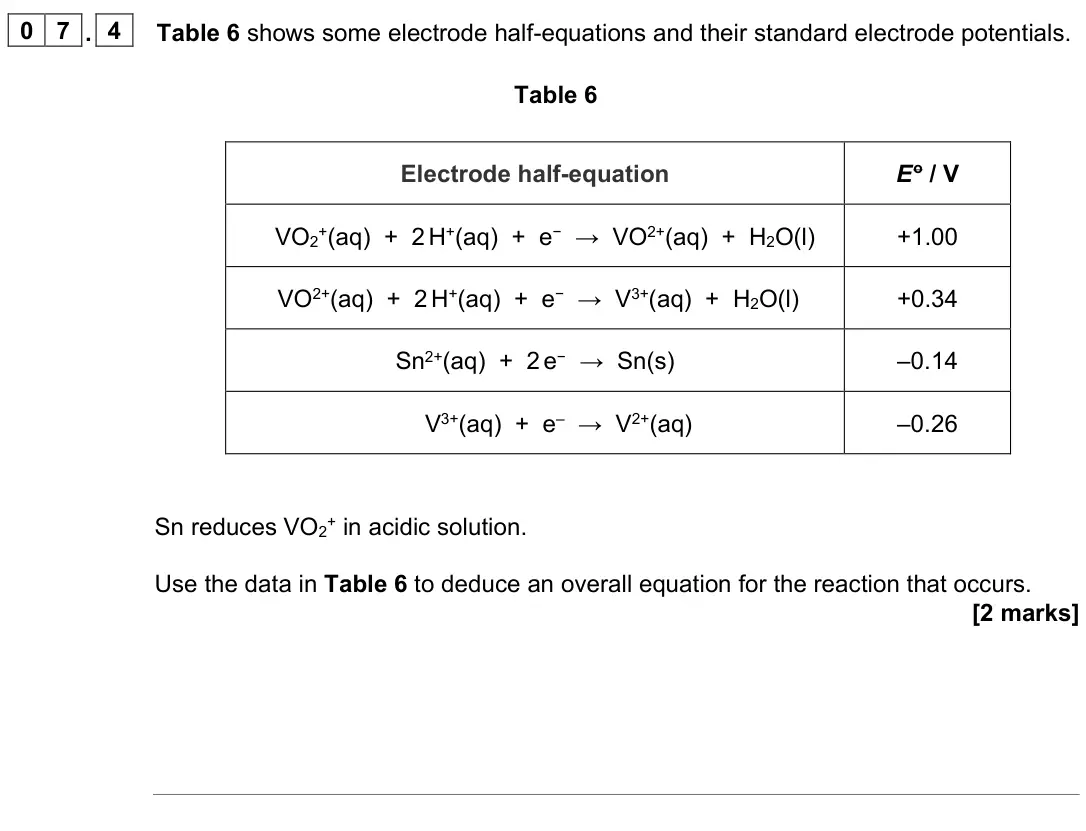
Q03.1
The whole paper ↗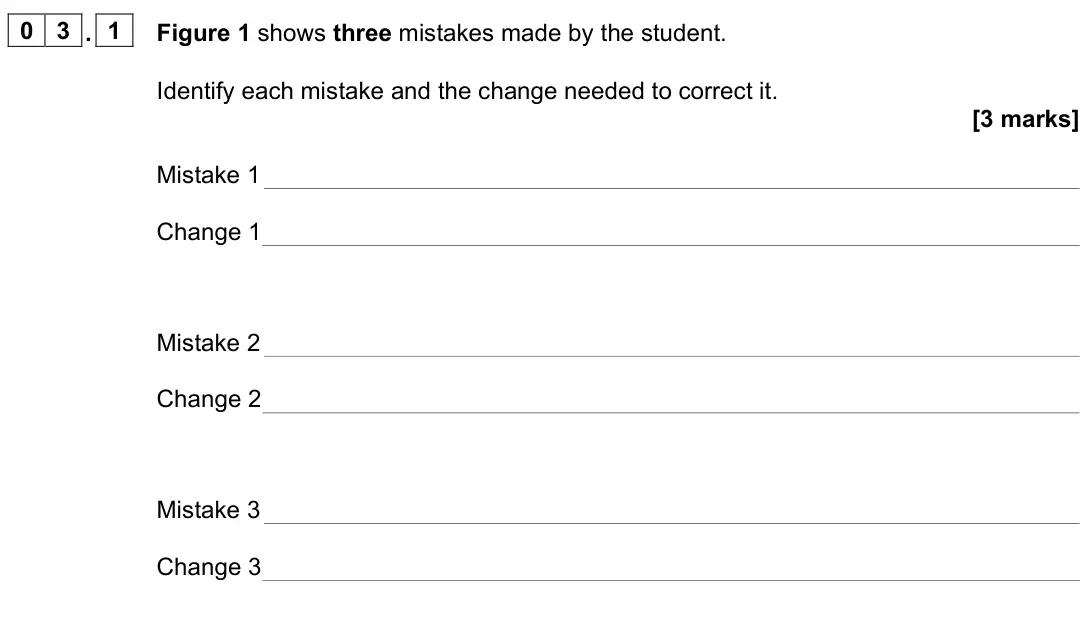
Q03.2
The whole paper ↗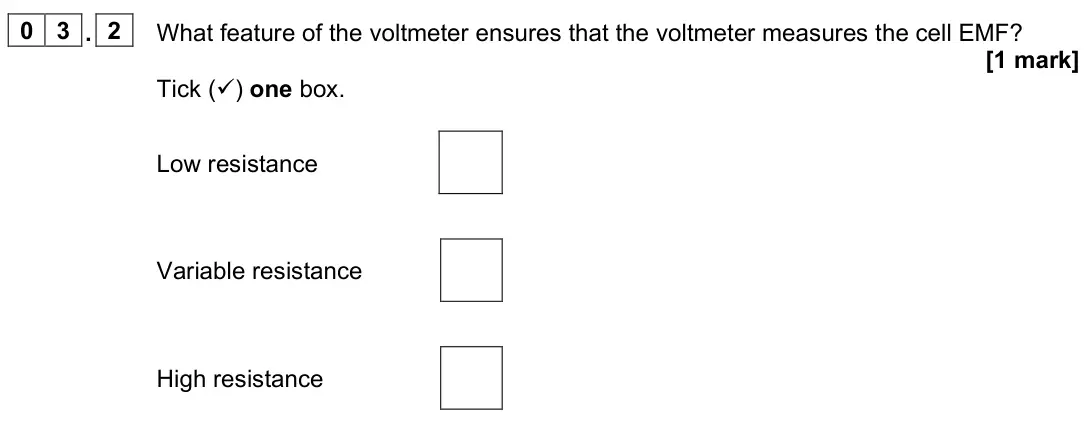
Q03.3
The whole paper ↗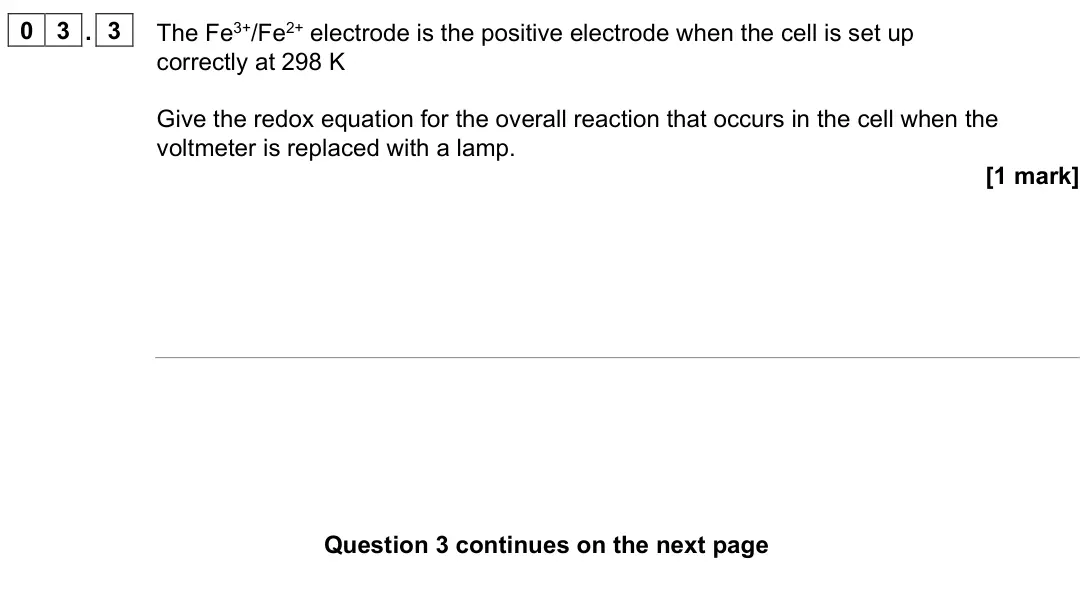
Q03.4
The whole paper ↗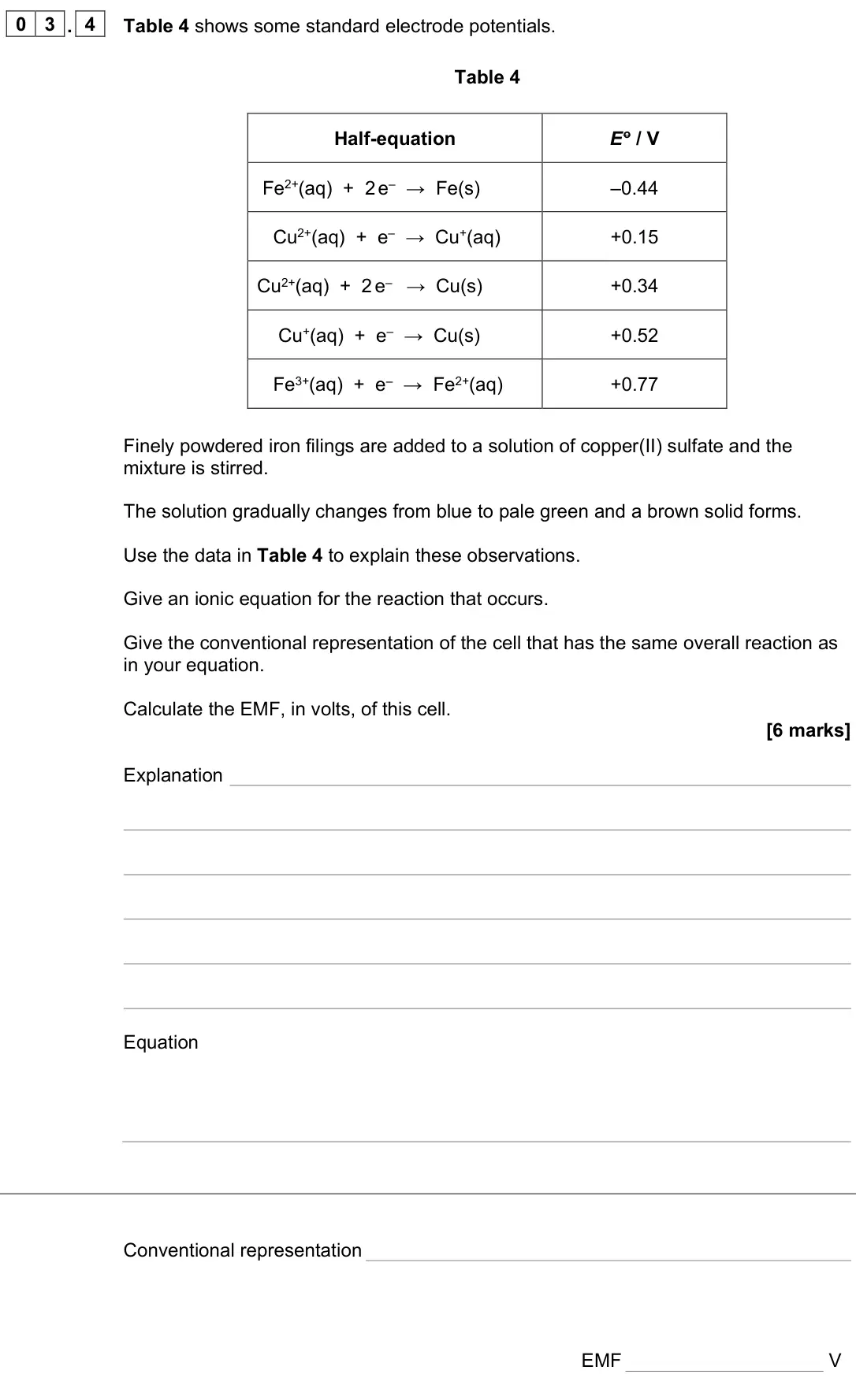
Q06.1
The whole paper ↗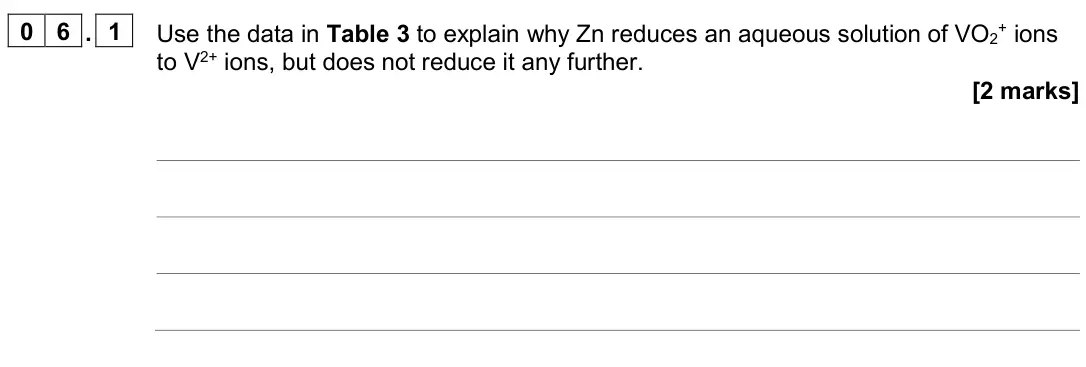
Q06.2
The whole paper ↗
Q06.3
The whole paper ↗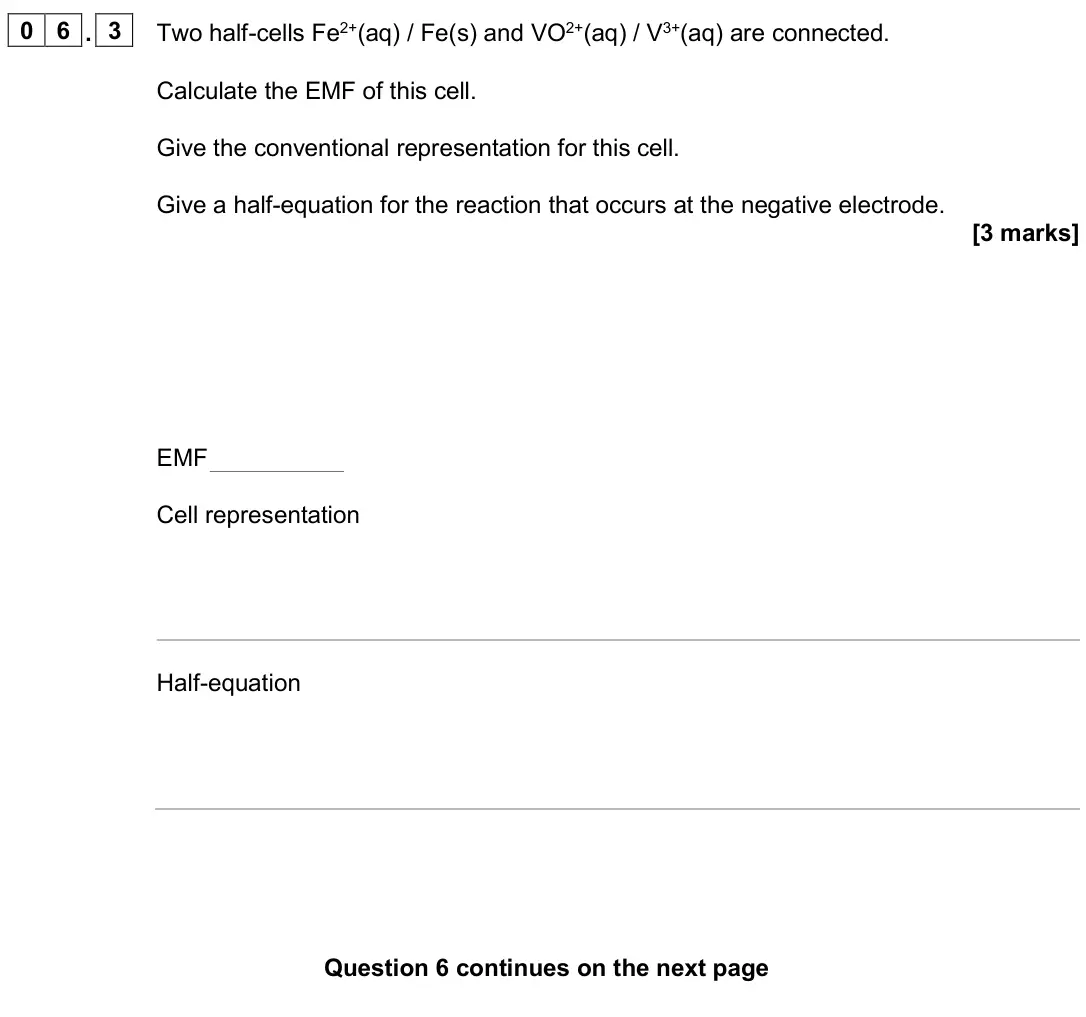
Q09.7
The whole paper ↗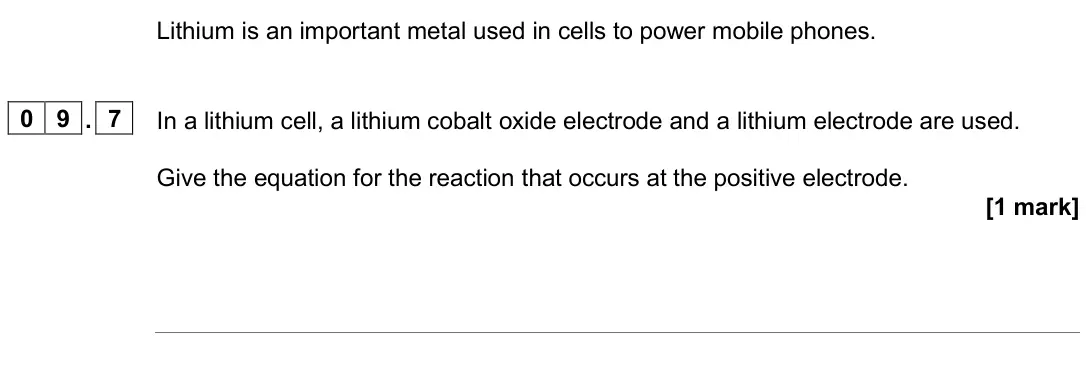
Q09.8
The whole paper ↗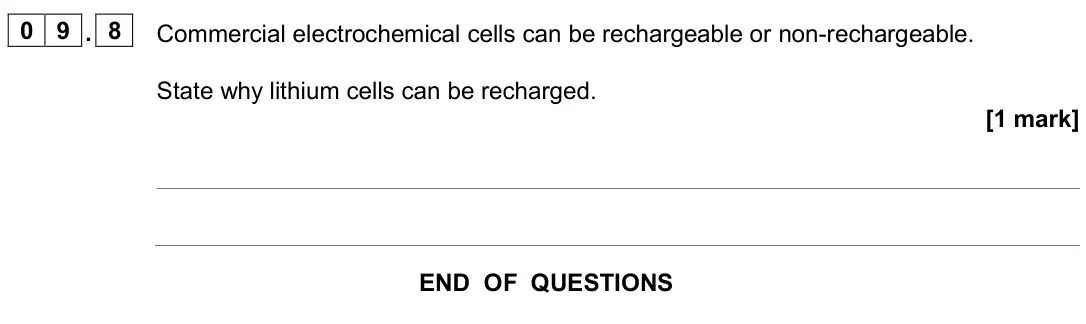
Q02.1
The whole paper ↗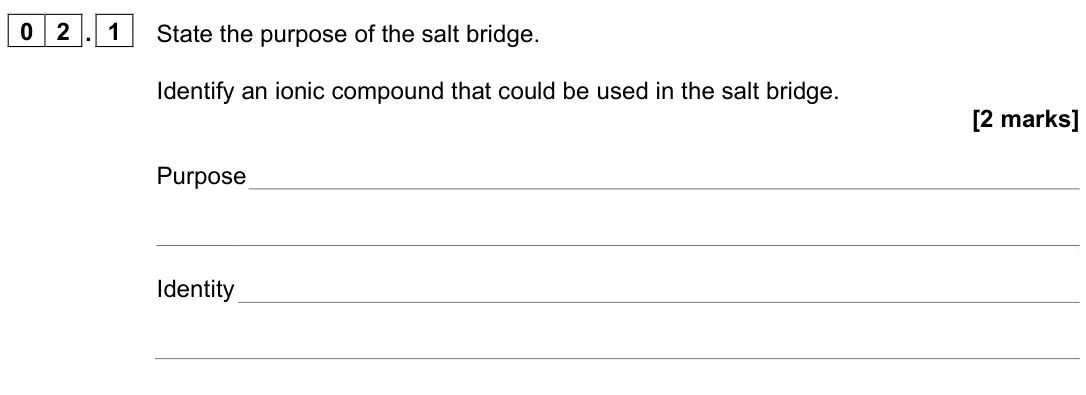
Q02.2
The whole paper ↗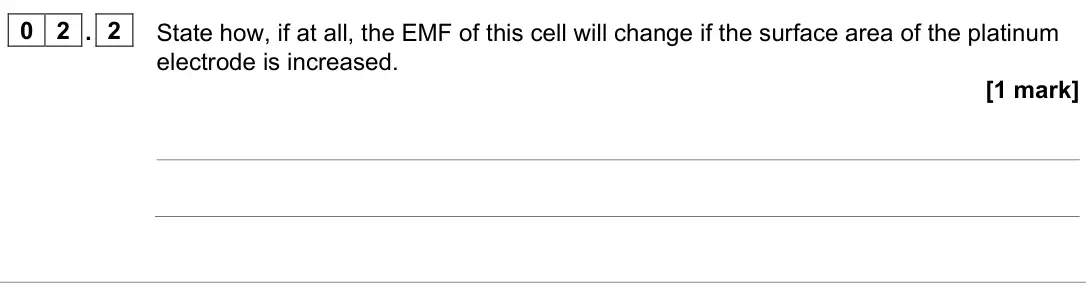
All 78 questions on Electrode potentials and electrochemical cells, as a list
- June 2025, Paper 1, Q06.1 (2 marks): Give a half-equation for the reaction occurring, in alkaline conditions, at each electrode. [2 marks] At negative electrode At positive electrode
- June 2025, Paper 1, Q06.2 (1 mark): Suggest why it is not necessary to replace the KOH electrolyte during the operation of this fuel cell. [1 mark]
- June 2025, Paper 1, Q06.3 (2 marks): Describe how the reactions at the electrodes generate an electric current that can power the motor in the external circuit. [2 marks]
- June 2025, Paper 1, Q06.4 (1 mark): This fuel cell uses pure oxygen, rather than air, as an oxidising agent. Suggest the identity of the gas in air that would react with the KOH and affect the eff
- June 2025, Paper 1, Q06.5 (1 mark): When an alkaline hydrogen-oxygen fuel cell is used to power the motor in a car, the hydrogen can be stored as a liquid. Suggest an advantage of storing hydrogen
- June 2025, Paper 1, Q06.6 (1 mark): Which graph shows the change in EMF, with time, for an alkaline hydrogen-oxygen fuel cell? [1 mark] Tick () one box. A B C
- June 2025, Paper 1, Q06.7 (1 mark): An acidic hydrogen-oxygen fuel cell has different reactions at the electrodes. Suggest why the EMF of the acidic hydrogen-oxygen fuel cell is the same as that o
- June 2025, Paper 1, Q07.4 (2 marks): Table 6 shows some electrode half-equations and their standard electrode potentials. Table 6 Electrode half-equation E o / V VO2+(aq) + 2 H+(aq) + e− → VO2+(aq)
- June 2025, Paper 3, Q03.1 (3 marks): Figure 1 shows three mistakes made by the student. Identify each mistake and the change needed to correct it. [3 marks] Mistake 1 Change 1 Mistake 2 Change 2 Mi
- June 2025, Paper 3, Q03.2 (1 mark): What feature of the voltmeter ensures that the voltmeter measures the cell EMF? [1 mark] Tick () one box. Low resistance Variable resistance High resistance
- June 2025, Paper 3, Q03.3 (1 mark): The Fe3+/Fe2+ electrode is the positive electrode when the cell is set up correctly at 298 K Give the redox equation for the overall reaction that occurs in the
- June 2025, Paper 3, Q03.4 (6 marks): Table 4 shows some standard electrode potentials. Table 4 Half-equation E o / V Fe2+(aq) + 2 e– → Fe(s) –0.44 Cu2+(aq) + e– → Cu+(aq) +0.15 Cu2+(aq) + 2 e– → Cu
- June 2024, Paper 1, Q06.1 (2 marks): Use the data in Table 3 to explain why Zn reduces an aqueous solution of VO2+ ions to V2+ ions, but does not reduce it any further. [2 marks]
- June 2024, Paper 1, Q06.2 (1 mark): Identify the species in Table 3 that can reduce an aqueous solution of VO2+ to V [1 mark]
- June 2024, Paper 1, Q06.3 (3 marks): Two half-cells Fe2+(aq) / Fe(s) and VO2+(aq) / V3+(aq) are connected. Calculate the EMF of this cell. Give the conventional representation for this cell. Give a
- June 2024, Paper 1, Q09.7 (1 mark): In a lithium cell, a lithium cobalt oxide electrode and a lithium electrode are used. Give the equation for the reaction that occurs at the positive electrode.
- June 2024, Paper 1, Q09.8 (1 mark): Commercial electrochemical cells can be rechargeable or non-rechargeable. State why lithium cells can be recharged. [1 mark]
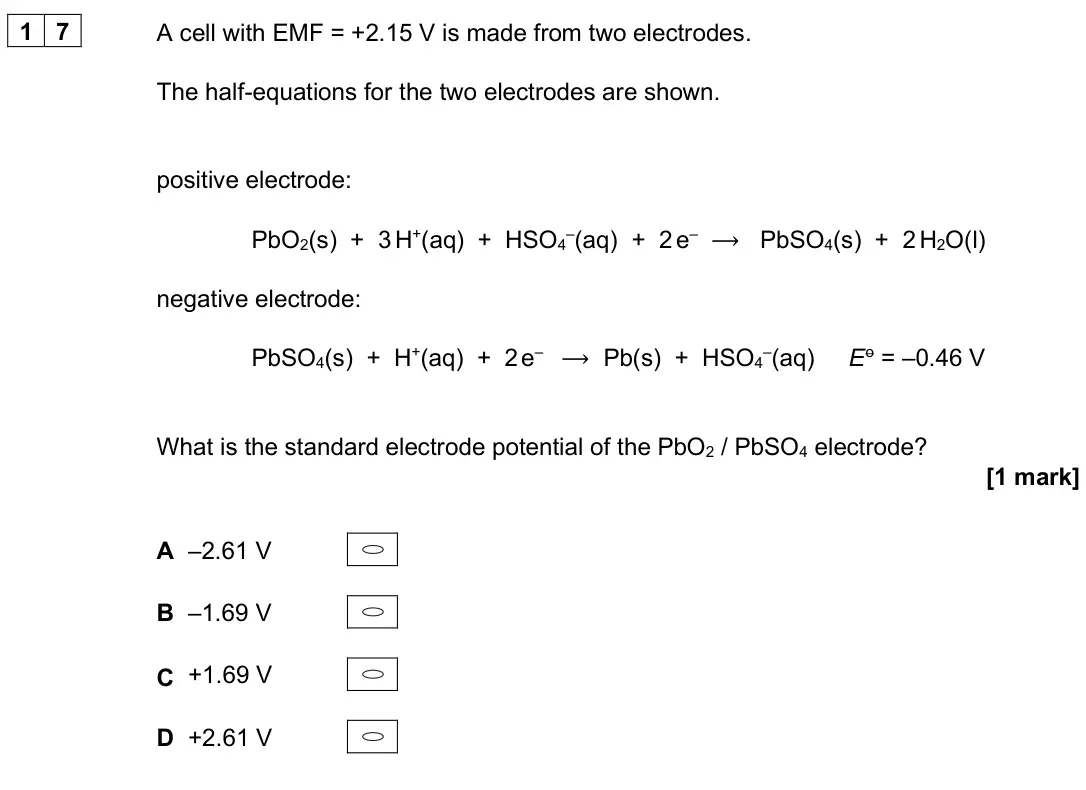
- June 2024, Paper 3, Q17 (1 mark): A cell with EMF = +2.15 V is made from two electrodes. The half-equations for the two electrodes are shown. positive electrode: PbO2(s) + 3 H+(aq) + HSO4–(aq) +
- June 2023, Paper 1, Q02.1 (2 marks): State the purpose of the salt bridge. Identify an ionic compound that could be used in the salt bridge. [2 marks] Purpose Identity
- June 2023, Paper 1, Q02.2 (1 mark): State how, if at all, the EMF of this cell will change if the surface area of the platinum electrode is increased. [1 mark]
- June 2023, Paper 1, Q02.3 (1 mark): Water is added to the beaker containing the magnesium chloride solution. What is the effect on the magnitude of the EMF of the cell? [1 mark] Tick () one box.
- June 2023, Paper 1, Q02.4 (1 mark): The voltmeter V shown in Figure 1 is replaced by a bulb. Give an equation for the overall reaction that occurs when the cell is operating. [1 mark]
- June 2023, Paper 1, Q08.1 (1 mark): At the positive electrode, oxygen reacts with hydrogen ions to form water. Give a half-equation for this reaction. [1 mark]
- June 2023, Paper 1, Q08.2 (1 mark): At the negative electrode, methanol reacts with water to produce carbon dioxide and hydrogen ions. Give a half-equation for this reaction. [1 mark]
- June 2023, Paper 1, Q08.3 (1 mark): The standard electrode potential for the CO2 / CH3OH electrode is +0.03 V Calculate the standard electrode potential for the O2 / H2O electrode. [1 mark]
- June 2023, Paper 1, Q08.4 (1 mark): State why a fuel cell does not need to be electrically recharged. [1 mark]
- June 2023, Paper 1, Q08.5 (1 mark): Suggest one advantage of using methanol, rather than hydrogen, in a fuel cell for use in cars. [1 mark]
- June 2022, Paper 1, Q08.1 (1 mark): The half-equations for two electrodes that combine to make a non-rechargeable cell are Zn2+(aq) + 2e− → Zn(s) E o = −0.76 V 2 MnO2(s) + 2 NH4+(aq) + 2e– → Mn2O3
- June 2022, Paper 1, Q08.2 (1 mark): Suggest the function of the porous separator in Figure 1. [1 mark]
- June 2022, Paper 1, Q08.3 (1 mark): The standard electrode potentials for two half-equations for the silver–zinc cell are Ag2O(s) + H2O(l) + 2e– 2 Ag(s) + 2 OH–(aq) E o = +0.34 V ZnO(s) + H2O(l)
- June 2022, Paper 1, Q08.4 (2 marks): Give the half-equation for the other electrode and calculate its standard electrode potential. [2 marks] Equation E o
- June 2022, Paper 1, Q08.5 (1 mark): Suggest why the EMF values of the acidic and alkaline hydrogen–oxygen fuel cells are the same. [1 mark]
- June 2022, Paper 3, Q11 (1 mark): Which change to a hydrogen electrode has no effect on the electrode potential? [1 mark] A the concentration of the hydrogen ions B the pressure of the hydrogen
- June 2022, Paper 3, Q12 (1 mark): Some electrode potential data are shown. Zn2+(aq) + 2 e− → Zn(s) E ɵ = − 0.76 V Pb2+(aq) + 2 e− → Pb(s) E ɵ = − 0.13 V Which is a correct statement about this c
- November 2021, Paper 1, Q08.1 (1 mark): State the meaning of the term electrochemical series. [1 mark]
- November 2021, Paper 1, Q08.2 (1 mark): State two conditions needed for the following half-cell to have E o = 0.00 V H+(aq) + e– → 1 2 H2(g) [1 mark]
- November 2021, Paper 1, Q08.3 (1 mark): Identify the weakest reducing agent in Table 8. [1 mark]
- November 2021, Paper 1, Q08.4 (2 marks): Use half-equations from Table 8 to deduce an equation for the reduction of VO2+ to form VO2+ in aqueous solution by iron. [2 marks]
- November 2021, Paper 1, Q08.5 (2 marks): Use data from Table 8 to explain why [Co(H2O)6]3+(aq) will undergo a redox reaction with [Fe(H2O)6]2+(aq) Give an equation for this reaction. [2 marks] Explanat
- November 2021, Paper 1, Q08.6 (1 mark): Suggest why the two cobalt(III) complex ions in Table 8 have different electrode potentials. [1 mark]
- November 2021, Paper 1, Q09.1 (2 marks): Use data in Table 9 to explain why an aqueous electrolyte is not used for a lithium cell. [2 marks]
- November 2021, Paper 1, Q09.2 (1 mark): In the 1970s lithium-iodine cells became a common power source for heart pacemakers. Lithium iodide is the final product of the cell reaction. Use the data in T
- November 2021, Paper 1, Q09.3 (1 mark): An EMF value for a commercial lithium-iodine cell is 2.80 V Suggest why this value is different from the value calculated in Question 09.2. [1 mark]
- November 2021, Paper 1, Q09.5 (1 mark): Give an equation for the reaction that occurs at the positive lithium cobalt oxide electrode. [1 mark]
- November 2021, Paper 1, Q09.6 (1 mark): Give an equation for the reaction that occurs at the negative lithium electrode. [1 mark]
- November 2020, Paper 1, Q11.1 (1 mark): Deduce the half-equation for the reaction at the negative electrode. [1 mark]
- November 2020, Paper 1, Q11.2 (1 mark): Deduce the half-equation for the reaction at the positive electrode. [1 mark]
- November 2020, Paper 1, Q11.3 (1 mark): Give the equation for the overall reaction that occurs in the Glucose–oxygen fuel cell. [1 mark]
- November 2020, Paper 1, Q11.4 (2 marks): The negative electrode is made of carbon and the positive electrode is made of platinum. Give the conventional representation for the glucose–oxygen fuel cell.
- November 2020, Paper 1, Q11.5 (1 mark): State what must be done to maintain the EMF of this fuel cell when in use. [1 mark]
- November 2020, Paper 3, Q06.1 (3 marks): State the substances and conditions needed in a standard hydrogen electrode. [3 marks]
- November 2020, Paper 3, Q06.2 (6 marks): Describe an experiment the student does to show that the standard electrode potential for the TiO2+(aq) / Ti(s) electrode is −0.88 V The student is provided wit
- November 2020, Paper 3, Q06.3 (1 mark): Give the half-equation for the electrode reaction in the TiO2+(aq) / Ti(s) electrode in acidic conditions. [1 mark]
- November 2020, Paper 3, Q06.4 (3 marks): Table 2 shows some electrode potential data. Table 2 Electrode reaction Eo / V 2 H+(aq) + 2 e− → H2(g) 0.00 Cu2+(aq) + 2 e− → Cu(s) +0.34 NO3−(aq) + 4 H+(aq) +
- June 2019, Paper 3, Q03.1 (1 mark): Name the piece of apparatus labelled A. [1 mark]
- June 2019, Paper 3, Q03.2 (1 mark): State the purpose of A. [1 mark]
- June 2019, Paper 3, Q03.3 (1 mark): Name the substance used as electrode B in Figure 1. [1 mark]
- June 2019, Paper 3, Q03.4 (4 marks): Complete Table 1 to identify C, D and E from Figure 1. Include the essential conditions for each. [4 marks] Table 1 Identity Conditions C D E
- June 2019, Paper 3, Q03.5 (2 marks): The standard electrode potential, Eo, for the Fe3+/Fe2+ electrode is +0.77 V Give the ionic equation for the overall reaction in the cell in Figure 1. State the
- June 2019, Paper 3, Q03.6 (3 marks): A student sets up a cell as shown in the cell representation. Zn(s)|Zn2+(aq)||Cu2+(aq)|Cu(s) The student measures the cell EMF, Ecell, with several different co
- June 2019, Paper 3, Q03.7 (3 marks): This equation shows how Ecell varies with concentration for this reaction. This equation is in the form of the equation for a straight line, y = mx + c Calculat
- June 2019, Paper 3, Q03.8 (2 marks): In experiment 2 in Table 2 the electrode potential of the Cu2+/Cu electrode is +0.33 V Use data from Table 2 in question 03.6 to calculate the electrode potenti
- June 2019, Paper 3, Q13 (1 mark): The Eo values for two electrodes are shown. Fe2+(aq) + 2 e– → Fe(s) Eo= –0.44 V Cu2+(aq) + 2 e– → Cu(s) Eo= +0.34 V What is the EMF of the cell Fe(s)|Fe2+(aq)||
- June 2018, Paper 1, Q06.1 (1 mark): Explain how the salt bridge provides an electrical connection between the two solutions. [1 mark]
- June 2018, Paper 1, Q06.2 (1 mark): The standard electrode potential for the Cu2+/Cu electrode is Cu2+(aq) + 2e– → Cu(s) Eo = + 0.34 V Calculate the electrode potential of the left-hand electrode
- June 2018, Paper 1, Q06.3 (1 mark): Both electrodes contain a strip of copper metal in a solution of aqueous Cu2+ ions. State why the left-hand electrode does not have an electrode potential of +0
- June 2018, Paper 1, Q06.4 (1 mark): Give the conventional representation for the cell in Figure 2. Include all state symbols. [1 mark]
- June 2018, Paper 1, Q06.5 (2 marks): When the voltmeter is replaced by a bulb, the EMF of the cell in Figure 2 decreases over time to 0 V Suggest how the concentration of copper(II) ions in the lef
- June 2018, Paper 1, Q09.1 (2 marks): Use data from Table 4 to identify the species that can be used to reduce VO2 + ions to VO2+ in aqueous solution and no further. Explain your answer. Table 4 Ele
- June 2017, Paper 1, Q10.2 (1 mark): State the weakest reducing agent in Table 4. [1 mark]
- June 2017, Paper 1, Q10.3 (2 marks): Write the conventional representation of the cell that has an EMF of +0.43 V [2 marks]
- June 2017, Paper 1, Q10.4 (4 marks): Use data from Table 4 to identify an acid that will oxidise copper. Explain your choice of acid. Use these data to suggest a possible equation for the reaction.
- Specimen, Paper 1, Q03.1 (2 marks): 3 Fuel cells are an increasingly important energy source for vehicles. Standard electrode potentials are used in understanding some familiar chemical reactions
- Specimen, Paper 1, Q03.2: Use data from Table 1 to deduce the halide ion that is the weakest reducing agent. [1 mar 0 3 . 2
- Specimen, Paper 1, Q03.3 (1 mark): Use data from Table 1 to justify why sulfate ions should not be capable of oxidising bromide ions. [1 mark] 0 3 . 3
- Specimen, Paper 1, Q03.4 (1 mark): EMF = V
- Specimen, Paper 1, Q03.5 (1 mark): 8
- Specimen, Paper 3, Q15 (1 mark): 8
Questions, mark schemes and examiner’s reports are © AQA, from their published past papers. Plumi isn’t affiliated with any exam board. Want whole papers? Every AQA A-Level Chemistry paper.
Rather write your answers by hand on iPad? Plumi marks them against the same mark schemes.