 plumi
Wave properties: WJEC A‑Level Physics questions
Every WJEC A-Level Physics exam question on 2.5 Wave properties, 2016–2025, with its mark scheme and examiner’s report.
Find questions1,173
Calculations
Q7(a)
The whole paper ↗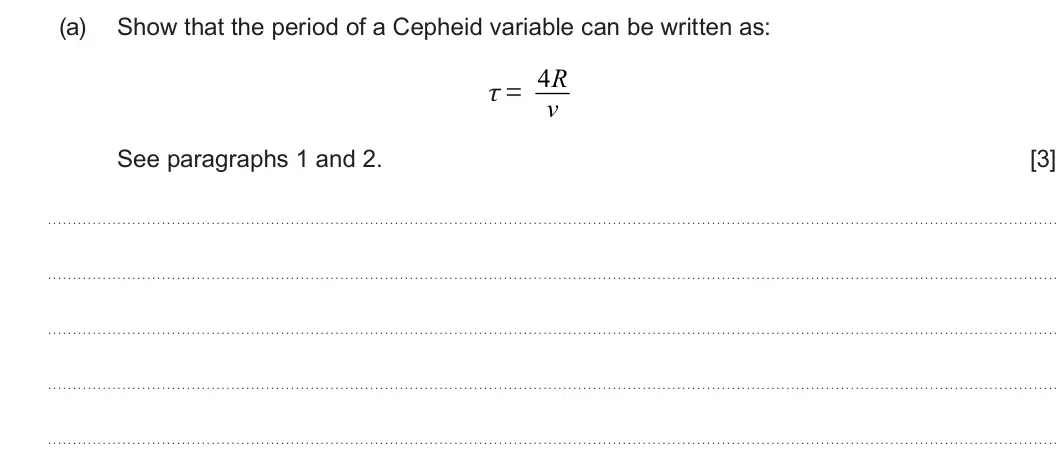
Q4(a)
The whole paper ↗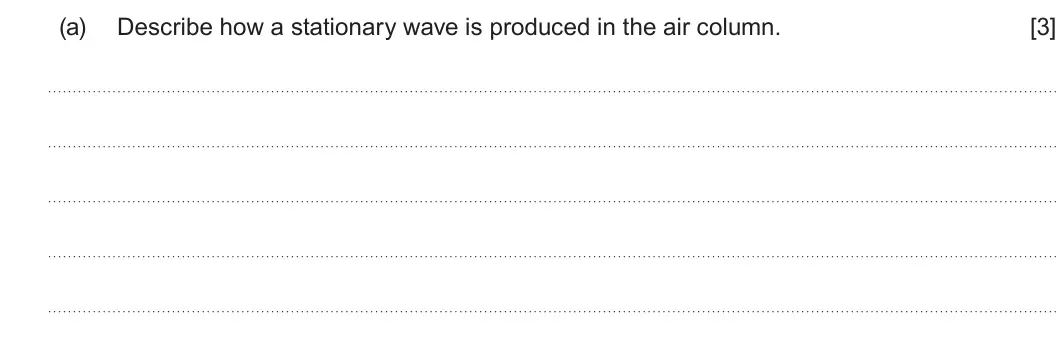
Q4(b)(i)
The whole paper ↗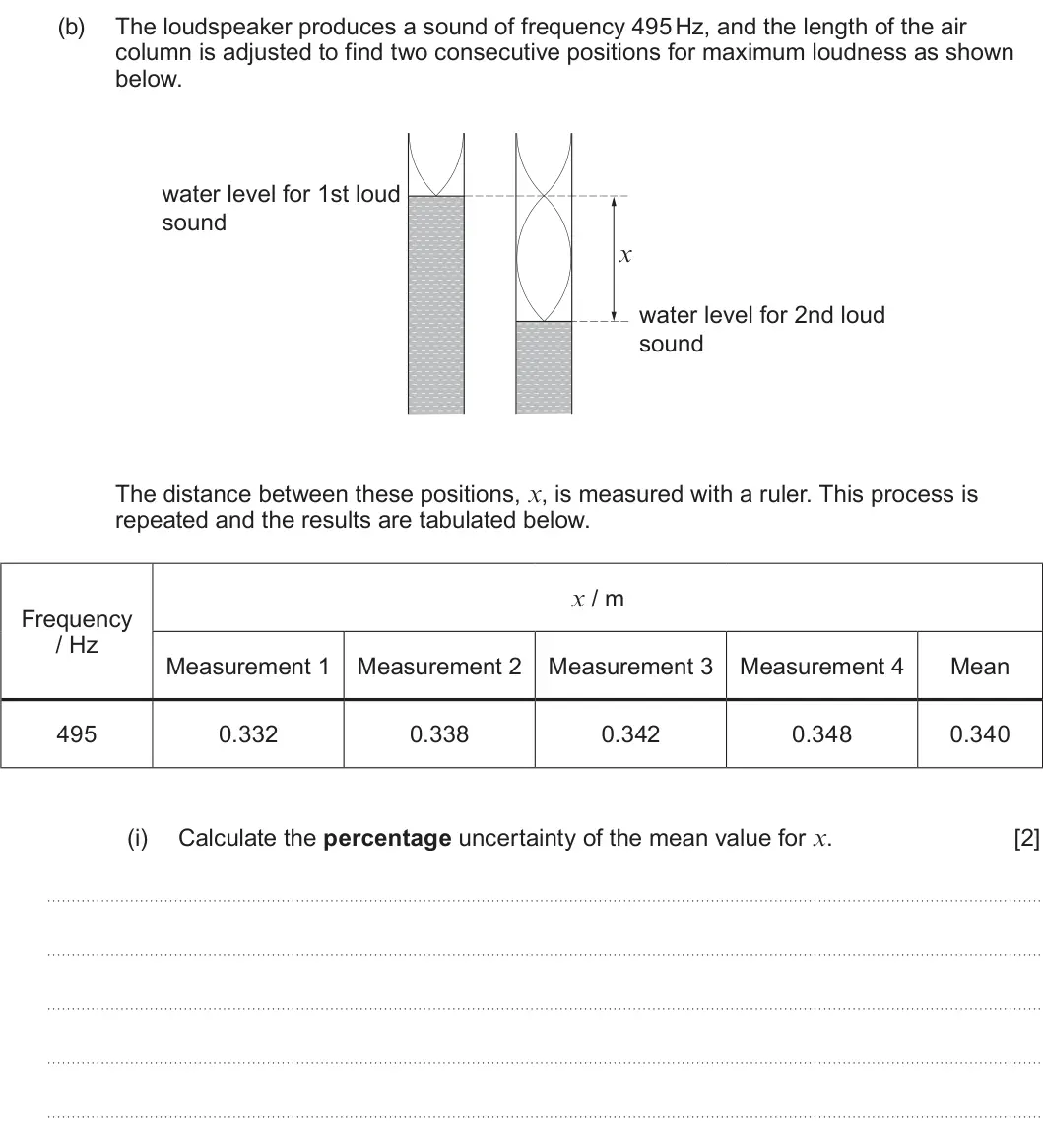
Q4(b)(ii)
The whole paper ↗
Q4(b)(iii)
The whole paper ↗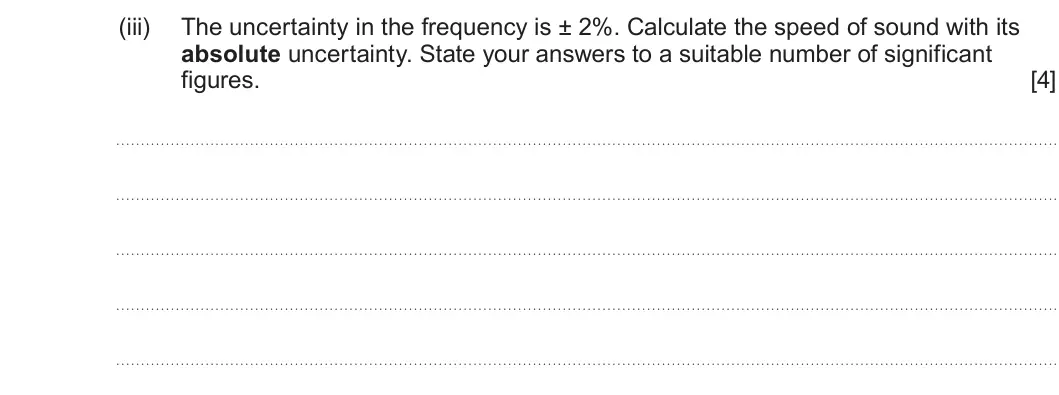
Q5(a)
The whole paper ↗
Q5(b)(i)
The whole paper ↗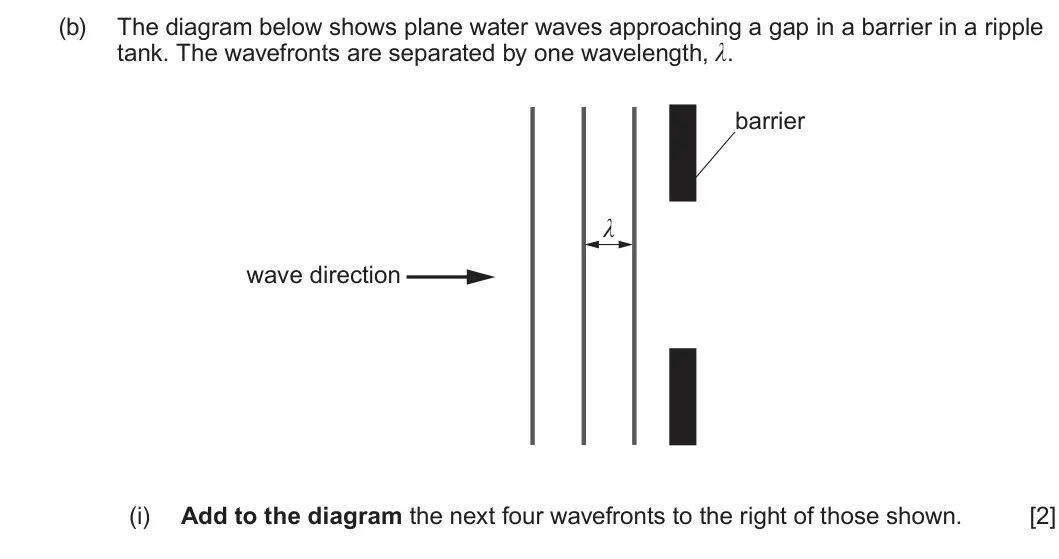
Q5(b)(ii)
The whole paper ↗
Q5(c)(i)
The whole paper ↗
Q5(c)(ii)
The whole paper ↗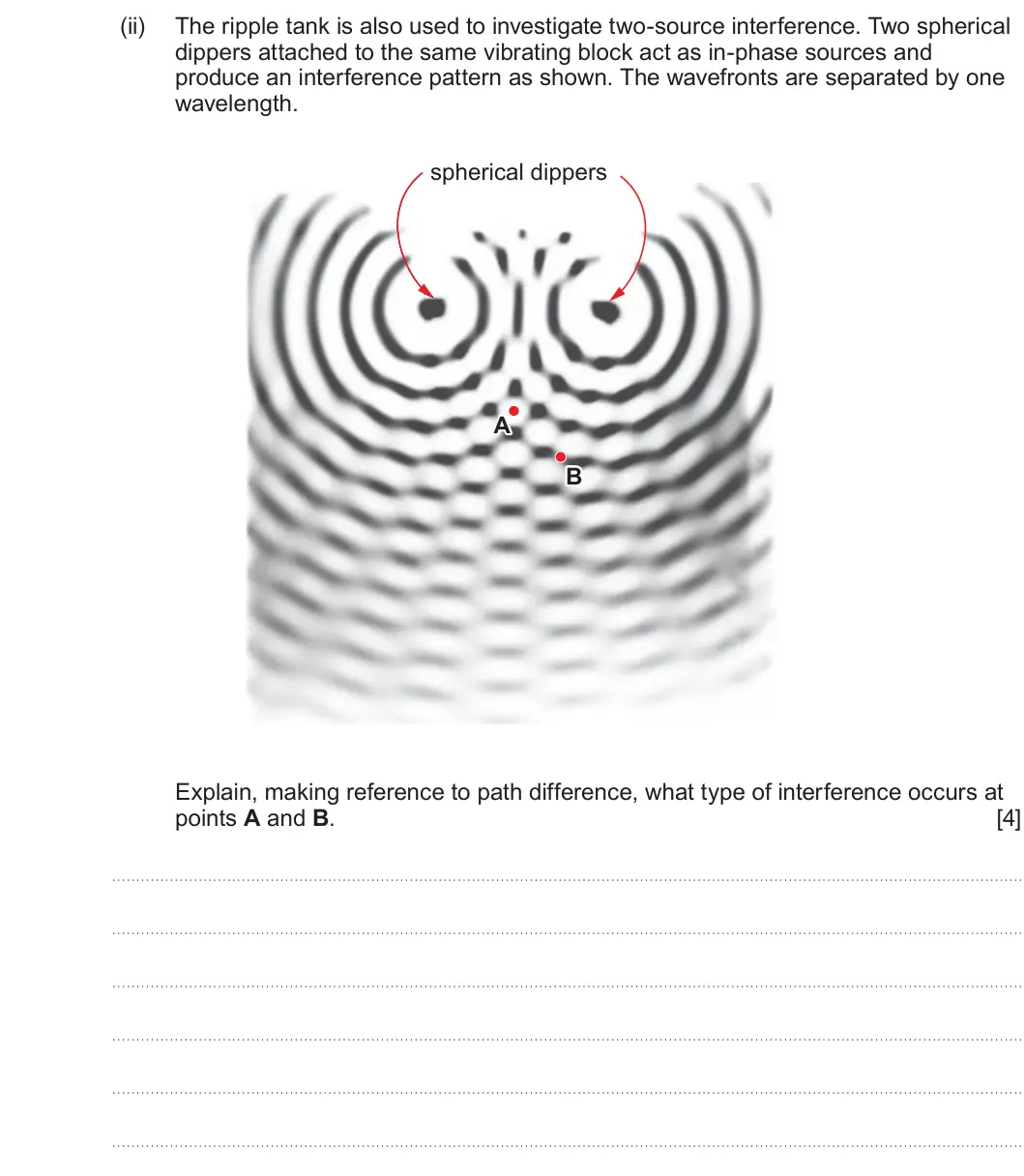
Q5(c)(iii)
The whole paper ↗
Q4(b)(i)
The whole paper ↗
Q4(b)(ii)
The whole paper ↗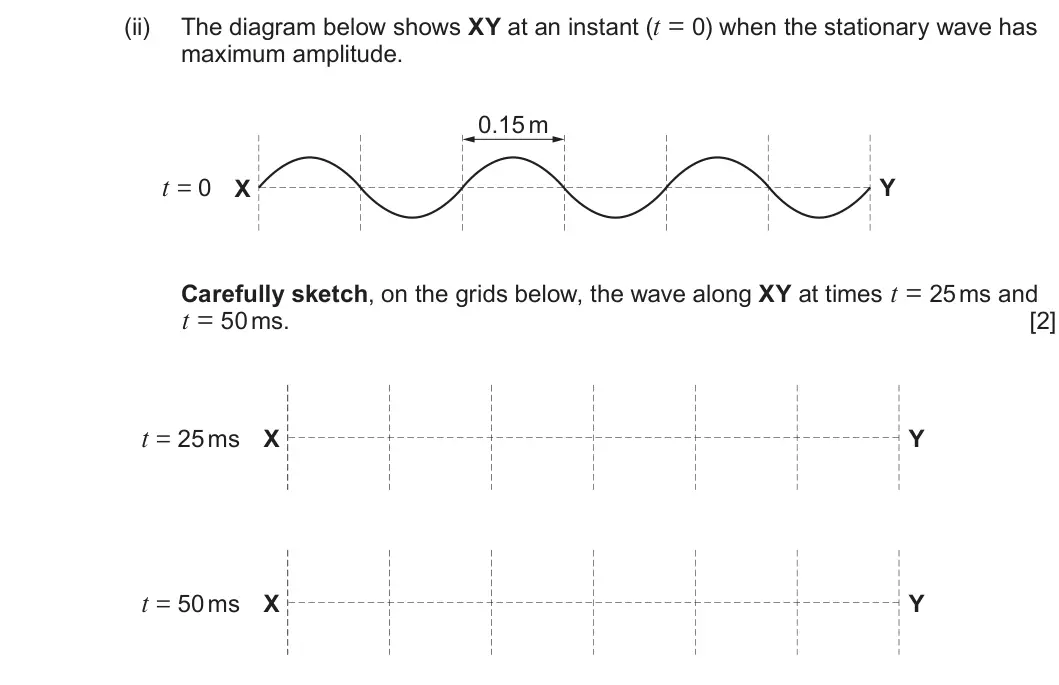
Q5(a)(i)
The whole paper ↗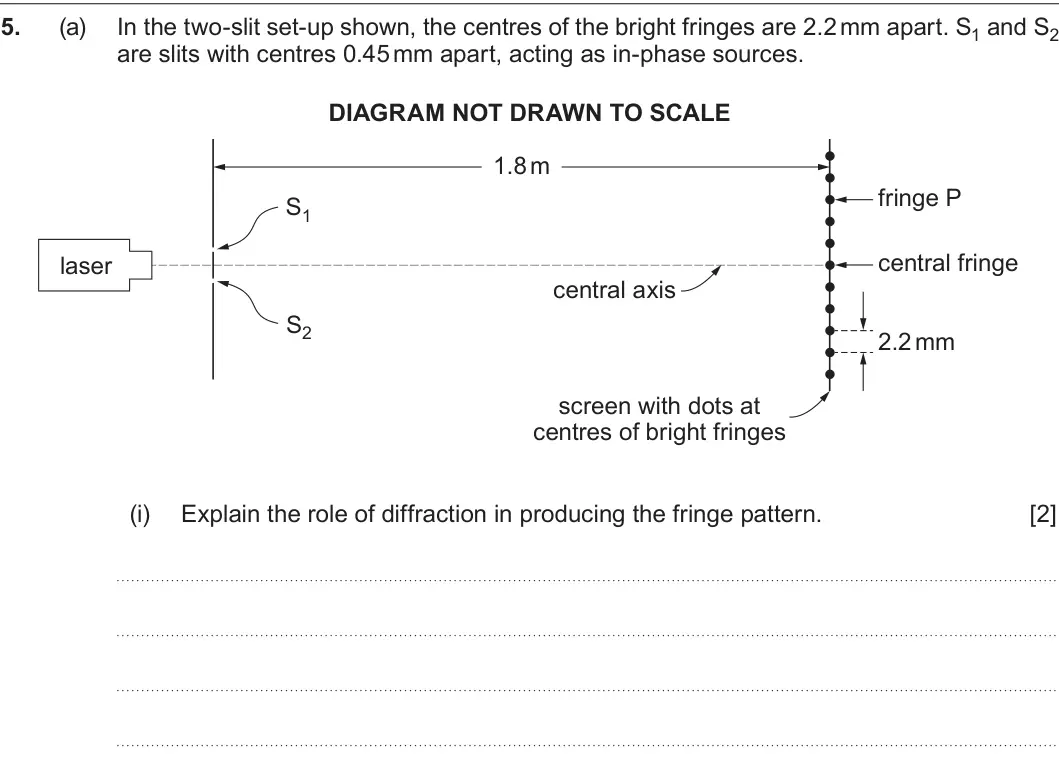
Q5(a)(ii)
The whole paper ↗
Q5(a)(iii)
The whole paper ↗
Q5(b)
The whole paper ↗
Q3(b)
The whole paper ↗
Q4(a)
The whole paper ↗
Q4(b)(i)
The whole paper ↗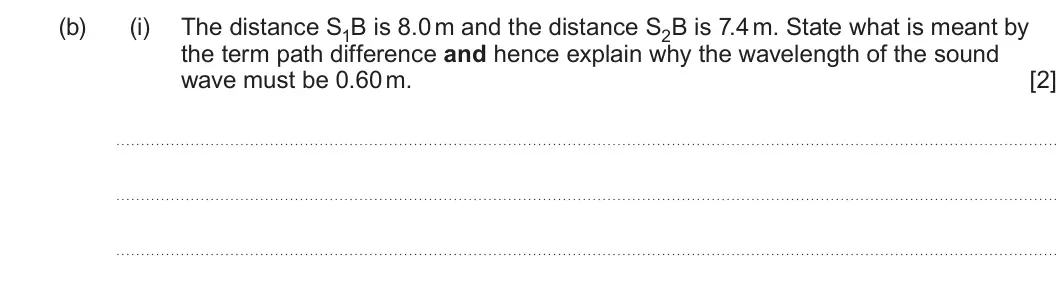
All 58 questions on Wave properties, as a list
- Summer 2025, Unit 3, Q7(a) (3 marks): Read through the following article carefully. Paragraph Are Cepheid variables giant stars or giant musical instruments? Stars called Cepheid variables vary in b
- Summer 2025, AS Unit 2, Q4(a) (3 marks): Describe how a stationary wave is produced in the air column. [3]
- Summer 2025, AS Unit 2, Q4(b)(i) (2 marks): Calculate the percentage uncertainty of the mean value for x. [2]
- Summer 2025, AS Unit 2, Q4(b)(ii) (2 marks): Show that the speed of sound, c, can be given by: c = 2 f x [2]
- Summer 2025, AS Unit 2, Q4(b)(iii) (4 marks): The uncertainty in the frequency is ± 2%. Calculate the speed of sound with its absolute uncertainty. State your answers to a suitable number of significant fig
- Summer 2025, AS Unit 2, Q5(a) (1 mark): Explain what is meant by diffraction. [1]
- Summer 2025, AS Unit 2, Q5(b)(i) (2 marks): Add to the diagram the next four wavefronts to the right of those shown. [2]
- Summer 2025, AS Unit 2, Q5(b)(ii) (1 mark): Describe the shape of the wavefronts if the gap in the barrier is made less than λ. [1]
- Summer 2025, AS Unit 2, Q5(c)(i) (1 mark): State the term used to describe sources that have a constant phase relationship. [1]
- Summer 2025, AS Unit 2, Q5(c)(ii) (4 marks): The ripple tank is also used to investigate two-source interference. Two spherical dippers attached to the same vibrating block act as in-phase sources and prod
- Summer 2025, AS Unit 2, Q5(c)(iii) (3 marks): A technician wants to use light sources in order to demonstrate a two-source interference pattern. He considers the following options: • Red laser light directe
- Summer 2024, AS Unit 2, Q4(b)(i) (2 marks): Explain how this stationary wave arises. [2]
- Summer 2024, AS Unit 2, Q4(b)(ii) (2 marks): maximum amplitude. 0.15 m t = 0 X Y Carefully sketch, on the grids below, the wave along XY at times t = 25 ms and t = 50 ms. [2] t = 25 ms X Y t = 50 ms X Y
- Summer 2024, AS Unit 2, Q5(a)(i) (2 marks): Explain the role of diffraction in producing the fringe pattern. [2]
- Summer 2024, AS Unit 2, Q5(a)(ii) (2 marks): Calculate a value for the wavelength of the laser light. [2]
- Summer 2024, AS Unit 2, Q5(a)(iii) (3 marks): Using your answer to (a)(ii) determine the path difference S2P – S1P (see diagram), giving your reasoning. [3]
- Summer 2024, AS Unit 2, Q5(b) (2 marks): Give two reasons why a diffraction grating would be expected to give a more precise value for the wavelength than the two-slit method. [2]
- Summer 2023, AS Unit 2, Q3(b) (6 marks): The progressive wave set-up in part (a) can be modified in order to create a stationary wave pattern. Explain how a stationary wave is formed and describe the s
- Summer 2023, AS Unit 2, Q4(a) (1 mark): Explain what is meant by coherent sources. [1]
- Summer 2023, AS Unit 2, Q4(b)(i) (2 marks): The distance S1B is 8.0 m and the distance S2B is 7.4 m. State what is meant by the term path difference and hence explain why the wavelength of the sound wave
- Summer 2023, AS Unit 2, Q4(b)(ii) (2 marks): Mobile phone C detects a minimum intensity. Determine two possible values of the distance (S2C – S1C). [2]
- Summer 2023, AS Unit 2, Q4(c)(i) (2 marks): State the principle of superposition. [2]
- Summer 2023, AS Unit 2, Q4(c)(ii) (3 marks): Loudspeaker S2 develops a fault whose only effect is to reduce the amplitude of the sound waves it emits. Explain why the intensities at A and B decrease and th
- Summer 2022, AS Unit 2, Q4(a)(i) (3 marks): Calculate a value for the wavelength of light from the laser. [3]
- Summer 2022, AS Unit 2, Q4(a)(ii) (2 marks): Each slit is several wavelengths wide. Suggest why the intensity of the bright fringes decreases the further the fringes are from the centre of the pattern. [2]
- Summer 2022, AS Unit 2, Q4(a)(iii) (3 marks): A student suggests that replacing the laser with one that emits near infra-red (that is infra-red just beyond the end of the visible spectrum) will increase the
- Summer 2022, AS Unit 2, Q4(b) (3 marks): More than 200 years ago Thomas Young drew a conclusion from his ‘fringes’ experiment. It was not generally accepted for several years. State what conclusion You
- Summer 2022, AS Unit 2, Q5(a)(ii) (2 marks): S1 and S2 are now made to vibrate in phase, to act as wave sources of equal amplitude. Carefully sketch, on the lower two grids opposite, displacement-time grap
- Summer 2022, AS Unit 2, Q5(a)(iii) (3 marks): A student suggests that, with S1 and S2 vibrating as before, the displacement at Q (see diagram below) will be zero all the time. VIEW FROM ABOVE λ = 20 mm S1 Q
- Summer 2022, AS Unit 2, Q5(b)(i) (2 marks): Calculate the angle to the normal at which third order beams emerge. [2]
- Summer 2022, AS Unit 2, Q5(b)(ii) (1 mark): The diagram shows light emerging at this angle from two adjacent slits in the grating. Light shone Diagram not normally at drawn to scale grating State the valu
- Summer 2019, AS Unit 2, Q4(a) (6 marks): Explain the conditions that are required of the light sources, for a two-source interference pattern to be observed. Include examples of when the requirements w
- Summer 2019, AS Unit 2, Q4(b)(i) (4 marks): Six students measure the distance x, obtaining these results: 6.5 mm 6.3 mm 6.9 mm 6.9 mm 6.7 mm 6.4 mm Calculate the mean value for fringe separation (the sepa
- Summer 2019, AS Unit 2, Q4(b)(ii) (3 marks): The uncertainty in the distance of 1.50 m shown in the diagram is negligible. The separation between the centres of the slits is given by the makers of the doub
- Summer 2019, AS Unit 2, Q4(c)(i) (2 marks): Determine a value for the wavelength of the laser light from the data. [2]
- Summer 2019, AS Unit 2, Q4(c)(ii) (4 marks): The beams from the grating strike the screen as shown opposite. The pattern on the screen may be compared with the pattern of fringes in part (b) (Young’s exper
- Summer 2018, AS Unit 2, Q4(b)(i) (2 marks): First order beams emerge at angles of 24.9° to the normal (see diagram). Calculate the wavelength of the light. [2]
- Summer 2018, AS Unit 2, Q4(b)(ii) (3 marks): Explain in terms of path difference why the second order beams emerge from the diffraction grating at 57.4° to the normal. You will need to add to the diagram (
- Summer 2018, AS Unit 2, Q5(a)(i) (1 mark): The width, w, of the gap is 25 mm. What can be deduced about the wavelength of the microwaves? [1]
- Summer 2018, AS Unit 2, Q5(a)(ii) (2 marks): Rhian suggests that making the gap wider will increase the intensity of the microwaves detected. Discuss to what extent she is correct. [2]
- Summer 2018, AS Unit 2, Q5(b) (4 marks): In the set-up shown, slits S1 and S2 act as in-phase sources. Rhian detects minima of wave intensity at P and Q, and a single maximum between P and Q. 240mm P 7
- Summer 2018, AS Unit 2, Q6(a)(i) (2 marks): Calculate the mean value of x along with its percentage uncertainty. [2]
- Summer 2018, AS Unit 2, Q6(a)(ii) (2 marks): Hence calculate the value of vs along with its absolute uncertainty. [2]
- Summer 2018, AS Unit 2, Q6(b)(i) (2 marks): Derive the equation: [2] vs = 4 fx
- Summer 2018, AS Unit 2, Q6(b)(ii) (2 marks): If the inner glass tube is raised considerably further a second distance is found at which a loud note of frequency, f, is heard. This again corresponds to a st
- Summer 2017, AS Unit 2, Q4(b)(i) (2 marks): State what is meant by a node in a stationary wave, and state how far apart the nodes will be in this stationary wave. [2]
- Summer 2017, AS Unit 2, Q4(b)(ii) (2 marks): State how, if at all, the phase of the oscillations of the particles of the string varies with distance along the string, for a stationary wave. [2]
- Summer 2017, AS Unit 2, Q4(b)(iii) (2 marks): Explain, in terms of interference, how the stationary wave is produced for this stationary wave on the string. [2]
- Summer 2017, AS Unit 2, Q4(b)(iv) (1 mark): Stationary waves may also be observed on the string when the wave source is set to higher frequencies. State one way, apart from having a different frequency, i
- Summer 2017, AS Unit 2, Q5(a) (6 marks): Describe in detail how you would determine the wavelength of light from a (low-power) laser, given an opaque plate with two parallel slits. (The distance betwee
- Summer 2017, AS Unit 2, Q5(b)(i) (2 marks): Using a labelled sketch of a relevant triangle (in the space below), explain why, to a very good approximation: 0.0153 sinθ1 = 0.600 in which θ1 is the angle be
- Summer 2017, AS Unit 2, Q5(b)(ii) (2 marks): Determine the wavelength of light from the laser. [2]
- Summer 2017, AS Unit 2, Q5(b)(iii) (2 marks): Calculate the highest order produced by this grating for this wavelength, and suggest why so many orders are produced by this grating. [2]
- Summer 2016, AS Unit 2, Q4(a) (3 marks): normal given by the equation: d sin θ = nλ [3]
- Summer 2016, AS Unit 2, Q4(b)(i) (3 marks): Plot a graph of sin θ (y-axis) against n (x-axis) on the grid provided. [3]
- Summer 2016, AS Unit 2, Q4(b)(ii) (3 marks): Use your graph to determine the wavelength of the light. The separation between the centres of slits in the grating is 1 800 nm. Show your working. [3]
- Summer 2016, AS Unit 2, Q6(a)(i) (2 marks): Referring to the diagram, explain in terms of interference how an antinode is produced. [2]
- Summer 2016, AS Unit 2, Q6(a)(ii) (2 marks): From the data, determine whether there is a node or an antinode at point P (on the metal plate). Give your reasoning in terms of wavelength. [2]
Questions, mark schemes and examiner’s reports are © WJEC CBAC Ltd, from their published past papers. Plumi isn’t affiliated with any exam board. Want whole papers? Every WJEC A-Level Physics paper.
Rather write your answers by hand on iPad? Plumi marks them against the same mark schemes.