 plumi
Photons: WJEC A‑Level Physics questions
Every WJEC A-Level Physics exam question on 2.7 Photons, 2016–2025, with its mark scheme and examiner’s report.
Find questions1,173
Calculations
Q6(b)(ii)
The whole paper ↗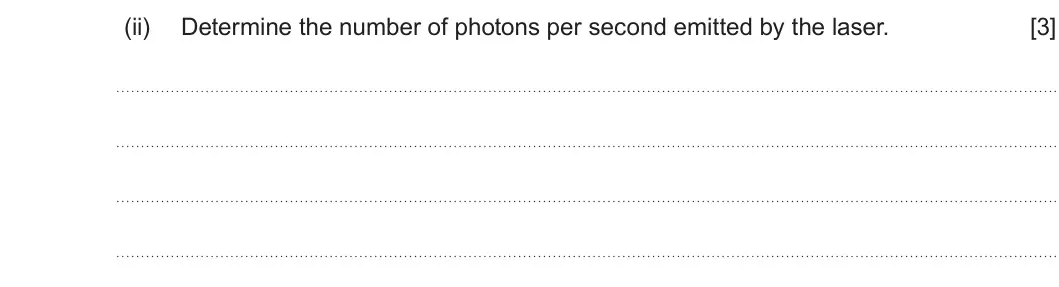
Q7(a)
The whole paper ↗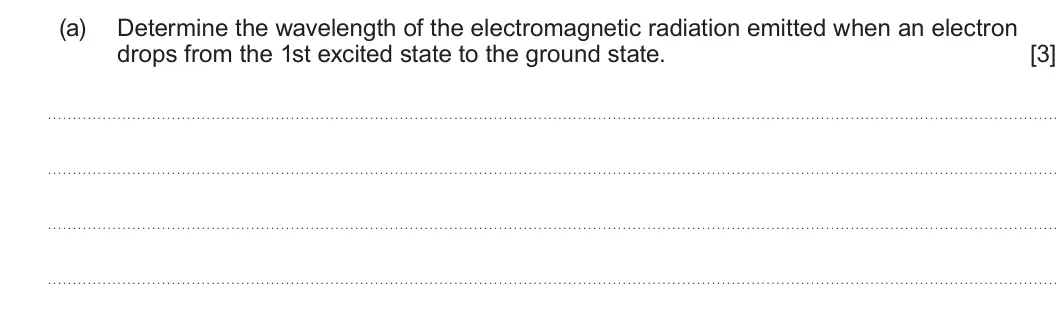
Q7(b)
The whole paper ↗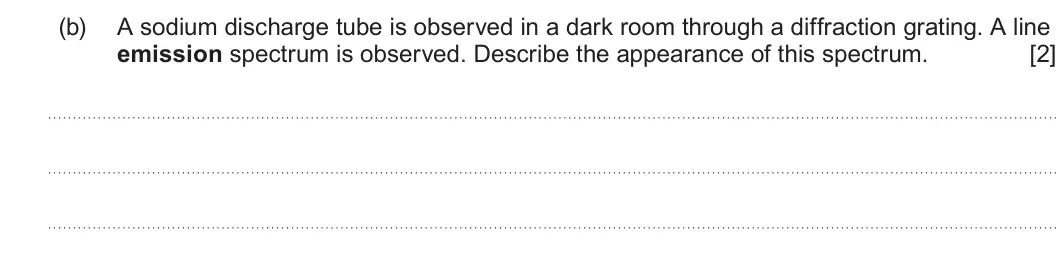
Q7(c)
The whole paper ↗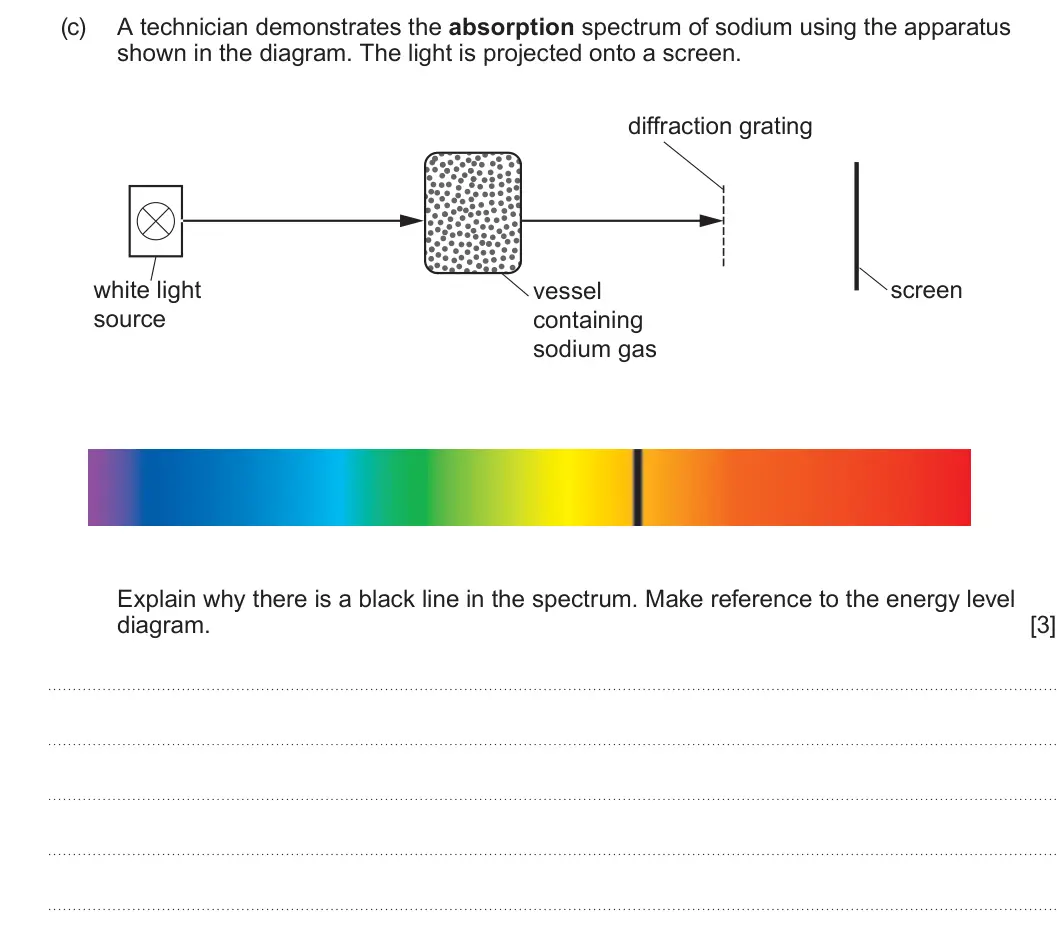
Q8(a)
The whole paper ↗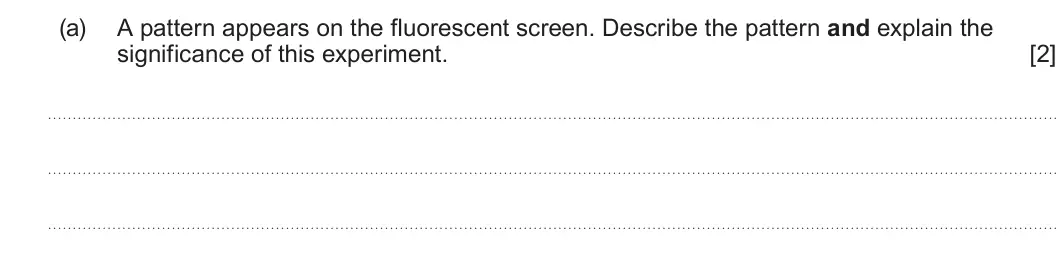
Q8(b)
The whole paper ↗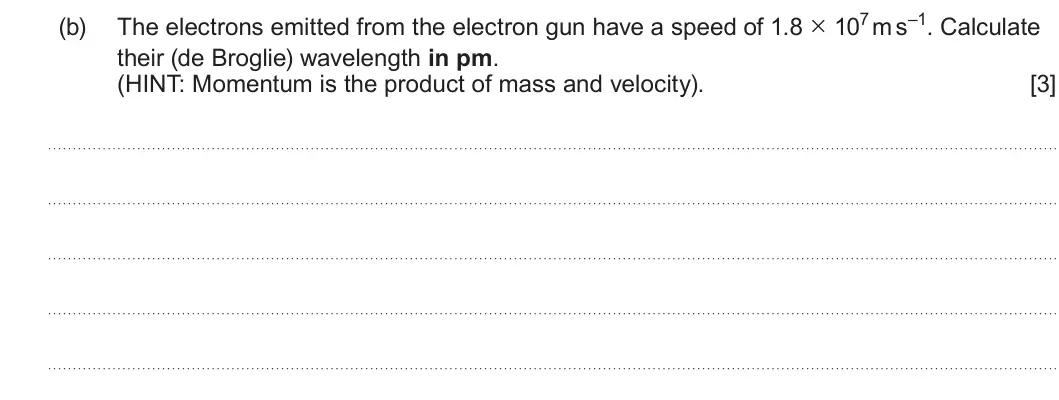
Q3(b)(i)
The whole paper ↗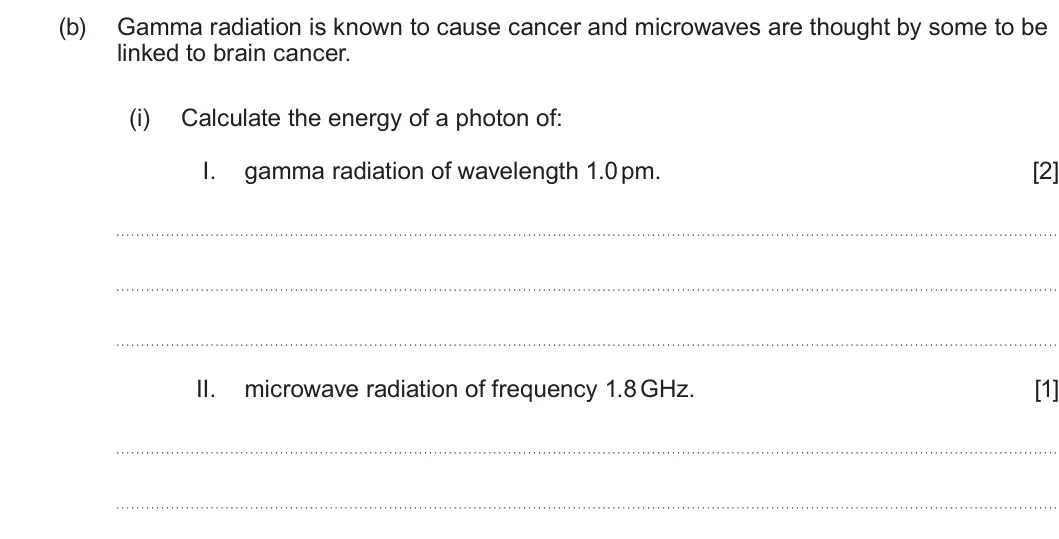
Q3(b)(ii)
The whole paper ↗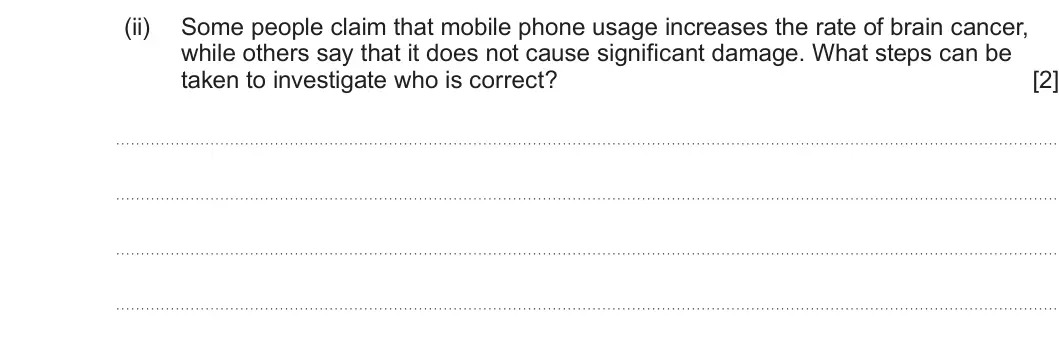
Q8(a)(i)
The whole paper ↗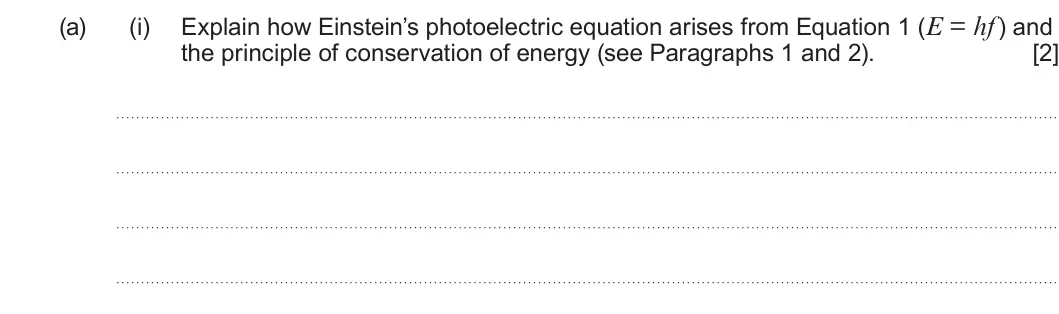
Q8(a)(ii)
The whole paper ↗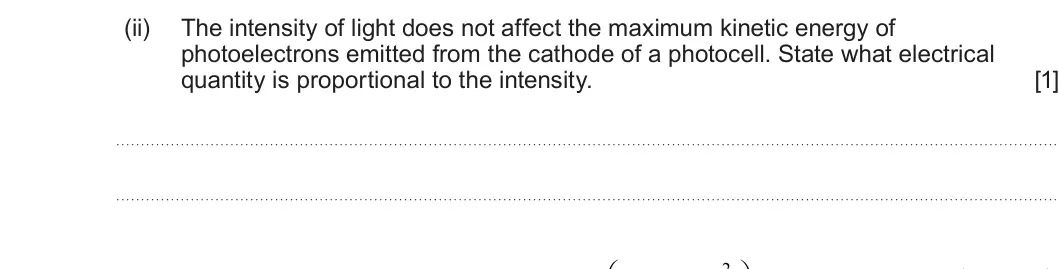
Q8(b)
The whole paper ↗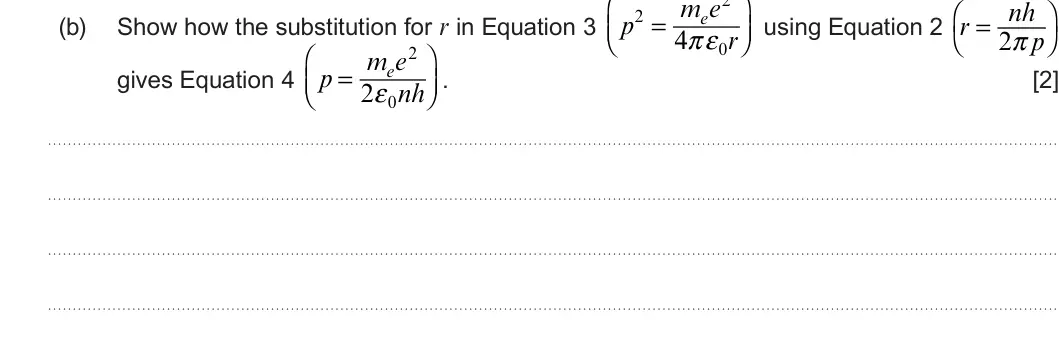
Q8(c)(i)
The whole paper ↗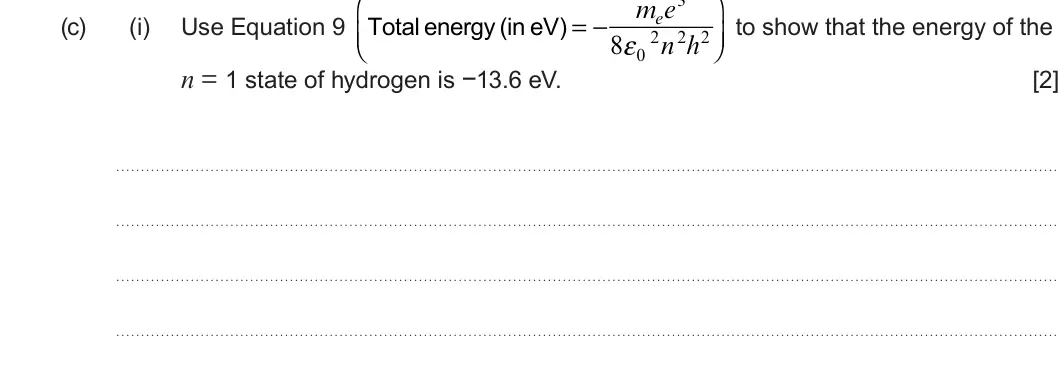
Q8(c)(ii)
The whole paper ↗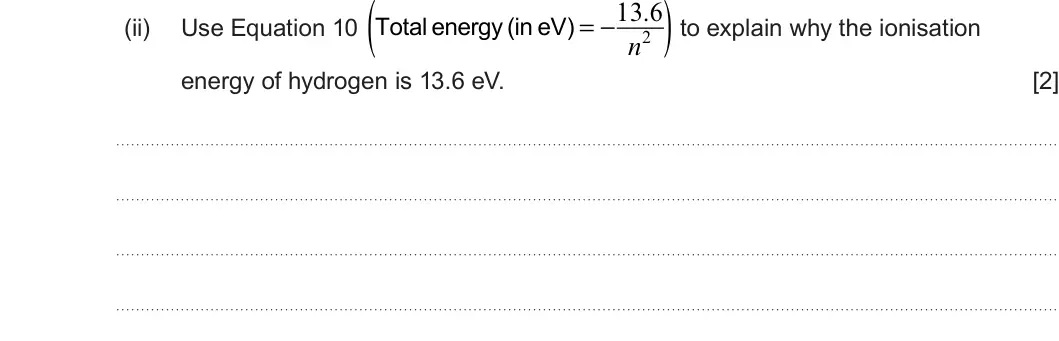
Q8(d)
The whole paper ↗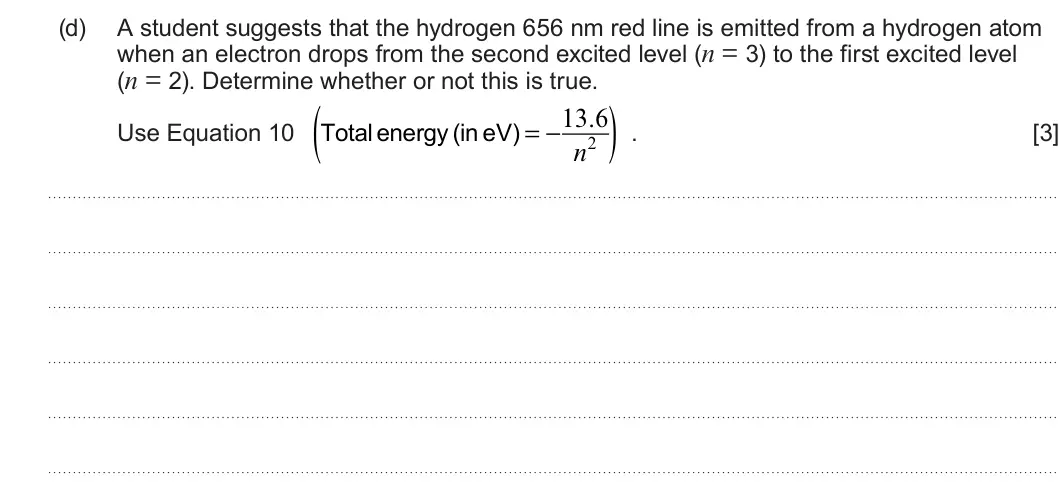
Q8(e)
The whole paper ↗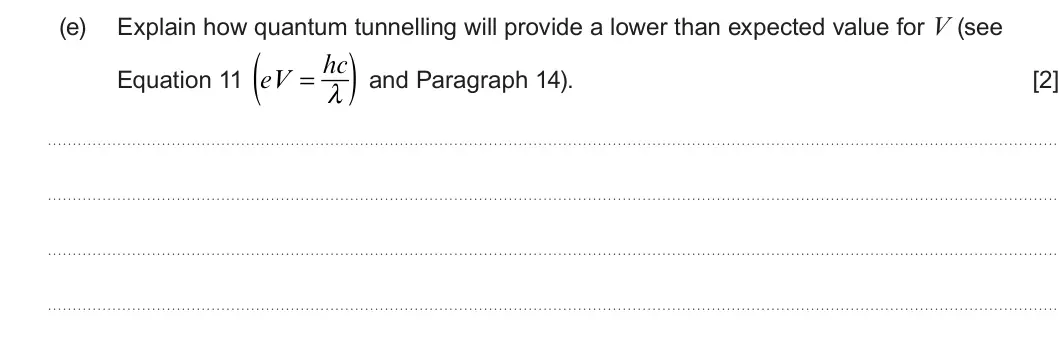
Q8(a)(i)
The whole paper ↗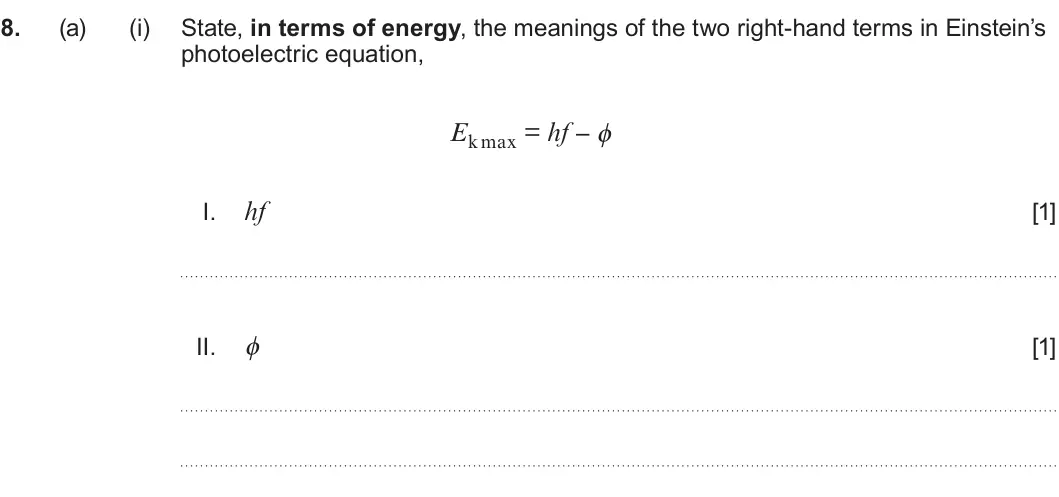
Q8(a)(ii)
The whole paper ↗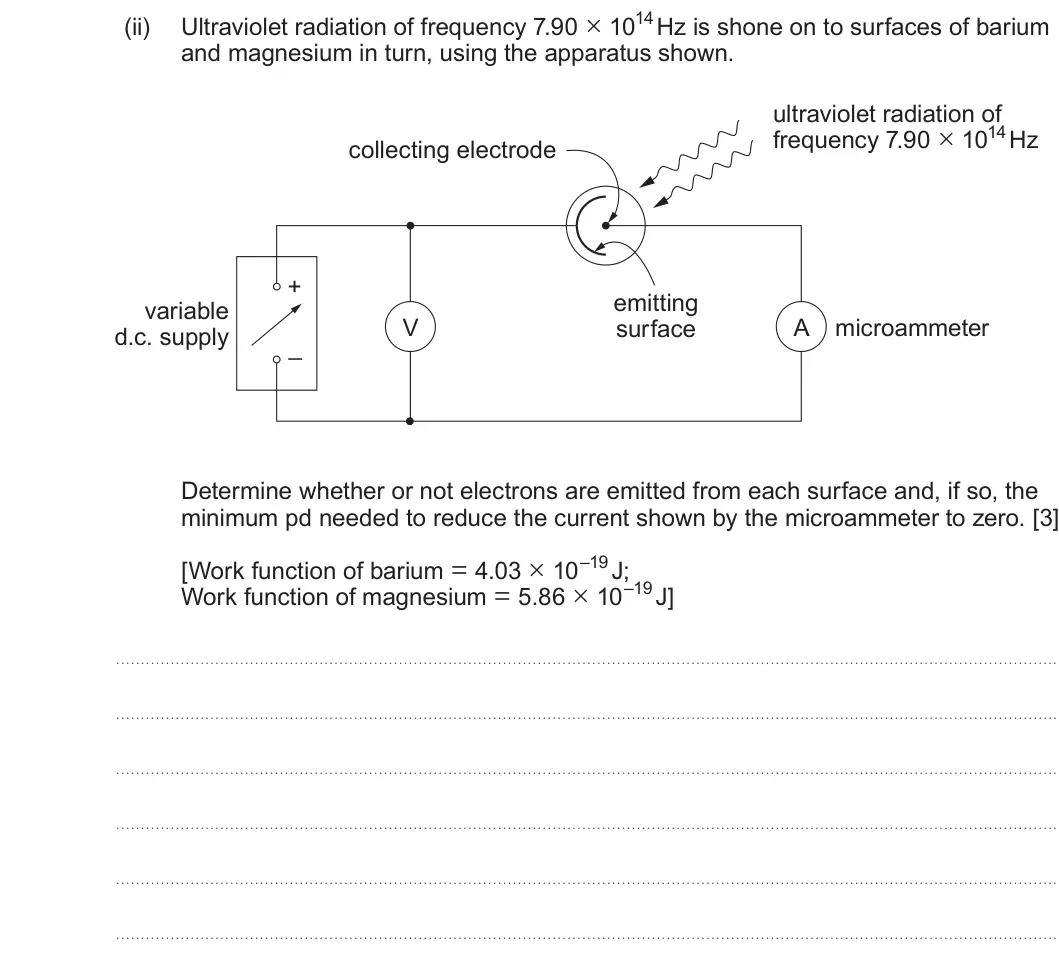
Q8(b)
The whole paper ↗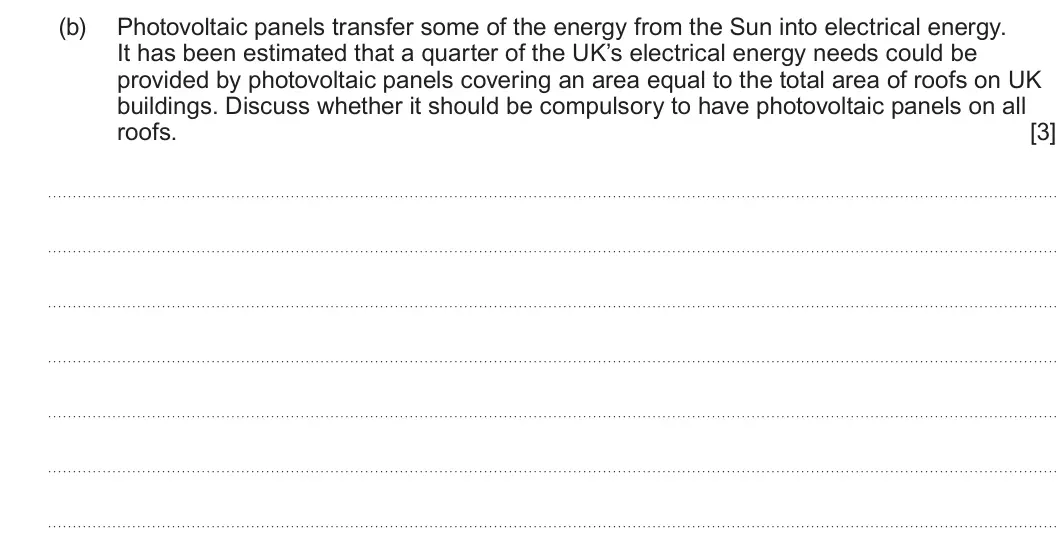
Q9(c)(i)
The whole paper ↗
Q9(c)(ii)
The whole paper ↗
All 58 questions on Photons, as a list
- Summer 2025, AS Unit 2, Q6(b)(ii) (3 marks): Determine the number of photons per second emitted by the laser. [3]
- Summer 2025, AS Unit 2, Q7(a) (3 marks): Determine the wavelength of the electromagnetic radiation emitted when an electron drops from the 1st excited state to the ground state. [3]
- Summer 2025, AS Unit 2, Q7(b) (2 marks): A sodium discharge tube is observed in a dark room through a diffraction grating. A line emission spectrum is observed. Describe the appearance of this spectrum
- Summer 2025, AS Unit 2, Q7(c) (3 marks): A technician demonstrates the absorption spectrum of sodium using the apparatus shown in the diagram. The light is projected onto a screen. diffraction grating
- Summer 2025, AS Unit 2, Q8(a) (2 marks): A pattern appears on the fluorescent screen. Describe the pattern and explain the significance of this experiment. [2]
- Summer 2025, AS Unit 2, Q8(b) (3 marks): their (de Broglie) wavelength in pm. (HINT: Momentum is the product of mass and velocity). [3]
- Summer 2024, Unit 3, Q3(b)(i) (3 marks): Calculate the energy of a photon of: I. gamma radiation of wavelength 1.0 pm. [2] II. microwave radiation of frequency 1.8 GHz. [1]
- Summer 2024, Unit 3, Q3(b)(ii) (2 marks): Some people claim that mobile phone usage increases the rate of brain cancer, while others say that it does not cause significant damage. What steps can be take
- Summer 2024, Unit 3, Q8(a)(i) (2 marks): Paragraph 8 Read through the following article carefully. Some Interesting Aspects of Quantum Physics The whole idea of quantum physics usually starts with the
- Summer 2024, Unit 3, Q8(a)(ii) (1 mark): Paragraph 8 Read through the following article carefully. Some Interesting Aspects of Quantum Physics The whole idea of quantum physics usually starts with the
- Summer 2024, Unit 3, Q8(b) (2 marks): Paragraph 8 Read through the following article carefully. Some Interesting Aspects of Quantum Physics The whole idea of quantum physics usually starts with the
- Summer 2024, Unit 3, Q8(c)(i) (2 marks): Paragraph 8 Read through the following article carefully. Some Interesting Aspects of Quantum Physics The whole idea of quantum physics usually starts with the
- Summer 2024, Unit 3, Q8(c)(ii) (2 marks): Paragraph 8 Read through the following article carefully. Some Interesting Aspects of Quantum Physics The whole idea of quantum physics usually starts with the
- Summer 2024, Unit 3, Q8(d) (3 marks): Paragraph 8 Read through the following article carefully. Some Interesting Aspects of Quantum Physics The whole idea of quantum physics usually starts with the
- Summer 2024, Unit 3, Q8(e) (2 marks): Paragraph 8 Read through the following article carefully. Some Interesting Aspects of Quantum Physics The whole idea of quantum physics usually starts with the
- Summer 2024, AS Unit 2, Q8(a)(i) (2 marks): State, in terms of energy, the meanings of the two right-hand terms in Einstein’s photoelectric equation, Ek max = hf – ϕ I. hf [1] ϕ II. [1]
- Summer 2024, AS Unit 2, Q8(a)(ii) (3 marks): and magnesium in turn, using the apparatus shown. ultraviolet radiation of frequency 7.90 × 10¹⁴ Hz collecting electrode + emitting variable V surface A microam
- Summer 2024, AS Unit 2, Q8(b) (3 marks): Photovoltaic panels transfer some of the energy from the Sun into electrical energy. It has been estimated that a quarter of the UK’s electrical energy needs co
- Summer 2024, AS Unit 2, Q9(c)(i) (1 mark): [1]
- Summer 2024, AS Unit 2, Q9(c)(ii) (2 marks): Calculate the magnitude of the momentum of an emitted photon. [2]
- Summer 2024, AS Unit 2, Q9(c)(iii) (2 marks): The light from the laser strikes a shiny surface at right angles. Assuming that the surface reflects all the light, calculate the force exerted on the surface b
- Summer 2023, AS Unit 2, Q6(a) (1 mark): [1]
- Summer 2023, AS Unit 2, Q6(b) (1 mark): Sodium will undergo the photoelectric effect when illuminated by visible light, but zinc requires ultraviolet radiation. Explain which material has the greater
- Summer 2023, AS Unit 2, Q6(c)(i) (2 marks): Use Einstein’s photoelectric effect equation to show that the maximum wavelength, λmax, for emission is given by the equation: [2] hc λmax = φ
- Summer 2023, AS Unit 2, Q6(c)(ii) (2 marks): incident on a metal surface of work function of 3.7 × 10⁻¹⁹ J. Determine which wavelength or wavelengths of light will be unable to release electrons from the m
- Summer 2023, AS Unit 2, Q6(c)(iii) (2 marks): Explain, in terms of photons, whether or not the intensity of the light will affect the maximum kinetic energy of the released electrons. [2]
- Summer 2023, AS Unit 2, Q7(a)(i) (3 marks): Determine the mean value for Vmin along with its percentage uncertainty. [3]
- Summer 2023, AS Unit 2, Q7(a)(ii) (3 marks): Lewis uses the following equation to calculate the wavelength of the light expected to be produced by the LED: hc eVmin = λ Calculate the mean value for λ and i
- Summer 2023, AS Unit 2, Q7(b) (1 mark): Lewis noted the value for Vmin when he noticed that the LED had turned on. Suggest an improvement to his method. [1]
- Summer 2022, AS Unit 2, Q6(a) (2 marks): The work function of the metal rubidium is 3.62 × 10⁻¹⁹ J. Explain what this statement means. [2]
- Summer 2022, AS Unit 2, Q6(b) (3 marks): The minimum frequency of light that will eject electrons from a surface of work function ϕ ϕ is . Explain in terms of photons why this is so. [3] h
- Summer 2022, AS Unit 2, Q6(c)(i) (3 marks): Calculate the mean value and the absolute uncertainty of the stopping pd, giving your answers to an appropriate number of significant figures. [3]
- Summer 2022, AS Unit 2, Q6(c)(ii) (4 marks): Evaluate whether or not the student should conclude that the emitting electrode might be made of rubidium. [Work function of rubidium = 3.62 × 10⁻¹⁹ J.] [4]
- Summer 2019, Unit 3, Q7(d) (4 marks): A student claims that a 4 keV electron is suitable for atomic diffraction experiments. Determine whether or not she is correct (see paragraphs 6 & 8). [4]
- Summer 2019, AS Unit 2, Q5(a) (1 mark): Define the work function of a metal. [1]
- Summer 2019, AS Unit 2, Q5(b) (2 marks): eject electrons from a caesium surface with a maximum kinetic energy of 1.5 × 10⁻¹⁹ J is approximately 7 × 10¹⁴ Hz. [2]
- Summer 2019, AS Unit 2, Q5(c)(i) (2 marks): Show that the number of photons striking the caesium surface each second is approximately 6 × 10¹⁷. [2]
- Summer 2019, AS Unit 2, Q5(c)(ii) (3 marks): The current indicated by the ammeter is 0.80 µA. Calculate the number of electrons per second emitted from the caesium surface, stating your assumption. [3]
- Summer 2019, AS Unit 2, Q5(c)(iii) (1 mark): Hence calculate the probability of a photon of this frequency ejecting an electron from a caesium surface. [1]
- Summer 2019, AS Unit 2, Q6(a) (3 marks): The diagram shows how the absorption spectrum of sodium atoms may be produced. screen ‘white’ light vapour of sodium atoms in diffraction glass container gratin
- Summer 2018, AS Unit 2, Q3(b)(i) (2 marks): [2]
- Summer 2018, AS Unit 2, Q3(b)(ii) (2 marks): Calculate the momentum of the light leaving the laser per second. [2]
- Summer 2018, AS Unit 2, Q3(b)(iii) (1 mark): Calculate the force exerted by the light beam on a perfectly reflecting surface, if it strikes the surface normally. [1]
- Summer 2018, AS Unit 2, Q8(a)(i) (3 marks): Light of frequency less than cannot eject electrons from a surface of work h function ϕ, even if the light intensity is increased. Explain this in terms of phot
- Summer 2018, AS Unit 2, Q8(a)(ii) (4 marks): The emitting surface in a vacuum photocell is known to be made of one of the metals listed below (with their work functions). Metal caesium potassium barium cal
- Summer 2018, AS Unit 2, Q8(b)(i) (1 mark): On the graph draw the line of best fit. [1]
- Summer 2018, AS Unit 2, Q8(b)(ii) (2 marks): Discuss the extent to which the graph supports an equation of this form. [2]
- Summer 2018, AS Unit 2, Q8(b)(iii) (3 marks): ∆V number of significant figures. Assume that the equation predicts correctly. [3] ∆ f Show your working clearly.
- Summer 2017, AS Unit 2, Q7(a)(i) (2 marks): Describe briefly how he used the apparatus to obtain this result. [2]
- Summer 2017, AS Unit 2, Q7(a)(ii) (3 marks): Determine a value for the work function of strontium from this result. [3]
- Summer 2017, AS Unit 2, Q7(a)(iii) (3 marks): The student next attempts to measure Ek max for the same surface, but with light of wavelength 650 nm. He is surprised to find that the micro-ammeter reads zero
- Summer 2017, AS Unit 2, Q7(b)(i) (2 marks): Calculate the speed at which an electron must be moving to have a de Broglie wavelength of 5.0 × 10⁻¹¹ m. [2]
- Summer 2017, AS Unit 2, Q7(b)(ii) (2 marks): The diagram shows one way in which an aspect of the nature of electrons may be demonstrated by experiment. thin layer of vacuum graphite crystals fluorescent sc
- Summer 2016, AS Unit 2, Q2(a)(i) (1 mark): Define the work function of a material. [1]
- Summer 2016, AS Unit 2, Q2(a)(ii) (7 marks): electrons of maximum kinetic energy 1.2 × 10⁻¹⁹ J are ejected at a rate of 2.0 × 10¹⁵ electrons per second. I. Explain, in terms of photons, how, if at all, the
- Summer 2016, AS Unit 2, Q2(b)(i) (2 marks): Derive an expression for the number of photons, N, striking the surface per second, in terms of P, λ, h and c. [2]
- Summer 2016, AS Unit 2, Q2(b)(ii) (2 marks): Hence derive an expression for the momentum change per second of the light when it strikes the surface. [2]
- Summer 2016, AS Unit 2, Q2(b)(iii) (1 mark): A student suggests that the answer to (ii) gives the pressure that the light exerts on the surface. What should she have said instead of pressure? [1]
Questions, mark schemes and examiner’s reports are © WJEC CBAC Ltd, from their published past papers. Plumi isn’t affiliated with any exam board. Want whole papers? Every WJEC A-Level Physics paper.
Rather write your answers by hand on iPad? Plumi marks them against the same mark schemes.