 plumi
Refraction of light: WJEC A‑Level Physics questions
Every WJEC A-Level Physics exam question on 2.6 Refraction of light, 2016–2025, with its mark scheme and examiner’s report.
Find questions1,173
Calculations
Q6(a)(i)
The whole paper ↗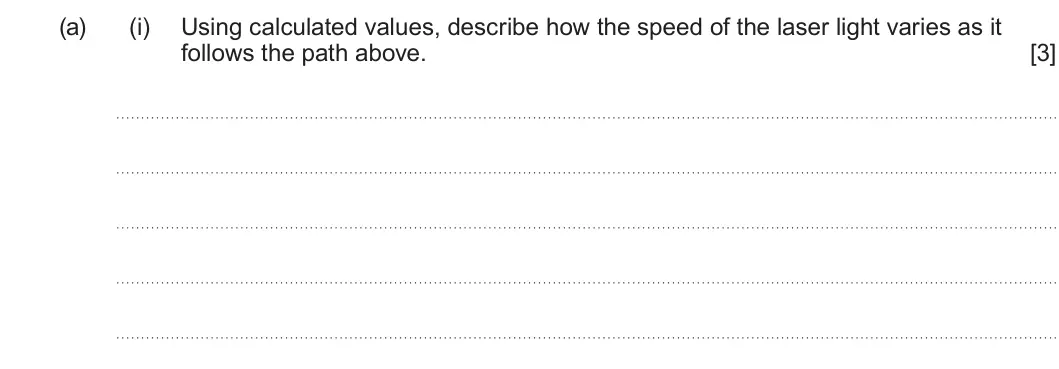
Q6(a)(ii)
The whole paper ↗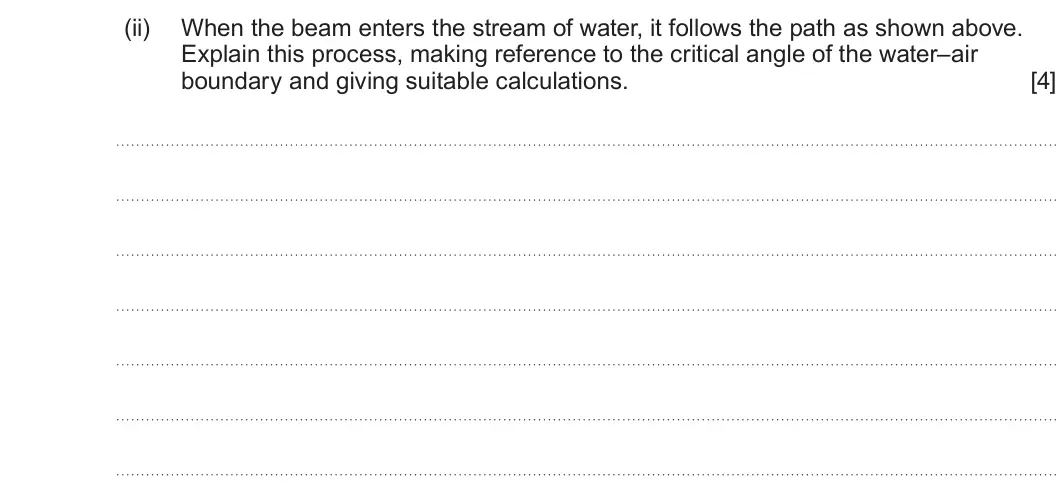
Q7(a)
The whole paper ↗
Q7(b)
The whole paper ↗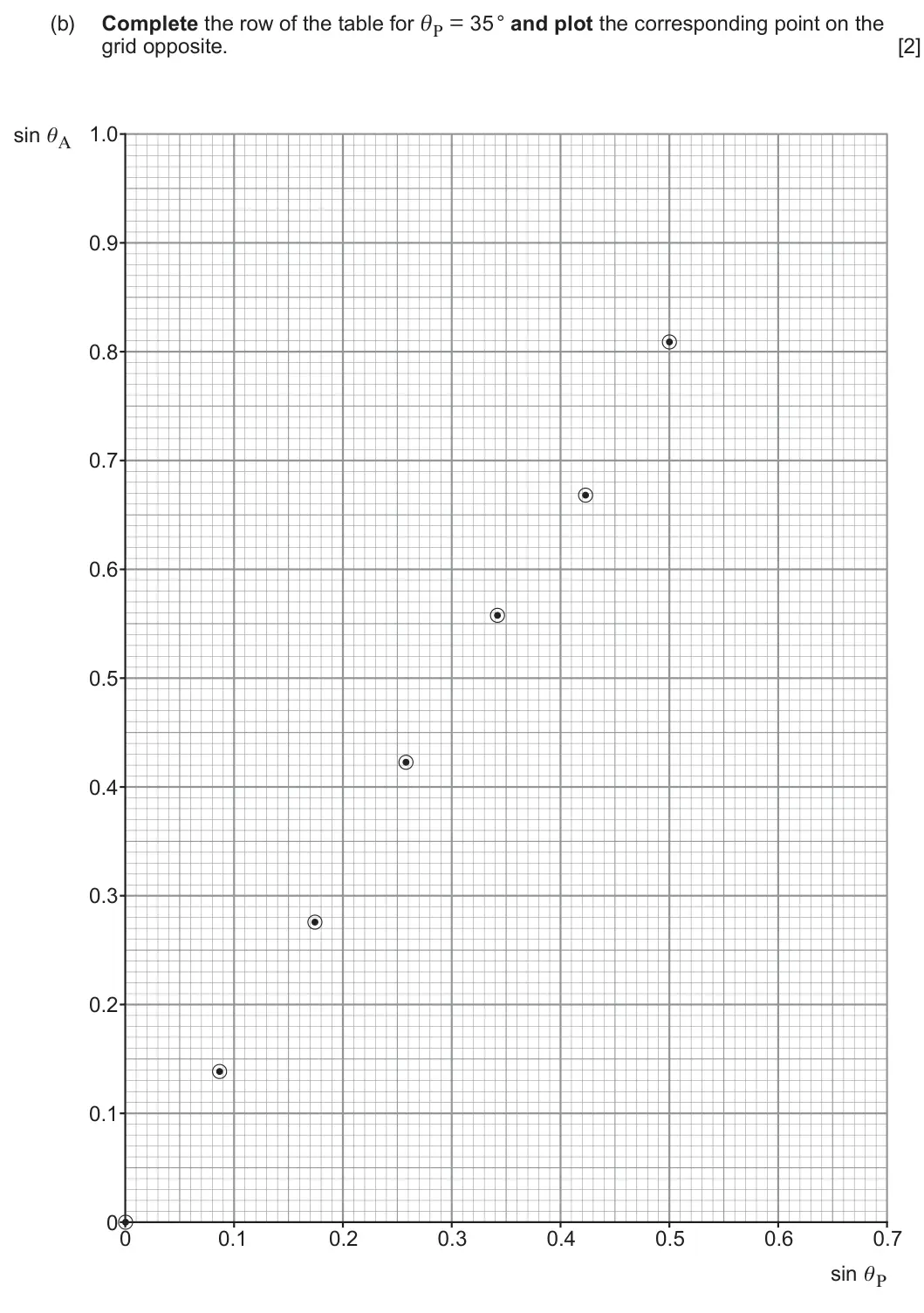
Q7(c)(i)
The whole paper ↗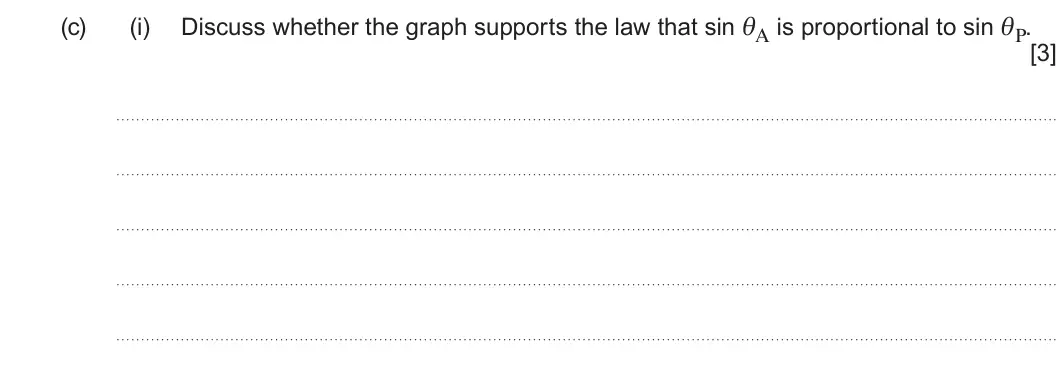
Q7(c)(ii)
The whole paper ↗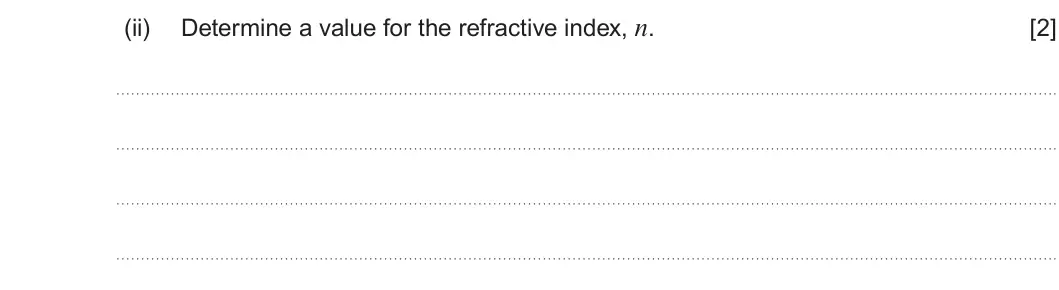
Q7(d)
The whole paper ↗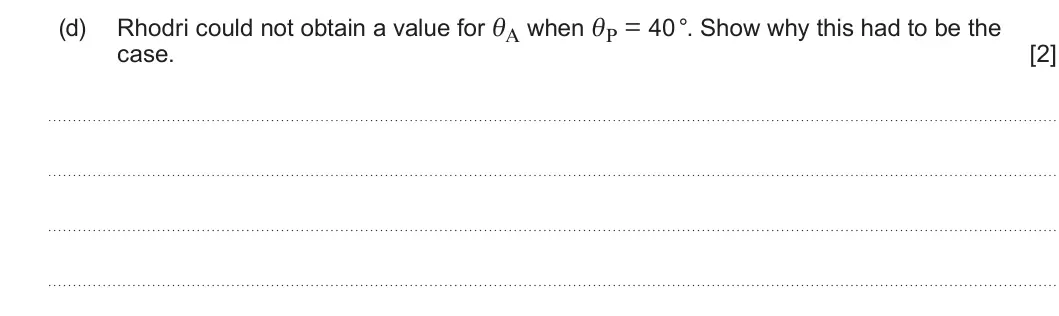
Q5(a)
The whole paper ↗
Q5(b)(i)
The whole paper ↗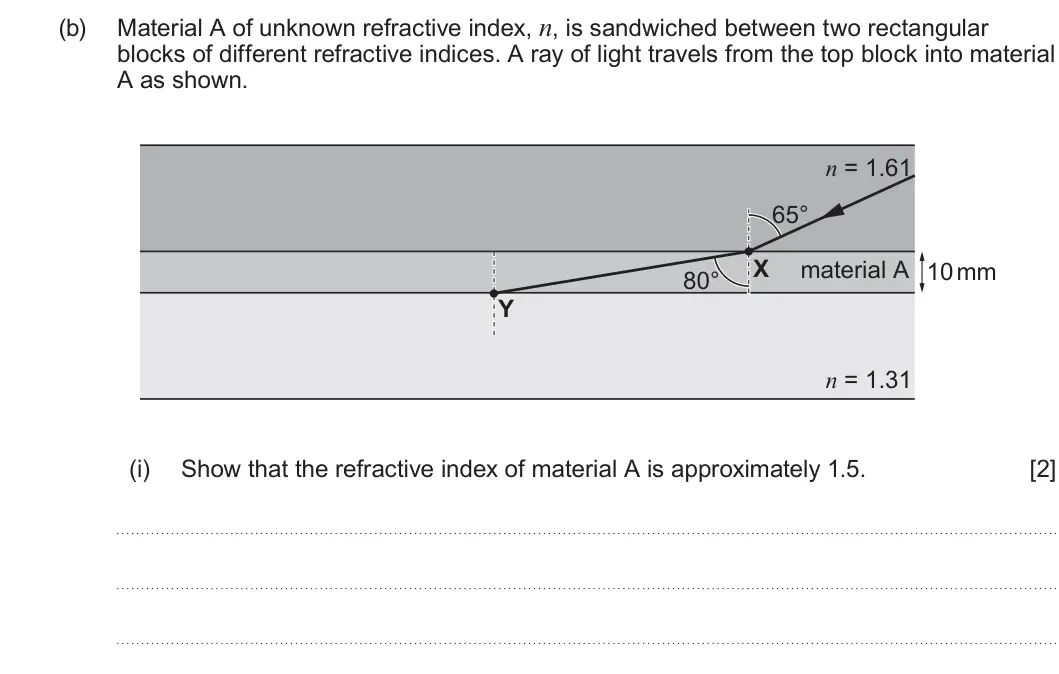
Q5(b)(ii)
The whole paper ↗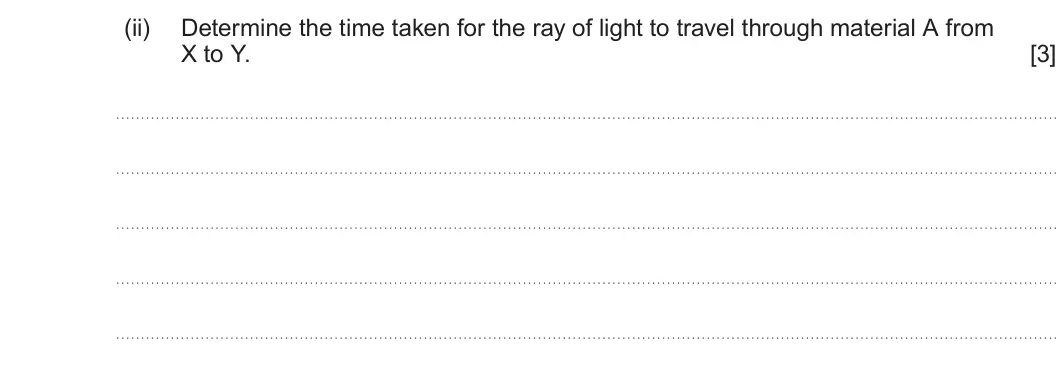
Q5(c)(i)
The whole paper ↗
Q5(c)(ii)
The whole paper ↗
Q8(a)(i)
The whole paper ↗
Q8(a)(ii)
The whole paper ↗
Q8(b)(i)
The whole paper ↗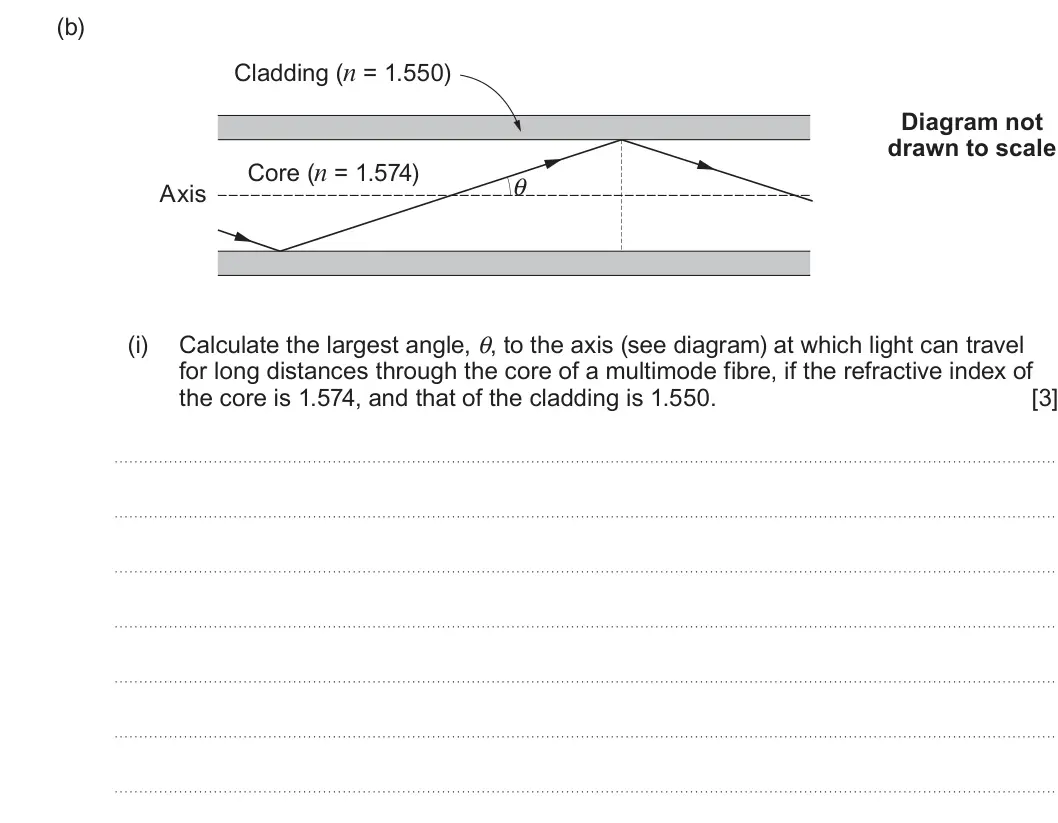
Q8(b)(ii)
The whole paper ↗
Q7(a)(i)
The whole paper ↗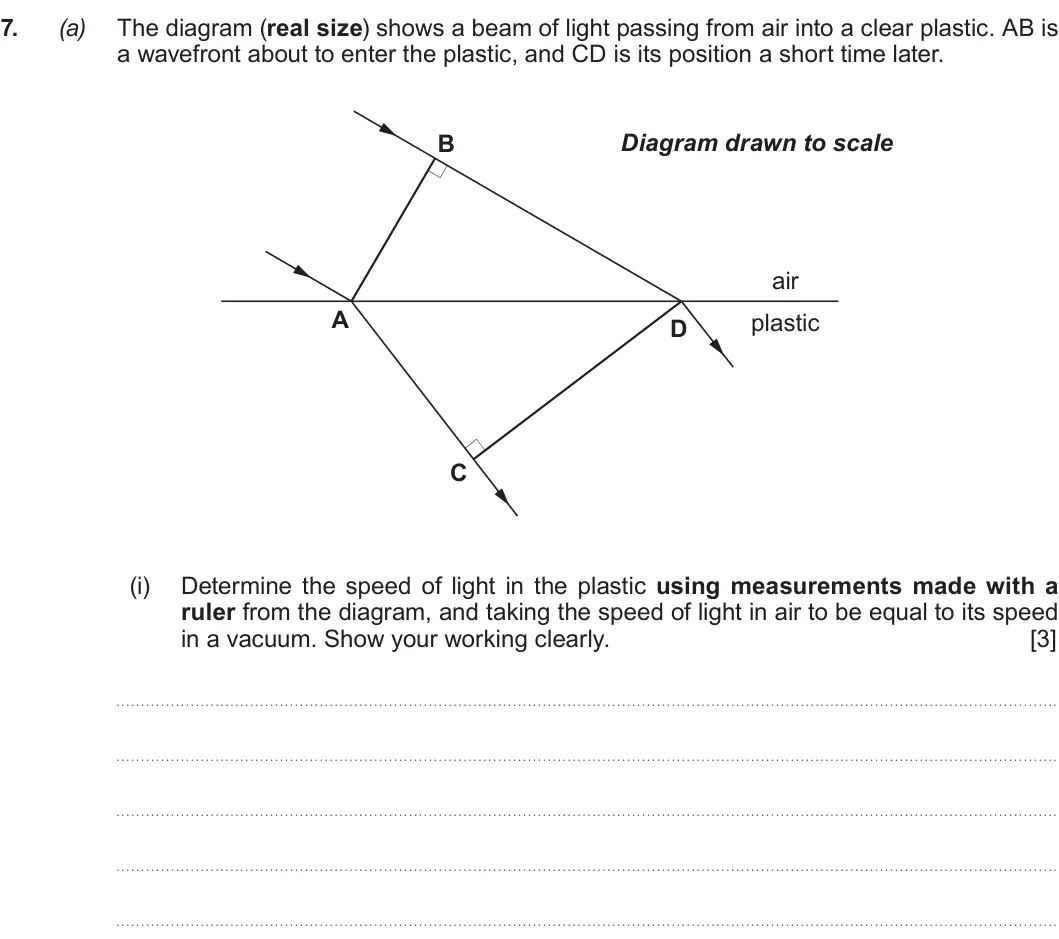
Q7(a)(ii)
The whole paper ↗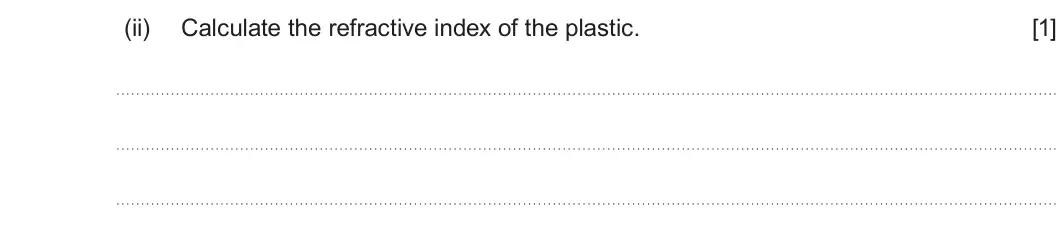
Q7(b)(i)
The whole paper ↗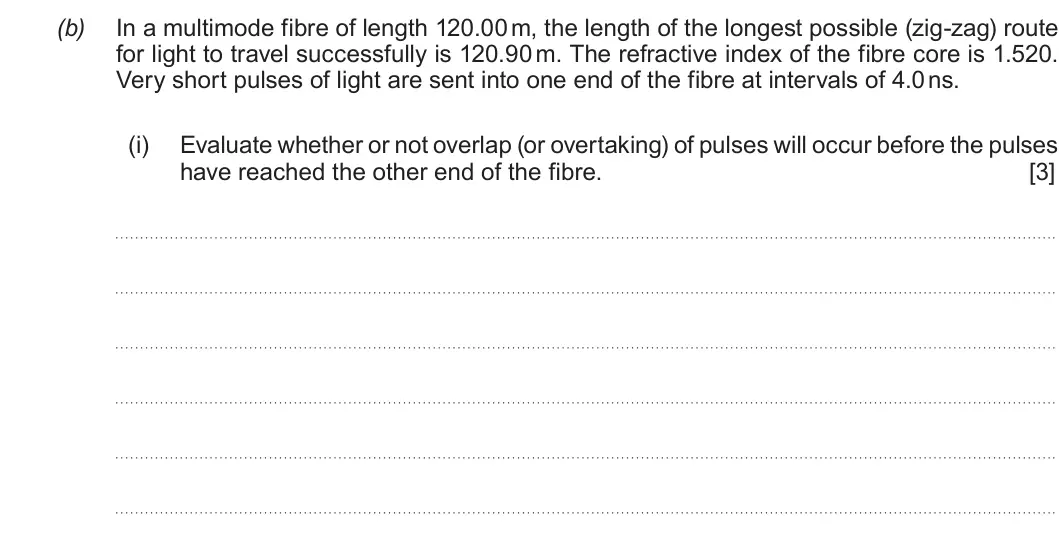
Q7(b)(ii)
The whole paper ↗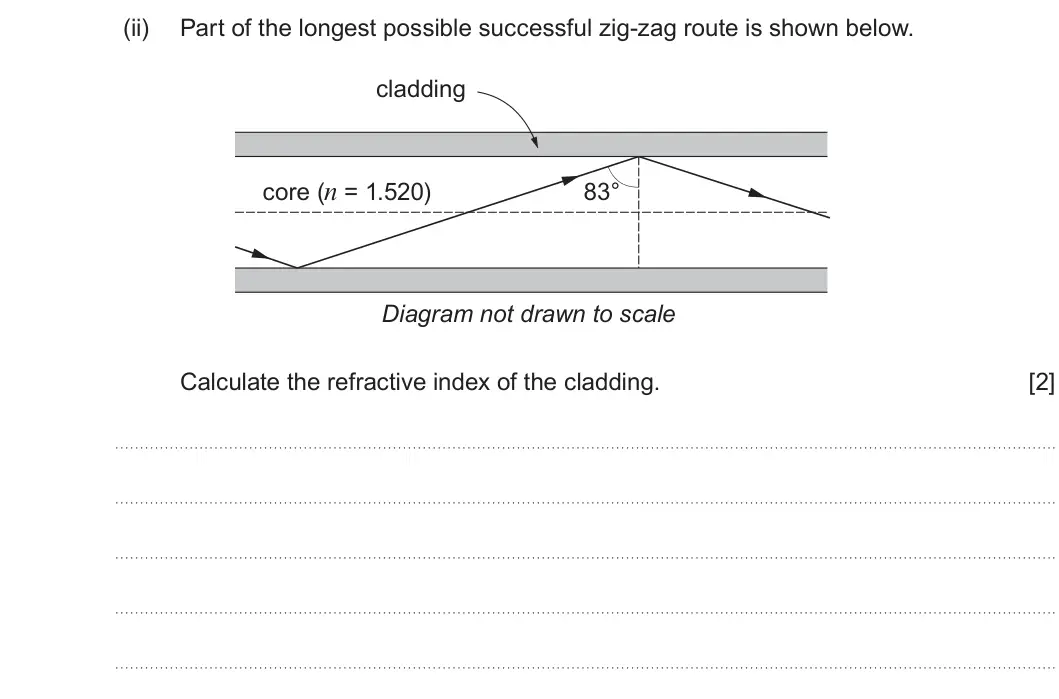
All 38 questions on Refraction of light, as a list
- Summer 2025, AS Unit 2, Q6(a)(i) (3 marks): Using calculated values, describe how the speed of the laser light varies as it follows the path above. [3]
- Summer 2025, AS Unit 2, Q6(a)(ii) (4 marks): When the beam enters the stream of water, it follows the path as shown above. Explain this process, making reference to the critical angle of the water–air boun
- Summer 2024, AS Unit 2, Q7(a) (1 mark): State why no bending of the beam occurs as it enters the curved face of the block. [1]
- Summer 2024, AS Unit 2, Q7(b) (2 marks): grid opposite. [2] sin θA 1.0 0.9 0.8 0.7 0.6 0.5 0.4 0.3 0.2 0.1 0 0 0.1 0.2 0.3 0.4 0.5 0.6 0.7 sin θP
- Summer 2024, AS Unit 2, Q7(c)(i) (3 marks): [3]
- Summer 2024, AS Unit 2, Q7(c)(ii) (2 marks): Determine a value for the refractive index, n. [2]
- Summer 2024, AS Unit 2, Q7(d) (2 marks): case. [2]
- Summer 2023, AS Unit 2, Q5(a) (1 mark): Define the refractive index of a material. [1]
- Summer 2023, AS Unit 2, Q5(b)(i) (2 marks): Show that the refractive index of material A is approximately 1.5. [2]
- Summer 2023, AS Unit 2, Q5(b)(ii) (3 marks): Determine the time taken for the ray of light to travel through material A from X to Y. [3]
- Summer 2023, AS Unit 2, Q5(c)(i) (3 marks): Confirm that total internal reflection will occur at Y. [3]
- Summer 2023, AS Unit 2, Q5(c)(ii) (1 mark): On the diagram opposite continue the path of the light ray inside material A. [1]
- Summer 2022, AS Unit 2, Q8(a)(i) (2 marks): Explain how multimode dispersion arises in a glass fibre. [2]
- Summer 2022, AS Unit 2, Q8(a)(ii) (1 mark): State what feature of a monomode fibre prevents multimode dispersion. [1]
- Summer 2022, AS Unit 2, Q8(b)(i) (3 marks): Calculate the largest angle, θ, to the axis (see diagram) at which light can travel for long distances through the core of a multimode fibre, if the refractive
- Summer 2022, AS Unit 2, Q8(b)(ii) (2 marks): Explain what would happen to light entering the fibre at an angle to the axis greater than the angle calculated in (b)(i). [2]
- Summer 2019, AS Unit 2, Q7(a)(i) (3 marks): Determine the speed of light in the plastic using measurements made with a ruler from the diagram, and taking the speed of light in air to be equal to its speed
- Summer 2019, AS Unit 2, Q7(a)(ii) (1 mark): Calculate the refractive index of the plastic. [1]
- Summer 2019, AS Unit 2, Q7(b)(i) (3 marks): Evaluate whether or not overlap (or overtaking) of pulses will occur before the pulses have reached the other end of the fibre. [3]
- Summer 2019, AS Unit 2, Q7(b)(ii) (2 marks): Part of the longest possible successful zig-zag route is shown below. cladding core (n = 1.520) 83° Diagram not drawn to scale Calculate the refractive index of
- Summer 2018, Unit 3, Q8(b) (2 marks): Figure 2 is less than 80 ° (paragraph 3). [2]
- Summer 2018, Unit 3, Q8(c) (2 marks): (paragraphs 3 & 4 and Figures 2 & 3). [2]
- Summer 2018, Unit 3, Q8(d) (4 marks): paragraphs 3 & 4 and Figures 2 & 3). [4]
- Summer 2018, Unit 3, Q8(e) (3 marks): Rhys makes the following claim: “A multimode optical fibre that can transfer data at a maximum bit rate of 500 Mb s–1 over a distance of 1 km would be able to t
- Summer 2018, Unit 3, Q8(f) (3 marks): A certain type of optical fibre has an attenuation of 0.8 dB/km. When the signal decreases to 6% of its original intensity it must be amplified or the signal wi
- Summer 2018, Unit 3, Q8(g) (4 marks): Aled claims that a core diameter of around 13 μm is thin enough for a monomode optical fibre because a wavelength in air of 1.3 μm is usually used in communicat
- Summer 2018, AS Unit 2, Q7(a)(i) (3 marks): A narrow beam of light enters a glass block of quarter-circle cross-section, as shown. The refractive index of the glass is 1.60. normal 30° 100mm nglass = 1.60
- Summer 2018, AS Unit 2, Q7(a)(ii) (3 marks): Calculate the largest distance, x, along the bottom face of the block, at which the beam can enter the block normally, for it to emerge from the curved face. Yo
- Summer 2018, AS Unit 2, Q7(b) (6 marks): Explain how a multimode (thick) glass fibre transmits light, and why rapid streams of data cannot be transmitted successfully through long lengths of multimode
- Summer 2017, AS Unit 2, Q6(a)(i) (1 mark): Give the full name of the process by which the light changes direction in the prisms. [1]
- Summer 2017, AS Unit 2, Q6(a)(ii) (3 marks): The student wonders whether the periscope will still work properly if the lower prism is surrounded by water (nwater = 1.33). Determine whether or not it will,
- Summer 2017, AS Unit 2, Q6(b)(i) (3 marks): A particular monomode fibre has a core of refractive index 1.515. Calculate the time it takes for a pulse of light to travel through 1.50 km of the fibre. [3]
- Summer 2017, AS Unit 2, Q6(b)(ii) (3 marks): Explain the advantage of a monomode fibre over a fibre with a much thicker core, for the transmission of a rapid stream of data. [3]
- Summer 2016, AS Unit 2, Q3(a)(i) (2 marks): Calculate the speed of light in the plastic. [2]
- Summer 2016, AS Unit 2, Q3(a)(ii) (1 mark): Calculate the critical angle for light approaching air from the plastic. [1]
- Summer 2016, AS Unit 2, Q3(b)(i) (2 marks): The refractive index of the core is 1.530. Calculate the refractive index of the cladding. [2]
- Summer 2016, AS Unit 2, Q3(b)(ii) (1 mark): Show that the zigzag route in the diagram is 1.0125 times longer than a straight path through the same length of fibre. [1]
- Summer 2016, AS Unit 2, Q3(b)(iii) (3 marks): The difference in times of travel for a data pulse by these two extreme routes is required to be no more than 7.5 ns. Determine whether or not 150 m of fibre wi
Questions, mark schemes and examiner’s reports are © WJEC CBAC Ltd, from their published past papers. Plumi isn’t affiliated with any exam board. Want whole papers? Every WJEC A-Level Physics paper.
Rather write your answers by hand on iPad? Plumi marks them against the same mark schemes.