 plumi
Radioactive decay: OCR A‑Level Physics B questions
OCR A-Level Physics B past-paper questions on 5.1.1.3 Radioactive decay, 2016–2025, with mark schemes and examiner’s reports where available.
Paper
All papers
Exam
All years
Calculations
Q3(a)(i)
The whole paper ↗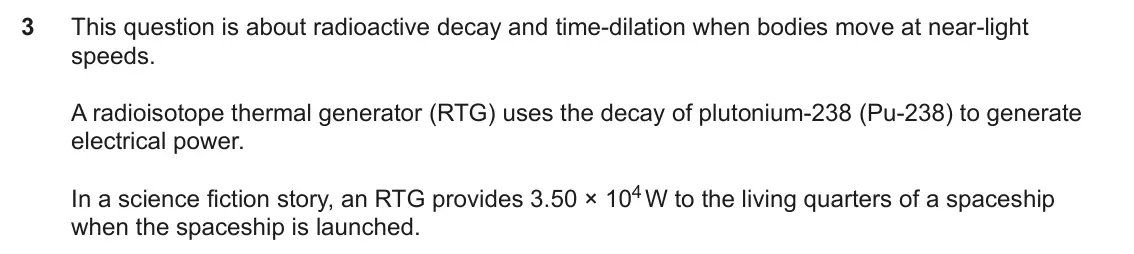
Q3(a)(ii)
The whole paper ↗Q3(b)(i)
The whole paper ↗Q3(b)(iii)
The whole paper ↗Q39(a)
The whole paper ↗Q39(c)(i)
The whole paper ↗Q39(c)(ii)
The whole paper ↗Q6(b)(i)
The whole paper ↗
Q6(b)(ii)
The whole paper ↗Q6(c)(ii)
The whole paper ↗- Your answer
- Your answer
- Your answer
- Your answer
- Your answer
Q3(a)
The whole paper ↗
Q3(b)(i)
The whole paper ↗Q3(b)(iii)
The whole paper ↗Q3(b)(iv)
The whole paper ↗Q3(c)(i)
The whole paper ↗
All 41 questions on Radioactive decay, as a list
- June 2025, Paper 2, Q3(a)(i) (1 mark): Energy released in one decay of Pu‑238 = 8.96 × 10⁻¹³ J [1]
- June 2025, Paper 2, Q3(a)(ii) (2 marks): Calculate the initial mass of Pu‑238 in the generator. Decay constant of Pu‑238 = 2.48 × 10⁻¹⁰ s–1 Mass of one plutonium‑238 atom = 3.95 × 10⁻²⁵ kg mass = kg [2
- June 2025, Paper 2, Q3(b)(i) (2 marks): Show that the power output of a stationary RTG will have fallen to about 72% of its original value after 42 years. Initial power of RTG = 3.50 × 10⁴ W [2] 7 Whe
- June 2025, Paper 2, Q3(b)(iii) (4 marks): Explain by using relevant calculations, why the power output of the RTG when the spaceship lands on WST‑A is approximately 79% of its value at launch. Assume th
- June 2024, Paper 1, Q39(a) (2 marks): Radioactive decay happens when an unstable nucleus emits a particle or electromagnetic radiation to become more stable. This is a random process. Explain the me
- June 2024, Paper 1, Q39(c)(i) (1 mark): Explain why the ionisation current is proportional to the number of radon-220 atoms remaining in the chamber. [1] 44 The reading on the pico-ammeter is noted ev
- June 2024, Paper 1, Q39(c)(ii) (6 marks): (ii)* Another student starts to plot a graph of ln (I) against time. time / s 40 0 20 60 80 100 120 140 160 –27.8 –28.0 –28.2 –28.4 –28.6 –28.8 ln (I/A) –29.0 –
- June 2024, Paper 2, Q6(b)(i) (2 marks): Calculate the number of uranium nuclei in the sample when the spacecraft was launched. half-life of uranium-238 = 4.51 × 10⁹ years number of nuclei = [2]
- June 2024, Paper 2, Q6(b)(ii) (3 marks): Calculate how many years it will take for one third of the original nuclei in the sample to become stable lead-206. Assume that the half-life of uranium is the
- June 2024, Paper 2, Q6(c)(ii) (4 marks): In a reactor, uranium-238 can capture a neutron to become unstable uranium-239. This decays through two beta decays to plutonium-239 which will fission. β decay
- June 2023, Paper 1, Q27 (1 mark): The 222Ra sample has 1.0 × 10⁻¹⁴ mol of nuclei. How many mol of nuclei are in the 222Ac sample? 3.3 × 10⁻¹⁵ mol A 5.0 × 10⁻¹⁵ mol B 6.7 × 10⁻¹⁵ mol C 1.5 × 10⁻¹
- June 2023, Paper 1, Q28 (1 mark): After t seconds, the activity of the 222Ac is 40% of its original value. What is the activity of the 222Ra at t seconds, compared to its original value? A 46% B
- June 2022, Paper 1, Q12 (1 mark): A sample of a radioisotope has initial activity = A0. What is its activity after 0.5 half-lives? A 0.250 A0 B 0.293 A0 C 0.707 A0 D 0.750 A0 Your answer [1]
- June 2022, Paper 1, Q13 (1 mark): Muons are subatomic particles with a decay constant of 4.4 × 10⁵ s–1 when at rest. A muon is travelling at a relative speed of 2.94 × 10⁸ m s–1. What is its obs
- June 2022, Paper 1, Q22 (1 mark): A radioactive source has a half-life of 27 days. The initial activity of the source is determined to be 2.5 × 10⁴ Bq. How long will it take for the activity to
- June 2022, Paper 3, Q3(a) (2 marks): The decay equation is ΔN Δt = –λN where λ is the decay constant and N is the number of nuclei present. Explain what the decay constant represents for a particul
- June 2022, Paper 3, Q3(b)(i) (2 marks): Complete the remaining rows of Table 3.1. [2]
- June 2022, Paper 3, Q3(b)(iii) (1 mark): How is the activity of the sample represented in this model? [1]
- June 2022, Paper 3, Q3(b)(iv) (2 marks): Explain why a better model is created if Δt = 0.5 s. [2]
- June 2022, Paper 3, Q3(c)(i) (2 marks): Explain why 10‑second intervals over a period of a few minutes are suitable for this experiment. [2]
- June 2022, Paper 3, Q3(c)(ii) (4 marks): Fig. 3.2 shows a graph of ln(count rate) against t from this experiment. Use the graph to find a value for the decay constant for protactinium‑234 and hence the
- November 2021, Paper 1, Q34(a) (2 marks): Show that the number of atoms of 125I atoms initially present in one seed is about 6 × 10¹³. [2]
- November 2021, Paper 1, Q41(a)(iii) (2 marks): Estimate the number of neutrons that would decay in one second from a sample of 104 free neutrons. number per second = [2]
- November 2021, Paper 3, Q4(a)(iv) (1 mark): Krypton-81m has a half-life of only 13 seconds, whilst rubidium-81 has a half-life of 4 hours. Suggest why hospital stocks do not lose their activity before pat
- November 2020, Paper 1, Q39 (6 marks): 39* The age of atoms in terrestrial rocks can be estimated by considering the ratio of numbers of atoms of radioactive isotopes. Today the number ratio for the
- November 2020, Paper 2, Q8(b) (2 marks): Radiocarbon dating uses a value for the half-life of 14C = 5.70 × 10³ years. The 14C/12C ratio in living material is about 1.4 × 10⁻¹². Calculate the 14C/12C ra
- November 2020, Paper 2, Q8(c) (6 marks): This question is about radiocarbon dating (lines 44–61). (c)* Explain why living plants growing near active volcanoes may have radiocarbon ages that suggest the
- June 2019, Paper 1, Q21 (1 mark): number of 225Ra atoms remaining 21 After 30 days which ratio gives number of 225Ac atoms remaining ? 1 A 2 3 B 4 4 C 3 D 2 Your answer [1]
- June 2019, Paper 1, Q22 (1 mark): activity of the 225Ra source 22 After 30 days which ratio gives activity of the 225Ac source ? 1 A 2 3 B 4 4 C 3 D 2 Your answer [1]
- June 2019, Paper 2, Q5(a) (1 mark): For a stable product, the number of daughter nuclei D at time t is given by the equation D = N0 – N where N0 is the original number of parent nuclei and N is th
- June 2019, Paper 2, Q5(b)(ii) (1 mark): The half-life of the series is 4.47 × 10 9 years. This means that it will take about 4.5 billion years before half the uranium-238 (238U) has decayed into lead-
- June 2019, Paper 2, Q5(b)(iii) (3 marks): A rock is assumed to have contained no lead-206 when it was formed. In a sample of the rock, the ratio number of lead-206 atoms present in rock sample original
- June 2019, Paper 2, Q5(c)(i) (1 mark): Use the relationship N = N0 e–mt to show that the number of daughter nuclei after time t is given by D = N ( 1 e–mt – 1) where N is the number of parent nuclei
- June 2019, Paper 2, Q5(c)(ii) (3 marks): Use the equation for D given in (c)(i) and the data given to calculate the value for the age of the rock based on the uranium-235 decay series. age of rock = ye
- June 2018, Paper 1, Q22 (1 mark): This table shows the half-lives of three radioactive isotopes. Isotope 60 cobalt 192 iridium 210 thallium Half-life 5.3 years 74 days 1.8 minutes Which statemen
- June 2018, Paper 2, Q3(a) (4 marks): An average banana contains about 5 × 10⁻⁴ kg of potassium. About 0.012% of this potassium is the beta-emitting isotope, potassium-40. Show that a single banana
- June 2018, Paper 3, Q2(b)(i) (2 marks): Explain what is meant by “Corrected count rate” and complete this column in the table. [2]
- June 2018, Paper 3, Q2(b)(iv) (6 marks): An experiment is carried out to find the half-life of a solid radioactive isotope X which emits beta radiation. (iv)* Use your graph to find the value of half-l
- June 2017, Paper 1, Q14 (1 mark): Suppose that a particular radioactive nucleus is observed for a period of time to find when it decays. The isotope’s half-life is 1 hour, and after 1 hour the p
- June 2017, Paper 2, Q4(c) (6 marks): This question is about the New Horizons spacecraft mission to the dwarf planet Pluto. In July 2015, the Long Range Reconnaissance Imager (LORRI) sent the image
- June 2017, Paper 2, Q6(c) (3 marks): Muons travel through the atmosphere at 98% of the speed of light. The half-life of a muon at rest is about 1.5 × 10⁻⁶ s. Show that about 0.0005% of the original
Questions, mark schemes and examiner’s reports are © OCR, from their published past papers. Plumi isn’t affiliated with any exam board. Want whole papers? OCR A-Level Physics B past papers.
The Plumi iPad app also offers exam-style questions with AI feedback on your handwritten working.