 plumi
Simple harmonic motion: OCR A‑Level Physics B questions
OCR A-Level Physics B past-paper questions on 5.1.1.5 Simple harmonic motion, 2016–2025, with mark schemes and examiner’s reports where available.
Paper
All papers
Exam
All years
Calculations
- Your answer
Q34(a)(i)
The whole paper ↗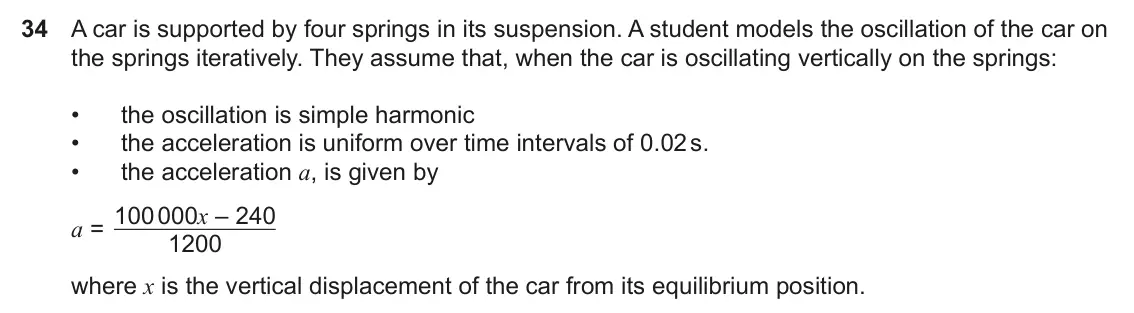
Q34(a)(ii)
The whole paper ↗Q34(a)(iii)
The whole paper ↗Q34(b)(i)
The whole paper ↗Q34(b)(ii)
The whole paper ↗Q34(b)(iii)
The whole paper ↗Q4(c)(iv)
The whole paper ↗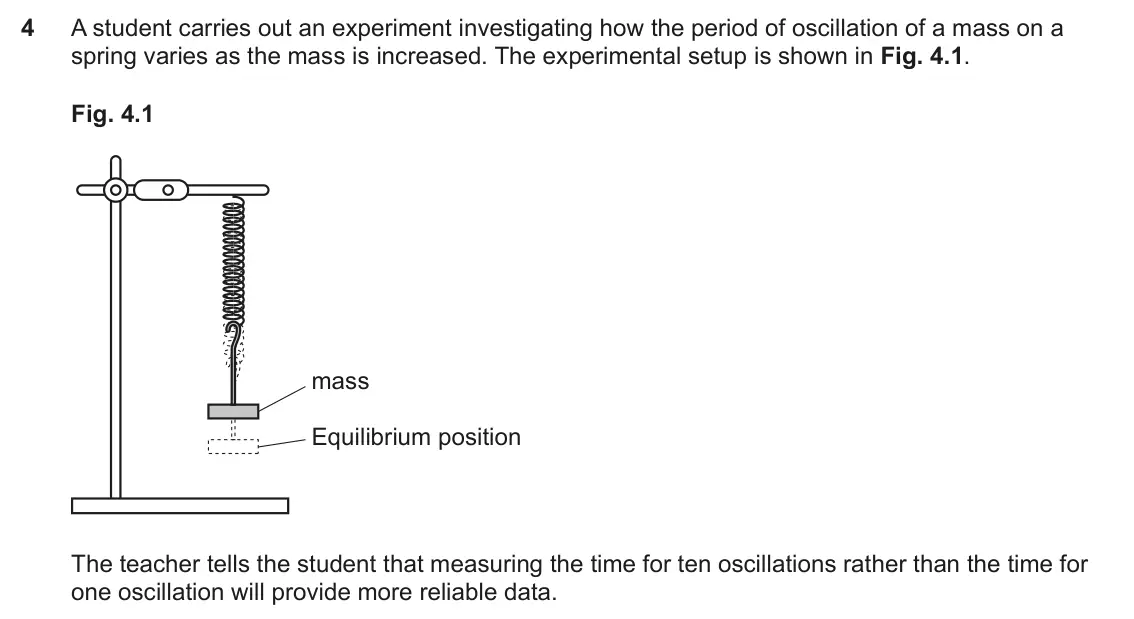
Q4(d)(ii)
The whole paper ↗- Your answer
Q36(a)(ii)
The whole paper ↗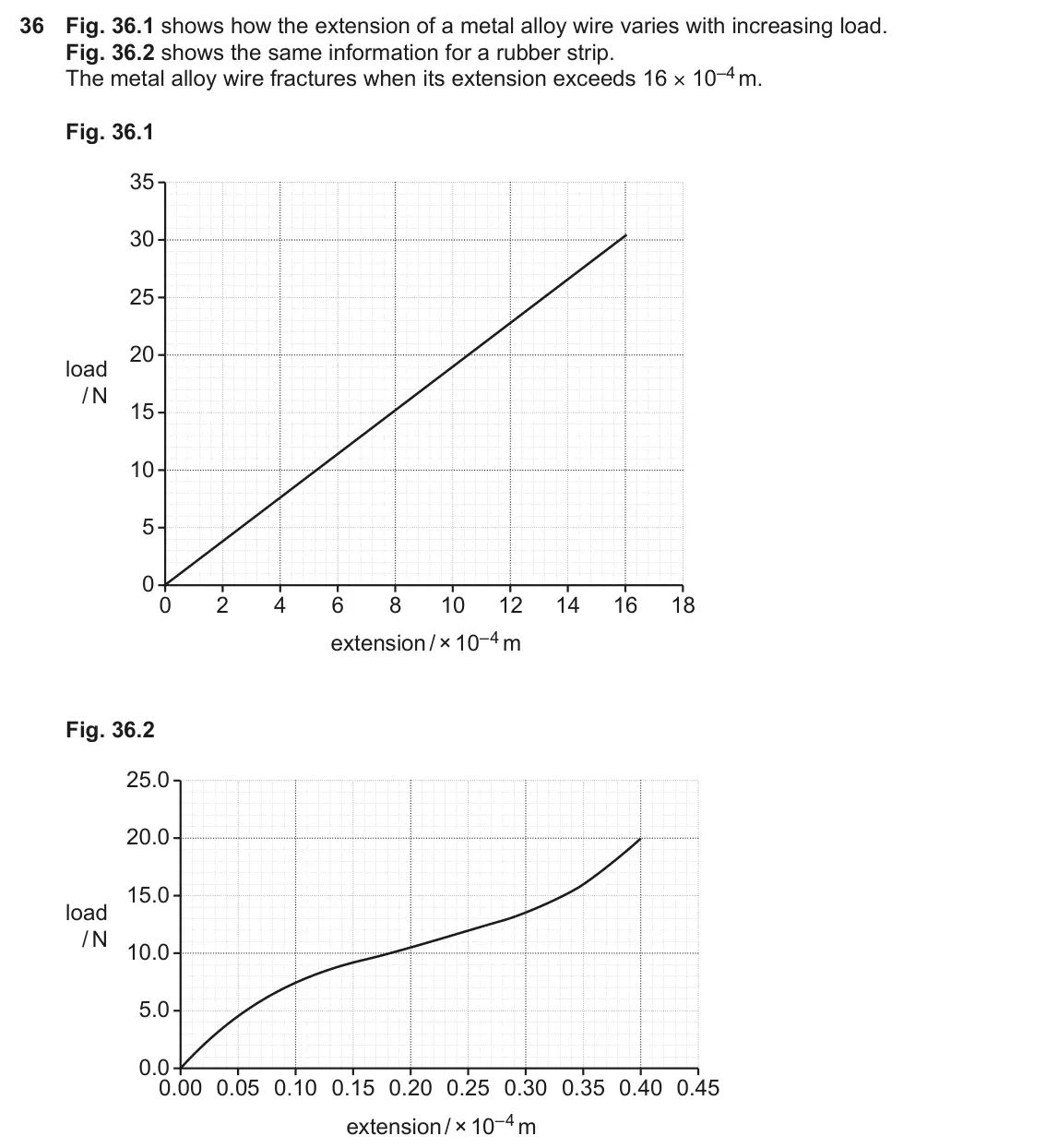
Q36(a)(iii)
The whole paper ↗Q3(b)(i)
The whole paper ↗
Q3(b)(ii)
The whole paper ↗Q3(d)
The whole paper ↗- Your answer
Q40(b)
The whole paper ↗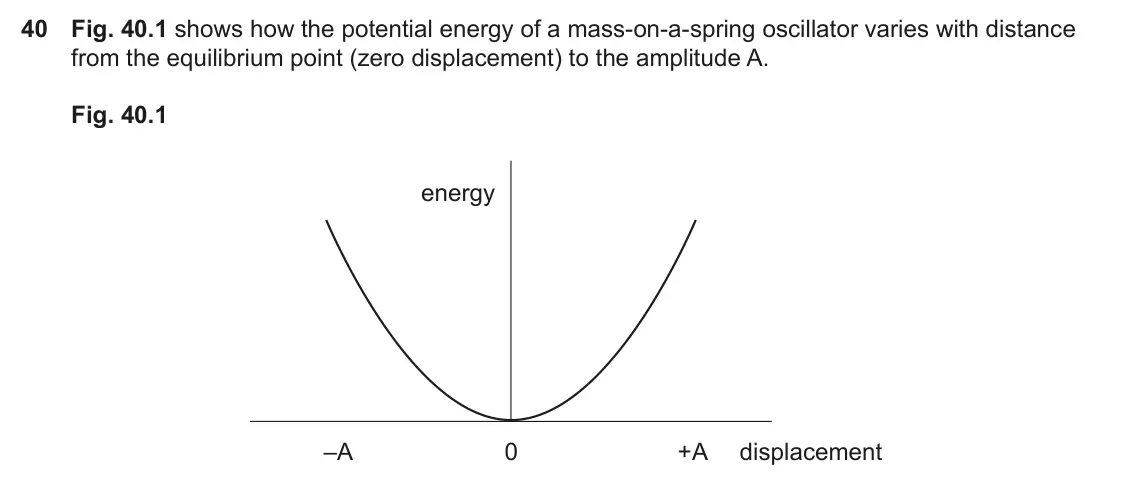
Q40(c)(i)
The whole paper ↗- Your answer
- Your answer
All 46 questions on Simple harmonic motion, as a list
- June 2025, Paper 1, Q17 (1 mark): An object is oscillating with simple harmonic motion. The graph shows how its displacement x varies with time t. 2.0 1.5 Displacement 1.0 x / cm 0.5 Time t / s
- June 2025, Paper 1, Q34(a)(i) (1 mark): [1]
- June 2025, Paper 1, Q34(a)(ii) (2 marks): Show that the change of displacement over the initial 0.02 s is approximately 0.0008 m. [2]
- June 2025, Paper 1, Q34(a)(iii) (1 mark): Hence calculate the displacement of the car from its equilibrium position after the first 0.02 s. displacement = m [1]
- June 2025, Paper 1, Q34(b)(i) (2 marks): Use data from the graph to estimate the period of the oscillation. period = s [2]
- June 2025, Paper 1, Q34(b)(ii) (2 marks): Calculate a value for the time period of the oscillation. Use the equation a = 4π 2f 2x where f = frequency of oscillation. Use data from (a)(i) period calculat
- June 2025, Paper 1, Q34(b)(iii) (1 mark): Explain how the iterative model can be improved. [1]
- June 2025, Paper 3, Q4(c)(iv) (2 marks): A different student calculates their gradient to be 2.05 s2kg–1. Show that the spring constant of the oscillating system is approximately 19 Nm–1. [2]
- June 2025, Paper 3, Q4(d)(ii) (3 marks): Measurements of mass in space can be challenging. Suggest briefly how to adapt the method shown in Fig. 4.3 to measure mass in zero g environments. Estimate a r
- June 2024, Paper 1, Q22 (1 mark): A simple pendulum P has length L and mass M. Its period is T. A simple pendulum Q has length 2L and mass M. What is the period of simple pendulum Q? A 0.5T B 0.
- June 2024, Paper 1, Q36(a)(ii) (2 marks): The mass suspended from the wire oscillates vertically with simple harmonic motion. Calculate the period of oscillation for the wire when it carries a 10 N load
- June 2024, Paper 1, Q36(a)(iii) (2 marks): Explain why the oscillations of the wire are simple harmonic but those of the rubber strip are not. [2]
- June 2024, Paper 2, Q3(b)(i) (2 marks): Refer to Fig. 3.1 to explain why the mass will oscillate with simple harmonic motion for oscillations of amplitude less than about 0.11 m. [2]
- June 2024, Paper 2, Q3(b)(ii) (2 marks): Explain why the oscillation will not be simple harmonic for oscillations with a greater amplitude than 0.11 m. [2]
- June 2024, Paper 2, Q3(d) (3 marks): The hydrogen chloride molecule (HCl ) can be modelled as a light mass (the hydrogen atom) attached to a much heavier mass (the chlorine atom) by an elastic spri
- June 2023, Paper 1, Q25 (1 mark): Io is a natural satellite of Jupiter. A pendulum is calculated to have a period of 3.50 s on the Moon and 3.30 s on Io. gravitational field strength on the surf
- June 2023, Paper 1, Q40(b) (3 marks): A mass oscillates between two springs as shown in Fig. 40.2. Fig. 40.2 It is released from its maximum displacement of 0.050 m at t = 0.0 s. The frequency of th
- June 2023, Paper 1, Q40(c)(i) (2 marks): Calculate the frequency of the oscillation of the molecule. f = Hz [2]
- June 2022, Paper 1, Q14 (1 mark): A mass is hung from a spring and oscillates at the same frequency as a simple pendulum of length 1.0 m. What mass is hung from the spring? The spring has a spri
- June 2022, Paper 1, Q23 (1 mark): What is the magnitude of the maximum acceleration of the end of the strip? 1.8 m s–2 A 4.5 m s–2 B 28 m s–2 C 180 m s–2 D Your answer [1]
- June 2022, Paper 1, Q24 (1 mark): When the strip oscillates at an amplitude of 0.020 m the maximum velocity at the end of the strip is v. What is its maximum velocity when the amplitude is incre
- June 2022, Paper 2, Q6(a)(ii) (1 mark): Draw a curve on Fig. 6.1 showing how the velocity of the oscillator varies with time. Label this line ‘v’. [1]
- June 2022, Paper 2, Q6(a)(iii) (1 mark): Draw a curve on Fig. 6.1 showing how the acceleration of the oscillator varies with time. Label this line ‘a’. [1] 17 The oscillation of a mass held between spr
- June 2022, Paper 2, Q6(b)(i) (1 mark): State why the change in displacement during an iteration is given by vnew + vold Δx = Δt 2 [1]
- June 2022, Paper 2, Q6(b)(ii) (3 marks): The model starts at t = 0 s with x = 0.1200 m at a velocity vnew = 0.000 m s–1. The table below has the first two rows filled in. Use the flow chart to complete
- June 2022, Paper 2, Q6(b)(iii) (4 marks): Use the graph to estimate the frequency of the oscillation and compare this to the result found using the equation for the time period of a mass-spring oscillat
- June 2022, Paper 2, Q6(c) (4 marks): When the model is run over many more iterations, the graph in Fig. 6.5 is produced. 5 4 3 2 1 time / s 0 0 1 2 3 4 5 6 7 8 9 10 – 1 – 2 – 3 – 4 – 5 Fig. 6.5 The
- November 2021, Paper 1, Q11 (1 mark): The maximum speed of the oscillating object is 0.08 m s–1 A 0.24 m s–1 B 0.39 m s–1 C 39 m s–1 D Your answer [1]
- November 2021, Paper 1, Q12 (1 mark): The mass of the oscillating object is 600 g. The spring constant k of the spring is 14 N m–1 A 18 N m–1 B 56 N m–1 C 14 000 N m–1 D Your answer [1]
- November 2021, Paper 2, Q5(a) (2 marks): The mass oscillates between the springs with a time period of 1.3 s. Calculate the spring constant k of the system. spring constant = N m–1 [2]
- November 2021, Paper 2, Q5(d) (2 marks): Calculate the time interval between releasing the mass from its position of maximum displacement and the first time the kinetic energy of the mass is equal to t
- November 2021, Paper 3, Q3(a)(i) (2 marks): Apply a test to the data to show that length is proportional to period. Explain the method. [2]
- November 2021, Paper 3, Q3(a)(ii) (1 mark): Calculate the natural frequency for a blade with a length of 24.0 cm. frequency = Hz [1]
- June 2019, Paper 1, Q27 (1 mark): Which of the arrangements will give the simple harmonic oscillator of lowest frequency? Your answer [1]
- June 2019, Paper 1, Q28 (1 mark): Which of the arrangements will give a simple harmonic oscillator whose frequency f is given by the following equation? f = 1 2k m 2π Your answer [1]
- June 2019, Paper 3, Q2(a)(i) (2 marks): Explain why, for small angle θ of deflection, F can be given by the expression F ≈ – Tsx L . [2]
- June 2019, Paper 3, Q2(a)(ii) (2 marks): For small angle θ, Ts ≈ mg. Therefore, the acceleration a of the bob can be given by the expression a ≈ – gx L . Use the equation for simple harmonic motion, a
- June 2019, Paper 3, Q2(b)(ii) (1 mark): Complete the table by calculating the three missing values of T 2 / s2. [1]
- June 2019, Paper 3, Q2(b)(iv) (2 marks): Use the graph to determine a value for the acceleration due to gravity g. Show your working. g = m s–2 [2] 9 Fig. 2.2
- June 2018, Paper 1, Q9 (1 mark): The graph shows the displacement of a body which is oscillating periodically with time period T. displacement 0 time X T Which statement is correct? A The accel
- June 2017, Paper 1, Q38(a) (2 marks): Use Fig. 38.1 to find the magnitude of the maximum velocity of the swing. Make your method clear. velocity = m s–1 [2]
- June 2017, Paper 1, Q38(b) (2 marks): On Fig. 38.2 scale the y-axis suitably and draw the velocity v against time t graph for this motion. v / m s–1 0 0.5 1 1.5 2 2.5 3 3.5 4 4.5 5 t / s Fig. 38.2 [
- June 2017, Paper 1, Q38(c) (2 marks): Show that the length of the simple pendulum having the same time period as the swing in Fig. 38.1 is less than 4.0 m. [2]
- June 2017, Paper 3, Q2(b)(i) (1 mark): Mark two points on the curve shown in Fig. 2.3, to indicate where the speed of the oscillating mass is at its maximum. Label each point with a letter V. [1]
- June 2017, Paper 3, Q2(b)(ii) (2 marks): Use data from the trace shown in Fig. 2.3 to calculate the natural frequency f of the mass and spring system. f = Hz [2]
- June 2017, Paper 3, Q2(b)(iii) (2 marks): Show that the mass m supported by the spring is about 500 g. [2]
Questions, mark schemes and examiner’s reports are © OCR, from their published past papers. Plumi isn’t affiliated with any exam board. Want whole papers? OCR A-Level Physics B past papers.
The Plumi iPad app also offers exam-style questions with AI feedback on your handwritten working.