 plumi
Exponential relationships and log graphs: OCR A‑Level Physics B questions
OCR A-Level Physics B past-paper questions on 5.1.1.4 Exponential relationships and log graphs, 2016–2025, with mark schemes and examiner’s reports where available.
Paper
All papers
Exam
All years
Calculations
Q39(c)(ii)
The whole paper ↗Q37(a)(iii)
The whole paper ↗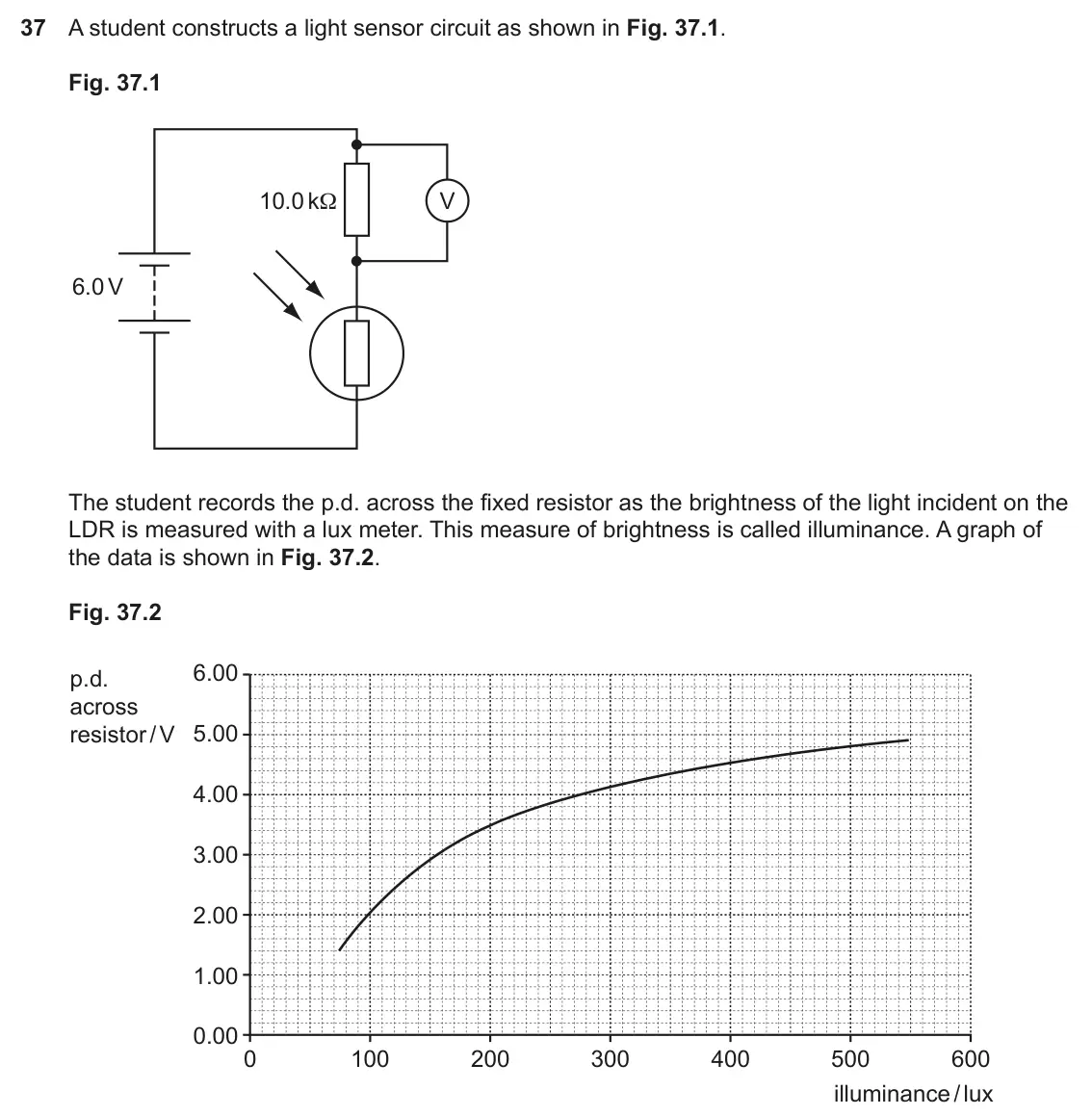
Q37(b)(i)
The whole paper ↗Q37(b)(ii)
The whole paper ↗Q3(b)(i)
The whole paper ↗
Q4(b)(iii)
The whole paper ↗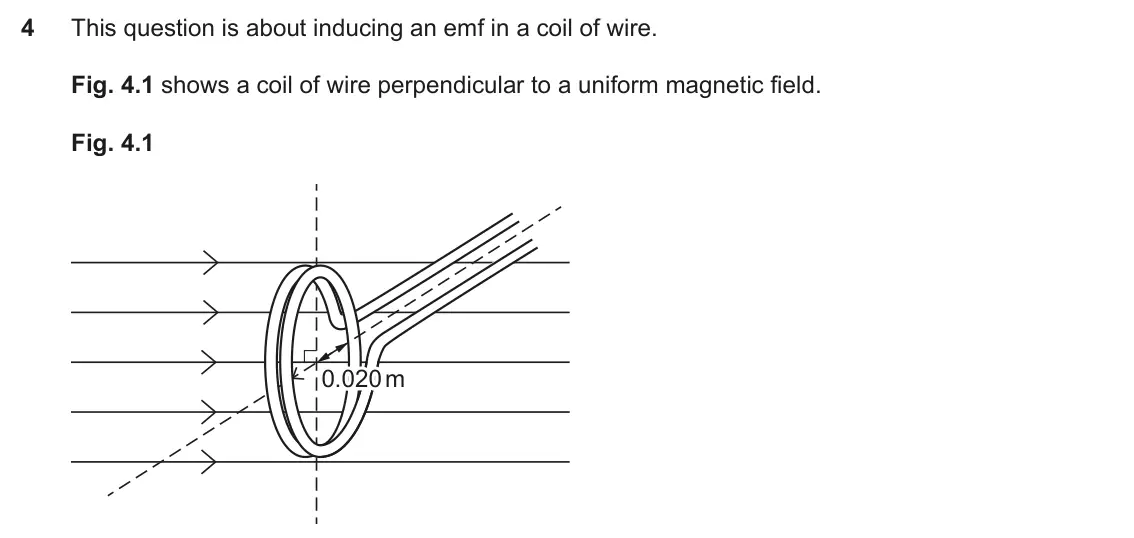
Q3(c)(ii)
The whole paper ↗
Q9(a)(ii)
The whole paper ↗
Q9(b)(i)
The whole paper ↗Q9(b)(ii)
The whole paper ↗Q4(c)(i)
The whole paper ↗
Q4(c)(ii)
The whole paper ↗Q3(c)(i)
The whole paper ↗
Q3(c)(ii)
The whole paper ↗Q2(b)(ii)
The whole paper ↗
Q2(b)(iv)
The whole paper ↗
All 16 questions on Exponential relationships and log graphs, as a list
- June 2024, Paper 1, Q39(c)(ii) (6 marks): (ii)* Another student starts to plot a graph of ln (I) against time. time / s 40 0 20 60 80 100 120 140 160 –27.8 –28.0 –28.2 –28.4 –28.6 –28.8 ln (I/A) –29.0 –
- June 2023, Paper 1, Q37(a)(iii) (3 marks): The student places transparent sheets between the light source and the lux meter. The graph in Fig. 37.3 shows how the illuminance detected varies with the numb
- June 2023, Paper 1, Q37(b)(i) (3 marks): Describe how this apparatus can be used to gather data to determine the absorption coefficient of the absorbing material. [3]
- June 2023, Paper 1, Q37(b)(ii) (2 marks): The intensity of a gamma-ray beam is reduced to 15% of its original value after passing through 3.2 cm of lead. Calculate the absorption coefficient of the lead
- June 2023, Paper 3, Q3(b)(i) (3 marks): Capacitor discharge is an example of exponential decay and follows the equation –t V = V0e RC. Complete the ln V column in Table 3 and then perform a mathematic
- June 2023, Paper 3, Q4(b)(iii) (6 marks): This question is about inducing an emf in a coil of wire. Fig. 4.1 shows a coil of wire perpendicular to a uniform magnetic field. Fig. 4.1 0.020 m 0.020 m (iii
- June 2022, Paper 3, Q3(c)(ii) (4 marks): Fig. 3.2 shows a graph of ln(count rate) against t from this experiment. Use the graph to find a value for the decay constant for protactinium‑234 and hence the
- November 2021, Paper 2, Q9(a)(ii) (3 marks): A pulse emitted by the bat returns after reflection from a small object at a distance of 2.4 m. Calculate the change in power in decibels (dB) of the pulse from
- November 2021, Paper 2, Q9(b)(i) (2 marks): Ignoring the effects of spreading, the power of a sound wave of frequency 100 kHz falls to 93% of its original value after travelling 0.1 m. Show that the atten
- November 2021, Paper 2, Q9(b)(ii) (4 marks): By considering only the effects of spreading and attenuation calculate the difference in power in decibels between the transmitted pulse and detected echo when
- November 2021, Paper 3, Q4(c)(i) (6 marks): The student gathers the following data. Shielding Corrected count rate Count rate / s–1 thickness, / s–1 x / cm 0 1250 1240 1 915 905 2 636 626 3 475 465 4 353
- November 2021, Paper 3, Q4(c)(ii) (4 marks): Using the equation I = I0 e–μx, and the information in Fig. 4.4, determine the value of the attenuation coefficient, μ. attenuation coefficient = unit [4] 17 8
- June 2019, Paper 2, Q3(c)(i) (4 marks): Explain what the student means by ‘decreases exponentially’ and, using ideas from part (b), explain whether you would expect the speed of the disk to decrease i
- June 2019, Paper 2, Q3(c)(ii) (3 marks): Use data from the graph to test whether there is an exponential decrease in speed over time. Make your conclusion clear. [3]
- June 2018, Paper 3, Q2(b)(ii) (1 mark): Complete the fourth column of the table by calculating the missing values for ln (A / Bq). [1]
- June 2018, Paper 3, Q2(b)(iv) (6 marks): An experiment is carried out to find the half-life of a solid radioactive isotope X which emits beta radiation. (iv)* Use your graph to find the value of half-l
Questions, mark schemes and examiner’s reports are © OCR, from their published past papers. Plumi isn’t affiliated with any exam board. Want whole papers? OCR A-Level Physics B past papers.
The Plumi iPad app also offers exam-style questions with AI feedback on your handwritten working.