 plumi
Time dilation: OCR A‑Level Physics B questions
OCR A-Level Physics B past-paper questions on 5.1.3.2 Time dilation, 2016–2025, with mark schemes and examiner’s reports where available.
Paper
All papers
Exam
All years
Calculations
Q3(b)(ii)
The whole paper ↗
Q3(b)(iii)
The whole paper ↗- Your answer
- Your answer
- Your answer
- Your answer
Q2(b)(i)
The whole paper ↗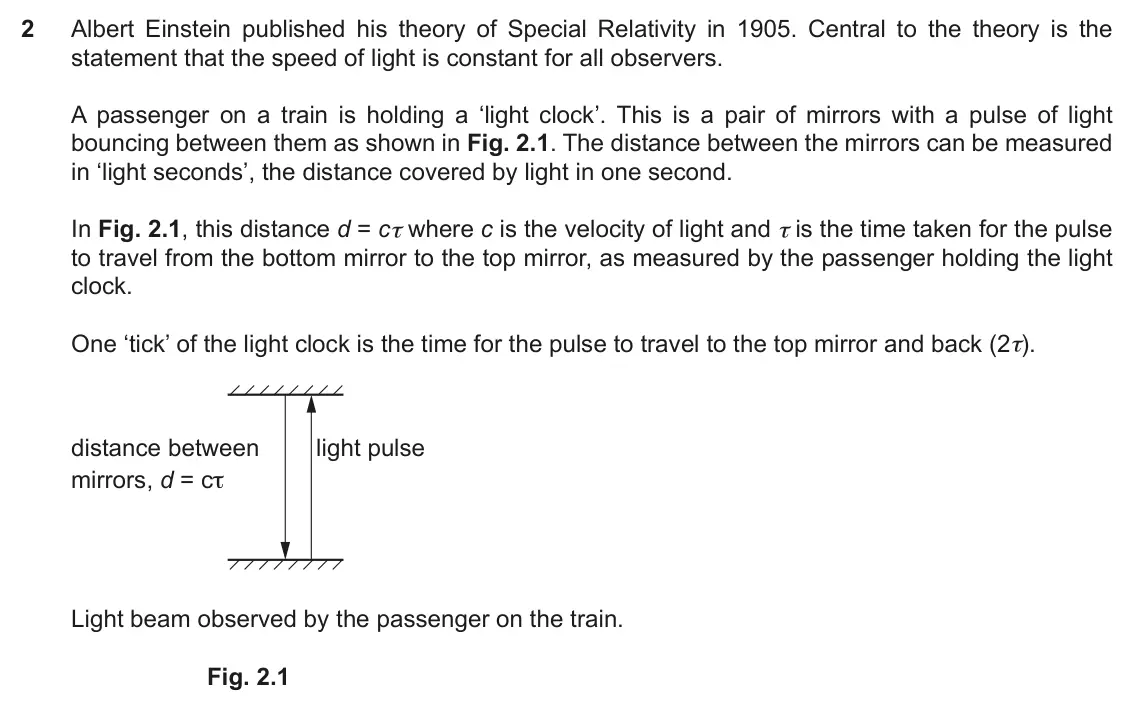
Q2(b)(ii)
The whole paper ↗Q2(c)
The whole paper ↗Q2(d)
The whole paper ↗Q34(a)(ii)
The whole paper ↗
Q34(b)
The whole paper ↗- Your answer
Q6(d)(i)
The whole paper ↗
Q6(d)(ii)
The whole paper ↗
All 15 questions on Time dilation, as a list
- June 2025, Paper 2, Q3(b)(ii) (1 mark): Calculate the average velocity of the spaceship during its 42‑year journey. average velocity = m s–1 [1]
- June 2025, Paper 2, Q3(b)(iii) (4 marks): Explain by using relevant calculations, why the power output of the RTG when the spaceship lands on WST‑A is approximately 79% of its value at launch. Assume th
- June 2024, Paper 1, Q20 (1 mark): A muon is an unstable particle. The half-life of muons measured at rest is 2.2 μs. The half-life of a muon travelling at speed v is measured by an observer as 8
- June 2023, Paper 1, Q21 (1 mark): Pions are particles with a half-life of 1.8 × 10⁻⁸ s when they are not moving relative to an observer. Accelerated pions are observed to have a half-life of 3.1
- June 2022, Paper 1, Q13 (1 mark): Muons are subatomic particles with a decay constant of 4.4 × 10⁵ s–1 when at rest. A muon is travelling at a relative speed of 2.94 × 10⁸ m s–1. What is its obs
- November 2020, Paper 1, Q10 (1 mark): 10 Which statement about the relativistic factor γ = is correct? v2 1− c2 A as v tends to c, γ tends to 0 B as v tends to 0, γ tends to ∞ C γ can be used to pre
- November 2020, Paper 2, Q2(b)(i) (2 marks): Explain why the ‘ticks’ will be further apart for the observer on the platform than for the passenger on the train. [2]
- November 2020, Paper 2, Q2(b)(ii) (2 marks): Use Pythagoras’s theorem to show that, for the shaded triangle in Fig. 2.2, t = . 1 – v 2 c 2 [2]
- November 2020, Paper 2, Q2(c) (2 marks): Slow neutrons outside the nucleus have a half-life of 611 s. ‘Fast’ neutrons released in a fission reactor typically have speeds of up to 5.4 × 10⁷ m s−1. Calcu
- November 2020, Paper 2, Q2(d) (2 marks): It has been said that, ‘from the point of view of a photon, it takes no time to cross the Universe’. Use the equation in (b)(ii) to explain this statement. [2]
- June 2019, Paper 1, Q34(a)(ii) (2 marks): Show that they are travelling at about 0.75 c. [2]
- June 2019, Paper 1, Q34(b) (2 marks): The mean lifetime of π− mesons at low speeds is 2.6 × 10⁻⁸ s. Calculate the mean distance the fast mesons will travel before decaying. mean distance = m [2]
- June 2018, Paper 1, Q30 (1 mark): 30 The relativistic factor c = 2 v 1 - 2 c Which statement about this factor is correct? A At the speed of sound c is close to zero. B c 1 as v c. C c predicts
- June 2017, Paper 2, Q6(d)(i) (3 marks): In a measurement it is found that about 9% of the muons remain after travelling through 8 km of atmosphere. Explain why a greater number of muons remain than su
- June 2017, Paper 2, Q6(d)(ii) (3 marks): Use your answer to (c) and the measured value of 9% of muons remaining after passing through 8 km of atmosphere to calculate the relativistic factor γ for the m
Questions, mark schemes and examiner’s reports are © OCR, from their published past papers. Plumi isn’t affiliated with any exam board. Want whole papers? OCR A-Level Physics B past papers.
The Plumi iPad app also offers exam-style questions with AI feedback on your handwritten working.