 plumi
Binding energy and nuclear stability: OCR A‑Level Physics B questions
OCR A-Level Physics B past-paper questions on 6.2.2.2 Binding energy and nuclear stability, 2016–2025, with mark schemes and examiner’s reports where available.
Paper
All papers
Exam
All years
Calculations
- Your answer
- Your answer
- Your answer
Q39(a)
The whole paper ↗Q6(a)(ii)
The whole paper ↗
- Your answer
Q39(c)(i)
The whole paper ↗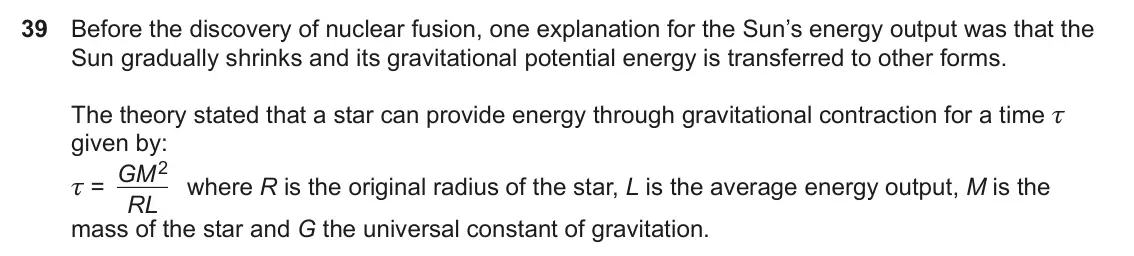
Q39(c)(iii)
The whole paper ↗Q5(b)(iii)
The whole paper ↗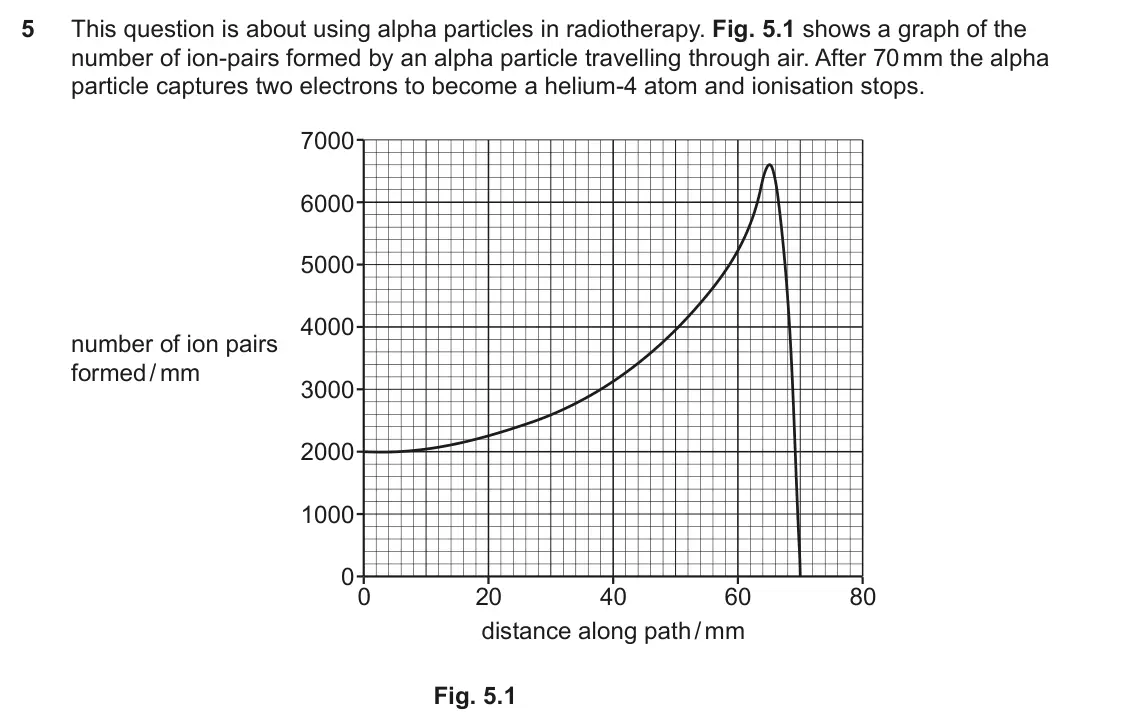
Q39(a)
The whole paper ↗
Q39(b)(i)
The whole paper ↗- Your answer
Q41(a)(i)
The whole paper ↗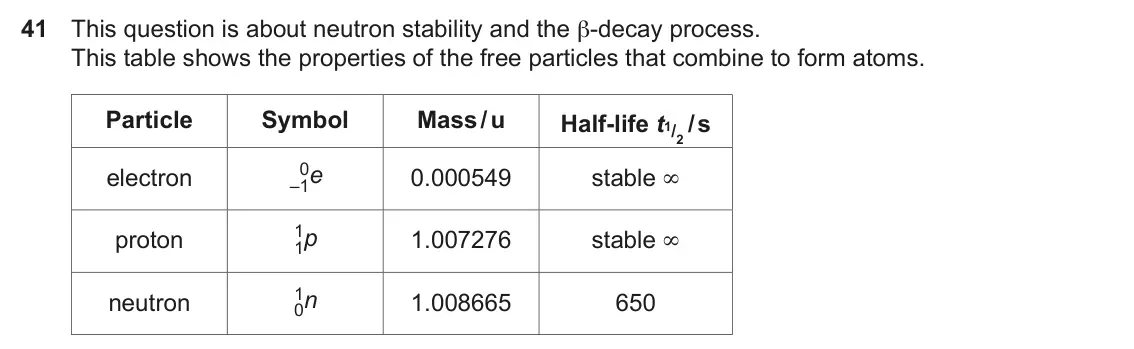
Q41(b)
The whole paper ↗Q3(c)(ii)
The whole paper ↗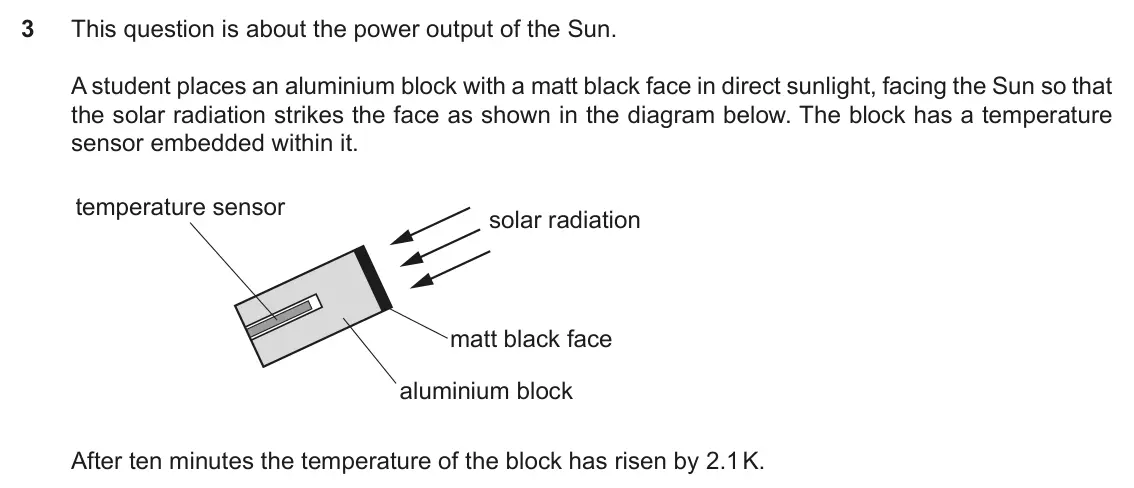
Q31(b)
The whole paper ↗
- Your answer
- Your answer
Q37(a)(ii)
The whole paper ↗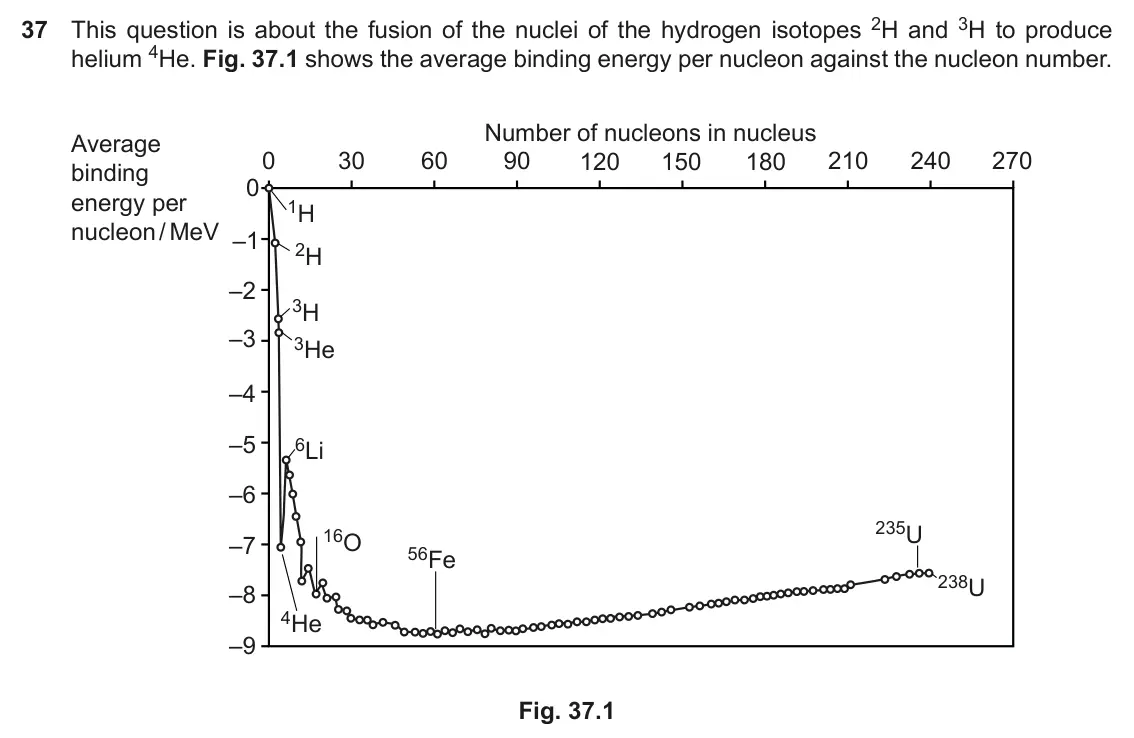
Q37(c)(ii)
The whole paper ↗
All 29 questions on Binding energy and nuclear stability, as a list
- June 2025, Paper 1, Q26 (1 mark): Which statement about the binding energy per nucleon in a nucleus is correct? A It becomes less negative when hydrogen nuclei undergo fusion to produce a helium
- June 2025, Paper 1, Q30 (1 mark): What is the difference between the masses of the strontium-90 nucleus and the yttrium-90 nucleus? Assume that particle X has negligible mass. 9.707 × 10⁻³¹ kg A
- June 2024, Paper 1, Q19 (1 mark): The isotope of polonium 214 84Po decays by four transformations to a final stable isotope of lead 206 82Pb. The particles emitted during the transformations are
- June 2024, Paper 1, Q39(a) (2 marks): Radioactive decay happens when an unstable nucleus emits a particle or electromagnetic radiation to become more stable. This is a random process. Explain the me
- June 2024, Paper 2, Q6(a)(ii) (2 marks): The masses of the two nuclei in part (i) and the beta-minus particle are given below. Calculate the energy released in the decay. mass of thorium-234 nucleus: 2
- June 2023, Paper 1, Q9 (1 mark): A nucleus decays by alpha emission. The nucleus formed then decays by beta emission. Which graph of nucleon number N plotted against proton number Z shows the t
- June 2023, Paper 1, Q39(c)(i) (2 marks): Use data from Fig. 39.1 to show that the total energy released in the three-stage process is about 5 × 10–12 J. [2]
- June 2023, Paper 1, Q39(c)(iii) (2 marks): Calculate the rate at which mass is being converted to energy in the Sun. rate = kg s–1 [2]
- June 2023, Paper 2, Q5(b)(iii) (6 marks): This question is about using alpha particles in radiotherapy. Fig. 5.1 shows a graph of the number of ion-pairs formed by an alpha particle travelling through a
- June 2022, Paper 1, Q39(a) (2 marks): Explain what is meant by the ‘binding energy’ of a nucleus and describe how its value can be calculated from the mass of the nucleus and the values for the mass
- June 2022, Paper 1, Q39(b)(i) (2 marks): The fission reaction is 234 137 54Xe + 94 38Sr + 3 1 92U 0n The binding energy of the U-234 nucleus is –1778 MeV. Use the graph to show that the energy released
- November 2021, Paper 1, Q28 (1 mark): The graph shows the binding energy per nucleon for different nuclides. nucleon number, A 0 25 50 75 100 125 150 175 200 225 250 0 –1 –2 –3 binding energy –4 per
- November 2021, Paper 1, Q41(a)(i) (2 marks): Calculate the maximum energy available when a free neutron decays into a proton and a β-particle. 1 u = 931 MeV energy = MeV [2]
- November 2021, Paper 1, Q41(b) (1 mark): Neutrons bound in nuclei can be either stable or unstable, see Fig. 41.2 showing the neutron number N against proton number Z for the light nuclei. All known β-
- November 2021, Paper 2, Q3(c)(ii) (4 marks): Use the data below to calculate an estimate of the number of fusion three-stage reactions occurring in the Sun each second. 98% of the energy released in the pr
- November 2020, Paper 1, Q31(b) (3 marks): The masses of the nuclides (in atomic mass units) are: Nuclide Mass / u 239Pu 239.00055 134Xe 133.87575 103Zr 102.90345 1 n 1.00867 Calculate the binding energy
- June 2019, Paper 1, Q20 (1 mark): A radioactive nucleus is formed by β-decay. This nucleus then decays by α-emission. Which graph of nucleon number N plotted against proton number Z shows the β-
- June 2019, Paper 1, Q29 (1 mark): The graph shows neutron number N plotted against proton number Z for stable nuclei. N 120 110 100 90 80 70 60 50 40 30 20 10 0 10 20 30 40 50 60 70 80 Z Which s
- June 2019, Paper 1, Q37(a)(ii) (2 marks): Use data from Fig. 37.1 to show that the binding energy released in this reaction is more than 15 MeV. You should calculate the binding energy of the reactants
- June 2019, Paper 1, Q37(c)(ii) (2 marks): Compare this to the possible fusion energy released by the bead. Use your answer to (a)(ii). You can assume 100% conversion to 4He. [2]
- June 2019, Paper 2, Q5(b)(i) (2 marks): Show that a total of eight alpha decays and six beta decays will produce 206 82Pb from 238 92U. [2]
- June 2018, Paper 1, Q23 (1 mark): The graph shows neutron number N plotted against proton number Z for stable nuclei. N = neutron number 120 110 100 90 80 70 60 50 40 30 20 10 0 10 20 30 40 50 6
- June 2018, Paper 1, Q33(a) (2 marks): Complete the decay equation. 210 210 0 0 83 Bi Po + −1 e + y [2]
- June 2018, Paper 2, Q2(b) (2 marks): The graph in Fig. 2.1 shows the binding energies per nucleon of the nuclei involved in the reaction. nucleon number A 0 235U 146La 87Br –9 Fig. 2.1 Use the grap
- June 2018, Paper 2, Q2(c) (3 marks): Each fission reaction releases about 16 MeV. Calculate the mass change in a single reaction. mass change = kg [3]
- June 2017, Paper 1, Q26 (1 mark): Which one of the following statements is correct? A All unstable nuclei have less binding energy than stable nuclei. 56Fe requires less energy per nucleon than
- June 2017, Paper 1, Q27 (1 mark): 27 Which is the best estimate for the total binding energy for a nucleus of 8O (Oxygen)? A – 10 pJ B – 20 pJ C – 64 pJ D – 128 pJ Your answer [1]
- June 2017, Paper 1, Q28 (1 mark): Isotopes of a given element all have the same A proton number. B charge / mass ratio. C neutron number. D nucleon number. Your answer [1]
- June 2017, Paper 1, Q30 (1 mark): 214 30 Pb decays by a series of transformations to a final stable product. 82 The particles emitted are: β, β, α, β, β, α. Which one of the isotopes below is th
Questions, mark schemes and examiner’s reports are © OCR, from their published past papers. Plumi isn’t affiliated with any exam board. Want whole papers? OCR A-Level Physics B past papers.
The Plumi iPad app also offers exam-style questions with AI feedback on your handwritten working.