 plumi
Waves and polarisation: OCR A‑Level Physics B questions
OCR A-Level Physics B past-paper questions on 3.1.1.4 Waves and polarisation, 2016–2025, with mark schemes and examiner’s reports where available.
Paper
All papers
Exam
All years
Calculations
Q39(a)
The whole paper ↗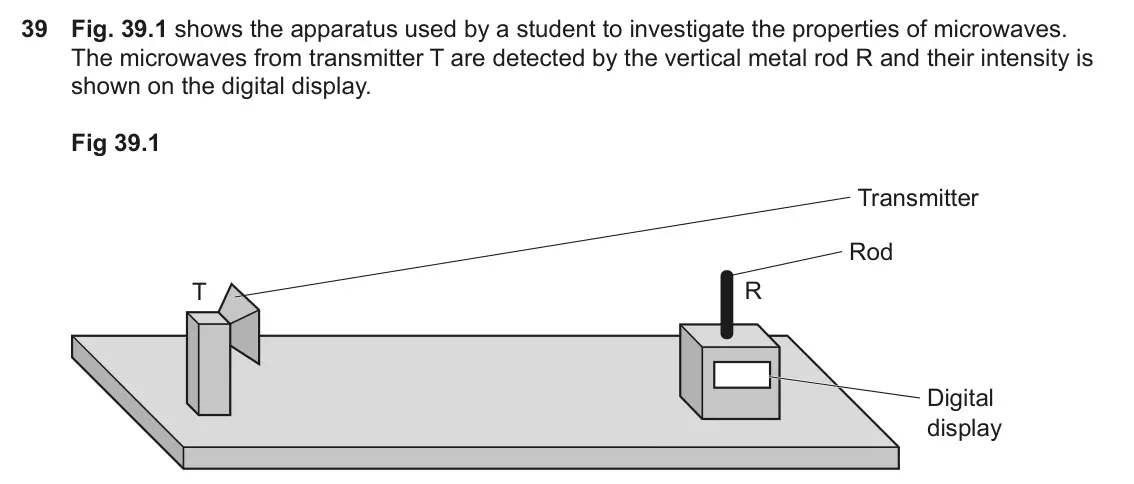
How many marks did you get?
Q26(b)(i)
The whole paper ↗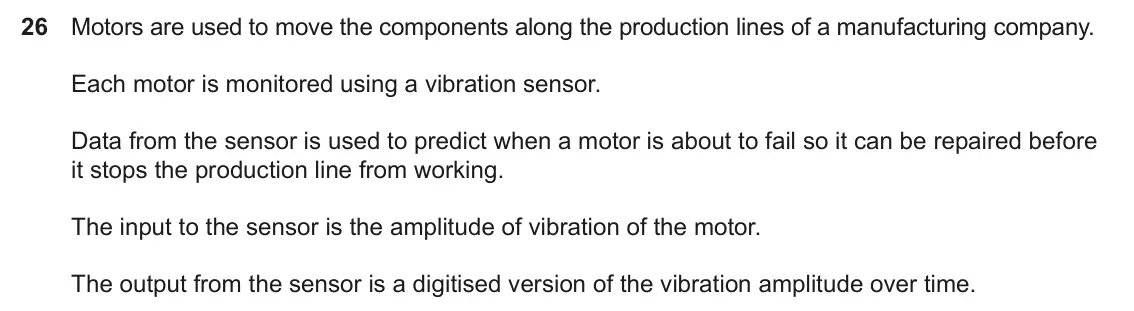
- Your answer
- Your answer
- Your answer
Q1(a)(i)
The whole paper ↗Q1(a)(ii)
The whole paper ↗Q31(a)
The whole paper ↗Q31(b)
The whole paper ↗- Your answer
- Your answer
- Your answer
Q26(b)
The whole paper ↗
Q7(a)(ii)
The whole paper ↗
Q1(a)
The whole paper ↗
Q1(b)
The whole paper ↗Q1(c)(i)
The whole paper ↗Q1(c)(ii)
The whole paper ↗Q24(a)
The whole paper ↗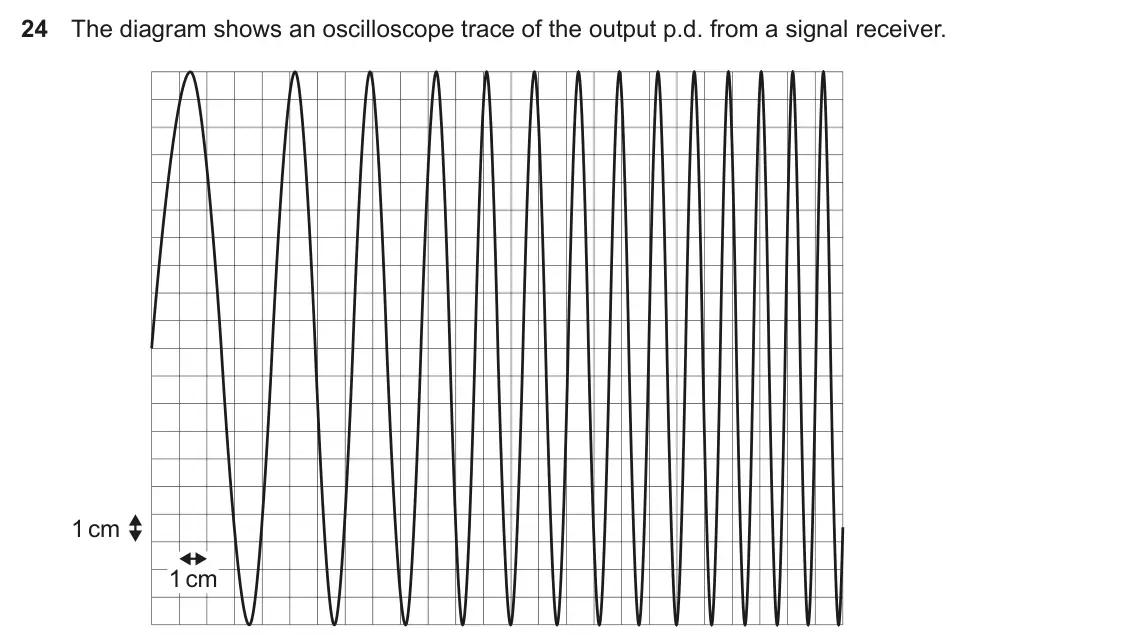
All 38 questions on Waves and polarisation, as a list
- June 2025, Paper 1, Q39(a) (2 marks): Explain how the apparatus can be used to test if the microwaves from T are polarised vertically or horizontally. [2]
- June 2025, AS Paper 1, Q8 (1 mark): A student uses a microwave transmitter and receiver as shown in the diagram. receiver transmitter metal grille The microwaves from the transmitter are polarised
- June 2025, AS Paper 1, Q26(b)(i) (1 mark): What is meant by the term amplitude? [1]
- June 2024, Paper 1, Q2 (1 mark): Which statement about ultrasound is correct? A Ultrasound can be diffracted and polarised. B Ultrasound can be diffracted but cannot be polarised. C Ultrasound
- June 2024, AS Paper 1, Q7 (1 mark): A student is using a microwave transmitter and receiver as shown in the diagram. receiver transmitter meter metal grille The student notices the reading on the
- June 2024, AS Paper 1, Q13 (1 mark): The diagram shows a sound wave displayed on an oscilloscope screen. The oscilloscope timebase is set to 1 ms / div. displacement time The frequency of the sound
- June 2024, AS Paper 2, Q1(a)(i) (1 mark): Fig. 1.2 is a graph of the light intensity registered by the detector against the angle of rotation of polaroid Q from its initial position. Fig. 1.2 intensity
- June 2024, AS Paper 2, Q1(a)(ii) (1 mark): What characteristic of a light wave allows it to be polarised? [1]
- June 2023, Paper 1, Q31(a) (1 mark): Electromagnetic waves can be polarised. State the difference between a polarised and an unpolarised wave. [1]
- June 2023, Paper 1, Q31(b) (2 marks): It is suggested that visible light is partially polarised when it is reflected. Describe how you can use a polarising filter to determine if this suggestion is
- June 2023, AS Paper 1, Q2 (1 mark): A sound wave has frequency 440 Hz. The speed of sound in air is 330 m s–1. The wavelength of 2 the sound wave is: A 75 cm B 125 cm C 1.45 m D 75 m Your answer [
- June 2023, AS Paper 1, Q7 (1 mark): In a plane-polarised light ray, the oscillations in the electric field are: A In all directions, perpendicular to the direction of propagation B In one plane, p
- June 2023, AS Paper 1, Q17 (1 mark): A detector receives a signal of constant amplitude carried by a plane-polarised wave. Which answer describes a possible sequence of amplitude measurements when
- June 2023, AS Paper 1, Q26(b) (1 mark): State the amplitude of the electrical signal. amplitude = mV [1]
- June 2023, AS Paper 2, Q7(a)(ii) (2 marks): Describe and explain the feature of Fig. 7.1 which shows that this musical note contains more than one frequency. [2]
- June 2022, Paper 3, Q1(a) (2 marks): Explain what is meant by the term polarisation and state why all electromagnetic waves can be polarised. [2]
- June 2022, Paper 3, Q1(b) (3 marks): A student looks at light reflected from a glass block through one polarising filter. Explain how they could tell if the reflected light shows any polarisation.
- June 2022, Paper 3, Q1(c)(i) (2 marks): Describe how the angle of rotation could be measured in a school laboratory. [2]
- June 2022, Paper 3, Q1(c)(ii) (3 marks): The results from the investigation are plotted on the graph shown in Fig. 1.2. Use data points from the graph below (excluding voltage = 0) to test whether the
- June 2022, AS Paper 1, Q24(a) (1 mark): What is meant by the term frequency? [1]
- June 2022, AS Paper 2, Q2(a) (2 marks): Calculate the ratio fsound . fradio fsound = [2]
- November 2021, Paper 2, Q7(b) (3 marks): The frequency of the ultrasound used is 3.5 MHz and each pulse lasts 1 μs. Calculate the longitudinal resolution of the pulse. longitudinal resolution = m [3]
- November 2021, Paper 2, Q9(a)(i) (2 marks): A bat emits a pulse from a single point. The intensity of the sound emitted varies with distance from that point in an inverse square relationship. The pulse st
- November 2021, Paper 2, Q9(a)(ii) (3 marks): A pulse emitted by the bat returns after reflection from a small object at a distance of 2.4 m. Calculate the change in power in decibels (dB) of the pulse from
- November 2021, AS Paper 1, Q7 (1 mark): A source of plane-polarised light of intensity A0 is viewed through a polarising filter. The axis of the filter is perpendicular to the axis of polarisation of
- November 2020, AS Paper 1, Q26(a) (1 mark): Describe what the student would observe as he rotates the filter. [1] The student uses the unpolarised light source to illuminate the surface of a glass block.
- November 2020, AS Paper 1, Q26(b) (2 marks): Describe how the meter reading changes as the angle of incidence increases from 50° to 70°. [2] The angle at which the meter reading is zero is called the Brews
- November 2020, AS Paper 1, Q26(c) (1 mark): Estimate the Brewster angle from the graph. Brewster angle ≈ ° [1]
- November 2020, AS Paper 1, Q26(d) (2 marks): Explain what the student can deduce about the reflected light at this angle. [2] 20 The student wants to find a more precise value for the Brewster angle. He re
- June 2019, Paper 1, Q7 (1 mark): The frequency of the wave shown in the diagram is 3.0 Hz. What is the wave speed on the string? A 1.2 m s−1 B 2.4 m s−1 C 3.8 m s−1 D 7.5 m s−1 [1] Your answer
- June 2018, Paper 2, Q1(a) (2 marks): A student takes two polarising filters as shown in Fig. 1.1. Unpolarised light is incident on the filter 1. Filter 2 is initially set up to allow all the light
- June 2018, Paper 2, Q1(b)(i) (4 marks): Describe and explain how the p.d. across the LDR changes as the second filter is rotated through 360° from its original orientation. You do not need to give val
- June 2017, AS Paper 1, Q7 (1 mark): A plane-polarised light wave is passed through a single polarising filter. The filter is rotated and the intensity observed drops from a maximum to zero. Throug
- June 2017, AS Paper 1, Q8 (1 mark): The graphs below describe a sound wave. P, Q and R are intervals of time or distance as indicated on the graphs. displacement / m displacement / m P R Q Q time
- June 2016, AS Paper 1, Q7 (1 mark): The display of a laptop screen is viewed through a polarising filter by a student. The intensity of the light changes when the filter is rotated. Which property
- June 2016, AS Paper 1, Q22(a) (1 mark): Explain the term polarised. [1]
- June 2016, AS Paper 1, Q22(b) (1 mark): The transmitter T faces the receiver R as shown in Fig. 22. The signal received is a maximum. T R Fig. 22 State what happens to the intensity of the signal rece
- June 2016, AS Paper 1, Q23(b) (1 mark): Estimate the frequency of the analogue signal shown in Fig. 23. Make your method clear. frequency = Hz [1]
Questions, mark schemes and examiner’s reports are © OCR, from their published past papers. Plumi isn’t affiliated with any exam board. Want whole papers? OCR A-Level Physics B past papers.
The Plumi iPad app also offers exam-style questions with AI feedback on your handwritten working.