 plumi
Ionising radiations and their effects: OCR A‑Level Physics B questions
OCR A-Level Physics B past-paper questions on 6.2.2.1 Ionising radiations and their effects, 2016–2025, with mark schemes and examiner’s reports where available.
Paper
All papers
Exam
All years
Calculations
Q2(a)(i)
The whole paper ↗
Q39(b)
The whole paper ↗Q7(b)
The whole paper ↗
Q37(b)(i)
The whole paper ↗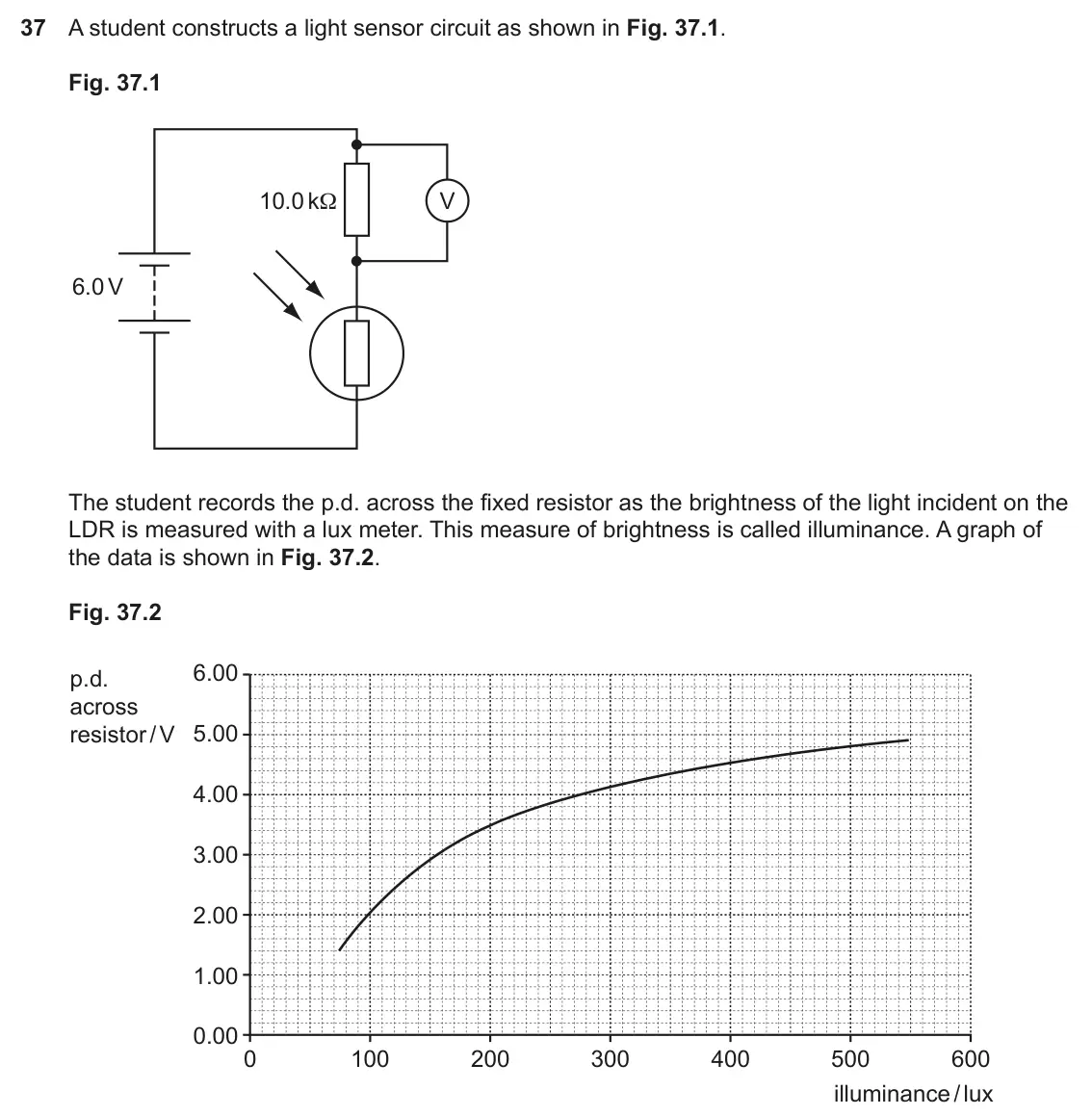
Q37(b)(ii)
The whole paper ↗Q5(a)(i)
The whole paper ↗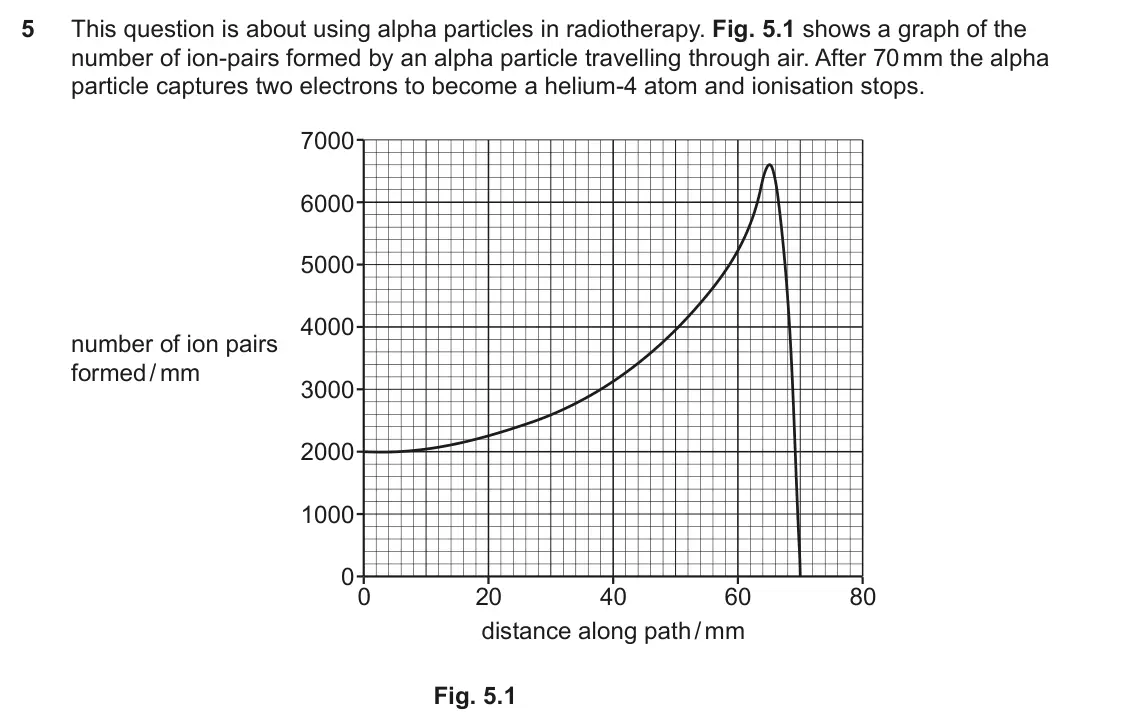
Q5(a)(ii)
The whole paper ↗Q5(a)(iii)
The whole paper ↗Q5(b)(ii)
The whole paper ↗Q34(c)
The whole paper ↗
Q4(a)(i)
The whole paper ↗
Q4(a)(ii)
The whole paper ↗Q4(b)(i)
The whole paper ↗Q4(b)(ii)
The whole paper ↗Q4(c)(i)
The whole paper ↗Q4(c)(ii)
The whole paper ↗Q41(a)(i)
The whole paper ↗
Q41(b)(i)
The whole paper ↗- Your answer
Q10(b)
The whole paper ↗
All 24 questions on Ionising radiations and their effects, as a list
- June 2025, Paper 2, Q2(a)(i) (2 marks): Show that the average energy to remove an electron from a molecule (ionisation energy) in air is less than 6 × 10–18 J. [2]
- June 2024, Paper 1, Q39(b) (4 marks): Thorium-232 is a radioactive metal that can be added to welding rods to improve their performance. These welding rods are said to be thoriated. Thorium-232 deca
- June 2024, Paper 2, Q7(b) (2 marks): Fig. 1 in the article shows that half the gamma rays incident at the top of the atmosphere are absorbed as they pass through the first 120 km of the atmosphere.
- June 2023, Paper 1, Q37(b)(i) (3 marks): Describe how this apparatus can be used to gather data to determine the absorption coefficient of the absorbing material. [3]
- June 2023, Paper 1, Q37(b)(ii) (2 marks): The intensity of a gamma-ray beam is reduced to 15% of its original value after passing through 3.2 cm of lead. Calculate the absorption coefficient of the lead
- June 2023, Paper 2, Q5(a)(i) (1 mark): State how the graph shows that an alpha particle produces about 240 000 ion pairs along its track. [1]
- June 2023, Paper 2, Q5(a)(ii) (2 marks): It takes about 30 eV to produce an ion-pair. Estimate the kinetic energy of the alpha particle when it is ejected from a nucleus. Explain your reasoning. Reason
- June 2023, Paper 2, Q5(a)(iii) (2 marks): Explain why beta particles have a longer range in air than alpha particles of the same initial energy. [2]
- June 2023, Paper 2, Q5(b)(ii) (1 mark): Alpha emitters can be implanted into body tissue. The range of alpha particles in the tissue is typically about 0.1 mm. State why the range is smaller in tissue
- November 2021, Paper 1, Q34(c) (1 mark): Seeds are implanted into cancer masses and remain there for many half-lives. Suggest why implanting many seeds throughout a 50 gram cancer may be better than im
- November 2021, Paper 3, Q4(a)(i) (1 mark): Complete the tracks by drawing on Fig. 4.1 continuing the lines through each material unless a material absorbs 100% of the incident radiation. [1] Table 4.1 sh
- November 2021, Paper 3, Q4(a)(ii) (2 marks): Using the information in Table 4.1 suggest and explain which isotope of xenon should be used as a medical imaging tracer. Consider the effect on the patient of
- November 2021, Paper 3, Q4(b)(i) (2 marks): Suggest and explain one safety precaution required when handling a source of ionising radiation. [2]
- November 2021, Paper 3, Q4(b)(ii) (2 marks): Before taking any measurements with the absorber and source in place, the student takes several readings of the count rate. Explain why they do this. [2]
- November 2021, Paper 3, Q4(c)(i) (6 marks): The student gathers the following data. Shielding Corrected count rate Count rate / s–1 thickness, / s–1 x / cm 0 1250 1240 1 915 905 2 636 626 3 475 465 4 353
- November 2021, Paper 3, Q4(c)(ii) (4 marks): Using the equation I = I0 e–μx, and the information in Fig. 4.4, determine the value of the attenuation coefficient, μ. attenuation coefficient = unit [4] 17 8
- November 2020, Paper 1, Q41(a)(i) (2 marks): Suggest why a γ-ray source is chosen for this purpose rather than α or β. [2]
- November 2020, Paper 1, Q41(b)(i) (2 marks): Explain why this equation: • has an exponential term • has an inverse square law. [2]
- June 2019, Paper 1, Q26 (1 mark): What is the best estimate of the energy of one of the α-particles? A 2.2 MeV B 3.5 MeV C 4.4 MeV D 5.6 MeV Your answer [1] 18 This diagram is for use in questio
- June 2019, Paper 2, Q10(b) (2 marks): Explain why exposure to radiation increases the risk of contracting cancer and how the high level of radiation on the surface of Mars may affect the design of t
- June 2018, Paper 1, Q12 (1 mark): The diagram shows the beta energy spectrum for emissions from a radioactive isotope. 1.0 relative frequency of beta emission 0.8 0.6 0.4 0.2 0 0.0 0.2 0.4 0.6 0
- June 2018, Paper 3, Q2(a) (2 marks): Describe two safety precautions necessary for handling such a material in the laboratory. [2]
- June 2017, Paper 1, Q39(a) (3 marks): One of the sources emits α, β and γ radiation, one source emits β and γ and one source emits pure β. For each source below state which radiations are emitted. J
- June 2017, Paper 1, Q39(b)(ii) (4 marks): State whether the graph shows that the count rate C varies as C ∝ 2 R and explain which radiation(s) α, β or γ might be responsible for such a variation. [4]
Questions, mark schemes and examiner’s reports are © OCR, from their published past papers. Plumi isn’t affiliated with any exam board. Want whole papers? OCR A-Level Physics B past papers.
The Plumi iPad app also offers exam-style questions with AI feedback on your handwritten working.