 plumi
Properties of carboxylic acids: OCR A‑Level Chemistry A questions
OCR A-Level Chemistry A past-paper questions on 6.1.3.1 Properties of carboxylic acids, 2016–2025, with mark schemes and examiner’s reports where available.
Paper
All papers
Exam
All years
Calculations
Q21(e)
The whole paper ↗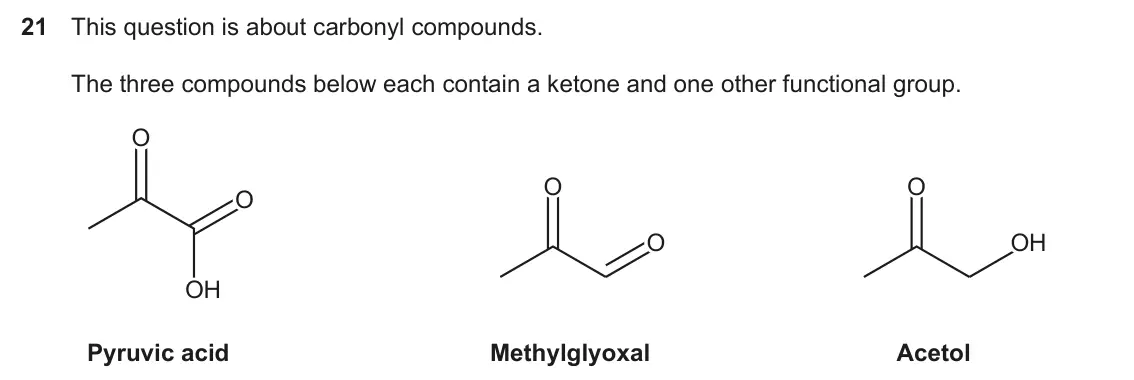
Q22(b)(i)
The whole paper ↗
Q2(b)(i)
The whole paper ↗
Q20(a)
The whole paper ↗
Q23(b)(i)
The whole paper ↗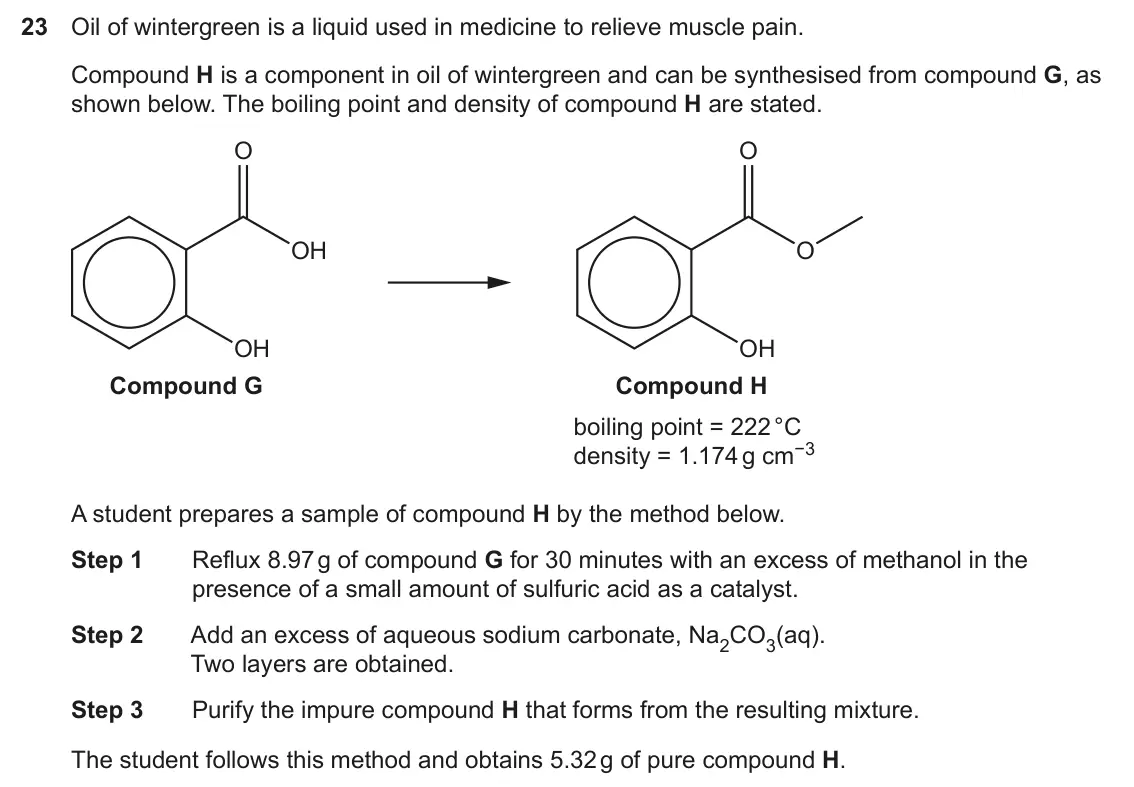
Q20(a)
The whole paper ↗
Q5(b)(ii)
The whole paper ↗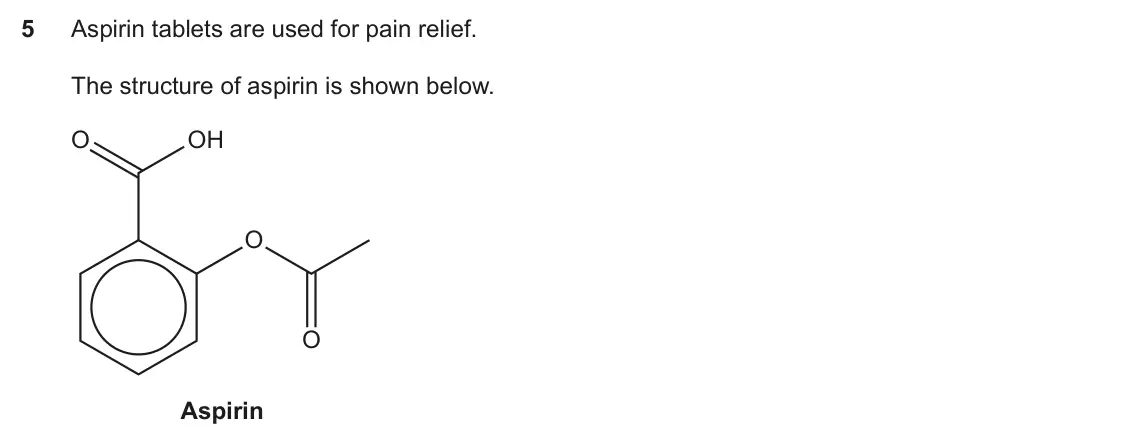
Q19(a)
The whole paper ↗
- Your answer
Q18(d)(ii)
The whole paper ↗
Q1(e)
The whole paper ↗
- Your answer
- Your answer
Q18(a)(ii)
The whole paper ↗
Q21(b)(ii)
The whole paper ↗
Q18(c)
The whole paper ↗
Q2(b)
The whole paper ↗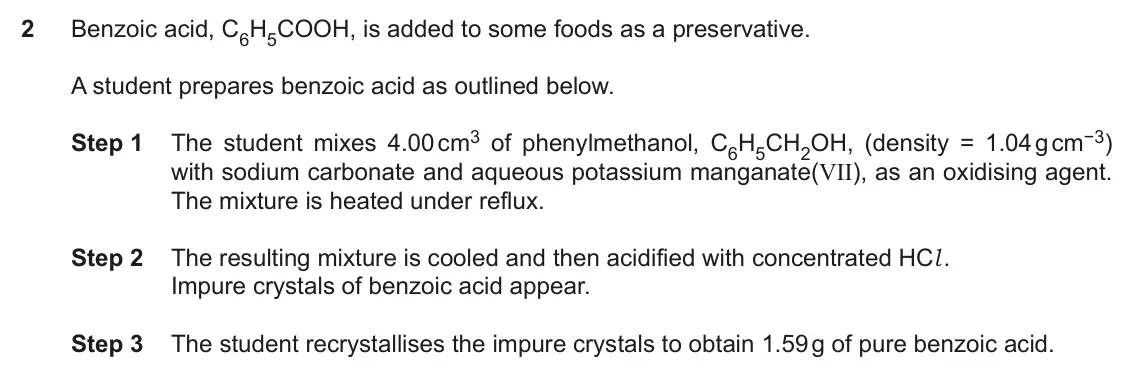
Q21(a)
The whole paper ↗
- Your answer
Q4(b)(i)
The whole paper ↗
All 20 questions on Properties of carboxylic acids, as a list
- June 2025, Paper 2, Q21(e) (7 marks): Complete the flowchart for the reactions of pyruvic acid. excess NH3 Acyl chloride Compound P reagent(s) O NaOH(aq) O OH Pyruvic acid CH3OH / H2SO4 reagent(s) O
- June 2025, Paper 2, Q22(b)(i) (2 marks): Draw the structures of the organic products you would expect from the decomposition of the two other β-keto acids below. O O OH O O OH [2]
- June 2025, Paper 3, Q2(b)(i) (1 mark): Why does paracetamol not react with Na2CO3(aq)? [1]
- June 2024, Paper 2, Q20(a) (2 marks): Short-chain carboxylic acids, such as methanoic acid, HCOOH, are soluble in water. Explain, with a labelled diagram, how HCOOH interacts with water when it diss
- June 2024, Paper 2, Q23(b)(i) (3 marks): In Step 2, Na2CO3(aq) removes the sulfuric acid catalyst and any unreacted compound G from the mixture. Write equations for this removal. Removal of sulfuric ac
- June 2023, Paper 2, Q20(a) (4 marks): Salicylic acid, shown below, is used in the manufacture of some important medicines. COOH OH Salicylic acid Complete the flowchart for reactions of salicylic ac
- June 2023, Paper 3, Q5(b)(ii) (3 marks): In this reaction, 1 mol of aspirin reacts with 3 mol of hot NaOH(aq). Complete the equation for the reaction of aspirin with an excess of hot NaOH(aq). Show str
- June 2022, Paper 2, Q19(a) (4 marks): Carboxylic acids react with alkalis, metals and carbonates to form salts. Write full equations for the following three reactions. Show structures for organic co
- November 2021, Paper 2, Q15 (1 mark): Compounds 1, 2 and 3 are heated with NaOH(aq). Which compound(s) react(s)? OH 1 COOH 2 CH2Br 3 A 1, 2 and 3 B Only 1 and 2 C Only 2 and 3 D Only 1 Your answer [
- November 2021, Paper 2, Q18(d)(ii) (1 mark): Suggest why tablets based on a salt of ibuprofen should act faster in the body than ibuprofen. [1]
- November 2021, Paper 3, Q1(e) (4 marks): The structure of lactic acid is shown below. OH OH O lactic acid Complete and balance the equations for two reactions of lactic acid. Reaction with sodium carbo
- November 2020, Paper 2, Q3 (1 mark): Which of these reagent(s) will not react with HOCH2CH2CH2COOH? A NaCN in ethanol B C2H5OH in the presence of an acid catalyst C (CH3CO)2O D concentrated H2SO4 Y
- November 2020, Paper 2, Q7 (1 mark): Which one of the following reacts with ethanoic acid and with phenol? A Aqueous potassium hydroxide B Bromine C Calcium carbonate D Methanol and an acid catalys
- November 2020, Paper 2, Q18(a)(ii) (2 marks): HOOC(CH2)2COOH is soluble in water. Explain, using a labelled diagram, why HOOC(CH2)2COOH is soluble in water. [2]
- November 2020, Paper 2, Q21(b)(ii) (4 marks): A sample of aspartame is hydrolysed with aqueous acid. Draw the structures of the three organic products of the complete acid hydrolysis of aspartame. [4]
- June 2019, Paper 2, Q18(c) (1 mark): Compound B is a structural isomer of ester A. • Compound B reacts with aqueous sodium carbonate. • The 13C NMR spectrum of B has 4 peaks. Draw a possible struct
- June 2019, Paper 3, Q2(b) (1 mark): In Step 2, explain why the mixture must be acidified so that crystals of benzoic acid appear. [1]
- June 2018, Paper 2, Q21(a) (3 marks): The flowchart below shows some reactions of compound H. In the boxes, draw the organic products of these reactions. Na2CO3(aq) NaOH(aq) O C OH HO compound H Br2
- June 2017, Paper 2, Q10 (1 mark): Equal amounts of the four compounds are added to the same volume of water. Which compound would produce the most acidic solution? A CH3CONH2 B CH3COOH C CH3COOC
- June 2017, Paper 3, Q4(b)(i) (3 marks): Magnesium ribbon is added to a solution of compound A. Gas bubbles are seen and the magnesium slowly dissolves. Equation Type of reaction [3]
Questions, mark schemes and examiner’s reports are © OCR, from their published past papers. Plumi isn’t affiliated with any exam board. Want whole papers? OCR A-Level Chemistry A past papers, or our free OCR-style practice pack.
The Plumi iPad app also offers exam-style questions with AI feedback on your handwritten working.