 plumi
Neutralisation and salts: OCR A‑Level Chemistry A questions
OCR A-Level Chemistry A past-paper questions on 2.1.4.2 Neutralisation and salts, 2016–2025, with mark schemes and examiner’s reports where available.
Paper
All papers
Exam
All years
Calculations
Q1(b)
The whole paper ↗
Q23(b)(i)
The whole paper ↗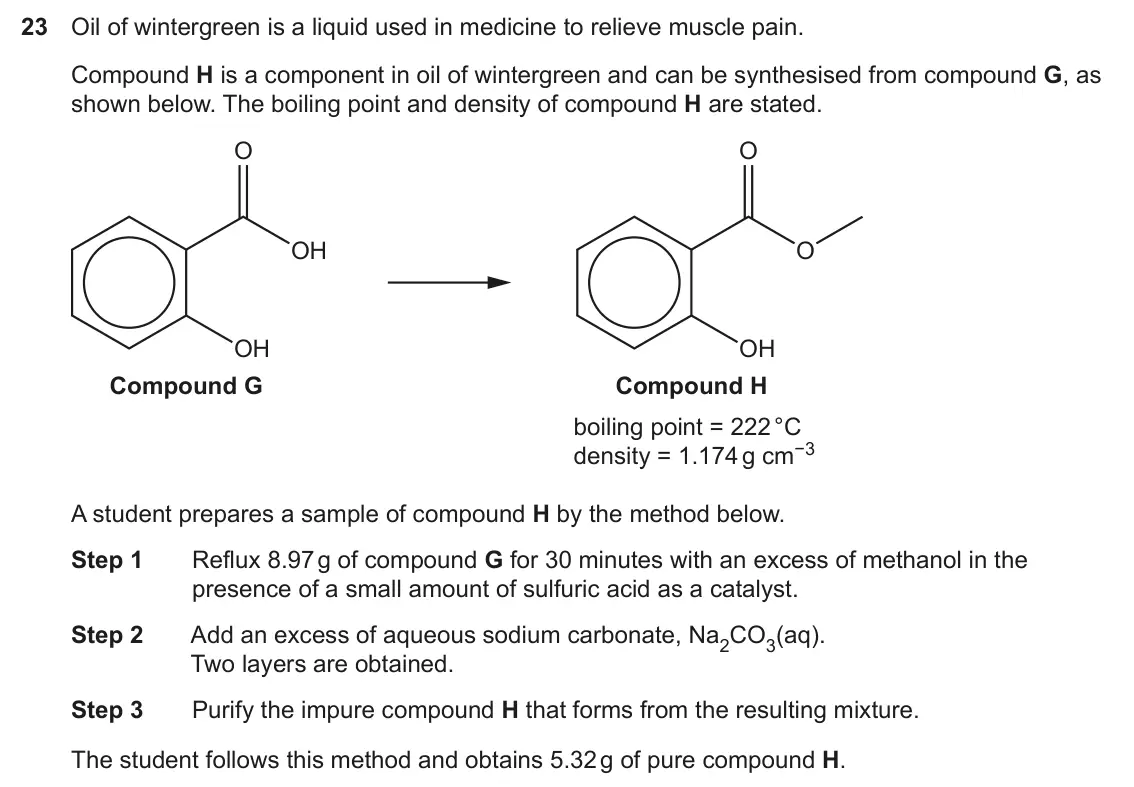
Q20(c)(i)
The whole paper ↗
Q6(b)(i)
The whole paper ↗
Q22(b)(i)
The whole paper ↗
Q22(b)(ii)
The whole paper ↗Q21(c)(ii)
The whole paper ↗
Q18(a)
The whole paper ↗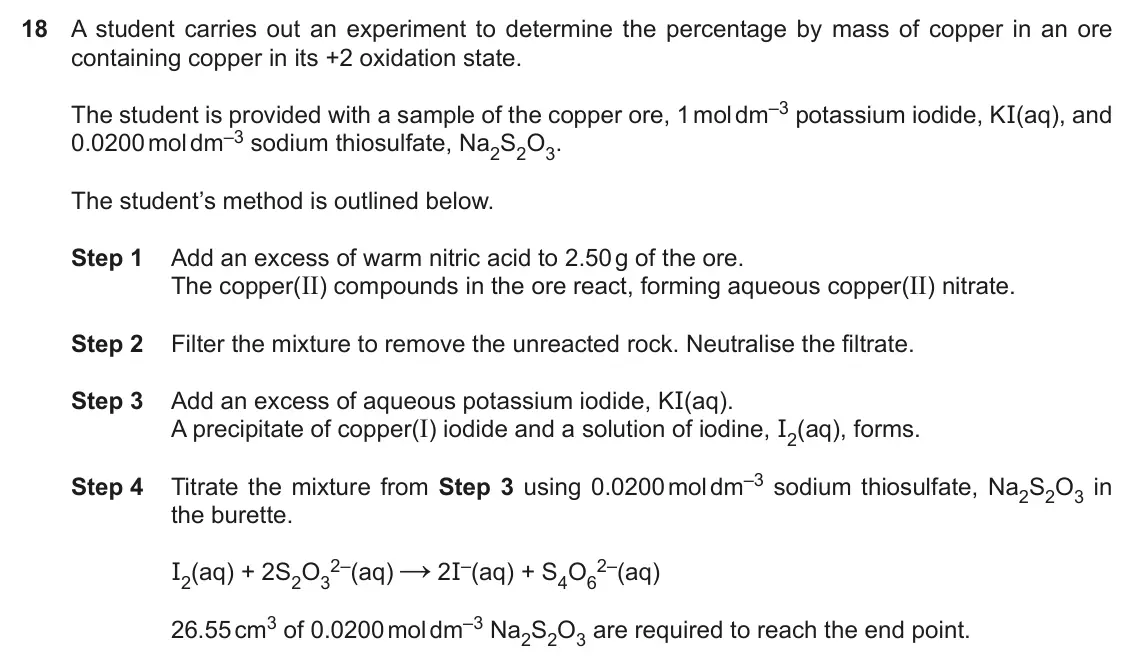
Q4(a)(iii)
The whole paper ↗
- Your answer
Q22(a)(iii)
The whole paper ↗
Q22(a)(iv)
The whole paper ↗Q17(a)
The whole paper ↗
- Your answer
Q21(c)(i)
The whole paper ↗
All 15 questions on Neutralisation and salts, as a list
- June 2025, AS Paper 2, Q1(b) (1 mark): Write the ionic equation for the neutralisation reaction between an acid and an alkali. [1]
- June 2024, Paper 2, Q23(b)(i) (3 marks): In Step 2, Na2CO3(aq) removes the sulfuric acid catalyst and any unreacted compound G from the mixture. Write equations for this removal. Removal of sulfuric ac
- June 2023, Paper 1, Q20(c)(i) (1 mark): Construct the equation for this reaction. [1]
- June 2023, Paper 3, Q6(b)(i) (2 marks): Write an equation for this reaction. [2]
- June 2023, AS Paper 1, Q22(b)(i) (1 mark): The reaction of copper(II) oxide with dilute hydrochloric acid. [1]
- June 2023, AS Paper 1, Q22(b)(ii) (2 marks): The reaction of ammonium carbonate with dilute nitric acid. [2]
- June 2022, Paper 1, Q21(c)(ii) (2 marks): Huntite is a carbonate mineral with the chemical formula Mg3Ca(CO3)4. Huntite reacts with dilute hydrochloric acid to produce bubbles of a gas and a colourless
- November 2021, Paper 1, Q18(a) (2 marks): In Step 1, the student observed that bubbles of gas were produced. Suggest the formula of the copper(II) compound which reacted with HNO3 to form the gas, and w
- November 2020, Paper 3, Q4(a)(iii) (1 mark): In Stage 3, write the ionic equation for the reaction taking place in the titration. [1]
- June 2018, AS Paper 1, Q5 (1 mark): Which equation does not represent a neutralisation reaction? A Zn + 2HCl → ZnCl 2 + H2 B 2NH3 + H2SO4 → (NH4)2SO4 C Na2CO3 + 2CH3COOH → 2CH3COONa + CO2 + H2O D
- June 2018, AS Paper 1, Q22(a)(iii) (2 marks): How could the student obtain a sample of magnesium phosphate after reacting magnesium with phosphoric acid? [2]
- June 2018, AS Paper 1, Q22(a)(iv) (2 marks): Magnesium phosphate can also be prepared by reacting phosphoric acid with a compound of magnesium. Choose a suitable magnesium compound for this preparation and
- June 2017, Paper 1, Q17(a) (1 mark): Barium chloride can be prepared from barium hydroxide in a neutralisation reaction. Write the equation for this reaction. State symbols are not required. [1]
- June 2016, AS Paper 1, Q4 (1 mark): Which equation is not a neutralisation reaction? Ca(s) + 2HCl(aq) → CaCl2(aq) + H2(g) A H+(aq) + OH–(aq) → H2O(l) B K2CO3(s) + 2HNO3(aq) → 2KNO3(aq) + H2O(l) +
- June 2016, AS Paper 1, Q21(c)(i) (1 mark): Write the equation for this reaction. [1]
Questions, mark schemes and examiner’s reports are © OCR, from their published past papers. Plumi isn’t affiliated with any exam board. Want whole papers? OCR A-Level Chemistry A past papers, or our free OCR-style practice pack.
The Plumi iPad app also offers exam-style questions with AI feedback on your handwritten working.