 plumi
Phenols and their reactions: OCR A‑Level Chemistry A questions
OCR A-Level Chemistry A past-paper questions on 6.1.1.3 Phenols and their reactions, 2016–2025, with mark schemes and examiner’s reports where available.
Paper
All papers
Exam
All years
Calculations
Q20(b)(i)
The whole paper ↗
Q20(b)(ii)
The whole paper ↗Q2(b)(i)
The whole paper ↗
Q21(b)(ii)
The whole paper ↗
Q21(b)(iii)
The whole paper ↗Q23(b)(ii)
The whole paper ↗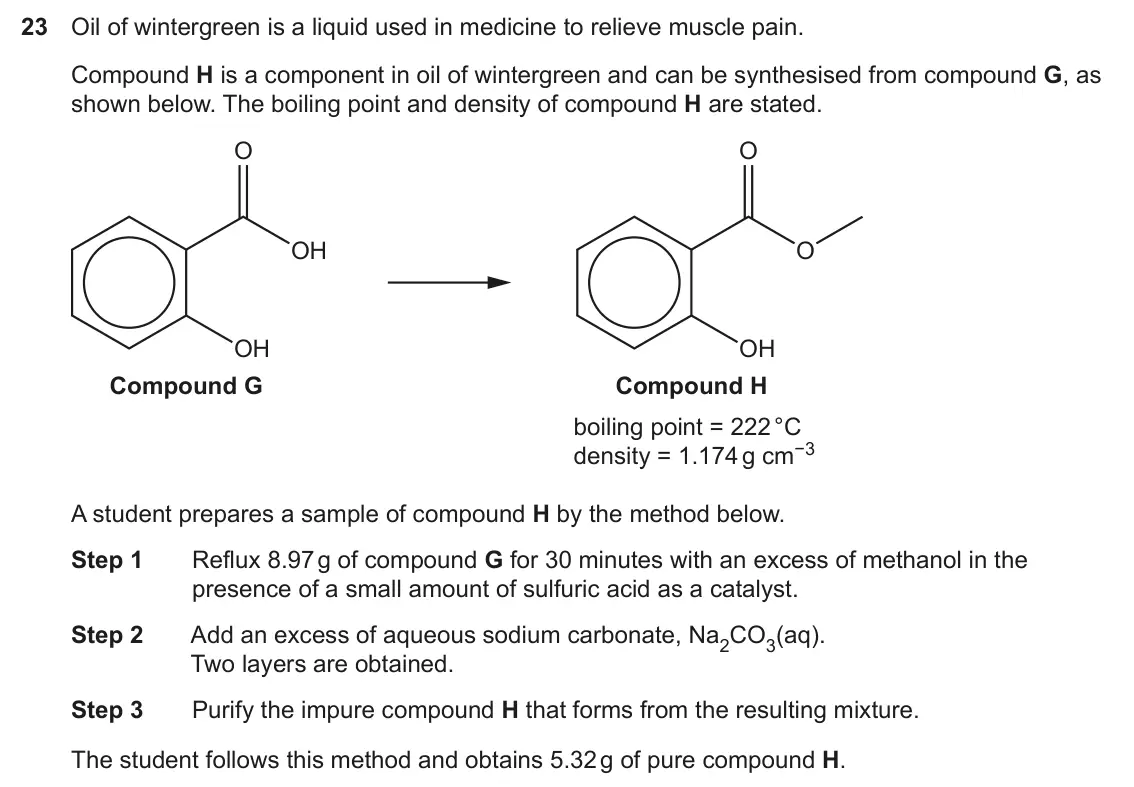
Q20(a)
The whole paper ↗
Q20(a)(i)
The whole paper ↗
Q20(b)
The whole paper ↗- Your answer
Q20(a)(i)
The whole paper ↗
Q20(a)(ii)
The whole paper ↗- Your answer
- Your answer
- Your answer
Q4(a)(iii)
The whole paper ↗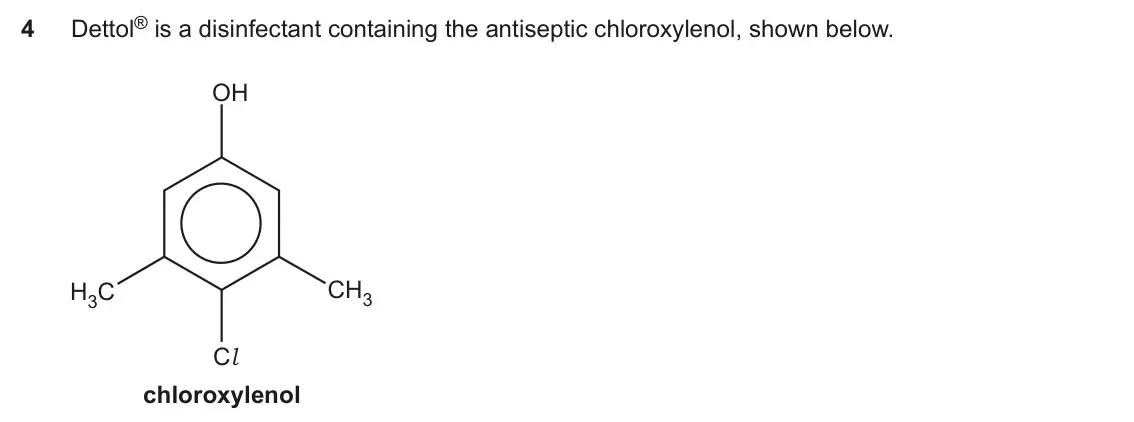
Q18(a)(ii)
The whole paper ↗
Q21(a)
The whole paper ↗
Q17(b)(i)
The whole paper ↗
Q17(b)(ii)
The whole paper ↗
All 20 questions on Phenols and their reactions, as a list
- June 2025, Paper 2, Q20(b)(i) (3 marks): Explain the difference in the relative reactivities of benzene and phenol with bromine. [3]
- June 2025, Paper 2, Q20(b)(ii) (2 marks): The white precipitate has a relative molecular mass of 330.7. Construct an equation for the reaction of phenol with excess bromine shown in Table 20.1. Show the
- June 2025, Paper 3, Q2(b)(i) (1 mark): Why does paracetamol not react with Na2CO3(aq)? [1]
- June 2024, Paper 2, Q21(b)(ii) (2 marks): The reactions of C6H5NH2 are similar to the reactions of phenol. Write an equation for the tri-substitution of C6H5NH2 with chlorine. [2]
- June 2024, Paper 2, Q21(b)(iii) (3 marks): Explain why chlorine reacts much more readily with C6H5NH2 than with benzene. [3]
- June 2024, Paper 2, Q23(b)(ii) (1 mark): Another student suggests that adding aqueous sodium hydroxide would be more effective in removing the sulfuric acid catalyst than Na2CO3(aq). Comment on whether
- June 2023, Paper 2, Q20(a) (4 marks): Salicylic acid, shown below, is used in the manufacture of some important medicines. COOH OH Salicylic acid Complete the flowchart for reactions of salicylic ac
- June 2022, Paper 2, Q20(a)(i) (1 mark): What chemical test(s) could be used to confirm the presence of the phenol group in compounds K and L? [1]
- June 2022, Paper 2, Q20(b) (3 marks): Compounds K and L react with chlorine much more readily than compound J. Explain why. [3]
- November 2021, Paper 2, Q15 (1 mark): Compounds 1, 2 and 3 are heated with NaOH(aq). Which compound(s) react(s)? OH 1 COOH 2 CH2Br 3 A 1, 2 and 3 B Only 1 and 2 C Only 2 and 3 D Only 1 Your answer [
- November 2021, Paper 2, Q20(a)(i) (6 marks): Complete the mechanism below for Stage 1 and Stage 2. Show curly arrows, the structure of the intermediate and the missing formulae on the dotted lines. Stage 1
- November 2021, Paper 2, Q20(a)(ii) (2 marks): What are the roles of –OH and CO2 in the mechanism? –OH CO2 [2]
- November 2020, Paper 2, Q7 (1 mark): Which one of the following reacts with ethanoic acid and with phenol? A Aqueous potassium hydroxide B Bromine C Calcium carbonate D Methanol and an acid catalys
- June 2019, Paper 2, Q8 (1 mark): Phenol reacts with bromine. Which is the least likely organic product? OH Br A Br OH Br Br B OH Br C Br OH Br Br D Br Your answer [1]
- June 2019, Paper 2, Q14 (1 mark): Which chemical(s) can react with phenol? 1 Potassium hydroxide 2 Ethanoyl chloride 3 Nitric acid A 1, 2 and 3 B Only 1 and 2 C Only 2 and 3 D Only 1 Your answer
- June 2019, Paper 3, Q4(a)(iii) (2 marks): Name the functional group responsible for the acidity of chloroxylenol and describe a simple test which would confirm the presence of this group. Functional gro
- June 2018, Paper 2, Q18(a)(ii) (3 marks): Explain why phenol is nitrated more readily than benzene. [3]
- June 2018, Paper 2, Q21(a) (3 marks): The flowchart below shows some reactions of compound H. In the boxes, draw the organic products of these reactions. Na2CO3(aq) NaOH(aq) O C OH HO compound H Br2
- June 2017, Paper 2, Q17(b)(i) (1 mark): State the trend in the relative ease of nitration of phenol, benzene, and benzoic acid. [1]
- June 2017, Paper 2, Q17(b)(ii) (3 marks): Apply your knowledge of the bonding in arenes to explain the trend in part (b)(i). [3]
Questions, mark schemes and examiner’s reports are © OCR, from their published past papers. Plumi isn’t affiliated with any exam board. Want whole papers? OCR A-Level Chemistry A past papers, or our free OCR-style practice pack.
The Plumi iPad app also offers exam-style questions with AI feedback on your handwritten working.