 plumi
Carbon-13 NMR spectra: OCR A‑Level Chemistry A questions
OCR A-Level Chemistry A past-paper questions on 6.3.2.1 Carbon-13 NMR spectra, 2016–2025, with mark schemes and examiner’s reports where available.
Paper
All papers
Exam
All years
Calculations
- Your answer
- Your answer
Q17(d)
The whole paper ↗
- Your answer
Q20(a)(ii)
The whole paper ↗
- Your answer
- Your answer
Q17(c)(i)
The whole paper ↗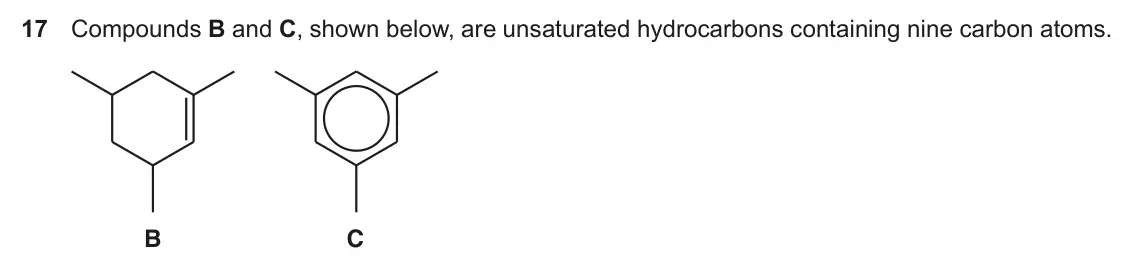
Q1(b)(ii)
The whole paper ↗
- Your answer
- Your answer
Q18(c)
The whole paper ↗
Q4(a)(ii)
The whole paper ↗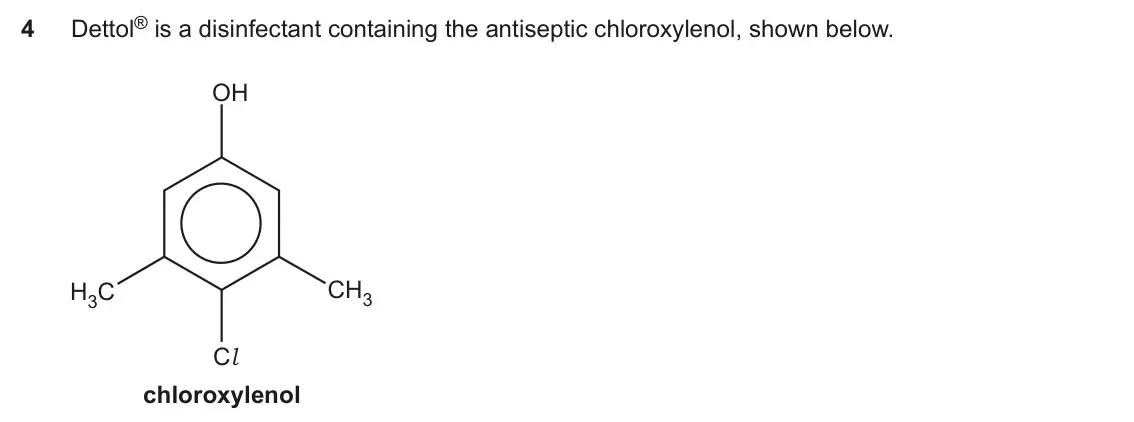
Q18(a)(i)
The whole paper ↗
Q20(c)
The whole paper ↗
All 15 questions on Carbon-13 NMR spectra, as a list
- June 2025, Paper 2, Q15 (1 mark): Which compound(s) has/have three peaks in their 13C NMR spectrum? OH 1 OH OH 2 HO HO OH 3 A 1, 2 and 3 B Only 1 and 2 C Only 2 and 3 D Only 1 Your answer [1]
- June 2024, Paper 2, Q14 (1 mark): The structures of 3 compounds, 1, 2 and 3, are shown below. Which compound(s) would produce a carbon-13 NMR spectrum with 2 peaks? HO OH 1 2 3 A 1, 2 and 3 B On
- June 2023, Paper 2, Q17(d) (5 marks): There are 4 structural isomers of C4H10O that are alcohols. A student predicts that these structural isomers could be distinguished using carbon-13 NMR spectros
- June 2022, Paper 2, Q15 (1 mark): Which isomer(s) of C5H12O has/have 4 peaks in its/their 13C NMR spectrum? 1 3-methylbutan-2-ol 2 2-methylbutan-2-ol 3 2-methylbutan-1-ol A 1, 2 and 3 B Only 1 a
- June 2022, Paper 2, Q20(a)(ii) (3 marks): A student thought that 13C NMR spectroscopy could be used to distinguish between compounds J, K and L. Explain, with reasoning, whether the student is correct.
- November 2021, Paper 2, Q13 (1 mark): Which compound(s) has/have four peaks in a 13C NMR spectrum? O 1 2 O 3 A 1, 2 and 3 B Only 1 and 2 C Only 2 and 3 D Only 1 Your answer [1]
- November 2020, Paper 2, Q8 (1 mark): Which isomer of C6H12O2 produces the smallest number of peaks in its 13C NMR spectrum? 8 O A OH O B O O C OH O D OH Your answer [1]
- November 2020, Paper 2, Q17(c)(i) (2 marks): Predict the number of peaks in the 13C NMR spectra of compounds C and D. Compound C Compound D Number of peaks [2]
- November 2020, Paper 3, Q1(b)(ii) (6 marks): Amine A is a liquid at room temperature and pressure. When vaporised, 0.202 g of the amine produces 72.0 cm3 of gas at 1.00 × 10⁵ Pa and 100 °C. The 13C NMR spe
- June 2019, Paper 2, Q10 (1 mark): Which compound shows 4 peaks in its carbon-13 NMR spectrum? A B C D Your answer [1]
- June 2019, Paper 2, Q12 (1 mark): A compound produces the 13C NMR spectrum below. 80 70 60 50 40 30 20 10 0 chemical shift, d / ppm Which compound could have produced this spectrum? A Propane B
- June 2019, Paper 2, Q18(c) (1 mark): Compound B is a structural isomer of ester A. • Compound B reacts with aqueous sodium carbonate. • The 13C NMR spectrum of B has 4 peaks. Draw a possible struct
- June 2019, Paper 3, Q4(a)(ii) (1 mark): Predict the number of peaks in a 13C NMR spectrum of chloroxylenol. [1]
- June 2018, Paper 2, Q18(a)(i) (3 marks): A student carries out the nitration of phenol with dilute nitric acid to produce 2-nitrophenol and 4-nitrophenol. A small amount of 3-nitrophenol is also produc
- June 2017, Paper 2, Q20(c) (3 marks): The carbon-13 NMR spectrum of the compound is shown below. 200 180 160 140 120 100 80 60 40 20 0 chemical shift, / ppm δ Using the spectrum and the results from
Questions, mark schemes and examiner’s reports are © OCR, from their published past papers. Plumi isn’t affiliated with any exam board. Want whole papers? OCR A-Level Chemistry A past papers, or our free OCR-style practice pack.
The Plumi iPad app also offers exam-style questions with AI feedback on your handwritten working.