 plumi
Electrostatic and gravitational fields of force: Eduqas A‑Level Physics questions
Every Eduqas A-Level Physics exam question on 2.6 Electrostatic and gravitational fields of force, 2016–2025, with its mark scheme and examiner’s report.
Find questions1,592
Calculations
Q5(c)(i)
The whole paper ↗
Q8(b)
The whole paper ↗
Q6(a)
The whole paper ↗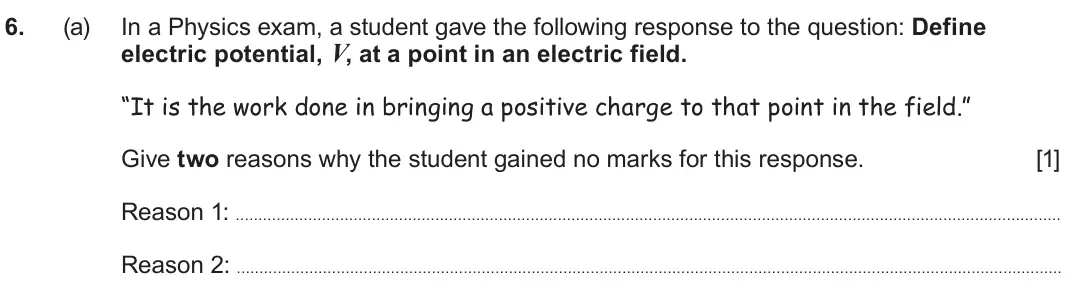
Q6(b)(i)
The whole paper ↗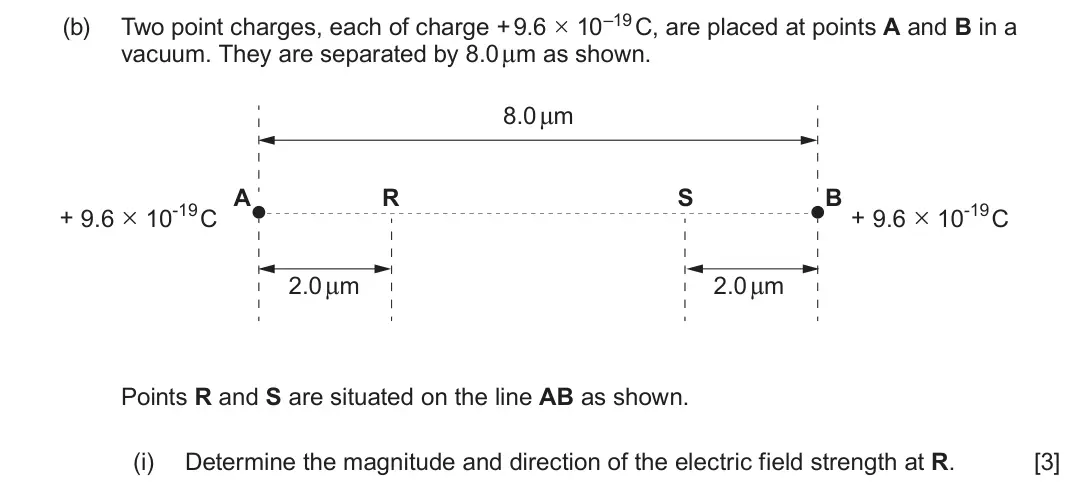
Q6(b)(ii)
The whole paper ↗
Q6(b)(iii)
The whole paper ↗
Q7(c)
The whole paper ↗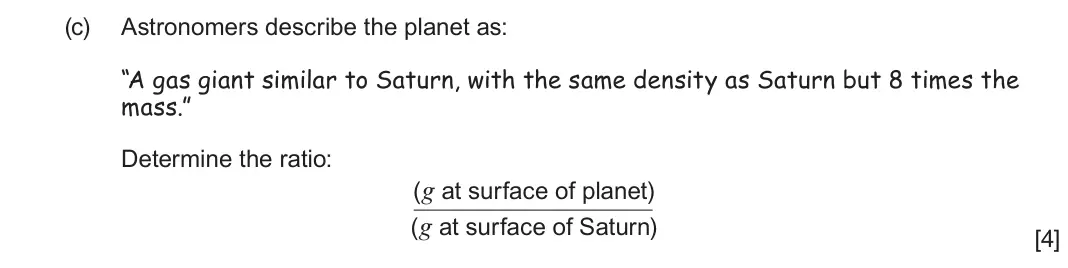
Q5(a)
The whole paper ↗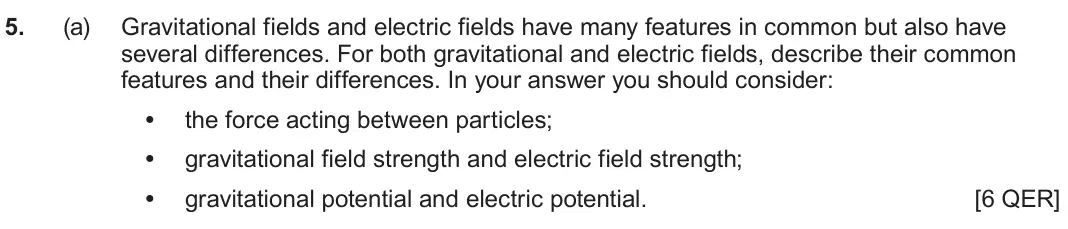
Q5(b)(i)
The whole paper ↗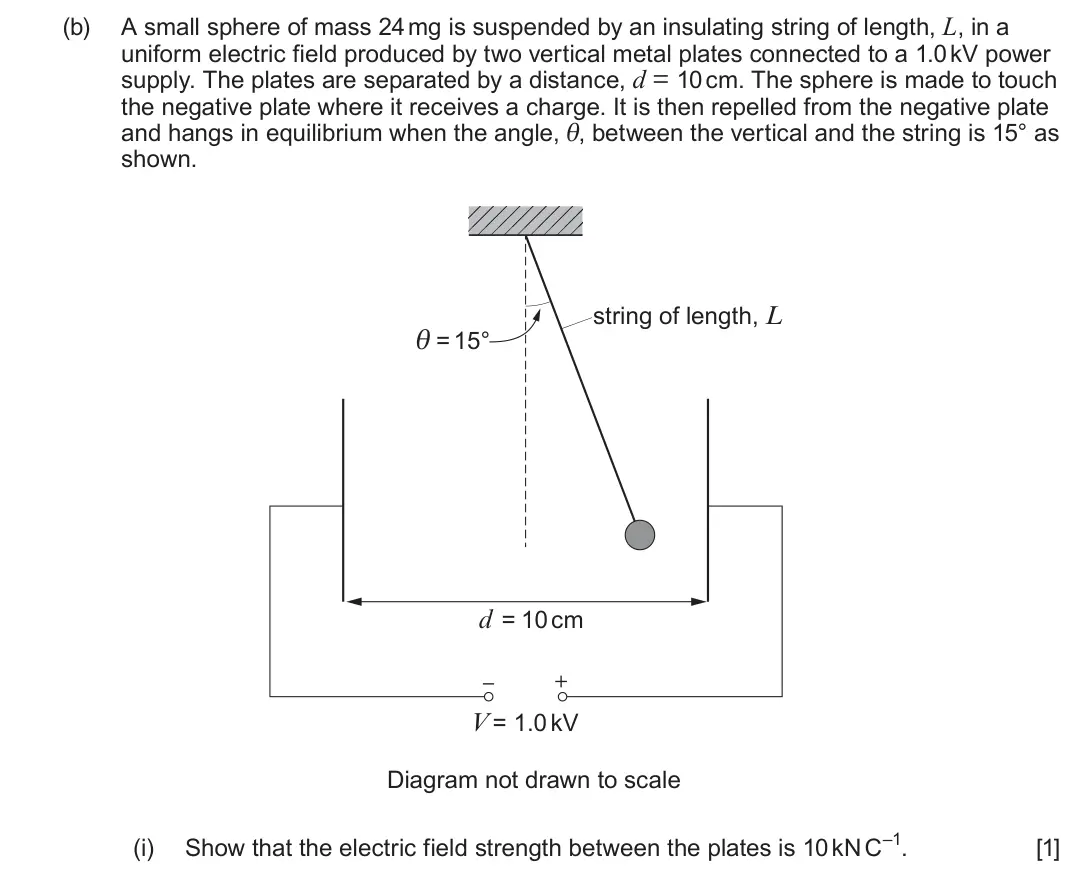
Q5(b)(ii)
The whole paper ↗
Q5(b)(iii)
The whole paper ↗
Q5(c)
The whole paper ↗
Q8(b)
The whole paper ↗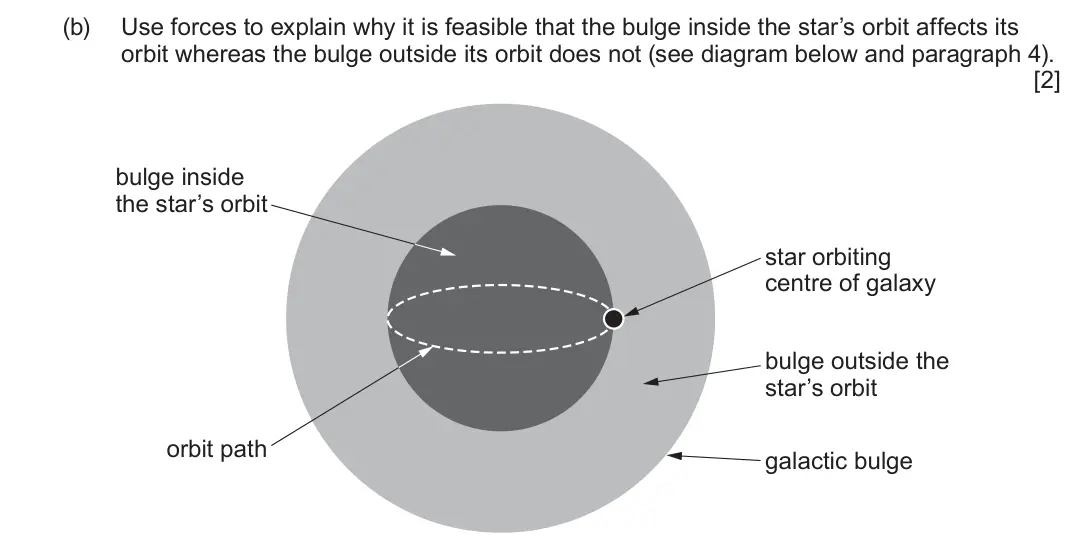
Q5(a)
The whole paper ↗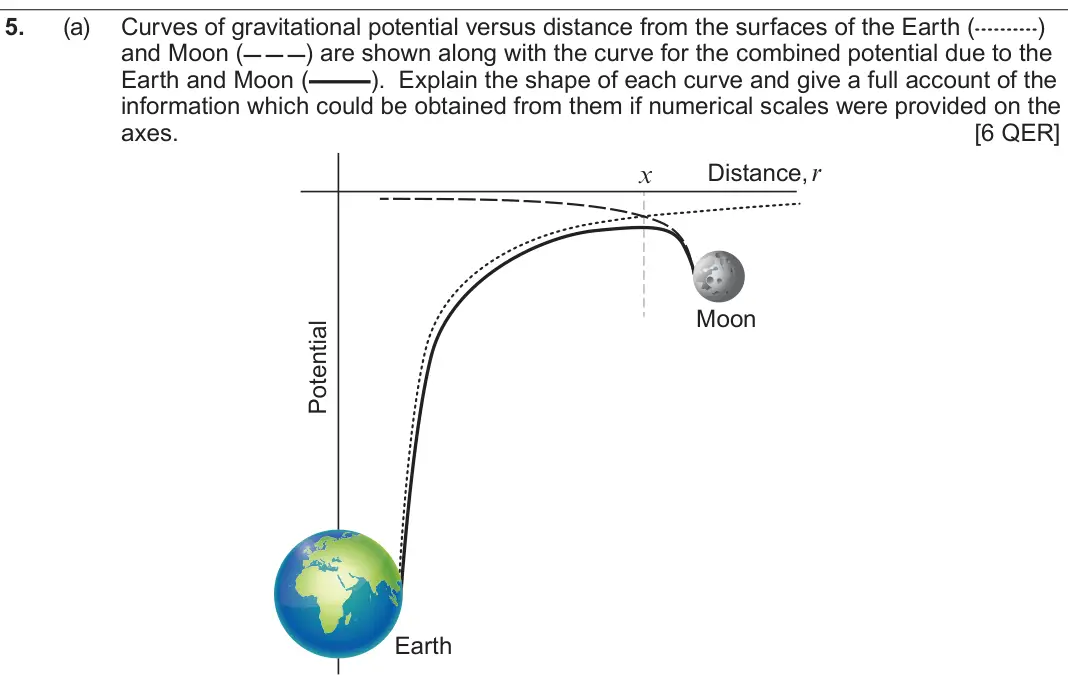
Q5(b)(i)
The whole paper ↗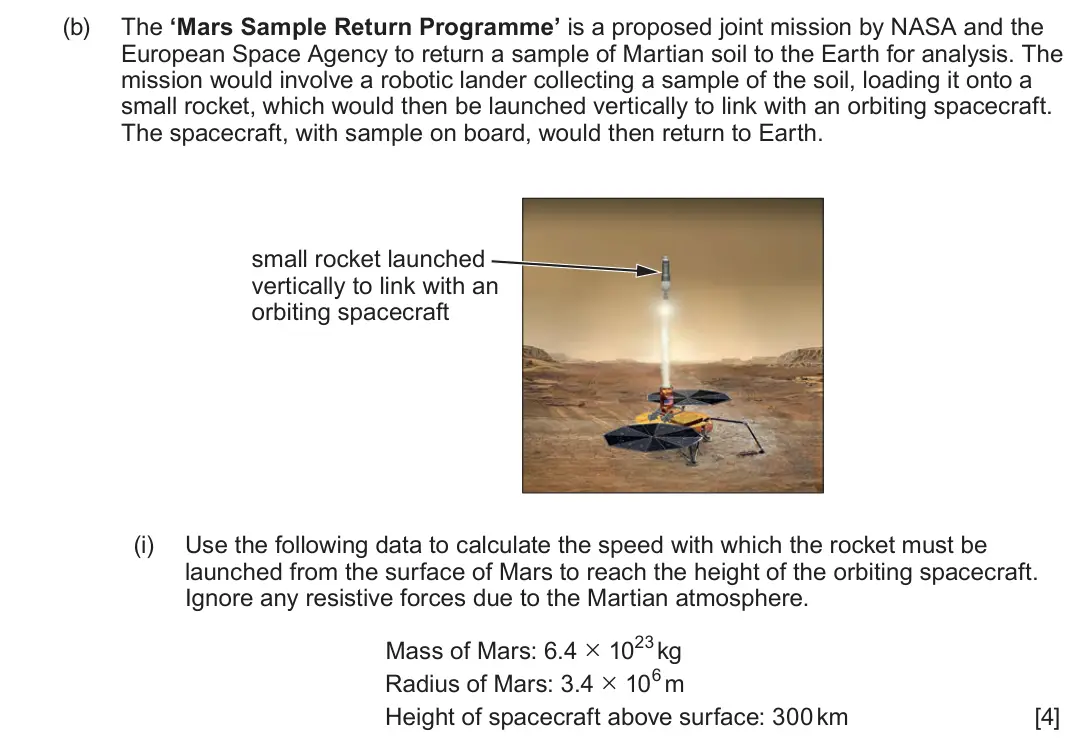
Q6(a)
The whole paper ↗
Q6(b)
The whole paper ↗
Q6(c)
The whole paper ↗
Q4(b)(ii)
The whole paper ↗
Q5(a)(i)
The whole paper ↗
All 60 questions on Electrostatic and gravitational fields of force, as a list
- June 2025, Component 1, Q5(c)(i) (2 marks): Determine the gravitational field strength on the surface of the Moon. [2] Mass of Moon, MM = 7.4 × 10²² kg and radius of Moon, RM = 1740 km
- June 2025, Component 1, Q8(b) (3 marks): Read through the following article carefully. Paragraph Laser Fusion 1 Apart from the hydrogen fusion bomb, which actually requires a fission bomb to detonate i
- June 2025, Component 2, Q6(a) (1 mark): In a Physics exam, a student gave the following response to the question: Define electric potential, V, at a point in an electric field. “It is the work done in
- June 2025, Component 2, Q6(b)(i) (3 marks): Determine the magnitude and direction of the electric field strength at R. [3]
- June 2025, Component 2, Q6(b)(ii) (2 marks): A teacher states: “When a small test charge is moved between R and S, the net work done is zero.” Explain, without calculation, why the teacher is correct. [2]
- June 2025, Component 2, Q6(b)(iii) (4 marks): Calculate the work done in moving a proton from the mid-point of AB to point S. [4]
- June 2025, Component 2, Q7(c) (4 marks): Astronomers describe the planet as: “A gas giant similar to Saturn, with the same density as Saturn but 8 times the mass.” Determine the ratio: (g at surface of
- June 2024, Component 2, Q5(a) (6 marks): Gravitational fields and electric fields have many features in common but also have several differences. For both gravitational and electric fields, describe th
- June 2024, Component 2, Q5(b)(i) (1 mark): Show that the electric field strength between the plates is 10 kN C–1 [1]
- June 2024, Component 2, Q5(b)(ii) (3 marks): On the diagram above, draw arrows to represent the three forces acting on the sphere. Label each arrow with the name of the force it represents. [3]
- June 2024, Component 2, Q5(b)(iii) (4 marks): Hence calculate the charge on the sphere. [4]
- June 2024, Component 2, Q5(c) (1 mark): A physics student comments: “The charge on the sphere corresponds to trillions of electrons being placed on it.” Determine whether the student’s comment is just
- June 2023, Component 1, Q8(b) (2 marks): Read through the following article carefully. Paragraph Bulges and supermassive black holes 1 It could be argued that dark matter was first predicted by Lord Ke
- June 2023, Component 2, Q5(a) (6 marks): Curves of gravitational potential versus distance from the surfaces of the Earth ( ) and Moon ( ) are shown along with the curve for the combined potential due
- June 2023, Component 2, Q5(b)(i) (4 marks): Use the following data to calculate the speed with which the rocket must be launched from the surface of Mars to reach the height of the orbiting spacecraft. Ig
- June 2023, Component 2, Q6(a) (5 marks): Calculate the magnitude and direction of the resultant electric field strength at P. [5]
- June 2023, Component 2, Q6(b) (3 marks): Calculate the potential at P. [3]
- June 2023, Component 2, Q6(c) (3 marks): An electron released from rest from a point where the potential is +50 V follows a path that takes it through point P. John calculates that, at P, the electron’
- Autumn 2021, Component 1, Q4(b)(ii) (3 marks): Assuming the charge on the nucleus to be +e, show that the speed of the electron is approximately 800 m s–1 [3]
- Autumn 2021, Component 2, Q5(a)(i) (2 marks): at least 4 electric field lines, including their direction;
- Autumn 2021, Component 2, Q5(a)(ii) (2 marks): at least 3 equipotential surfaces. [2] +
- Autumn 2021, Component 2, Q5(b)(i) (3 marks): Calculate the magnitude and direction of the force on the + 3.0 nC charge. [3]
- Autumn 2021, Component 2, Q5(b)(ii) (2 marks): Without further calculation, state the force on the – 6.0 nC charge, giving a reason for your answer. [2]
- Autumn 2021, Component 2, Q5(c)(i) (1 mark): Define electric potential, V, at a point in an electric field. [1]
- Autumn 2021, Component 2, Q5(c)(ii) (4 marks): The – 6.0 nC charge is now moved directly to the right of B by 2.0 mm, to point C, and is fixed there. This is shown below. +3.0 nC – 6.0 nC A 4.0 mm B 2.0 mm C
- Autumn 2021, Component 2, Q5(d) (3 marks): In moving the – 6.0 nC charge from B to C, the following alternative pathway is possible. Explain why the work done in moving the charge along this pathway is t
- Autumn 2020, Component 2, Q7(c)(ii) (6 marks): It is proposed to send a space-probe to study Phobos and Deimos. The first part of the mission will be to place the probe in orbit around Phobos. I. Show that t
- Autumn 2020, Component 2, Q7(c)(iii) (1 mark): Explain why it is not possible to use the equation ∆Ep = mg∆h when determining the change in the gravitational potential energy of the probe as it moves between
- Autumn 2020, Component 3, Q8(a) (5 marks): Show that, when the electron has travelled a distance, d, horizontally, it will have travelled a distance of d vertically (from the point where it enters the pa
- Autumn 2020, Component 3, Q8(b) (2 marks): Explain whether or not an oxygen ion with charge –2e accelerated from rest in the above set-up instead of an electron would pass through the same point. [2]
- Autumn 2020, Component 3, Q9(a) (5 marks): A sphere made of caesium is placed in space and illuminated by ultraviolet radiation of photon energy 10.3 eV. The work function of caesium is 2.1 eV. Explain i
- Autumn 2020, Component 3, Q9(b) (3 marks): Hence, calculate the maximum electric field strength around the caesium sphere given that its radius is 6.5 cm. [3]
- June 2019, Component 2, Q6(a) (2 marks): Assuming that the potential at the surface is correct, confirm that the potential at 3r is plotted correctly. [2]
- June 2019, Component 2, Q6(b)(i) (2 marks): Calculate the gravitational potential energy of a spacecraft of mass 600 kg at rest on the surface. [2]
- June 2019, Component 2, Q6(b)(ii) (3 marks): ‘Escape velocity’ is defined as the minimum velocity required for a body to escape from the gravitational influence of a massive body. Calculate the ‘escape vel
- June 2019, Component 2, Q6(c) (4 marks): The radius of Pluto is 1.18 × 10⁶ m and the gravitational field strength at the surface is 0.62 N kg–1. Using this information and by drawing a suitable tangent
- June 2019, Component 2, Q8(a) (2 marks): State one similarity and one difference between gravitational and electric fields. [2]
- June 2019, Component 2, Q8(b)(i) (3 marks): Show that the two forces acting on the sphere are approximately 9 × 10–14 N vertically and 7 × 10–14 N horizontally. [3]
- June 2019, Component 2, Q8(b)(ii) (3 marks): Draw, in the space below, a free body diagram for the sphere, showing the magnitude and direction of the two forces acting on it. Determine the direction with w
- June 2019, Component 2, Q8(c) (4 marks): Calculate the time taken for the sphere to travel a distance of 2.0 cm. [4]
- June 2018, Component 1, Q9(c) (2 marks): Show that the acceleration of an electron in an electric field, of strength E, is: a = eE (Equation 2) [2] me
- June 2018, Component 2, Q7(a) (3 marks): Complete the following table: [3] Quantity Definition Vector or Scalar Electric field strength, E Electric potential, V
- June 2018, Component 2, Q7(b)(i) (1 mark): Draw on the diagram two arrows to show the directions of the field strength at P due to each charge. [1]
- June 2018, Component 2, Q7(b)(ii) (1 mark): Hence draw on the diagram one arrow to represent the direction of the resultant field strength at P. Label this arrow R. [1]
- June 2018, Component 2, Q7(b)(iii) (4 marks): Calculate the magnitude and direction of the electric field strength at P. [4]
- June 2018, Component 2, Q7(c)(i) (2 marks): Show that the potential at P is + 540 V. [2]
- June 2018, Component 2, Q7(c)(ii) (2 marks): Calculate the gain in kinetic energy in joules of an electron as it moves from infinity to P. [2]
- June 2017, Component 2, Q4(a) (1 mark): Sketch the electric field pattern between the plates indicating clearly the direction of the field. [1]
- June 2017, Component 2, Q4(b)(i) (2 marks): the force on an electron; [2]
- June 2017, Component 2, Q4(b)(ii) (2 marks): the gain in kinetic energy of an electron as it travels from Y to X; [2]
- June 2017, Component 2, Q4(b)(iii) (3 marks): the time it takes for an electron to travel from Y to X. Assume the electron starts from rest at plate Y. [3]
- June 2017, Component 2, Q4(c) (2 marks): The separation between the plates is now halved but the pd is unchanged. The scientist believes that the gain in kinetic energy of an electron travelling (from
- June 2017, Component 2, Q5(a)(i) (4 marks): State an advantage and a disadvantage of each method. [4]
- June 2017, Component 2, Q5(a)(ii) (1 mark): Suggest an improvement to one of the techniques which would increase the accuracy of measuring r. [1]
- June 2017, Component 2, Q5(b)(i) (3 marks): Show that the value of Q1Q2, the product of the charges on the spheres, when r = 20 mm is approximately 4.4 × 10⁻¹⁸ C2. [3]
- June 2017, Component 2, Q5(b)(ii) (2 marks): One of the spheres is now discharged. The graph shows how the discharge current varies with time. 4.0 Current / μA 3.0 2.0 1.0 0.0 0.0 0.2 0.4 0.6 0.8 Time / ms
- June 2017, Component 2, Q7(a)(i) (2 marks): Explain why the potentials have negative signs. [2]
- June 2017, Component 2, Q7(a)(ii) (4 marks): A spacecraft of mass 300 kg orbits the Moon. Determine, showing your reasoning, the changes in the gravitational potential energy of the spacecraft when it move
- June 2017, Component 2, Q7(a)(iii) (4 marks): The spacecraft is now directed from point D towards the Moon’s surface with an initial speed of 0 m s–1 in this direction. Calculate the speed at which the spac
- June 2017, Component 2, Q7(b) (2 marks): Many space agencies have deliberately crashed their spacecraft on to the Moon for scientific purposes. The Lunar Crater Observation and Sensing Satellite (LCROS
Questions, mark schemes and examiner’s reports are © WJEC Eduqas, from their published past papers. Plumi isn’t affiliated with any exam board. Want whole papers? Every Eduqas A-Level Physics paper.
Rather write your answers by hand on iPad? Plumi marks them against the same mark schemes.