 plumi
Vibrations: Eduqas A‑Level Physics questions
Every Eduqas A-Level Physics exam question on 1.6 Vibrations, 2016–2025, with its mark scheme and examiner’s report.
Find questions1,592
Calculations
Q4(d)
The whole paper ↗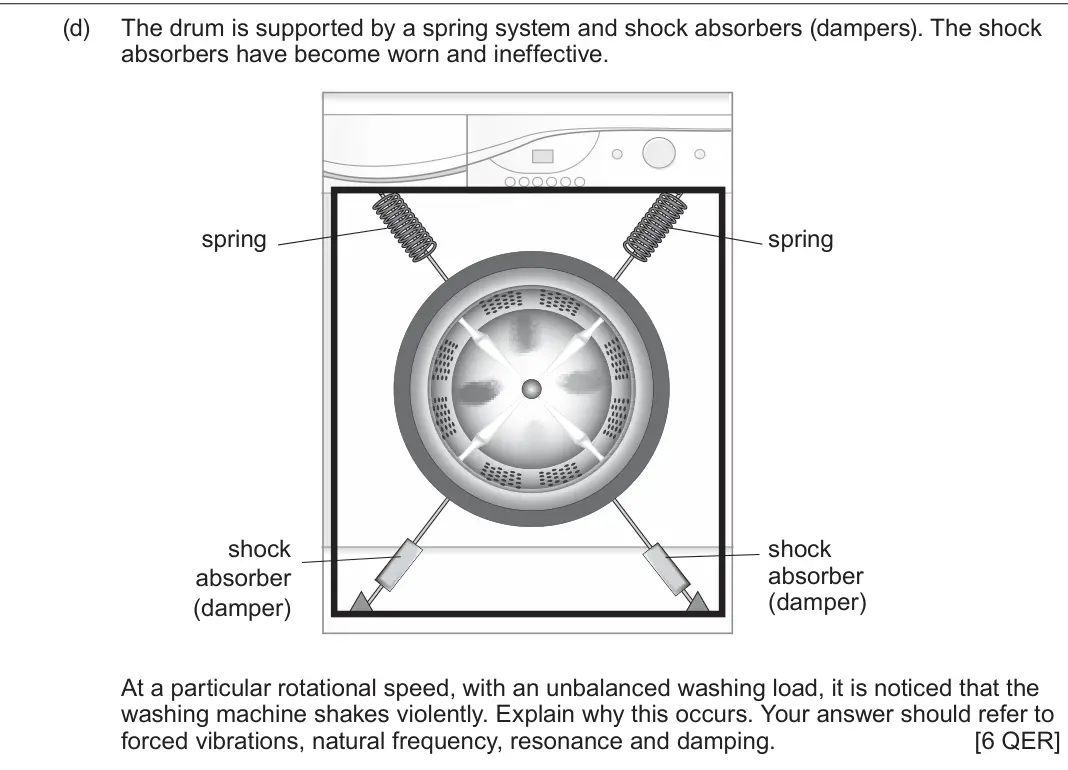
Q5(a)(i)
The whole paper ↗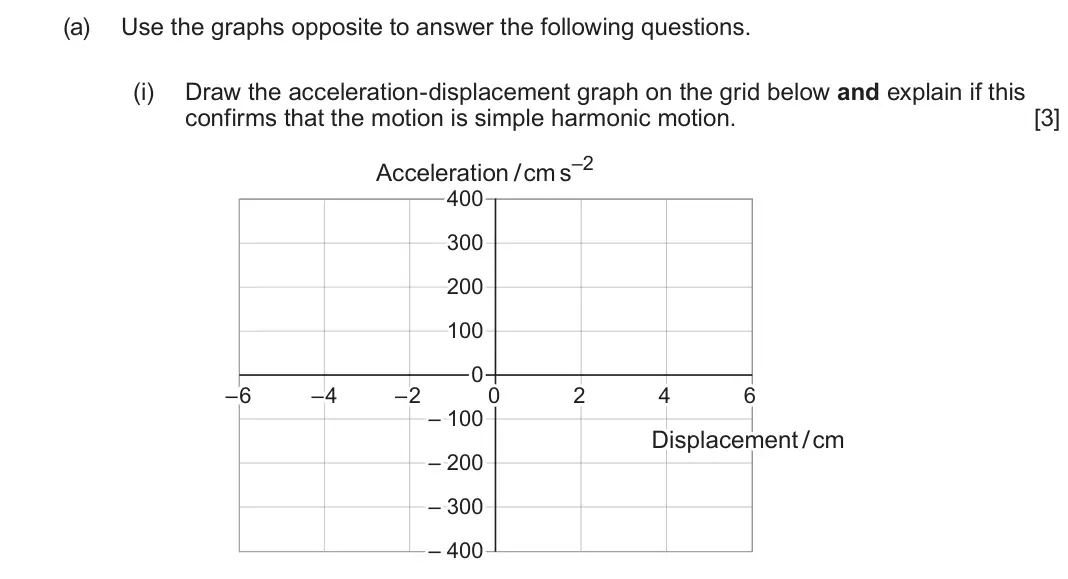
Q5(a)(ii)
The whole paper ↗
Q5(b)(ii)
The whole paper ↗
Q5(c)(ii)
The whole paper ↗
Q1(c)(ii)
The whole paper ↗
Q5(a)
The whole paper ↗
Q5(b)
The whole paper ↗
Q5(c)(i)
The whole paper ↗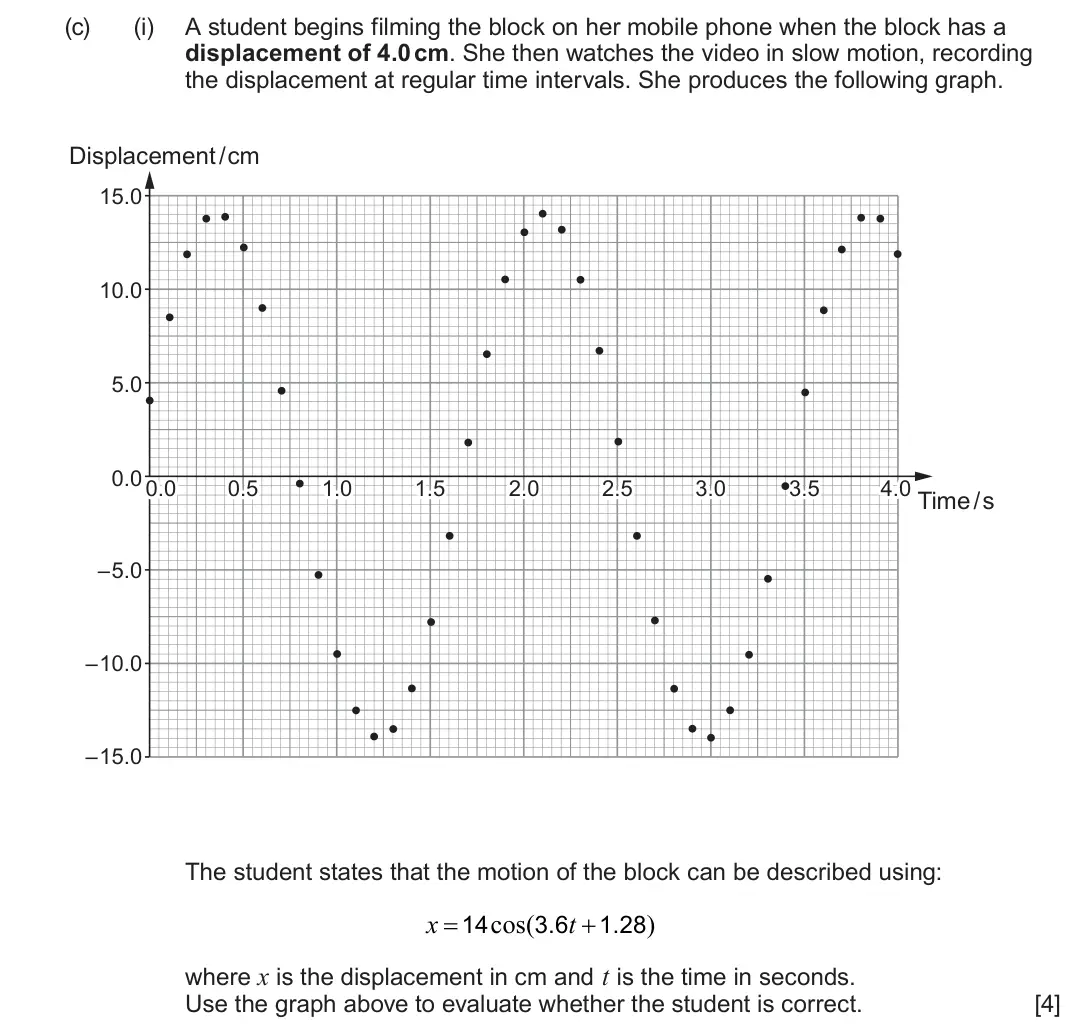
Q5(c)(ii)
The whole paper ↗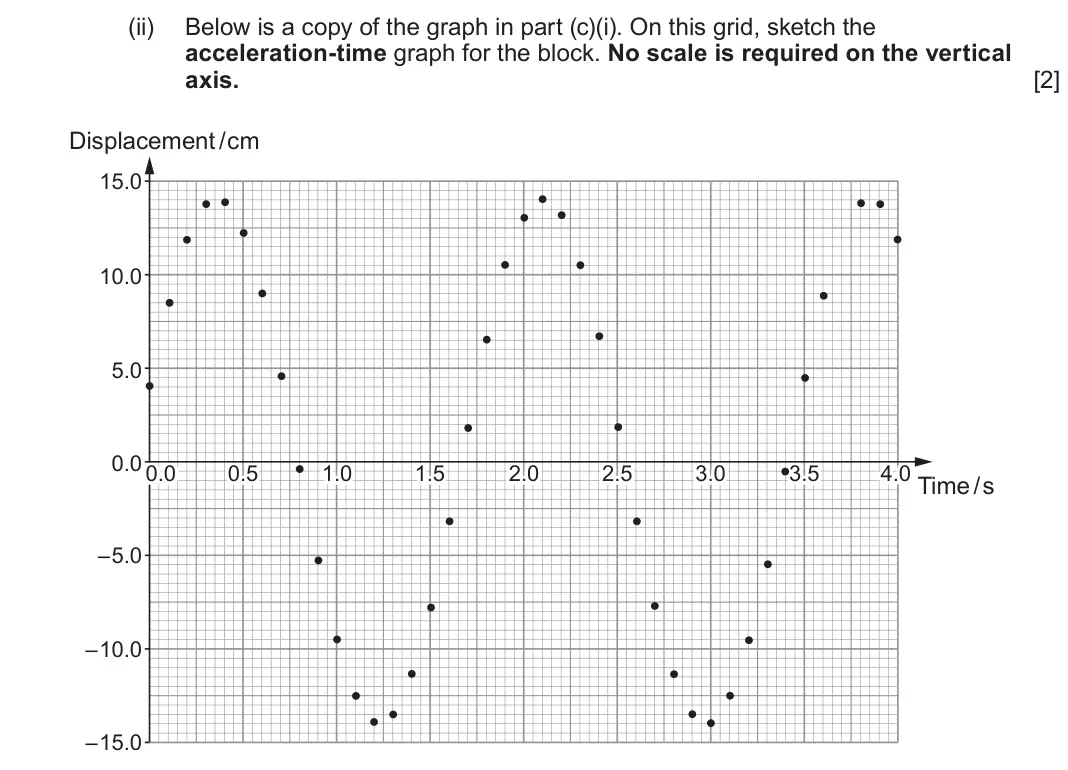
Q5(d)
The whole paper ↗
Q6(a)
The whole paper ↗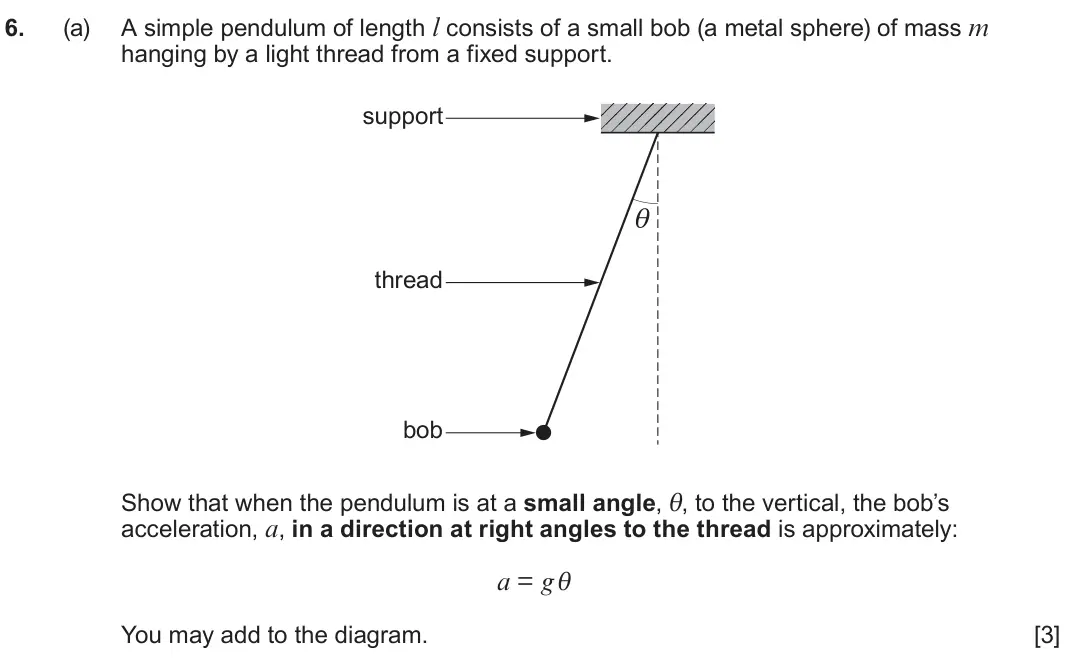
Q6(b)(i)
The whole paper ↗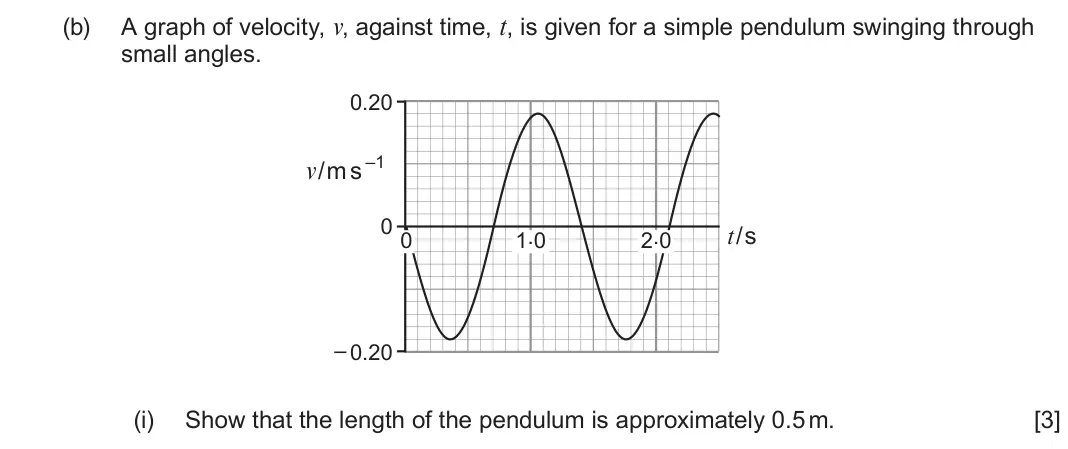
Q6(b)(ii)
The whole paper ↗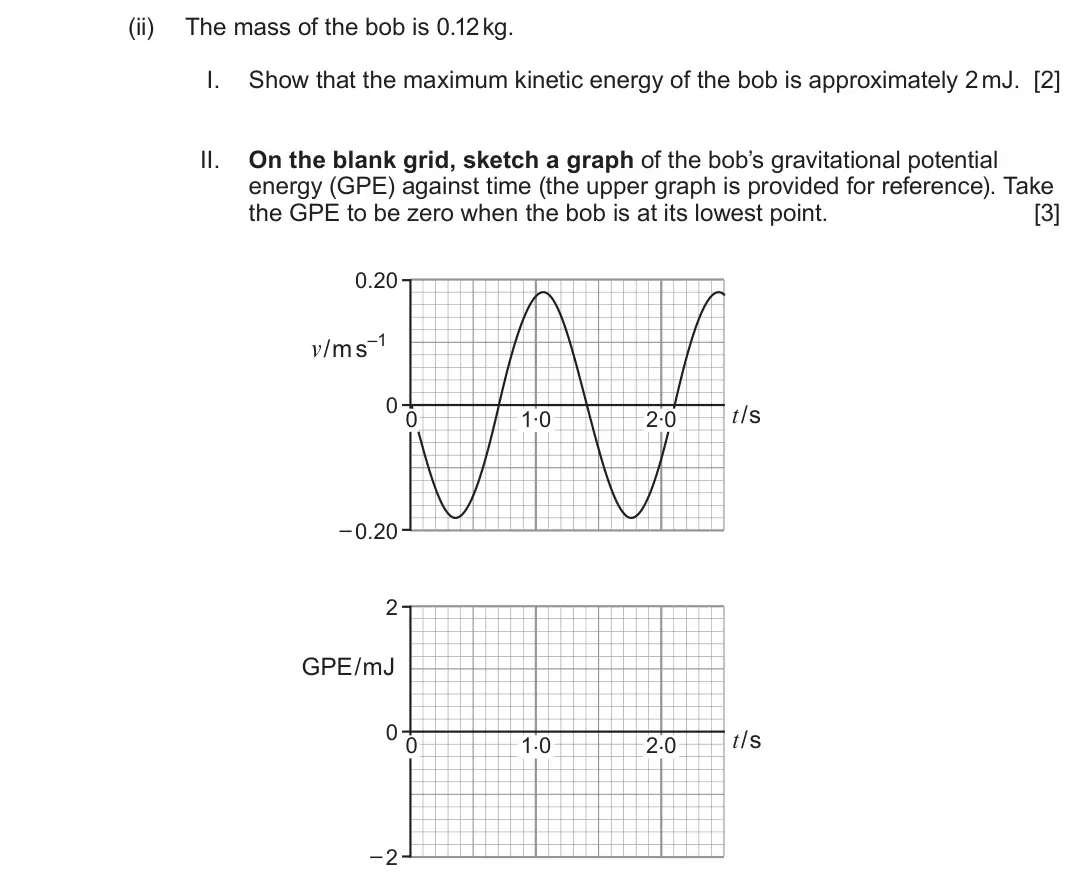
Q6(c)
The whole paper ↗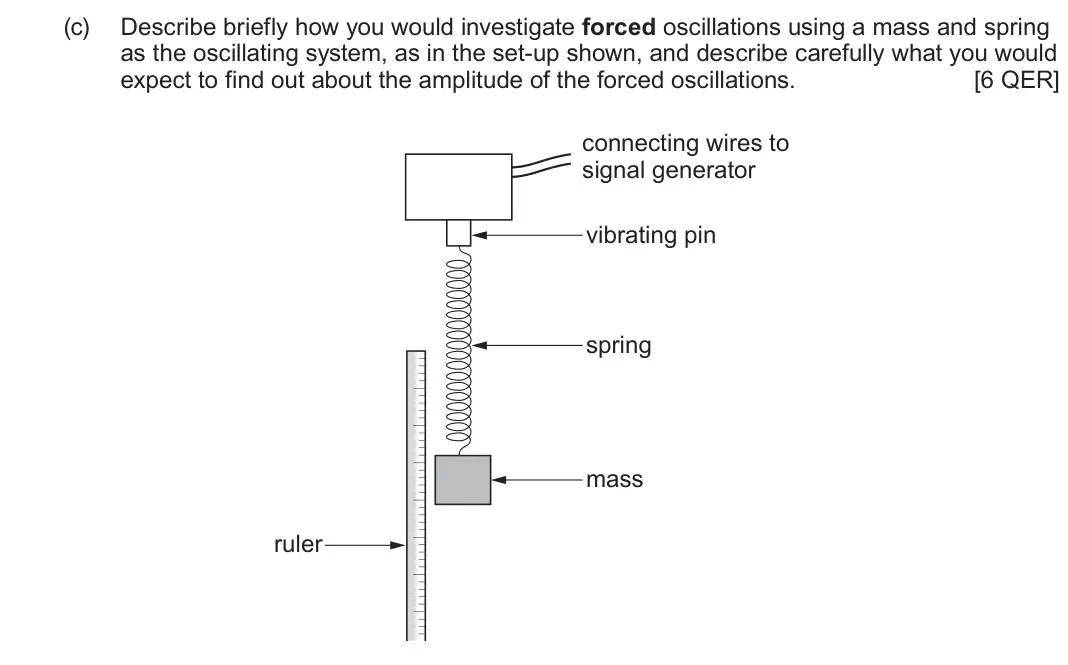
Q5(a)(i)
The whole paper ↗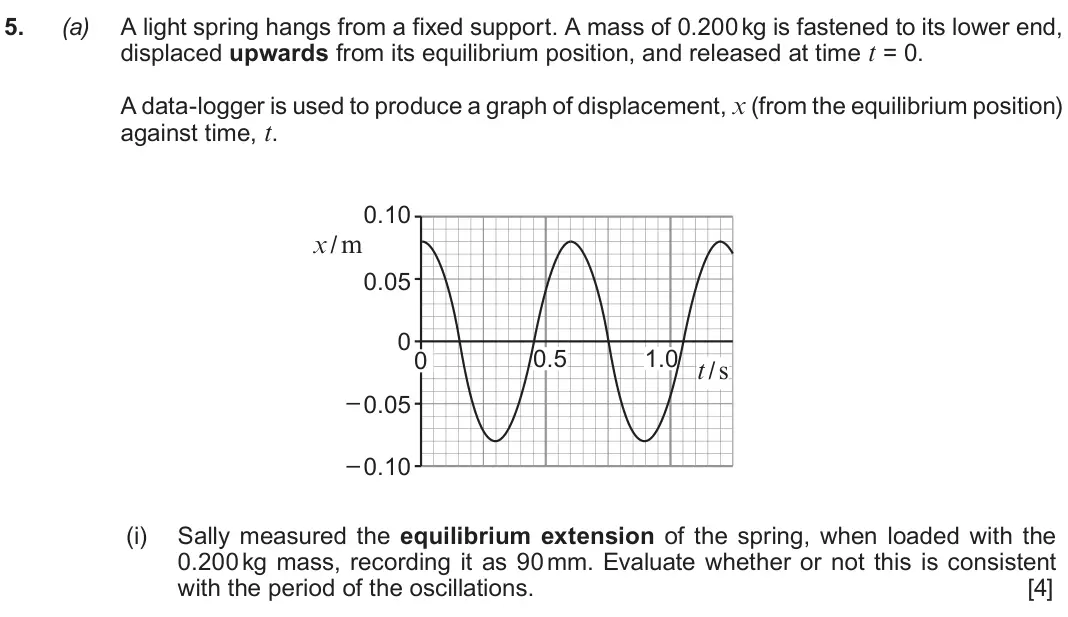
Q5(a)(ii)
The whole paper ↗
Q5(a)(iii)
The whole paper ↗
Q5(b)(i)
The whole paper ↗
Q5(b)(ii)
The whole paper ↗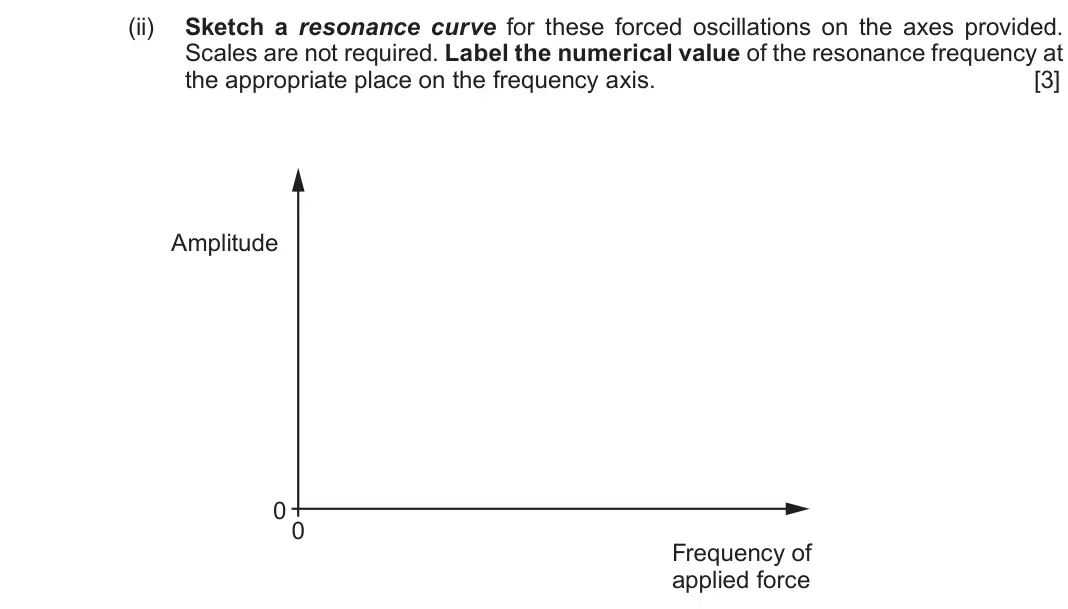
All 45 questions on Vibrations, as a list
- June 2025, Component 1, Q4(d) (6 marks): The drum is supported by a spring system and shock absorbers (dampers). The shock absorbers have become worn and ineffective. spring spring shock shock absorber
- June 2025, Component 1, Q5(a)(i) (3 marks): Draw the acceleration-displacement graph on the grid below and explain if this confirms that the motion is simple harmonic motion. [3] Acceleration /cm s–2 400
- June 2025, Component 1, Q5(a)(ii) (3 marks): Calculate the velocity of the test tube 0.32 s after its release. [3]
- June 2025, Component 1, Q5(b)(ii) (2 marks): The test tube has a cross-sectional area of 1.8 × 10⁻⁴ m2 and the density of water is 997 kg m–3. Determine the mass of the loaded test tube. [2]
- June 2025, Component 1, Q5(c)(ii) (3 marks): Determine the ratio for the loaded test tube where TE is its periodic time on T M Earth and TM is its periodic time on the Moon. [3]
- June 2025, Component 3, Q1(c)(ii) (2 marks): Calculate the maximum speed of oscillation of the water surface at this radius. [2]
- June 2024, Component 1, Q5(a) (2 marks): Define ‘simple harmonic motion’. [2]
- June 2024, Component 1, Q5(b) (2 marks): Show that the maximum displacement of the block is 14 cm. [2]
- June 2024, Component 1, Q5(c)(i) (4 marks): A student begins filming the block on her mobile phone when the block has a displacement of 4.0 cm. She then watches the video in slow motion, recording the dis
- June 2024, Component 1, Q5(c)(ii) (2 marks): Below is a copy of the graph in part (c)(i). On this grid, sketch the acceleration-time graph for the block. No scale is required on the vertical axis. [2] Disp
- June 2024, Component 1, Q5(d) (6 marks): The acceleration due to gravity, g, can be determined by conducting an experiment with a simple pendulum. Describe the experiment, including the graphical analy
- June 2023, Component 1, Q6(a) (3 marks): A simple pendulum of length l consists of a small bob (a metal sphere) of mass m hanging by a light thread from a fixed support. support θ thread bob Show that
- June 2023, Component 1, Q6(b)(i) (3 marks): Show that the length of the pendulum is approximately 0.5 m. [3]
- June 2023, Component 1, Q6(b)(ii) (5 marks): The mass of the bob is 0.12 kg. I. Show that the maximum kinetic energy of the bob is approximately 2 mJ. [2] II. On the blank grid, sketch a graph of the bob’s
- June 2023, Component 1, Q6(c) (6 marks): Describe briefly how you would investigate forced oscillations using a mass and spring as the oscillating system, as in the set-up shown, and describe carefully
- Autumn 2021, Component 1, Q5(a)(i) (4 marks): Sally measured the equilibrium extension of the spring, when loaded with the 0.200 kg mass, recording it as 90 mm. Evaluate whether or not this is consistent wi
- Autumn 2021, Component 1, Q5(a)(ii) (3 marks): I. Mark a point, P, on the graph at which the acceleration is upwards and has its greatest value. [1] II. Calculate this acceleration. [2]
- Autumn 2021, Component 1, Q5(a)(iii) (5 marks): I. Calculate the kinetic energy of the mass at t = 0.10 s. [3] II. Between t = 0 and t = 0.15 s, the mass gains kinetic energy and loses gravitational potential
- Autumn 2021, Component 1, Q5(b)(i) (2 marks): State the difference between forced oscillations and natural oscillations. [2]
- Autumn 2021, Component 1, Q5(b)(ii) (3 marks): Sketch a resonance curve for these forced oscillations on the axes provided. Scales are not required. Label the numerical value of the resonance frequency at th
- Autumn 2021, Component 1, Q5(c) (3 marks): Sally says “Damping should always be avoided because it involves energy dissipation”. Evaluate this claim. [3]
- Autumn 2021, Component 1, Q8(g) (2 marks): Paragraph 8 Read through the following article carefully. Build Your Own Strainmeter in an A-level Physics Classroom The first questions that need answering are
- Autumn 2020, Component 1, Q3(a)(i) (2 marks): State the features of the graph that show the body is performing simple harmonic motion. [2]
- Autumn 2020, Component 1, Q3(a)(ii) (1 mark): Determine the amplitude of the motion. [1]
- Autumn 2020, Component 1, Q3(a)(iii) (3 marks): Calculate the periodic time of the motion. [3]
- Autumn 2020, Component 1, Q3(b)(i) (1 mark): State why you would not expect the line of best fit to pass exactly through the origin. [1]
- Autumn 2020, Component 1, Q3(b)(ii) (6 marks): Determine a value for the acceleration due to gravity, g, together with its percentage uncertainty. Give your reasoning clearly. [6]
- Autumn 2020, Component 1, Q3(c)(i) (1 mark): What observed feature of the oscillations shows them to be damped? [1]
- Autumn 2020, Component 1, Q3(c)(ii) (2 marks): Explain in terms of forces how the damping comes about. [2]
- Autumn 2020, Component 1, Q3(d) (3 marks): Explain what is meant by critical damping, and state one application of critical damping (or of damping that is close to critical). [3]
- Autumn 2020, Component 2, Q5(c)(i) (2 marks): Calculate the period of this oscillation. [2]
- Autumn 2020, Component 2, Q5(c)(ii) (3 marks): Calculate the maximum possible velocity of the mass, m. [3]
- Autumn 2020, Component 2, Q5(c)(iii) (4 marks): Assuming the mass is released when the wire is at maximum extension without exceeding the elastic limit, sketch a graph showing how the stress in the wire varie
- June 2019, Component 1, Q5(a) (2 marks): Define simple harmonic motion. [2]
- June 2019, Component 1, Q5(b)(i) (3 marks): Calculate the stiffness constant, k, of the spring. [3]
- June 2019, Component 1, Q5(b)(ii) (3 marks): Calculate the maximum kinetic energy of the sphere. [3]
- June 2019, Component 1, Q5(b)(iii) (3 marks): Carefully sketch a graph of the sphere’s kinetic energy against time on the axes provided on the opposite page. A vertical scale is not needed. [3]
- June 2019, Component 1, Q5(c) (5 marks): Over several oscillations it is clear that the amplitude of the sphere’s motion is decreasing. Evgeniya suspects that the amplitude is decreasing exponentially,
- June 2018, Component 1, Q5(a)(i) (2 marks): Calculate the length of the pendulum. [2]
- June 2018, Component 1, Q5(a)(ii) (7 marks): Rachel now displaces the sphere by 0.050 m to one side of its equilibrium position and releases it at time t = 0 0.05 x / m 0 0 1 2 3 t / s –0.05 I. Sketch a gr
- June 2018, Component 1, Q5(b) (6 marks): Explain what is meant by resonance, and how its effects can be reduced in a particular case where resonance should be avoided. [6 QER]
- June 2017, Component 1, Q4(a) (2 marks): State what feature of the graph shows that the sphere’s oscillations are damped and identify the force responsible for this feature. [2]
- June 2017, Component 1, Q4(b) (4 marks): Evaluate whether or not ordinary simple harmonic motion theory predicts the actual periodic time as shown on the graph convincingly. [4]
- June 2017, Component 1, Q4(c) (4 marks): Mark with a small circle the point on the graph where the sphere’s speed is the greatest. Use shm theory to calculate a value for this speed and explain whether
- June 2017, Component 1, Q4(d) (2 marks): The amplitude, A, (in m) of the oscillations at time t is given by the equation: A = 0.020 e–λ t Determine the value of λ. [2]
Questions, mark schemes and examiner’s reports are © WJEC Eduqas, from their published past papers. Plumi isn’t affiliated with any exam board. Want whole papers? Every Eduqas A-Level Physics paper.
Rather write your answers by hand on iPad? Plumi marks them against the same mark schemes.