 plumi
Kinetic theory: Eduqas A‑Level Physics questions
Every Eduqas A-Level Physics exam question on 1.7 Kinetic theory, 2016–2025, with its mark scheme and examiner’s report.
Find questions1,592
Calculations
Q6(a)
The whole paper ↗
Q6(b)
The whole paper ↗
Q6(c)
The whole paper ↗
Q8(c)
The whole paper ↗
Q6(a)
The whole paper ↗
Q6(b)(i)
The whole paper ↗
Q6(b)(ii)
The whole paper ↗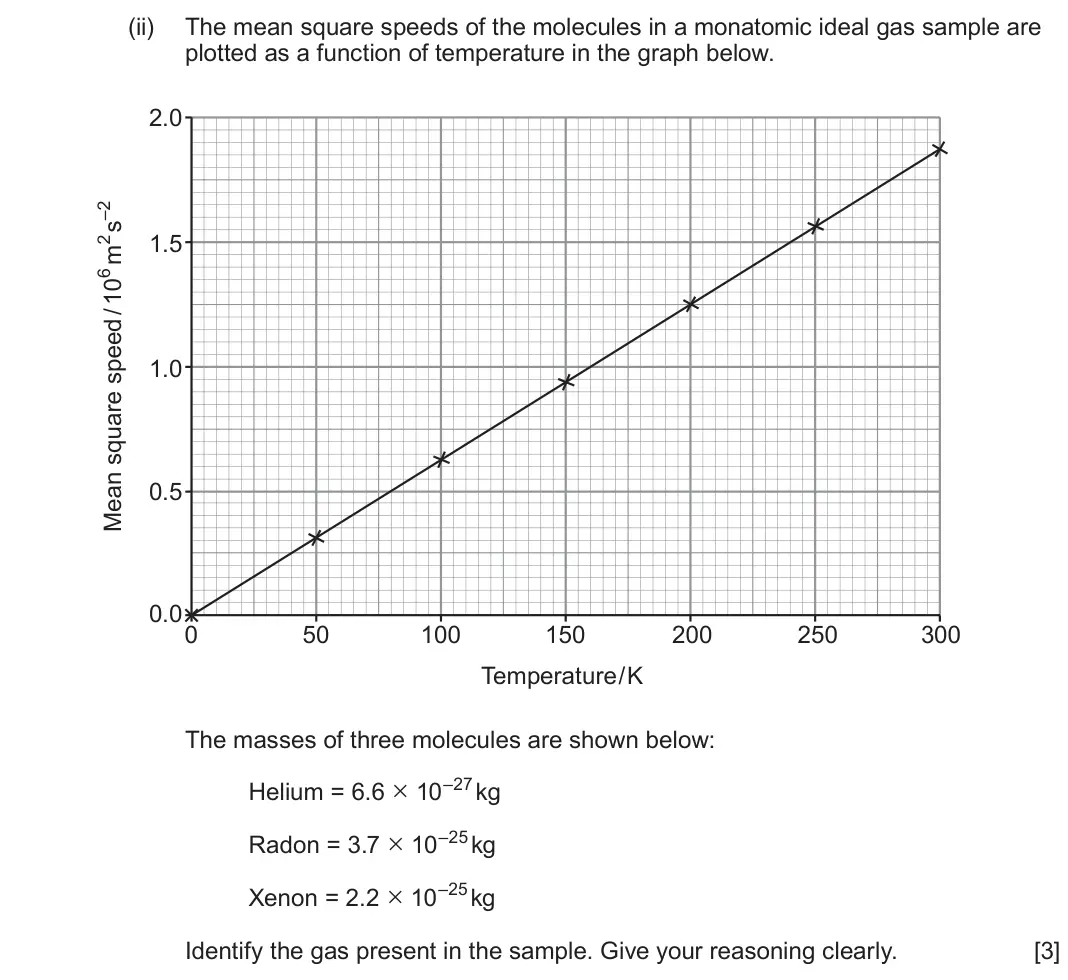
Q7(a)
The whole paper ↗
Q7(b)(iii)
The whole paper ↗
Q4(b)(i)
The whole paper ↗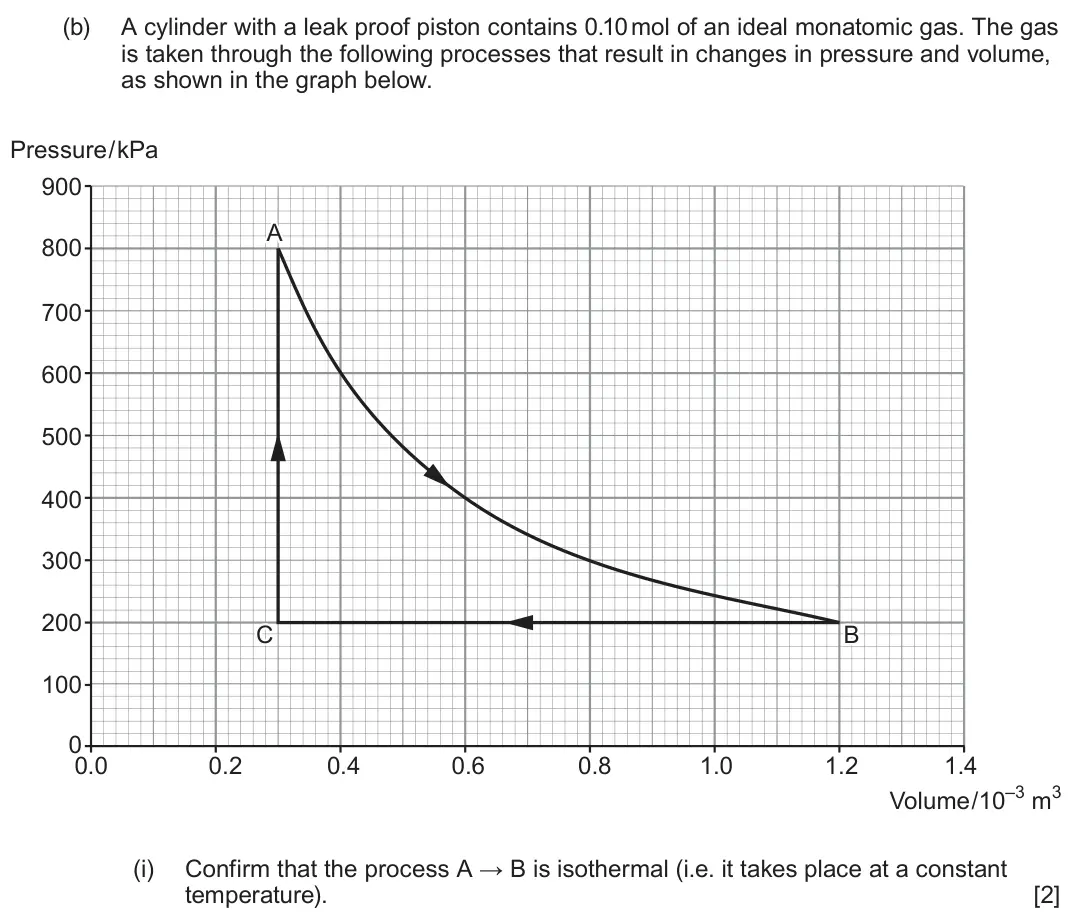
Q7(a)
The whole paper ↗
Q7(b)
The whole paper ↗
Q7(c)
The whole paper ↗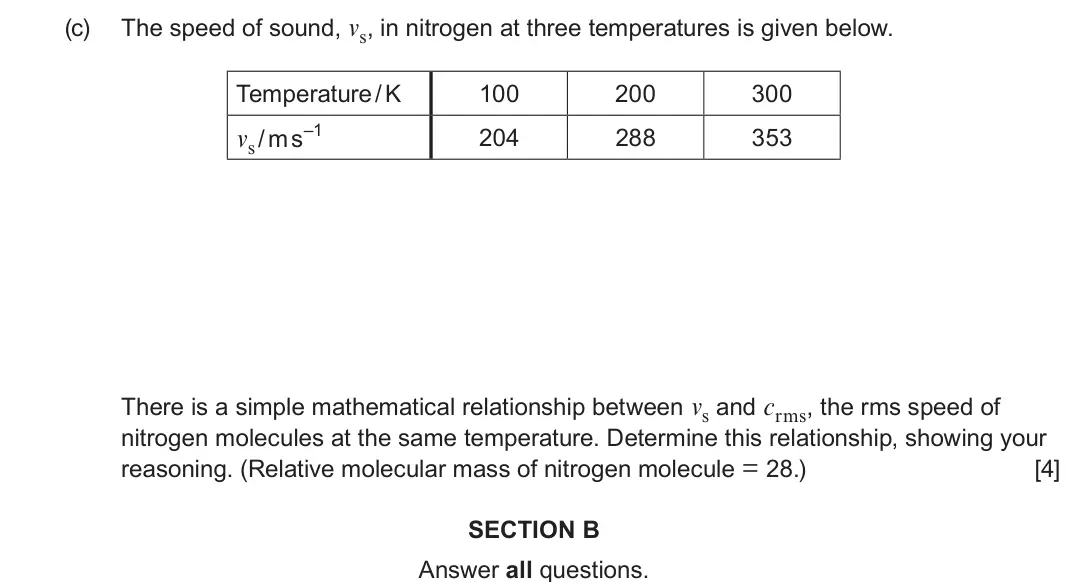
Q6(a)
The whole paper ↗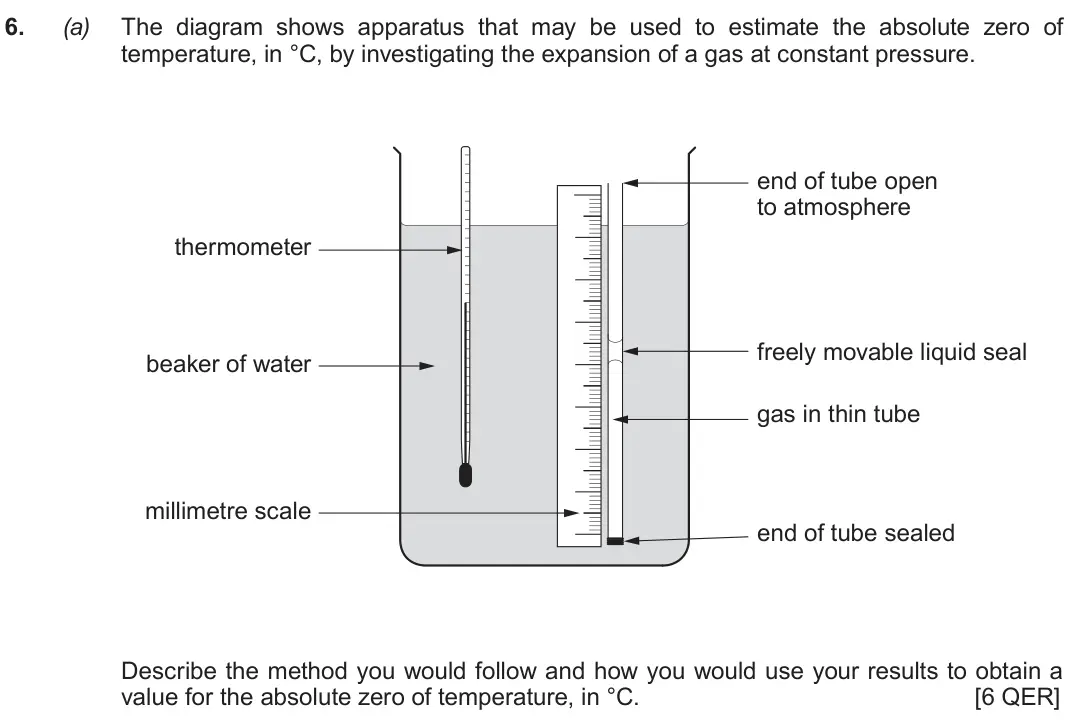
Q6(b)(i)
The whole paper ↗
Q6(b)(ii)
The whole paper ↗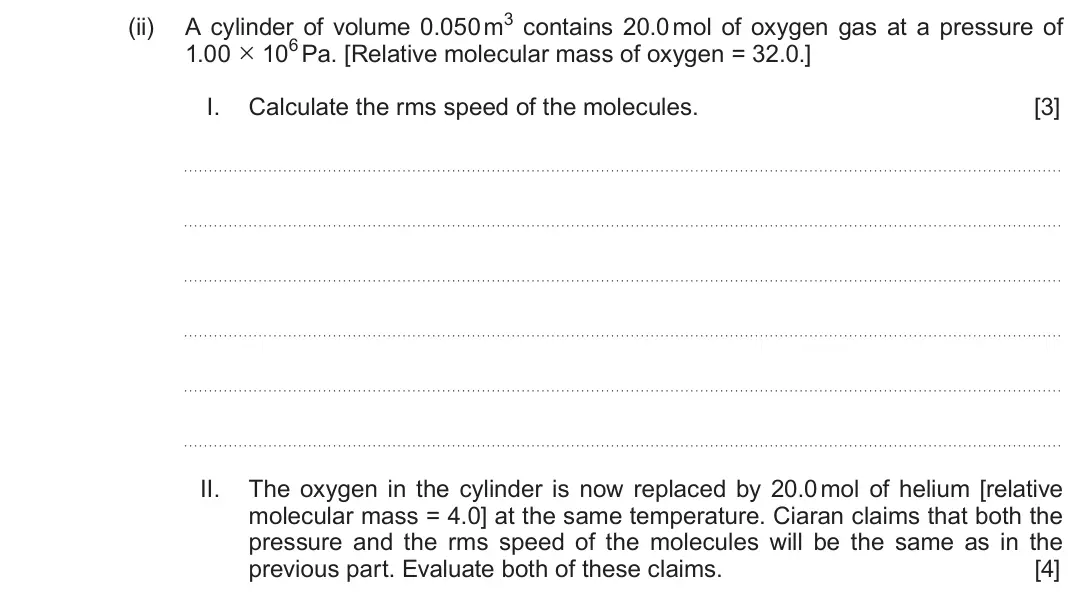
Q7(a)
The whole paper ↗
Q5(a)(i)
The whole paper ↗
Q5(a)(ii)
The whole paper ↗
Q5(b)(i)
The whole paper ↗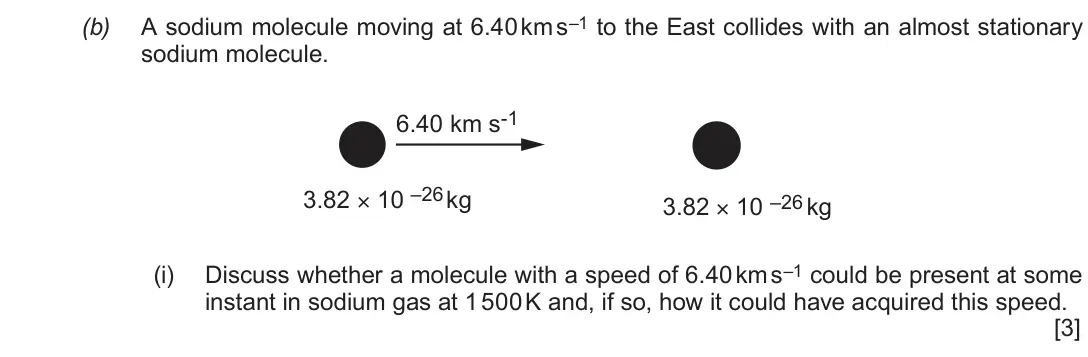
All 35 questions on Kinetic theory, as a list
- June 2025, Component 1, Q6(a) (2 marks): Calculate the mean kinetic energy of argon molecules at a temperature of 20 °C. [2]
- June 2025, Component 1, Q6(b) (4 marks): Determine the root mean square (rms) speed of argon molecules at this temperature. [4]
- June 2025, Component 1, Q6(c) (3 marks): Neon has a relative molecular mass of 20. Without further calculations, compare the following properties of neon with that of argon at 20 °C: • mean molecular k
- June 2025, Component 1, Q8(c) (3 marks): Read through the following article carefully. Paragraph Laser Fusion 1 Apart from the hydrogen fusion bomb, which actually requires a fission bomb to detonate i
- June 2024, Component 1, Q6(a) (1 mark): Define the ‘mole’. [1]
- June 2024, Component 1, Q6(b)(i) (3 marks): Use the ideal gas equation and pV Nmc 2 to show that, for one mole, the 3 3 total translational kinetic energy is given by RT . [3] 2
- June 2024, Component 1, Q6(b)(ii) (3 marks): The mean square speeds of the molecules in a monatomic ideal gas sample are plotted as a function of temperature in the graph below. 2.0 1.5 1.0 0.5 0.0 0 50 10
- June 2024, Component 1, Q7(a) (3 marks): Confirm that the change AB occurs at a constant temperature. [3]
- June 2024, Component 1, Q7(b)(iii) (4 marks): By considering the motion of the gas molecules, explain: • how a gas exerts a pressure on the walls of its container • why the pressure increases as temperature
- June 2023, Component 1, Q4(b)(i) (2 marks): Confirm that the process A → B is isothermal (i.e. it takes place at a constant temperature). [2]
- June 2023, Component 1, Q7(a) (3 marks): Explain why, according to the kinetic theory, a gas exerts a pressure on the walls of its container. You will need to use the idea of momentum as well as that o
- June 2023, Component 1, Q7(b) (2 marks): At one instant, three molecules in a sample of a gas have speeds in m s–1 of 394, 453 and 527 Calculate their rms speed. [2]
- June 2023, Component 1, Q7(c) (4 marks): The speed of sound, vs, in nitrogen at three temperatures is given below. Temperature / K 100 200 300 vs / m s–1 204 288 353 There is a simple mathematical rela
- Autumn 2021, Component 1, Q6(a) (6 marks): The diagram shows apparatus that may be used to estimate the absolute zero of temperature, in °C, by investigating the expansion of a gas at constant pressure.
- Autumn 2021, Component 1, Q6(b)(i) (2 marks): One assumption of the kinetic theory of ideal gases is that a gas consists of particles (molecules) in rapid random, translational, motion. State two other assu
- Autumn 2021, Component 1, Q6(b)(ii) (7 marks): A cylinder of volume 0.050 m3 contains 20.0 mol of oxygen gas at a pressure of 1.00 × 10⁶ Pa. [Relative molecular mass of oxygen = 32.0.] I. Calculate the rms s
- Autumn 2021, Component 1, Q7(a) (3 marks): Calculate the temperatures of the gas at A and at B. [3]
- Autumn 2020, Component 1, Q5(a)(i) (2 marks): Show that the mean kinetic energy of (monatomic) gas molecules at a temperature of 1 500 K is approximately 3 × 10–20 J. [2]
- Autumn 2020, Component 1, Q5(a)(ii) (2 marks): At 1 500 K, sodium is a gas of monatomic molecules, each of mass 3.82 × 10⁻²⁶ kg. Calculate their rms speed. [2]
- Autumn 2020, Component 1, Q5(b)(i) (3 marks): Discuss whether a molecule with a speed of 6.40 km s–1 could be present at some instant in sodium gas at 1 500 K and, if so, how it could have acquired this spe
- Autumn 2020, Component 1, Q6(a)(i) (3 marks): A cylinder of gas fitted with a pressure gauge is surrounded by melting ice. The gas pressure stabilises at 96 kPa. The cylinder is then surrounded instead by b
- Autumn 2020, Component 1, Q6(b)(i) (3 marks): Show clearly that the gas is at the same temperature at A and C, and determine this temperature. [3]
- Autumn 2020, Component 2, Q8(c)(iii) (2 marks): The temperature of the photosphere of the star is 7 100 K. Calculate the mean kinetic energy of particles in the photosphere. Give your answer in eV. [2]
- June 2019, Component 1, Q6(a)(ii) (2 marks): Determine the number of atoms per m3 of copper. The uncertainty is not required. The atomic mass of copper is 63.5 u. [2]
- June 2019, Component 1, Q6(b)(i) (5 marks): I. Calculate the number of molecules per m3 for a gas (assumed to be ideal) at a temperature of 15 °C and a pressure of 101 kPa. [3] II. When asked why there ar
- June 2019, Component 1, Q6(b)(ii) (4 marks): I. Two gases have molecular masses m(1) and m(2). Show clearly that when the gases are at the same temperature, the ratio of the rms speeds of their molecules i
- June 2018, Component 1, Q7(a) (2 marks): State two assumptions that must be made about the molecules of an ideal gas in order to derive the kinetic theory equation: [2] p = ρ c2 1 3
- June 2018, Component 1, Q7(b)(i) (3 marks): Calculate the rms speed of the argon molecules. [3]
- June 2018, Component 1, Q7(b)(ii) (3 marks): I. State what would happen to the rms speed if the kelvin temperature of the gas in the cylinder were doubled, justifying your answer. [2] II. Explain briefly w
- June 2018, Component 1, Q8(a)(i) (3 marks): Show that the expansion occurs at a constant temperature of approximately 360 K. [3]
- June 2018, Component 1, Q9(b) (2 marks): Calculate the temperature at which electrons are expected to have an rms speed of 100 km s–1 (see Equation 1). [2]
- June 2018, Component 1, Q9(g) (4 marks): Explain why resistivity should be proportional to the square root of temperature (see paragraph 8 and Equation 9). [4]
- June 2017, Component 1, Q5(a) (6 marks): Explain, in terms of molecules, how a gas exerts a pressure on the walls of its container, and why this pressure increases with temperature. [6 QER]
- June 2017, Component 1, Q5(b)(i) (3 marks): the rms speed of the molecules; [3]
- June 2017, Component 1, Q5(b)(ii) (3 marks): the temperature of the gas. [3]
Questions, mark schemes and examiner’s reports are © WJEC Eduqas, from their published past papers. Plumi isn’t affiliated with any exam board. Want whole papers? Every Eduqas A-Level Physics paper.
Rather write your answers by hand on iPad? Plumi marks them against the same mark schemes.