 plumi
Formulae and equations by experiment; molar volume of a gas (Core Practical 1): Edexcel International A Level Chemistry questions
Edexcel International A Level Chemistry past-paper questions on 1.2.5 Formulae and equations by experiment; molar volume of a gas (Core Practical 1), 2019–2025, with mark schemes and examiner’s reports where available.
Paper
All papers
Exam
All years
Calculations
Q17(a)
The whole paper ↗
Q2(a)
The whole paper ↗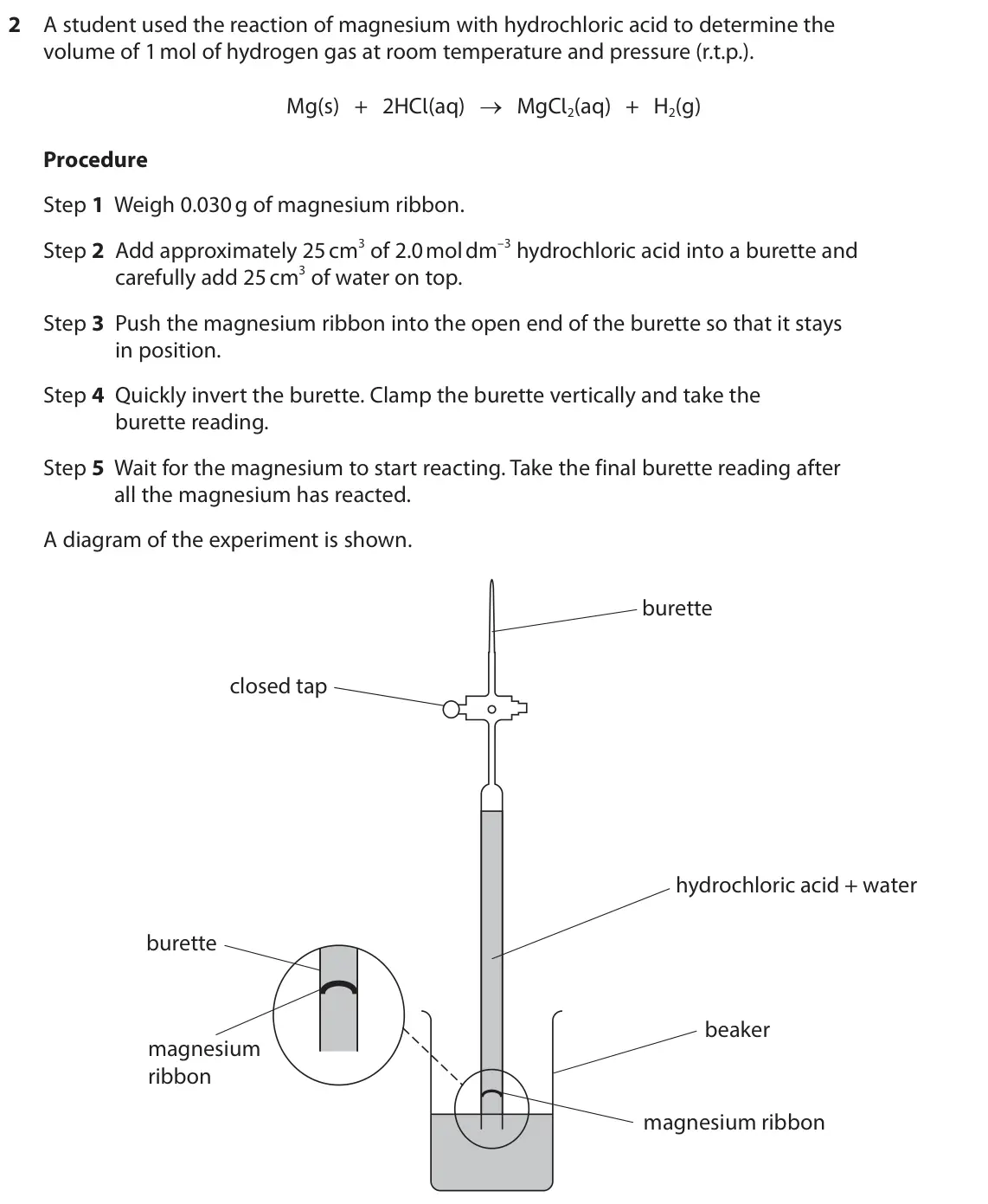
Q2(b)
The whole paper ↗Q2(c)
The whole paper ↗Q2(d)
The whole paper ↗Q2(e)
The whole paper ↗Q2(f)(ii)
The whole paper ↗Q17(a)(i)
The whole paper ↗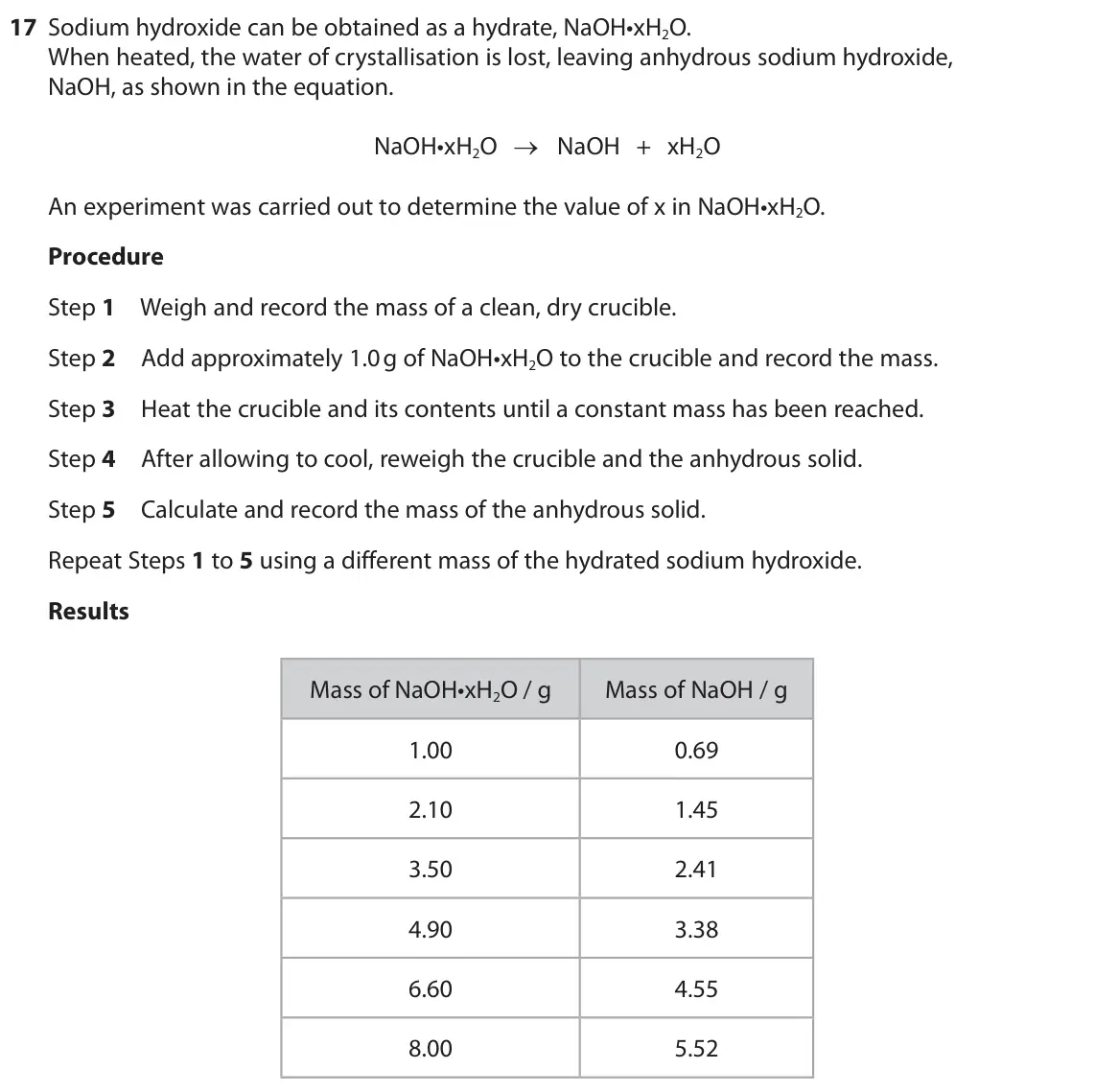
Q17(a)(ii)
The whole paper ↗Q17(a)(iii)
The whole paper ↗Q16(a)(i)
The whole paper ↗
Q16(a)(ii)
The whole paper ↗Q1(a)
The whole paper ↗
Q1(c)(i)
The whole paper ↗Q1(c)(ii)
The whole paper ↗Q1(a)
The whole paper ↗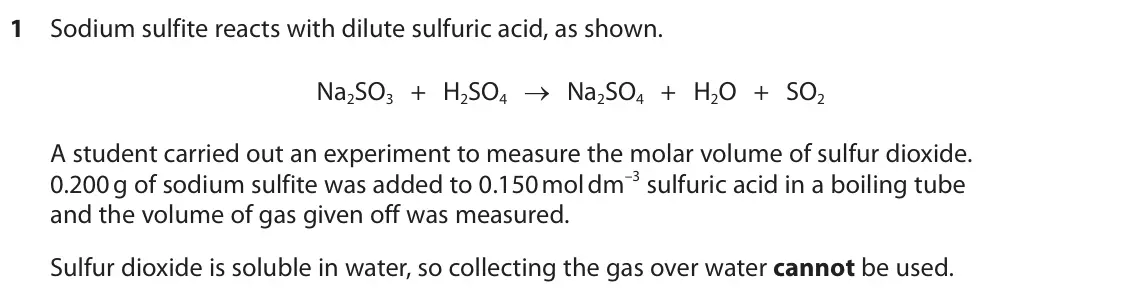
Q1(c)
The whole paper ↗Q1(d)(ii)
The whole paper ↗Q2(a)
The whole paper ↗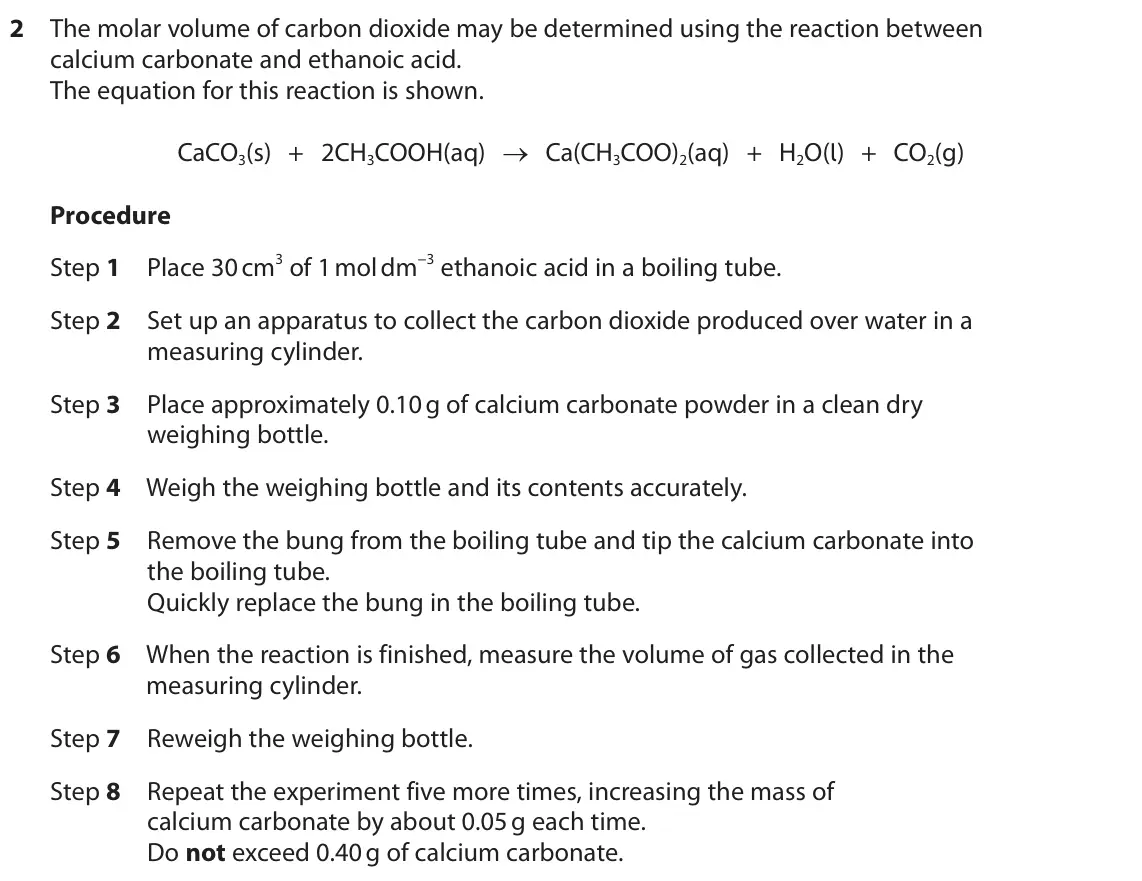
Q2(b)
The whole paper ↗
All 48 questions on Formulae and equations by experiment; molar volume of a gas (Core Practical 1), as a list
- June 2025, AS Unit 2, Q17(a) (7 marks): The value of n in a sample of a hydrated magnesium carbonate, MgCO3∙nH2O , can be determined by the reaction with hydrochloric acid. The equation for the reacti
- January 2025, AS Unit 3, Q2(a) (3 marks): Explain why the volume of hydrochloric acid added to the burette in Step 2 does not need to be exact. You must include a calculation. (3)
- January 2025, AS Unit 3, Q2(b) (1 mark): State why the magnesium does not start reacting as soon as the burette is inverted in Step 4. (1)
- January 2025, AS Unit 3, Q2(c) (2 marks): The diagram shows the burette readings from Steps 4 and 5. Burette reading from Step 4 Burette reading from Step 5 Record the burette readings, and hence the vo
- January 2025, AS Unit 3, Q2(d) (2 marks): Calculate the volume of 1 mol of hydrogen gas at r.t.p., in cm3, using your answer to (c), the reaction equation and the mass of magnesium (0.030 g) used in the
- January 2025, AS Unit 3, Q2(e) (2 marks): The magnesium ribbon used in Step 1 contained a magnesium oxide impurity of up to 2% by mass. Explain whether this magnesium oxide impurity could account for an
- January 2025, AS Unit 3, Q2(f)(ii) (1 mark): The student wanted to reduce the percentage uncertainty by using double the mass of magnesium. Give the reason why the experiment outlined in the procedure coul
- October 2024, AS Unit 1, Q17(a)(i) (3 marks): Complete a graph of the results by • plotting the points • labelling the axes • including a straight line of best fit. (3) 8 7 6 5 4 3 2 1 0 0 1 2 3 4 5 6 7 8
- October 2024, AS Unit 1, Q17(a)(ii) (1 mark): Use your graph to determine the mass of NaOH•xH2O needed to form 4.0 g of NaOH. You must show your working on the graph. (1)
- October 2024, AS Unit 1, Q17(a)(iii) (3 marks): Calculate the value of x in NaOH•xH2O using your answer to (a)(ii) and the equation for the reaction. NaOH•xH2O → NaOH + xH2O (3)
- October 2024, AS Unit 2, Q16(a)(i) (1 mark): State how you could ensure that all the water had been removed from the crystals. (1)
- October 2024, AS Unit 2, Q16(a)(ii) (3 marks): Calculate the number of water molecules of crystallisation, x, in the formula of this sample of hydrated magnesium sulfate. (3)
- June 2024, AS Unit 3, Q1(a) (3 marks): A student used the apparatus shown to collect the gas produced from the reaction between copper(II) carbonate and sulfuric acid. inverted 250 cm3 measuring cyli
- June 2024, AS Unit 3, Q1(c)(i) (2 marks): Give two reasons why the second set of apparatus gives a more accurate measurement of the volume of gas given off. Justify your answers. (2)
- June 2024, AS Unit 3, Q1(c)(ii) (3 marks): The reaction of 0.320 g of the Group 2 metal carbonate resulted in 89.0 cm3 of carbon dioxide gas being collected in the gas syringe. MCO3(s) + 2HCl(aq) → MCl2(
- June 2024 (R), AS Unit 3, Q1(a) (1 mark): Complete the diagram to show the apparatus that could be used to measure the volume of gas. (1) 0.150 mol dm–3 sulfuric acid and 0.200 g sodium sulfite
- June 2024 (R), AS Unit 3, Q1(c) (2 marks): The reaction produced 29.5 cm3 of sulfur dioxide. Calculate the molar volume of sulfur dioxide, in dm3, from this result. (2)
- June 2024 (R), AS Unit 3, Q1(d)(ii) (1 mark): Suggest another reason for the molar volume being lower than expected. (1)
- October 2023, AS Unit 3, Q2(a) (3 marks): Draw a diagram of the apparatus used to carry out the reaction and collect the carbon dioxide produced over water in a 100 cm3 measuring cylinder. Do not show s
- October 2023, AS Unit 3, Q2(b) (2 marks): Explain why ethanoic acid is used and not hydrochloric acid. (2)
- October 2023, AS Unit 3, Q2(c) (1 mark): A student suggested that the mass of calcium carbonate could be measured by weighing the weighing bottle empty and then when containing the solid. Give a reason
- October 2023, AS Unit 3, Q2(d)(i) (3 marks): Plot the data on the grid. (3) 0 0
- October 2023, AS Unit 3, Q2(d)(ii) (2 marks): Use the graph to determine the volume of carbon dioxide formed when 0.25 g of calcium carbonate is used. You must show your working on the graph. (2)
- October 2023, AS Unit 3, Q2(d)(iii) (3 marks): Calculate a value for the molar volume of carbon dioxide, using your volume from (d)(ii) and the equation for the reaction. (3)
- October 2023, AS Unit 3, Q2(e) (2 marks): Give two reasons why the molar volume obtained by this method is lower than the Data Booklet value. Assume that the experiment is carried out correctly and that
- June 2023, AS Unit 3, Q4(a)(ii) (4 marks): Calculate the value for the molar volume of hydrogen under these conditions, using the student’s results. Give your answer to an appropriate number of significa
- June 2023, AS Unit 3, Q4(b)(i) (1 mark): Calculate the percentage error in this student’s value. The data book value for the molar volume of hydrogen under these conditions is 23.9 dm3 mol–1. (1)
- June 2023, AS Unit 3, Q4(b)(ii) (2 marks): Give two possible reasons why this student obtained a value below the data book value. Assume the method was followed correctly and there were no measurement er
- October 2022, AS Unit 3, Q3(a)(ii) (1 mark): State why the height of the precipitate becomes approximately constant. (1)
- October 2022, AS Unit 3, Q3(b)(i) (2 marks): Determine the minimum volume of nitrate solution needed to react completely with 5.0 cm3 of potassium iodide solution. You must show your working on the graph.
- October 2022, AS Unit 3, Q3(b)(iv) (4 marks): Identify X by using your answers to (b)(i), (b)(ii) and (b)(iii) to determine the Mr of the metal nitrate. You must show all your working. (4)
- October 2022, Unit 6, Q1(b) (4 marks): Another cobalt salt, CoCl2.xH2O(s), decomposes when heated. CoCl2.xH2O(s) → CoCl2(s) + xH2O(g) Devise an outline procedure to determine the mass of water produc
- June 2022, AS Unit 1, Q5 (1 mark): Ten test tubes, each containing 1.0 cm3 of a chromium chloride solution of concentration 0.1 mol dm−3, were placed in a test tube rack. Different volumes of sil
- June 2022, AS Unit 1, Q19(a)(iii) (3 marks): Use your answers to (a)(i) and (a)(ii) to write the ionic equation for the reaction of iron with iron(III) chloride. Include state symbols. You must show your w
- January 2022, AS Unit 1, Q19(b) (2 marks): The correct value of x is greater than the value calculated in (a) (ii). Suggest a way of improving the method to obtain a more accurate result, using the same
- January 2022, AS Unit 3, Q3(a)(ii) (1 mark): Give a possible reason why it is necessary to add sodium sulfate solution. Justify your answer. (1)
- January 2022, AS Unit 3, Q3(b) (1 mark): Suggest why the red precipitate of silver chromate(VI) only forms after all the chloride ions have reacted. (1)
- January 2022, AS Unit 3, Q3(c)(i) (2 marks): Complete the table and use the concordant results to calculate the mean titre. (2)
- January 2022, AS Unit 3, Q3(c)(ii) (5 marks): Determine the value of x in the formula of the hydrated salt, BaCl2 · x H2O. Use information from the procedure and your mean titre from (c)(i). You must show y
- June 2021, AS Unit 1, Q24(e) (5 marks): When 6.95 g of FeSO4.xH2O is heated, 2.00 g of iron(III) oxide, 0.80 g of sulfur dioxide and 1.00 g of sulfur trioxide are produced. The only other product is w
- June 2019, AS Unit 1, Q21(b)(i) (3 marks): Plot a graph of these results. (3)
- June 2019, AS Unit 1, Q21(b)(ii) (1 mark): A student carried out a further experiment using a different mass of magnesium carbonate. Give the volume of gas collected using the inverted measuring cylinder
- June 2019, AS Unit 1, Q21(b)(iii) (1 mark): Determine the mass of magnesium carbonate added in the experiment in (ii), using your graph. (1)
- June 2019, AS Unit 1, Q21(b)(iv) (4 marks): Calculate the molar volume of carbon dioxide using your answers to parts (b)(ii) and (b)(iii). Give your value to an appropriate number of significant figures a
- June 2019, AS Unit 1, Q21(b)(v) (2 marks): The acid must be in excess for each experiment. Calculate the minimum concentration of hydrochloric acid needed for 30 cm3 of acid to completely react with 0.25
- June 2019, AS Unit 1, Q21(c) (2 marks): The value of molar volume calculated in (b)(iv) was lower than the student expected. Give two reasons for the value being lower than expected. Assume that the c
- June 2019, AS Unit 2, Q20(a)(i) (1 mark): State why the student used a warm oven to remove the water from the hydrated salt, rather than direct heating with a Bunsen burner. (1)
- June 2019, AS Unit 2, Q20(a)(ii) (4 marks): Use the data obtained by the student to calculate the value of x. You must show your working. (4)
Questions, mark schemes and examiner’s reports are © Pearson Edexcel, from their published past papers. Plumi isn’t affiliated with any exam board. Want whole papers? Edexcel International A Level Chemistry past papers.
The Plumi iPad app also offers exam-style questions with AI feedback on your handwritten working.