 plumi
Percentage yield and atom economy: Edexcel International A Level Chemistry questions
Edexcel International A Level Chemistry past-paper questions on 1.2.4 Percentage yield and atom economy, 2019–2025, with mark schemes and examiner’s reports where available.
Paper
All papers
Exam
All years
Calculations
- Your answer
- Your answer
Q22(c)
The whole paper ↗
Q18(d)(ii)
The whole paper ↗
Q4(g)
The whole paper ↗
Q15(b)
The whole paper ↗ Your answer
- Your answer
- Your answer
Q16(b)
The whole paper ↗ Your answer
Q4(f)
The whole paper ↗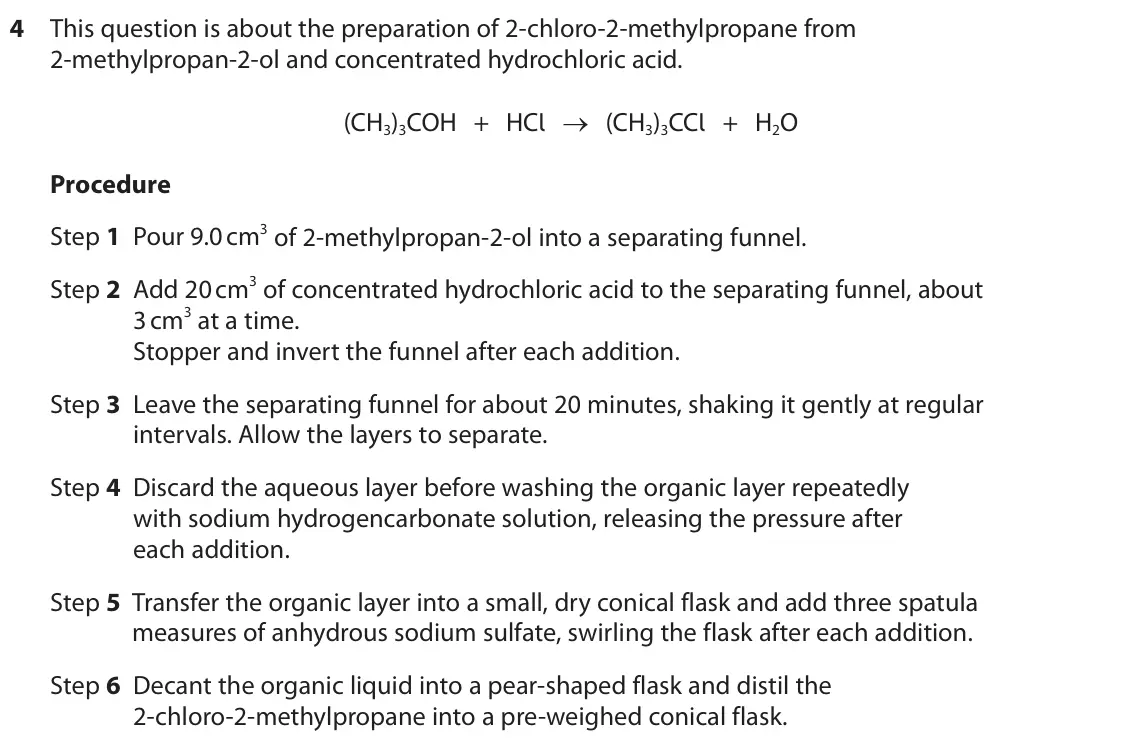
Q20(a)
The whole paper ↗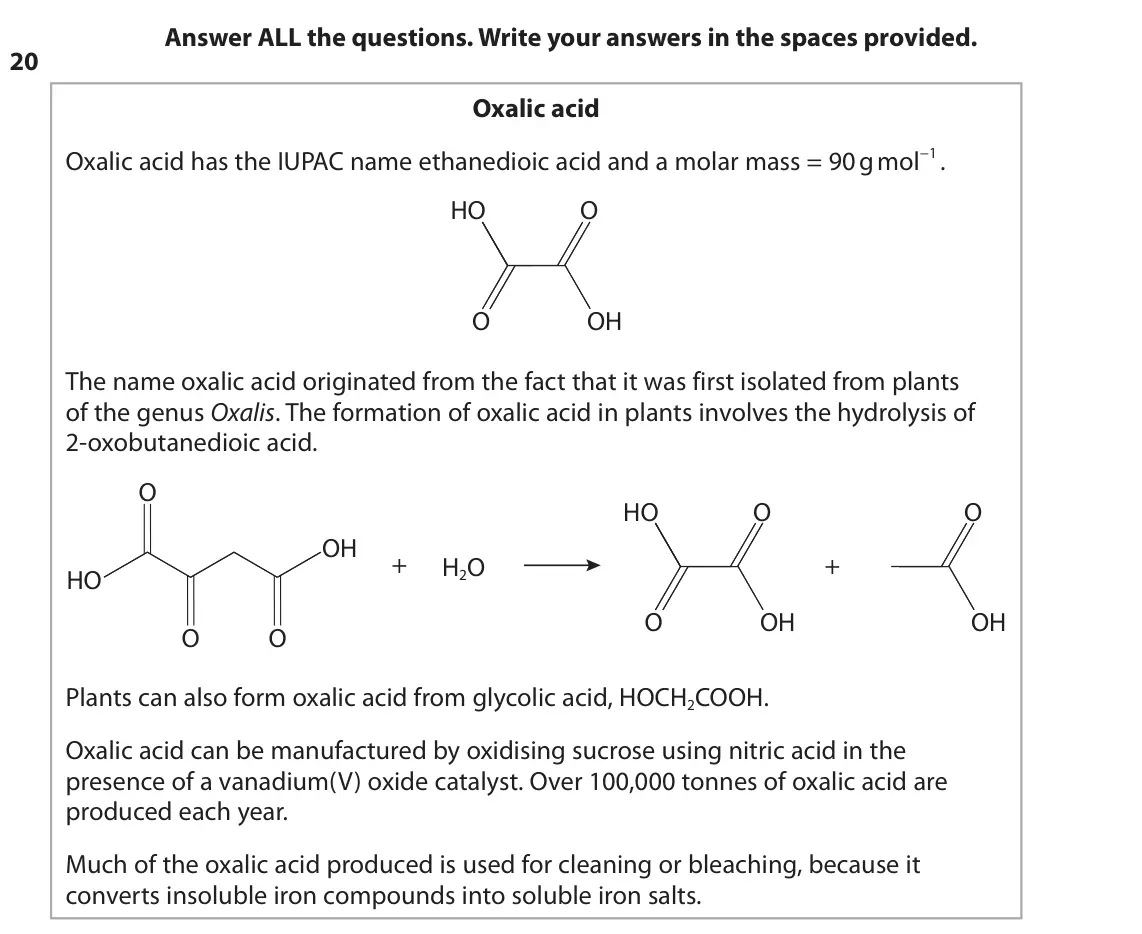
- Your answer
- Your answer
Q15(c)
The whole paper ↗ Your answer
Q6(a)
The whole paper ↗ Your answer
Q6(b)
The whole paper ↗Your answer- Your answer
Q5(a)
The whole paper ↗ Your answer
Q5(b)
The whole paper ↗Your answerQ9(a)
The whole paper ↗ Your answer
All 61 questions on Percentage yield and atom economy, as a list
- June 2025, AS Unit 1, Q9 (1 mark): Which method for the preparation of hydrogen has the highest atom economy by mass? A 2H2O → 2H2 + O2 B CH4 + H2O → 3H2 + CO C CO + H2O → H2 + CO2 D CH3OH + H2O
- June 2025, AS Unit 1, Q10 (1 mark): Which reaction to produce copper(II) nitrate (Mr = 187.5) has an atom economy of 46.5% by mass? A Cu + 4HNO3 → Cu(NO3)2 + 2NO2 + 2H2O B 2Cu + Pt(NO3)4 → 2Cu(NO3
- June 2025, AS Unit 1, Q22(c) (3 marks): Calculate the percentage yield if 1.00 g of trichlorobutane is produced from 10.0 g butane using the overall equation shown. C4H10 + 3Cl2 → C4H7Cl3 + 3HCl (3)
- June 2025, Unit 5, Q18(d)(ii) (3 marks): The yield, by mass, for the formation of sunset yellow is 67.9%. Calculate the mass of sunset yellow produced from 5.00 g of compound A. [Mr of sunset yellow =
- June 2025, Unit 6, Q4(g) (2 marks): Calculate the mass of phenyl benzoate that can be prepared from 5.00 g of phenol if the overall yield, by mass, is 65.0%. (2)
- June 2025 (A), Unit 5, Q15(b) (1 mark): What mass of aspirin would be produced from 47.0 g of phenol in this reaction scheme? [Data: Mr phenol = 94 Mr aspirin = 180] (1) A 47.3 g B 65.3 g C 90.0 g D 9
- January 2025, AS Unit 1, Q8 (1 mark): Ethanoic acid can be produced by the oxidation of butane. 2C4H10 + 5O2 → 4CH3COOH + 2H2O The atom economy, by mass, for the production of ethanoic acid is A 13%
- January 2025, AS Unit 2, Q13 (1 mark): Calcium carbonate can be heated to produce calcium oxide. CaCO3 → CaO + CO2 What is the atom economy, by mass, for the formation of calcium oxide? A 44.0% B 56.
- January 2025, AS Unit 2, Q16(b) (1 mark): What is the percentage yield if 25.0 g of magnesium oxide is produced? [ Mr MgO = 40.3 ] (1) A 13.6 % B 16.9 % C 31.0 % D 62.0 %
- January 2025, AS Unit 3, Q4(f) (4 marks): Calculate the mass of 2‑chloro‑2‑methylpropane produced in this procedure, if the percentage yield is 70%. [Density of 2‑methylpropan‑2‑ol = 0.78 g cm–3] [Mr of
- January 2025, Unit 4, Q20(a) (2 marks): Calculate the atom economy, by mass, for the formation of oxalic acid from the hydrolysis of 2‑oxobutanedioic acid. (2)
- January 2025, Unit 5, Q11 (1 mark): A synthesis of aspirin from phenol is shown. OH OH OCOCH3 CO2H CO2H Step 1 Step 2 yield 80% yield 75% phenol, Mr = 94 aspirin, Mr = 180 What mass of aspirin is
- October 2024, AS Unit 1, Q8 (1 mark): Ethanol is formed from glucose during fermentation. C6H12O6 → 2C2H5OH + 2CO2 What is the atom economy by mass for the formation of ethanol in this reaction? A 2
- October 2024, AS Unit 1, Q15(c) (1 mark): Cyclohexanol can be converted into cyclohexene. OH + H2O What mass of cyclohexanol is needed to make 7.20 g of cyclohexene, if the yield of this reaction is 72.
- October 2024, Unit 5, Q6(a) (1 mark): In an experiment, a 2.00 g sample of naphthalene was nitrated and produced 2.57 g of 1-nitronaphthalene. What is the percentage yield of 1-nitronaphthalene? (1)
- October 2024, Unit 5, Q6(b) (1 mark): A student carrying out this experiment calculated the percentage yield of the reaction to be greater than 100%. What is the most likely explanation for this res
- October 2024, Unit 5, Q9 (1 mark): The cumene process is the main industrial method for making phenol. The overall equation for this process is shown. OH O + + O O + What is the atom economy by m
- June 2024, AS Unit 1, Q5(a) (1 mark): What is the percentage atom economy by mass for the production by fermentation? C6H12O6 → 2CH3CH2OH + 2CO2 (1) A 24.4% B 25.6% C 48.9% D 51.1%
- June 2024, AS Unit 1, Q5(b) (1 mark): What is the percentage atom economy by mass for the production by hydration? C2H4 + H2O → CH3CH2OH (1) A 39.1% B 60.9% C 78.2% D 100% Use this space for any rou
- June 2024, Unit 5, Q9(a) (1 mark): What is the percentage atom economy (by mass) for the formation of 2,4,6‑tribromophenol? (1) A 42.3% B 57.7% C 69.0% D 100%
- June 2024, Unit 5, Q9(b) (1 mark): When 5.00 g of phenol was reacted and purified, the percentage yield of 2,4,6‑tribromophenol was 76.8%. What mass of purified 2,4,6‑tribromophenol was formed? (
- June 2024, Unit 6, Q4(e) (3 marks): The mass of pure methyl salicylate obtained was 14.1 g. Calculate the percentage yield, giving your answer to an appropriate number of significant figures. (3)
- January 2024, AS Unit 1, Q20(e)(v) (2 marks): The magnesium sulfate solution was allowed to crystallise. The crystals were dried and weighed. The mass of the hydrated crystals, MgSO4·7H2O, was 2.78 g. Calcu
- January 2024, Unit 5, Q14(c) (6 marks): In the final step of the synthesis, phenylamine reacts with either ethanoyl chloride or ethanoic anhydride. → N‑phenylethanamide + hydrogen chloride phenylamine
- January 2024, Unit 5, Q14(d) (4 marks): The overall yield for the synthesis of N‑phenylethanamide from benzene was found to be 35.2%. Calculate the minimum volume of benzene, in cm3, required to make
- October 2023, AS Unit 1, Q21(a)(ii) (2 marks): Calculate the atom economy by mass for the formation of basic nickel(II) carbonate by the reaction shown. (2)
- October 2023, AS Unit 3, Q3(g) (2 marks): In this preparation, 3.96 g of cyclohexanol reacted to form 2.09 g of cyclohexene. Calculate the percentage yield, by mass, in this preparation. (2)
- October 2023, Unit 4, Q10(b) (1 mark): Reaction 1 has a yield of 90 %. What mass of 2‑methylpropanoic acid is required to produce 6.66 g of 2‑methylpropan‑1‑ol? [Mr values 2‑methylpropanoic acid = 88
- October 2023, Unit 5, Q21(b)(iii) (3 marks): 2.00 g of salicylic acid produced a 74.8% yield of acetylsalicylic acid. Calculate the mass of acetylsalicylic acid formed. [Mr values: salicylic acid = 138 ace
- June 2023, AS Unit 2, Q21(b) (2 marks): An alternative method for producing methanal uses a silver catalyst at a temperature of 650 °C. The reaction is shown. CH3OH(g) → HCHO(g) + H2(g) Suggest one ad
- June 2023, Unit 6, Q4(f) (3 marks): The mass of dry methyl 3‑nitrobenzoate crystals prepared by one of the students was 3.05 g. Calculate the percentage yield by mass of methyl 3‑nitrobenzoate usi
- January 2023, AS Unit 2, Q18(b) (2 marks): Calculate the percentage atom economy by mass for the production of Ca(ClO)2 in this reaction. (2)
- January 2023, Unit 6, Q4(f) (3 marks): A student carried out the preparation using the amounts of reagents given in (e) and obtained a yield of 56.7 % of 2‑ethanoylaminobenzoic acid. Calculate the ma
- October 2022, AS Unit 1, Q13 (1 mark): A mass of 2.50 g of sodium chloride reacts with excess lead(II) nitrate solution forming lead(II) chloride with a yield of 95 %. What is the mass of lead(II) ch
- October 2022, AS Unit 1, Q16(d)(i) (2 marks): Calculate the atom economy, by mass, for the formation of germane. Use Ar of Ge = 72.6 (2)
- June 2022, Unit 5, Q12(f) (4 marks): Calculate the volume of benzene required to form 5.92 g of 2‑ethanoylaminobenzoic acid, assuming the overall yield for the synthesis is 28.2 %. Give your answer
- January 2022, AS Unit 1, Q18 (1 mark): Potassium chlorate(V) decomposes on heating to form oxygen. 2KClO3 ® 2KCl + 3O2 What is the atom economy (by mass) for the formation of oxygen? [Ar values: O =
- January 2022, AS Unit 1, Q20(c)(ii) (4 marks): An experiment was carried out to produce pure, dry crystals of hydrated copper(II) sulfate, CuSO4 • 5H2O. Copper(II) carbonate was mixed with 50.0 cm3 of 1.00 m
- January 2022, Unit 5, Q6(c) (1 mark): Which expression shows the mass in grams of 2,4,6‑trinitromethylbenzene formed from 10 g of methylbenzene if the yield of the reaction is 85 %? [Mr values: meth
- January 2022, Unit 6, Q4(h) (4 marks): This question is about the preparation of phenylamine by the reduction of nitrobenzene. NH2 NO2 + 6[H] → + 2H2O phenylamine nitrobenzene Outline procedure Step
- October 2021, AS Unit 1, Q4(d) (1 mark): Sodium hydroxide solution was added to magnesium sulfate solution. The equation for the reaction is shown. 2NaOH(aq) + MgSO4(aq) → Mg(OH)2(s) + Na2SO4(aq) What
- October 2021, Unit 5, Q21(e)(ii) (3 marks): Calculate the mass of 2‑nitrobenzaldehyde required to make 10.0 g of indigotin from this reaction when the percentage yield is 85.0 % . (3)
- June 2021, AS Unit 1, Q15 (1 mark): Cyclohexene may be prepared by the dehydration of cyclohexanol. OH + H2O cyclohexanol cyclohexene Mr = 100 Mr = 82 What mass of cyclohexene can be made from 12.
- June 2021, AS Unit 3, Q4(e)(i) (1 mark): Give one possible reason for the yield being less than 100 %. (1)
- June 2021, AS Unit 3, Q4(e)(ii) (4 marks): After some research the student decided to use 21.0 g of butan-1-ol to prepare 20 cm3 of 1-bromobutane. Calculate the percentage yield that the student expected
- June 2021, Unit 6, Q2(g)(i) (3 marks): Calculate the apparent percentage yield of Cu(NH3)4SO4.H2O. Give your answer to an appropriate number of significant figures. (3)
- January 2021, AS Unit 1, Q4 (1 mark): Which conversion has the lowest percentage atom economy (by mass) for the formation of CaCl2? A Ca + Cl2 → CaCl2 B Ca + 2HCl → CaCl2 + H2 C CaCO3 + 2HCl → CaCl2
- January 2021, AS Unit 1, Q21(d)(iii) (3 marks): Many large corporations now use squalane obtained entirely from plants. Squalane can be obtained sustainably from corn starch with a yield of 23 % by mass. The
- January 2021, AS Unit 2, Q17 (1 mark): The oxidation of propan-1-ol by acidified potassium dichromate(VI) forms propanoic acid with a yield of 36 % by mass. What mass of propan-1-ol is needed to form
- January 2021, AS Unit 2, Q22(a)(ii) (3 marks): Calculate the overall atom economy by mass for the production of potassium chlorate(V), KClO3 , using your equation in (a)(i). (3)
- January 2021, AS Unit 3, Q4(b) (3 marks): The equation for the reaction is (CH3)3COH(l) + HCl(aq) → (CH3)3CCl(l) + H2O(l) The final product after distillation weighed 2.62 g. Calculate the percentage yi
- January 2021, Unit 4, Q15 (1 mark): 2.95 g of ethanoic acid is produced from 2.50 g of ethanol. What is the percentage yield of ethanoic acid? [Molar masses in g mol−1: ethanoic acid = 60 ethanol
- January 2021, Unit 5, Q18 (1 mark): Benzenecarboxylic acid may be produced from benzene in a two-step synthesis. O OH CH3 C Step 1 Step 2 Yield 45% Yield 60% benzene methylbenzene benzenecarboxyli
- October 2020, AS Unit 1, Q12 (1 mark): What is the percentage atom economy, by mass, for the production of hydrogen in the reaction shown? CH4 + H2O → CO + 3H2 [Ar values: H = 1.00 C = 12.0 O = 16.0]
- October 2020, Unit 5, Q6 (1 mark): Phenol reacts with ethanoyl chloride to form phenyl ethanoate. OH O CH3 C + CH3COCl + HCl O phenol phenyl ethanoate Mr = 94 Mr = 136 In an experiment, 3.67 g of
- January 2020, AS Unit 1, Q10(d) (1 mark): What is the atom economy (by mass) for the formation of BaSO4 in this reaction? (1) A 33.3% B 62.2% C 66.6% D 80.0%
- January 2020, AS Unit 2, Q10(b) (1 mark): What is the percentage atom economy by mass for the production of silver iodide in this reaction? (1) A 29 % B 37 % C 50 % D 73 % Use this space for any rough w
- January 2020, AS Unit 2, Q17(d)(ii) (2 marks): Give two reasons why this reaction would produce a greater yield of this chloroalkane than the combined reactions in (b) and (c). (2)
- June 2019, AS Unit 1, Q24(c)(i) (3 marks): Reaction A produces more nitrogen to inflate the airbag. Calculate the atom economy, by mass, for the production of nitrogen in reaction A. Give your answer to
- June 2019, AS Unit 2, Q21(b) (4 marks): A student carried out the reaction. After separation and purification, the mass of butan-1-ol formed was 12.1 g. The yield of the reaction was 64.0 %. Calculate
- January 2019, AS Unit 1, Q23(f) (4 marks): A sample of 2-methylpropene was prepared from 2-methylpropan-2-ol. + H2O OH 2-methylpropan-2-ol 2-methylpropene Mr = 74.0 Mr = 56.0 The yield of this reaction w
Questions, mark schemes and examiner’s reports are © Pearson Edexcel, from their published past papers. Plumi isn’t affiliated with any exam board. Want whole papers? Edexcel International A Level Chemistry past papers.
The Plumi iPad app also offers exam-style questions with AI feedback on your handwritten working.