 plumi
Titrations, standard solutions and uncertainty (Core Practicals 3 and 4): Edexcel International A Level Chemistry questions
Edexcel International A Level Chemistry past-paper questions on 8.B.6 Titrations, standard solutions and uncertainty (Core Practicals 3 and 4), 2019–2025, with mark schemes and examiner’s reports where available.
Paper
All papers
Exam
All years
Calculations
Q17(a)
The whole paper ↗
Q2(b)
The whole paper ↗
Q2(c)(i)
The whole paper ↗Q2(c)(ii)
The whole paper ↗Q12(a)
The whole paper ↗ Your answer
Q12(b)
The whole paper ↗Your answerQ17(c)
The whole paper ↗
Q3(a)
The whole paper ↗
Q3(b)
The whole paper ↗Q3(c)(i)
The whole paper ↗Q3(c)(ii)
The whole paper ↗Q3(c)(iv)
The whole paper ↗- Your answer
Q2(a)(ii)
The whole paper ↗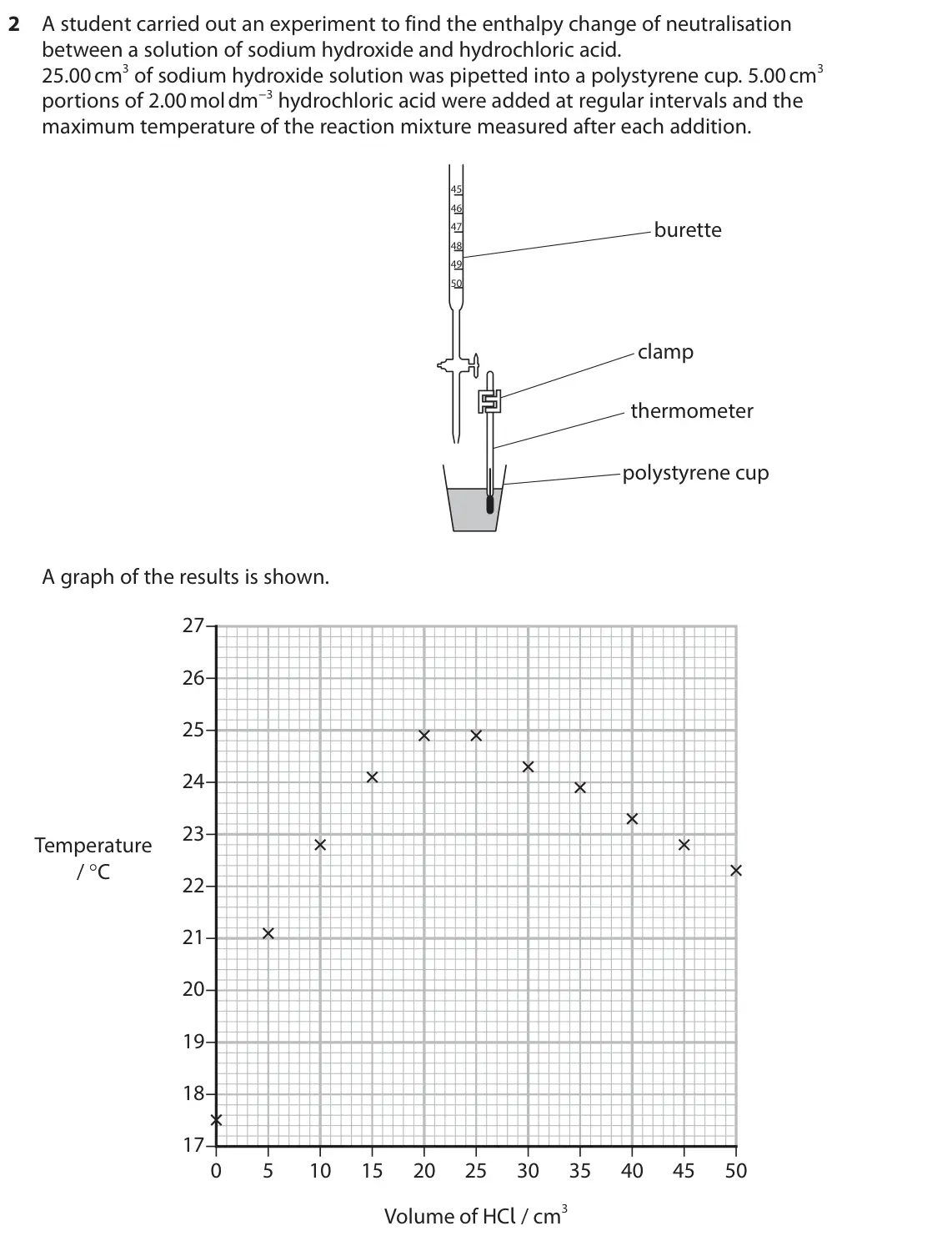
Q2(c)(i)
The whole paper ↗Q3(a)(i)
The whole paper ↗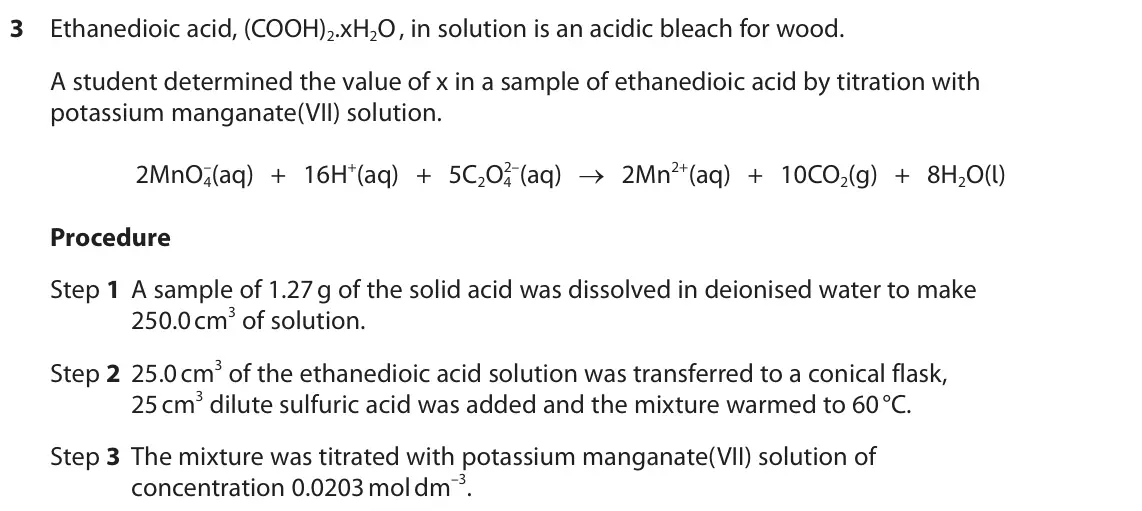
Q11(a)
The whole paper ↗ Your answer
Q11(b)
The whole paper ↗Your answerQ11(c)
The whole paper ↗Your answerQ17(b)
The whole paper ↗
All 118 questions on Titrations, standard solutions and uncertainty (Core Practicals 3 and 4), as a list
- June 2025, AS Unit 2, Q17(a) (7 marks): The value of n in a sample of a hydrated magnesium carbonate, MgCO3∙nH2O , can be determined by the reaction with hydrochloric acid. The equation for the reacti
- June 2025, Unit 6, Q2(b) (2 marks): Give the name of a suitable indicator to use in Step 4, including the expected colour change at the end-point. (2) Name of indicator Colour change from to
- June 2025, Unit 6, Q2(c)(i) (2 marks): Complete the table and calculate the mean titre in cm3. (2)
- June 2025, Unit 6, Q2(c)(ii) (4 marks): The equation for the titration is shown. Ca(OH)2(aq) + 2HCl(aq) → CaCl2(aq) + 2H2O(l) A data book value for the concentration of a saturated solution of calcium
- January 2025, AS Unit 2, Q12(a) (1 mark): What is the concentration of the sodium hydroxide solution? (1) A 0.176 mol dm–3 B 0.239 mol dm–3 C 0.351 mol dm–3 D 0.702 mol dm–3
- January 2025, AS Unit 2, Q12(b) (1 mark): What is the percentage error in the titre? [The burette is accurate to 0.05 cm3 per reading] (1) A 0.10% B 0.34% C 0.40% D 0.68%
- January 2025, AS Unit 2, Q17(c) (2 marks): Another student suggested that the reaction between manganate(VII) and rhubarb juice could be used to find the concentration of ethanedioic acid in rhubarb juic
- January 2025, AS Unit 3, Q3(a) (1 mark): State what is meant by the term standard solution. (1)
- January 2025, AS Unit 3, Q3(b) (6 marks): Describe the preparation of 100.0 cm3 of a 0.0500 mol dm–3 standard solution of ethanedioic acid, starting with crystals of ethanedioic acid dihydrate, H2C2O4.2
- January 2025, AS Unit 3, Q3(c)(i) (1 mark): Name the piece of apparatus that should be used to add the ethanedioic acid solution, H2C2O4(aq), to the conical flask. (1)
- January 2025, AS Unit 3, Q3(c)(ii) (2 marks): The titration was carried out with a few drops of phenolphthalein indicator in the conical flask. State the colour change observed at the end‑point of the titra
- January 2025, AS Unit 3, Q3(c)(iv) (3 marks): The titration was repeated, giving a mean titre of 31.55 cm3. Calculate the concentration of the barium hydroxide solution, Ba(OH)2(aq), in g dm–3. Ba(OH)2 and
- October 2024, AS Unit 2, Q7 (1 mark): Sulfuric acid and sodium hydroxide react as shown. H2SO4(aq) + 2NaOH(aq) → Na2SO4(aq) + 2H2O(l) Which sample of sulfuric acid solution will be exactly neutralis
- October 2024, AS Unit 3, Q2(a)(ii) (2 marks): Calculate the concentration of the sodium hydroxide solution, using an answer from (a)(i) and information from the procedure. (2)
- October 2024, AS Unit 3, Q2(c)(i) (1 mark): Give an improvement to the experimental method that will increase the accuracy of the calculated titre value. (1)
- October 2024, Unit 6, Q3(a)(i) (3 marks): Describe how to make 250.0 cm3 of a solution of ethanedioic acid in Step 1. (3)
- June 2024, AS Unit 2, Q11(a) (1 mark): The titration is carried out using methyl orange as an indicator. What would be the colour change at the end‑point of the titration? (1) A orange to red B red t
- June 2024, AS Unit 2, Q11(b) (1 mark): What is the concentration, in mol dm–3, of the potassium sulfate solution produced by this reaction at the end‑point, to 2 significant figures? (1) A 0.010 B 0.
- June 2024, AS Unit 2, Q11(c) (1 mark): Information about the uncertainties in each reading used to measure the volumes of the solutions in this titration is shown. Uncertainty / cm3 Solution Equipmen
- June 2024, AS Unit 2, Q17(b) (1 mark): Calculate the number of moles of ammonia added at the end‑point. (1)
- June 2024, Unit 6, Q5(b)(i) (4 marks): Calculate the molar mass of NH4X. Use the data from Steps 1 and 2. (4)
- June 2024, Unit 6, Q5(c) (4 marks): Another student carried out the experiment but did not titrate all the contents of the conical flask in Step 6. Instead they transferred the contents of the con
- June 2024 (R), AS Unit 3, Q3(a) (2 marks): Phenolphthalein indicator was used in the experiment. State the colour change seen at the end-point. (2)
- June 2024 (R), AS Unit 3, Q3(b) (1 mark): Calculate the mean titre of sodium hydroxide solution using the concordant results. (1)
- June 2024 (R), AS Unit 3, Q3(c) (2 marks): Calculate the concentration of the maleic acid solution in mol dm–3. [Mr maleic acid = 116] (2)
- June 2024 (R), AS Unit 3, Q3(d) (3 marks): Use your answers to (b) and (c) to calculate the concentration of the sodium hydroxide solution in mol dm–3. (3)
- January 2024, AS Unit 3, Q2(a) (1 mark): Draw a circle around the concordant results in the table. (1)
- January 2024, AS Unit 3, Q2(b) (1 mark): Calculate the mean titre, using your answer from (a). (1)
- January 2024, AS Unit 3, Q2(c)(i) (1 mark): State the colour change that occurs at the end‑point of the titration. (1)
- January 2024, AS Unit 3, Q2(c)(ii) (5 marks): Calculate the percentage by mass of citric acid in the lemon juice, using your mean titre from (b). Give your answer to two significant figures. [Concentration
- January 2024, AS Unit 3, Q2(d) (1 mark): Suggest a possible reason why the value obtained in (c) is valid, even though lemon juice also contains some ascorbic acid and malic acid. (1)
- January 2024, AS Unit 3, Q2(e)(i) (1 mark): Student B added too much deionised water in Step 2. State how Student B should correct this mistake. (1)
- January 2024, AS Unit 3, Q2(e)(ii) (2 marks): Student C used sodium hydroxide solution labelled 0.103 mol dm–3 that had been made up several months ago and stored since then. Explain what effect this would
- October 2023, AS Unit 2, Q20(b)(i) (4 marks): Calculate the concentration of the saturated solution, in g dm–3. (4)
- October 2023, AS Unit 3, Q4(a) (2 marks): State the colour change of the indicator at the end-point of the titration. (2) From to
- October 2023, AS Unit 3, Q4(b) (1 mark): The diagram shows the burette at the end-point of the rough titration. 23 24 25 Give the burette reading for this rough titration. (1)
- October 2023, AS Unit 3, Q4(c) (3 marks): The student refilled the burette and prepared a second conical flask by adding sodium carbonate solution and methyl orange indicator. Describe how an accurate t
- October 2023, AS Unit 3, Q4(d) (3 marks): The mean titre from two accurate titrations was 22.65 cm3 . Calculate the concentration of the hydrochloric acid, in mol dm−3 . The equation for the reaction is
- October 2023, Unit 5, Q21(f) (6 marks): Acetylsalicylic acid in aspirin tablets is hydrolysed by excess sodium hydroxide. CH3COOC6H4COOH + 2NaOH → CH3COONa + HOC6H4COONa + H2O The unreacted sodium hyd
- June 2023, AS Unit 3, Q4(c)(i) (2 marks): State the colour change observed in the conical flask at
- June 2023, AS Unit 3, Q4(c)(ii) (2 marks): Complete the table and use the concordant results to calculate the mean titre. (2)
- June 2023, AS Unit 3, Q4(c)(iii) (4 marks): The reaction taking place in this titration is Ca(OH)2(aq) + 2HCl(aq) → CaCl2(aq) + 2H2O(l) Calculate the concentration of the calcium hydroxide solution in g d
- January 2023, AS Unit 3, Q3(a)(i) (2 marks): In Step 1, the student rinsed both the pipette and the volumetric flask with deionised water before transferring 25.0 cm3 of solution A. State the effect, if an
- January 2023, AS Unit 3, Q3(a)(ii) (1 mark): Give a reason why the student inverted the volumetric flask several times in Step 1. (1)
- January 2023, AS Unit 3, Q3(a)(iv) (2 marks): State the colour change of the phenolphthalein indicator at the end‑point of the titration in Step 3. (2) From to
- January 2023, AS Unit 3, Q3(a)(v) (1 mark): The results of the student’s experiment are shown. Titration Trial 1 2 3 4 Final volume / cm3 29.25 33.25 32.00 29.50 28.90 Initial volume / cm3 0.00 4.50 3.15
- January 2023, AS Unit 3, Q3(a)(vi) (1 mark): Give a reason why the student did not need to carry out titrations 3 and 4. (1)
- January 2023, AS Unit 3, Q3(a)(vii) (1 mark): Give a reason why solution A was diluted before titrating it with this sodium hydroxide solution. (1)
- January 2023, AS Unit 3, Q3(b)(ii) (5 marks): Calculate the concentration of citric acid in solution A in g dm–3, using the equation from (b)(i) and the results from (a)(v). Give your answer to three signif
- January 2023, AS Unit 3, Q3(b)(iii) (2 marks): Using the result of the experiment, the student concluded that the stated concentration of the descaler (200 g dm–3) was incorrect. State whether or not this di
- October 2022, AS Unit 2, Q19 (1 mark): A student carries out two sets of titrations, one using methyl orange and the other using phenolphthalein as indicators. The conical flask contains sodium hydro
- October 2022, AS Unit 3, Q2(a)(i) (1 mark): Complete the table. (1)
- October 2022, AS Unit 3, Q2(a)(ii) (1 mark): Calculate the mean titre for the titration. (1)
- October 2022, AS Unit 3, Q2(b)(i) (2 marks): Calculate the number of moles of sulfuric acid that reacted with the sodium hydroxide in the mean titre, using your answer from (a)(ii). (2)
- October 2022, AS Unit 3, Q2(b)(ii) (1 mark): Calculate the total number of moles of sulfuric acid used at the start of the experiment. (1)
- October 2022, AS Unit 3, Q2(b)(iii) (4 marks): Calculate the percentage of magnesium carbonate in the antacid tablet, using your answers to (b)(i) and (b)(ii). You must show all your working. (4) MgCO3 + H2S
- October 2022, AS Unit 3, Q2(c)(i) (1 mark): Give one possible reason for carrying out a rough titration. (1)
- October 2022, AS Unit 3, Q2(c)(ii) (2 marks): Phenolphthalein indicator was used in the titration. State the colour change seen at the end‑point. (2) From to
- October 2022, Unit 6, Q2(b) (2 marks): Describe how to make the 250.0 cm3 of sodium hydroxide solution in Step 4. (2)
- October 2022, Unit 6, Q2(c) (5 marks): The mean titre was 12.75 cm3. Calculate the percentage by mass of ammonium sulfate, (NH4)2SO4 , in the sample of plant fertiliser. [Relative formula mass of (NH
- October 2022, Unit 6, Q2(d)(i) (3 marks): Explain the effect, if any, on the titre value and hence on the calculated percentage of ammonium sulfate in the fertiliser. (3)
- June 2022, AS Unit 2, Q9(a) (1 mark): What is the colour change of the indicator at the end-point of this titration? (1) A red to orange B red to yellow C yellow to orange D yellow to red
- June 2022, AS Unit 2, Q9(b) (1 mark): A student carried out the first titration and did not notice that there was an air bubble between the tap and the tip of the burette. During the titration, the
- June 2022, AS Unit 2, Q9(c) (1 mark): 25.0 cm3 of 0.100 mol dm−3 aqueous sodium hydroxide required a mean titre of 18.70 cm3 of sulfuric acid. 2NaOH(aq) + H2SO4(aq) → Na2SO4(aq) + 2H2O(l) What is th
- June 2022, AS Unit 3, Q2(a) (4 marks): Calculate the value for the Ar of the metal M from the data of the first student. MHCO3 and HCl react in a 1 : 1 ratio. You must show your working. Give your an
- June 2022, AS Unit 3, Q2(b)(i) (1 mark): Calculate the experimental error for the second student. [Ar of potassium = 39.1] (1)
- June 2022, AS Unit 3, Q2(b)(ii) (3 marks): The second student calculated the Ar value of M to be 37.52 with a total percentage uncertainty of 4.5 %. Comment on the value of 37.52 obtained by this student
- June 2022, AS Unit 3, Q2(b)(iii) (2 marks): The first student suggested that the burette was the biggest source of experimental uncertainty. Explain how the percentage uncertainty of the burette reading c
- June 2022, AS Unit 3, Q2(b)(iv) (4 marks): The second student was told that using a beaker to prepare their standard solution was incorrect. Describe the steps the student should take to make a standard
- January 2022, AS Unit 2, Q15 (1 mark): A titre of 13.25 cm3 was obtained using a 50 cm3 burette. What is the percentage uncertainty in the titre? [Each reading of the burette has an uncertainty of ±
- October 2021, AS Unit 2, Q21(b)(i) (2 marks): The indicator used was phenolphthalein. State the colour change at the end-point. (2) from to
- October 2021, AS Unit 2, Q21(b)(ii) (4 marks): Calculate the relative atomic mass of M and use it to identify the Group 1 metal, M. (4)
- October 2021, AS Unit 2, Q21(c) (2 marks): Another student repeated the experiment, using a different sample of metal M, but did not wipe off the oil before weighing it. State how this would change the c
- October 2021, AS Unit 3, Q5(a) (1 mark): Complete the titre values. (1) Titration number Rough 1 2 3 4 Final reading 24.90 21.25 42.85 21.80 43.15 / cm3 Initial reading 2.30 0.00 21.25 0.50 21.80 / cm3
- October 2021, AS Unit 3, Q5(b)(i) (1 mark): State why the value from Titration 2 was not used to calculate the mean. (1)
- October 2021, AS Unit 3, Q5(b)(ii) (4 marks): Calculate the concentration of the sodium hydroxide solution in mol dm−3. (4)
- October 2021, AS Unit 3, Q5(c) (1 mark): Each reading of the burette has an uncertainty of ±0.05 cm3. Calculate the percentage uncertainty in Titration 4. (1)
- October 2021, AS Unit 3, Q5(d) (2 marks): State the colour change that would be seen at the end-point in this titration using phenolphthalein as the indicator. (2) From to
- June 2021, AS Unit 2, Q15(b) (1 mark): 25.0 cm3 of the sodium hydroxide solution prepared in (a) was placed in a conical flask and titrated with sulfuric acid. 2NaOH + H2SO4 → Na2SO4 + 2H2O Calculate
- June 2021, AS Unit 2, Q15(c) (1 mark): Phenolphthalein indicator was used for the titration in (b). What was the colour change at the endpoint? (1) A colourless → pink B pink → colourless C orange →
- June 2021, AS Unit 3, Q3(a) (2 marks): State the colour change observed at the end-point of the titration. (2) From to
- June 2021, AS Unit 3, Q3(b)(i) (1 mark): Complete the table. (1)
- June 2021, AS Unit 3, Q3(b)(ii) (1 mark): Give a reason why the first titre should not be used to calculate the mean titre. (1)
- June 2021, AS Unit 3, Q3(b)(iii) (2 marks): Calculate the number of moles of hydrochloric acid in the mean titre. (2)
- June 2021, AS Unit 3, Q3(b)(iv) (3 marks): The equation for the reaction in the titration is Ba(OH)2(aq) + 2HCl(aq) → BaCl2(aq) + 2H2O(l) Calculate the concentration of barium hydroxide, in g dm−3, givin
- January 2021, AS Unit 2, Q18 (1 mark): Barium chloride solution, BaCl2(aq), reacts with gallium sulfate solution, Ga2(SO4)3(aq) to form a precipitate of barium sulfate, BaSO4(s). What is the minimum
- January 2021, AS Unit 3, Q2(a)(i) (1 mark): Give a possible reason why any solution remaining in the beaker is washed into the volumetric flask before making up to the mark. (1)
- January 2021, AS Unit 3, Q2(a)(ii) (2 marks): Calculate the concentration of this standard solution of ethanedioic acid in mol dm–3. Give your answer to an appropriate number of significant figures. [Molar
- January 2021, AS Unit 3, Q2(b)(i) (1 mark): Explain why the burette is rinsed with ethanedioic acid solution in Step 2. (1)
- January 2021, AS Unit 3, Q2(b)(ii) (2 marks): The diagram shows how the student read the filled pipette in Step 3. Identify the two mistakes the student made. (2) 25 cm3 ± 0.06 pipette B20 °C mark
- January 2021, AS Unit 3, Q2(b)(iii) (2 marks): The student completely emptied the pipette for each transfer in Step 3. Explain the effect on the titre of completely emptying the pipette rather than leaving a
- January 2021, AS Unit 3, Q2(b)(iv) (2 marks): State the colour change in the conical flask at the end-point. (2) From to
- January 2021, AS Unit 3, Q2(c)(i) (2 marks): Complete the table and calculate the mean titre. (2)
- January 2021, AS Unit 3, Q2(c)(ii) (3 marks): Calculate the concentration of the sodium hydroxide solution in mol dm–3. The equation for the titration is (COOH)2 + 2NaOH → (COONa)2 + 2H2O (3)
- January 2021, Unit 4, Q11 (1 mark): A diprotic acid, H2A, was titrated with sodium hydroxide solution. H2A(aq) + 2NaOH(aq) o Na2A(aq) + 2H2O(l) A 25.0 cm3 portion of 0.100 mol dm−3 sodium hydroxid
- October 2020, AS Unit 2, Q14(b) (4 marks): The concentration of a saturated solution of calcium hydroxide can be determined by titration. 25.0 cm3 portions of a saturated solution of calcium hydroxide we
- October 2020, AS Unit 3, Q5(a) (1 mark): Name a suitable piece of apparatus to measure the 25.0 cm3 of solution. (1)
- October 2020, AS Unit 3, Q5(b) (2 marks): Methyl orange indicator was used in this titration. Give the colour change in the conical flask at the end-point. (2) Colour change from to
- October 2020, AS Unit 3, Q5(c)(i) (1 mark): Complete the table. (1)
- October 2020, AS Unit 3, Q5(c)(ii) (1 mark): Using appropriate titrations, calculate the mean titre. (1)
- October 2020, AS Unit 3, Q5(c)(iii) (1 mark): Using your answer to (c)(ii), calculate the number of moles of HCl in the mean titre. (1)
- October 2020, AS Unit 3, Q5(c)(iv) (2 marks): Calculate the number of moles of M2CO3 in 25.0 cm3 of the solution. Hence calculate the number of moles of M2CO3 in the 250.0 cm3 volumetric flask. (2)
- October 2020, AS Unit 3, Q5(c)(v) (1 mark): Using your answer in (c)(iv) and the mass of M2CO3.10H2O in the 250 cm3 of solution, calculate the molar mass of M2CO3.10H2O. (1)
- October 2020, AS Unit 3, Q5(c)(vi) (2 marks): Use your answer to (c)(v) to identify metal M. (2)
- January 2020, AS Unit 2, Q15(d)(i) (2 marks): Calculate the amount, in moles, of sodium carbonate in the 250.0 cm3 of solution. (2)
- January 2020, AS Unit 2, Q15(d)(ii) (4 marks): The 250.0 cm3 of solution was prepared by dissolving 3.29 g of Na2CO3.xH2O. Use this mass and your answer to (d)(i) to determine the value of x. Give your answe
- January 2020, AS Unit 3, Q3(a) (2 marks): The indicator used was methyl orange. State the colour change at the end-point. (2) From to
- January 2020, AS Unit 3, Q3(b)(i) (2 marks): Complete the table and, using appropriate titrations, calculate the mean titre. (2)
- January 2020, AS Unit 3, Q3(b)(ii) (5 marks): Calculate the percentage purity, by mass, of the sodium carbonate. (5)
- June 2019, AS Unit 2, Q23(d)(i) (2 marks): Phenolphthalein is a suitable indicator for this titration. State the colour change at the end-point. (2)
- June 2019, AS Unit 2, Q23(d)(ii) (2 marks): Suggest two possible reasons why the titre for Run 1 is greater than the other two titres. (2)
- June 2019, AS Unit 2, Q23(d)(iii) (5 marks): The equation for the reaction of propanoic acid with sodium hydroxide is CH3CH2COOH + NaOH → CH3CH2COONa + H2O Calculate the mass in grams of propanoic acid ext
- June 2019, AS Unit 2, Q23(d)(iv) (2 marks): Use your answer to (d)(iii) to determine whether the acid in this sample lies within the permitted range for use in animal feed. (2)
- June 2019, AS Unit 2, Q23(d)(v) (1 mark): Suggest how the animal feed would be affected if the amount of propanoic acid was outside the permitted range. (1)
- June 2019, AS Unit 3, Q4(a) (1 mark): State what is meant by the term ‘concordant results’. (1)
- June 2019, AS Unit 3, Q4(b) (1 mark): Using appropriate titres, calculate the mean titre. (1)
- June 2019, AS Unit 3, Q4(c) (2 marks): State the colour change at the endpoint of the titration. (2) From to
- June 2019, AS Unit 3, Q4(d) (4 marks): The equation for the reaction is NaOH(aq) + HCl(aq) → NaCl(aq) + H2O(l) Calculate the purity of the sodium hydroxide, NaOH, as a percentage by mass. (4)
Questions, mark schemes and examiner’s reports are © Pearson Edexcel, from their published past papers. Plumi isn’t affiliated with any exam board. Want whole papers? Edexcel International A Level Chemistry past papers.
The Plumi iPad app also offers exam-style questions with AI feedback on your handwritten working.