 plumi
Reacting masses: Edexcel International A Level Chemistry questions
Edexcel International A Level Chemistry past-paper questions on 1.2.2 Reacting masses, 2019–2025, with mark schemes and examiner’s reports where available.
Paper
All papers
Exam
All years
Calculations
Q20(b)(iii)
The whole paper ↗
Q4(e)(i)
The whole paper ↗
Q4(e)(ii)
The whole paper ↗Q5(a)
The whole paper ↗
- Your answer
Q4(c)
The whole paper ↗
- Your answer
- Your answer
Q2(a)
The whole paper ↗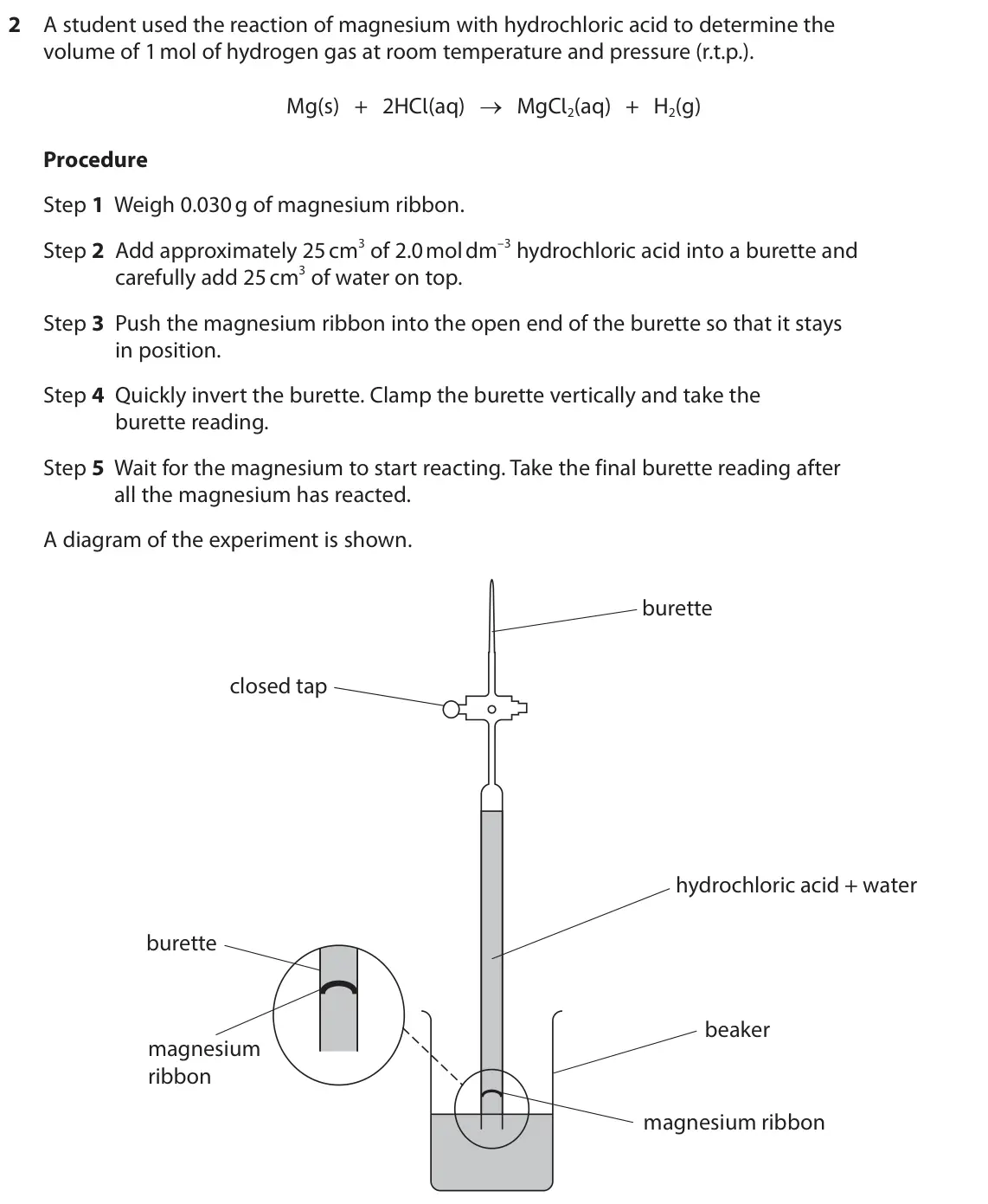
- Your answer
Q20(e)(i)
The whole paper ↗
Q20(e)(ii)
The whole paper ↗Q18(b)(ii)
The whole paper ↗
- Your answer
Q16(b)(iii)
The whole paper ↗
Q4(a)
The whole paper ↗
Q18(a)
The whole paper ↗
Q22(f)
The whole paper ↗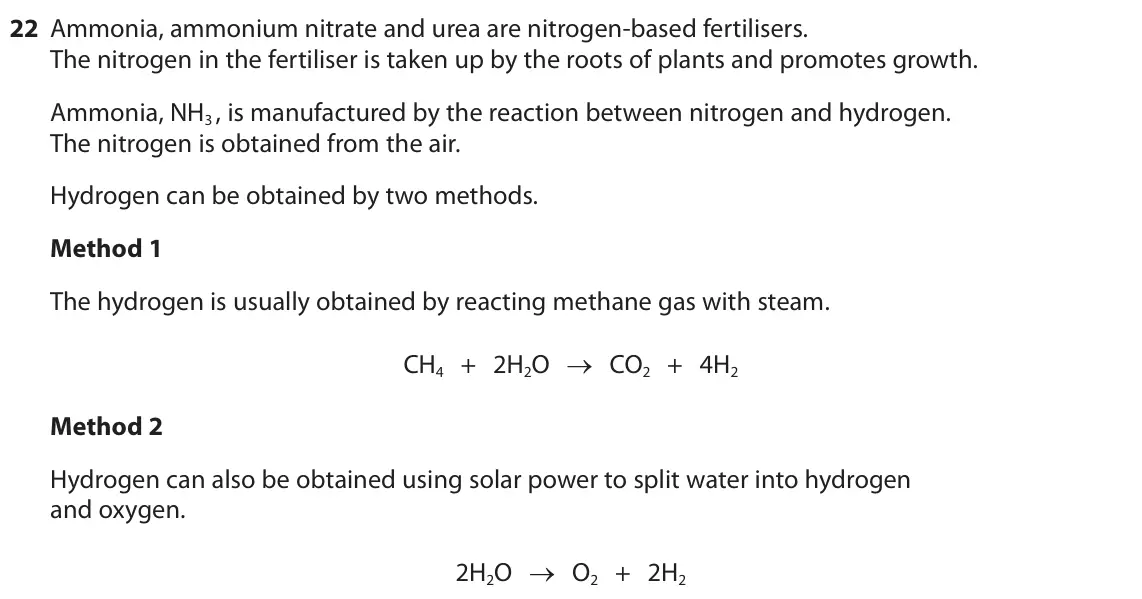
Q1(b)
The whole paper ↗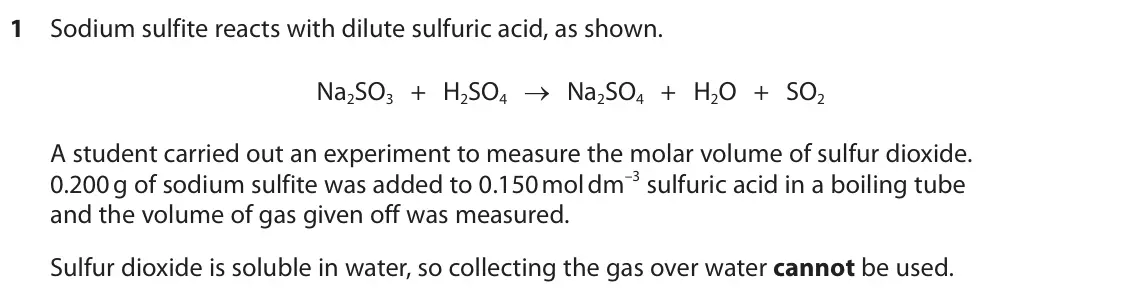
Q1(d)(i)
The whole paper ↗
All 75 questions on Reacting masses, as a list
- June 2025, AS Unit 1, Q20(b)(iii) (6 marks): Kerosene is used as aeroplane fuel. A jet plane can carry a maximum of 800 passengers and uses 11 400 dm3 of fuel per hour. Calculate the mass, in kg, of carbon
- June 2025, AS Unit 3, Q4(e)(i) (3 marks): Calculate the maximum mass of iron(III) chloride that could be produced. (3)
- June 2025, AS Unit 3, Q4(e)(ii) (2 marks): Explain why, during an experiment using 2.00 g of accurately weighed out iron wool, the mass of product measured in the weighing bottle was greater than your an
- June 2025, AS Unit 3, Q5(a) (2 marks): Show, by calculation, that magnesium was in excess. (2)
- June 2025, Unit 5, Q12 (1 mark): A substituted benzene compound has the general formula CnH2n−6 . When completely combusted, 0.025 mol of the compound produced 11.0 g of CO2 . Which could be th
- June 2025, Unit 6, Q4(c) (4 marks): Deduce why the volume of benzoyl chloride added in Step 2 does not need to be exact. Include a calculation in your answer. [Density of benzoyl chloride = 1.21 g
- June 2025 (A), Unit 5, Q6 (1 mark): Excess aqueous silver nitrate is added to a solution containing 0.100 mol of chromium(III) chloride, CrCl3•6H2O. A precipitate, AgCl, appears immediately, which
- January 2025, AS Unit 2, Q15 (1 mark): A volume of 10.0 cm3 of magnesium chloride solution was added to an excess of sodium hydroxide solution, forming a precipitate of magnesium hydroxide. After fil
- January 2025, AS Unit 3, Q2(a) (3 marks): Explain why the volume of hydrochloric acid added to the burette in Step 2 does not need to be exact. You must include a calculation. (3)
- October 2024, AS Unit 1, Q6 (1 mark): Copper metal can displace silver from silver nitrate solution according to the equation shown. Cu + 2AgNO3 → 2Ag + Cu(NO3)2 10 g of copper metal was added to an
- October 2024, Unit 4, Q20(e)(i) (2 marks): Show that the hydrochloric acid is in excess in this reaction. (2)
- October 2024, Unit 4, Q20(e)(ii) (3 marks): All of the barium carbonate reacted and produced 6.19 g of hydrated barium chloride. Calculate the relative formula mass of BaCl2 • nH2O and hence deduce the va
- October 2024, Unit 5, Q18(b)(ii) (3 marks): 12.8 cm3 of 0.05 mol dm−3 iron(III) chloride solution reacted with 8.0 cm3 of 0.08 mol dm−3 ammonium thiocyanate to form a complex ion. Deduce the formula of th
- June 2024, AS Unit 2, Q9 (1 mark): Which compound needs exactly nine moles of oxygen (O2) for complete combustion of one mole of the compound? A C5H12 B C6H12O C C6H14 D C6H14O
- June 2024, Unit 5, Q16(b)(iii) (3 marks): When a 5 dm3 sample of wastewater was treated with excess acidified sodium dimethyldithiocarbamate, 245.0 mg of the dry precipitate H+[Ni((CH3)2NCS2)3]− was for
- June 2024, Unit 6, Q4(a) (3 marks): Show, by calculation, that the methanol is in excess in this preparation. [Mr values: salicylic acid = 138.0 methanol = 32.0, Density of methanol = 0.791 g cm–3
- June 2024 (R), AS Unit 2, Q18(a) (3 marks): A sample of magnesium carbonate was heated for 4 minutes. The mass of the sample decreased from 4.17 g to 2.35 g. Calculate the percentage of magnesium carbonat
- June 2024 (R), AS Unit 2, Q22(f) (4 marks): A field needs 160 kg of N per hectare to be applied using urea fertiliser. The field size is 500 m × 640 m. [1 hectare (ha) = 10 000 m2 , molar mass of urea = 6
- June 2024 (R), AS Unit 3, Q1(b) (2 marks): Calculate the number of moles of sodium sulfite in 0.200 g. (2)
- June 2024 (R), AS Unit 3, Q1(d)(i) (1 mark): Calculate the minimum volume of 0.150 mol dm–3 acid that should be present in the boiling tube to fully react with 0.200 g of sodium sulfite. Use your answer to
- January 2024, AS Unit 1, Q10 (1 mark): An excess of sodium sulfate solution is added to 50 cm3 of a 0.100 mol dm−3 solution of barium chloride. What is the mass of barium sulfate formed? [Mr value: B
- January 2024, AS Unit 1, Q20(e)(i) (1 mark): Calculate the number of moles of sulfuric acid used in this experiment. (1)
- January 2024, AS Unit 1, Q20(e)(ii) (1 mark): Calculate the mass of magnesium needed to react with the sulfuric acid. (1)
- January 2024, AS Unit 1, Q20(e)(iii) (1 mark): Give a reason why slightly more than this mass of magnesium was used. (1)
- January 2024, AS Unit 2, Q8 (1 mark): Equal volumes of some 0.01 mol dm–3 solutions were mixed. Which pair of solutions gave the greatest mass of precipitate? A BaCl2 and AgNO3 B BaCl2 and Ag2SO4 C
- January 2024, AS Unit 2, Q10 (1 mark): Bromine, Br2(l), can be disposed of safely by reaction with aqueous sodium thiosulfate, Na2S2O3(aq). Br2(l) + 2Na2S2O3(aq) → 2NaBr(aq) + Na2S4O6(aq) What is the
- January 2024, AS Unit 2, Q11 (1 mark): What is the mass of nitrogen atoms in 50 cm3 of a 2.0 mol dm–3 solution of ammonium nitrate, NH4NO3(aq)? A 35 g B 8.0 g C 2.8 g D 1.4 g
- January 2024, Unit 5, Q14(d) (4 marks): The overall yield for the synthesis of N‑phenylethanamide from benzene was found to be 35.2%. Calculate the minimum volume of benzene, in cm3, required to make
- January 2024, Unit 6, Q4(b) (3 marks): Show, by calculation, that ethanoic anhydride is in excess in this preparation. (3)
- October 2023, AS Unit 1, Q3(b) (1 mark): Excess calcium carbide and 10 g of water react to form the hydrocarbon ethyne, C2H2. CaC2 + 2H2O → C2H2 + Ca(OH)2 What is the mass of ethyne that forms, assumin
- October 2023, AS Unit 1, Q19(a)(ii) (1 mark): The density of the E10 fuel is 0.729 g cm–3. Calculate the mass of 1500 cm3 of the fuel. (1)
- October 2023, AS Unit 1, Q20(c)(i) (1 mark): Calculate the amount, in mol, of α-bisabolene in 5.51 g. (1)
- October 2023, AS Unit 1, Q20(c)(iii) (1 mark): Deduce the number of carbon-carbon double bonds in a molecule of α-bisabolene, using your answers to (c)(i) and (c)(ii). (1)
- October 2023, AS Unit 2, Q10 (1 mark): In a neutralisation reaction, 20.0 cm3 of 0.500 mol dm–3 nitric acid reacts with 10.0 cm3 of 1.00 mol dm–3 aqueous sodium hydroxide. HNO3(aq) + NaOH(aq) → NaNO3
- October 2023, AS Unit 2, Q16 (1 mark): A sample of propane‑1,2‑diol with a mass of 1.52 g reacts completely with excess phosphorus(V) chloride. What is the maximum mass, in grams, of the organic prod
- October 2023, AS Unit 2, Q19(a)(ii) (3 marks): Calculate the percentage by mass of potassium iodide in the mixture. Give your answer to an appropriate number of significant figures. [Ar values: Ag = 107.9 K
- October 2023, Unit 5, Q11 (1 mark): An electrochemical cell is set up: • a half-cell is made from a piece of zinc and a solution of zinc chloride, ZnCl2 a second half-cell is made from a piece of
- June 2023, AS Unit 2, Q11 (1 mark): A piece of sodium weighing 1.15 g reacts completely with distilled water and the solution formed is made up to 250.0 cm3. 2Na(s) + 2H2O(l) → 2NaOH(aq) + H2(g) W
- June 2023, AS Unit 2, Q22(b)(ii) (4 marks): A 750 cm3 bottle of a toilet cleaner contains 85.0 g of hydrochloric acid. Calculate the maximum mass of calcium carbonate limescale that could be removed by 50
- January 2023, AS Unit 1, Q25(c) (3 marks): Aluminium trichloride also reacts with sodium hydroxide. AlCl3(g) + 3NaOH(aq) → Al(OH)3(s) + 3NaCl(aq) Calculate the maximum mass of aluminium hydroxide precipi
- January 2023, Unit 5, Q20(e)(i) (3 marks): Show that the potassium manganate(VII) is in excess. [Molar masses / g mol–1: C6H5CH3 = 92 KMnO4 = 158] (3)
- January 2023, Unit 6, Q4(e) (2 marks): Show by calculation that, in the preparation, 10 cm3 of ethanoyl chloride is an excess compared to 5.00 g of 2‑aminobenzoic acid. Data Molar mass / g mol–1 CH3C
- October 2022, AS Unit 1, Q13 (1 mark): A mass of 2.50 g of sodium chloride reacts with excess lead(II) nitrate solution forming lead(II) chloride with a yield of 95 %. What is the mass of lead(II) ch
- October 2022, AS Unit 1, Q16(e)(ii) (1 mark): Deduce the number of moles of HX formed when GeX4 reacted with the excess water. (1)
- October 2022, AS Unit 1, Q16(e)(iii) (1 mark): Deduce the number of moles of GeX4 that reacted with the excess water. (1)
- October 2022, AS Unit 1, Q16(e)(iv) (2 marks): Calculate the molar mass of GeX4 and hence identify X. (2)
- October 2022, AS Unit 1, Q17(e)(ii) (3 marks): Orange peel contains 1.63 % of limonene by mass. A chewing gum remover contains 30 cm3 of limonene per bottle. Calculate the mass of orange peel, in kg, needed
- October 2022, AS Unit 2, Q4 (1 mark): What is the mass of carbon formed when 1.80 g of propan-1-ol, C3H7OH, undergoes incomplete combustion according to the equation shown? C3H7OH(l) + 2O2(g) → 2C(s
- October 2022, Unit 6, Q3(a) (2 marks): Calculate which reactant is in excess in this synthesis. Molar mass / g mol–1 Density / g cm–3 Compound ethanol 46.0 0.79 butanoic acid 88.0 0.96 (2)
- June 2022, AS Unit 1, Q19(a)(i) (2 marks): Calculate the number of moles of iron that react. (2)
- June 2022, AS Unit 2, Q16(e) (3 marks): A sample of seawater was evaporated to dryness. The solid residue was weighed, then dissolved completely in deionised water. Excess aqueous silver nitrate was a
- June 2022, AS Unit 2, Q17(d) (3 marks): Bromoethane is prepared by reacting ethanol with potassium bromide and concentrated sulfuric acid. C2H5OH + KBr + H2SO4 → C2H5Br + KHSO4 + H2O Calculate the max
- June 2022, AS Unit 3, Q1(b)(i) (2 marks): Show by calculation that the zinc powder is in excess. (2)
- June 2022, Unit 5, Q17(a)(i) (4 marks): Determine whether or not this type of brass is a gilding metal, by calculating its percentage by mass of copper. (4)
- January 2022, AS Unit 1, Q16 (1 mark): Iron(III) oxide is reduced by hydrogen in a two-step process. Step 1: 3Fe2O3 + H2 ® 2Fe3O4 + H2O Step 2: Fe3O4 + 4H2 ® 3Fe + 4H2O What is the maximum mass of ir
- January 2022, AS Unit 2, Q23(a)(ii) (4 marks): After heating a 6.0 g sample of magnesium ethanedioate for three minutes, the decomposition was 70 % complete. Calculate the total mass of the solid mixture tha
- October 2021, AS Unit 2, Q9 (1 mark): The equation for the complete combustion of propan-1-ol is shown. C3H7OH(l) + 4½O2(g) ® 3CO2(g) + 4H2O(l) 2.00 × 10⁻³ mol of propan-1-ol undergoes complete comb
- October 2021, AS Unit 2, Q18 (1 mark): 10.00 g of hydrated magnesium sulfate, MgSO4.7H2O, is heated to remove the water of crystallisation. What mass of anhydrous magnesium sulfate, MgSO4 , is formed
- June 2021, AS Unit 2, Q19(b) (3 marks): A student carried out an experiment to determine the enthalpy change of the reaction. A sample of 0.50 g of magnesium powder was added to 25 cm3 of 0.20 mol dm−
- June 2021, AS Unit 2, Q21(a) (4 marks): A 6.0 g sample of magnesium oxalate was heated for three minutes but the decomposition was only 70 % complete. Calculate the total mass of solid that remains. (
- January 2021, AS Unit 1, Q21(d)(ii) (2 marks): Calculate the minimum number of sharks that would be needed to produce 2.8 million dm3 of squalene. [Density of squalene = 0.86 g cm-3] (2)
- January 2021, AS Unit 2, Q16 (1 mark): How many moles are there in 15.1 cm3 of liquid propan-1-ol? [Density of propan-1-ol = 0.80 g cm−3 Mr of propan-1-ol = 60] A (0.80 × 15.1) ÷ 60 B 0.80 ÷ (60 × 15
- January 2021, AS Unit 2, Q18 (1 mark): Barium chloride solution, BaCl2(aq), reacts with gallium sulfate solution, Ga2(SO4)3(aq) to form a precipitate of barium sulfate, BaSO4(s). What is the minimum
- January 2021, AS Unit 2, Q22(c)(ii) (5 marks): 1.52 g of impure potassium chlorate(V), formed in the Liebig Process, was heated until the mass of solid remaining was constant at 1.02 g. The reaction that occ
- January 2021, Unit 6, Q2(b) (2 marks): The reaction in Step 2 produced 0.430 g of a white precipitate of silver chloride, AgCl. Calculate the concentration of KClO3 in the solution, in mol dm–3, foun
- October 2020, AS Unit 1, Q21(a) (2 marks): Calculate the volume, in cm3, of 0.0300 mol of cyclohexene. Give your answer to an appropriate number of significant figures. You must show your working. Data A
- October 2020, AS Unit 1, Q21(d) (3 marks): Because bromine is so hazardous it is usually used in the laboratory in aqueous solution. A sample of bromine reacts with exactly 0.0300 mol of cyclohexene. Cal
- October 2020, AS Unit 2, Q15(b)(ii) (2 marks): Student B used a gravimetric method, which involved weighing a product of a reaction. A 50.0 cm3 sample of the same silver nitrate solution was mixed with exces
- October 2020, AS Unit 2, Q17(c)(ii) (1 mark): Calculate the mass of carbon dioxide released when 1 mol of octane (C8H18) is burned completely. (1)
- October 2020, AS Unit 2, Q17(c)(iii) (2 marks): A motorist who uses 1200 kg of fuel each year in a car changes to a fuel with 5% of the mass of petrol replaced by methanol produced by CCU. Calculate the annua
- October 2020, Unit 6, Q4(c) (3 marks): Show, by calculation, that the ethanoic anhydride is in excess in this preparation. (3)
- January 2020, AS Unit 1, Q10(c) (1 mark): What is the maximum mass of BaSO4 that could be produced from 0.500 g of BaCl2 in this reaction? (1) A 0.446 g B 0.500 g C 0.560 g D 0.821 g
- January 2020, AS Unit 2, Q4 (1 mark): How many moles of CO2 are formed when 3.0 mol of chloroethene, C2H3Cl, is mixed with 10.0 mol of oxygen and react as shown? 2C2H3Cl + 5O2 → 4CO2 + 2H2O + 2HCl A
- June 2019, AS Unit 1, Q21(b)(v) (2 marks): The acid must be in excess for each experiment. Calculate the minimum concentration of hydrochloric acid needed for 30 cm3 of acid to completely react with 0.25
- June 2019, AS Unit 3, Q3(b)(iii) (3 marks): The equation for the reaction of M with copper(II) sulfate is M(s) + CuSO4(aq) → MSO4(aq) + Cu(s) Use the equation and your answer to (b)(ii) to calculate the r
Questions, mark schemes and examiner’s reports are © Pearson Edexcel, from their published past papers. Plumi isn’t affiliated with any exam board. Want whole papers? Edexcel International A Level Chemistry past papers.
The Plumi iPad app also offers exam-style questions with AI feedback on your handwritten working.