 plumi
Combustion, halogenation and dehydration of alcohols: Edexcel International A Level Chemistry questions
Edexcel International A Level Chemistry past-paper questions on 10.C.2 Combustion, halogenation and dehydration of alcohols, 2019–2025, with mark schemes and examiner’s reports where available.
Paper
All papers
Exam
All years
Calculations
Q16(a)
The whole paper ↗
Q1(a)
The whole paper ↗
Q20(c)
The whole paper ↗
Q2(j)
The whole paper ↗
Q1(a)
The whole paper ↗
Q20(b)(i)
The whole paper ↗
Q5(c)(i)
The whole paper ↗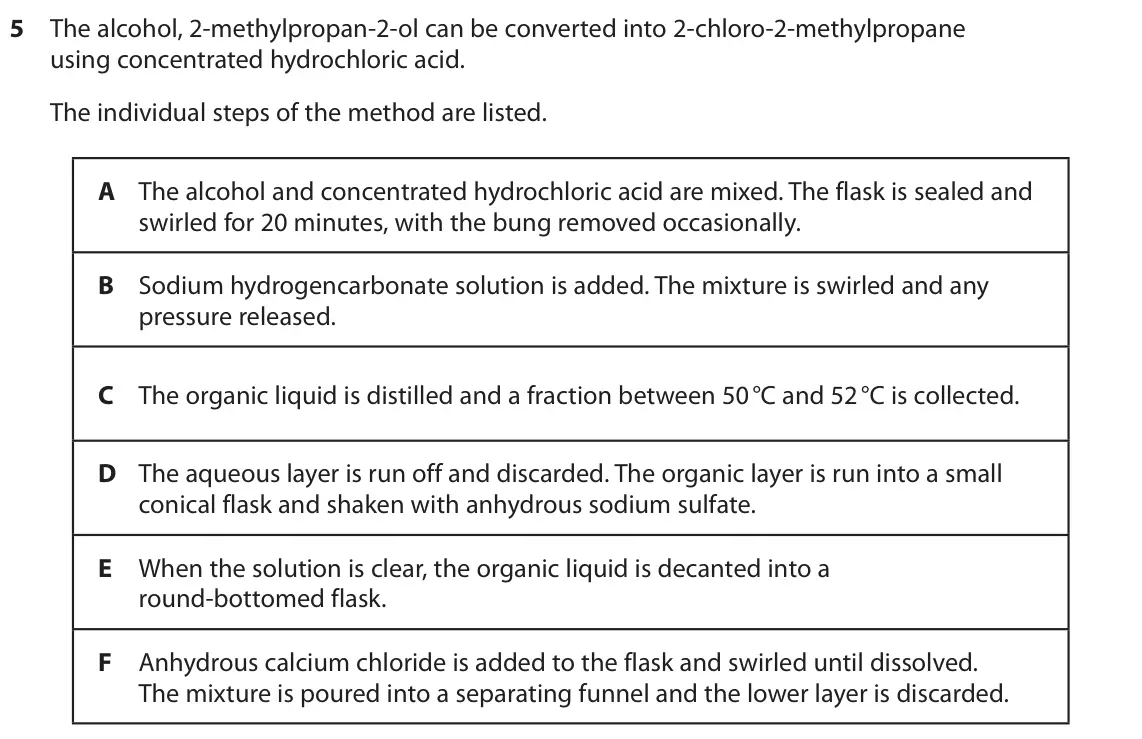
- Your answer
- Your answer
Q1(b)
The whole paper ↗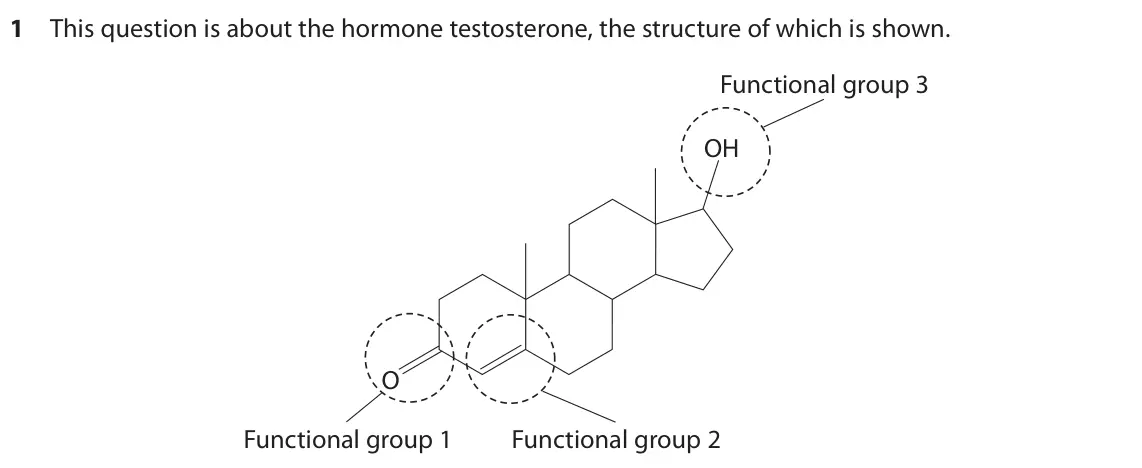
Q13(b)
The whole paper ↗ Your answer
- Your answer
Q3(h)
The whole paper ↗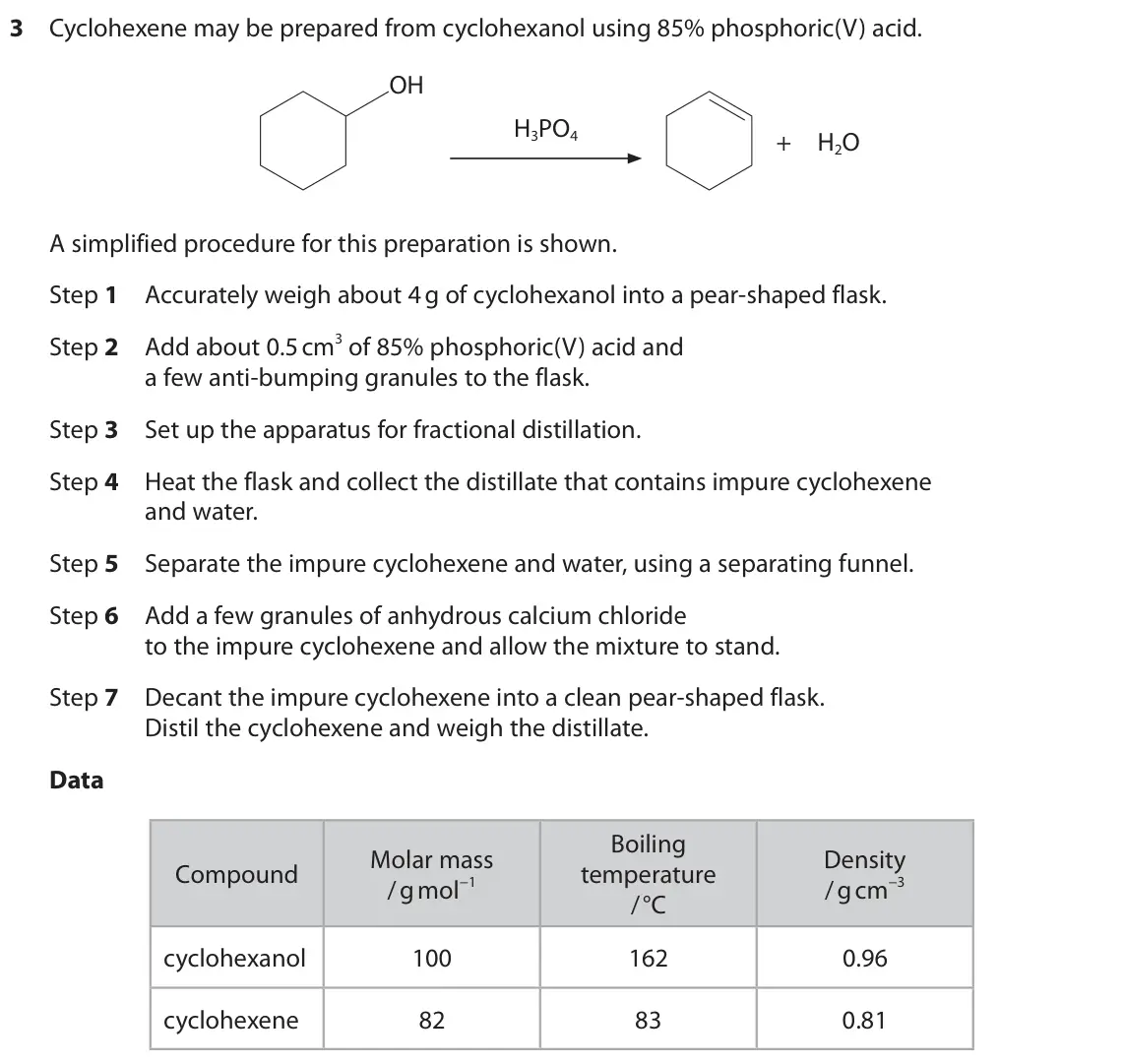
Q18(a)
The whole paper ↗ Your answer
Q18(b)
The whole paper ↗Your answerQ2(a)
The whole paper ↗
Q3(b)(i)
The whole paper ↗
Q19(c)
The whole paper ↗
Q4(a)
The whole paper ↗
Q14(a)
The whole paper ↗ Your answer
All 45 questions on Combustion, halogenation and dehydration of alcohols, as a list
- June 2025, AS Unit 2, Q16(a) (2 marks): Give a chemical test, including the result, to show that alcohols contain an OH group. (2)
- June 2025, AS Unit 3, Q1(a) (1 mark): Phosphorus(V) chloride is added to separate samples of P and Q. A gas, R, is evolved in each reaction. Identify R, by name or formula. (1)
- June 2024, AS Unit 2, Q20(c) (6 marks): Three students were asked to carry out a single chemical test to unambiguously identify the presence of the ‒OH group in the three terpenoid compounds, menthol,
- June 2024, AS Unit 3, Q2(j) (4 marks): State a chemical test for the –OH group in ethanol and a chemical test for the –Br group in bromoethane. Include the expected positive observations. (4) –OH gro
- June 2024, Unit 6, Q1(a) (2 marks): Test 1 A small amount of phosphorus(V) chloride, PCl5, is added to 2 cm3 of A. Observation misty fumes given off Test 2 Aqueous sodium hydrogencarbonate, NaHCO3
- June 2024 (R), AS Unit 2, Q20(b)(i) (3 marks): Some chemical tests were carried out on acetoin. These tests identify one of the two functional groups. Acetoin produced steamy fumes when reacted with PCl5 . A
- June 2024 (R), AS Unit 3, Q5(c)(i) (3 marks): The C–O bond is broken in the mechanism. Using your knowledge of carbocations, explain which alcohol may react fastest in the experiment. (3)
- January 2024, AS Unit 2, Q17 (1 mark): Which is a correct equation for the incomplete combustion of butan-1-ol? A CH3CH2CH2CH2OH + 6O2 → 4CO2 + 5H2O B CH3CH2CH2CH2OH + 6½O2 → 4CO2 + 5H2O C CH3CH2CH2C
- January 2024, AS Unit 2, Q18 (1 mark): Which reagent(s) could be used to produce a chloroalkane from a tertiary alcohol? 1 PCl5 2 concentrated HCl 3 concentrated H2SO4 and KCl A 1, 2 and 3 B 1 and 3
- January 2024, AS Unit 3, Q1(b) (4 marks): Describe a chemical test and the expected positive result for both functional group 2 and functional group 3. (4) Functional group 2 Test Result Functional grou
- October 2023, AS Unit 2, Q13(b) (1 mark): Which reagent reacts with tertiary alcohols? (1) A acidified aqueous potassium dichromate(VI) B bromine water C phosphorus(V) chloride D sodium carbonate soluti
- October 2023, AS Unit 2, Q16 (1 mark): A sample of propane‑1,2‑diol with a mass of 1.52 g reacts completely with excess phosphorus(V) chloride. What is the maximum mass, in grams, of the organic prod
- October 2023, AS Unit 3, Q3(h) (2 marks): Separate samples of cyclohexanol and the cyclohexene product were tested with phosphorus(V) chloride and with bromine water. Complete the table to show the obse
- June 2023, AS Unit 2, Q18(a) (1 mark): Which reagent is used for this reaction? (1) A 50 % sulfuric acid B ethanolic potassium hydroxide C phosphoric(V) acid D red phosphorus
- June 2023, AS Unit 2, Q18(b) (1 mark): The reaction is best classified as (1) A elimination B hydrolysis C reduction D substitution
- June 2023, AS Unit 3, Q2(a) (1 mark): A small amount of phosphorus(V) chloride, PCl5 , is added to separate 2 cm3 samples of each compound. Observations C D Misty fumes are given off Misty fumes are
- June 2023, AS Unit 3, Q3(b)(i) (1 mark): Name a suitable chemical reagent to carry out this elimination reaction. (1)
- January 2023, AS Unit 2, Q19(c) (3 marks): Give the structure of the organic product of each reaction shown. (3) Reaction 1 K2Cr2O7 , H2SO4 OH heat under reflux Reaction 2 K2Cr2O7 , H2SO4 OH heat under r
- January 2023, AS Unit 3, Q4(a) (2 marks): Give a chemical test, with the expected result, which would show the presence of the –OH group in any alcohol. (2) Test Result
- June 2022, AS Unit 2, Q14(a) (1 mark): What is the reagent for Reaction 1? (1) A acidified potassium manganate(VII) B aqueous bromine C concentrated phosphoric(V) acid D phosphorus(V) chloride
- June 2022, AS Unit 3, Q3(g)(ii) (2 marks): State a chemical test and the expected observation for an –OH group. (2)
- June 2022, AS Unit 3, Q3(g)(iii) (1 mark): State whether or not the test in (g)(ii) could be used on the organic product to show if cyclohexanol remains when Step 5 is complete. Justify your answer. (1)
- January 2022, AS Unit 2, Q10 (1 mark): Which reagent would convert an alcohol into an alkene? A acidified potassium dichromate(VI) B anhydrous calcium sulfate C concentrated phosphoric acid D ethanol
- January 2022, AS Unit 3, Q2(b) (1 mark): When phosphorus(V) chloride is added to X, steamy white fumes are seen. State what can be deduced about compound X from this observation only. (1)
- October 2021, AS Unit 3, Q2(a) (4 marks): Geraniol has two different types of functional group. Name the functional groups, giving a chemical test and its positive result to show the presence of each gr
- October 2021, Unit 6, Q4(b) (2 marks): The distillate collected in Step 3 is the alcohol ROH. Describe a chemical test, and its positive result, to show the presence of an –OH group in any alcohol. (
- June 2021, AS Unit 2, Q18(a) (1 mark): 1-bromopropane does not occur naturally but can be made from propan-1-ol. Identify the reagent or reagents you would use to make 1-bromopropane from propan-1-ol
- June 2021, AS Unit 3, Q2(a) (2 marks): Give a chemical test to show the presence of the OH group in all three compounds, including the expected result. (2)
- June 2021, AS Unit 3, Q4(a) (2 marks): Suggest why the percentage yield of 1-bromobutane might be lower if the cold water bath was not used in Step 1. (2)
- January 2021, AS Unit 2, Q14(a) (1 mark): What type of reaction occurs? A addition B elimination C hydrolysis D substitution
- January 2021, AS Unit 2, Q14(b) (1 mark): The structure of 2-methylpentan-3-ol is shown. CH₃ H₃C CH₃ OH This alcohol reacts with concentrated phosphoric(V) acid. How many different alkenes can form? A o
- January 2021, AS Unit 2, Q20(a)(ii) (1 mark): Identify, by name or formula, a suitable reagent for Step 1. (1)
- January 2021, Unit 4, Q17(a)(iii) (1 mark): Give the structure of the organic product formed when lactic acid reacts with concentrated phosphoric(V) acid, H3PO4 . (1)
- October 2020, AS Unit 2, Q12(c) (1 mark): Compound L can also be converted into compound N. Cl N Which reagent should be used? (1) A Cl2(g) B HCl(g) C PCl5(s) D KCl(aq)
- October 2020, AS Unit 3, Q3(a)(i) (1 mark): Identify, by name or formula, the steamy fumes produced in Test 1. (1) Test 2 About 1 cm3 of sodium hydrogencarbonate solution was added to 1 cm3 of each liquid
- January 2020, AS Unit 2, Q17(b)(i) (1 mark): Identify by name or formula a reagent for this reaction. (1)
- January 2020, AS Unit 2, Q17(b)(ii) (1 mark): Draw the displayed formula of the other alkene formed. (1)
- January 2020, AS Unit 2, Q17(d)(i) (1 mark): Complete the equation for this reaction. (1) C5H11OH + PCl5
- January 2020, AS Unit 2, Q17(d)(ii) (2 marks): Give two reasons why this reaction would produce a greater yield of this chloroalkane than the combined reactions in (b) and (c). (2)
- January 2020, AS Unit 3, Q1(c)(ii) (2 marks): Give a chemical test, with the expected observation, to confirm the presence of the hydroxy group. (2) Test Observation
- June 2019, AS Unit 2, Q22(a) (2 marks): Describe a chemical test and its positive result for the alcohol functional group in Y. (2)
- June 2019, AS Unit 2, Q22(b)(i) (4 marks): Draw the skeletal formulae of the four isomers formed in this reaction. (4)
- June 2019, AS Unit 3, Q2(a) (2 marks): A chemical test may be used to confirm the presence of the hydroxyl group in A. Identify a suitable reagent for this test, giving the positive result. (2)
- June 2019, AS Unit 3, Q2(c)(i) (2 marks): Give two reasons for the use of the mineral wool. (2)
- June 2019, AS Unit 3, Q2(c)(ii) (2 marks): Explain why it is necessary to remove the delivery tube from the heated tube immediately when heating stops. (2)
Questions, mark schemes and examiner’s reports are © Pearson Edexcel, from their published past papers. Plumi isn’t affiliated with any exam board. Want whole papers? Edexcel International A Level Chemistry past papers.
The Plumi iPad app also offers exam-style questions with AI feedback on your handwritten working.