 plumi
Reactions of carboxylic acids: Edexcel International A Level Chemistry questions
Edexcel International A Level Chemistry past-paper questions on 15.C.3 Reactions of carboxylic acids, 2019–2025, with mark schemes and examiner’s reports where available.
Paper
All papers
Exam
All years
Calculations
Q15(a)(iii)
The whole paper ↗
Q15(a)(iv)
The whole paper ↗Q15(a)(v)
The whole paper ↗- Your answer
Q20(f)
The whole paper ↗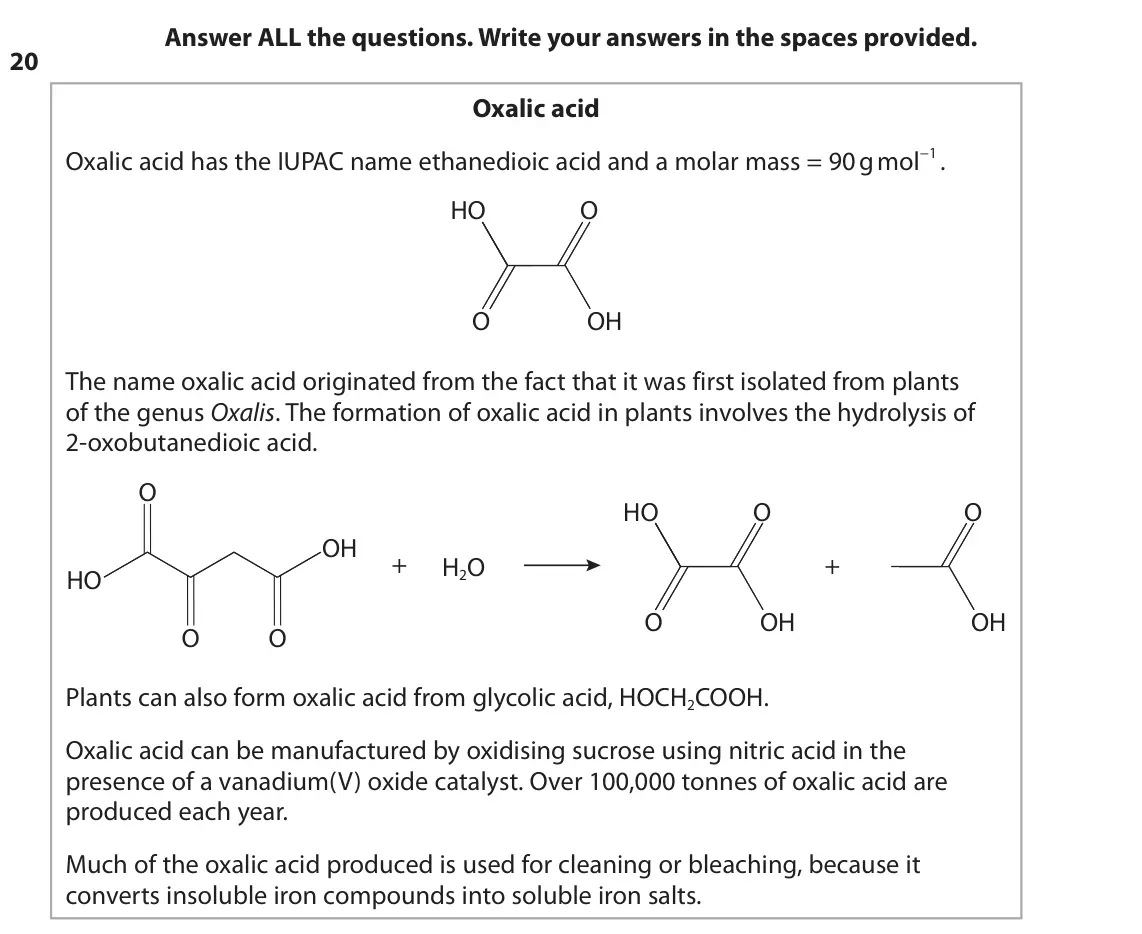
Q10(a)
The whole paper ↗ Your answer
Q14(a)
The whole paper ↗ Your answer
Q14(b)
The whole paper ↗Your answerQ17(b)(i)
The whole paper ↗
Q17(b)(iii)
The whole paper ↗Q17(b)(iv)
The whole paper ↗Q1(a)
The whole paper ↗
Q4(b)
The whole paper ↗
- Your answer
- Your answer
Q18(c)(i)
The whole paper ↗
Q2(b)(i)
The whole paper ↗
Q2(d)
The whole paper ↗Q10(a)
The whole paper ↗ Your answer
Q10(c)
The whole paper ↗Your answer
All 45 questions on Reactions of carboxylic acids, as a list
- June 2025, Unit 4, Q15(a)(iii) (2 marks): Give the structural formula and name of Substance C. (2)
- June 2025, Unit 4, Q15(a)(iv) (2 marks): Identify, by name or formula, the reagent required to carry out Reaction D, giving one observation. (2) Reagent Observation
- June 2025, Unit 4, Q15(a)(v) (1 mark): Write the full equation for the formation of Substance E. State symbols are not required. (1)
- January 2025, Unit 4, Q1 (1 mark): Which reducing reagent is used to convert carboxylic acids to alcohols? A acidified potassium dichromate(VI) B concentrated sulfuric acid C hydrogen gas with a
- January 2025, Unit 4, Q20(f) (2 marks): Write the equation for the reaction of oxalic acid with excess phosphorus(V) chloride. (2)
- October 2024, Unit 4, Q10(a) (1 mark): O OH and OH (1) A warm each compound with Tollens’ reagent B add sodium carbonate solution to each compound C warm each compound with iodine under alkaline cond
- October 2024, Unit 4, Q14(a) (1 mark): What solvent is used in this reaction? (1) A ethanol B ether C ethyl ethanoate D water
- October 2024, Unit 4, Q14(b) (1 mark): What is the organic product that forms? (1) O A OH B O C OH D
- June 2024, Unit 4, Q17(b)(i) (1 mark): Give the reagents and conditions for Reaction 1. (1)
- June 2024, Unit 4, Q17(b)(iii) (2 marks): Give the structure of the organic product formed in Reaction 3. (2)
- June 2024, Unit 4, Q17(b)(iv) (1 mark): Give the structure of the organic product formed in Reaction 4. (1)
- June 2024, Unit 6, Q1(a) (2 marks): Test 1 A small amount of phosphorus(V) chloride, PCl5, is added to 2 cm3 of A. Observation misty fumes given off Test 2 Aqueous sodium hydrogencarbonate, NaHCO3
- June 2024, Unit 6, Q4(b) (1 mark): State the purpose of the sulfuric acid. (1)
- January 2024, Unit 4, Q12 (1 mark): From which two reactants could CH3(CH2)2COO(CH2)4CH3 be made? A butanoic acid and pentan‑1‑ol B butanoyl chloride and butan‑1‑ol C butanal and pentan‑1‑ol D pen
- January 2024, Unit 4, Q13 (1 mark): The reaction between ethanoic acid and lithium tetrahydridoaluminate(III) is best described as A elimination B oxidation C reduction D substitution
- January 2024, Unit 4, Q18(c)(i) (1 mark): State the type of reaction in Step 3. (1)
- January 2024, Unit 6, Q2(b)(i) (1 mark): Name the functional group in X identified by this test. (1)
- January 2024, Unit 6, Q2(d) (1 mark): A sample of Z produced bubbles when sodium carbonate solution was added. Draw the displayed formula of Z, showing all the bonds. (1)
- October 2023, Unit 4, Q10(a) (1 mark): Which reagent is required for Reaction 1? (1) A acidified potassium dichromate(VI) B concentrated sulfuric acid C hydrogen with a nickel catalyst D lithium tetr
- October 2023, Unit 4, Q10(c) (1 mark): Which condition is essential for Reaction 2? (1) A acid catalyst B anhydrous C high temperature D ether solvent
- October 2023, Unit 4, Q17(a) (6 marks): These four isomers can be identified using three chemical tests. Each test gives a positive result for only one isomer. All three tests give a negative result f
- October 2023, Unit 5, Q14 (1 mark): An organic compound, J, reacts with • sodium hydroxide to form an ionic compound • hydrogen in the presence of a nickel catalyst • ethanol in the presence of su
- October 2023, Unit 5, Q21(d) (1 mark): Identify, by name or formula, the reagent needed to convert salicylic acid into methyl salicylate. (1)
- June 2023, Unit 5, Q24(a)(iii) (2 marks): The structure of PAA in aqueous solution is pH-dependent. Below pH 4, the structure of PAA is compact due to the formation of intramolecular hydrogen bonds. Abo
- June 2023, Unit 6, Q2(d)(i) (1 mark): Name the compound that would react with both X and Y to form ethyl esters. (1)
- June 2023, Unit 6, Q2(d)(ii) (2 marks): A student prepared an ester using X and a suitable compound. Explain why the student added aqueous sodium hydrogencarbonate to the reaction mixture to allow the
- June 2023, Unit 6, Q2(e) (2 marks): Both X and Y react with concentrated ammonia but form different products. Identify these products, by name or formula. (2) Product with X Product with Y
- June 2022, Unit 5, Q15(b) (2 marks): N‑phenylanthranilic acid has the structure shown. O OH H N The solution used as an indicator was prepared by mixing 100 mg of this acid in 5 cm3 of sodium hydro
- January 2022, Unit 4, Q14 (1 mark): Compound X, C4H10O, is oxidised to form compound Y. Compound Y reacts with ethanol in the presence of concentrated sulfuric acid to give an ester, Z. Which of t
- January 2022, Unit 4, Q21(b)(ii) (4 marks): Explain one advantage and one disadvantage of using Reaction 2 rather than Reaction 1. (4)
- January 2022, Unit 6, Q2(d)(i) (1 mark): When aqueous sodium carbonate is added to Y, effervescence is observed. Identify, by name or formula, the functional group present in Y. (1)
- October 2021, Unit 6, Q4(c)(i) (1 mark): Write an equation for the reaction taking place in Step 4. Use structural formulae for the organic substances. State symbols are not required. (1)
- June 2021, Unit 4, Q17(b)(ii) (1 mark): Draw the structures of two organic compounds that would react together to form Y. (1)
- June 2021, Unit 4, Q19(b) (1 mark): Sodium hydrogencarbonate, NaHCO3 , has been used by some athletes to help prevent lactic acid causing muscle pain during exercise. Write an equation for the rea
- June 2021, Unit 6, Q1(c) (3 marks): A white solid with a slight vinegar-like smell contains ammonium ions, NH4 an anion represented by Y−. The smell of vinegar intensifies on the addition of a few
- June 2021, Unit 6, Q3(b)(i) (2 marks): A and B O O OH OH O B A (2)
- January 2021, Unit 4, Q17(b) (3 marks): A reaction scheme involving butanoic acid is shown. O O acidified K2Cr2O7 reagent Y alcohol X Cl OH heat under reflux butanoic acid CH3NH2 compound Z Identify X
- January 2021, Unit 4, Q17(d)(ii) (1 mark): Aqueous sodium hydrogencarbonate is added to a sample of E. No effervescence occurs. State what can be deduced by this observation. (1)
- October 2020, Unit 4, Q14 (1 mark): An organic compound that reacts with both lithium tetrahydridoaluminate(III) (lithium aluminium hydride) and magnesium could be A an aldehyde B a carboxylic aci
- October 2020, Unit 4, Q17(c)(i) (4 marks): Identify, by name or formula, compounds V, W and F. Justify your answer by using all the available information. (4)
- October 2020, Unit 4, Q17(c)(iii) (1 mark): State the role of sulfuric acid in the formation of F. (1)
- October 2020, Unit 6, Q2(b)(i) (2 marks): When sodium hydrogencarbonate solution is added to separate samples of Q and R, effervescence occurs and a gas is evolved which turns limewater milky. Deduce th
- January 2020, Unit 4, Q4 (1 mark): The compound HOOCCH CHCOOH reacts with excess sodium hydroxide solution. What is the organic product formed in the reaction? A NaOOCCH CHCOONa B HOOCCH CHCOONa
- January 2020, Unit 4, Q6 (1 mark): Which of these reacts directly with ethanoic acid to form ethanoyl chloride? A chlorine B chloroethane C hydrogen chloride D phosphorus(V) chloride
- January 2020, Unit 4, Q20(a)(v) (1 mark): Describe how the sodium ethanoate in the final reaction mixture could be converted into ethanoic acid. (1)
Questions, mark schemes and examiner’s reports are © Pearson Edexcel, from their published past papers. Plumi isn’t affiliated with any exam board. Want whole papers? Edexcel International A Level Chemistry past papers.
The Plumi iPad app also offers exam-style questions with AI feedback on your handwritten working.