 plumi
Oxidation of alcohols: Edexcel International A Level Chemistry questions
Edexcel International A Level Chemistry past-paper questions on 10.C.3 Oxidation of alcohols, 2019–2025, with mark schemes and examiner’s reports where available.
Paper
All papers
Exam
All years
Calculations
Q12(b)
The whole paper ↗ Your answer
Q12(c)
The whole paper ↗Your answerQ16(c)(i)
The whole paper ↗
Q1(b)(i)
The whole paper ↗
Q18(d)
The whole paper ↗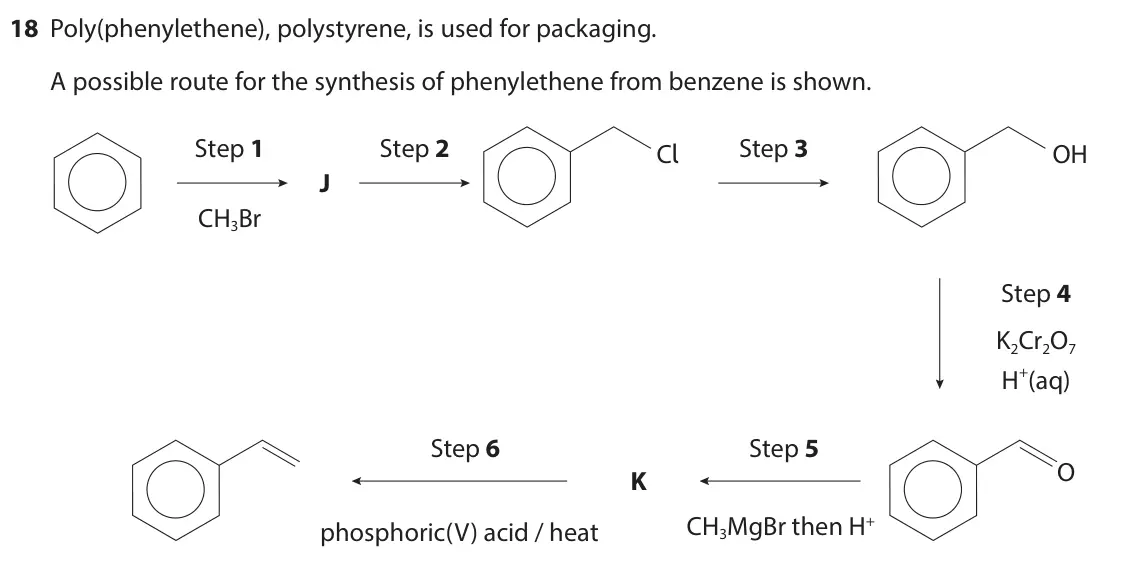
Q21(d)(i)
The whole paper ↗
Q21(d)(ii)
The whole paper ↗Q20(b)
The whole paper ↗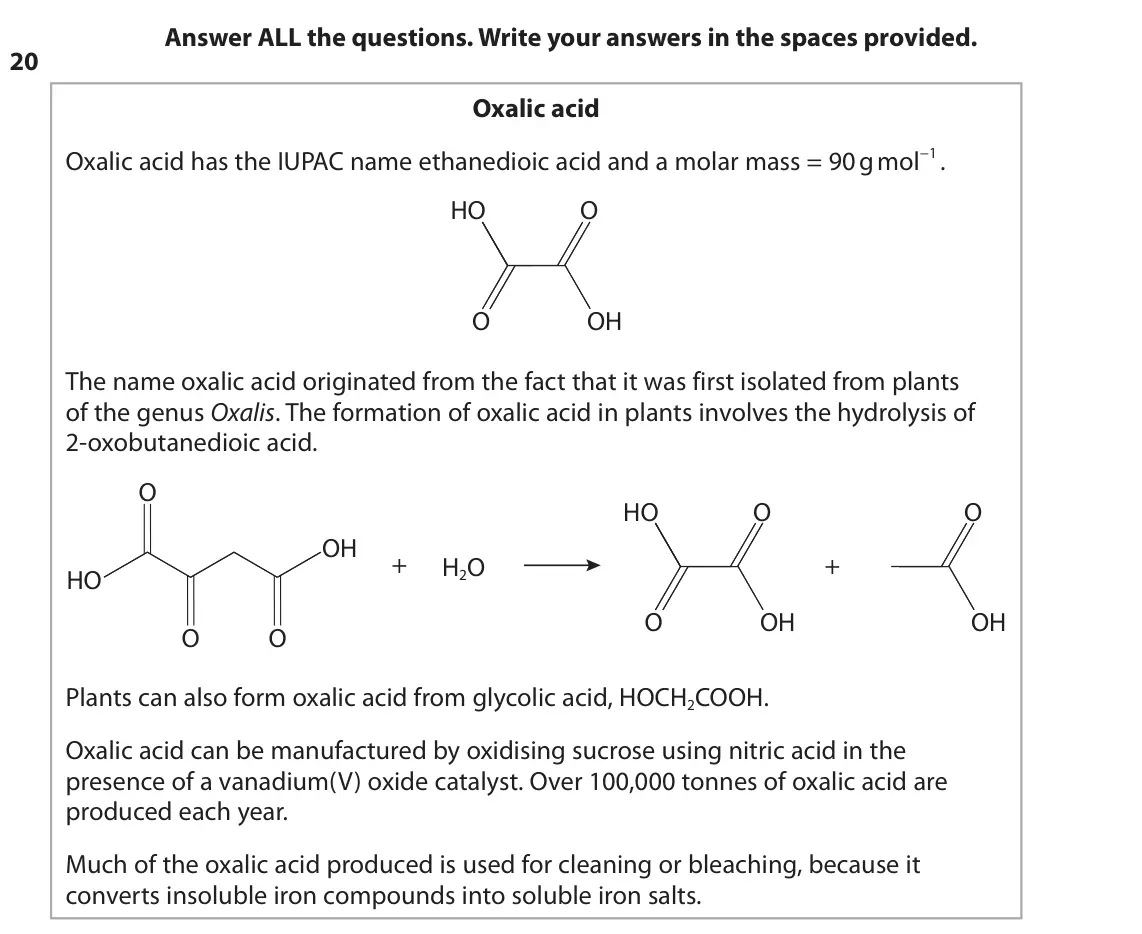
Q14(a)
The whole paper ↗ Your answer
Q3(c)(i)
The whole paper ↗
Q20(b)(i)
The whole paper ↗
Q5(c)(ii)
The whole paper ↗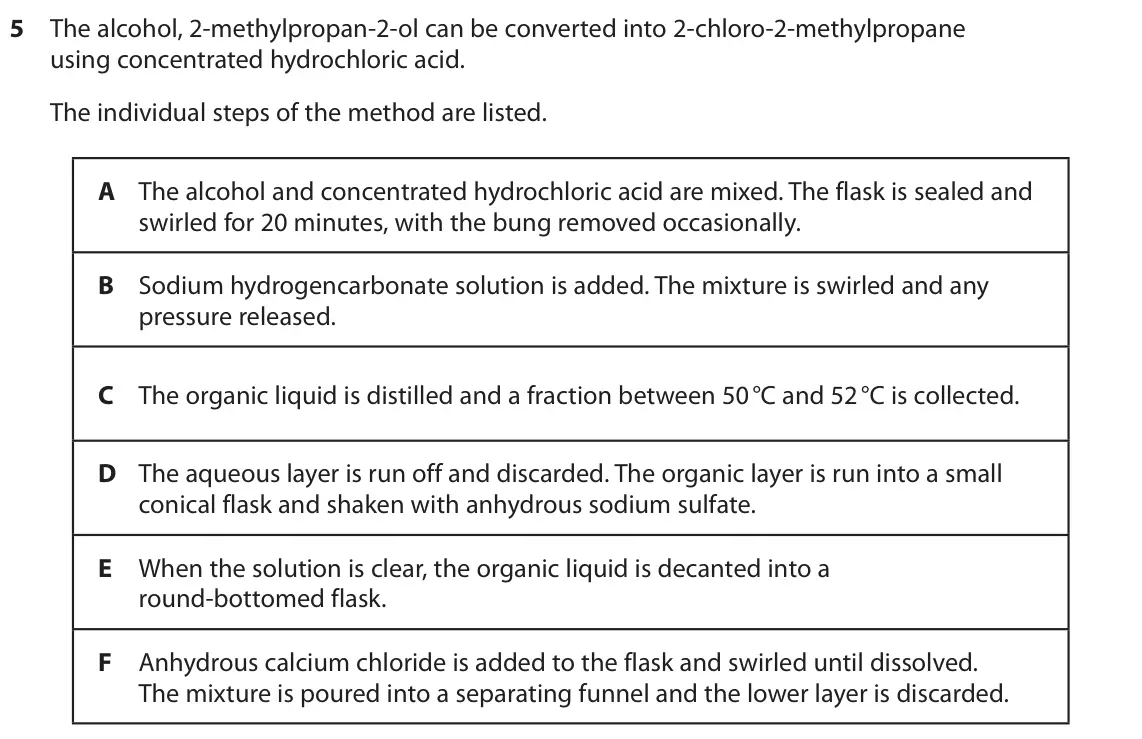
- Your answer
Q1(b)
The whole paper ↗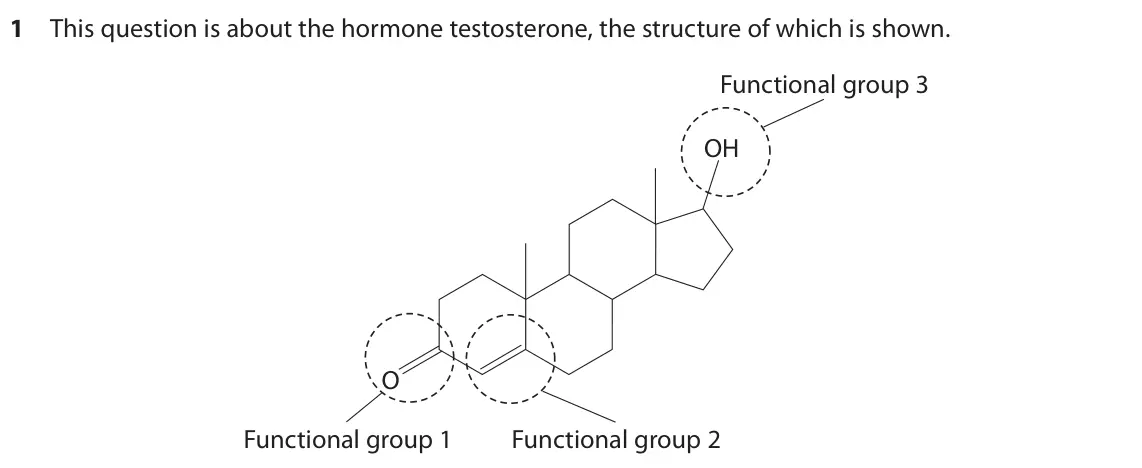
Q4(b)(i)
The whole paper ↗
Q14(a)
The whole paper ↗ Your answer
Q14(b)
The whole paper ↗Your answerQ21(b)(ii)
The whole paper ↗
Q3(a)(i)
The whole paper ↗
All 61 questions on Oxidation of alcohols, as a list
- June 2025, AS Unit 2, Q12(b) (1 mark): Which compound can be oxidised to form a ketone? (1) A butanone B butanal C butan-2-ol D methylpropan-2-ol
- June 2025, AS Unit 2, Q12(c) (1 mark): Which compound forms a red precipitate when warmed with Fehling’s solution? (1) A butanone B butanal C butan-2-ol D methylpropan-2-ol Use this space for any rou
- June 2025, AS Unit 2, Q16(c)(i) (2 marks): Name the reagents and conditions for this conversion. (2)
- June 2025, AS Unit 3, Q1(b)(i) (1 mark): Give the colour change of the mixtures during heating. (1) From To
- June 2025 (A), Unit 5, Q18(d) (2 marks): Suggest two ways in which the maximum yield of the aldehyde in Step 4 could be obtained. (2)
- January 2025, AS Unit 2, Q21(d)(i) (1 mark): State the type of reaction taking place as methanol is converted into methanal. (1)
- January 2025, AS Unit 2, Q21(d)(ii) (4 marks): Give the reagents and conditions that are needed for this reaction in the laboratory. Include in your answer any colour change seen. (4) Reagents . Conditions C
- January 2025, Unit 4, Q20(b) (2 marks): Give the laboratory reagents and conditions required to convert glycolic acid, HOCH2COOH, to oxalic acid. Do not consider nitric acid. (2)
- October 2024, AS Unit 2, Q14(a) (1 mark): Which compound would not give a colour change when heated with acidified potassium dichromate(VI) solution? (1) A propan-1-ol B propan-2-ol C propanal D propano
- October 2024, AS Unit 3, Q3(c)(i) (4 marks): The purified organic liquid was refluxed with acidified potassium dichromate(VI) solution. A colour change was observed while refluxing. The resulting solution
- June 2024 (R), AS Unit 2, Q17 (1 mark): Which alcohol can be oxidised to a carboxylic acid by acidified potassium dichromate(VI)? OH A B OH C OH OH D
- June 2024 (R), AS Unit 2, Q20(b)(i) (3 marks): Some chemical tests were carried out on acetoin. These tests identify one of the two functional groups. Acetoin produced steamy fumes when reacted with PCl5 . A
- June 2024 (R), AS Unit 3, Q5(c)(ii) (5 marks): Describe how a solution of acidified potassium dichromate(VI) and subsequent chemical tests could be used to distinguish between alcohols X, Y and Z. You may as
- January 2024, AS Unit 2, Q19 (1 mark): What amount, in mol, of [O] is needed to convert 1 mol of pentane-1,3,5-triol into 3-oxopentanedioic acid and water? OH O OH OH HO OH O O pentane-1,3,5-triol 3-
- January 2024, AS Unit 3, Q1(b) (4 marks): Describe a chemical test and the expected positive result for both functional group 2 and functional group 3. (4) Functional group 2 Test Result Functional grou
- January 2024, AS Unit 3, Q4(b)(i) (2 marks): Explain why the reaction mixture is heated as shown, instead of heating under reflux. (2)
- October 2023, AS Unit 2, Q14(a) (1 mark): When propan‑2‑ol is refluxed with excess acidified potassium dichromate(VI), the product will show a peak due to (1) A O H stretching at 3750 – 3200 cm–1 B C O
- October 2023, AS Unit 2, Q14(b) (1 mark): When propan‑1‑ol is heated with acidified potassium dichromate(VI), the product that is distilled off as it is formed will show a peak due to (1) A O H stretchi
- October 2023, AS Unit 2, Q21(b)(ii) (1 mark): The propenal is then oxidised to propenoic acid. Write an equation for this reaction using [O] to represent the oxygen from the oxidising agent. (1)
- June 2023, AS Unit 3, Q3(a)(i) (2 marks): Explain why apparatus E is not suitable for the oxidation of butan‑1‑ol to butanoic acid. (2)
- June 2023, AS Unit 3, Q3(a)(iv) (1 mark): State the reaction mixture that can be used to oxidise the butan‑1‑ol to butanoic acid. (1)
- June 2023, AS Unit 3, Q3(a)(v) (1 mark): Give the colour change observed in the flask during this oxidation. (1) From to
- January 2023, AS Unit 2, Q19(c) (3 marks): Give the structure of the organic product of each reaction shown. (3) Reaction 1 K2Cr2O7 , H2SO4 OH heat under reflux Reaction 2 K2Cr2O7 , H2SO4 OH heat under r
- January 2023, AS Unit 3, Q4(b)(i) (2 marks): A sample of butan‑1‑ol is warmed with a solution of potassium dichromate(VI) in dilute sulfuric acid. State the colour change which would be observed. (2)
- January 2023, AS Unit 3, Q4(b)(ii) (1 mark): The three isomers K, L and M are warmed separately with portions of a solution of potassium dichromate(VI) in dilute sulfuric acid. No colour change is observed
- January 2023, AS Unit 3, Q4(b)(iii) (3 marks): The other isomers L and M are oxidised when warmed with a solution of potassium dichromate(VI) in dilute sulfuric acid. Complete the table to show the displayed
- October 2022, AS Unit 2, Q6 (1 mark): How many structural isomers with the molecular formula C5H10O react with Benedict’s or Fehling’s solutions? A 2 B 3 C 4 D 5
- October 2022, AS Unit 2, Q22(c)(i) (2 marks): Identify by name or formula the reagents needed to prepare the oxidising mixture. (2)
- October 2022, AS Unit 2, Q22(c)(ii) (1 mark): Write the equation for Step 1 using [O] to represent the oxygen from the oxidising agent. (1)
- October 2022, AS Unit 3, Q4(a) (2 marks): State the colour change seen when an alcohol is oxidised with acidified potassium dichromate(VI). (2)
- October 2022, AS Unit 3, Q4(c)(ii) (1 mark): State why there is no reaction when 2-methylpropan-2-ol is heated with acidified potassium dichromate(VI). (1)
- October 2022, AS Unit 3, Q4(c)(iii) (1 mark): Identify, by name or formula, all the possible oxidation products of propan‑1‑ol and propan‑2‑ol. (1)
- October 2022, AS Unit 3, Q4(c)(iv) (4 marks): Give a further chemical test and the positive result for each of the oxidation products of propan‑1‑ol. (4)
- October 2022, Unit 5, Q23(b)(i) (2 marks): State the reagents and conditions needed for this oxidation. (2)
- October 2022, Unit 5, Q23(b)(ii) (2 marks): The boiling temperature of salicylaldehyde is 197 °C. Suggest why this makes it very difficult to obtain salicylaldehyde by oxidising salicyl alcohol. . (2)
- June 2022, AS Unit 2, Q13 (1 mark): Which of these alcohols will produce a carboxylic acid when heated under reflux with acidified potassium dichromate(VI)? P Q OH OH R S OH OH A P only B P and Q
- June 2022, AS Unit 2, Q14(b) (1 mark): The reagent for Reaction 2 is acidified potassium dichromate(VI). Which equation best represents this reaction? (1) A C6H11OH → C6H10O + H2 B C6H11OH → C6H10O +
- January 2022, AS Unit 3, Q2(c) (3 marks): Compound X is converted into compound Y when refluxed with excess sodium dichromate(VI) in sulfuric acid. Compound Y is a liquid that is soluble in the reaction
- January 2022, Unit 4, Q14 (1 mark): Compound X, C4H10O, is oxidised to form compound Y. Compound Y reacts with ethanol in the presence of concentrated sulfuric acid to give an ester, Z. Which of t
- October 2021, AS Unit 2, Q2 (1 mark): Which of these compounds does not react with acidified potassium dichromate(VI)? A CH3CH2OH B CH3CHOHCH3 C CH3CH2CHO D CH3COCH3
- October 2021, AS Unit 2, Q22(b) (1 mark): Suggest why this fermentation must be carried out in the absence of air. (1)
- June 2021, AS Unit 3, Q2(c) (2 marks): Separate samples of each of these compounds are warmed with acidified potassium dichromate(VI). Complete the table to give the colour changes observed, if any.
- June 2021, Unit 4, Q8(c) (1 mark): Four groups of students warmed samples of menthol with sodium dichromate(VI) in acid. They purified the reaction mixture and carried out a series of qualitative
- January 2021, AS Unit 2, Q19(c)(i) (1 mark): Draw the structure of Y. (1)
- January 2021, AS Unit 2, Q19(c)(ii) (2 marks): State the conditions needed to maximise the yield of each product. (2) Conditions for maximum yield of Y Conditions for maximum yield of ethanoic acid
- January 2021, Unit 4, Q17(b) (3 marks): A reaction scheme involving butanoic acid is shown. O O acidified K2Cr2O7 reagent Y alcohol X Cl OH heat under reflux butanoic acid CH3NH2 compound Z Identify X
- October 2020, AS Unit 2, Q17(b)(i) (2 marks): State the reagents and reaction conditions for this oxidation in the laboratory. (2)
- October 2020, AS Unit 2, Q17(b)(ii) (1 mark): Complete the equation to show the products of this oxidation. State symbols are not required. (1) CH3OH + [O] →
- October 2020, Unit 4, Q15(b) (1 mark): Which test would distinguish between 2-methylpropan-2-ol, (CH3)3COH, and butan-1-ol, CH3CH2CH2CH2OH? (1) A B C D
- October 2020, Unit 5, Q25(e)(ii) (4 marks): The Lanthanides The lanthanides form a series in the Periodic Table comprising the elements from lanthanum, La (Z = 57) to lutetium, Lu (Z = 71). They have impo
- October 2020, Unit 6, Q1(b)(ii) (1 mark): Suggest the name or formula of the organic product formed in the green mixture. (1)
- January 2020, AS Unit 2, Q14(b) (1 mark): Propanal and propanone can be distinguished by chemical tests. Which pair of observations is correct? (1) Observation with Observation Test propanal with propan
- January 2020, AS Unit 2, Q17(e) (2 marks): In the liver, enzymes oxidise some alcohols as part of the process which removes them from the body. During this process any aldehydes produced are toxic. Other
- January 2020, AS Unit 3, Q1(c)(i) (2 marks): Acidified potassium dichromate(VI) solution was added to two test tubes each containing a different alcohol. The test tubes were placed in a warm water bath. Th
- June 2019, AS Unit 2, Q23(a) (1 mark): Write the balanced equation for the oxidation of propan-1-ol to form propanoic acid. Use [O] to represent the oxygen from the oxidising agent. State symbols are
- June 2019, AS Unit 2, Q23(b) (6 marks): Propan-1-ol is heated with a concentrated solution of acidified potassium dichromate(VI). Explain how the conditions used affect the rate of the reaction and en
- June 2019, AS Unit 2, Q23(c) (1 mark): A student suggested using universal indicator to check for the presence of propanoic acid formed in the reaction mixture. Give a reason why the result of this t
- June 2019, AS Unit 3, Q2(b)(i) (1 mark): Identify the reagent mixture that can be used to oxidise A. (1)
- June 2019, AS Unit 3, Q2(b)(ii) (2 marks): One student said that if A was a primary alcohol this could be shown by oxidising it to the corresponding aldehyde and testing the product. Identify which appar
- June 2019, AS Unit 3, Q2(b)(iv) (1 mark): State whether or not a positive result for the test in (b)(iii), together with the molecular formula, would allow the alcohol A to be identified. Justify your a
- June 2019, AS Unit 3, Q2(b)(v) (2 marks): Another student said that if A was a secondary alcohol this could be shown by oxidising it to the corresponding ketone. Identify which apparatus (1, 2 or 3) sho
Questions, mark schemes and examiner’s reports are © Pearson Edexcel, from their published past papers. Plumi isn’t affiliated with any exam board. Want whole papers? Edexcel International A Level Chemistry past papers.
The Plumi iPad app also offers exam-style questions with AI feedback on your handwritten working.