Skip to content

Water: Edexcel A‑Level Biology B questions

Every Edexcel A-Level Biology B exam question on 1.7 Water, 2016–2025, with its mark scheme and examiner’s report.

Find questions1,826
Calculations

1,826 questions

  1. Q5(a)

    June 2025 · AS Paper 1

    3 marks1.7 Water
    The whole paper ↗
    June 2025 AS Paper 1, question 5(a): Explain how the properties of water molecules result in a high surface tension. (3)
  2. Q5(b)(i)

    June 2025 · AS Paper 1

    2 marks1.7 Water
    The whole paper ↗
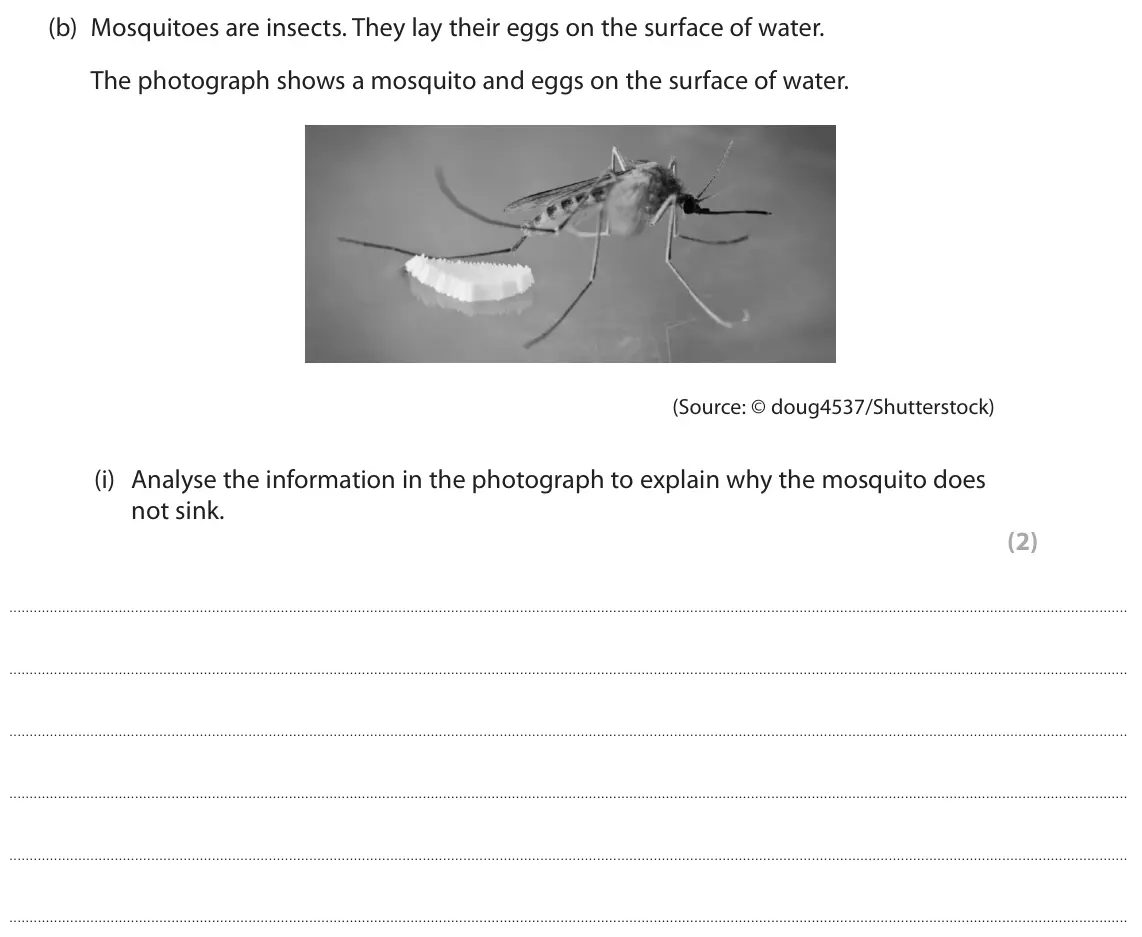
    June 2025 AS Paper 1, question 5(b)(i): Analyse the information in the photograph to explain why the mosquito does not sink. (2)
  3. Q5(b)(ii)

    June 2025 · AS Paper 1

    2 marks1.7 Water
    The whole paper ↗
    June 2025 AS Paper 1, question 5(b)(ii): Kerosene is a mixture of non‑polar organic molecules made of carbon and hydrogen. When kerosene is sprayed on the water, the floating mosquito eggs sink. Explai
  4. Q5(c)(i)

    June 2025 · AS Paper 1

    2 marks1.7 Water
    The whole paper ↗
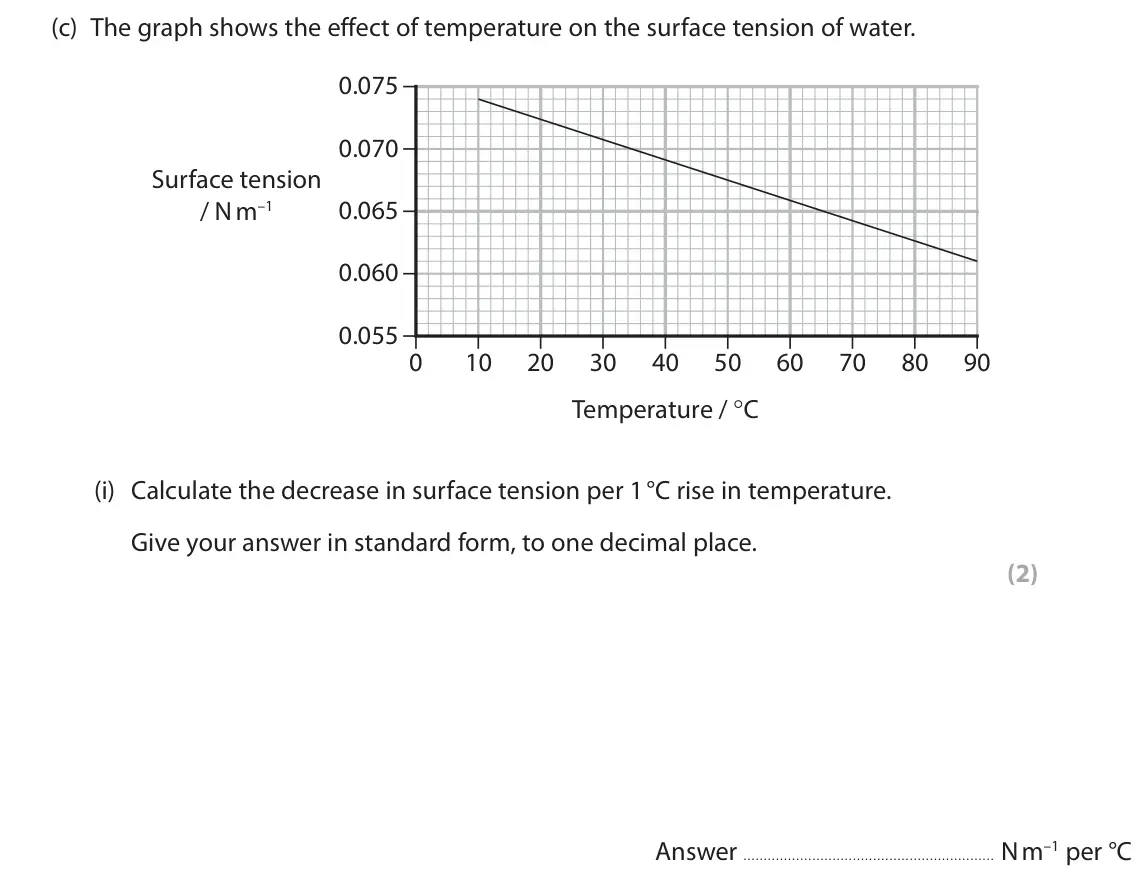
    June 2025 AS Paper 1, question 5(c)(i): Calculate the decrease in surface tension per 1 °C rise in temperature. Give your answer in standard form, to one decimal place. (2) Answer N m–1 per °C
  5. Q5(c)(ii)

    June 2025 · AS Paper 1

    2 marks1.7 Water
    The whole paper ↗
    June 2025 AS Paper 1, question 5(c)(ii): Explain why a rise in temperature causes a decrease in surface tension. (2)
  6. Q1(a)(ii)

    June 2024 · AS Paper 1

    2 marks1.7 Water
    The whole paper ↗
    June 2024 AS Paper 1, question 1(a)(ii): Explain why these ions dissolve in water. (2)
  7. Q5(a)

    June 2022 · AS Paper 1

    1 mark1.7 Water
    The whole paper ↗
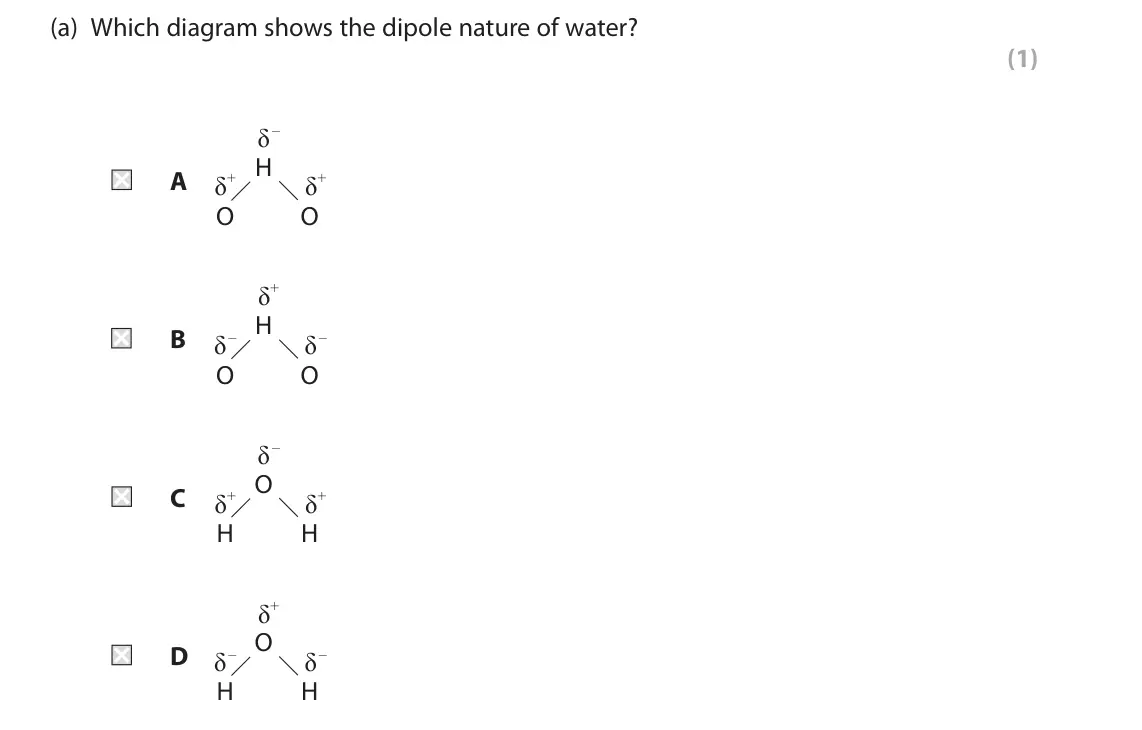
    June 2022 AS Paper 1, question 5(a): Which diagram shows the dipole nature of water? (1) δ – H A δ+ δ+ O O δ+ H B δ – δ – O O δ – O C δ+ δ+ H H δ+ O D δ – δ – H H
  8. Q5(b)(i)

    June 2022 · AS Paper 1

    2 marks1.7 Water
    The whole paper ↗
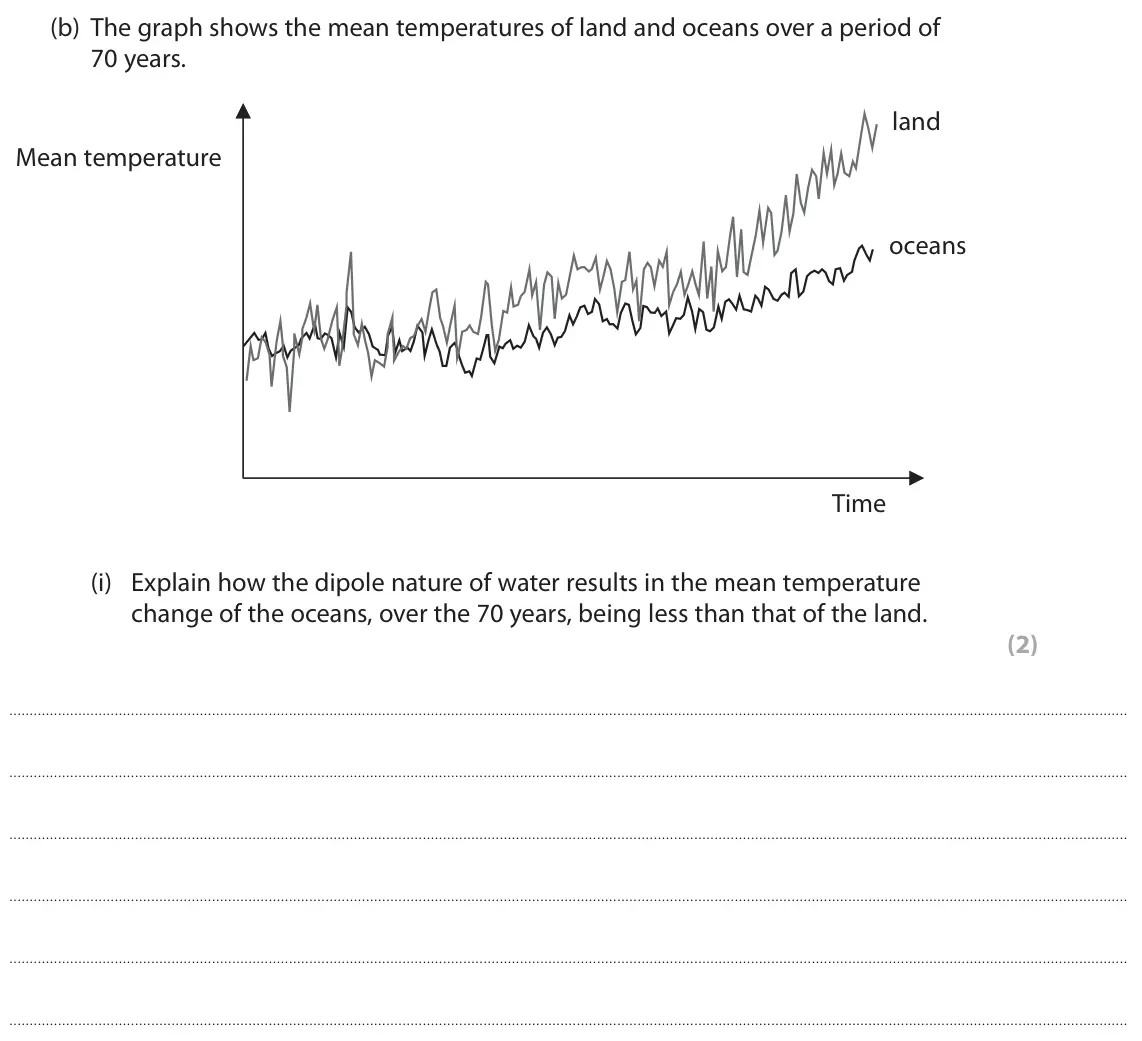
    June 2022 AS Paper 1, question 5(b)(i): Explain how the dipole nature of water results in the mean temperature change of the oceans, over the 70 years, being less than that of the land. (2)
  9. Q5(b)(ii)

    June 2022 · AS Paper 1

    2 marks1.7 Water
    The whole paper ↗
    June 2022 AS Paper 1, question 5(b)(ii): Explain the importance of this lower change in mean temperature to organisms, such as fish, that live in the oceans. (2)
  10. Q5(c)

    June 2022 · AS Paper 1

    3 marks1.7 Water
    The whole paper ↗
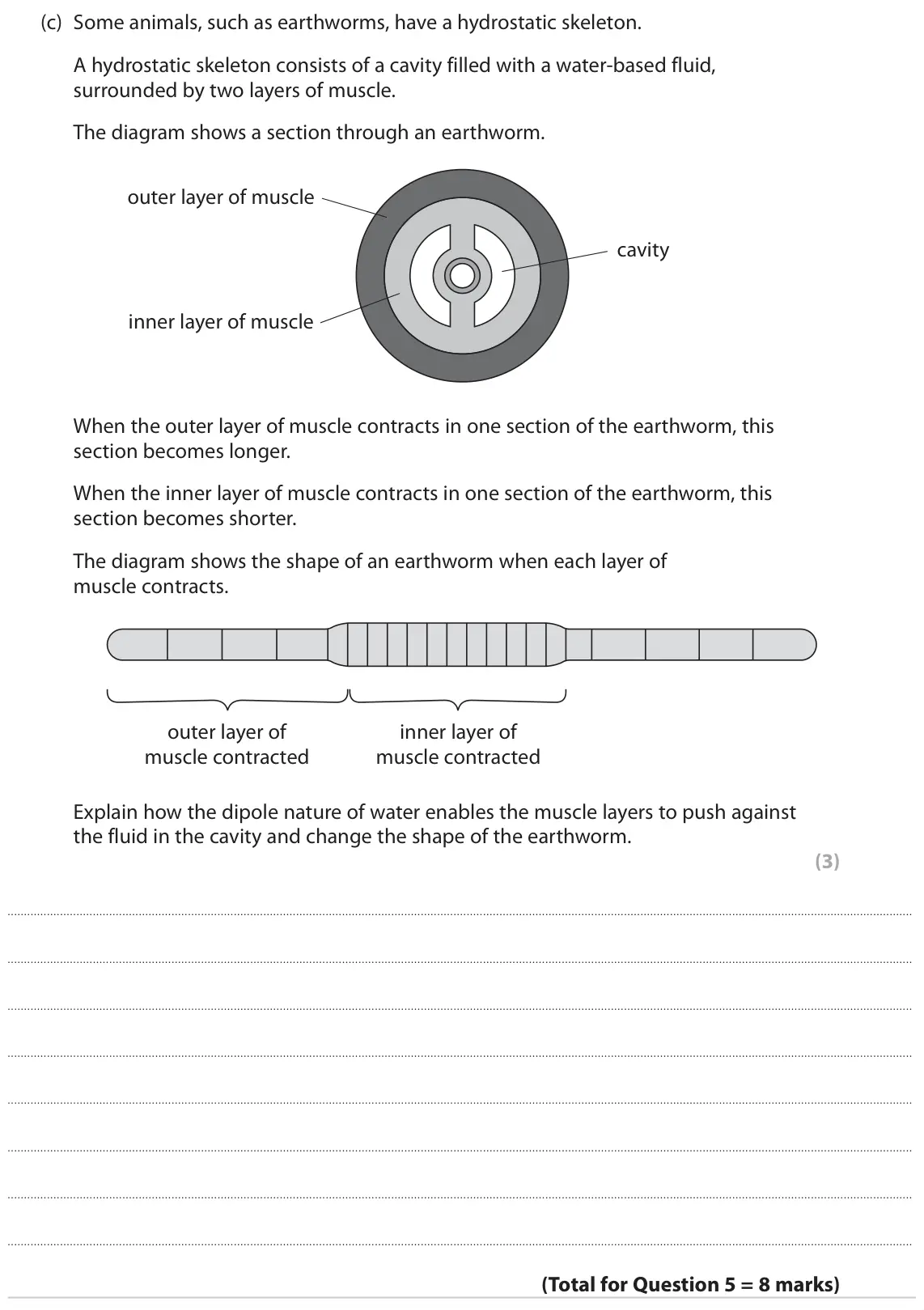
    June 2022 AS Paper 1, question 5(c): Some animals, such as earthworms, have a hydrostatic skeleton. A hydrostatic skeleton consists of a cavity filled with a water-based fluid, surrounded by two la
  11. Q4(c)

    November 2021 · Paper 1

    The whole paper ↗
    November 2021 Paper 1, question 4(c): Explain how transpiration depends on the dipole nature of water. (3)
  12. Q9(a)(i)

    June 2019 · Paper 2

    1 mark1.7 Water
    The whole paper ↗
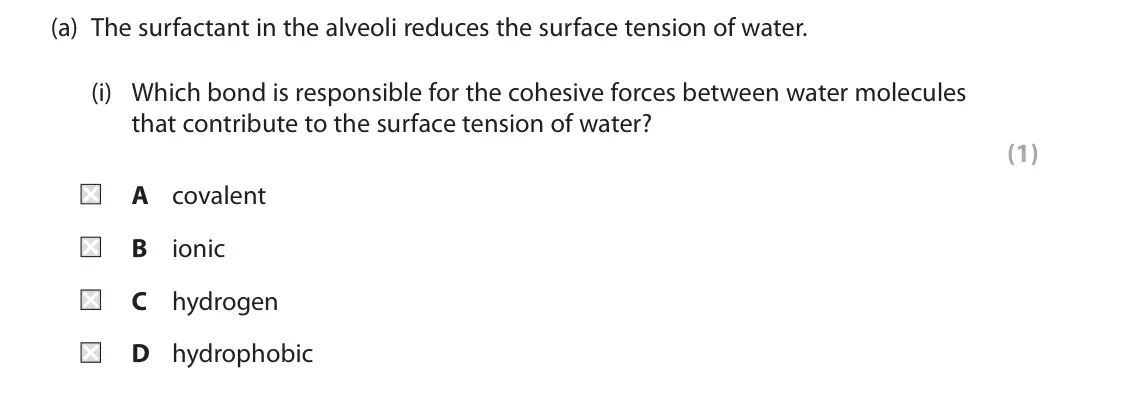
    June 2019 Paper 2, question 9(a)(i): Which bond is responsible for the cohesive forces between water molecules that contribute to the surface tension of water? (1) A covalent B ionic C hydrogen D h
  13. Q3(a)

    June 2016 · AS Paper 1

    3 marks1.7 Water
    The whole paper ↗
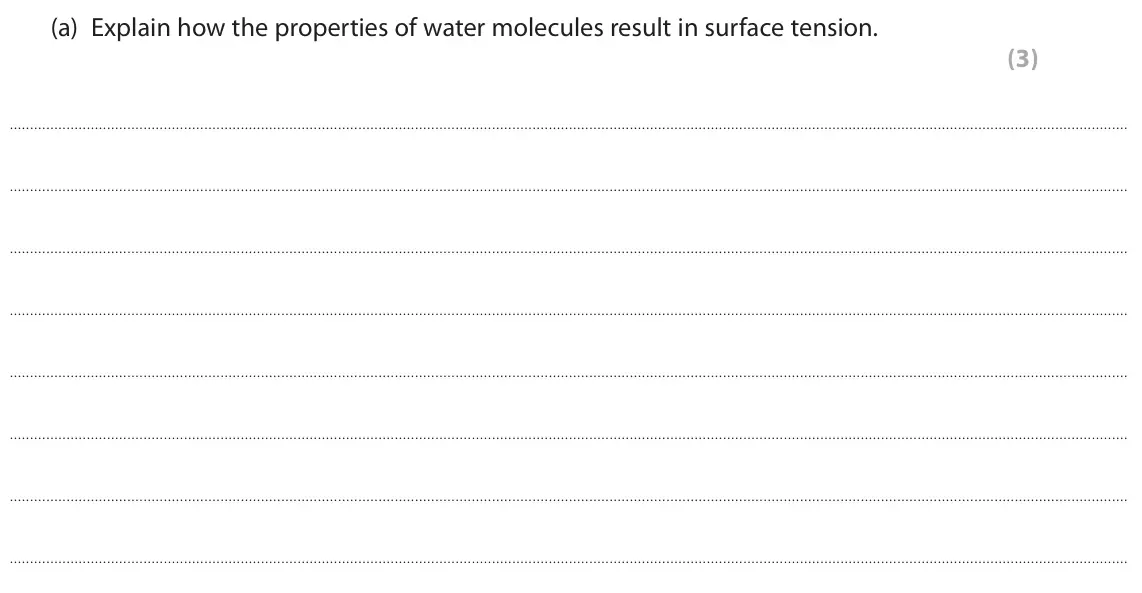
    June 2016 AS Paper 1, question 3(a): Explain how the properties of water molecules result in surface tension. (3)
  14. Q3(b)(i)

    June 2016 · AS Paper 1

    3 marks1.7 Water
    The whole paper ↗
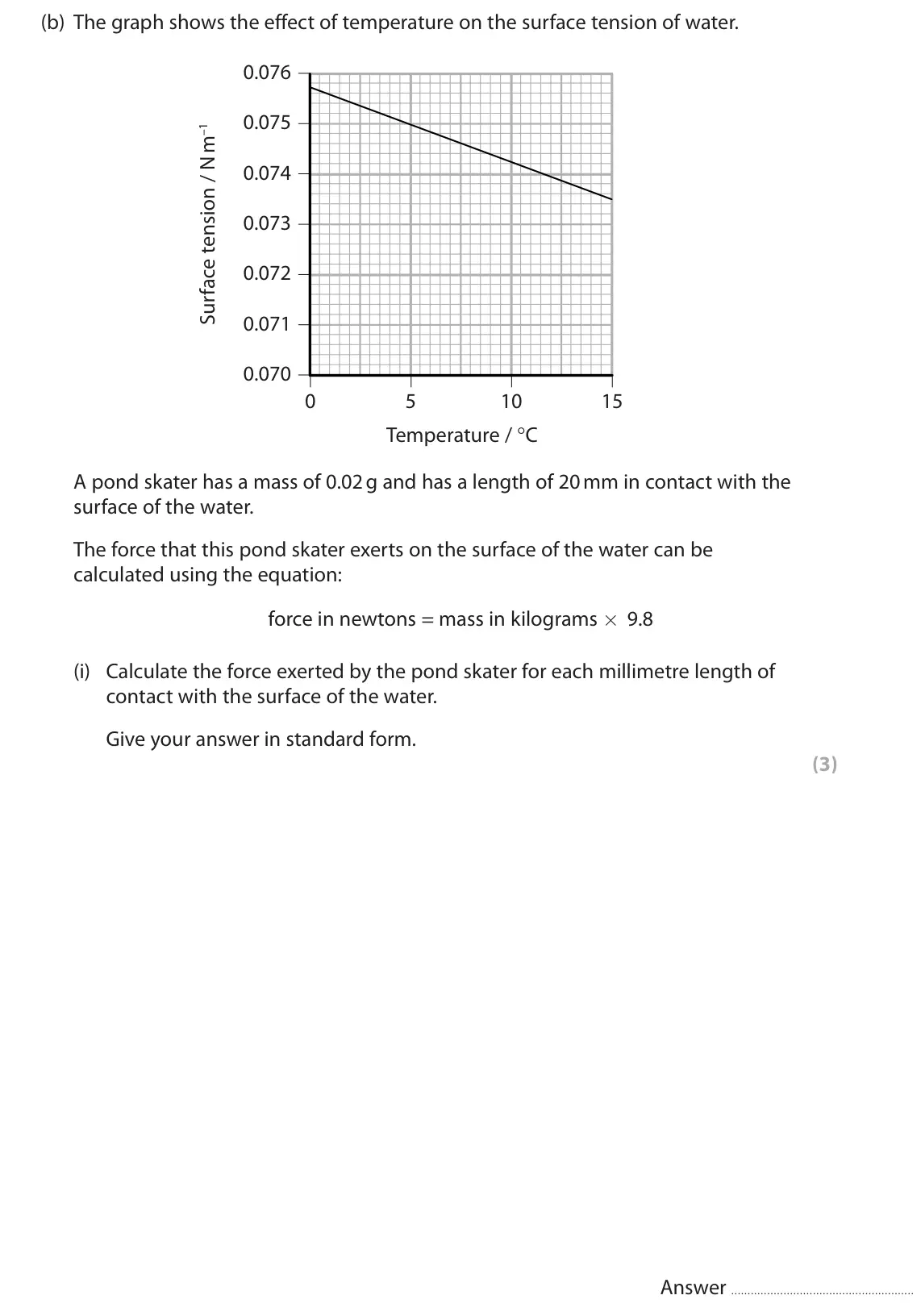
    June 2016 AS Paper 1, question 3(b)(i): Calculate the force exerted by the pond skater for each millimetre length of contact with the surface of the water. Give your answer in standard form. (3) Answe
  15. Q3(b)(ii)

    June 2016 · AS Paper 1

    3 marks1.7 Water
    The whole paper ↗
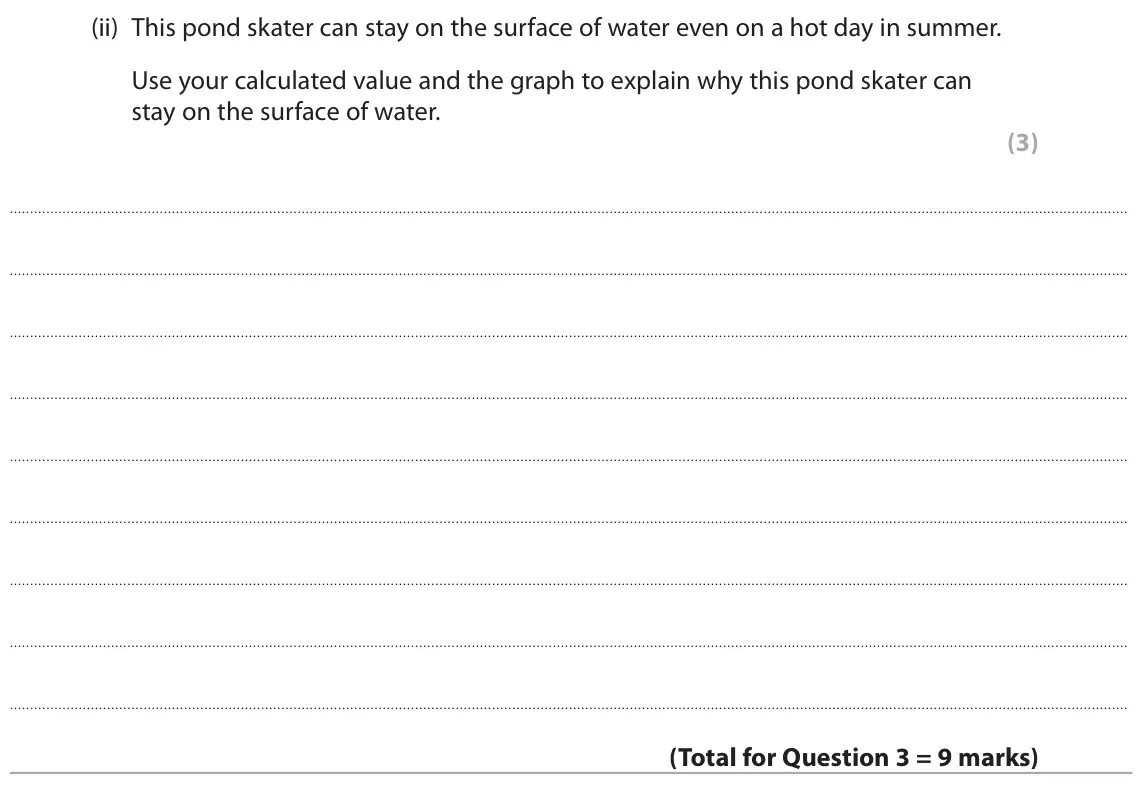
    June 2016 AS Paper 1, question 3(b)(ii): This pond skater can stay on the surface of water even on a hot day in summer. Use your calculated value and the graph to explain why this pond skater can stay
All 15 questions on Water, as a list
  1. June 2025, AS Paper 1, Q5(a) (3 marks): Explain how the properties of water molecules result in a high surface tension. (3)
  2. June 2025, AS Paper 1, Q5(b)(i) (2 marks): Analyse the information in the photograph to explain why the mosquito does not sink. (2)
  3. June 2025, AS Paper 1, Q5(b)(ii) (2 marks): Kerosene is a mixture of non‑polar organic molecules made of carbon and hydrogen. When kerosene is sprayed on the water, the floating mosquito eggs sink. Explai
  4. June 2025, AS Paper 1, Q5(c)(i) (2 marks): Calculate the decrease in surface tension per 1 °C rise in temperature. Give your answer in standard form, to one decimal place. (2) Answer N m–1 per °C
  5. June 2025, AS Paper 1, Q5(c)(ii) (2 marks): Explain why a rise in temperature causes a decrease in surface tension. (2)
  6. June 2024, AS Paper 1, Q1(a)(ii) (2 marks): Explain why these ions dissolve in water. (2)
  7. June 2022, AS Paper 1, Q5(a) (1 mark): Which diagram shows the dipole nature of water? (1) δ – H A δ+ δ+ O O δ+ H B δ – δ – O O δ – O C δ+ δ+ H H δ+ O D δ – δ – H H
  8. June 2022, AS Paper 1, Q5(b)(i) (2 marks): Explain how the dipole nature of water results in the mean temperature change of the oceans, over the 70 years, being less than that of the land. (2)
  9. June 2022, AS Paper 1, Q5(b)(ii) (2 marks): Explain the importance of this lower change in mean temperature to organisms, such as fish, that live in the oceans. (2)
  10. June 2022, AS Paper 1, Q5(c) (3 marks): Some animals, such as earthworms, have a hydrostatic skeleton. A hydrostatic skeleton consists of a cavity filled with a water-based fluid, surrounded by two la
  11. November 2021, Paper 1, Q4(c) (3 marks): Explain how transpiration depends on the dipole nature of water. (3)
  12. June 2019, Paper 2, Q9(a)(i) (1 mark): Which bond is responsible for the cohesive forces between water molecules that contribute to the surface tension of water? (1) A covalent B ionic C hydrogen D h
  13. June 2016, AS Paper 1, Q3(a) (3 marks): Explain how the properties of water molecules result in surface tension. (3)
  14. June 2016, AS Paper 1, Q3(b)(i) (3 marks): Calculate the force exerted by the pond skater for each millimetre length of contact with the surface of the water. Give your answer in standard form. (3) Answe
  15. June 2016, AS Paper 1, Q3(b)(ii) (3 marks): This pond skater can stay on the surface of water even on a hot day in summer. Use your calculated value and the graph to explain why this pond skater can stay

Questions, mark schemes and examiner’s reports are © Pearson Edexcel, from their published past papers. Plumi isn’t affiliated with any exam board. Want whole papers? Every Edexcel A-Level Biology B paper.

Rather write your answers by hand on iPad? Plumi marks them against the same mark schemes.