 plumi
Stable and unstable nuclei: AQA A‑Level Physics questions
AQA A-Level Physics past-paper questions on 3.2.1.2 Stable and unstable nuclei, 2008–2025, with mark schemes and examiner’s reports where available.
Paper
All papers
Exam
All years
Calculations
Q01.4
The whole paper ↗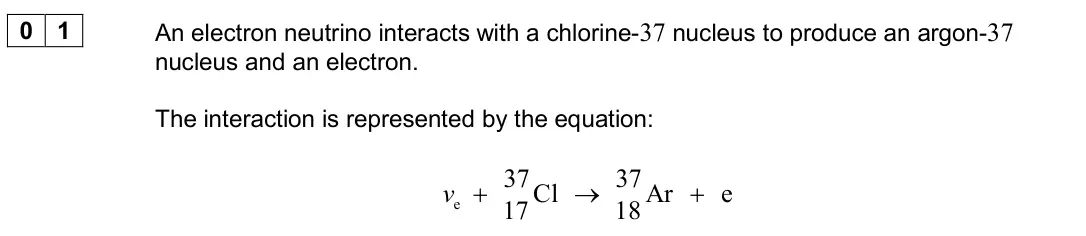
Q01.1
The whole paper ↗
Q02.2
The whole paper ↗
Q01.2
The whole paper ↗Q01.3
The whole paper ↗Q01.2
The whole paper ↗Q01.4
The whole paper ↗Q01.3
The whole paper ↗Q01.4
The whole paper ↗- Your answer
Q07.2
The whole paper ↗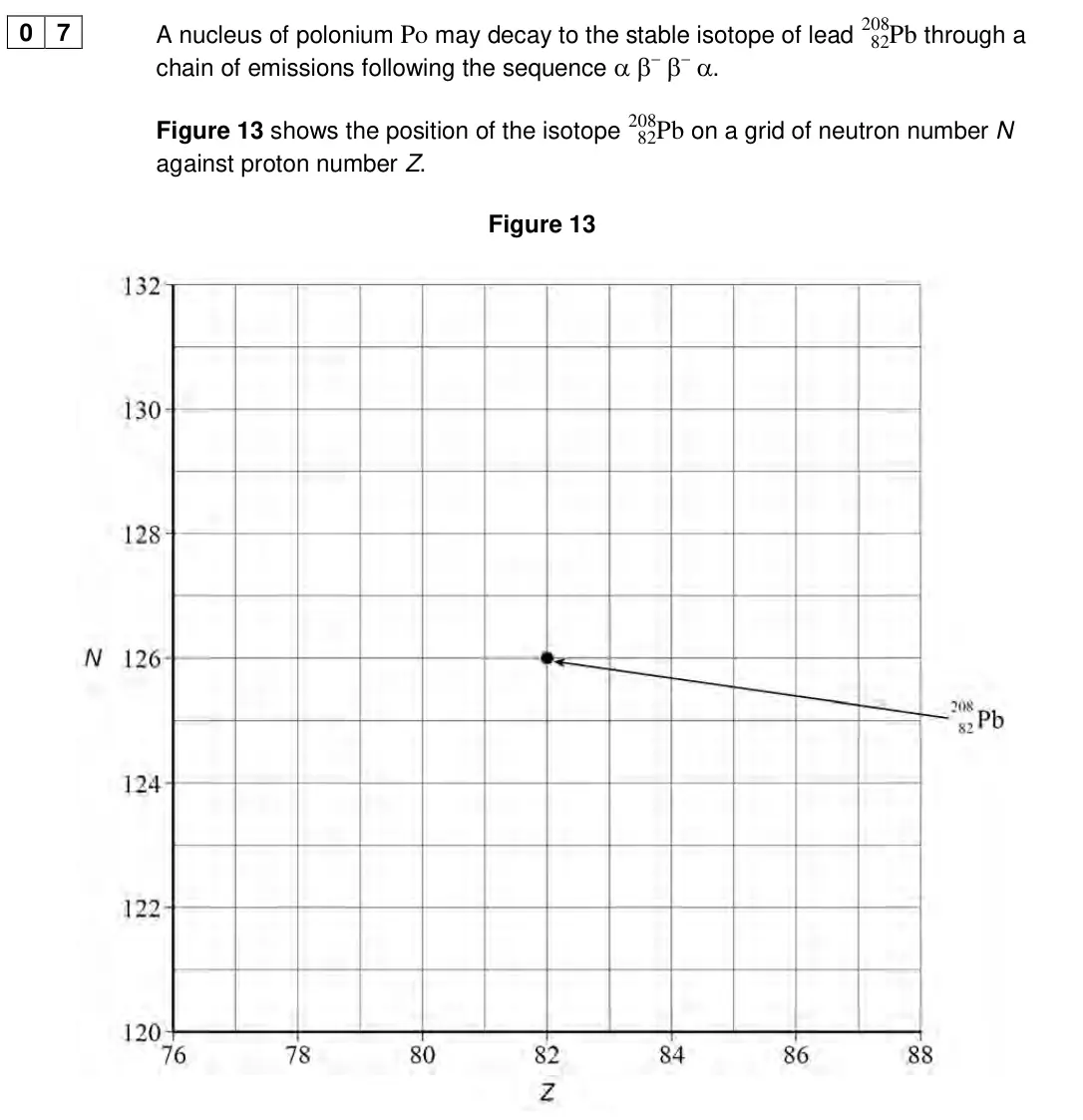
Q01.1
The whole paper ↗Q03.3
The whole paper ↗
All 51 questions on Stable and unstable nuclei, as a list
- June 2024, AS Paper 1, Q01.4 (6 marks): The argon-37 nucleus decays into a stable nucleus. Describe the nature of the forces that act between nucleons and how these forces can maintain nuclear stabili
- June 2024, AS Paper 2, Q05 (1 mark): [multiple choice] A sequence of radioactive decays starts with nuclide P and ends with an isotope of P. Which is a possible sequence for these decays? [1 mark]
- June 2023, AS Paper 2, Q22 (1 mark): A nucleus of bismuth-209 209Bi 83 absorbs a neutron. The newly formed nucleus subsequently decays in two stages to form a nucleus of nuclide X.
- June 2022, Paper 1, Q01.1 (2 marks): An atom of 4 2He is produced in a rock that contains uranium. It is produced following the radioactive decay of a 238 92U atom. The decay also creates an atom o
- June 2022, Paper 1, Q02.2 (2 marks): Figure 2 shows the distribution of kinetic energies of β− particles from the decay of carbon-14. Figure 2 Explain how Figure 2 supports the existence of the ant
- June 2022, Paper 1, Q11 (1 mark): Which row describes the variation with distance of the strong nuclear force? [1 mark] Attractive Repulsive A beyond 3 fm from 0.5 fm to 3 fm B from 0.5 fm to 3
- June 2022, AS Paper 2, Q10 (1 mark): An alpha particle and a nucleus of boron 10B 5 interact to form an unstable nucleus and a free neutron. The unstable nucleus decays by positron emission to form
- November 2021, AS Paper 1, Q01.2 (2 marks): A polonium-210 nucleus is formed when a stationary nucleus of bismuth-210 decays. A beta-minus (β−) particle is emitted in this decay. Outline, with reference t
- November 2021, AS Paper 1, Q01.3 (2 marks): Explain how the data in Figure 1 support the hypothesis that a third particle is produced during β− decay. [2 marks]
- November 2021, AS Paper 2, Q12 (1 mark): Which row describes the nature of the strong nuclear force between two nucleons at separations of 0.25 fm, 2.0 fm and 8.0 fm? [1 mark] At a separation of 0.25 f
- November 2020, AS Paper 2, Q07 (1 mark): Tl 81 x decays to Pb 82 206 by a series of four radioactive decays. Each decay involves the emission of either a single α particle or a single β− particle. What
- June 2019, Paper 1, Q01.2 (1 mark): A 131 53 I nuclide undergoes beta (β–) decay to form a xenon nuclide. State the nucleon number of the xenon nuclide. [1 mark]
- June 2019, Paper 1, Q01.4 (3 marks): Internal conversion is a process in which a nucleus in an excited state can release its excess energy. In internal conversion all of the excess energy is transf
- June 2019, AS Paper 1, Q01.3 (3 marks): The deuterium nucleus is stable. Describe how the variation of the strong nuclear force with distance contributes to the stability of the deuterium nucleus. [3
- June 2019, AS Paper 1, Q01.4 (3 marks): Tritium is an isotope of hydrogen. Its nucleus contains one proton and two neutrons. Tritium undergoes radioactive decay. Three modes of radioactive decay are •
- June 2019, AS Paper 2, Q07 (1 mark): Unstable nuclide P decays to nuclide T through a series of alpha (α) and beta-minus (β–) decays. α β– β– α P → Q → R → S → T Which statement is correct? [1 mark
- June 2018, Paper 1, Q12 (1 mark): An iodine nucleus decays into a nucleus of Xe−131, a beta-minus particle and particle Y. I → Xe + e −1 0 54 131 53 131 + Y Which is a property of particle Y? [1
- June 2018, Paper 2, Q07.2 (4 marks): A nucleus of the stable isotope Pb 82 208 has more neutrons than protons. Explain why there is this imbalance between proton and neutron numbers by referring to
- June 2018, AS Paper 1, Q01.1 (3 marks): Describe the interaction that is responsible for keeping protons and neutrons together in a stable nucleus. You should include details of the properties of the
- June 2018, AS Paper 2, Q03.3 (3 marks): An alpha particle transfers all its kinetic energy to air molecules and produces 5.1 × 10⁴ ions per centimetre over its range of 3.5 cm Calculate the average io
- June 2018, AS Paper 2, Q06 (1 mark): 236 92U undergoes a series of decays to produce 204 82Pb. How many alpha decays are involved in this decay series? [1 mark] A 5 B 6 C 8 D 10
- June 2017, Paper 1, Q01.4 (3 marks): The potassium isotope can also decay by a second decay process to form a calcium-40 nuclide ( Ca 20 40 ). Suggest how the emissions from a nucleus of decaying p
- June 2017, AS Paper 2, Q08 (1 mark): When a nucleus of the radioactive isotope Ni 28 65 decays, a β‾ particle and an electron antineutrino are emitted. How many protons and neutrons are there in th
- June 2016, AS Paper 2, Q04.1 (2 marks): Complete the equation for the alpha decay of plutonium-238. [2 marks]
- June 2016, AS Paper 2, Q05 (1 mark): A nucleus of a particular element decays, emitting a series of α and β– particles. Which of the following series of emissions would result in an isotope of the
- Specimen, Paper 1, Q01.2 (2 marks): A common type of smoke detector contains a very small amount of americium-241, Am 95 241 0 1 Americium-241 is produced in nuclear reactors through the decay of
- Specimen, Paper 1, Q01.3 (3 marks): A common type of smoke detector contains a very small amount of americium-241, Am 95 241 0 1 An americium-241 nucleus decays into nuclide X by emitting an alpha
- Specimen, Paper 1, Q07 (1 mark): Only one answer per question is allowed. For each answer completely fill in the circle alongside the appropriate answer. If you want to change your answer you m
- June 2016, PHYA4 Section B (old spec), Q3(d) (1 mark): Explain why the expressions in parts (b)(i) and (b)(ii) could not be applied when an unstable nucleus decays by emitting a β−particle. [1 mark] ________________
- June 2016, PHYA1 (old spec), Q1(d) (3 marks): 237 92U decays by β– emission to form an isotope of neptunium (Np). Complete the equation for this decay. [3 marks] 237 92U → Np + β _ + ____ ____ ____ _____ __
- June 2015, PHYA1 (old spec), Q1(a) (4 marks): Complete Table 1 by ticking one box in each row to identify the appropriate isotope. The first row has been completed for you. [4 marks]
- June 2014, PHYA1 (old spec), Q2(a)(iv) (3 marks): Complete the following equation to represent β– decay of nucleus R to form nucleus X. [3 marks] 14 6R→ X + +
- June 2014, PHYA1 (old spec), Q2(b)(i) (3 marks): The strong nuclear force is responsible for keeping the protons and neutrons bound in a nucleus. Describe how the strong nuclear force between two nucleons vari
- January 2013, PHYA1 (old spec), Q1(b)(i) (1 mark): Identify the particle X. (1 mark)
- January 2013, PHYA1 (old spec), Q1(b)(ii) (2 marks): Determine the values of A and Z. A = Z = (2 marks)
- June 2011, PHYA1 (old spec), Q2(ii) (2 marks): Complete this equation for alpha decay. (2 marks) A ZX→ Y + α 4 2
- June 2011, PHYA1 (old spec), Q2(iv) (2 marks): Explain why the alpha particle, once outside the nucleus, is unaffected by the strong nuclear force. (2 marks)
- June 2011, PHYA1 (old spec), Q3(a) (4 marks): Complete the following equation which represents this decay. (4 marks) 40 19K→ ……… + ……… + ………
- January 2011, PHYA1 (old spec), Q2(a)(iii) (4 marks): This isotope of radium decays by β– decay to form an element with symbol, Ac. Write down an equation that represents this decay. (4 marks)
- June 2010, PHYA1 (old spec), Q1(a) (1 mark): Name the particle which is difficult to detect. answer = (1 mark)
- June 2010, PHYA1 (old spec), Q1(b) (2 marks): Write down the proton number and the nucleon number of the new nucleus. proton number nucleon number (2 marks)
- June 2010, PHYA1 (old spec), Q2(a) (3 marks): Describe how the strong nuclear force between two nucleons varies with the separation of the nucleons quoting suitable values for separation.
- June 2010, PHYA1 (old spec), Q2(b)(ii) (2 marks): Complete the equation below to represent the emission of an α particle by a 238 92U nucleus. (2 marks) 238 92U→ Th + α
- June 2010, PHYA1 (old spec), Q2(c)(ii) (3 marks): If there are eight alpha decays involved in the sequence of decays from 238 92U to 206 82Pb deduce how many β– decays are involved. answer = (3 marks)
- January 2010, PHYA1 (old spec), Q3(a)(i) (1 mark): What part of the atom is the same as a β– particle? (1 mark)
- January 2010, PHYA1 (old spec), Q3(a)(ii) (2 marks): State the changes, if any, in A and Z when X decays. change in A change in Z (2 marks)
- January 2010, PHYA1 (old spec), Q3(b)(i) (1 mark): Give an equation for this decay. (1 mark)
- January 2010, PHYA1 (old spec), Q3(b)(ii) (2 marks): State and explain which conservation law may be used to show that it is an anti-neutrino rather than a neutrino that is released. (2 marks)
- January 2010, PHYA1 (old spec), Q3(b)(iii) (2 marks): What must be done to validate the predictions of an unconfirmed scientific theory? (2 marks) Turn to page 8 for the next question
- January 2009, PA01 (2008 spec), Q1(d) (1 mark): 1 (d) Write down the numbers represented by x and y in the equation. x y (1 mark)
- June 2008, PA10 (2008 spec), Q7(b) (3 marks): 7 (b) Discuss the role of each of the following three forces when two protons collide, fuse and form a 2H 1 nucleus. the electrostatic force the strong nuclear
Questions, mark schemes and examiner’s reports are © AQA, from their published past papers. Plumi isn’t affiliated with any exam board. Want whole papers? AQA A-Level Physics past papers.
The Plumi iPad app also offers exam-style questions with AI feedback on your handwritten working.