 plumi
Particle interactions: AQA A‑Level Physics questions
AQA A-Level Physics past-paper questions on 3.2.1.4 Particle interactions, 2008–2025, with mark schemes and examiner’s reports where available.
Paper
All papers
Exam
All years
Calculations
Q01.1
The whole paper ↗
Q01.2
The whole paper ↗- Your answer
Q01.1
The whole paper ↗Q01.3
The whole paper ↗Q01.4
The whole paper ↗Q01.3
The whole paper ↗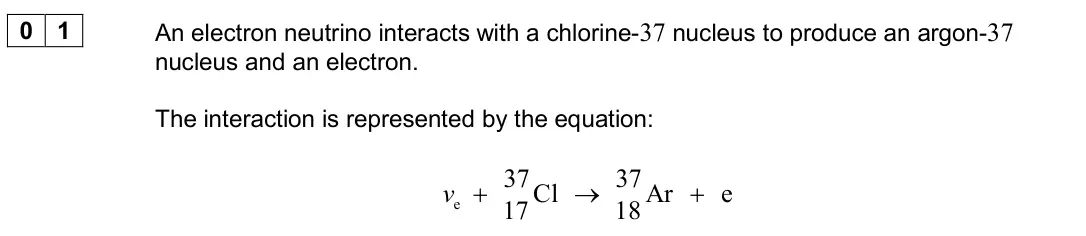
Q01.4
The whole paper ↗Q01.2
The whole paper ↗
Q01.2
The whole paper ↗
Q01.5
The whole paper ↗Q01.7
The whole paper ↗
All 70 questions on Particle interactions, as a list
- June 2025, Paper 1, Q01.1 (3 marks): Complete Figure 1 to show the quark change that occurs during electron capture. Label the incoming and outgoing particles and the exchange particle. [3 marks] F
- June 2025, Paper 1, Q01.2 (1 mark): In some circumstances, a nucleus of this isotope can exist with no orbiting electrons. Explain why a neutral atom of this isotope is less stable than a nucleus
- June 2025, Paper 1, Q10 (1 mark): In β− decay: [1 mark] A energy is conserved. B an up quark changes into a down quark. C the interaction occurs outside the nucleus of an atom. D momentum is not
- June 2025, AS Paper 2, Q08 (1 mark): Which diagram represents an electron–proton collision? [1 mark] A B C D
- June 2024, Paper 1, Q01.1 (1 mark): State the names of the four fundamental interactions. [1 mark] 1 2 3 4
- June 2024, Paper 1, Q01.3 (2 marks): Explain which of the fundamental interactions is responsible for the decay of the neutron. [2 marks]
- June 2024, Paper 1, Q01.4 (3 marks): The forces between two moving electrons cause their paths to change. Explain, using the concept of exchange particles, why the electron paths change. [3 marks]
- June 2024, AS Paper 1, Q01.3 (4 marks): In a different interaction, the argon-37 nucleus interacts with an electron. Figure 1 represents the interaction of a quark in a baryon of the nucleus. Figure 1
- June 2024, AS Paper 1, Q01.4 (6 marks): The argon-37 nucleus decays into a stable nucleus. Describe the nature of the forces that act between nucleons and how these forces can maintain nuclear stabili
- June 2023, Paper 1, Q01.2 (2 marks): State and explain which interaction is involved in this decay. [2 marks]
- June 2023, Paper 1, Q11 (1 mark): The diagram represents a quark change in which an electron antineutrino is produced. What are E, F and G? [1 mark] E F G A up quark down quark β− B down quark u
- June 2023, AS Paper 2, Q15 (1 mark): Which exchange particle transfers charge during electron capture? [1 mark] A meson B pion C virtual photon D W boson
- June 2023, AS Paper 2, Q23 (1 mark): The concept of exchange particles was introduced to explain forces between elementary particles. This concept requires that exchange particles have [1 mark] A c
- June 2022, Paper 1, Q01.2 (2 marks): A 3 2He nucleus can be produced by the decay of a tritium nucleus 3 1H. State and explain which exchange particle is responsible for this decay. [2 marks]
- June 2022, AS Paper 2, Q08 (1 mark): Which diagram represents the process of electron capture? [1 mark] A B C D A B C D
- November 2021, Paper 1, Q09 (1 mark): The gravitational force is one of the four fundamental forces. The ticks in the table match particles with the other fundamental forces. In which row is the par
- November 2021, Paper 1, Q11 (1 mark): The diagram represents a particle interaction. Which row identifies particles E, F and G? [1 mark] E F G A up quark down quark neutrino B down quark up quark ne
- November 2021, AS Paper 1, Q01.5 (2 marks): A large tank of water is used as part of an electron antineutrino detector. An electron antineutrino νതe enters the tank and interacts with a proton (p). Figure
- November 2021, AS Paper 1, Q01.7 (3 marks): The range of the electromagnetic interaction is infinite. Table 1 gives the range of the strong nuclear interaction and the range of the weak nuclear interactio
- November 2021, AS Paper 2, Q07 (1 mark): Which is an exchange particle for the weak interaction? [1 mark] A lepton B photon C pion D W+
- November 2021, AS Paper 2, Q14 (1 mark): What are the products when a free neutron decays? [1 mark] A p + e− + ev B p + e+ + ev C p + e− + ev D p + e+ + ev
- November 2020, Paper 1, Q01.4 (4 marks): The nucleus is held together by a force. It was predicted that a particle exists that is responsible for this force. The particle itself must experience this fo
- November 2020, Paper 2, Q05.1 (1 mark): State the fundamental force involved when alpha particle 1 is scattered by the nucleus in Figure 11. [1 mark]
- November 2020, AS Paper 2, Q06 (1 mark): Which diagram represents electron capture? [1 mark] A B C D A B C D
- June 2019, Paper 1, Q01.3 (2 marks): A 125 53 I nuclide decays by electron capture to form a tellurium nuclide. State two differences between the constituents of the iodine nucleus and the telluriu
- June 2019, Paper 1, Q01.4 (3 marks): Internal conversion is a process in which a nucleus in an excited state can release its excess energy. In internal conversion all of the excess energy is transf
- June 2019, Paper 1, Q08 (1 mark): [multiple choice] The process of beta plus (β+) decay can be represented by Which row identifies particles X and Y? [1 mark] X Y A W+ e B W+ e C W– e D W– e
- June 2019, AS Paper 1, Q01.2 (1 mark): The proton and neutron in the deuterium nucleus are held together by the strong nuclear force. Which is an exchange particle of the strong nuclear force? Tick (
- June 2019, AS Paper 2, Q10 (1 mark): A muon [1 mark] A is subject to the strong interaction. B can decay into an electron only. C is a stable particle. D is subject to the weak interaction.
- June 2018, AS Paper 1, Q01.4 (1 mark): The kaon decays by the weak interaction. The equation shows an example of kaon decay. K0 →π++ π– State one feature of this decay that shows it is an example of
- June 2018, AS Paper 2, Q07 (1 mark): The partially completed diagram represents electron capture. Which row identifies the exchange particle Q and the quark structure of particle R? [1 mark] Partic
- June 2017, Paper 1, Q01.1 (2 marks): The decay is represented by this equation: K 19 40 + e −1 0 → Ar + Complete the equation to show the decay by filling in the gaps. [2 marks]
- June 2017, Paper 1, Q01.2 (2 marks): Explain which fundamental interaction is responsible for the decay in question 01.1. [2 marks]
- June 2017, Paper 1, Q09 (1 mark): Which diagram represents the process of beta-plus decay? [1 mark] A B C D
- June 2017, AS Paper 1, Q01.2 (1 mark): State the type of interaction that occurs in this decay. [1 mark]
- June 2017, AS Paper 1, Q01.3 (1 mark): State the class of particles to which the W− belongs. [1 mark]
- June 2017, AS Paper 2, Q13 (1 mark): What interactions are involved in the production of a strange particle and its decay into non-strange particles? [1 mark] Production Decay A strong weak B stron
- June 2016, AS Paper 1, Q06.5 (1 mark): What interaction would be responsible for the decay in Question 6.4? Tick () the correct answer in the right-hand column. [1 mark] if correct electromagnetic
- June 2015, PHYA1 (old spec), Q3(a) (6 marks): Baryons, mesons and leptons are affected by particle interactions. Write an account of these interactions. Your account should: include the names of the intera
- June 2015, PHYA1 (old spec), Q3(b) (3 marks): Draw a labelled Feynman diagram that represents a particle interaction. [3 marks]
- June 2014, PHYA1 (old spec), Q2(b)(ii) (2 marks): Another significant interaction acts between the protons in the nucleus of an atom. Name the interaction and name the exchange particle responsible for the inte
- June 2013, PHYA1 (old spec), Q2(a) (3 marks): Identify the particles labelled A, B, C and D in the diagram. A B C D (3 marks)
- June 2013, PHYA1 (old spec), Q2(b)(i) (1 mark): State the interaction responsible for this process. (1 mark)
- June 2013, PHYA1 (old spec), Q2(b)(ii) (1 mark): State which letter in Figure 1 represents an exchange particle. (1 mark)
- June 2013, PHYA1 (old spec), Q2(b)(iii) (1 mark): State one difference between this exchange particle and a photon. (1 mark)
- January 2013, PHYA1 (old spec), Q3(b) (2 marks): The forces between particles can be explained in terms of exchange particles. Complete the following table by identifying an exchange particle involved in the i
- January 2013, PHYA1 (old spec), Q3(c)(i) (3 marks): Draw a Feynman diagram that represents this interaction. (3 marks)
- June 2012, PHYA1 (old spec), Q1(b)(i) (1 mark): Which interaction is responsible for this decay? (1 mark)
- June 2012, PHYA1 (old spec), Q3(a) (2 marks): Protons can interact with electrons by gravity and by two other fundamental interactions. In the following table identify these interactions and name the exchan
- June 2012, PHYA1 (old spec), Q3(c)(i) (3 marks): Explain what is meant by electron capture.
- June 2012, PHYA1 (old spec), Q3(c)(ii) (3 marks): In the space below draw a Feynman diagram representing electron capture. (3 marks)
- June 2011, PHYA1 (old spec), Q1(c)(i) (1 mark): State what interaction is involved in this decay. (1 mark)
- June 2011, PHYA1 (old spec), Q3(b)(i) (1 mark): What is this type of decay called? (1 mark)
- June 2011, PHYA1 (old spec), Q3(b)(ii) (1 mark): Where does the electron on the left-hand side of the equation come from? (1 mark)
- June 2011, PHYA1 (old spec), Q3(b)(iv) (3 marks): Complete the Feynman diagram shown in Figure 1 that represents this decay. Figure 1 (3 marks) p e–
- January 2011, PHYA1 (old spec), Q1(b) (2 marks): The Feynman Diagram in Figure 1 represents an interaction known as electron capture. Figure 1 1 (b) State a conservation laws obeyed in this interaction. Show h
- June 2010, PHYA1 (old spec), Q1(e) (3 marks): Complete the following Feynman diagram so that it represents β+ decay. (3 marks) u
- January 2010, PHYA1 (old spec), Q1(d)(i) (2 marks): State, with a reason, what interaction is responsible for this decay. (2 marks)
- June 2009, PHYA1 (old spec), Q3(b)(iii) (1 mark): What interaction is responsible for this reaction? (1 mark)
- January 2009, PHYA1 (old spec), Q3(a)(i) (2 marks): State the type of interaction involved and name the exchange particle. (2 marks)
- January 2009, PHYA1 (old spec), Q3(b)(i) (3 marks): Complete the diagram to show the two particles formed in the interaction and the exchange particle. (3 marks)
- January 2009, PHYA1 (old spec), Q3(b)(ii) (1 mark): Name the type of interaction responsible for this exchange particle. (1 mark)
- January 2009, PHYA1 (old spec), Q3(b)(iv) (2 marks): The exchange particle in this interaction was discovered by experiment with a rest mass that had been predicted. Why is it important to test by experiment the p
- January 2009, PA01 (2008 spec), Q1(d) (1 mark): 1 (d) Write down the numbers represented by x and y in the equation. x y (1 mark)
- January 2009, PA01 (2008 spec), Q5(a) (3 marks): 5 (a) β – decay is represented by the equation n p + β – + ve Draw a Feynman diagram that shows the change in quark composition in a β – decay. (3 marks)
- June 2008, PA01 (2008 spec), Q3(c) (2 marks): 3 (c) (i) By which fundamental interaction does the K° decay? 3 (c) (ii) Give a reason for your answer. (2 marks)
- June 2008, PA10 (2008 spec), Q7(a) (5 marks): 7 (a) (i) Complete the nuclear equation below. 2H 1 p + p → + + 7 (a) (ii) State the quark composition of a proton and of a 2H 1 nucleus. 7 (a) (iii) Describe,
- June 2008, PA10 (2008 spec), Q7(b) (3 marks): 7 (b) Discuss the role of each of the following three forces when two protons collide, fuse and form a 2H 1 nucleus. the electrostatic force the strong nuclear
- January 2008, PA01 (2008 spec), Q3(a) (3 marks): 3 (a) A muon can decay via the weak interaction μ – e – + X + νµ (i) Name a mediating particle of the weak interaction. (ii) Identify particle X. (3 marks)
- January 2008, PA01 (2008 spec), Q3(b) (3 marks): (b) An electron-neutrino may interact with a neutron as represented in the following equation. νe + n e – + p Draw a Feynman diagram to represent this interacti
Questions, mark schemes and examiner’s reports are © AQA, from their published past papers. Plumi isn’t affiliated with any exam board. Want whole papers? AQA A-Level Physics past papers.
The Plumi iPad app also offers exam-style questions with AI feedback on your handwritten working.