 plumi
Classification of particles: AQA A‑Level Physics questions
AQA A-Level Physics past-paper questions on 3.2.1.5 Classification of particles, 2008–2025, with mark schemes and examiner’s reports where available.
Paper
All papers
Exam
All years
Calculations
Q01.2
The whole paper ↗Q02.1
The whole paper ↗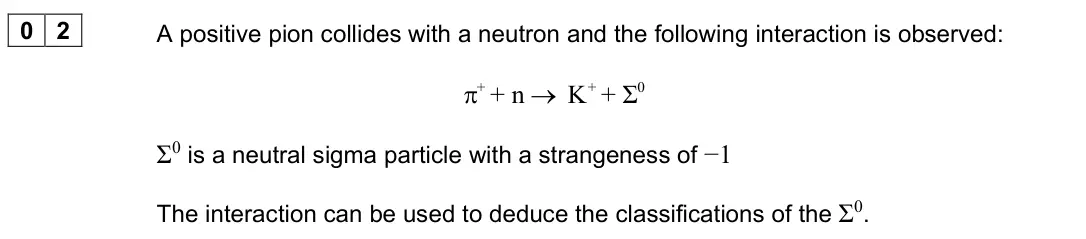
Q02.3
The whole paper ↗Q02.5
The whole paper ↗Q01.5
The whole paper ↗
Q01.4
The whole paper ↗Q01.4
The whole paper ↗
- Your answer
Q01.2
The whole paper ↗Q01.5
The whole paper ↗Q01.1
The whole paper ↗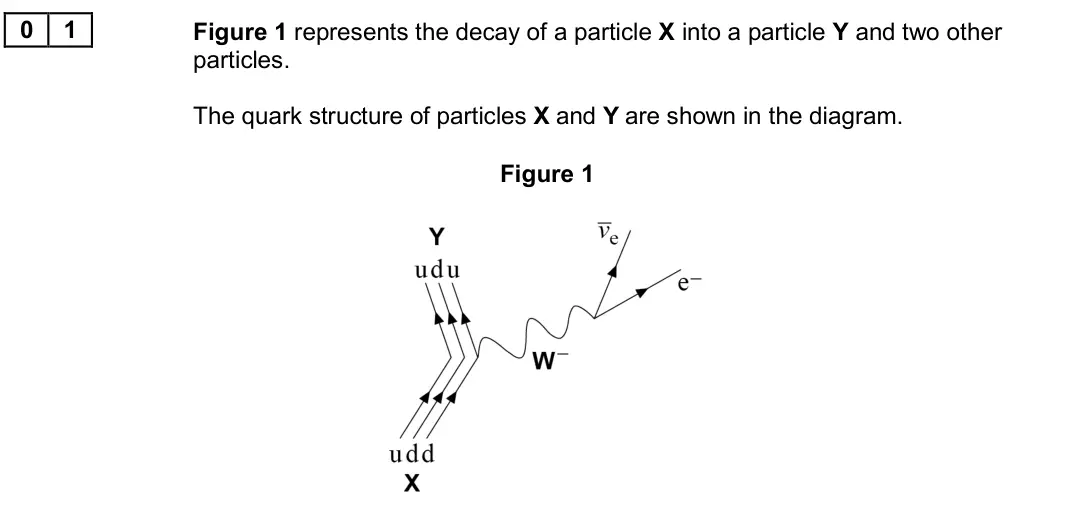
All 47 questions on Classification of particles, as a list
- June 2024, Paper 1, Q01.2 (1 mark): State the products of the decay of a free neutron. [1 mark]
- June 2024, Paper 1, Q02.1 (2 marks): Identify the classifications of each particle in Table 1. Tick () the appropriate boxes for each particle. [2 marks] Table 1 Particle Baryon Hadron Lepton Meso
- June 2024, Paper 1, Q02.3 (2 marks): Compare the rest energies of the particles involved in this decay. [2 marks]
- June 2024, Paper 1, Q02.5 (1 mark): The Standard Model is a theory that classifies elementary particles. Evidence for the theory has been collected since about 1950. However, the term Standard Mod
- June 2023, Paper 1, Q01.5 (1 mark): The discovery of particles such as the Λ0 is made by large international research teams. Suggest one reason for this. [1 mark]
- June 2023, Paper 1, Q10 (1 mark): Which statement about muons is correct? [1 mark] A They consist of a quark and an antiquark. B They include pions and kaons. C They are subject to the strong in
- June 2023, AS Paper 2, Q16 (1 mark): A free neutron decays to produce a proton and [1 mark] A an electron and an antineutrino. B an electron and a neutrino. C a positron and an antineutrino. D a po
- June 2022, Paper 1, Q12 (1 mark): Which statement is correct? [1 mark] A All strange particles are mesons. B Strange particles are always created in pairs. C Strangeness can only change in stron
- June 2022, AS Paper 2, Q09 (1 mark): Which row is correct? [1 mark] Name of particle Classification Quark structure A antineutron meson uu d B positive kaon baryon u s C antiproton baryon uu d D po
- November 2021, Paper 1, Q09 (1 mark): The gravitational force is one of the four fundamental forces. The ticks in the table match particles with the other fundamental forces. In which row is the par
- November 2021, AS Paper 2, Q35 (1 mark): Which shows the classification of particles? [1 mark] A B C D A B C D
- November 2020, Paper 1, Q01.4 (4 marks): The nucleus is held together by a force. It was predicted that a particle exists that is responsible for this force. The particle itself must experience this fo
- November 2020, AS Paper 1, Q01.4 (6 marks): Some subatomic particles are classified as hadrons. There are two classes of hadrons. Discuss the nature of hadrons. Your answer should include: • the identifyi
- June 2019, AS Paper 2, Q08 (1 mark): Which row gives a particle with its quark combination and category? [1 mark] Particle Quark combination Category A Negative pion dū baryon B Positive pion ud ha
- June 2019, AS Paper 2, Q09 (1 mark): Which row gives the numbers of baryons and leptons in an atom of C 6 12 ? [1 mark] Number of baryons Number of leptons A 6 6 B 12 6 C 6 12 D 18 0
- June 2019, AS Paper 2, Q10 (1 mark): A muon [1 mark] A is subject to the strong interaction. B can decay into an electron only. C is a stable particle. D is subject to the weak interaction.
- June 2018, Paper 1, Q12 (1 mark): An iodine nucleus decays into a nucleus of Xe−131, a beta-minus particle and particle Y. I → Xe + e −1 0 54 131 53 131 + Y Which is a property of particle Y? [1
- June 2018, AS Paper 1, Q01.2 (3 marks): Nuclei can decay by alpha decay and by beta decay. In alpha decay only one particle is emitted but in beta decay there are two emitted particles. Explain how ba
- June 2018, AS Paper 1, Q01.5 (2 marks): There have been considerable advances in our understanding of particle physics over the past 100 years. Explain why it is necessary for many teams of scientists
- June 2017, AS Paper 1, Q01.1 (1 mark): Deduce the name of particle X. [1 mark]
- June 2017, AS Paper 1, Q01.5 (1 mark): Name the only stable baryon. [1 mark]
- June 2017, AS Paper 1, Q01.6 (1 mark): A muon is an unstable particle. State the names of the particles that are produced when a muon decays. [1 mark]
- June 2017, AS Paper 2, Q06 (1 mark): Which row shows the correct interactions experienced by a hadron or a lepton? [1 mark] Particle Strong interaction Weak interaction A Hadron Yes Yes B Lepton Ye
- June 2016, AS Paper 1, Q06.4 (2 marks): Complete this equation for the possible decay of an antineutron. [2 marks]
- June 2016, AS Paper 2, Q07 (1 mark): Which of the following is not made of quarks? [1 mark] A kaon B muon C neutron D pion
- June 2016, PHYA1 (old spec), Q2(b)(iii) (3 marks): Complete the following table using ticks to indicate correct classifications for each particle. The first column has been completed for you. [3 marks] Charged H
- June 2015, PHYA1 (old spec), Q2(a)(ii) (2 marks): State and explain whether X is a lepton, baryon or meson. [2 marks]
- June 2014, PHYA1 (old spec), Q1(a)(ii) (1 mark): What is the baryon number of the K+? [1 mark]
- June 2014, PHYA1 (old spec), Q1(b)(i) (3 marks): Complete Table 1 using ticks and crosses as indicated in the first row. [3 marks] Table 1 Classification K+ vμ μ+ lepton × charged particle hadron meson
- June 2013, PHYA1 (old spec), Q3(a) (6 marks): Hadrons and leptons are two groups of particles. Write an account of how particles are placed into one or other of these two groups. Your account should include
- January 2013, PHYA1 (old spec), Q3(a)(i) (1 mark): State how many quarks there are in a baryon. (1 mark)
- January 2013, PHYA1 (old spec), Q3(a)(ii) (1 mark): Hadrons fall into two groups, baryons being one of them. State the name that is given to the other group of hadrons. (1 mark)
- January 2013, PHYA1 (old spec), Q3(a)(iii) (2 marks): Give two properties of hadrons that distinguish them from leptons. property 1 property 2 (2 marks)
- June 2012, PHYA1 (old spec), Q1(a)(ii) (1 mark): ( ) 1 (a) (ii) State the baryon number of the K– meson. (1 mark)
- January 2012, PHYA1 (old spec), Q1(a) (7 marks): The table gives information about some fundamental particles. Complete the table by filling in the missing information. (7 marks) particle quark structure charg
- June 2011, PHYA1 (old spec), Q1(a)(i) (2 marks): Name two baryons. (2 marks)
- June 2011, PHYA1 (old spec), Q1(c)(iii) (2 marks): Deduce whether X is a meson, baryon or lepton, explaining how you arrive at your answer. (2 marks)
- June 2011, PHYA1 (old spec), Q1(c)(iv) (1 mark): Which particle in this interaction is the most stable? (1 mark)
- January 2011, PHYA1 (old spec), Q1(a)(i) (1 mark): State one difference between these two groups of particles. (1 mark)
- January 2011, PHYA1 (old spec), Q1(a)(ii) (2 marks): Give an example of a non-strange hadron and an example of a lepton. hadron lepton (2 marks)
- January 2011, PHYA1 (old spec), Q1(a)(iii) (3 marks): Hadrons can be further divided into two groups. Name these two groups and state a difference between them. (3 marks)
- June 2010, PHYA1 (old spec), Q1(c) (3 marks): Name the baryon and each of the leptons formed as a result of this decay. baryon lepton lepton (3 marks)
- January 2010, PHYA1 (old spec), Q1(a)(i) (1 mark): What property defines a hadron? (1 mark)
- January 2010, PHYA1 (old spec), Q1(c) (2 marks): Complete the table below which lists properties of the antiproton. (2 marks) charge/C baryon quark number structure antiproton
- June 2009, PHYA1 (old spec), Q3(b)(iv) (1 mark): Into what particle will the neutron formed in this reaction eventually decay? (1 mark)
- January 2009, PA01 (2008 spec), Q1(b) (1 mark): 1 (b) How many hadrons are there in an atom of 40K 19 ? (1 mark)
- June 2008, PA01 (2008 spec), Q3(b) (2 marks): 3 (b) Complete the following table with ticks and crosses. baryon lepton hadron charged K° × " – ! (2 marks)
Questions, mark schemes and examiner’s reports are © AQA, from their published past papers. Plumi isn’t affiliated with any exam board. Want whole papers? AQA A-Level Physics past papers.
The Plumi iPad app also offers exam-style questions with AI feedback on your handwritten working.